生け花いけばな
ikebana
Japanese flower arrangement
花をたくさん飾るのではなく、減らしていく芸術。空間そのものが作品になる。
一言で言うと
これだけ覚えれば最低限伝わる一文
Ikebana is Japanese flower arrangement, where the empty space matters as much as the flowers.
生け花は日本の花の芸術で、花そのものと同じくらい、空いた空間が重要です。
30秒で説明する
外国人に説明するときの標準サイズ
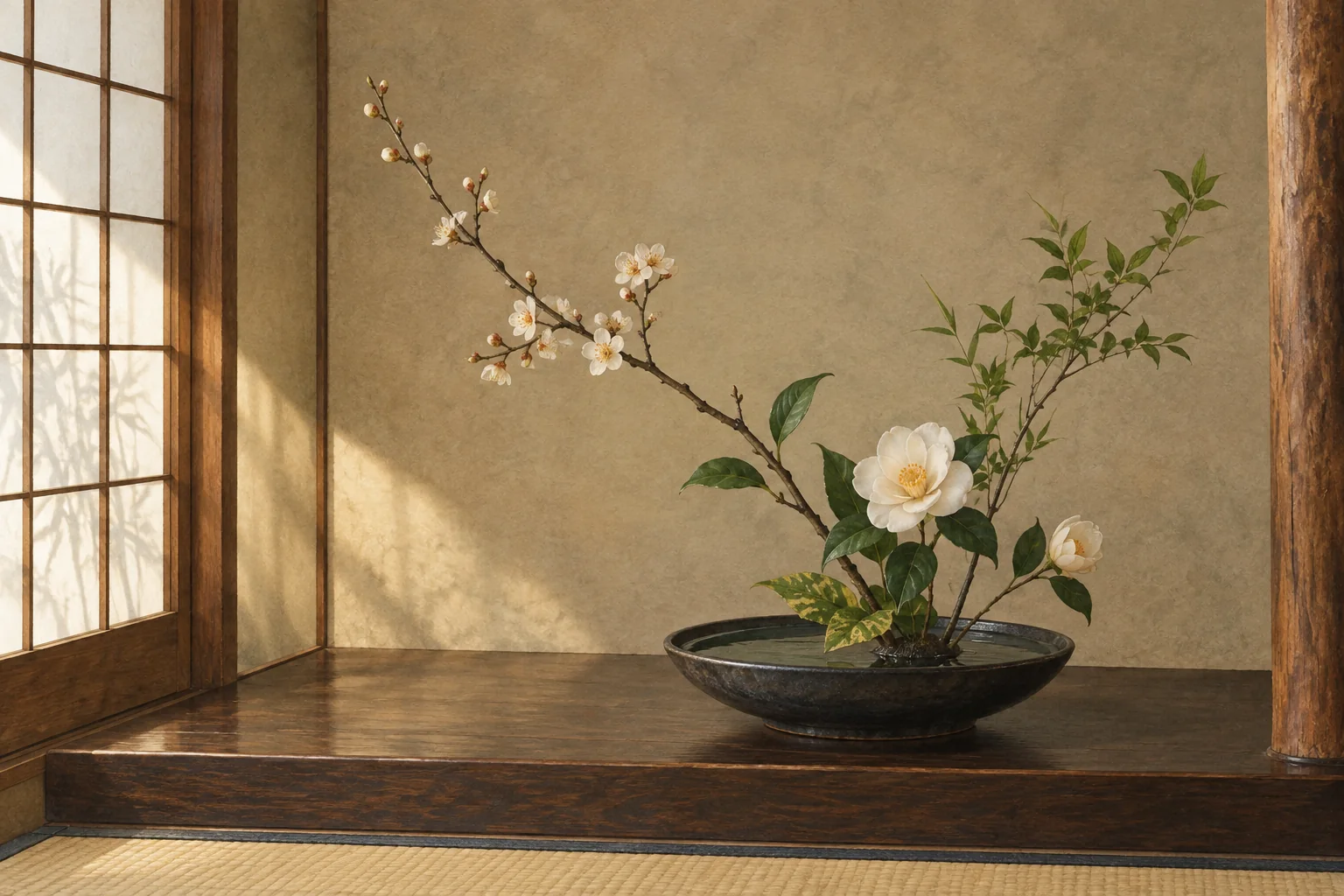
Ikebana arranges a small number of stems, often with branches and leaves rather than only flowers, according to lines and angles set by the school. Where a Western bouquet fills a space with mass and color, ikebana removes material until a few lines carry the whole arrangement. The empty space between them is part of the composition.
生け花は少数の枝や葉、花を、流派ごとに定められた線と角度に従って構成します。西洋の花束が量と色で空間を満たすのに対し、生け花は数本の線だけで全体を支えるところまで削ります。その間に残る空間が、作品の一部です。
スピーチ・英作文
通訳案内士の二次口述・大学入試の自由英作文に
Ikebana is Japanese flower arrangement, and the difference from a Western bouquet is easy to see once it is pointed out. A bouquet fills a space: many flowers, dense color, symmetrical. An ikebana arrangement removes things until only a few stems are left, often more branch and leaf than flower, set at specific angles.
The empty space between them is not what is left over. It is part of the work. Many schools build the arrangement around three main lines, often explained as heaven, earth and humanity, with everything else supporting them.
It began with flowers offered at Buddhist altars and became a separate practice from around the fifteenth century. You are also expected to arrange for the season and for the specific room, which means that, like the tea ceremony, it is made for one occasion and then taken apart.
生け花は日本の花の芸術で、西洋の花束との違いは、一度指摘されれば簡単に分かります。花束は空間を満たします。花の数が多く、色が密で、左右が対称です。生け花は、数本だけが残るまで削ります。花より枝や葉が多いことも多く、それぞれが決まった角度に置かれます。
その間に残る空間は、余りではありません。作品の一部です。多くの流派は三つの主要な線を軸に構成します。その線は天・地・人と説明されることが多く(呼び名は流派で異なります)、他はすべてそれを支えます。
始まりは仏前に供えた花で、15世紀ごろから独立した芸として発展しました。季節と、その部屋のために生けることも求められます。つまり茶道と同じく、一度きりのために作られ、そして解かれるのです。
こう聞かれたら
外国人から実際にされる質問と、その答え方。
Why so few flowers?
どうして花が少ないのですか。
Because the aim is a line, not a mass. Removing material makes each remaining stem carry more, and the space around it becomes visible. Adding more would hide the structure.
目指すのが量ではなく線だからです。減らすほど残った一本の働きが増し、周りの空間が見えてきます。足せば構造が隠れてしまいます。
Are there rules, or is it free?
決まりがあるのですか、それとも自由なのですか。
There are rules, and they differ by school. Ikenobo is the oldest and most classical; Sogetsu is modern and allows almost any material. You learn a form first, then work within or against it.
決まりがあり、流派によって異なります。池坊が最も古く古典的、草月は現代的でほぼどんな素材も認めます。まず形を学び、そのうえでその内側で、あるいはそれに抗して作ります。
Is it connected to Buddhism?
仏教と関係があるのですか。
In origin, yes. It grew out of flowers offered before Buddhist altars, and the oldest school is based at a temple in Kyoto. As a practice today it is not religious.
起源としては、そうです。仏前に供える花から発展し、最も古い流派は京都の寺を本拠にしています。今の実践としては宗教的なものではありません。
そのまま使えるフレーズ
- The empty space is part of the arrangement.空いている空間も作品のうちです。
- It's often more branch than flower.花より枝が多いこともよくあります。
- The three main lines are often called heaven, earth and humanity.三つの主な線は、天・地・人と呼ばれることがあります。
- You arrange for the season and for the room.季節と、その部屋に合わせて生けます。
- Different schools have different rules.流派によって決まりが違います。
説明に使う語句
- arrangement生け花、活け方
- stem茎、枝
- negative space余白、空いた空間
- asymmetry非対称
- school (of art)流派
動画で見る
YouTube より豆知識
生け花の最も古い流派は池坊で、京都の六角堂(頂法寺)の僧が仏前に花を供えたことに始まるとされ、室町時代の池坊専慶の名が記録に残る。江戸時代には「立花」「生花」といった様式が整い、明治以降は西洋の花も使う「盛花」が生まれた。1927年に創流した草月流は自由な素材と造形を認め、現代美術に近い作品も作る。花を支える「剣山」は、盛花の広まりとともに一般化した近代の道具とされる。なお「華道」と「生け花」はほぼ同義で使われるが、「華道」は道としての稽古の側面を強調する言い方である。
