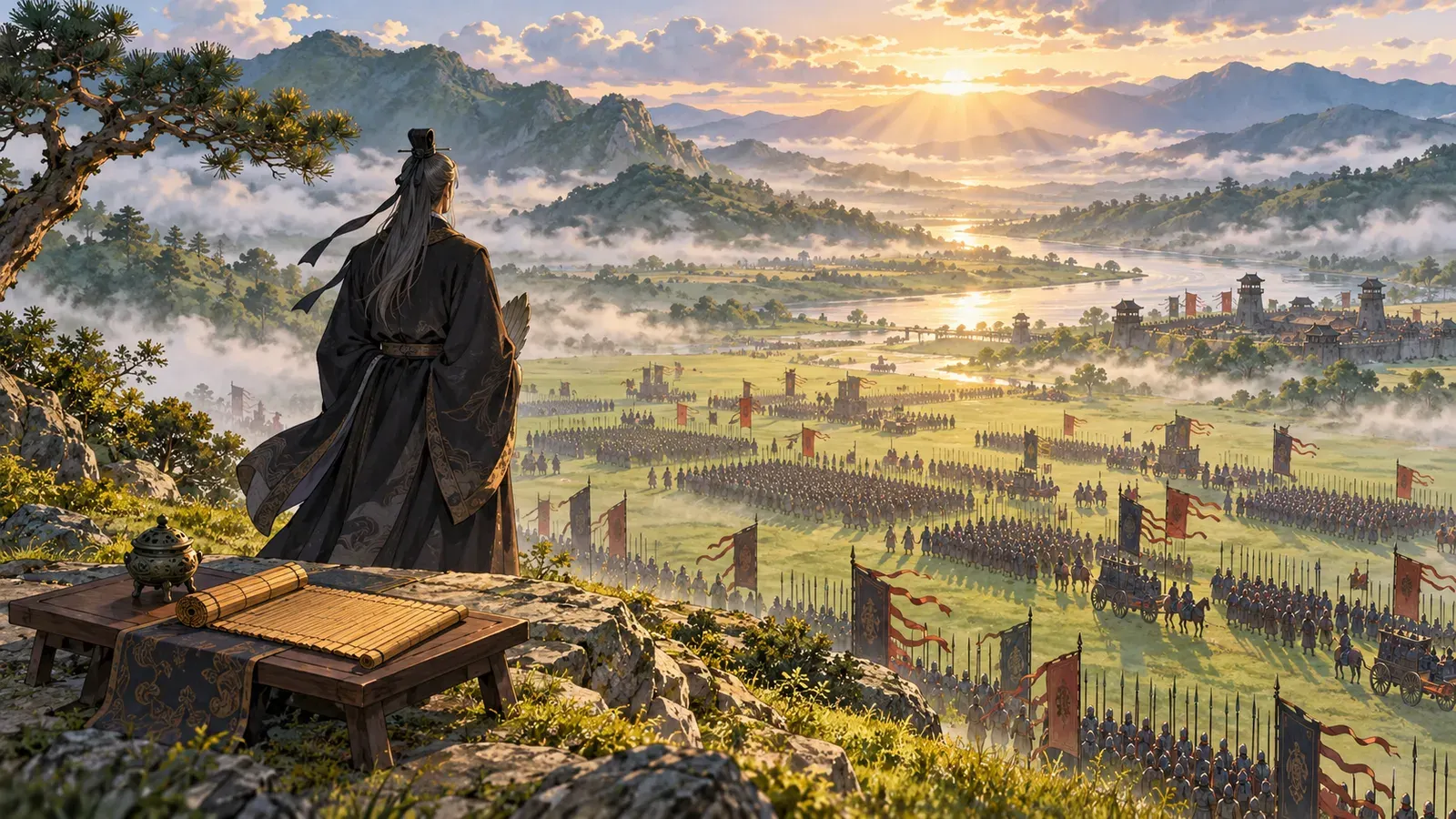
1. Sun Tzŭ said: The art of war recognises nine varieties of ground: (1) Dispersive ground; (2) facile ground; (3) contentious ground; (4) open ground; (5) ground of intersecting highways; (6) serious ground; (7) difficult ground; (8) hemmed-in ground; (9) desperate ground.
1. 孫子は言う。兵法では、土地を九つに分ける。(1) 散地(兵が散りやすい土地)、(2) 軽地(浅く入った土地)、(3) 争地(奪い合う土地)、(4) 交地(行き来の自由な土地)、(5) 衢地(くち、大道の交わる土地)、(6) 重地(深く入った土地)、(7) 圮地(ひち、行き来の難しい土地)、(8) 囲地(囲まれた土地)、(9) 死地(逃げ場のない土地)である。
2. When a chieftain is fighting in his own territory, it is dispersive ground.
2. 諸侯が自分の国の中で戦うとき、そこを散地という。
3. When he has penetrated into hostile territory, but to no great distance, it is facile ground.
3. 敵の国に入り込んだが、まだ深くは入っていないとき、そこを軽地という。
4. Ground the possession of which imports great advantage to either side, is contentious ground.
4. 手に入れれば、どちらにとっても大きな利益になる土地を、争地という。
5. Ground on which each side has liberty of movement is open ground.
5. 敵も味方も自由に動ける土地を、交地という。
6. Ground which forms the key to three contiguous states, so that he who occupies it first has most of the Empire at his command, is ground of intersecting highways.
6. 三つの国が接する要の場所にあり、先に押さえた者が天下の大部分を思いのままにできる土地を、衢地という。
7. When an army has penetrated into the heart of a hostile country, leaving a number of fortified cities in its rear, it is serious ground.
7. 敵の国の奥深くまで入り込み、背後に敵の城がいくつも残っている土地を、重地という。
8. Mountain forests, rugged steeps, marshes and fens—all country that is hard to traverse: this is difficult ground.
8. 山林、険しい斜面、沼や湿地など、通り抜けるのが難しい土地を、圮地という。
9. Ground which is reached through narrow gorges, and from which we can only retire by tortuous paths, so that a small number of the enemy would suffice to crush a large body of our men: this is hemmed in ground.
9. 入るには狭い谷を通らなければならず、出るには曲がりくねった道を通るしかない。そのため、敵が少しの兵で、こちらの大軍を打ち砕けるような土地を、囲地という。
10. Ground on which we can only be saved from destruction by fighting without delay, is desperate ground.
10. すぐに戦わなければ滅びるしかない土地を、死地という。
11. On dispersive ground, therefore, fight not. On facile ground, halt not. On contentious ground, attack not.
11. だから、散地では戦ってはならない。軽地ではとどまってはならない。争地では攻めてはならない。
12. On open ground, do not try to block the enemy's way. On ground of intersecting highways, join hands with your allies.
12. 交地では、敵の行く手をふさごうとしてはならない。衢地では、近隣の国と手を結べ。
13. On serious ground, gather in plunder. In difficult ground, keep steadily on the march.
13. 重地では、敵地の物を奪って食糧にせよ。圮地では、とどまらずに進み続けよ。
14. On hemmed-in ground, resort to stratagem. On desperate ground, fight.
14. 囲地では、計略を使え。死地では、戦え。
15. Those who were called skilful leaders of old knew how to drive a wedge between the enemy's front and rear; to prevent co-operation between his large and small divisions; to hinder the good troops from rescuing the bad, the officers from rallying their men.
15. 昔、戦の上手と呼ばれた者は、敵の前の部隊と後ろの部隊を引き離し、大きな部隊と小さな部隊が助け合えないようにした。強い部隊が弱い部隊を救えないようにし、将校が兵を立て直せないようにした。
16. When the enemy's men were scattered, they prevented them from concentrating; even when their forces were united, they managed to keep them in disorder.
16. 敵の兵が散らばっていれば、集まらせなかった。兵が集まっていても、乱れたままにさせておいた。
17. When it was to their advantage, they made a forward move; when otherwise, they stopped still.
17. 有利なときには動き、そうでなければじっと止まっていた。
18. If asked how to cope with a great host of the enemy in orderly array and on the point of marching to the attack, I should say: "Begin by seizing something which your opponent holds dear; then he will be amenable to your will."
18. 「きちんと陣を組んだ大軍が、今にも攻めてこようとしている。どう立ち向かえばよいか」と聞かれたら、私はこう答える。「まず、相手がいちばん大切にしているものを奪え。そうすれば、相手はこちらの思うままになる。」
19. Rapidity is the essence of war: take advantage of the enemy's unreadiness, make your way by unexpected routes, and attack unguarded spots.
19. 戦はすばやさが命である。敵の備えが整わないうちにつけ込み、思いもよらない道を通り、守りのないところを攻めよ。
20. The following are the principles to be observed by an invading force: The further you penetrate into a country, the greater will be the solidarity of your troops, and thus the defenders will not prevail against you.
20. 敵国に攻め入る軍が守るべき原則は、次のとおりである。敵国の奥深くに入れば入るほど、兵は心を一つにする。だから、守る側はこちらに勝てない。
21. Make forays in fertile country in order to supply your army with food.
21. 豊かな土地で物資を集め、軍の食糧にせよ。
22. Carefully study the well-being of your men, and do not overtax them. Concentrate your energy and hoard your strength. Keep your army continually on the move, and devise unfathomable plans.
22. 兵の体をよくいたわり、無理をさせるな。気力を一つに集め、力をたくわえよ。軍をたえず動かし、敵には見通せないはかりごとを立てよ。
23. Throw your soldiers into positions whence there is no escape, and they will prefer death to flight. If they will face death, there is nothing they may not achieve. Officers and men alike will put forth their uttermost strength.
23. 兵を逃げ場のない場所に投げ込めば、逃げるより死ぬほうを選ぶ。死を覚悟すれば、成し遂げられないことはない。将校も兵も、ありったけの力を出す。
24. Soldiers when in desperate straits lose the sense of fear. If there is no place of refuge, they will stand firm. If they are in the heart of a hostile country, they will show a stubborn front. If there is no help for it, they will fight hard.
24. 兵は、ひどく追いつめられると、恐れを忘れる。逃げ込む場所がなければ、踏みとどまる。敵国の奥深くにいれば、頑強に立ち向かう。どうしようもなければ、必死に戦う。
25. Thus, without waiting to be marshalled, the soldiers will be constantly on the qui vive; without waiting to be asked, they will do your will; without restrictions, they will be faithful; without giving orders, they can be trusted.
25. だから、整えられるのを待たなくても、兵はいつも気を張っている。頼まれなくても、将軍の思いどおりに動く。しばられなくても、忠実である。命令しなくても、信頼できる。
26. Prohibit the taking of omens, and do away with superstitious doubts. Then, until death itself comes, no calamity need be feared.
26. 占いを禁じ、迷信による迷いを取り除け。そうすれば、死そのものが来るまで、どんな災いも恐れることはない。
27. If our soldiers are not overburdened with money, it is not because they have a distaste for riches; if their lives are not unduly long, it is not because they are disinclined to longevity.
27. 兵がありあまるほどの財産を持っていないのは、富が嫌いだからではない。兵の命が長くないのは、長生きを望まないからではない。
28. On the day they are ordered out to battle, your soldiers may weep, those sitting up bedewing their garments, and those lying down letting the tears run down their cheeks. But let them once be brought to bay, and they will display the courage of a Chu or a Kuei.
28. 出陣を命じられた日、兵たちは泣くかもしれない。座っている者は涙で着物をぬらし、横になっている者は頬に涙を流す。だが、いったん追いつめられれば、専諸(せんしょ)や曹劌(そうかい)のような勇気を見せるのである。
29. The skilful tactician may be likened to the shuai-jan. Now the shuai-jan is a snake that is found in the Ch'ang mountains. Strike at its head, and you will be attacked by its tail; strike at its tail, and you will be attacked by its head; strike at its middle, and you will be attacked by head and tail both.
29. 戦の上手な者は、率然(そつぜん)のようなものである。率然とは、常山にいる蛇のことである。その頭を打てば尾が襲いかかり、尾を打てば頭が襲いかかり、胴を打てば頭と尾の両方が襲いかかってくる。
30. Asked if an army can be made to imitate the shuai-jan, I should answer, Yes. For the men of Wu and the men of Yüeh are enemies; yet if they are crossing a river in the same boat and are caught by a storm, they will come to each other's assistance just as the left hand helps the right.
30. 「軍を率然のようにすることはできるか」と聞かれたら、私は「できる」と答える。呉の人と越の人とは憎み合う敵どうしである。だが、同じ舟に乗って川を渡っているときに嵐にあえば、左の手が右の手を助けるように、互いに助け合う。いわゆる「呉越同舟」である。
31. Hence it is not enough to put one's trust in the tethering of horses, and the burying of chariot wheels in the ground.
31. だから、馬をつなぎとめ、戦車の車輪を地面に埋めて、兵が逃げられないようにするだけでは、まだ頼りにならない。
32. The principle on which to manage an army is to set up one standard of courage which all must reach.
32. 軍を治める原則は、誰もが達しなければならない勇気の基準を一つ定めることである。
33. How to make the best of both strong and weak—that is a question involving the proper use of ground.
33. 強い者も弱い者も、それぞれ生かすにはどうすればよいか。それは、地形をうまく使えるかどうかにかかっている。
34. Thus the skilful general conducts his army just as though he were leading a single man, willy-nilly, by the hand.
34. だから戦の上手な将軍は、一人の人の手を引いていやおうなしに連れていくように、全軍を動かすのである。
35. It is the business of a general to be quiet and thus ensure secrecy; upright and just, and thus maintain order.
35. 将軍の務めは、静かに落ち着いていて、はかりごとを秘密に保つこと、そして正しく公平で、秩序を保つことである。
36. He must be able to mystify his officers and men by false reports and appearances, and thus keep them in total ignorance.
36. 将軍は、偽りの知らせや見せかけで将校や兵を惑わし、何も知らせずにおかなければならない。
37. By altering his arrangements and changing his plans, he keeps the enemy without definite knowledge. By shifting his camp and taking circuitous routes, he prevents the enemy from anticipating his purpose.
37. 段取りを改め、計画を変えて、敵にはっきりしたことを分からせない。陣の場所を移し、回り道をして、敵にこちらの狙いを読ませない。
38. At the critical moment, the leader of an army acts like one who has climbed up a height and then kicks away the ladder behind him. He carries his men deep into hostile territory before he shows his hand.
38. いざというとき、軍を率いる者は、高いところに登らせてから、後ろのはしごを外してしまうようにする。敵国の奥深くまで兵を連れて行ってから、初めて手の内を見せるのである。
39. He burns his boats and breaks his cooking-pots; like a shepherd driving a flock of sheep, he drives his men this way and that, and none knows whither he is going.
39. 舟を焼き、鍋を壊す。羊飼いが羊の群れを追うように、兵をあちらへこちらへと追い立てる。どこへ向かっているのか、誰にも分からない。
40. To muster his host and bring it into danger:—this may be termed the business of the general.
40. 全軍を集めて、危険の中に投げ込む。これが将軍の仕事である。
41. The different measures suited to the nine varieties of ground; the expediency of aggressive or defensive tactics; and the fundamental laws of human nature: these are things that must most certainly be studied.
41. 九つの土地に応じたさまざまな手立て、攻めるか守るかの見極め、そして人の心の根本の法則。これらは、何よりもよく学ばなければならないことである。
42. When invading hostile territory, the general principle is, that penetrating deeply brings cohesion; penetrating but a short way means dispersion.
42. 敵国に攻め入るときの原則として、深く入れば兵はまとまり、浅く入っただけなら兵は散る。
43. When you leave your own country behind, and take your army across neighbourhood territory, you find yourself on critical ground. When there are means of communication on all four sides, the ground is one of intersecting highways.
43. 自分の国を離れ、隣の国を越えて軍を進めれば、そこは絶地(国から切り離された危うい土地)である。四方に道が通じていれば、そこは衢地である。
44. When you penetrate deeply into a country, it is serious ground. When you penetrate but a little way, it is facile ground.
44. 敵国に深く入れば、そこは重地である。少し入っただけなら、そこは軽地である。
45. When you have the enemy's strongholds on your rear, and narrow passes in front, it is hemmed-in ground. When there is no place of refuge at all, it is desperate ground.
45. 背後に敵の砦があり、前に狭い通り道があれば、そこは囲地である。逃げ込む場所がまったくなければ、そこは死地である。
46. Therefore, on dispersive ground, I would inspire my men with unity of purpose. On facile ground, I would see that there is close connection between all parts of my army.
46. だから、散地では、私は兵の心を一つにしようと努める。軽地では、軍の各部隊がしっかりつながっているように気を配る。
47. On contentious ground, I would hurry up my rear.
47. 争地では、後ろの部隊を急がせる。
48. On open ground, I would keep a vigilant eye on my defences. On ground of intersecting highways, I would consolidate my alliances.
48. 交地では、守りによく目を光らせる。衢地では、同盟をしっかり固める。
49. On serious ground, I would try to ensure a continuous stream of supplies. On difficult ground, I would keep pushing on along the road.
49. 重地では、食糧が途切れないようにする。圮地では、道をひたすら進み続ける。
50. On hemmed-in ground, I would block any way of retreat. On desperate ground, I would proclaim to my soldiers the hopelessness of saving their lives.
50. 囲地では、退く道をふさいでしまう。死地では、生きのびる望みはないと兵に言い聞かせる。
51. For it is the soldier's disposition to offer an obstinate resistance when surrounded, to fight hard when he cannot help himself, and to obey promptly when he has fallen into danger.
51. 兵というものは、囲まれれば頑強に抵抗し、どうしようもなければ必死に戦い、危険に陥ればすぐに命令に従うものだからである。
52. We cannot enter into alliance with neighbouring princes until we are acquainted with their designs. We are not fit to lead an army on the march unless we are familiar with the face of the country—its mountains and forests, its pitfalls and precipices, its marshes and swamps. We shall be unable to turn natural advantages to account unless we make use of local guides.
52. 近隣の諸侯のもくろみを知らないうちは、同盟を結ぶことはできない。山や林、落とし穴や崖、沼や湿地など、土地のありさまをよく知らなければ、軍を率いて進むことはできない。土地の道案内を使わなければ、地の利を生かすことはできない。
53. To be ignorant of any one of the following four or five principles does not befit a warlike prince.
53. これから述べる四つ五つの原則のうち、一つでも知らないようでは、覇者たる君主にはふさわしくない。
54. When a warlike prince attacks a powerful state, his generalship shows itself in preventing the concentration of the enemy's forces. He overawes his opponents, and their allies are prevented from joining against him.
54. 覇者たる君主が強い国を攻めるときは、敵の兵力が集まらないようにすることで、その手腕を示す。敵を威圧して、その同盟国が敵と手を組めないようにするのである。
55. Hence he does not strive to ally himself with all and sundry, nor does he foster the power of other states. He carries out his own secret designs, keeping his antagonists in awe. Thus he is able to capture their cities and overthrow their kingdoms.
55. だから覇者は、誰とでも手を結ぼうとはしないし、ほかの国の力を育てもしない。自分のひそかなはかりごとを実行して、敵を恐れさせておく。だから敵の城を奪い、国を倒すことができるのである。
56. Bestow rewards without regard to rule, issue orders without regard to previous arrangements; and you will be able to handle a whole army as though you had to do with but a single man.
56. 決まりにとらわれずにほうびを与え、前もって決めたことにとらわれずに命令を出せ。そうすれば、全軍を、まるで一人の人を扱うように動かすことができる。
57. Confront your soldiers with the deed itself; never let them know your design. When the outlook is bright, bring it before their eyes; but tell them nothing when the situation is gloomy.
57. 兵には、やるべきことだけを示し、はかりごとは決して知らせるな。見通しが明るいときはそれを見せ、状況が暗いときは何も知らせるな。
58. Place your army in deadly peril, and it will survive; plunge it into desperate straits, and it will come off in safety.
58. 軍を滅びそうな危険に置けば、かえって生き残る。死地に投げ込めば、かえって無事に切り抜ける。
59. For it is precisely when a force has fallen into harm's way that is capable of striking a blow for victory.
59. 軍は、危ない目にあってこそ、勝利をつかむ一撃を放つことができるからである。
60. Success in warfare is gained by carefully accommodating ourselves to the enemy's purpose.
60. 戦で成功するには、敵の狙いに注意深く合わせて動くことである。
61. By persistently hanging on the enemy's flank, we shall succeed in the long run in killing the commander-in-chief.
61. 敵の側面にしつこく食らいついていれば、やがては敵の総大将を討ち取ることができる。
62. This is called ability to accomplish a thing by sheer cunning.
62. これを、巧みな計略で事を成し遂げる力という。
63. On the day that you take up your command, block the frontier passes, destroy the official tallies, and stop the passage of all emissaries.
63. 将軍の任に就いた日には、国境の関所を閉ざし、通行の割り符を廃止し、使者の行き来をすべて止めよ。
64. Be stern in the council-chamber, so that you may control the situation.
64. 軍議の場では厳しくふるまい、状況をしっかりとにぎれ。
65. If the enemy leaves a door open, you must rush in.
65. 敵が門を開けたら、すぐに飛び込め。
66. Forestall your opponent by seizing what he holds dear, and subtly contrive to time his arrival on the ground.
66. 敵が大切にしているものを先に奪って、相手の機先を制せよ。そして敵が戦場に着く時を、ひそかにこちらの思うように仕向けよ。
67. Walk in the path defined by rule, and accommodate yourself to the enemy until you can fight a decisive battle.
67. 兵法の決まりに沿って進み、決戦ができるときまで敵の動きに合わせよ。
68. At first, then, exhibit the coyness of a maiden, until the enemy gives you an opening; afterwards emulate the rapidity of a running hare, and it will be too late for the enemy to oppose you.
68. 始めは処女の如く、後は脱兎の如し。初めは乙女のようにしとやかにして、敵がすきを見せるのを待て。その後は、逃げるうさぎのようにすばやく動け。そうすれば、敵が防ごうとしても、もう間に合わない。