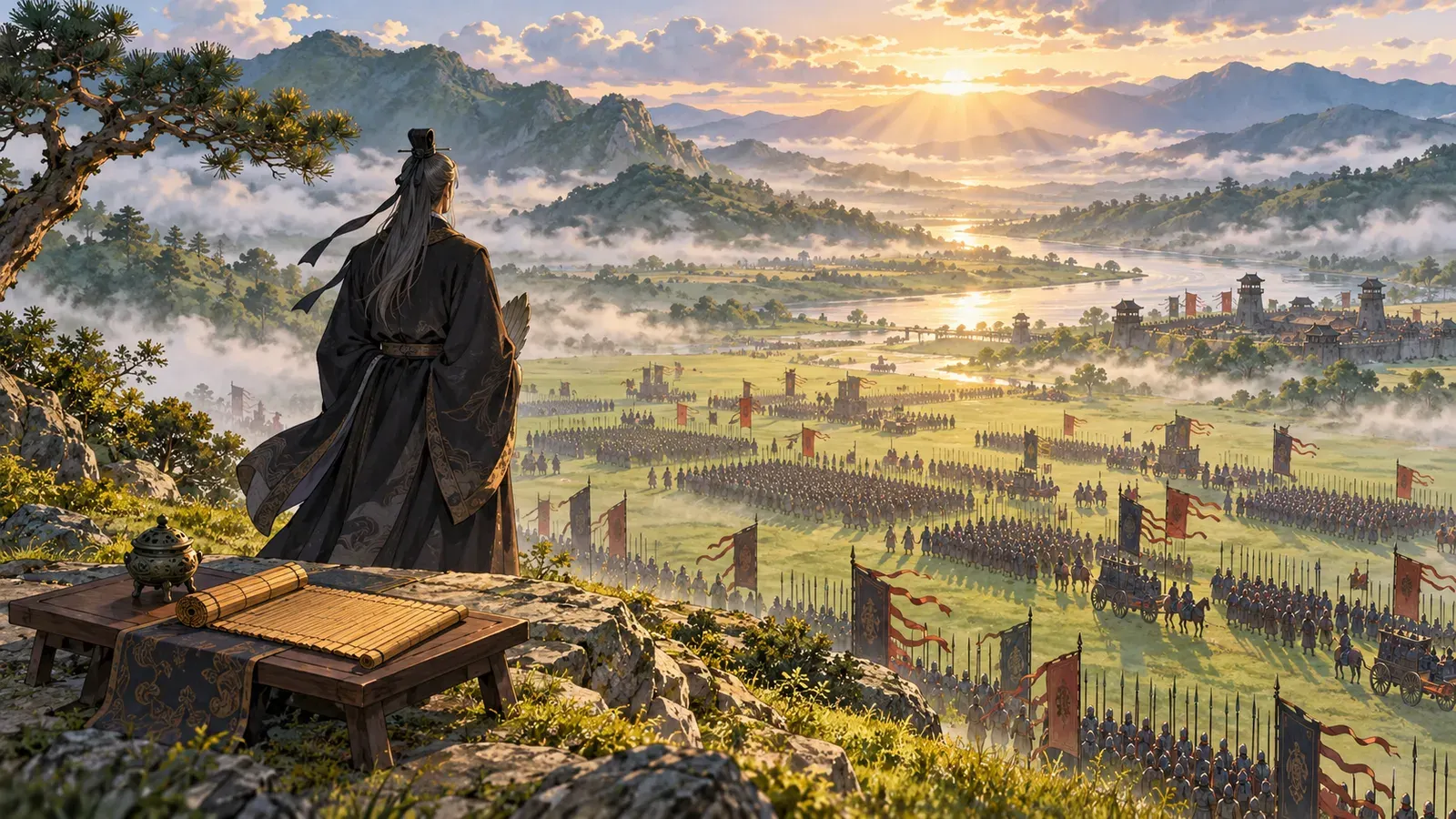
1. Sun Tzŭ said: Whoever is first in the field and awaits the coming of the enemy, will be fresh for the fight; whoever is second in the field and has to hasten to battle, will arrive exhausted.
1. 孫子は言う。先に戦場に着いて敵を待つ者は、元気いっぱいで戦える。後から戦場に着き、あわてて戦いに駆けつける者は、着いたときには疲れきっている。
2. Therefore the clever combatant imposes his will on the enemy, but does not allow the enemy's will to be imposed on him.
2. だから戦の上手な者は、敵を思いのままに動かし、敵に思いのままに動かされることはない。
3. By holding out advantages to him, he can cause the enemy to approach of his own accord; or, by inflicting damage, he can make it impossible for the enemy to draw near.
3. 得になりそうなものを見せれば、敵を自分から近寄らせることができる。痛手を与えれば、敵を近寄れなくすることができる。
4. If the enemy is taking his ease, he can harass him; if well supplied with food, he can starve him out; if quietly encamped, he can force him to move.
4. 敵がくつろいでいれば、たえず悩ませて疲れさせる。食糧が十分にあれば、飢えさせる。落ち着いて陣を構えていれば、動かざるをえないようにする。
5. Appear at points which the enemy must hasten to defend; march swiftly to places where you are not expected.
5. 敵が急いで守りに来なければならない場所に姿を現せ。敵が思いもよらない場所へ、すばやく進め。
6. An army may march great distances without distress, if it marches through country where the enemy is not.
6. 敵のいない土地を進めば、遠くまで行軍しても軍は苦しまない。
7. You can be sure of succeeding in your attacks if you only attack places which are undefended.You can ensure the safety of your defence if you only hold positions that cannot be attacked.
7. 守りのない場所だけを攻めれば、攻めは必ず成功する。攻められない場所だけを守れば、守りは必ず安全である。
8. Hence that general is skilful in attack whose opponent does not know what to defend; and he is skilful in defence whose opponent does not know what to attack.
8. だから攻めの上手な将軍が相手だと、敵はどこを守ればよいか分からない。守りの上手な将軍が相手だと、敵はどこを攻めればよいか分からない。
9. O divine art of subtlety and secrecy! Through you we learn to be invisible, through you inaudible; and hence we can hold the enemy's fate in our hands.
9. ああ、巧みさと秘密の神のような技よ。この技によって、私たちは姿を見せず、音も立てずにいることができる。だから、敵の運命を手中ににぎることができるのである。
10. You may advance and be absolutely irresistible, if you make for the enemy's weak points; you may retire and be safe from pursuit if your movements are more rapid than those of the enemy.
10. 敵の弱いところをめがけて進めば、誰にも止められない。敵よりすばやく動けば、退いても追いつかれない。
11. If we wish to fight, the enemy can be forced to an engagement even though he be sheltered behind a high rampart and a deep ditch. All we need do is attack some other place that he will be obliged to relieve.
11. こちらが戦いたいときは、敵が高い城壁と深い堀の陰に隠れていても、戦わせることができる。敵がどうしても救いに出なければならない別の場所を攻めればよいのである。
12. If we do not wish to fight, we can prevent the enemy from engaging us even though the lines of our encampment be merely traced out on the ground. All we need do is to throw something odd and unaccountable in his way.
12. こちらが戦いたくないときは、地面に線を引いただけの陣地にいても、敵に戦いをしかけさせないことができる。何か奇妙で、わけの分からないことをして、敵の行く手を惑わせればよいのである。
13. By discovering the enemy's dispositions and remaining invisible ourselves, we can keep our forces concentrated, while the enemy's must be divided.
13. 敵の陣構えをつかみ、自分の姿は見せない。そうすれば、こちらは兵力を一つに集められ、敵は兵力を分けざるをえなくなる。
14. We can form a single united body, while the enemy must split up into fractions. Hence there will be a whole pitted against separate parts of a whole, which means that we shall be many to the enemy's few.
14. こちらは一つにまとまり、敵はいくつにも分かれる。そうなれば、まとまった全体で、ばらばらになった敵の一部とぶつかることになる。つまり、こちらは多く、敵は少なくなるのである。
15. And if we are able thus to attack an inferior force with a superior one, our opponents will be in dire straits.
15. こうして多い兵で少ない兵を攻めることができれば、敵はひどい苦境におちいる。
16. The spot where we intend to fight must not be made known; for then the enemy will have to prepare against a possible attack at several different points; and his forces being thus distributed in many directions, the numbers we shall have to face at any given point will be proportionately few.
16. どこで戦うつもりかを、敵に知られてはならない。知られなければ、敵はあちこちで攻められることに備えなければならない。そうして兵力があちこちに散らばれば、どこで戦っても、こちらが相手にする敵の数はその分だけ少なくなる。
17. For should the enemy strengthen his van, he will weaken his rear; should he strengthen his rear, he will weaken his van; should he strengthen his left, he will weaken his right; should he strengthen his right, he will weaken his left. If he sends reinforcements everywhere, he will everywhere be weak.
17. 敵が前を固めれば後ろが手薄になり、後ろを固めれば前が手薄になる。左を固めれば右が手薄になり、右を固めれば左が手薄になる。あらゆるところに兵を送れば、あらゆるところが手薄になる。
18. Numerical weakness comes from having to prepare against possible attacks; numerical strength, from compelling our adversary to make these preparations against us.
18. 兵が少なくなるのは、攻められることに備えなければならないからである。兵が多くなるのは、敵にこちらへの備えをさせるからである。
19. Knowing the place and the time of the coming battle, we may concentrate from the greatest distances in order to fight.
19. 戦いの場所と時が分かっていれば、どんなに遠くからでも兵を集めて戦うことができる。
20. But if neither time nor place be known, then the left wing will be impotent to succour the right, the right equally impotent to succour the left, the van unable to relieve the rear, or the rear to support the van. How much more so if the furthest portions of the army are anything under a hundred li apart, and even the nearest are separated by several li!
20. だが、時も場所も分からなければ、左の翼は右を救えず、右の翼も左を救えない。前の部隊は後ろを助けられず、後ろの部隊も前を支えられない。まして、軍のいちばん遠い部隊どうしが百里近くも離れ、いちばん近い部隊どうしでも数里離れていたら、なおさらである。
21. Though according to my estimate the soldiers of Yüeh exceed our own in number, that shall advantage them nothing in the matter of victory. I say then that victory can be achieved.
21. 私の見積もりでは、越の兵は我が国の兵より多い。だが、それは勝敗には何の役にも立たない。だから私は言う。勝利はつくり出すことができるのだ、と。
22. Though the enemy be stronger in numbers, we may prevent him from fighting. Scheme so as to discover his plans and the likelihood of their success.
22. 敵の兵が多くても、戦えないようにすることはできる。策をめぐらして、敵のはかりごとと、それがうまくいく見込みを見抜け。
23. Rouse him, and learn the principle of his activity or inactivity. Force him to reveal himself, so as to find out his vulnerable spots.
23. 敵をつついて動かし、どういうときに動き、どういうときに動かないかを知れ。敵に姿を現させて、その弱いところを探れ。
24. Carefully compare the opposing army with your own, so that you may know where strength is superabundant and where it is deficient.
24. 敵の軍と自分の軍を注意深く比べて、どこの力があり余り、どこが足りないかを知れ。
25. In making tactical dispositions, the highest pitch you can attain is to conceal them; conceal your dispositions, and you will be safe from the prying of the subtlest spies, from the machinations of the wisest brains.
25. 軍の態勢のきわみは、形を見せないことである。形を隠せば、どんなに鋭い間者にものぞかれず、どんなに賢い者にもはかりごとをめぐらされない。
26. How victory may be produced for them out of the enemy's own tactics—that is what the multitude cannot comprehend.
26. 敵の出方に応じて勝利を生み出す。そのやり方を、一般の人々は理解できない。
27. All men can see the tactics whereby I conquer, but what none can see is the strategy out of which victory is evolved.
27. 私がどんな戦法で勝ったかは、誰にでも見える。だが、その勝利を生み出したもとの策は、誰にも見えない。
28. Do not repeat the tactics which have gained you one victory, but let your methods be regulated by the infinite variety of circumstances.
28. 一度勝った戦法を、繰り返してはならない。限りなく変わる状況に応じて、やり方を変えよ。
29. Military tactics are like unto water; for water in its natural course runs away from high places and hastens downwards.
29. 兵の形は水のようなものである。水は、自然に高いところを避けて、低いところへと流れていく。
30. So in war, the way is to avoid what is strong and to strike at what is weak.
30. 戦も同じで、敵の強いところを避けて、弱いところを撃つのである。
31. Water shapes its course according to the nature of the ground over which it flows; the soldier works out his victory in relation to the foe whom he is facing.
31. 水は流れる土地の形に従って流れを変える。兵は向き合う敵に応じて勝ちを生み出す。
32. Therefore, just as water retains no constant shape, so in warfare there are no constant conditions.
32. だから、水に決まった形がないように、戦にも決まった状況はない。
33. He who can modify his tactics in relation to his opponent and thereby succeed in winning, may be called a heaven-born captain.
33. 敵に応じて戦法を変え、それで勝つことのできる者を、神のような将軍と呼ぶ。
34. The five elements (water, fire, wood, metal, earth) are not always equally predominant; the four seasons make way for each other in turn. There are short days and long; the moon has its periods of waning and waxing.
34. 五行(水、火、木、金、土)は、どれかがいつも勝っているわけではない。四季は、かわるがわる移り変わる。日には短い日と長い日があり、月には欠ける時と満ちる時がある。