In a large town, full of houses and people, there is not room for everybody to have even a little garden, therefore they are obliged to be satisfied with a few flowers in flower-pots. In one of these large towns lived two poor children who had a garden something larger and better than a few flower-pots. They were not brother and sister, but they loved each other almost as much as if they had been. Their parents lived opposite to each other in two garrets, where the roofs of neighboring houses projected out towards each other and the water-pipe ran between them. In each house was a little window, so that any one could step across the gutter from one window to the other. The parents of these children had each a large wooden box in which they cultivated kitchen herbs for their own use, and a little rose-bush in each box, which grew splendidly. Now after a while the parents decided to place these two boxes across the water-pipe, so that they reached from one window to the other and looked like two banks of flowers. Sweet-peas drooped over the boxes, and the rose-bushes shot forth long branches, which were trained round the windows and clustered together almost like a triumphal arch of leaves and flowers. The boxes were very high, and the children knew they must not climb upon them, without permission, but they were often, however, allowed to step out together and sit upon their little stools under the rose-bushes, or play quietly. In winter all this pleasure came to an end, for the windows were sometimes quite frozen over. But then they would warm copper pennies on the stove, and hold the warm pennies against the frozen pane; there would be very soon a little round hole through which they could peep, and the soft bright eyes of the little boy and girl would beam through the hole at each window as they looked at each other. Their names were Kay and Gerda. In summer they could be together with one jump from the window, but in winter they had to go up and down the long staircase, and out through the snow before they could meet.
家や人でいっぱいの大きな町では、だれもが小さな庭を持てるほどの場所はありません。ですから、みんな植木鉢の花をいくつか置いて、がまんするしかないのです。そんな大きな町のひとつに、貧しい子どもがふたり住んでいました。ふたりの庭は、植木鉢をいくつか並べたものよりは、少し大きくて、りっぱでした。ふたりはきょうだいではありませんでしたが、まるできょうだいのように仲よしでした。ふたりの家族は、向かいあった屋根裏部屋に住んでいました。そこでは、となりあった家の屋根がおたがいのほうへせり出していて、そのあいだを雨どいが通っていました。どちらの家にも小さな窓があり、雨どいをひとまたぎすれば、こちらの窓からむこうの窓へ渡れるのでした。両方の家族は、それぞれ大きな木の箱を持っていて、そこに台所で使う野菜を植えていました。どちらの箱にも小さなバラの木が一本ずつ植わっていて、みごとに育っていました。しばらくして、親たちは、このふたつの箱を雨どいをまたぐように置くことにしました。すると箱は窓から窓まで届いて、ふたつの花壇のように見えました。スイートピーが箱からたれ下がり、バラの木は長い枝をのばしました。その枝を窓のまわりにからませたので、両方の枝が寄りあって、まるで葉と花でできた凱旋門のようでした。箱はとても高い所にあったので、子どもたちは、お許しがなければその上にのぼってはいけないと知っていました。それでも、ふたりで外へ出て、バラの木の下の小さな腰かけにすわったり、おとなしく遊んだりすることは、よく許してもらえました。冬になると、この楽しみもおしまいでした。窓がすっかり凍りついてしまうことがあったからです。けれどもそんなときには、ふたりはストーブで銅貨を温め、それを凍った窓ガラスに押し当てました。するとすぐに小さな丸い穴があいて、そこからのぞけるのです。そして、それぞれの窓の穴から、男の子と女の子のやさしく輝く目が、たがいを見つめてきらきらと光るのでした。ふたりの名前は、カイとゲルダといいました。夏なら窓からひと跳びで会えましたが、冬には長い階段を下りてはのぼり、雪の中を歩いていかなければ会えませんでした。
"See there are the white bees swarming," said Kay's old grandmother one day when it was snowing.
「ほら、白いミツバチが群れているよ」ある雪の日、カイのおばあさんが言いました。
"Have they a queen bee?" asked the little boy, for he knew that the real bees had a queen.
「白いミツバチにも女王バチがいるの?」と、男の子はたずねました。本物のミツバチには女王がいることを知っていたからです。
"To be sure they have," said the grandmother. "She is flying there where the swarm is thickest. She is the largest of them all, and never remains on the earth, but flies up to the dark clouds. Often at midnight she flies through the streets of the town, and looks in at the windows, then the ice freezes on the panes into wonderful shapes, that look like flowers and castles."
「もちろんいますとも」と、おばあさんは言いました。「女王は、群れがいちばん濃い所を飛んでいるんだよ。みんなのなかでいちばん大きくて、決して地面にとどまらずに、黒い雲のほうへ飛びあがっていくのさ。真夜中に町の通りを飛びまわって、窓からのぞきこむこともよくある。そうすると窓ガラスの氷が、花やお城のような不思議な形に凍りつくんだよ」
"Yes, I have seen them," said both the children, and they knew it must be true.
「うん、見たことがある」と、子どもたちはふたりとも言いました。そして、それは本当なのだと思いました。
"Can the Snow Queen come in here?" asked the little girl.
「雪の女王は、ここへ入ってこられるの?」と、女の子がたずねました。
"Only let her come," said the boy, "I'll set her on the stove and then she'll melt."
「来るなら来てみろ」と、男の子は言いました。「ストーブの上にすわらせてやる。そうしたら溶けちゃうさ」
Then the grandmother smoothed his hair and told him some more tales. One evening, when little Kay was at home, half undressed, he climbed on a chair by the window and peeped out through the little hole. A few flakes of snow were falling, and one of them, rather larger than the rest, alighted on the edge of one of the flower boxes. This snow-flake grew larger and larger, till at last it became the figure of a woman, dressed in garments of white gauze, which looked like millions of starry snow-flakes linked together. She was fair and beautiful, but made of ice—shining and glittering ice. Still she was alive and her eyes sparkled like bright stars, but there was neither peace nor rest in their glance. She nodded towards the window and waved her hand. The little boy was frightened and sprang from the chair; at the same moment it seemed as if a large bird flew by the window. On the following day there was a clear frost, and very soon came the spring. The sun shone; the young green leaves burst forth; the swallows built their nests; windows were opened, and the children sat once more in the garden on the roof, high above all the other rooms. How beautiful the roses blossomed this summer. The little girl had learnt a hymn in which roses were spoken of, and then she thought of their own roses, and she sang the hymn to the little boy, and he sang too:—
するとおばあさんは男の子の髪をなでて、またいくつかお話をしてくれました。ある晩、小さなカイは家にいて、服を半分ぬいだところで、窓ぎわのいすによじのぼり、小さな穴から外をのぞきました。雪がいくひらか舞い落ちていました。そのうちの、ほかより少し大きなひとひらが、花の箱のふちにとまりました。この雪のひとひらはどんどん大きくなり、とうとうひとりの女の人の姿になりました。白い薄絹の衣を着ていましたが、それは星の形をした雪のひとひらを、何百万もつなぎあわせたもののようでした。色白で美しい人でしたが、体は氷でできていました。きらきらと輝く氷です。それでも女の人は生きていて、その目は明るい星のようにきらめいていました。けれども、そのまなざしには、安らぎも落ち着きもありませんでした。女の人は窓のほうへうなずいて、手を振りました。男の子はこわくなって、いすから飛びおりました。ちょうどそのとき、大きな鳥が窓のそばを飛んでいったような気がしました。次の日は晴れて、きびしく冷えこみました。そしてまもなく、春がやってきました。太陽が輝き、若い緑の葉が芽吹き、ツバメが巣をつくりました。窓が開け放たれ、子どもたちはまた屋根の上の庭にすわりました。ほかのどの部屋よりも高い所です。この夏、バラはなんと美しく咲いたことでしょう。女の子は、バラのことが出てくる賛美歌を覚えていました。それで自分たちのバラのことを思って、男の子にその賛美歌を歌ってあげました。すると男の子も一緒に歌いました。
"Roses bloom and cease to be, But we shall the Christ-child see."
「バラは咲き、やがて散りゆく されどわれら 幼子イエスにまみえん」
Then the little ones held each other by the hand, and kissed the roses, and looked at the bright sunshine, and spoke to it as if the Christ-child were there. Those were splendid summer days. How beautiful and fresh it was out among the rose-bushes, which seemed as if they would never leave off blooming. One day Kay and Gerda sat looking at a book full of pictures of animals and birds, and then just as the clock in the church tower struck twelve, Kay said, "Oh, something has struck my heart!" and soon after, "There is something in my eye."
それから小さなふたりは手をとりあい、バラにキスをして、明るい日の光を見つめました。そして、まるで幼子イエスがそこにいるかのように、話しかけました。すばらしい夏の日々でした。バラの木はいつまでも咲きつづけるかのようで、その木のあいだにいると、なんと美しく、すがすがしかったことでしょう。ある日、カイとゲルダは、動物や鳥の絵がいっぱいの本を見ていました。ちょうど教会の塔の時計が十二時を打ったとき、カイが言いました。「あっ、何かが胸に刺さった!」そしてすぐに、「目に何か入った」
The little girl put her arm round his neck, and looked into his eye, but she could see nothing.
女の子はカイの首に腕をまわして、目の中をのぞきこみましたが、何も見えませんでした。
"I think it is gone," he said. But it was not gone; it was one of those bits of the looking-glass—that magic mirror, of which we have spoken—the ugly glass which made everything great and good appear small and ugly, while all that was wicked and bad became more visible, and every little fault could be plainly seen. Poor little Kay had also received a small grain in his heart, which very quickly turned to a lump of ice. He felt no more pain, but the glass was there still. "Why do you cry?" said he at last; "it makes you look ugly. There is nothing the matter with me now. Oh, see!" he cried suddenly, "that rose is worm-eaten, and this one is quite crooked. After all they are ugly roses, just like the box in which they stand," and then he kicked the boxes with his foot, and pulled off the two roses.
「もう取れたみたいだ」と、カイは言いました。けれども、取れてはいなかったのです。それは、あの鏡のかけらでした。前にお話しした、魔法の鏡です。偉大なものや善いものを小さく醜く見せ、悪いものやいやなものをいっそう目立たせて、どんな小さな欠点もはっきり見せてしまう、あの醜い鏡でした。かわいそうに、小さなカイは、心臓にも小さな粒が入っていました。それはたちまち氷のかたまりに変わってしまいました。もう痛くはありませんでしたが、ガラスはまだそこにあったのです。「なんで泣くんだよ」と、カイはとうとう言いました。「泣くと醜く見えるぞ。ぼくはもうなんともないんだから。あっ、見ろよ!」カイはいきなり叫びました。「あのバラは虫に食われてる。こっちのはすっかり曲がってる。結局、醜いバラなんだ。植わってる箱とおんなじさ」そう言うとカイは箱を足でけとばし、バラの花をふたつむしり取りました。
"Kay, what are you doing?" cried the little girl; and then, when he saw how frightened she was, he tore off another rose, and jumped through his own window away from little Gerda.
「カイ、何をするの?」と、女の子は叫びました。ゲルダがすっかりおびえているのを見ると、カイはもうひとつバラをむしり取りました。そして小さなゲルダを置いて、自分の窓から中へ跳びこんでいってしまいました。
When she afterwards brought out the picture book, he said, "It was only fit for babies in long clothes," and when grandmother told any stories, he would interrupt her with "but;" or, when he could manage it, he would get behind her chair, put on a pair of spectacles, and imitate her very cleverly, to make people laugh. By-and-by he began to mimic the speech and gait of persons in the street. All that was peculiar or disagreeable in a person he would imitate directly, and people said, "That boy will be very clever; he has a remarkable genius." But it was the piece of glass in his eye, and the coldness in his heart, that made him act like this. He would even tease little Gerda, who loved him with all her heart. His games, too, were quite different; they were not so childish. One winter's day, when it snowed, he brought out a burning-glass, then he held out the tail of his blue coat, and let the snow-flakes fall upon it. "Look in this glass, Gerda," said he; and she saw how every flake of snow was magnified, and looked like a beautiful flower or a glittering star. "Is it not clever?" said Kay, "and much more interesting than looking at real flowers. There is not a single fault in it, and the snow-flakes are quite perfect till they begin to melt."
あとでゲルダが絵本を持ってくると、カイは「そんなの、赤ん坊向きだ」と言いました。おばあさんがお話をすると、「でもさ」と口をはさみました。すきがあれば、おばあさんのいすのうしろにまわって眼鏡をかけ、とても上手におばあさんのまねをして、人を笑わせました。やがてカイは、通りを行く人たちの話し方や歩き方まで、まねするようになりました。人の変わったところや、いやなところがあると、すぐにまねしてみせるのです。人々は言いました。「あの子はきっと、とても頭のいい子になるよ。たいした才能だ」けれども、カイにこんなことをさせていたのは、目に入ったガラスのかけらと、心臓の冷たさだったのです。カイは、心の底から自分を好いてくれている小さなゲルダを、いじめることさえありました。遊びもすっかり変わって、前ほど子どもっぽくなくなりました。雪の降るある冬の日、カイは虫めがねを持ち出してきました。そして青い上着のすそを広げて、そこに雪のひとひらを受けました。「このガラスをのぞいてごらん、ゲルダ」と、カイは言いました。ゲルダがのぞいてみると、雪のひとひらひとひらが大きく見えて、美しい花か、きらめく星のようでした。「すごいだろう」と、カイは言いました。「本物の花を見るより、ずっとおもしろいよ。欠点がひとつもないんだ。雪のひとひらは、溶けはじめるまでは、完全そのものなんだよ」
Soon after Kay made his appearance in large thick gloves, and with his sledge at his back. He called up stairs to Gerda, "I've got to leave to go into the great square, where the other boys play and ride." And away he went.
まもなく、カイは大きな厚い手袋をはめ、そりを背負ってあらわれました。そして階段の上のゲルダに呼びかけました。「大きな広場へ行っていいって言われたんだ。ほかの男の子たちがそりで遊んでるところさ」そう言って、行ってしまいました。
In the great square, the boldest among the boys would often tie their sledges to the country people's carts, and go with them a good way. This was capital. But while they were all amusing themselves, and Kay with them, a great sledge came by; it was painted white, and in it sat some one wrapped in a rough white fur, and wearing a white cap. The sledge drove twice round the square, and Kay fastened his own little sledge to it, so that when it went away, he followed with it. It went faster and faster right through the next street, and then the person who drove turned round and nodded pleasantly to Kay, just as if they were acquainted with each other, but whenever Kay wished to loosen his little sledge the driver nodded again, so Kay sat still, and they drove out through the town gate. Then the snow began to fall so heavily that the little boy could not see a hand's breadth before him, but still they drove on; then he suddenly loosened the cord so that the large sled might go on without him, but it was of no use, his little carriage held fast, and away they went like the wind. Then he called out loudly, but nobody heard him, while the snow beat upon him, and the sledge flew onwards. Every now and then it gave a jump as if it were going over hedges and ditches. The boy was frightened, and tried to say a prayer, but he could remember nothing but the multiplication table.
大きな広場では、いちばん向こう見ずな男の子たちが、よく自分のそりをいなかの人の荷車に結びつけていました。そうして、ずいぶん遠くまで引っぱっていってもらうのです。これはすてきな遊びでした。みんなが、カイも一緒になって遊んでいると、大きなそりが一台やってきました。そりは白く塗られていて、中には、白いもじゃもじゃの毛皮にくるまり、白い帽子をかぶった人がすわっていました。そりは広場を二度まわりました。カイは自分の小さなそりを、その大きなそりに結びつけました。それで大きなそりが走りだすと、一緒についていったのです。そりはどんどん速くなって、となりの通りをまっすぐ走りぬけました。すると、そりを走らせている人がふり返って、まるで知りあいのように、カイににこやかにうなずきました。カイが小さなそりをほどこうとするたびに、その人はまたうなずくのです。それでカイはじっとすわったままでした。そして二台のそりは、町の門を出ていきました。やがて雪がひどく降りはじめ、男の子には、目の前の手のひらさえ見えなくなりました。それでもそりは走りつづけます。カイは急いで綱をほどいて、大きなそりだけを先へ行かせようとしましたが、むだでした。小さなそりはしっかりとくっついたまま、風のように走っていきます。カイは大声で叫びましたが、だれにも聞こえません。雪は激しく吹きつけ、そりは飛ぶように進んでいきました。ときどき、生け垣や溝を飛びこえるかのように、ぴょんと跳ねあがりました。男の子はこわくなって、お祈りをとなえようとしましたが、思い出せるのは九九の表だけでした。
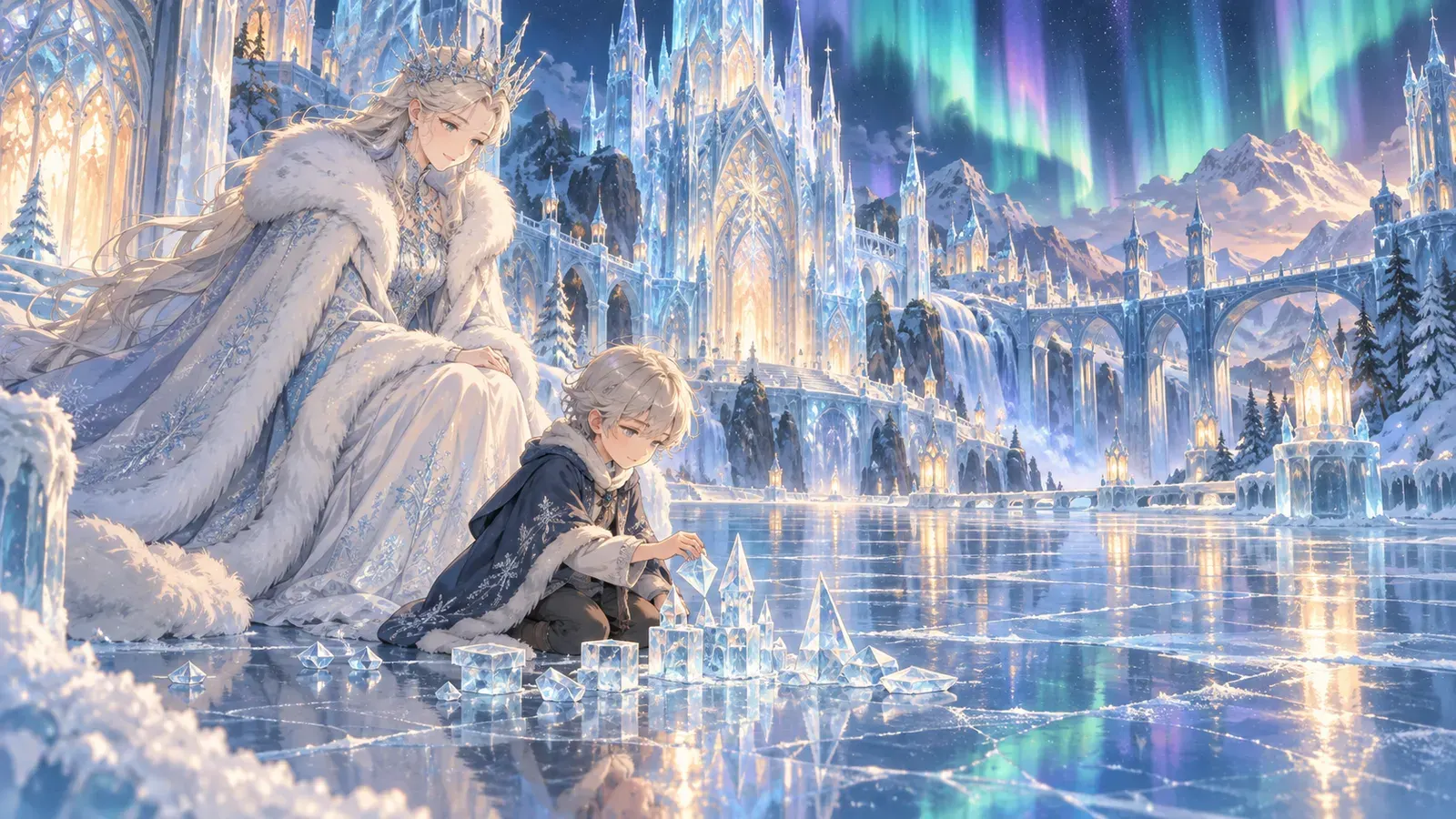
The snow-flakes became larger and larger, till they appeared like great white chickens. All at once they sprang on one side, the great sledge stopped, and the person who had driven it rose up. The fur and the cap, which were made entirely of snow, fell off, and he saw a lady, tall and white, it was the Snow Queen.
雪のひとひらはどんどん大きくなって、とうとう大きな白いにわとりのように見えるほどになりました。突然、雪はさっと両わきへ飛びのきました。大きなそりがとまって、それを走らせていた人が立ちあがりました。毛皮も帽子も、すっかり雪でできていて、それがはらりと落ちました。そこに立っていたのは、背の高い、まっ白な女の人でした。それは雪の女王だったのです。
"We have driven well," said she, "but why do you tremble? here, creep into my warm fur." Then she seated him beside her in the sledge, and as she wrapped the fur round him he felt as if he were sinking into a snow drift.
「ずいぶん走ったわね」と、女王は言いました。「でも、どうして震えているの? さあ、わたしの暖かい毛皮の中にもぐりこみなさい」そう言うと女王は、カイを自分のそりのとなりにすわらせ、毛皮でくるみました。カイは、雪の吹きだまりの中へ沈んでいくような気がしました。
"Are you still cold," she asked, as she kissed him on the forehead. The kiss was colder than ice; it went quite through to his heart, which was already almost a lump of ice; he felt as if he were going to die, but only for a moment; he soon seemed quite well again, and did not notice the cold around him.
「まだ寒いかしら」女王はそうたずねて、カイのひたいにキスをしました。そのキスは氷よりも冷たく、心臓までしみとおりました。カイの心臓は、もうほとんど氷のかたまりになっていたのです。カイは死んでしまうのではないかと思いましたが、それもほんの一瞬のことでした。すぐにすっかり元気になったような気がして、まわりの寒さも感じなくなりました。
"My sledge! don't forget my sledge," was his first thought, and then he looked and saw that it was bound fast to one of the white chickens, which flew behind him with the sledge at its back. The Snow Queen kissed little Kay again, and by this time he had forgotten little Gerda, his grandmother, and all at home.
「ぼくのそり! ぼくのそりを忘れないで」というのが、カイが最初に思ったことでした。見ると、そりは白いにわとりの一羽にしっかりと結びつけられていて、にわとりはそりを背負って、カイのうしろを飛んでいました。雪の女王は、もう一度小さなカイにキスをしました。このときにはもう、カイは小さなゲルダのことも、おばあさんのことも、家のみんなのことも忘れてしまっていました。
"Now you must have no more kisses," she said, "or I should kiss you to death."
「もうキスはおしまいよ」と、女王は言いました。「でないと、キスで死なせてしまうもの」
Kay looked at her, and saw that she was so beautiful, he could not imagine a more lovely and intelligent face; she did not now seem to be made of ice, as when he had seen her through his window, and she had nodded to him. In his eyes she was perfect, and she did not feel at all afraid. He told her he could do mental arithmetic, as far as fractions, and that he knew the number of square miles and the number of inhabitants in the country. And she always smiled so that he thought he did not know enough yet, and she looked round the vast expanse as she flew higher and higher with him upon a black cloud, while the storm blew and howled as if it were singing old songs. They flew over woods and lakes, over sea and land; below them roared the wild wind; the wolves howled and the snow crackled; over them flew the black screaming crows, and above all shone the moon, clear and bright,—and so Kay passed through the long winter's night, and by day he slept at the feet of the Snow Queen.
カイは女王を見つめました。なんて美しい人でしょう。これ以上愛らしく、賢そうな顔は、思い浮かべることもできません。窓の外からうなずきかけてきたときには氷でできているように見えましたが、今はもうそうは見えませんでした。カイの目には、女王は完全そのものに見えました。そしてカイは、少しもこわいと思いませんでした。カイは女王に話しました。ぼくは分数の暗算だってできるし、この国の広さが何平方マイルで、人が何人住んでいるかも知っているんだよ、と。女王はそのたびにほほえむばかりでした。それでカイは、自分はまだまだものを知らないのだと思うのでした。女王はカイを連れて黒い雲に乗り、どんどん高く飛びながら、果てしなく広がる空を見わたしました。嵐は、古い歌でもうたうように、ごうごうと吹き荒れていました。ふたりは森や湖をこえ、海や陸をこえて飛んでいきました。下では荒々しい風がうなり、オオカミが遠ぼえし、雪がぱりぱりと鳴っていました。上では黒いカラスが鳴きさけびながら飛び、そのさらに上では、月が澄みきって明るく輝いていました。こうしてカイは長い冬の夜を過ごし、昼は雪の女王の足もとで眠ったのでした。