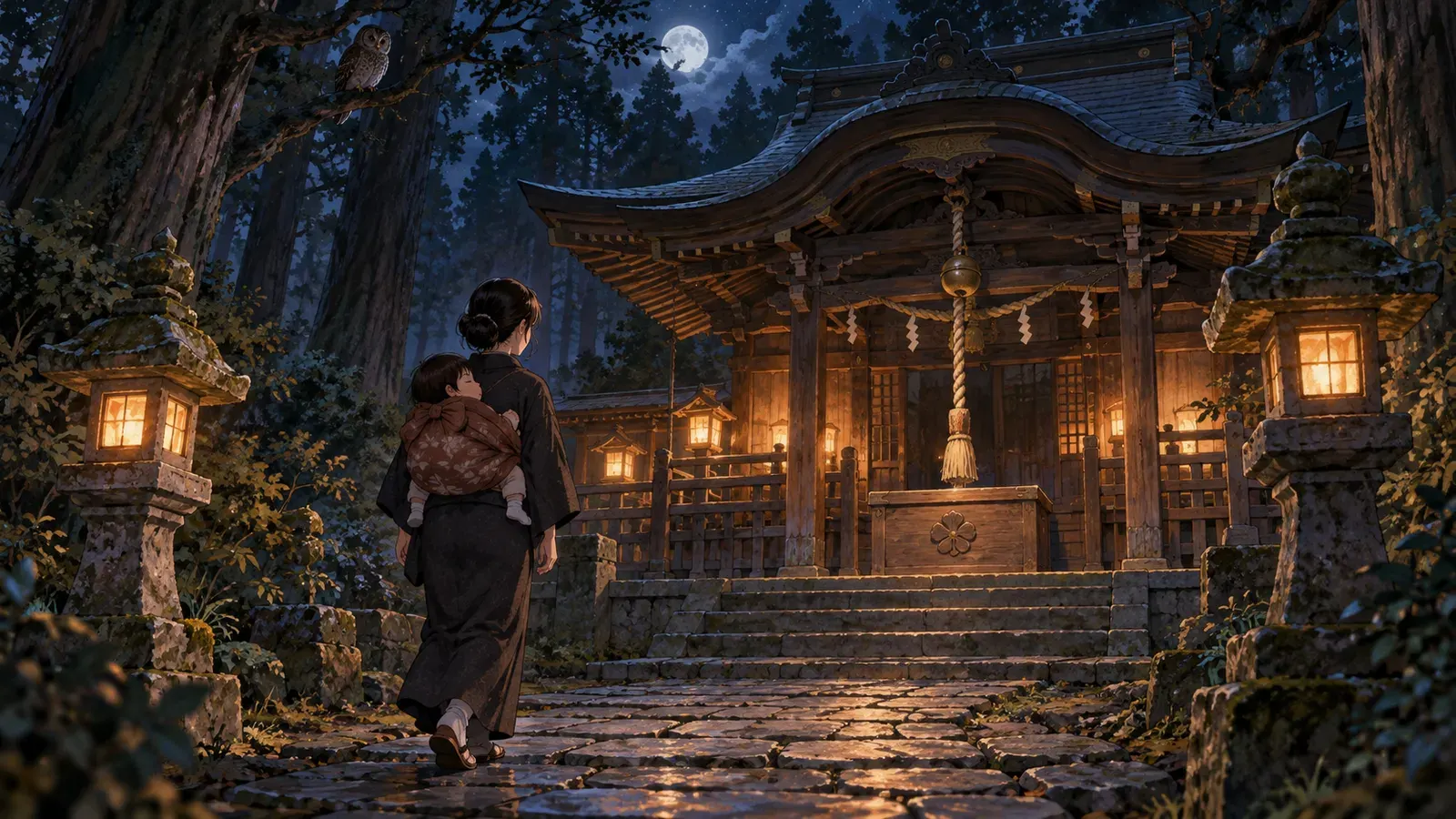
Somehow, the world had begun to feel restless. It looked as if a war might start at any moment. I felt as if horses, driven out of burning stables, were running wild around the house day and night, and foot soldiers were chasing them, day and night, with loud shouts. And yet inside the house, everything was silent.
世の中が、なんとなくざわつきはじめた。今にも戦が起こりそうに見えた。焼け出された裸馬が昼も夜も屋敷のまわりを暴れ回り、それを足軽たちが昼も夜もひしめき合って追いかけている――そんな心持ちがした。それでいて、家の中はしんと静まりかえっていた。
In the house lived a young mother and her three-year-old child. The father had gone somewhere. He had left in the middle of a night with no moon. He put on his straw sandals while still standing on the floor, covered his head with a black hood, and went out through the kitchen door. The light of the paper lantern in the mother's hand reached thin and long into the darkness and lit up an old cypress tree in front of the hedge.
家には、若い母と、三つになる子どもがいた。父はどこかへ行ってしまった。父が出ていったのは、月の出ていない真夜中だった。床の上でわらじをはき、黒い頭巾をかぶって、勝手口から出ていった。そのとき母の持っていた手燭の明かりが、暗い闇に細長くさして、生け垣の手前の古いヒノキを照らした。
The father never came back. Every day, the mother asked the child, "Where is Father?" At first, the child said nothing. After a while, he learned to answer, "Over there." When she asked, "When will he come home?" he still answered, "Over there," and laughed. Then the mother laughed, too. Again and again, she taught him to say, "He will come home soon." But the child learned only the word "soon." Sometimes, when she asked, "Where is Father?" he answered, "Soon."
父は、それきり帰ってこなかった。母は毎日、三つになる子に「お父さまは」と聞いていた。子どもは、はじめは何とも言わなかった。しばらくすると、「あっち」と答えるようになった。母が「いつお帰り」と聞いても、やはり「あっち」と答えて笑っていた。そのときは母も笑った。そして、「今にお帰り」という言葉を、何べんもくり返して教えた。けれども子どもは、「今に」だけしか覚えなかった。ときどき、「お父さまはどこ」と聞かれて、「今に」と答えることもあった。
At night, when everything around was quiet, the mother tied her sash tightly again and slipped a short sword in a sharkskin case into it. Then she tied the child onto her back with a thin sash and quietly went out through the small side gate. She always wore straw sandals. Sometimes the child fell asleep on her back, listening to the sound of her sandals.
夜になって、あたりが静まると、母は帯を締め直し、さめ皮のさやに入った短刀を帯の間へさした。それから子どもを細い帯で背中にくくりつけ、そっとくぐり戸から出ていった。母はいつも草履をはいていた。子どもはこの草履の音を聞きながら、母の背中で眠ってしまうこともあった。
She walked west along the street of samurai houses with their long earthen walls, and went all the way down a gentle slope. There stood a great ginkgo tree. She turned right at the ginkgo, and a short way ahead stood a stone torii gate. On one side was a rice field, and on the other side grew nothing but tall bamboo grass. She passed through the torii and came into a dark grove of cedar trees. After about forty meters along the stone path, she reached the steps of an old shrine.
土塀の続く侍屋敷の町を西へ下り、だらだら坂を降りきると、大きなイチョウの木があった。このイチョウを目印に右へ曲がると、少し奥に石の鳥居があった。片側は田んぼで、片側は背の高い熊笹ばかりだった。その中を鳥居まで来て、くぐり抜けると、暗い杉の木立に入った。そこから石畳を四十メートルほど伝っていくと、古い拝殿の階段の下に出た。
Above the gray offering box, washed pale by the rain, hung the long rope of a large bell. In the daytime, you could see a wooden board beside the bell with the words "Hachiman Shrine." It was interesting that the character for "eight" was written so that it looked like two doves facing each other. There were many other boards, too. Most of them showed golden targets that men of the clan had shot through with their arrows, with the archers' names beside them. Sometimes a sword had been offered, too.
雨に洗われて白っぽくなったねずみ色のさい銭箱の上に、大きな鈴の綱が垂れていた。昼間見ると、その鈴のそばに「八幡宮」と書いた額がかかっていた。「八」の字が、二羽の鳩が向かい合ったような書体になっているのがおもしろかった。ほかにも、いろいろな額があった。たいていは、藩の侍たちが弓で射抜いた金色の的に、射抜いた人の名前を書きそえたものだった。ときには、太刀を奉納したものもあった。
When she passed through the torii, an owl was always hooting high in the cedars. Her cheap straw sandals made soft, wet sounds on the stones. When the sound stopped in front of the shrine, the mother first rang the bell. Then she quickly crouched down and clapped her hands. Usually the owl suddenly stopped hooting at that moment. Then she prayed with all her heart for her husband's safety. Her husband was a samurai, and Hachiman was the god of the bow and arrow. So she believed with all her heart that the god could not possibly refuse such a desperate prayer.
鳥居をくぐると、杉のこずえでいつもフクロウが鳴いていた。そして、安物の草履が石畳の上でぴちゃぴちゃと鳴った。それが拝殿の前でやむと、母はまず鈴を鳴らし、すぐにしゃがんで柏手を打った。たいてい、このときフクロウはぱったり鳴きやんだ。それから母は、一心不乱に夫の無事を祈った。夫は侍であり、八幡さまは弓矢の神さまだ。だから、これほど切実な願いを聞き入れてくださらないはずはない――母は、ひたすらそう思いつめていたのである。
The child often woke up at the sound of the bell. When he looked around and saw only darkness, he would suddenly begin to cry on her back. Then the mother, still praying under her breath, would rock him gently on her back to calm him. Sometimes he stopped crying. Sometimes he cried even harder. Either way, the mother did not stand up easily.
子どもは、よくこの鈴の音で目を覚ました。あたりを見回すと真っ暗なので、背中で急に泣きだすことがあった。そんなとき母は、口の中で何か祈りながら、背中を揺すってあやそうとした。うまく泣きやむこともあった。いっそう激しく泣きたてることもあった。どちらにしても、母はなかなか立ち上がらなかった。
When she had finished praying for her husband, she untied the sash and slid the child down from her back and around to her front. Holding him in both arms, she climbed the steps of the shrine. "Be a good boy and wait for a little while," she always said, pressing her cheek against his. Then she made the sash long, tied the child with it, and tied the other end to the railing of the shrine. She went down the steps and began the prayer of a hundred visits. Back and forth she walked along the forty meters of stone path, a hundred times, praying each time.
ひととおり夫の無事を祈り終えると、今度は細い帯をほどいて、背中の子をすべらせるように前へ回し、両手に抱いて拝殿へ上がっていった。そして、「いい子だから、少しのあいだ待っておいでよ」と、決まって自分のほおを子どものほおにすりつけた。それから細い帯を長くして子どもを縛り、そのはしを拝殿の欄干にくくりつけた。そうして階段を降りてきて、四十メートルの石畳を行ったり来たりしながら、お百度を踏んだ。百回往復して、そのたびに祈ったのである。
The child tied to the shrine crawled around in the darkness on the wide wooden floor, as far as the sash would let him. On those nights, things were easy for the mother. But when the tied child cried and cried, she could not bear it. Her steps grew very fast, and she ran out of breath. When nothing else helped, she went back up to the shrine in the middle of her prayer, comforted him in every way she could, and then started her hundred walks all over again.
拝殿にくくりつけられた子は、暗闇の中で、細い帯の届くかぎり、広い縁側の上をはい回っていた。そういう晩は、母にとってずいぶん楽な夜だった。けれども、縛られた子にひいひい泣かれると、母は気が気でなかった。お百度の足がひどく速くなり、息がひどく切れた。どうにもならないときは、途中で拝殿に上がってきて、いろいろとなだめすかし、またお百度を最初から踏み直すこともあった。
Night after night the mother worried like this, without sleeping. But the father she was praying for had been killed by a masterless samurai long, long before.
こうして幾晩も幾晩も、母が気をもみ、夜も寝ずに無事を祈りつづけていた父は、とうの昔に、浪士に殺されていたのである。
I heard this sad story from my mother, in a dream.
こんな悲しい話を、夢の中で母から聞いた。