This is the dream I had.
こんな夢を見た。
It was a very, very long time ago, almost in the age of the gods. I had fought in a war, but luck was against me. My side lost, and I was taken prisoner. They brought me before the general of the enemy and made me sit in front of him.
なんでも、よほど古いことで、神代に近い大昔のことと思われる。私は戦をして、運悪く負けたために生け捕りにされ、敵の大将の前に引き据えられた。
In those days, everyone was tall, and everyone had a long beard. They wore leather belts, and from their belts hung swords like thick sticks. Their bows looked like thick wild vines, used just as they were. They had no paint and no polish. Everything was very simple.
そのころの人は、みんな背が高かった。そして、みんな長いひげを生やしていた。革の帯を締めて、そこへ棒のような剣をつるしていた。弓は、太い藤づるをそのまま使ったように見えた。漆も塗っていなければ、磨きもかけていない。ごく素朴なものだった。
The enemy general was sitting on something like an upside-down sake jar. In his right hand he held his bow by the middle, with one end on the grass. When I looked at his face, I saw that his thick eyebrows met above his nose. Of course, there were no razors in those days.
敵の大将は、酒がめを伏せたようなものの上に腰をかけていた。右手で弓の真ん中を握って、その弓を草の上に突いていた。顔を見ると、鼻の上で、左右の太い眉がつながっていた。そのころ、かみそりというものはもちろんなかったのだ。
I was a prisoner, so I could not sit on anything. I sat cross-legged on the grass. On my feet I wore big straw boots. The straw boots of that time were deep. When you stood up, they came up to your knees. At the top, a little of the straw was left loose. It hung down like tassels and moved when you walked.
私は捕虜だったから、腰をかけるわけにはいかなかった。草の上にあぐらをかいていた。足には大きなわらぐつをはいていた。この時代のわらぐつは深く、立つとひざがしらまで来た。そのふちのところは、わらを少し編み残して房のように垂らし、歩くとばらばら揺れるようにして、飾りにしていた。
The general looked at my face by the light of the fire and asked, "Will you die, or will you live?" This was the custom in those days. Every prisoner was asked this question. To answer "live" meant that you gave up. To answer "die" meant that you would never give in. I answered with one word: "Die."
大将はかがり火で私の顔を見て、「死ぬか、生きるか」と聞いた。これはそのころの習わしで、捕虜にはだれにでも、ひととおりこう聞いたのである。生きると答えれば降参したことになり、死ぬと言えば屈しないということになる。私はひと言、「死ぬ」と答えた。
The general threw his bow aside onto the grass and began to draw the thick sword that hung from his belt. The fire, blown by the wind, flared up beside him. I opened my right hand like a maple leaf, turned my palm toward him, and raised it above my eyes. It was a sign that meant "Wait." The general pushed his heavy sword back into its case with a click.
大将は草の上に突いていた弓を向こうへ投げ捨てて、腰につるした棒のような剣をするりと抜きかけた。そこへ、風になびいたかがり火が横から吹きつけた。私は右手をカエデの葉のように開いて、手のひらを大将のほうへ向け、目の上へさし上げた。「待て」という合図だった。大将は太い剣を、かちゃりとさやに収めた。
Even in those days, there was love. I said that before I died, I wanted to see the woman I loved, just once. The general said he would wait until dawn, when the rooster crowed. Before the rooster crowed, the woman had to come here. If she did not come by then, I would be killed without seeing her.
そのころでも、恋はあった。私は、死ぬ前にひと目、思う女に会いたいと言った。大将は、夜が明けて鶏が鳴くまでなら待とうと言った。鶏が鳴くまでに、女がここへ来なければならない。鶏が鳴いても女が来なければ、私は会えないまま殺されてしまう。
The general sat and looked at the fire. I sat on the grass with my big straw boots crossed, and waited for the woman. The night grew deeper and deeper.
大将は腰をかけたまま、かがり火を眺めていた。私は大きなわらぐつを組み合わせたまま、草の上で女を待っていた。夜はだんだん更けていった。
From time to time, the fire fell in with a crash. Each time it fell, the flames rushed toward the general as if in a panic. Under his black eyebrows, his eyes were shining. Then someone came and threw many new branches into the fire. Soon the fire began to crackle loudly. It was a brave sound, as if it were pushing back the darkness.
ときどき、かがり火の崩れる音がした。崩れるたびに、炎はうろたえたように大将へなだれかかった。真っ黒な眉の下で、大将の目がぎらぎらと光っていた。すると、誰かがやって来て、新しい枝をたくさん火の中へ投げこんでいった。しばらくすると、火がぱちぱちと鳴りだした。暗闇をはね返すような、勇ましい音だった。
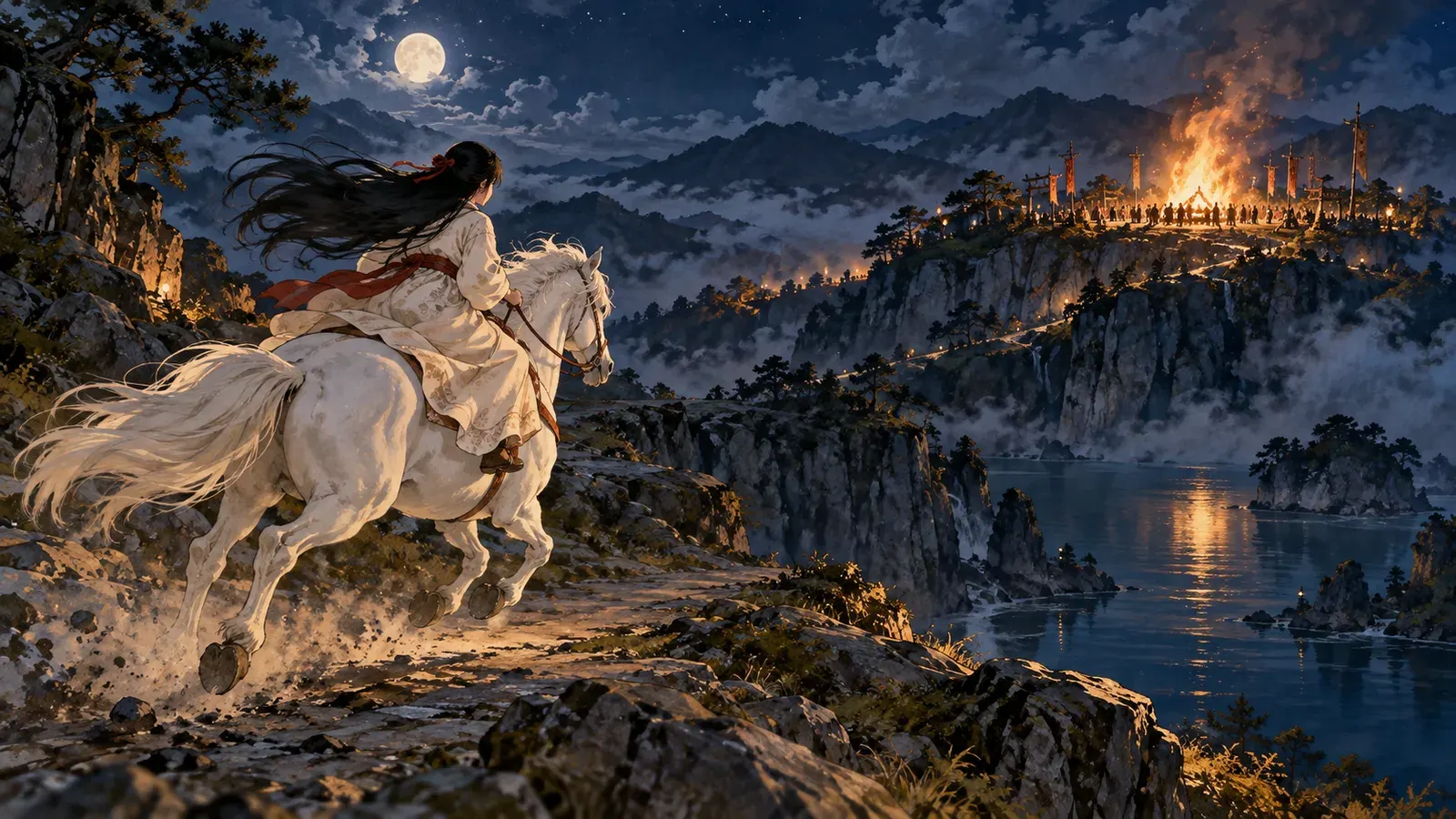
At that moment, the woman led out a white horse that was tied to an oak tree behind her house. She stroked its mane three times and jumped lightly onto its high back. There was no saddle, and there was nothing for her feet. When she kicked its sides with her long white legs, the horse began to run as fast as it could.
このとき、女は、裏のナラの木につないである白い馬を引き出した。たてがみを三度なでて、高い背にひらりと飛び乗った。くらもなく、あぶみもない、裸馬だった。長く白い足で太い腹をけると、馬はいっさんに駆けだした。
Because someone had added wood to the fire, the sky far away looked a little bright. The horse came flying through the darkness toward that light. Two breaths, like pillars of fire, came out of its nose. Still the woman kept kicking its sides with her thin legs. The horse ran so fast that its hooves seemed to ring in the air. Her hair streamed behind her in the dark like a long flag. But still she could not reach the place of the fire.
だれかがかがり火に木をつぎ足したので、遠くの空がうっすらと明るく見えた。馬はこの明るいものを目がけて、闇の中を飛んできた。鼻から火の柱のような息を二本吹き出して、飛んできた。それでも女は、細い足でひっきりなしに馬の腹をけった。馬は、ひづめの音が宙で鳴るほど速く飛んできた。女の髪は、吹き流しのように闇の中に尾を引いた。それでも、まだかがり火のあるところまでは来られなかった。
Suddenly, beside the pitch-dark road, a rooster crowed: "Cock-a-doodle-doo!" The woman leaned back and pulled hard on the reins with both hands. The horse's front hooves struck the hard rock and cut deep into it.
すると、真っ暗な道のわきで、いきなり「コケコッコー」という鶏の声がした。女は身をのけぞらせて、両手に握った手綱をぐいと引いた。馬は前足のひづめを、堅い岩の上に深く刻みこんだ。
"Cock-a-doodle-doo!" the rooster crowed once more.
「コケコッコー」と、鶏がもう一声鳴いた。
The woman cried out, and the reins went loose in her hands all at once. The horse fell to its knees and pitched forward, with her on its back. Below the rock was a deep pool.
女があっと叫ぶと、握っていた手綱が一度にゆるんだ。馬は両ひざを折って、女もろとも、まっすぐ前へのめった。岩の下は深い淵だった。
The marks of the hooves are still on that rock today. The one who copied the rooster's cry was Amanojaku, a wicked spirit who loves to do the opposite of what people wish. As long as those hoofprints remain on the rock, Amanojaku is my enemy.
ひづめの跡は、今でも岩の上に残っている。鶏の鳴きまねをしたのは天探女――人の望みの反対ばかりしたがる、意地の悪い魔物である。このひづめの跡が岩に刻みつけられているあいだ、天探女は私の敵なのである。