第1組曲(ホルスト)
First Suite in E-flat
ホルスト・1909
吹奏楽の「バイブル」。1つのテーマが全曲をつらぬく傑作。
吹奏楽のための第1組曲 変ホ長調のページへLate Romantic & Modern · 1874–1934
「「惑星」の作曲家」The man who set the planets to music
 チェルトナム(イギリス)
 ロンドン(イギリス)9 曲を収録
星占いが大好きな音楽の先生が、宇宙を音で描きました。A music teacher who loved astrology painted the heavens in sound.
 ホルストの名曲を聴く
ホルスト・1909
吹奏楽の「バイブル」。1つのテーマが全曲をつらぬく傑作。
吹奏楽のための第1組曲 変ホ長調のページへホルスト・1911
かじ屋の金床もカーン!イギリス民謡がつまった吹奏楽の名作。
吹奏楽のための第2組曲 ヘ長調のページへホルスト・1912–1913
音楽の先生ホルストが、女子校の生徒のために書いた弦楽の宝もの。
セント・ポール組曲のページへホルスト・1914
平原綾香「Jupiter」のメロディーは、ここから生まれた!
組曲「惑星」より「木星、快楽をもたらす者」のページへホルスト・1914
5拍子の不気味な行進!映画音楽の原点とも言われる迫力。
組曲「惑星」より「火星、戦争をもたらす者」のページへホルスト・1914(作曲)
戦いの「火星」のあとにおとずれる、しずかな平和の星。
組曲「惑星」より 金星(平和をもたらす者)のページへホルスト・1915(作曲)
チク、タク…時計がきざむ「老い」。ホルストいちばんのお気に入り。
組曲「惑星」より 土星(老いをもたらす者)のページへホルスト・1914–1916
7つの惑星をめぐる、音の宇宙旅行。地球はどこへ?
組曲「惑星」のページへホルスト・1916(作曲)
あっちへ、こっちへ!翼のくつで飛び回る、いちばん短い惑星。
組曲「惑星」より 水星(翼のある使者)のページへ
ホー!ホルストはお肉もお酒もとらず、長い散歩が大好きだったんだよ。
 生涯 Life Story
グスターヴ・ホルストは1874年、イギリスの温泉町チェルトナムの音楽一家に生まれました。本名はグスタヴス・セオドア・フォン・ホルストです。子どものころは体が弱く、ぜんそく、目の悪さ、右腕の神経の痛みに悩まされました。12歳のとき、ぜんそくに良いかもしれないとトロンボーンを始め、のちにロンドンの王立音楽大学で作曲を学びました。Gustav Holst was born in 1874 into a musical family in Cheltenham, a spa town in England. His birth name was Gustavus Theodore von Holst. He was a sickly child who suffered from asthma, poor eyesight and nerve pain in his right arm. At twelve he took up the trombone, partly in the hope that it would help his breathing, and he later studied composition at the Royal College of Music in London.
大学では一生の親友となるヴォーン・ウィリアムズと出会い、おたがいの曲を見せ合って意見を言い合いました。卒業後はトロンボーン奏者として歌劇団で働き、やがて教える道へ進みます。1905年から聖ポール女学校、1907年からはモーリー・カレッジで音楽を教えました。代表作は7つの曲からなる組曲「惑星」で、1914年に書きはじめ、1918年に初めて演奏されました。At college he met Ralph Vaughan Williams, who became his closest friend for life; the two always showed each other their new music and gave honest advice. After his studies Holst earned a living as a trombonist in an opera company, and then turned to teaching. He taught at St Paul's Girls' School from 1905 and at Morley College from 1907. His most famous work, The Planets, is a suite in seven movements. He began it in 1914, and it was first performed in 1918.
ホルストは古代インドの文学にひかれ、大学でサンスクリット語を学び、自分で詩を訳して歌にしました。星占いも大好きで、友だちの運勢を占っては「ちょっとした悪いくせ」と笑っていました。第一次世界大戦では体が弱く兵士になれませんでしたが、1918年、兵士たちに音楽を教える仕事でギリシャへ向かいます。このとき、ドイツ風に聞こえる「フォン」を名前から外しました。Holst was fascinated by ancient Indian literature. He studied Sanskrit at university and made his own translations of old hymns so that he could set them to music. He also loved astrology, cast horoscopes for his friends, and called it his 'pet vice'. During the First World War he was rejected as unfit for the army, but in 1918 he went to Greece to organise music for soldiers. Before he left, he officially dropped the German-sounding 'von' from his name.
「惑星」で有名になっても、ホルストは名声をいやがり、勲章やインタビュー、サインを断りました。1923年には演奏会の場ですべって頭を強く打ち、その後は体調をくずしがちになります。本人がいちばんの自信作と考えていたのは、荒れ野を描いた管弦楽曲「エグドン・ヒース」でした。1934年、手術のあと59歳でロンドンで亡くなり、遺灰はチチェスター大聖堂に納められています。Even after The Planets made him famous, Holst disliked fame. He turned down honours and refused interviews and autographs. In 1923 he slipped at a concert and hit his head badly, and his health was never quite the same again. The work he himself thought most successful was Egdon Heath, a dark orchestral picture of a lonely moor. He died in London in 1934, aged 59, after an operation, and his ashes lie in Chichester Cathedral.
Gustav Holst was born in England in 1874. He was often sick as a child. He played the trombone. Later he taught music at a girls' school. He wrote a famous piece called The Planets. It has seven parts, but there is no part for Earth!グスターヴ・ホルストは1874年にイギリスで生まれました。子どものころはよく病気になりました。彼はトロンボーンを演奏しました。のちに女子校で音楽を教えました。彼は「惑星」という有名な曲を書きました。7つの部分がありますが、地球の曲はありません!
 これだけは!鉄板情報 Must-Know Facts
 あっと驚くネタ Surprising Stories
 タップすると答えが開きます
ホルストが「惑星」を書いたころ、冥王星はまだ見つかっていませんでした(発見は1930年)。2000年に作曲家コリン・マシューズが「冥王星」を書き足しましたが、その冥王星は2006年に天文学の「惑星」からはずされてしまいました。
When Holst wrote the suite, Pluto had not yet been discovered; it was found in 1930. In 2000 the composer Colin Matthews added a movement called 'Pluto', but in 2006 astronomers decided Pluto was no longer a planet.
「惑星」は宇宙の科学ではなく、星占い(占星術)がヒントです。だから「戦争をもたらす者(火星)」「快楽をもたらす者(木星)」のように星の性格が副題になっていて、地球をのぞく7つの惑星が描かれています。
The Planets is based on astrology, not science. That is why each movement has a subtitle describing a planet's 'character', such as 'Mars, the Bringer of War' or 'Jupiter, the Bringer of Jollity'. The seven movements portray seven planets other than Earth.
1913年、聖ポール女学校に新しい音楽棟ができ、そこにはホルストが作曲するための防音の部屋がありました。そのお礼のように生徒たちのために書いたのが、弦楽合奏の「セントポール組曲」です。
In 1913 St Paul's Girls' School opened a new music wing, which included a soundproof room where Holst could compose in peace. To celebrate, he wrote the St Paul's Suite for the school's string players.
第一次世界大戦中、ドイツ風の「フォン」がつく名前は敵国風だと心配されました。ギリシャでの仕事のため、ホルストは1918年に正式な手続きで「フォン」を名前から外し、「グスターヴ・ホルスト」になりました。
During the First World War, a name with the German-sounding 'von' was seen as a problem. Before his work in Greece in 1918, Holst officially removed 'von' from his name and became simply Gustav Holst.
ホルストはとても内気で、名声がきらいでした。勲章や名誉を断り、インタビューやサインもいやがったそうです。ところが1931年、映画の群衆シーンのエキストラに選ばれたときは、おもしろがって引き受けたと伝えられています。
Holst was very shy and disliked being famous. He refused honours, interviews and autographs. Yet in 1931 he was amused to be picked as an extra in a crowd scene for a film.
2003年、歌手の平原綾香さんが「木星」の中間部のメロディーに日本語の歌詞をつけた「Jupiter」を歌い、大ヒットしました。ホルストのメロディーは、100年近くたって日本のポップスとしてよみがえったのです。
In 2003 the Japanese singer Ayaka Hirahara released 'Jupiter', a song with Japanese lyrics set to the central tune of Holst's movement. It became a huge hit, bringing his melody to a new audience almost a hundred years later.
 肖像画・写真・自筆譜 Gallery (Public Domain)
Wikimedia Commons でパブリックドメイン(または CC0)と確認した画像です。クリックで拡大。
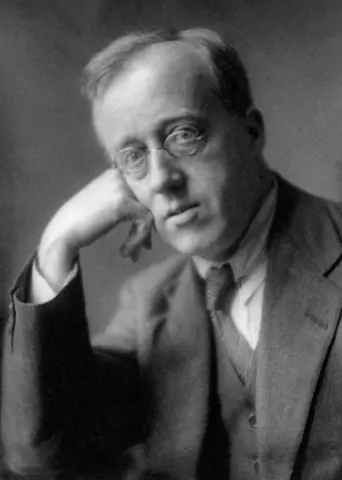
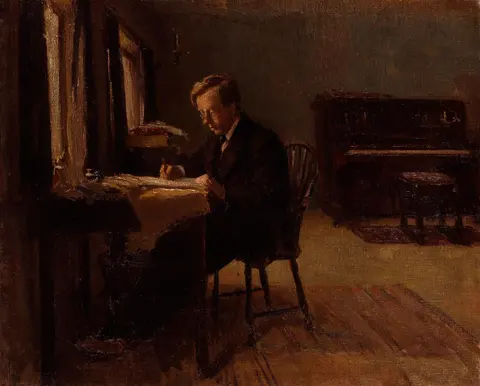
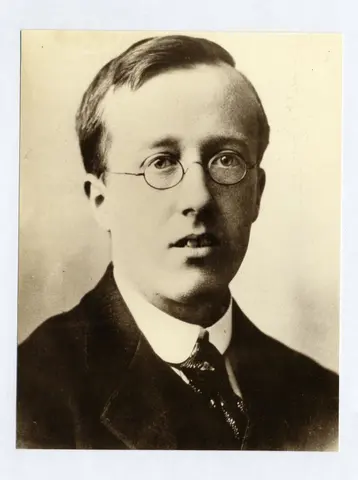
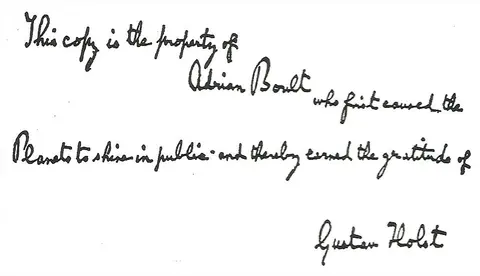
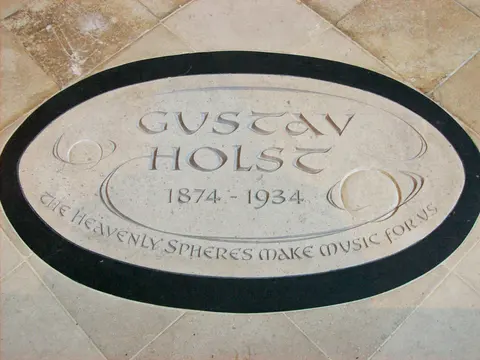

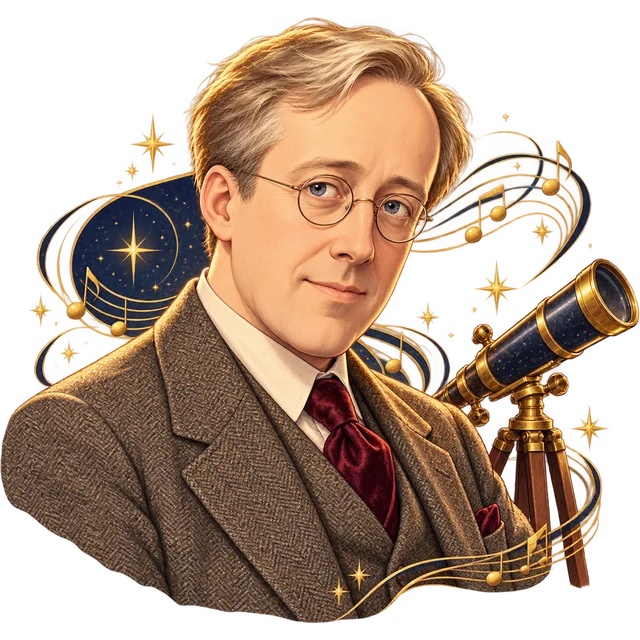
ページ上のイラストは、本物の肖像画をもとにこのサイトのために描いたものです。
 年表 Timeline
 ホルストで覚える英単語 Words
 クイズに挑戦 Quiz
MORE COMPOSERS

 MP3