

 書記バートルビー 全4部の 3番目
 約29分
 25:03
 原文そのまま
 全訳つき
 ハーマン・メルヴィルの作品をもっと読む(2作品)→
 人の朗読
 お道具箱
 読書ラウンジ
He remained as ever, a fixture in my chamber. Nay—if that were possible—he became still more of a fixture than before. What was to be done? He would do nothing in the office: why should he stay there? In plain fact, he had now become a millstone to me, not only useless as a necklace, but afflictive to bear. Yet I was sorry for him. I speak less than truth when I say that, on his own account, he occasioned me uneasiness. If he would but have named a single relative or friend, I would instantly have written, and urged their taking the poor fellow away to some convenient retreat. But he seemed alone, absolutely alone in the universe. A bit of wreck in the mid Atlantic. At length, necessities connected with my business tyrannized over all other considerations. Decently as I could, I told Bartleby that in six days' time he must unconditionally leave the office. I warned him to take measures, in the interval, for procuring some other abode. I offered to assist him in this endeavor, if he himself would but take the first step towards a removal. "And when you finally quit me, Bartleby," added I, "I shall see that you go not away entirely unprovided. Six days from this hour, remember."
彼は相変わらず、備え付けの家具のように私の事務所に居座っていた。いや、そんなことがあり得るなら、前にもまして備え付けの品になった。どうしたものだろう。事務所で何もしないというのなら、なぜそこにいる必要があるのか。ありのままに言えば、彼は今や私の首にかかった石臼だった。首飾りとして役に立たないばかりか、ぶら下げているだけで苦しい。それでも、私は彼を気の毒に思った。彼の身を思って不安になったと言っても、まだ本当の気持ちには足りないくらいである。親類か友人の名を一人でも挙げてくれたなら、私はすぐに手紙を書いて、この哀れな男をどこか適当な落ち着き先へ引き取ってくれるよう頼んだだろう。しかし、彼は独りぼっち、この宇宙にまったくの独りぼっちのようだった。大西洋の真ん中に漂う難破船のかけらである。やがて、仕事の上の必要が、ほかのあらゆる思いを押しのけた。私はできるだけ礼儀正しく、六日後には無条件で事務所を出ていかなければならないとバートルビーに告げた。それまでの間に、どこか別の住まいを見つける手を打っておくようにと言い渡した。引っ越しに向けて本人が最初の一歩さえ踏み出すなら、手伝おうとも申し出た。「それから、いよいよここを去るときにはね、バートルビー」と私は付け加えた。「何も持たずに出ていくことにはならないよう取り計らおう。今この時刻から六日後だ。忘れないように」
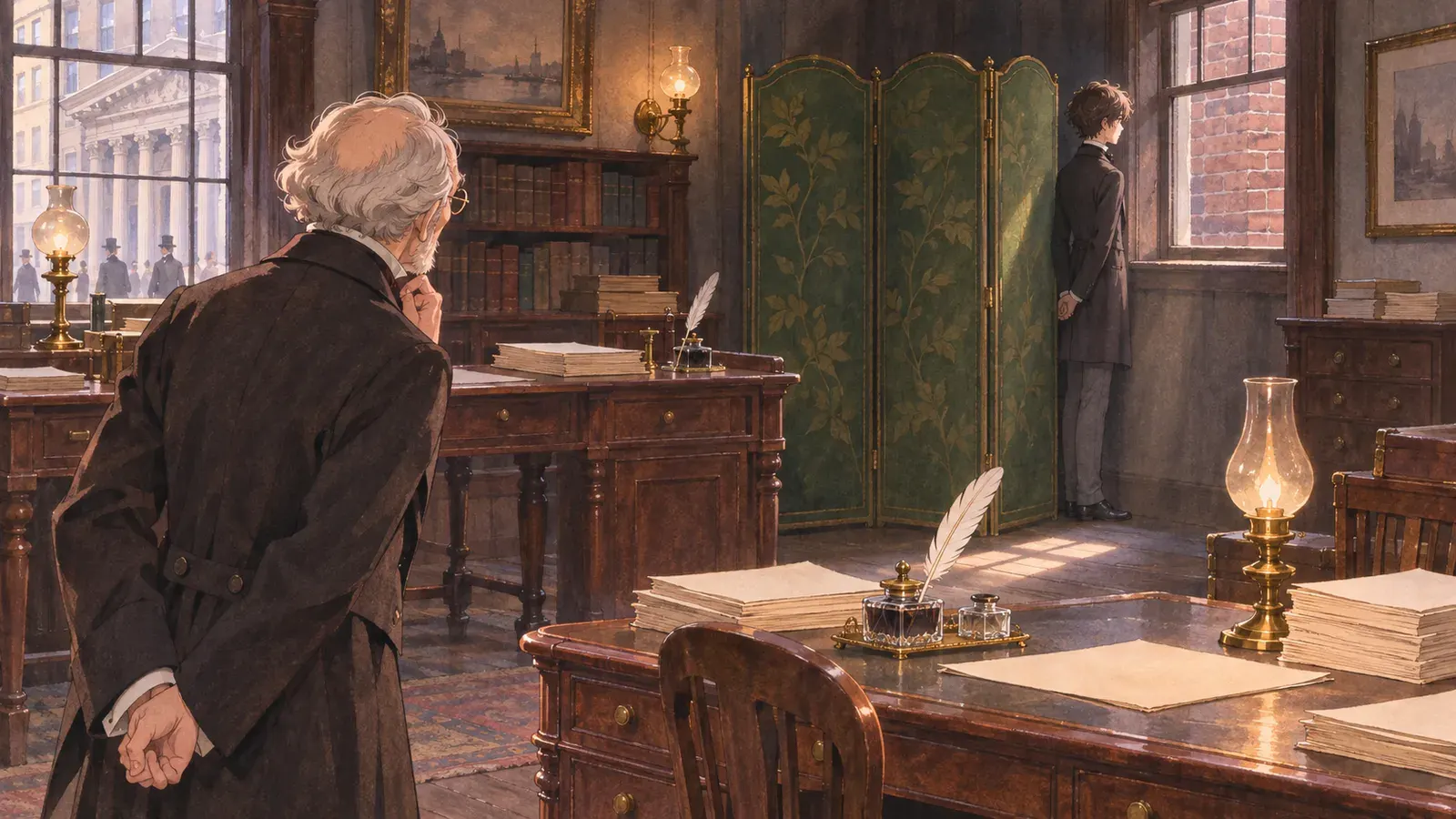
At the expiration of that period, I peeped behind the screen, and lo! Bartleby was there. I buttoned up my coat, balanced myself; advanced slowly towards him, touched his shoulder, and said, "The time has come; you must quit this place; I am sorry for you; here is money; but you must go."
その期限が切れたとき、ついたての奥をのぞくと、なんと、バートルビーはそこにいた。私は上着のボタンを掛け、気持ちを落ち着けてから、ゆっくりと歩み寄って肩に手を触れ、こう言った。「時が来た。ここを出ていかなければならない。気の毒には思う。ここに金がある。だが、行ってもらわなければ」
"I would prefer not," he replied, with his back still towards me. "You must." He remained silent. Now I had an unbounded confidence in this man's common honesty. He had frequently restored to me sixpences and shillings carelessly dropped upon the floor, for I am apt to be very reckless in such shirt-button affairs. The proceeding then which followed will not be deemed extraordinary.
「しないほうがいいのですが」と彼は、背を向けたまま答えた。「いや、出ていくのだ」彼は黙っていた。ところで私は、ごく当たり前の意味でのこの男の正直さには、限りない信頼を置いていた。私が床にうっかり落とした六ペンス硬貨やシリング硬貨を、彼は何度も拾って返してくれた。私はそういうシャツのボタンほどの小さなことには、ひどく無頓着な性分なのである。だから、そのあとに私が取った行動も、突飛なものとは思われないだろう。
"Bartleby," said I, "I owe you twelve dollars on account; here are thirty-two; the odd twenty are yours.—Will you take it?" and I handed the bills towards him. But he made no motion. "I will leave them here then," putting them under a weight on the table. Then taking my hat and cane and going to the door I tranquilly turned and added—"After you have removed your things from these offices, Bartleby, you will of course lock the door—since every one is now gone for the day but you—and if you please, slip your key underneath the mat, so that I may have it in the morning. I shall not see you again; so good-bye to you. If hereafter in your new place of abode I can be of any service to you, do not fail to advise me by letter. Good-bye, Bartleby, and fare you well."
「バートルビー」と私は言った。「君に払う給料の残りは十二ドルだ。ここに三十二ドルある。余分の二十ドルは君のものだ。受け取ってくれるかね」そう言って紙幣を差し出した。しかし、彼は身動き一つしなかった。「では、ここに置いておこう」私は紙幣を机の上の文鎮の下に挟んだ。それから帽子とステッキを手に戸口まで行き、落ち着いて振り返ると、こう言い添えた。「この事務所から自分の持ち物を運び出したら、バートルビー、もちろん扉に鍵を掛けてくれたまえ。今日はもう、君のほかはみんな帰ったのだから。それから、すまないが鍵は玄関マットの下に滑り込ませておいてほしい。朝、私が受け取れるように。もう会うことはあるまい。だから、さようなら。今後、新しい住まいで私が何か役に立てることがあったら、必ず手紙で知らせてくれたまえ。さようなら、バートルビー。元気でな」
But he answered not a word; like the last column of some ruined temple, he remained standing mute and solitary in the middle of the otherwise deserted room.
しかし、彼は一言も答えなかった。崩れ落ちた神殿に最後まで残った一本の柱のように、ほかには誰もいなくなった部屋の真ん中で、黙って独り立ち尽くしていた。
As I walked home in a pensive mood, my vanity got the better of my pity. I could not but highly plume myself on my masterly management in getting rid of Bartleby. Masterly I call it, and such it must appear to any dispassionate thinker. The beauty of my procedure seemed to consist in its perfect quietness. There was no vulgar bullying, no bravado of any sort, no choleric hectoring, and striding to and fro across the apartment, jerking out vehement commands for Bartleby to bundle himself off with his beggarly traps. Nothing of the kind. Without loudly bidding Bartleby depart—as an inferior genius might have done—I assumed the ground that depart he must; and upon that assumption built all I had to say. The more I thought over my procedure, the more I was charmed with it. Nevertheless, next morning, upon awakening, I had my doubts,—I had somehow slept off the fumes of vanity. One of the coolest and wisest hours a man has, is just after he awakes in the morning. My procedure seemed as sagacious as ever.—but only in theory. How it would prove in practice—there was the rub. It was truly a beautiful thought to have assumed Bartleby's departure; but, after all, that assumption was simply my own, and none of Bartleby's. The great point was, not whether I had assumed that he would quit me, but whether he would prefer so to do. He was more a man of preferences than assumptions.
物思いに沈んで家へ歩いて帰るうちに、哀れみよりも虚栄心のほうが勝ってきた。バートルビーを追い払った自分の見事な手際を、大いに自慢せずにはいられなかった。見事と私は呼ぶ。冷静に考える人なら、誰の目にもそう映るはずだ。私のやり方の美しさは、その完全な静かさにあるように思えた。下品な脅しもなければ、虚勢を張ることも一切なく、かんしゃくを起こしてどなりつけることも、部屋を大またで行ったり来たりしながら、みすぼらしい荷物をまとめてとっとと出ていけと激しい命令を浴びせることもなかった。そんなまねは何一つしなかった。凡庸な頭の持ち主ならやったかもしれないように、出ていけと大声で命じたりはせず、彼は出ていくものだという前提に立ち、その前提の上に、言うべきことをすべて組み立てたのである。自分のやり方を考えれば考えるほど、私はほれぼれとした。ところが翌朝、目を覚ますと疑いが湧いてきた。眠っているうちに、虚栄心の酔いがどうやら覚めたらしい。人間が最も冷静で賢くなれるのは、朝、目覚めた直後のひとときである。私のやり方は相変わらず賢明に思えた。ただし、理屈の上だけの話だ。実際にどうなるか、そこが問題だった。バートルビーは出ていくものと決めてかかったのは、まことに美しい思いつきだった。しかし結局のところ、その前提は私だけのもので、バートルビーのものではない。肝心なのは、彼が出ていくと私が決めてかかったかどうかではなく、彼がそうしたほうがいいと思うかどうかだった。彼は「前提」の人というより、「ほうがいい」の人なのである。
After breakfast, I walked down town, arguing the probabilities pro and con. One moment I thought it would prove a miserable failure, and Bartleby would be found all alive at my office as usual; the next moment it seemed certain that I should see his chair empty. And so I kept veering about. At the corner of Broadway and Canal-street, I saw quite an excited group of people standing in earnest conversation.
朝食のあと、うまくいく見込みとそうでない見込みをあれこれ比べながら、ダウンタウンへ歩いていった。みじめな失敗に終わって、バートルビーはいつもどおり事務所でぴんぴんしているだろうと思ったかと思うと、次の瞬間には、彼の椅子が空になっているのは確実に思えてくる。そんなふうに、考えはあちらこちらへ揺れ続けた。ブロードウェイとカナル街の角で、ひどく興奮した人々の一団が立ったまま熱心に話し込んでいるのが目に入った。
"I'll take odds he doesn't," said a voice as I passed. "Doesn't go?—done!" said I, "put up your money." I was instinctively putting my hand in my pocket to produce my own, when I remembered that this was an election day. The words I had overheard bore no reference to Bartleby, but to the success or non-success of some candidate for the mayoralty. In my intent frame of mind, I had, as it were, imagined that all Broadway shared in my excitement, and were debating the same question with me. I passed on, very thankful that the uproar of the street screened my momentary absent-mindedness.
「賭けてもいい、だめなほうにな」通りすがりに、そんな声が聞こえた。「出ていかないほうに? よし、乗った!」と私は言った。「さあ、金を出したまえ」思わずポケットに手を入れて自分の金を出しかけたところで、今日が選挙の日だと思い出した。耳に入った言葉はバートルビーとは何の関係もなく、市長選のある候補者が当選するかどうかの話だったのだ。思い詰めていた私は、ブロードウェイ中の人が私と同じように興奮し、同じ問題を論じ合っているかのように思い込んでいたわけである。通りの騒がしさのおかげで、つかの間のうっかりが人目につかずに済んだことを深く感謝しながら、私は先へ進んだ。
As I had intended, I was earlier than usual at my office door. I stood listening for a moment. All was still. He must be gone. I tried the knob. The door was locked. Yes, my procedure had worked to a charm; he indeed must be vanished. Yet a certain melancholy mixed with this: I was almost sorry for my brilliant success. I was fumbling under the door mat for the key, which Bartleby was to have left there for me, when accidentally my knee knocked against a panel, producing a summoning sound, and in response a voice came to me from within—"Not yet; I am occupied."
予定どおり、いつもより早く事務所の扉の前に着いた。しばらく立ったまま耳を澄ました。物音一つしない。出ていったに違いない。取っ手を回してみた。鍵が掛かっている。そうだ、私のやり方は魔法のように効いたのだ。彼は本当に消えたに違いない。とはいえ、そこにはいくらかの寂しさも混じっていた。輝かしい成功が、惜しいような気さえしたのである。バートルビーが置いていったはずの鍵を探して玄関マットの下を手探りしていると、たまたま膝が扉の羽目板に当たり、人を呼ぶノックのような音がした。すると、それに答えて中から声が聞こえてきた。「まだです。今、取り込んでいます」
It was Bartleby. I was thunderstruck. For an instant I stood like the man who, pipe in mouth, was killed one cloudless afternoon long ago in Virginia, by a summer lightning; at his own warm open window he was killed, and remained leaning out there upon the dreamy afternoon, till some one touched him, when he fell.
バートルビーだった。私は雷に打たれたようになった。一瞬、あの男のように立ちすくんだ。ずっと昔、バージニアで、雲一つないある午後に、パイプをくわえたまま夏の稲妻に打たれて死んだ男である。暖かい日の開け放った自宅の窓辺で死んだその男は、夢のような午後の景色に向かって身を乗り出したままの姿でいて、誰かが触れたとたんに倒れたのだった。
"Not gone!" I murmured at last. But again obeying that wondrous ascendancy which the inscrutable scrivener had over me, and from which ascendancy, for all my chafing, I could not completely escape, I slowly went down stairs and out into the street, and while walking round the block, considered what I should next do in this unheard-of perplexity. Turn the man out by an actual thrusting I could not; to drive him away by calling him hard names would not do; calling in the police was an unpleasant idea; and yet, permit him to enjoy his cadaverous triumph over me,—this too I could not think of. What was to be done? or, if nothing could be done, was there any thing further that I could assume in the matter? Yes, as before I had prospectively assumed that Bartleby would depart, so now I might retrospectively assume that departed he was. In the legitimate carrying out of this assumption, I might enter my office in a great hurry, and pretending not to see Bartleby at all, walk straight against him as if he were air. Such a proceeding would in a singular degree have the appearance of a home-thrust. It was hardly possible that Bartleby could withstand such an application of the doctrine of assumptions. But upon second thoughts the success of the plan seemed rather dubious. I resolved to argue the matter over with him again.
「出ていっていない!」やっとのことで私はつぶやいた。しかし、あの不可解な書記が私に対して持っている不思議な支配力に、またしても従ってしまった。どれほどいら立っても、その力から完全には逃れられないのである。私はゆっくりと階段を下りて通りへ出ると、あたりを一回りしながら、この前代未聞の難問を次にどうすべきか考えた。実際に力ずくで男を突き出すことは、私にはできない。ひどい言葉を浴びせて追い払うのもよくない。警察を呼ぶのは気が進まない。かといって、あの死人のような顔で私に勝ち誇らせておくことも、やはり考えられない。どうすればよいのか。打つ手が何もないとしても、この件でほかに何か前提にできることはないだろうか。そうだ。前には、バートルビーはこれから出ていくものと先回りして決めてかかった。それなら今度は、もう出ていったものと、さかのぼって決めてかかればよい。この前提を正しく実行に移すなら、私は大急ぎで事務所に入り、バートルビーなどまるで見えないふりをして、空気であるかのように真っすぐ彼にぶつかっていけばいいわけだ。そういうやり方は、急所を突く一撃として格別の効き目がありそうだった。前提の理論をこんなふうに当てはめられては、バートルビーも持ちこたえられまい。しかし考え直してみると、この計画がうまくいくかどうかは、かなり怪しく思えた。私は、もう一度彼と話し合って決着をつけることにした。
"Bartleby," said I, entering the office, with a quietly severe expression, "I am seriously displeased. I am pained, Bartleby. I had thought better of you. I had imagined you of such a gentlemanly organization, that in any delicate dilemma a slight hint would have suffice—in short, an assumption. But it appears I am deceived. Why," I added, unaffectedly starting, "you have not even touched that money yet," pointing to it, just where I had left it the evening previous.
「バートルビー」私は静かながら厳しい表情で事務所に入り、言った。「私は本気で不愉快に思っている。心が痛むよ、バートルビー。君のことをもっと高く買っていたのだ。君は紳士らしい気質の持ち主だから、微妙で難しい立場に置かれても、ちょっとほのめかすだけで、つまりは前提を示すだけで十分だろうと思っていた。だが、どうやら私の見込み違いだったらしい。おや」私は芝居ではなく本当にぎくりとして、付け加えた。「あの金に、まだ触れてもいないじゃないか」そう言って指さした金は、前の晩に私が置いたまさにその場所にあった。
He answered nothing. "Will you, or will you not, quit me?" I now demanded in a sudden passion, advancing close to him. "I would prefer not to quit you," he replied, gently emphasizing the not. "What earthly right have you to stay here? Do you pay any rent? Do you pay my taxes? Or is this property yours?"
彼は何も答えなかった。「出ていくのか、いかないのか、どっちだ」私は急にかっとなり、彼のすぐそばまで詰め寄って問いただした。「あなたのもとを去らないほうがいいのですが」と彼は、「ない」のところを穏やかに強めて答えた。「いったい何の権利があってここにいるのだ。家賃を払っているのか。私の税金を払ってくれるのか。それとも、ここは君の持ち物なのか」
He answered nothing. "Are you ready to go on and write now? Are your eyes recovered? Could you copy a small paper for me this morning? or help examine a few lines? or step round to the post-office? In a word, will you do any thing at all, to give a coloring to your refusal to depart the premises?"
彼は何も答えなかった。「これからまた書く気になったのか。目は治ったのか。今朝、短い書類を一つ写してもらえるか。数行の照合を手伝うのはどうだ。郵便局までひとっ走りするのは。要するに、ここを立ち退こうとしないことに少しでも筋が通るよう、何か一つでもする気はあるのか」
He silently retired into his hermitage. I was now in such a state of nervous resentment that I thought it but prudent to check myself at present from further demonstrations. Bartleby and I were alone. I remembered the tragedy of the unfortunate Adams and the still more unfortunate Colt in the solitary office of the latter; and how poor Colt, being dreadfully incensed by Adams, and imprudently permitting himself to get wildly excited, was at unawares hurried into his fatal act—an act which certainly no man could possibly deplore more than the actor himself. Often it had occurred to me in my ponderings upon the subject, that had that altercation taken place in the public street, or at a private residence, it would not have terminated as it did. It was the circumstance of being alone in a solitary office, up stairs, of a building entirely unhallowed by humanizing domestic associations—an uncarpeted office, doubtless, of a dusty, haggard sort of appearance;—this it must have been, which greatly helped to enhance the irritable desperation of the hapless Colt.
彼は黙って隠れ家に引っ込んだ。私は神経が高ぶり、ひどく腹を立てていたので、今はこれ以上感情をあらわにしないよう自分を抑えるのが賢明だと思った。バートルビーと私は二人きりだった。私は、不運なアダムズと、それ以上に不運なコルトの悲劇を思い出した。コルトの人けのない事務所で起きた事件である。哀れなコルトは、アダムズにひどく怒らされ、軽率にも我を忘れるほど興奮してしまい、気づかぬうちにあの取り返しのつかない行為へと駆り立てられた。その行為を誰よりも深く悔やんだのは、間違いなく、やった本人だったはずだ。この事件についてあれこれ考えるたびに、私はよく思ったものである。あの口論が人通りのある往来か、誰かの住まいで起きていたなら、あんな結末にはならなかっただろう。人けのない事務所に二人きりでいたこと、それも建物の上の階で、人の心を和らげる家庭のぬくもりなど少しも染み込んでいない建物だったこと、きっとじゅうたんも敷いていない、ほこりっぽくてやつれたような事務所だったこと。そうした事情が、不幸なコルトのいら立ちと捨て鉢な気持ちを大いにあおったに違いない。
But when this old Adam of resentment rose in me and tempted me concerning Bartleby, I grappled him and threw him. How? Why, simply by recalling the divine injunction: "A new commandment give I unto you, that ye love one another." Yes, this it was that saved me. Aside from higher considerations, charity often operates as a vastly wise and prudent principle—a great safeguard to its possessor. Men have committed murder for jealousy's sake, and anger's sake, and hatred's sake, and selfishness' sake, and spiritual pride's sake; but no man that ever I heard of, ever committed a diabolical murder for sweet charity's sake. Mere self-interest, then, if no better motive can be enlisted, should, especially with high-tempered men, prompt all beings to charity and philanthropy. At any rate, upon the occasion in question, I strove to drown my exasperated feelings towards the scrivener by benevolently construing his conduct. Poor fellow, poor fellow! thought I, he don't mean any thing; and besides, he has seen hard times, and ought to be indulged.
しかし、アダム以来の人間の古い性である怒りが私の中で頭をもたげ、バートルビーのことで私をそそのかしたとき、私はそいつと組み合って投げ倒した。どうやってか。なに、神のあの戒めを思い出しただけのことである。「あなたがたに新しいおきてを与える。互いに愛し合いなさい」そうだ、私を救ったのはこの言葉だった。もっと高尚な理由は別にしても、慈愛はしばしば、実に賢くて用心深い方針として働く。慈愛を抱く者にとって、大きな身の守りになるのだ。人は嫉妬のために、怒りのために、憎しみのために、利己心のために、そして信仰上の思い上がりのために人を殺してきた。しかし、優しい慈愛のために悪魔のような人殺しをした者がいたとは、私は一度も聞いたことがない。だから、もっと立派な動機が見つからないのなら、ただ自分の利益のためだけにでも、人はみな、とりわけ気の短い人は、慈愛と博愛に努めるべきなのである。ともかく、問題のこのとき、私は書記の振る舞いを好意的に解釈することで、彼に対するいら立ちを押し流そうと努めた。かわいそうな男だ、かわいそうな男だ、と私は思った。悪気は何もないのだ。それに、つらい目に遭ってきたのだから、大目に見てやらなければ。
I endeavored also immediately to occupy myself, and at the same time to comfort my despondency. I tried to fancy that in the course of the morning, at such time as might prove agreeable to him, Bartleby, of his own free accord, would emerge from his hermitage, and take up some decided line of march in the direction of the door. But no. Half-past twelve o'clock came; Turkey began to glow in the face, overturn his inkstand, and become generally obstreperous; Nippers abated down into quietude and courtesy; Ginger Nut munched his noon apple; and Bartleby remained standing at his window in one of his profoundest dead-wall reveries. Will it be credited? Ought I to acknowledge it? That afternoon I left the office without saying one further word to him.
私はまた、すぐに何か仕事に取りかかると同時に、沈んだ気持ちを慰めようともした。午前のうちに、本人の都合のよいころ合いを見て、バートルビーが自分から進んで隠れ家を出て、戸口のほうへきっぱりと行進を始めてくれる。そう想像してみようとしたのである。だが、そうはならなかった。十二時半になった。ターキーは顔を赤く輝かせ、インクつぼをひっくり返し、何かにつけて騒々しくなり始めた。ニッパーズは静かで礼儀正しい男へと落ち着いていった。ジンジャー・ナットは昼のリンゴをむしゃむしゃ食べた。そしてバートルビーは窓辺に立ったまま、壁を見つめるいつもの物思いの、中でもとりわけ深いものにふけっていた。信じてもらえるだろうか。白状すべきだろうか。その日の午後、私は彼にそれ以上一言も言わずに事務所を出たのである。
Some days now passed, during which, at leisure intervals I looked a little into "Edwards on the Will," and "Priestly on Necessity." Under the circumstances, those books induced a salutary feeling. Gradually I slid into the persuasion that these troubles of mine touching the scrivener, had been all predestinated from eternity, and Bartleby was billeted upon me for some mysterious purpose of an all-wise Providence, which it was not for a mere mortal like me to fathom. Yes, Bartleby, stay there behind your screen, thought I; I shall persecute you no more; you are harmless and noiseless as any of these old chairs; in short, I never feel so private as when I know you are here. At last I see it, I feel it; I penetrate to the predestinated purpose of my life. I am content. Others may have loftier parts to enact; but my mission in this world, Bartleby, is to furnish you with office-room for such period as you may see fit to remain.
それから数日が過ぎた。その間、私は暇を見ては、エドワーズの『意志論』とプリーストリーの『必然論』を少しずつのぞいてみた。こういう事情のもとでは、これらの本は心に良い効き目があった。書記をめぐる私の悩みはすべて、永遠の昔からあらかじめ定められていたのであり、バートルビーは全知の神の摂理の何か不思議な目的のために私のもとへ割り当てられたのだ。その目的は、私のようなただの人間に推し量れるものではない。私は次第に、そう信じるようになっていった。そうだ、バートルビー、そのついたての奥にいるがいい、と私は思った。もう君を責め立てはしない。君はここにある古い椅子と同じで、害もなければ音も立てない。要するに、君がここにいると分かっているときほど、私が一人で落ち着いた気分になれることはないのだ。ようやく私には見える。感じられる。あらかじめ定められた自分の人生の目的が、私には見通せる。私は満足だ。ほかの人々には、もっと気高い役回りがあるのかもしれない。だが、この世での私の使命はね、バートルビー、君がいたいと思う間、事務所の居場所を君に与えることなのだ。
I believe that this wise and blessed frame of mind would have continued with me, had it not been for the unsolicited and uncharitable remarks obtruded upon me by my professional friends who visited the rooms. But thus it often is, that the constant friction of illiberal minds wears out at last the best resolves of the more generous. Though to be sure, when I reflected upon it, it was not strange that people entering my office should be struck by the peculiar aspect of the unaccountable Bartleby, and so be tempted to throw out some sinister observations concerning him. Sometimes an attorney having business with me, and calling at my office and finding no one but the scrivener there, would undertake to obtain some sort of precise information from him touching my whereabouts; but without heeding his idle talk, Bartleby would remain standing immovable in the middle of the room. So after contemplating him in that position for a time, the attorney would depart, no wiser than he came.
この賢明でありがたい心境は、事務所を訪ねてくる同業の友人たちが、頼みもしないのに思いやりのない意見を押しつけてこなかったなら、きっとそのまま続いていたと思う。しかし、よくあることだが、心の狭い人々に絶えずこすられているうちに、寛大な人間の最も立派な決心も、ついにはすり減ってしまうのである。もっとも、よく考えてみれば、私の事務所に入ってきた人が、不可解なバートルビーの異様な姿にぎょっとして、彼について何か意地の悪いことを言ってみたくなるのも、不思議ではなかった。私に用のある弁護士が事務所を訪ねてきて、書記のほかに誰もいないと知ると、私の居場所について何かはっきりしたことを彼から聞き出そうとすることがあった。ところがバートルビーは、相手の無駄口には耳も貸さず、部屋の真ん中にじっと立ったまま動かない。そこで弁護士は、その姿をしばらく眺めたあげく、来たときと同じく何も分からないまま帰っていくのだった。
Also, when a Reference was going on, and the room full of lawyers and witnesses and business was driving fast; some deeply occupied legal gentleman present, seeing Bartleby wholly unemployed, would request him to run round to his (the legal gentleman's) office and fetch some papers for him. Thereupon, Bartleby would tranquilly decline, and yet remain idle as before. Then the lawyer would give a great stare, and turn to me. And what could I say? At last I was made aware that all through the circle of my professional acquaintance, a whisper of wonder was running round, having reference to the strange creature I kept at my office. This worried me very much. And as the idea came upon me of his possibly turning out a long-lived man, and keep occupying my chambers, and denying my authority; and perplexing my visitors; and scandalizing my professional reputation; and casting a general gloom over the premises; keeping soul and body together to the last upon his savings (for doubtless he spent but half a dime a day), and in the end perhaps outlive me, and claim possession of my office by right of his perpetual occupancy: as all these dark anticipations crowded upon me more and more, and my friends continually intruded their relentless remarks upon the apparition in my room; a great change was wrought in me. I resolved to gather all my faculties together, and for ever rid me of this intolerable incubus.
また、付託された事件の審理が開かれ、部屋が弁護士や証人でいっぱいになり、仕事がどんどん進んでいるときのことである。その場にいて手のふさがった法律家の一人が、バートルビーが何もしていないのを見て、自分の事務所までひとっ走りして書類を取ってきてくれと頼むことがあった。するとバートルビーは落ち着き払って断り、それでいて相変わらず何もせずにいる。弁護士は目を丸くして彼を見つめ、それから私のほうを向く。私に何が言えただろう。やがて私は、同業の知り合いの間に、私が事務所に置いている奇妙な人物についての驚きのささやきが広まっていることに気づかされた。これはひどく気がかりだった。そのうえ、こんな考えも浮かんできた。彼は長生きするかもしれない。そして私の事務所に居座り続け、私の権威を認めず、来客を困惑させ、法律家としての私の評判に傷をつけ、事務所全体に暗い影を落とすだろう。蓄えで最後まで命をつなぎ(一日に五セントしか使っていないのは間違いないのだから)、ついには私より長生きして、ずっと住み続けてきたことを理由に、私の事務所の所有権を主張するかもしれない。こうした暗い予想が次々と押し寄せ、友人たちも私の部屋の幽霊について容赦のない意見を絶えず浴びせてくるうちに、私の中で大きな変化が起きた。私は持てる力をすべて奮い起こし、悪夢のようにのしかかるこの耐えがたい重荷を、きっぱりと振り払おうと決心した。
Ere revolving any complicated project, however, adapted to this end, I first simply suggested to Bartleby the propriety of his permanent departure. In a calm and serious tone, I commended the idea to his careful and mature consideration. But having taken three days to meditate upon it, he apprised me that his original determination remained the same; in short, that he still preferred to abide with me.
もっとも、その目的のための込み入った計画を練る前に、私はまずバートルビーに、ここをきっぱり立ち去るのが適切だろうと、ただそれだけを持ちかけてみた。穏やかで真剣な口調で、この案をじっくりと慎重に考えてみるよう勧めたのである。ところが、三日かけて考えたすえに彼が知らせてきたのは、最初の決心は変わらないということだった。要するに、やはり私のところにいるほうがいいというのである。
What shall I do? I now said to myself, buttoning up my coat to the last button. What shall I do? what ought I to do? what does conscience say I should do with this man, or rather ghost. Rid myself of him, I must; go, he shall. But how? You will not thrust him, the poor, pale, passive mortal,—you will not thrust such a helpless creature out of your door? you will not dishonor yourself by such cruelty? No, I will not, I cannot do that. Rather would I let him live and die here, and then mason up his remains in the wall. What then will you do? For all your coaxing, he will not budge. Bribes he leaves under your own paperweight on your table; in short, it is quite plain that he prefers to cling to you.
どうしよう。私は上着のボタンを一番上まで掛けながら、自分に言った。どうしよう。どうすべきなのか。この男を、いや、この幽霊をどうすべきだと、良心は言っているのか。追い払わなければならない。出ていかせるのだ。だが、どうやって。あの哀れな、青白い、何の手向かいもしない人間を突き出したりはしないだろうな。あんな無力な者を戸口から放り出したりはしないだろうな。そんな残酷なまねをして、自分の名誉を汚したりはしないだろうな。そうだ、するものか。そんなことは私にはできない。それくらいなら、ここで生きて死ぬに任せ、なきがらを壁に塗り込めてやるほうがましだ。では、どうするつもりだ。いくらなだめすかしても、あの男はびくともしない。買収の金には手も触れず、お前の机の、お前の文鎮の下に置いたままだ。要するに、お前にしがみついているほうがいいと思っているのは、まったく明らかではないか。
Then something severe, something unusual must be done. What! surely you will not have him collared by a constable, and commit his innocent pallor to the common jail? And upon what ground could you procure such a thing to be done?—a vagrant, is he? What! he a vagrant, a wanderer, who refuses to budge? It is because he will not be a vagrant, then, that you seek to count him as a vagrant. That is too absurd. No visible means of support: there I have him. Wrong again: for indubitably he does support himself, and that is the only unanswerable proof that any man can show of his possessing the means so to do. No more then. Since he will not quit me, I must quit him. I will change my offices; I will move elsewhere; and give him fair notice, that if I find him on my new premises I will then proceed against him as a common trespasser.
それなら、何か厳しい手、普通ではない手を打たなければならない。なんだって。まさか巡査にあの男の襟首をつかませ、罪のないあの青白い顔を町の留置場に送り込むつもりではあるまいな。だいたい、どんな理由でそんなことをしてもらえるというのだ。浮浪者だから、か。なんだって。てこでも動こうとしないあの男が、浮浪者、さすらい歩く者だと。すると、浮浪者になろうとしないからこそ、浮浪者に数えようというわけか。あまりにもばかげている。生計を立てる手段が見当たらない。これだ、これなら捕まえられる。いや、それも違う。彼が自分で暮らしを立てているのは疑いようがなく、それこそ、人が生計の手段を持っていることを示す、反論しようのないただ一つの証拠なのだから。では、もうよそう。彼が私から離れないのなら、私のほうが彼から離れるしかない。事務所を替えよう。よそへ移るのだ。そして、新しい事務所で姿を見かけたら、そのときはただの不法侵入者として訴えると、きちんと通告しておこう。
Acting accordingly, next day I thus addressed him: "I find these chambers too far from the City Hall; the air is unwholesome. In a word, I propose to remove my offices next week, and shall no longer require your services. I tell you this now, in order that you may seek another place."
その考えに従って、翌日、私は彼にこう告げた。「この事務所は市庁舎から遠すぎるし、空気も体に良くない。要するに、来週、事務所を移すつもりだ。君の勤めはもう必要なくなる。今のうちに伝えておくのは、君が別の居場所を探せるようにするためだ」
He made no reply, and nothing more was said. On the appointed day I engaged carts and men, proceeded to my chambers, and having but little furniture, every thing was removed in a few hours. Throughout, the scrivener remained standing behind the screen, which I directed to be removed the last thing. It was withdrawn; and being folded up like a huge folio, left him the motionless occupant of a naked room. I stood in the entry watching him a moment, while something from within me upbraided me.
彼は何も答えず、それ以上の話は出なかった。予定の日、私は荷車と人夫を雇って事務所へ出向いた。家具はわずかしかなかったので、数時間ですべて運び出された。その間ずっと、書記はついたての奥に立ったままだった。ついたては最後に運ぶよう、私が指図しておいた。それも取り払われ、巨大な二つ折りの本のように畳まれてしまうと、がらんとした部屋に、身動きもしない彼だけが残された。私は入り口に立ってしばらく彼を見つめていた。その間、胸の内で何かが私を責めた。
I re-entered, with my hand in my pocket—and—and my heart in my mouth. "Good-bye, Bartleby; I am going—good-bye, and God some way bless you; and take that," slipping something in his hand. But it dropped upon the floor, and then,—strange to say—I tore myself from him whom I had so longed to be rid of.
私はもう一度中へ入った。手はポケットに入れ、そして、そして心臓は口から飛び出しそうだった。「さようなら、バートルビー。私は行くよ。さようなら。どうか神が何らかの形で君を祝福してくださるように。それから、これを取っておきたまえ」そう言って、あるものを彼の手に滑り込ませた。しかし、それは床に落ちた。そして、不思議なことに、あれほど追い払いたいと願っていた相手から、私は身を引きはがすようにして立ち去ったのである。
 4段落目に「the odd twenty are yours.」(余分な20ドルは君のものだ)とあります。32ドルは合計額です。

 原田英語の究極の英単語帳(CEFR-J 6,868語)
 聞くだけモードで、文字を見ずに内容がわかるか試す。
 1文リピートで音読・シャドーイングも。


 英語の名スピーチ