

 書記バートルビー 全4部の 2番目
 約37分
 33:12
 原文そのまま
 全訳つき
 ハーマン・メルヴィルの作品をもっと読む(2作品)→
 人の朗読
 お道具箱
 読書ラウンジ
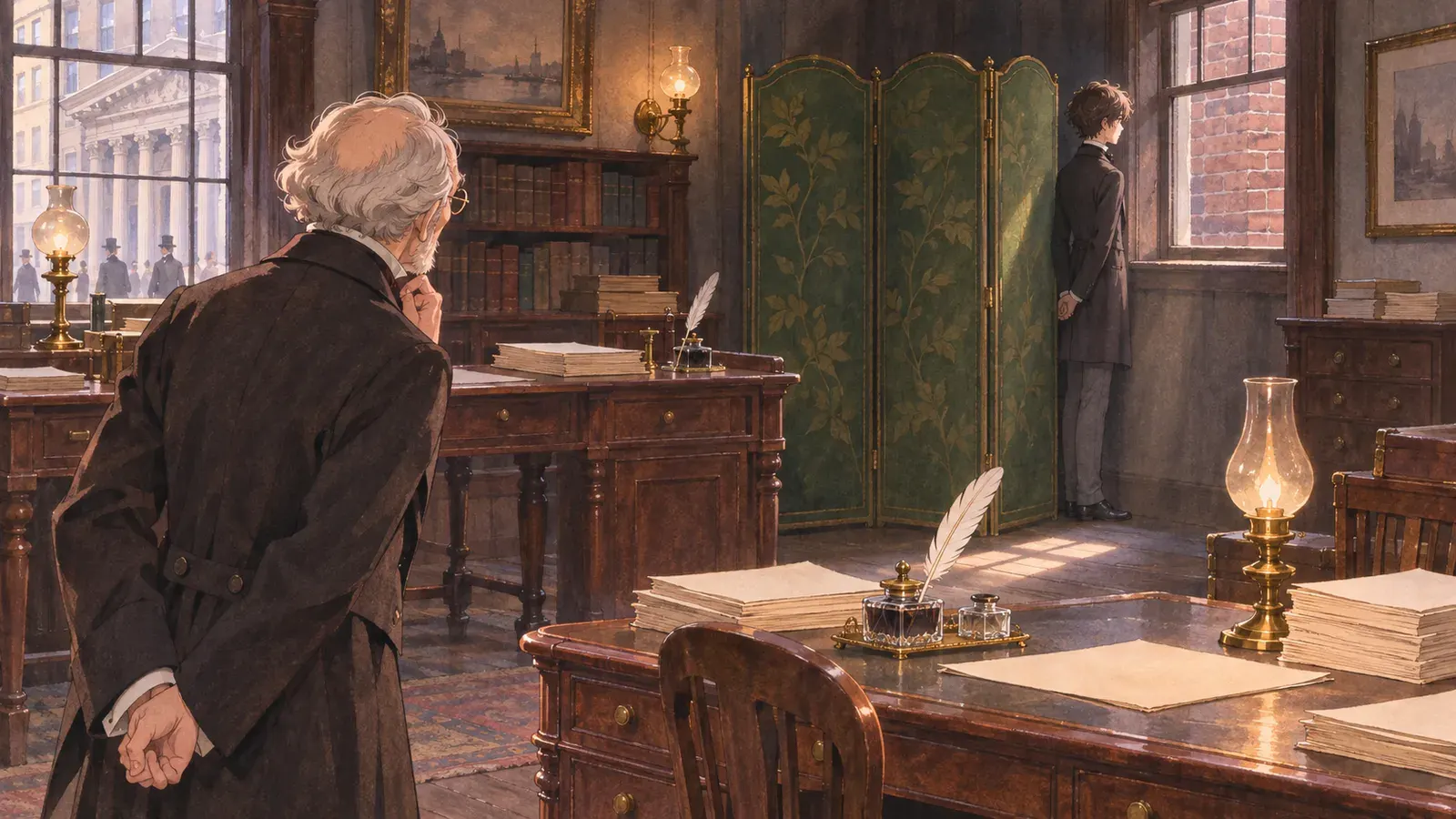
Some days passed, the scrivener being employed upon another lengthy work. His late remarkable conduct led me to regard his ways narrowly. I observed that he never went to dinner; indeed that he never went any where. As yet I had never of my personal knowledge known him to be outside of my office. He was a perpetual sentry in the corner. At about eleven o'clock though, in the morning, I noticed that Ginger Nut would advance toward the opening in Bartleby's screen, as if silently beckoned thither by a gesture invisible to me where I sat. The boy would then leave the office jingling a few pence, and reappear with a handful of ginger-nuts which he delivered in the hermitage, receiving two of the cakes for his trouble.
数日がたち、書記はまた別の長い仕事に取りかかっていた。先日の驚くべき振る舞いがあったので、私はその行動を細かく観察するようになった。気づいてみると、バートルビーは決して食事に出かけなかった。それどころか、どこにも出かけなかった。私が自分で知る限り、事務所の外にいるのを見たことはまだ一度もなかった。いつも部屋の隅を離れない歩哨のようなものだった。ただ、午前十一時ごろになると、ジンジャー・ナットがバートルビーのついたての開いた所へ近づいていくのに私は気づいた。私の席からは見えない身ぶりで、黙って手招きされたかのようだった。それから少年は、数ペンスの小銭をちゃらちゃら鳴らしながら事務所を出ていき、菓子のジンジャー・ナットを一つかみ持って戻ってくると、それを隠れ家に届け、駄賃としてそのうちの二枚をもらうのだった。
He lives, then, on ginger-nuts, thought I; never eats a dinner, properly speaking; he must be a vegetarian then; but no; he never eats even vegetables, he eats nothing but ginger-nuts. My mind then ran on in reveries concerning the probable effects upon the human constitution of living entirely on ginger-nuts. Ginger-nuts are so called because they contain ginger as one of their peculiar constituents, and the final flavoring one. Now what was ginger? A hot, spicy thing. Was Bartleby hot and spicy? Not at all. Ginger, then, had no effect upon Bartleby. Probably he preferred it should have none.
すると、ジンジャー・ナットを食べて生きているのだな、と私は思った。ちゃんとした食事は決して取らない。それなら菜食主義者に違いない。いや、違う。野菜さえ食べない。ジンジャー・ナットしか食べないのだ。それから私の心は、ジンジャー・ナットだけで生きると人間の体にどんな影響がありそうかについて、あれこれと空想にふけった。ジンジャー・ナットという名は、独特の成分の一つとして、また最後に風味を決めるものとして、ジンジャーつまりしょうがが入っているから付いている。さて、しょうがとは何だったか。ぴりっと辛くて刺激の強いものだ。バートルビーはぴりっと辛くて刺激が強いか。まったくそんなことはない。すると、しょうがはバートルビーに何の効き目もなかったのだ。おそらく本人が、効き目などないほうがいいと思っていたのだろう。
Nothing so aggravates an earnest person as a passive resistance. If the individual so resisted be of a not inhumane temper, and the resisting one perfectly harmless in his passivity; then, in the better moods of the former, he will endeavor charitably to construe to his imagination what proves impossible to be solved by his judgment. Even so, for the most part, I regarded Bartleby and his ways. Poor fellow! thought I, he means no mischief; it is plain he intends no insolence; his aspect sufficiently evinces that his eccentricities are involuntary. He is useful to me. I can get along with him. If I turn him away, the chances are he will fall in with some less indulgent employer, and then he will be rudely treated, and perhaps driven forth miserably to starve. Yes. Here I can cheaply purchase a delicious self-approval. To befriend Bartleby; to humor him in his strange willfulness, will cost me little or nothing, while I lay up in my soul what will eventually prove a sweet morsel for my conscience. But this mood was not invariable with me. The passiveness of Bartleby sometimes irritated me. I felt strangely goaded on to encounter him in new opposition, to elicit some angry spark from him answerable to my own. But indeed I might as well have essayed to strike fire with my knuckles against a bit of Windsor soap. But one afternoon the evil impulse in me mastered me, and the following little scene ensued:
真面目な人間を何よりいらだたせるのは、受け身の抵抗である。抵抗される側が思いやりのない性格ではなく、抵抗する側がその受け身の態度においてまったく無害であれば、抵抗される側は機嫌のよいときには、理性ではどうしても解けないことを、想像力を使って好意的に解釈しようと努めるものだ。私も大体はそのようにして、バートルビーとその振る舞いを見ていた。かわいそうな男だ、と私は思った。悪気はないのだ。無礼を働くつもりがないのは明らかだ。あの奇行がわざとではないことは、様子を見れば十分に分かる。私の役には立っている。私ならうまくやっていける。もし追い出せば、もっと厳しい雇い主に当たる見込みが大きい。そうなれば手荒く扱われ、ことによると惨めに追い出されて飢え死にするかもしれない。そうだ。ここで私は、甘美な自己満足を安く買える。バートルビーの味方になり、あの奇妙なわがままを大目に見てやっても、ほとんど、いやまったく損はしない。それでいて、いずれ私の良心にとって甘い一口となるものを、魂の中に蓄えておけるのだ。しかし、私もいつもこんな気分でいたわけではない。バートルビーの受け身の態度に、時々いらいらさせられた。新たにぶつかってみたい、私の怒りに見合う怒りの火花をバートルビーからも引き出してみたいと、妙に駆り立てられるのだった。しかし実のところ、ウィンザーせっけんのかけらに拳を打ち付けて火を起こそうとするようなものだった。ところがある午後、私の中の悪い衝動が私を負かしてしまい、次のようなちょっとした場面が持ち上がった。
"Bartleby," said I, "when those papers are all copied, I will compare them with you." "I would prefer not to." "How? Surely you do not mean to persist in that mulish vagary?" No answer. I threw open the folding-doors near by, and turning upon Turkey and Nippers, exclaimed in an excited manner—
「バートルビー」と私は言った。「その書類を全部写し終えたら、君と一緒に照合しよう。」「しないほうがいいのですが。」「何だって。まさか、そのラバのように強情な気まぐれを押し通すつもりではないだろうね。」答えはない。私はすぐそばの折り戸をさっと開け放ち、ターキーとニッパーズのほうを向いて、興奮して叫んだ。
"He says, a second time, he won't examine his papers. What do you think of it, Turkey?" It was afternoon, be it remembered. Turkey sat glowing like a brass boiler, his bald head steaming, his hands reeling among his blotted papers.
「自分の書類の照合はしないと、また言うのだ。どう思うね、ターキー。」思い出していただきたいが、これは午後のことである。ターキーは真ちゅうのボイラーのように赤く輝いて座っていた。はげ頭からは湯気が立ち、両手は染みだらけの書類の間をよろよろと動き回っていた。
"Think of it?" roared Turkey; "I think I'll just step behind his screen, and black his eyes for him!" So saying, Turkey rose to his feet and threw his arms into a pugilistic position. He was hurrying away to make good his promise, when I detained him, alarmed at the effect of incautiously rousing Turkey's combativeness after dinner.
「どう思うか、ですと?」とターキーはほえた。「ひとつ、ついたての向こうへ行って、あいつの両目に青あざを付けてやろうと思いますな!」そう言うとターキーは立ち上がり、両腕を上げて拳闘の構えを取った。そして言ったことを実行しようと急いで行きかけたので、私は引き止めた。昼食後のターキーの闘争心をうかつにかき立てるとどうなるかを知って、慌てたのである。
"Sit down, Turkey," said I, "and hear what Nippers has to say. What do you think of it, Nippers? Would I not be justified in immediately dismissing Bartleby?" "Excuse me, that is for you to decide, sir. I think his conduct quite unusual, and indeed unjust, as regards Turkey and myself. But it may only be a passing whim."
「座りなさい、ターキー」と私は言った。「ニッパーズの意見を聞こう。君はどう思う、ニッパーズ。バートルビーをすぐ首にしても当然ではないかね。」「失礼ですが、それはあなたがお決めになることです。あの男の振る舞いはまったく普通ではないと思いますし、ターキーと私に対しては実に不公平です。ですが、ただの一時の気まぐれかもしれません。」
"Ah," exclaimed I, "you have strangely changed your mind then—you speak very gently of him now." "All beer," cried Turkey; "gentleness is effects of beer—Nippers and I dined together to-day. You see how gentle I am, sir. Shall I go and black his eyes?"
「おや」と私は声を上げた。「妙に考えが変わったものだね。今度はずいぶん優しい言い方をするじゃないか。」「ビールですよ」とターキーが叫んだ。「優しいのはビールのせいです。今日はニッパーズと私で一緒に昼食を取りましたのでね。ご覧のとおり、私もこんなに優しいでしょう。行って、あいつの目に青あざを付けてきましょうか。」
"You refer to Bartleby, I suppose. No, not to-day, Turkey," I replied; "pray, put up your fists." I closed the doors, and again advanced towards Bartleby. I felt additional incentives tempting me to my fate. I burned to be rebelled against again. I remembered that Bartleby never left the office.
「バートルビーのことを言っているのだろうね。いや、今日はやめておこう、ターキー」と私は答えた。「頼むから、拳を下ろしてくれ。」私は戸を閉め、またバートルビーのほうへ進んだ。自分から災いを招きたいという気持ちが、いっそう強く私をそそのかした。もう一度逆らわれたくてたまらなかった。バートルビーが決して事務所を出ないことを思い出した。
"Bartleby," said I, "Ginger Nut is away; just step round to the Post Office, won't you? (it was but a three minute walk,) and see if there is any thing for me." "I would prefer not to." "You will not?"
「バートルビー」と私は言った。「ジンジャー・ナットが出かけている。ちょっと郵便局まで行って、私あてに何か来ていないか見てきてくれないか。」郵便局までは歩いてほんの三分だった。「しないほうがいいのですが。」「しないと言うのだね。」
"I prefer not." I staggered to my desk, and sat there in a deep study. My blind inveteracy returned. Was there any other thing in which I could procure myself to be ignominiously repulsed by this lean, penniless wight?—my hired clerk? What added thing is there, perfectly reasonable, that he will be sure to refuse to do?
「しないほうがいいのです。」私はよろよろと自分の机に戻り、座って深く考え込んだ。盲目的な意地がまた頭をもたげた。このやせた一文なしの男、私が雇っている事務員に、不名誉にもはねつけられるようなことが、まだほかに何かないだろうか。まったく道理にかなっていて、しかもこの男がきっと断るようなことが、あとほかに何があるだろう。
"Bartleby!" No answer. "Bartleby," in a louder tone. No answer. "Bartleby," I roared. Like a very ghost, agreeably to the laws of magical invocation, at the third summons, he appeared at the entrance of his hermitage. "Go to the next room, and tell Nippers to come to me."
「バートルビー!」答えはない。「バートルビー」と、もっと大きな声で呼んだ。答えはない。「バートルビー」と私はどなった。まるで幽霊そのもので、魔法の呼び出しの決まりどおり、三度目の呼び声でバートルビーは隠れ家の入り口に現れた。「隣の部屋へ行って、ニッパーズに私の所へ来るように言ってくれ。」
"I prefer not to," he respectfully and slowly said, and mildly disappeared. "Very good, Bartleby," said I, in a quiet sort of serenely severe self-possessed tone, intimating the unalterable purpose of some terrible retribution very close at hand. At the moment I half intended something of the kind. But upon the whole, as it was drawing towards my dinner-hour, I thought it best to put on my hat and walk home for the day, suffering much from perplexity and distress of mind.
「しないほうがいいのです」とバートルビーはうやうやしく、ゆっくりと言って、穏やかに姿を消した。「よろしい、バートルビー」と私は言った。静かで、落ち着き払って厳しく、取り乱したところのない口調で、何か恐ろしい報いが必ず、それもすぐそこまで迫っていることをほのめかしたのである。そのときは、半ば本気でそんなことをするつもりだった。しかしよく考えてみると、そろそろ食事の時間でもあったので、今日のところは帽子をかぶって歩いて家に帰るのが一番よいと思った。心は困惑と苦悩でひどく痛んでいた。
Shall I acknowledge it? The conclusion of this whole business was, that it soon became a fixed fact of my chambers, that a pale young scrivener, by the name of Bartleby, and a desk there; that he copied for me at the usual rate of four cents a folio (one hundred words); but he was permanently exempt from examining the work done by him, that duty being transferred to Turkey and Nippers, one of compliment doubtless to their superior acuteness; moreover, said Bartleby was never on any account to be dispatched on the most trivial errand of any sort; and that even if entreated to take upon him such a matter, it was generally understood that he would prefer not to—in other words, that he would refuse pointblank.
白状してしまおうか。この一件の結末はこうである。やがて次のことが、私の事務所の動かしがたい事実になった。バートルビーという名の青白い若い書記が、事務所に机を持っている。フォリオ一枚(百語)につき四セントという普通の料金で、私のために筆写をする。しかし自分のした仕事の照合は永久に免除されていて、その務めはターキーとニッパーズに回される。二人のほうが目が鋭いことへの敬意、ということなのだろう。さらに、このバートルビーは、どんなにささいな使いにも、どんな事情があろうと決して出されない。たとえそういう用を引き受けてくれと頼み込んでも、「しないほうがいいのですが」と言う、つまりきっぱり断るものと、みなが承知している。
As days passed on, I became considerably reconciled to Bartleby. His steadiness, his freedom from all dissipation, his incessant industry (except when he chose to throw himself into a standing revery behind his screen), his great stillness, his unalterableness of demeanor under all circumstances, made him a valuable acquisition. One prime thing was this,—he was always there;—first in the morning, continually through the day, and the last at night. I had a singular confidence in his honesty. I felt my most precious papers perfectly safe in his hands. Sometimes to be sure I could not, for the very soul of me, avoid falling into sudden spasmodic passions with him. For it was exceeding difficult to bear in mind all the time those strange peculiarities, privileges, and unheard of exemptions, forming the tacit stipulations on Bartleby's part under which he remained in my office. Now and then, in the eagerness of dispatching pressing business, I would inadvertently summon Bartleby, in a short, rapid tone, to put his finger, say, on the incipient tie of a bit of red tape with which I was about compressing some papers. Of course, from behind the screen the usual answer, "I prefer not to," was sure to come; and then, how could a human creature with the common infirmities of our nature, refrain from bitterly exclaiming upon such perverseness—such unreasonableness. However, every added repulse of this sort which I received only tended to lessen the probability of my repeating the inadvertence.
日がたつにつれて、私はバートルビーとかなり折り合いが付くようになった。堅実で、道楽とは一切縁がなく、絶え間なく働き(ついたての陰で立ったまま物思いにふけることを選んだときは別だが)、とても静かで、どんな場合にも態度が変わらない。おかげでバートルビーは貴重な拾い物となった。何より大事なのは、いつでもそこにいることだった。朝は一番に来ていて、日中はずっといて、夜は最後まで残っていた。その正直さを、私は不思議なほど信頼していた。一番大切な書類も、バートルビーの手にあればまったく安全だと感じていた。もっとも時には、どうにもこらえきれずに、突然かっとなって当たり散らしてしまうこともあった。バートルビーが私の事務所にとどまるについて暗黙の条件としている、あの奇妙な癖や特権や前代未聞の免除を、いつも忘れずにいるのはひどく難しかったからである。時々、急ぎの仕事を片付けようと夢中になって、私はうっかり短く早口でバートルビーを呼んでしまった。たとえば、書類を束ねようとしている赤いひもの結びかけの所を、指で押さえてくれと言うのである。もちろん、ついたての向こうからは決まって、いつもの答え「しないほうがいいのです」が返ってくる。そうなると、人並みの弱さを持つ生身の人間が、こんなひねくれ方、こんな分からず屋ぶりに、苦々しく声を上げずにいられるだろうか。とはいえ、こうしてはねつけられるたびに、私が同じうっかりを繰り返す見込みは少なくなっていくばかりだった。
Here it must be said, that according to the custom of most legal gentlemen occupying chambers in densely-populated law buildings, there were several keys to my door. One was kept by a woman residing in the attic, which person weekly scrubbed and daily swept and dusted my apartments. Another was kept by Turkey for convenience sake. The third I sometimes carried in my own pocket. The fourth I knew not who had.
ここで言っておかなければならないが、人の込み合った法律事務所ビルに部屋を持つたいていの法律家の習慣どおり、私の事務所の扉にも鍵がいくつかあった。一つは屋根裏に住む女が持っていて、この女が週に一度床を磨き、毎日掃いてほこりを払ってくれた。もう一つは、便利なようにターキーが持っていた。三つ目は、私が時々自分のポケットに入れていた。四つ目は誰が持っているのか知らなかった。
Now, one Sunday morning I happened to go to Trinity Church, to hear a celebrated preacher, and finding myself rather early on the ground, I thought I would walk around to my chambers for a while. Luckily I had my key with me; but upon applying it to the lock, I found it resisted by something inserted from the inside. Quite surprised, I called out; when to my consternation a key was turned from within; and thrusting his lean visage at me, and holding the door ajar, the apparition of Bartleby appeared, in his shirt sleeves, and otherwise in a strangely tattered dishabille, saying quietly that he was sorry, but he was deeply engaged just then, and—preferred not admitting me at present. In a brief word or two, he moreover added, that perhaps I had better walk round the block two or three times, and by that time he would probably have concluded his affairs.
さて、ある日曜日の朝、私は有名な説教師の話を聞こうと、たまたまトリニティ教会に出かけた。少し早く着きすぎたので、しばらく事務所に寄ってみようと思った。幸い鍵は持っていた。ところが鍵穴に差し込もうとすると、内側から何かが差してあってつかえる。ひどく驚いて声をかけた。すると、ぎょっとしたことに内側から鍵が回り、扉が少しだけ開いて、やせた顔がこちらに突き出された。幽霊のようなバートルビーが現れたのである。シャツ姿で、ほかも妙にぼろぼろのだらしない格好だった。そして静かにこう言った。申し訳ないが、今はすっかり取り込んでいるので、当面は私を中に入れないほうがいいのですが、と。さらに一言二言、短く付け加えた。近所を二、三回ぐるりと歩いてこられたほうがよいでしょう、そのころには用も済んでいるでしょうから、と。
Now, the utterly unsurmised appearance of Bartleby, tenanting my law-chambers of a Sunday morning, with his cadaverously gentlemanly nonchalance, yet withal firm and self-possessed, had such a strange effect upon me, that incontinently I slunk away from my own door, and did as desired. But not without sundry twinges of impotent rebellion against the mild effrontery of this unaccountable scrivener. Indeed, it was his wonderful mildness chiefly, which not only disarmed me, but unmanned me, as it were. For I consider that one, for the time, is a sort of unmanned when he tranquilly permits his hired clerk to dictate to him, and order him away from his own premises. Furthermore, I was full of uneasiness as to what Bartleby could possibly be doing in my office in his shirt sleeves, and in an otherwise dismantled condition of a Sunday morning. Was any thing amiss going on? Nay, that was out of the question. It was not to be thought of for a moment that Bartleby was an immoral person. But what could he be doing there?—copying? Nay again, whatever might be his eccentricities, Bartleby was an eminently decorous person. He would be the last man to sit down to his desk in any state approaching to nudity. Besides, it was Sunday; and there was something about Bartleby that forbade the supposition that he would by any secular occupation violate the proprieties of the day.
日曜の朝に私の法律事務所に居座っているバートルビーの、まったく思いがけない出現。死人のように青白いのに紳士らしく平然としていて、それでいて断固として落ち着き払ったあの態度。それが私に奇妙な効き目を及ぼし、私はすぐさま自分の事務所の戸口からこそこそと立ち去って、言われたとおりにした。もっとも、この不可解な書記の穏やかな厚かましさに対して、どうにもならない反抗心が何度かうずかなかったわけではない。実際、私の気勢をそいだだけでなく、いわば私から男らしさまで奪ったのは、主にあの驚くべき穏やかさだった。自分の雇った事務員に指図され、自分の事務所から立ち去れと命じられて、おとなしく従うような人間は、その間は男らしさを失っているようなものだと思うからである。その上、日曜の朝にバートルビーが私の事務所で、シャツ姿の、ほかも服の乱れた格好で一体何をしているのか、不安でたまらなかった。何かよからぬことが行われているのか。いや、それは問題外だ。バートルビーが不道徳な人間だなどとは、一瞬たりとも考えられない。では何をしているのか。筆写か。それも違う。どんな奇行があるにせよ、バートルビーはきわめて礼儀正しい人間だ。裸に近い格好で机に向かうことなど、決してしない男である。それに日曜日だった。バートルビーには、世俗の仕事をして安息日の決まりを破るとはとても思えないところがあった。
Nevertheless, my mind was not pacified; and full of a restless curiosity, at last I returned to the door. Without hindrance I inserted my key, opened it, and entered. Bartleby was not to be seen. I looked round anxiously, peeped behind his screen; but it was very plain that he was gone. Upon more closely examining the place, I surmised that for an indefinite period Bartleby must have ate, dressed, and slept in my office, and that too without plate, mirror, or bed. The cushioned seat of a rickety old sofa in one corner bore the faint impress of a lean, reclining form. Rolled away under his desk, I found a blanket; under the empty grate, a blacking box and brush; on a chair, a tin basin, with soap and a ragged towel; in a newspaper a few crumbs of ginger-nuts and a morsel of cheese. Yes, thought I, it is evident enough that Bartleby has been making his home here, keeping bachelor's hall all by himself. Immediately then the thought came sweeping across me, What miserable friendlessness and loneliness are here revealed! His poverty is great; but his solitude, how horrible! Think of it. Of a Sunday, Wall-street is deserted as Petra; and every night of every day it is an emptiness. This building too, which of week-days hums with industry and life, at nightfall echoes with sheer vacancy, and all through Sunday is forlorn. And here Bartleby makes his home; sole spectator of a solitude which he has seen all populous—a sort of innocent and transformed Marius brooding among the ruins of Carthage!
それでも私の心は静まらなかった。落ち着かない好奇心でいっぱいになって、とうとう私は扉の所に戻った。今度は何の妨げもなく鍵が入り、扉を開けて中に入った。バートルビーの姿はなかった。私は心配になって辺りを見回し、ついたての陰ものぞいてみたが、出ていったのは明らかだった。もっと詳しく調べてみて、私はこう推測した。バートルビーはいつからとも知れない間、私の事務所で食べ、着替え、眠ってきたに違いない。それも皿も鏡もベッドもなしにである。片隅のがたがたの古いソファーの、詰め物をした座面には、やせた体が横たわった跡がかすかに残っていた。机の下には丸めた毛布が押し込んであった。空の暖炉の火格子の下には靴墨の箱とブラシがあり、椅子の上にはブリキの洗面器とせっけんとぼろぼろのタオルがあった。新聞紙の中には、ジンジャー・ナットのくずが少しと、チーズが一かけら包んであった。そうか、と私は思った。バートルビーがここを自分の家にして、たった一人で独身者の住まいを構えていたのは明らかだ。するとすぐに、ある思いが私の胸を吹き抜けた。ここに現れているのは、何と惨めな、友のない孤独だろう! 貧しさもひどい。しかしその孤独は、何と恐ろしいことか! 考えてもみるがよい。日曜日のウォール街は、ペトラの遺跡のように人けがない。そして毎日、夜になれば空っぽになる。この建物も、平日は仕事と活気でざわめいているのに、日が暮れるとまったくの空虚がこだまし、日曜日は一日じゅう見捨てられている。そんな所をバートルビーは自分の家にしているのだ。かつては人であふれているのを見たその場所の寂しさを、ただ一人で眺めている。カルタゴの廃墟で物思いに沈むマリウスが、罪のない姿に変わったようなものではないか!
For the first time in my life a feeling of overpowering stinging melancholy seized me. Before, I had never experienced aught but a not-unpleasing sadness. The bond of a common humanity now drew me irresistibly to gloom. A fraternal melancholy! For both I and Bartleby were sons of Adam. I remembered the bright silks and sparkling faces I had seen that day, in gala trim, swan-like sailing down the Mississippi of Broadway; and I contrasted them with the pallid copyist, and thought to myself, Ah, happiness courts the light, so we deem the world is gay; but misery hides aloof, so we deem that misery there is none. These sad fancyings—chimeras, doubtless, of a sick and silly brain—led on to other and more special thoughts, concerning the eccentricities of Bartleby. Presentiments of strange discoveries hovered round me. The scrivener's pale form appeared to me laid out, among uncaring strangers, in its shivering winding sheet.
生まれて初めて、胸を刺すような、抑えようのない憂うつが私を捕らえた。それまで私は、どこか快くさえある悲しみしか味わったことがなかった。今や、同じ人間であるというきずなが、あらがいようもなく私を暗い気持ちへと引き込んだ。兄弟としての憂うつ! 私もバートルビーも、ともにアダムの子なのだ。私はその日見かけた、輝く絹の服と晴れやかな顔を思い出した。晴れ着に身を包み、ブロードウェイというミシシッピ川を白鳥のように滑り下っていく人々である。その人々を青白い筆耕と比べて、私は心の中で思った。ああ、幸福は光を求める。だから私たちは世の中を楽しいものだと思う。しかし不幸は離れた所に隠れている。だから私たちは不幸などないと思うのだ。こうした悲しい空想は、きっと病んだ愚かな頭が生んだ妄想だったのだろうが、やがてバートルビーの奇行についての、もっと具体的な別の考えへとつながっていった。奇妙な発見の予感が私の周りを漂った。書記の青白い体が、気にも留めない他人たちの間で、寒々とした死に装束に包まれて横たえられている姿が目に浮かんだ。
Suddenly I was attracted by Bartleby's closed desk, the key in open sight left in the lock. I mean no mischief, seek the gratification of no heartless curiosity, thought I; besides, the desk is mine, and its contents too, so I will make bold to look within. Every thing was methodically arranged, the papers smoothly placed. The pigeon holes were deep, and removing the files of documents, I groped into their recesses. Presently I felt something there, and dragged it out. It was an old bandanna handkerchief, heavy and knotted. I opened it, and saw it was a savings' bank.
ふと、バートルビーの閉じた机に目が引き付けられた。鍵が、よく見える所に、鍵穴に差したままになっていた。悪気はないし、心ない好奇心を満たそうというのでもない、と私は思った。それに机は私のものだし、中身も私のものだ。だから思い切って中を見てみよう。何もかもきちんと整理され、書類はきれいにそろえて置いてあった。書類を入れる仕切り棚は奥行きが深かったので、私は書類の束を取り出して、その奥を手で探った。やがて何かに触れたので、引っ張り出した。古いバンダナのハンカチで、ずっしりと重く、結び目が作ってあった。開けてみると、それはバートルビーの貯金箱だった。
I now recalled all the quiet mysteries which I had noted in the man. I remembered that he never spoke but to answer; that though at intervals he had considerable time to himself, yet I had never seen him reading—no, not even a newspaper; that for long periods he would stand looking out, at his pale window behind the screen, upon the dead brick wall; I was quite sure he never visited any refectory or eating house; while his pale face clearly indicated that he never drank beer like Turkey, or tea and coffee even, like other men; that he never went any where in particular that I could learn; never went out for a walk, unless indeed that was the case at present; that he had declined telling who he was, or whence he came, or whether he had any relatives in the world; that though so thin and pale, he never complained of ill health. And more than all, I remembered a certain unconscious air of pallid—how shall I call it?—of pallid haughtiness, say, or rather an austere reserve about him, which had positively awed me into my tame compliance with his eccentricities, when I had feared to ask him to do the slightest incidental thing for me, even though I might know, from his long-continued motionlessness, that behind his screen he must be standing in one of those dead-wall reveries of his.
私は、この男に見て取っていた静かな謎の数々を、今すべて思い返した。答えるとき以外は決して口をきかないこと。時々かなりの暇があったのに、何かを読んでいるのを見たことがないこと。そう、新聞さえ読まなかった。ついたての陰の青白い窓辺に立って、長いこと、死んだようなれんがの壁を眺めていること。食堂や料理屋のたぐいには決して行かないと、私はほぼ確信していた。そしてあの青白い顔からして、ターキーのようにビールを飲むことも、ほかの人のように紅茶やコーヒーを飲むことさえもないのは明らかだった。私の知る限り、これといってどこへも出かけなかった。散歩にも出なかった。もっとも、今がまさにそうなのかもしれないが。自分が何者なのか、どこから来たのか、この世に身寄りがあるのかどうかを、話すのを断ったこと。あれほどやせて青白いのに、体の具合が悪いとは決してこぼさなかったこと。そして何よりも私が思い出したのは、本人も気づかずにまとっている、ある青白い、何と呼べばよいか、青白い高慢さとでも言うか、いやむしろ厳しい慎み深さのようなものである。まさにそれに気おされて、私はおとなしくこの男の奇行に従ってきたのだった。長いこと身動きの気配がなくて、ついたての向こうであの壁を見つめる物思いにふけっているに違いないと分かっているときでさえ、ほんのささいな用を頼むのも怖かったのである。
Revolving all these things, and coupling them with the recently discovered fact that he made my office his constant abiding place and home, and not forgetful of his morbid moodiness; revolving all these things, a prudential feeling began to steal over me. My first emotions had been those of pure melancholy and sincerest pity; but just in proportion as the forlornness of Bartleby grew and grew to my imagination, did that same melancholy merge into fear, that pity into repulsion. So true it is, and so terrible too, that up to a certain point the thought or sight of misery enlists our best affections; but, in certain special cases, beyond that point it does not. They err who would assert that invariably this is owing to the inherent selfishness of the human heart. It rather proceeds from a certain hopelessness of remedying excessive and organic ill. To a sensitive being, pity is not seldom pain. And when at last it is perceived that such pity cannot lead to effectual succor, common sense bids the soul rid of it. What I saw that morning persuaded me that the scrivener was the victim of innate and incurable disorder. I might give alms to his body; but his body did not pain him; it was his soul that suffered, and his soul I could not reach.
こうしたことをあれこれ思い巡らし、さらに、私の事務所をいつもの住まい、自分の家にしていたという今しがた分かった事実と結び付け、あの病的な陰気さも忘れずに考え合わせているうちに、用心しなければという気持ちが私に忍び寄ってきた。最初に感じたのは、純粋な憂うつと心からの哀れみだった。ところが、バートルビーの寂しい境遇が想像の中でどんどん大きくなるにつれて、ちょうどそれと同じだけ、その憂うつは恐れに、その哀れみは嫌悪に変わっていった。不幸を思ったり見たりすると、ある点までは私たちの最もよい感情が呼び起こされる。しかし特別な場合には、その点を越えるとそうはならない。これはまさに真実で、しかも恐ろしいことである。それはいつでも人間の心に生まれつきある身勝手さのせいだ、と言い張る人は間違っている。むしろ、度を越した根の深い不幸はどうにも治しようがない、という一種の絶望から来るのである。感じやすい人間にとって、哀れみが苦痛であることは珍しくない。そして、その哀れみが実のある救いにつながらないとついに悟ったとき、常識は魂に、そんな哀れみは捨ててしまえと命じる。あの朝に見たものによって、私は、この書記が生まれつきの、治る見込みのない病の犠牲者だと確信した。体に施しをすることはできるかもしれない。しかし、この男を苦しめているのは体ではなかった。苦しんでいるのは魂であり、その魂に私の手は届かなかった。
I did not accomplish the purpose of going to Trinity Church that morning. Somehow, the things I had seen disqualified me for the time from church-going. I walked homeward, thinking what I would do with Bartleby. Finally, I resolved upon this;—I would put certain calm questions to him the next morning, touching his history, etc., and if he declined to answer them openly and unreservedly (and I supposed he would prefer not), then to give him a twenty dollar bill over and above whatever I might owe him, and tell him his services were no longer required; but that if in any other way I could assist him, I would be happy to do so, especially if he desired to return to his native place, wherever that might be, I would willingly help to defray the expenses. Moreover, if, after reaching home, he found himself at any time in want of aid, a letter from him would be sure of a reply.
その朝、トリニティ教会へ行くという目的は果たさなかった。なぜか、目にしたもののせいで、当分は教会へ行く資格がなくなったような気がした。私はバートルビーをどうしようかと考えながら、家へ向かって歩いた。そして最後に、こう決めた。明日の朝、身の上などについて、いくつか穏やかに質問をしてみよう。もし率直に包み隠さず答えるのを断ったら(たぶん「しないほうがいいのですが」と言うだろうと思った)、払うべき給料に加えて二十ドル札を一枚渡し、もう働いてもらう必要はないと告げよう。ただし、ほかのことで力になれるなら喜んでそうする。特に、どこであれ故郷に帰りたいのなら、費用の足しを喜んで出す。それに、故郷に着いてから助けが必要になったときには、いつでも手紙をくれれば必ず返事をする、と言ってやろう。
The next morning came. "Bartleby," said I, gently calling to him behind his screen. No reply. "Bartleby," said I, in a still gentler tone, "come here; I am not going to ask you to do any thing you would prefer not to do—I simply wish to speak to you."
翌朝になった。「バートルビー」と私は、ついたての向こうへ優しく呼びかけた。返事はない。「バートルビー」と私はいっそう優しい口調で言った。「こっちへ来てくれ。君がしないほうがいいと思うようなことを頼むつもりはない。ただ話がしたいだけだ。」
Upon this he noiselessly slid into view. "Will you tell me, Bartleby, where you were born?" "I would prefer not to." "Will you tell me any thing about yourself?" "I would prefer not to." "But what reasonable objection can you have to speak to me? I feel friendly towards you."
するとバートルビーは、音もなくすっと姿を現した。「バートルビー、どこで生まれたのか教えてくれないか。」「しないほうがいいのですが。」「君自身のことを、何でもいいから話してくれないか。」「しないほうがいいのですが。」「しかし、私と話すのに、どんなもっともな差し支えがあると言うのだ。私は君に好意を持っているのだよ。」
He did not look at me while I spoke, but kept his glance fixed upon my bust of Cicero, which as I then sat, was directly behind me, some six inches above my head. "What is your answer, Bartleby?" said I, after waiting a considerable time for a reply, during which his countenance remained immovable, only there was the faintest conceivable tremor of the white attenuated mouth.
私が話している間、バートルビーは私を見ず、キケロの胸像にじっと目を向けていた。そのとき私が座っていた位置から言うと、胸像は私の真後ろ、頭の上六インチほどの所にあった。「返事はどうなのだ、バートルビー」と、かなり長いこと答えを待ってから私は言った。その間、バートルビーの顔つきは動かなかった。ただ、血の気のない薄い口元が、あるかなきかにかすかに震えていた。
"At present I prefer to give no answer," he said, and retired into his hermitage. It was rather weak in me I confess, but his manner on this occasion nettled me. Not only did there seem to lurk in it a certain calm disdain, but his perverseness seemed ungrateful, considering the undeniable good usage and indulgence he had received from me.
「今のところ、お答えしないほうがいいのです」とバートルビーは言い、隠れ家に引っ込んだ。我ながら弱いところだったと白状するが、このときの態度には腹が立った。そこには一種の静かな軽蔑が潜んでいるように思えただけではない。私から紛れもなく良い待遇を受け、大目に見てもらってきたことを思えば、このひねくれ方は恩知らずに思えた。
Again I sat ruminating what I should do. Mortified as I was at his behavior, and resolved as I had been to dismiss him when I entered my offices, nevertheless I strangely felt something superstitious knocking at my heart, and forbidding me to carry out my purpose, and denouncing me for a villain if I dared to breathe one bitter word against this forlornest of mankind. At last, familiarly drawing my chair behind his screen, I sat down and said: "Bartleby, never mind then about revealing your history; but let me entreat you, as a friend, to comply as far as may be with the usages of this office. Say now you will help to examine papers to-morrow or next day: in short, say now that in a day or two you will begin to be a little reasonable:—say so, Bartleby."
私はまた、どうしたものかと座って思案した。その振る舞いには悔しい思いをさせられたし、事務所に入ったときには首にすると心に決めていた。それなのに不思議にも、何か迷信めいたものが胸の戸をたたいて、その決心を実行することを禁じ、人類の中で最も寂しいこの男に一言でも辛い言葉を吐こうものなら、お前は悪党だと責め立てるのを感じた。ついに私は、親しげに自分の椅子をついたての陰へ引いていって腰を下ろし、こう言った。「バートルビー、それなら身の上を明かすことはもういい。だが友人として頼む。できる限り、この事務所の慣習に従ってくれないか。明日か明後日には書類の照合を手伝うと、今ここで言ってくれ。要するに、一日か二日のうちに少しは聞き分けがよくなると、今ここで言ってくれ。そう言ってくれ、バートルビー。」
"At present I would prefer not to be a little reasonable," was his mildly cadaverous reply. Just then the folding-doors opened, and Nippers approached. He seemed suffering from an unusually bad night's rest, induced by severer indigestion than common. He overheard those final words of Bartleby.
「今のところ、少しでも聞き分けがよくならないほうがいいのですが」というのが、穏やかで死人のような答えだった。ちょうどそのとき折り戸が開いて、ニッパーズが近づいてきた。いつもよりひどい消化不良のせいで、ゆうべは格別によく眠れなかったらしい。ニッパーズは、バートルビーの最後の言葉を耳にした。
"Prefer not, eh?" gritted Nippers—"I'd prefer him, if I were you, sir," addressing me—"I'd prefer him; I'd give him preferences, the stubborn mule! What is it, sir, pray, that he prefers not to do now?" Bartleby moved not a limb.
「しないほうがいい、だと?」とニッパーズは歯ぎしりして言った。「私があなたなら」と、これは私に向かってである。「こいつは置いておかないほうがいいと言ってやりますね。『ほうがいい』がどういうものか、たっぷり思い知らせてやりますよ、この強情なラバめ! それで、今度は何をしないほうがいいと言っているんです。」バートルビーは手足一つ動かさなかった。
"Mr. Nippers," said I, "I'd prefer that you would withdraw for the present." Somehow, of late I had got into the way of involuntarily using this word "prefer" upon all sorts of not exactly suitable occasions. And I trembled to think that my contact with the scrivener had already and seriously affected me in a mental way. And what further and deeper aberration might it not yet produce? This apprehension had not been without efficacy in determining me to summary means.
「ニッパーズ君」と私は言った。「今は席を外してくれたほうがいいのだが」どういうわけか近ごろ、私はこの「ほうがいい」という言い方を、あまりふさわしくない場面でもつい口にするようになっていた。あの書記と接しているうちに、すでに頭のほうまで深刻な影響を受けているのではないか。そう思うとぞっとした。このうえ、さらに深い狂いが生じないと言えるだろうか。こうした不安も、思い切った手段を取ろうと私に決心させるのに、一役買っていたのである。
As Nippers, looking very sour and sulky, was departing, Turkey blandly and deferentially approached. "With submission, sir," said he, "yesterday I was thinking about Bartleby here, and I think that if he would but prefer to take a quart of good ale every day, it would do much towards mending him, and enabling him to assist in examining his papers."
ニッパーズがひどく不機嫌な、ふてくされた顔で出ていくと、入れ替わりにターキーが、物柔らかにうやうやしく近づいてきた。「恐れながら、先生」と彼は言った。「昨日、このバートルビーのことを考えておりましたのですが、毎日、上等のエールを一クォートずつ飲むほうがいいと本人が思ってくれさえすれば、ずいぶん良くなって、書類の照合も手伝えるようになるのではないでしょうか」
"So you have got the word too," said I, slightly excited. "With submission, what word, sir," asked Turkey, respectfully crowding himself into the contracted space behind the screen, and by so doing, making me jostle the scrivener. "What word, sir?"
「では、君にもあの言葉がうつったのか」私は少し興奮して言った。「恐れながら、どの言葉でございましょう」ターキーはそう尋ねながら、ついたての奥の狭い場所へ遠慮がちに体を押し込んできた。おかげで私は書記にぶつかってしまった。「どの言葉でしょうか、先生」
"I would prefer to be left alone here," said Bartleby, as if offended at being mobbed in his privacy. "That's the word, Turkey," said I—"that's it." "Oh, prefer? oh yes—queer word. I never use it myself. But, sir, as I was saying, if he would but prefer—"
「ここでは一人にしておいてもらうほうがいいのですが」とバートルビーが言った。自分だけの場所に大勢で押しかけられて、気を悪くしたかのようだった。「その言葉だよ、ターキー」と私は言った。「それだ」「ああ、『ほうがいい』ですか。なるほど、妙な言葉ですな。私自身は決して使いません。ですが先生、先ほど申しましたとおり、本人が飲むほうがいいと思ってくれさえすれば……」
"Turkey," interrupted I, "you will please withdraw." "Oh certainly, sir, if you prefer that I should." As he opened the folding-door to retire, Nippers at his desk caught a glimpse of me, and asked whether I would prefer to have a certain paper copied on blue paper or white. He did not in the least roguishly accent the word prefer. It was plain that it involuntarily rolled from his tongue. I thought to myself, surely I must get rid of a demented man, who already has in some degree turned the tongues, if not the heads of myself and clerks. But I thought it prudent not to break the dismission at once.
「ターキー」私はさえぎった。「下がってくれたまえ」「ええ、もちろんですとも、先生。そうしたほうがいいとおっしゃるなら」ターキーが出ていこうと折り戸を開けると、机に向かっていたニッパーズが私の姿を見つけ、ある書類は青い紙に写したほうがいいか、白い紙のほうがいいかと尋ねてきた。「ほうがいい」のところを、ふざけてわざと強めたわけでは少しもない。ひとりでに口から転がり出たのは明らかだった。私は心の中で思った。この頭のおかしな男は、どうしても追い出さなければならない。私や書記たちの頭まではともかく、舌のほうは、すでにいくらかおかしくしてしまったのだから。それでも、解雇をすぐに言い渡すのは控えるのが賢明だと考えた。
The next day I noticed that Bartleby did nothing but stand at his window in his dead-wall revery. Upon asking him why he did not write, he said that he had decided upon doing no more writing. "Why, how now? what next?" exclaimed I, "do no more writing?"
翌日、バートルビーが窓辺に立ったまま、壁を見つめて物思いにふけるばかりで、ほかに何もしていないことに気づいた。なぜ書かないのかと尋ねると、もう筆写はしないことに決めたと言った。「なんだって、どういうことだ。次は何を言い出すのだ」と私は叫んだ。「もう筆写はしない、だと?」
"No more." "And what is the reason?" "Do you not see the reason for yourself," he indifferently replied. I looked steadfastly at him, and perceived that his eyes looked dull and glazed. Instantly it occurred to me, that his unexampled diligence in copying by his dim window for the first few weeks of his stay with me might have temporarily impaired his vision.
「もうしません」「それで、理由は何だ」「ご自分で見て、理由がお分かりになりませんか」と彼は気のない調子で答えた。じっと顔を見つめると、目がどんよりと濁っているのが分かった。とっさに思い当たった。ここへ来て最初の数週間、薄暗い窓辺でほかに例のないほど熱心に筆写を続けたせいで、一時的に視力を損ねたのかもしれない。
I was touched. I said something in condolence with him. I hinted that of course he did wisely in abstaining from writing for a while; and urged him to embrace that opportunity of taking wholesome exercise in the open air. This, however, he did not do. A few days after this, my other clerks being absent, and being in a great hurry to dispatch certain letters by the mail, I thought that, having nothing else earthly to do, Bartleby would surely be less inflexible than usual, and carry these letters to the post-office. But he blankly declined. So, much to my inconvenience, I went myself.
私は胸を打たれた。慰めの言葉をいくつかかけた。しばらく書くのを控えるのは、もちろん賢明なことだとそれとなく伝え、この機会に外へ出て、体に良い運動をするよう勧めた。ところが、彼はそうしなかった。それから数日後のことである。ほかの書記たちは出払っていて、私は何通かの手紙を大急ぎで郵便に出さなければならなかった。バートルビーはほかにすることが何一つないのだから、さすがにいつもほど頑固ではあるまい、この手紙を郵便局まで持っていってくれるだろうと私は考えた。しかし、彼はにべもなく断った。おかげで、ひどく不便な思いをしながら、私が自分で行った。
Still added days went by. Whether Bartleby's eyes improved or not, I could not say. To all appearance, I thought they did. But when I asked him if they did, he vouchsafed no answer. At all events, he would do no copying. At last, in reply to my urgings, he informed me that he had permanently given up copying. "What!" exclaimed I; "suppose your eyes should get entirely well—better than ever before—would you not copy then?" "I have given up copying," he answered, and slid aside.
さらに日が過ぎた。バートルビーの目が良くなったのかどうか、私には分からなかった。見たところでは、良くなったように思えた。しかし、良くなったのかと尋ねても、答えてはくれなかった。いずれにせよ、筆写は一切しようとしなかった。私がしつこく迫ると、とうとう彼は、筆写は永久にやめたのだと告げた。「なんだって!」と私は叫んだ。「目がすっかり治ったとしたら、前よりも良くなったとしたら、そのときは筆写をするのではないのか」「筆写はやめたのです」と答えて、彼はすっと脇へ引っ込んだ。
 2段落目に「he eats nothing but ginger-nuts.」(彼はジンジャーナッツしか食べない)とあります。

 原田英語の究極の英単語帳(CEFR-J 6,868語)
 聞くだけモードで、文字を見ずに内容がわかるか試す。
 1文リピートで音読・シャドーイングも。



 英語の名スピーチ