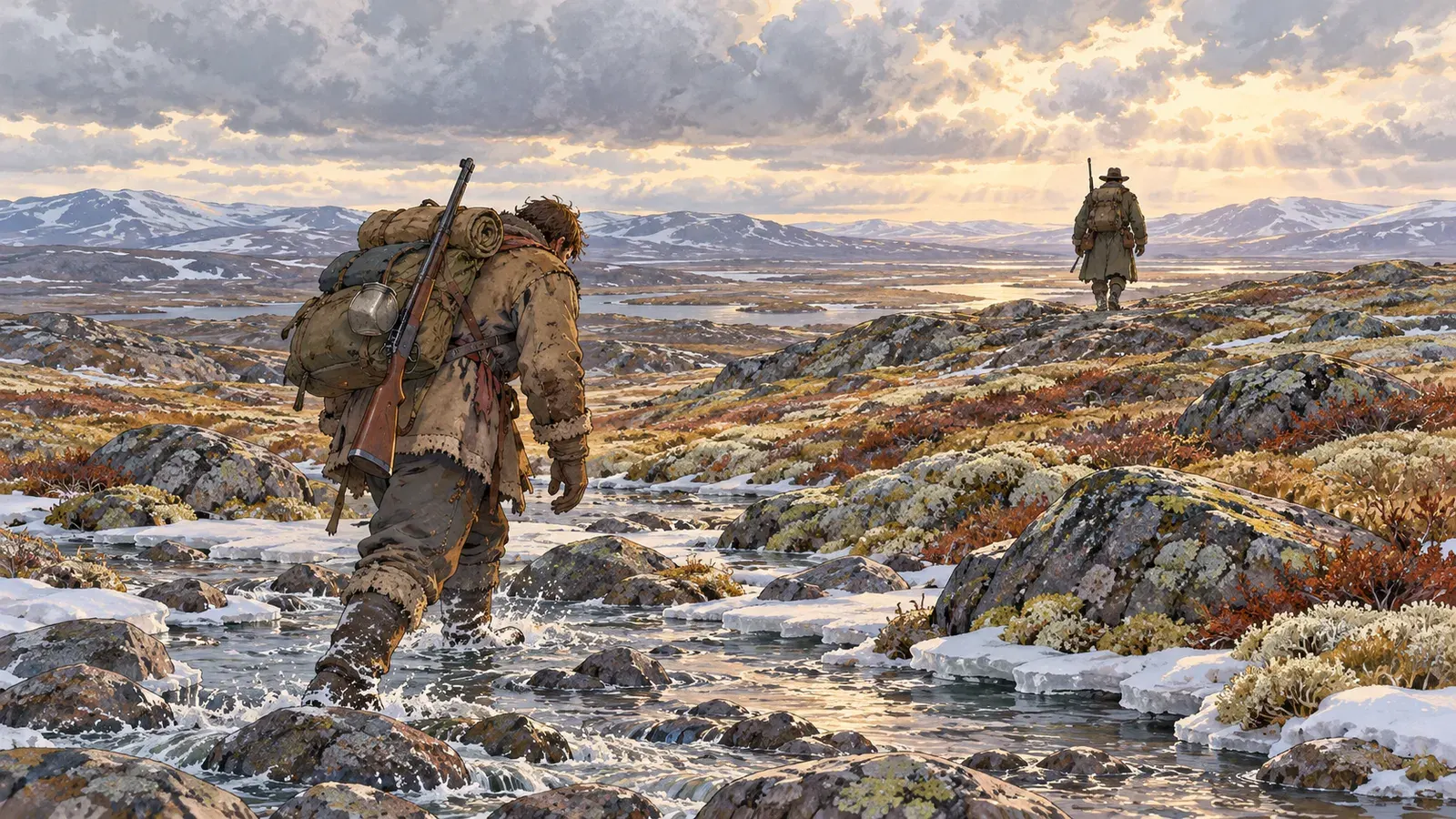
This was a day of fog, and this day hunger awoke in him again. He was very weak and was afflicted with a giddiness which at times blinded him. It was no uncommon thing now for him to stumble and fall; and stumbling once, he fell squarely into a ptarmigan nest. There were four newly hatched chicks, a day old—little specks of pulsating life no more than a mouthful; and he ate them ravenously, thrusting them alive into his mouth and crunching them like egg-shells between his teeth. The mother ptarmigan beat about him with great outcry. He used his gun as a club with which to knock her over, but she dodged out of reach. He threw stones at her and with one chance shot broke a wing. Then she fluttered away, running, trailing the broken wing, with him in pursuit.
その日は霧だった。そしてその日、飢えがまた男の中で目を覚ました。男はひどく弱っていて、ときどき目の前が真っ暗になるほどのめまいに苦しんだ。いまでは、つまずいて倒れることも珍しくなかった。一度つまずいたとき、男はライチョウの巣の上にまともに倒れこんだ。生まれて一日の、かえったばかりのひなが四羽いた。ひと口にもならない、脈打つ小さな命の粒だった。男はそれをがつがつと食べた。生きたまま口に押しこみ、卵の殻のように歯でばりばりと噛み砕いた。母鳥が大きな声で鳴きたてながら、男のまわりをばたばたと飛びまわった。男は銃を棍棒がわりにして、母鳥をたたき落とそうとした。だが母鳥は身をかわして、手の届かないところへ逃げた。男は石を投げつけ、まぐれで当たった一投で、片方の翼を折った。母鳥は折れた翼を引きずりながら、羽ばたき、走って逃げていった。男はそれを追いかけた。
The little chicks had no more than whetted his appetite. He hopped and bobbed clumsily along on his injured ankle, throwing stones and screaming hoarsely at times; at other times hopping and bobbing silently along, picking himself up grimly and patiently when he fell, or rubbing his eyes with his hand when the giddiness threatened to overpower him.
小さなひなは、男の食欲をかき立てただけだった。男はくじいた足首で、ぶざまにはねたりつんのめったりしながら追いかけた。石を投げ、ときどきしわがれた声で叫んだ。黙ってはねたりつんのめったりしながら進むこともあった。倒れると、歯を食いしばって、根気よく起き上がった。めまいに負けそうになると、手で目をこすった。
The chase led him across swampy ground in the bottom of the valley, and he came upon footprints in the soggy moss. They were not his own—he could see that. They must be Bill's. But he could not stop, for the mother ptarmigan was running on. He would catch her first, then he would return and investigate.
追いかけているうちに、男は谷底のぬかるんだ土地を横切り、ぐしょぐしょの苔の上に足跡を見つけた。自分の足跡ではない。それはわかった。ビルの足跡にちがいない。だが立ち止まるわけにはいかなかった。母鳥がまだ走っていたからだ。まず母鳥をつかまえて、それから戻ってきて調べればいい。
He exhausted the mother ptarmigan; but he exhausted himself. She lay panting on her side. He lay panting on his side, a dozen feet away, unable to crawl to her. And as he recovered she recovered, fluttering out of reach as his hungry hand went out to her. The chase was resumed. Night settled down and she escaped. He stumbled from weakness and pitched head foremost on his face, cutting his cheek, his pack upon his back. He did not move for a long while; then he rolled over on his side, wound his watch, and lay there until morning.
男は母鳥をへとへとにさせた。だが自分もへとへとになってしまった。母鳥は横向きに倒れてあえいでいた。男も十二フィートほど離れたところで、横向きに倒れてあえいでいた。そこまで這っていくこともできなかった。男が息を吹き返すと、母鳥も息を吹き返した。男が飢えた手を伸ばすと、母鳥はばたばたと手の届かないところへ逃げた。また追いかけっこが始まった。夜になり、母鳥は逃げてしまった。男は弱りきってつまずき、荷を背負ったまま、頭からうつぶせに倒れて、頬を切った。男は長いあいだ動かなかった。それから横向きに寝返りを打ち、時計のねじを巻いて、朝までそこに横たわっていた。
Another day of fog. Half of his last blanket had gone into foot-wrappings. He failed to pick up Bill's trail. It did not matter. His hunger was driving him too compellingly—only—only he wondered if Bill, too, were lost. By midday the irk of his pack became too oppressive. Again he divided the gold, this time merely spilling half of it on the ground. In the afternoon he threw the rest of it away, there remaining to him only the half-blanket, the tin bucket, and the rifle.
また霧の日だった。最後の毛布は、半分が足に巻く布になっていた。ビルの足跡は、もう見つけられなかった。どうでもよかった。飢えが、有無を言わさず男を駆り立てていたのだ。ただ、ただ、ビルも道に迷ったのではないかと気になった。昼ごろには、荷の重さが耐えられないほどになった。男はまた金を分けた。今度はただ、半分を地面にこぼしただけだった。午後には、残りも捨ててしまった。手もとに残ったのは、半分になった毛布と、ブリキのバケツと、銃だけだった。
An hallucination began to trouble him. He felt confident that one cartridge remained to him. It was in the chamber of the rifle and he had overlooked it. On the other hand, he knew all the time that the chamber was empty. But the hallucination persisted. He fought it off for hours, then threw his rifle open and was confronted with emptiness. The disappointment was as bitter as though he had really expected to find the cartridge.
男は、ある思いこみに悩まされはじめた。弾が一発残っている、と確信したのだ。銃の薬室に入っていて、自分はそれを見落としていたのだ。一方では、薬室が空なのもずっとわかっていた。だが、その思いこみはしつこく続いた。何時間もそれと闘ったあげく、銃を開けてみて、空っぽなのを突きつけられた。本気で弾があると思っていたかのように、がっかりして、苦い気持ちになった。
He plodded on for half an hour, when the hallucination arose again. Again he fought it, and still it persisted, till for very relief he opened his rifle to unconvince himself. At times his mind wandered farther afield, and he plodded on, a mere automaton, strange conceits and whimsicalities gnawing at his brain like worms. But these excursions out of the real were of brief duration, for ever the pangs of the hunger-bite called him back. He was jerked back abruptly once from such an excursion by a sight that caused him nearly to faint. He reeled and swayed, doddering like a drunken man to keep from falling. Before him stood a horse. A horse! He could not believe his eyes. A thick mist was in them, intershot with sparkling points of light. He rubbed his eyes savagely to clear his vision, and beheld, not a horse, but a great brown bear. The animal was studying him with bellicose curiosity.
三十分ほど、とぼとぼと歩き続けると、またあの思いこみがわき起こった。また闘ったが、それでもしつこく続いた。とうとう、ただ楽になりたい一心で、思いこみを打ち消すために銃を開けた。ときどき、男の心はもっと遠くへさまよい出た。男はただの機械のように、とぼとぼと歩き続けた。おかしな妄想や、とりとめのない考えが、虫のように脳をかじっていた。だが、こうして現実から抜け出すのは、いつもつかのまだった。飢えの噛みつくような痛みが、いつも呼び戻したのだ。一度、そうしてさまよっているところを、ある光景にいきなり引き戻された。男はあやうく気を失いかけた。よろめき、ふらつき、倒れまいとして、酔っぱらいのようによたよたした。目の前に、一頭の馬が立っていたのだ。馬が! 男はわが目を疑った。目には濃い霧がかかっていて、そこにきらきらと光の点が飛び交っていた。よく見ようと、乱暴に目をこすった。見えたのは馬ではなく、大きなヒグマだった。ヒグマは、けんか腰の好奇心で、男をじろじろ眺めていた。
The man had brought his gun halfway to his shoulder before he realized. He lowered it and drew his hunting-knife from its beaded sheath at his hip. Before him was meat and life. He ran his thumb along the edge of his knife. It was sharp. The point was sharp. He would fling himself upon the bear and kill it. But his heart began its warning thump, thump, thump. Then followed the wild upward leap and tattoo of flutters, the pressing as of an iron band about his forehead, the creeping of the dizziness into his brain.
気がついたときには、男は銃を半分まで肩に持ち上げていた。男は銃をおろし、腰の、ビーズ飾りのついたさやから狩猟用のナイフを抜いた。目の前にあるのは、肉であり、命だった。親指でナイフの刃をなぞった。鋭かった。切っ先も鋭かった。クマに飛びかかって殺してやろう。だが、心臓が警告するように、どきん、どきん、どきんと打ちはじめた。続いて、激しく跳ね上がって、小刻みにばたばたと打った。鉄の輪で額をしめつけられるようになり、めまいがじわじわと頭にしのびこんできた。
His desperate courage was evicted by a great surge of fear. In his weakness, what if the animal attacked him? He drew himself up to his most imposing stature, gripping the knife and staring hard at the bear. The bear advanced clumsily a couple of steps, reared up, and gave vent to a tentative growl. If the man ran, he would run after him; but the man did not run. He was animated now with the courage of fear. He, too, growled, savagely, terribly, voicing the fear that is to life germane and that lies twisted about life's deepest roots.
押し寄せる大きな恐怖に、必死の勇気は追い払われた。こんなに弱っているのに、もしこいつが襲いかかってきたらどうなる? 男はできるかぎり堂々と背筋を伸ばし、ナイフを握りしめて、クマをにらみつけた。クマはのっそりと二歩ほど進み出て、後ろ足で立ち上がり、様子をうかがうように、ひと声うなった。もし男が逃げだしたら、クマは追いかけてきただろう。だが男は逃げなかった。いまや男は、恐怖から生まれる勇気に突き動かされていた。男もうなった。荒々しく、恐ろしく。それは、命と切っても切れない、命のいちばん深い根にからみついている恐怖を、声にしたものだった。
The bear edged away to one side, growling menacingly, himself appalled by this mysterious creature that appeared upright and unafraid. But the man did not move. He stood like a statue till the danger was past, when he yielded to a fit of trembling and sank down into the wet moss.
クマは、脅すようにうなりながら、じりじりとわきへ離れていった。まっすぐに立って、少しも恐れていないように見えるこの得体の知れない生き物に、クマのほうもぞっとしたのだ。だが男は動かなかった。危険が去るまで、彫像のように立ちつくしていた。それから、ふるえの発作に身をまかせ、ぬれた苔の上にへたりこんだ。
He pulled himself together and went on, afraid now in a new way. It was not the fear that he should die passively from lack of food, but that he should be destroyed violently before starvation had exhausted the last particle of the endeavor in him that made toward surviving. There were the wolves. Back and forth across the desolation drifted their howls, weaving the very air into a fabric of menace that was so tangible that he found himself, arms in the air, pressing it back from him as it might be the walls of a wind-blown tent.
男は気を取り直して、また進んだ。いまは、新しい恐れをいだいていた。食べ物がなくて、ただ力つきて死んでいくのではない。飢えが、生きのびようとする力の最後のひとかけらまで使いはたす前に、むごたらしく殺されてしまうのではないか。そういう恐れだった。狼がいたのだ。荒野のあちこちを、狼の遠吠えがただよった。遠吠えは空気そのものを、手でさわれるほどの脅威の布に織りあげていた。気がつくと、男は両腕を上げて、それを押し返していた。まるで、風にあおられたテントの壁を押し返すように。
Now and again the wolves, in packs of two and three, crossed his path. But they sheered clear of him. They were not in sufficient numbers, and besides they were hunting the caribou, which did not battle, while this strange creature that walked erect might scratch and bite.
ときどき、二、三匹ずつの狼が、男の行く手を横切った。だが狼たちは、男をよけて通った。数が足りなかったし、それに、狼たちはカリブーを狩っていた。カリブーは戦わない。だが、このまっすぐ立って歩く奇妙な生き物は、ひっかいたり、噛みついたりするかもしれないのだ。
In the late afternoon he came upon scattered bones where the wolves had made a kill. The debris had been a caribou calf an hour before, squawking and running and very much alive. He contemplated the bones, clean-picked and polished, pink with the cell-life in them which had not yet died. Could it possibly be that he might be that ere the day was done! Such was life, eh? A vain and fleeting thing. It was only life that pained. There was no hurt in death. To die was to sleep. It meant cessation, rest. Then why was he not content to die?
午後遅く、男は狼たちが獲物を仕留めたあとに、骨が散らばっているところに出くわした。この残骸は、一時間前には、きいきい鳴いて走りまわる、元気いっぱいのカリブーの子どもだったのだ。男は骨をじっと眺めた。きれいにしゃぶりつくされて、つやつやしていた。骨の中の細胞はまだ死にきっておらず、そのためにピンク色をしていた。日が暮れる前に、自分もこうなっているかもしれないのだろうか! 命とは、こういうものなのか。むなしく、はかないものだ。痛むのは、生きているあいだだけだ。死ねば痛みはない。死ぬことは眠ることだ。終わりであり、休みだ。それなら、なぜ自分は死ぬことに満足しないのだろう?
But he did not moralize long. He was squatting in the moss, a bone in his mouth, sucking at the shreds of life that still dyed it faintly pink. The sweet meaty taste, thin and elusive almost as a memory, maddened him. He closed his jaws on the bones and crunched. Sometimes it was the bone that broke, sometimes his teeth. Then he crushed the bones between rocks, pounded them to a pulp, and swallowed them. He pounded his fingers, too, in his haste, and yet found a moment in which to feel surprise at the fact that his fingers did not hurt much when caught under the descending rock.
だが、男が人生について考えていたのは、長いあいだではなかった。男は苔の上にしゃがみこみ、骨を一本口にくわえて、まだ骨をかすかにピンク色に染めている命の切れはしを吸っていた。甘い肉の味は、思い出と同じくらい薄く、つかみどころがなかった。それが男を狂わせた。男は骨にあごを閉じて、噛み砕いた。骨が折れることもあれば、歯が折れることもあった。それから骨を岩と岩のあいだにはさんで砕き、どろどろになるまでたたきつぶして、飲みこんだ。あわてていたので、指までたたきつぶした。それでも、振りおろした岩にはさまれた指がたいして痛まないのに、驚くだけの暇はあった。
Came frightful days of snow and rain. He did not know when he made camp, when he broke camp. He travelled in the night as much as in the day. He rested wherever he fell, crawled on whenever the dying life in him flickered up and burned less dimly. He, as a man, no longer strove. It was the life in him, unwilling to die, that drove him on. He did not suffer. His nerves had become blunted, numb, while his mind was filled with weird visions and delicious dreams.
雪と雨の、恐ろしい日々がやって来た。いつ野宿をし、いつ発ったのか、男にはわからなかった。昼と同じくらい、夜も歩いた。倒れたところで休み、自分の中の消えかけた命がちらりと燃え上がって、少しでも明るく燃えるたびに、這って進んだ。一人の人間としての男は、もうもがいてはいなかった。男を駆り立てていたのは、死にたがらない、男の中の命だった。男は苦しんではいなかった。神経は鈍り、しびれていた。そして心は、奇怪な幻と、甘い夢でいっぱいだった。
But ever he sucked and chewed on the crushed bones of the caribou calf, the least remnants of which he had gathered up and carried with him. He crossed no more hills or divides, but automatically followed a large stream which flowed through a wide and shallow valley. He did not see this stream nor this valley. He saw nothing save visions. Soul and body walked or crawled side by side, yet apart, so slender was the thread that bound them.
それでも男は、いつも、カリブーの子どもの砕いた骨を吸ったり噛んだりしていた。最後のひとかけらまで拾い集めて、持って歩いていたのだ。もう丘も分水嶺も越えなかった。広く浅い谷を流れる大きな川を、ひとりでに足が向くままにたどっていった。男はその川も、その谷も見ていなかった。幻のほかは、何も見えていなかった。魂と体は並んで歩き、あるいは這っていた。並んでいながら、離れていた。二つをつなぐ糸は、それほど細かったのだ。
He awoke in his right mind, lying on his back on a rocky ledge. The sun was shining bright and warm. Afar off he heard the squawking of caribou calves. He was aware of vague memories of rain and wind and snow, but whether he had been beaten by the storm for two days or two weeks he did not know.
男は正気に返って目を覚ました。岩棚の上に仰向けに寝ていた。太陽が明るく、暖かく照っていた。遠くで、カリブーの子どもたちがきいきい鳴いているのが聞こえた。雨や風や雪のぼんやりとした記憶はあった。だが、嵐に打ちのめされていたのが二日だったのか、二週間だったのか、わからなかった。
For some time he lay without movement, the genial sunshine pouring upon him and saturating his miserable body with its warmth. A fine day, he thought. Perhaps he could manage to locate himself. By a painful effort he rolled over on his side. Below him flowed a wide and sluggish river. Its unfamiliarity puzzled him. Slowly he followed it with his eyes, winding in wide sweeps among the bleak, bare hills, bleaker and barer and lower-lying than any hills he had yet encountered. Slowly, deliberately, without excitement or more than the most casual interest, he followed the course of the strange stream toward the sky-line and saw it emptying into a bright and shining sea. He was still unexcited. Most unusual, he thought, a vision or a mirage—more likely a vision, a trick of his disordered mind. He was confirmed in this by sight of a ship lying at anchor in the midst of the shining sea. He closed his eyes for a while, then opened them. Strange how the vision persisted! Yet not strange. He knew there were no seas or ships in the heart of the barren lands, just as he had known there was no cartridge in the empty rifle.
しばらくのあいだ、男は身動きもせずに横たわっていた。心地よい日の光が降りそそぎ、みじめな体をぬくもりでひたしていた。いい日だ、と男は思った。たぶん、自分がどこにいるのか見当がつけられるだろう。苦しい思いをして、男は横向きに寝返りを打った。下に、広い、ゆるやかな川が流れていた。見覚えのない川で、男はとまどった。ゆっくりと目でたどっていくと、川は荒涼とした裸の丘のあいだを、大きく曲がりくねって流れていた。その丘は、これまでに見たどの丘よりも、荒涼として、裸で、低かった。ゆっくりと、落ちついて、興奮もせず、ほんの何気ない関心しか持たずに、男はその見知らぬ川を地平線のほうへたどっていった。すると川は、明るく輝く海に注いでいた。それでも男は興奮しなかった。じつに妙だ、と男は思った。幻か蜃気楼だろう。たぶん幻だ。乱れた頭のいたずらだ。輝く海のまんなかに、船が一隻、錨をおろしているのが見えたので、男はますますそう思った。しばらく目を閉じて、それから開けた。幻がいつまでも消えないとは妙だ! いや、妙でもなんでもない。不毛地帯のどまんなかに、海も船もあるはずがない。空の銃に弾が入っていないのがわかっていたのと同じように、それはわかっていた。
He heard a snuffle behind him—a half-choking gasp or cough. Very slowly, because of his exceeding weakness and stiffness, he rolled over on his other side. He could see nothing near at hand, but he waited patiently. Again came the snuffle and cough, and outlined between two jagged rocks not a score of feet away he made out the gray head of a wolf. The sharp ears were not pricked so sharply as he had seen them on other wolves; the eyes were bleared and bloodshot, the head seemed to droop limply and forlornly. The animal blinked continually in the sunshine. It seemed sick. As he looked it snuffled and coughed again.
背後で、くんくんと鼻を鳴らす音がした。なかば息の詰まったような、あえぎか咳だった。ひどく弱って、体がこわばっていたので、男はごくゆっくりと、反対側へ寝返りを打った。近くには何も見えなかった。だが男は根気よく待った。また鼻を鳴らす音と咳が聞こえた。二十フィートと離れていない、ぎざぎざの二つの岩のあいだに、狼の灰色の頭の輪郭が浮かんでいるのがわかった。とがった耳は、ほかの狼で見たほど、ぴんと立ってはいなかった。目はかすんで血走り、頭はぐったりと、しょんぼり垂れているように見えた。狼は日の光の中で、しきりにまばたきをしていた。病気のようだった。見ていると、狼はまた鼻を鳴らし、咳をした。
This, at least, was real, he thought, and turned on the other side so that he might see the reality of the world which had been veiled from him before by the vision. But the sea still shone in the distance and the ship was plainly discernible. Was it reality, after all? He closed his eyes for a long while and thought, and then it came to him. He had been making north by east, away from the Dease Divide and into the Coppermine Valley. This wide and sluggish river was the Coppermine. That shining sea was the Arctic Ocean. That ship was a whaler, strayed east, far east, from the mouth of the Mackenzie, and it was lying at anchor in Coronation Gulf. He remembered the Hudson Bay Company chart he had seen long ago, and it was all clear and reasonable to him.
これは、少なくとも本物だ、と男は思った。そして、さっきまで幻に覆い隠されていた本当の世界を見ようと、反対側へ寝返りを打った。だが、海はやはり遠くで輝いていて、船もはっきりと見えた。結局、これは本物なのだろうか? 男は長いあいだ目を閉じて考えた。そして、わかった。自分はディーズ川の分水嶺から離れ、北北東へ向かって、コッパーマイン川の谷へ入りこんでいたのだ。この広い、ゆるやかな川はコッパーマイン川だった。あの輝く海は北極海だった。あの船は捕鯨船で、マッケンジー川の河口から、はるか東へさまよってきて、コロネーション湾に錨をおろしているのだ。ずっと前に見たハドソン湾会社の地図を思い出すと、何もかもはっきりと筋が通った。
He sat up and turned his attention to immediate affairs. He had worn through the blanket-wrappings, and his feet were shapeless lumps of raw meat. His last blanket was gone. Rifle and knife were both missing. He had lost his hat somewhere, with the bunch of matches in the band, but the matches against his chest were safe and dry inside the tobacco pouch and oil paper. He looked at his watch. It marked eleven o'clock and was still running. Evidently he had kept it wound.
男は身を起こし、さしあたってしなければならないことに目を向けた。足に巻いた毛布はすり切れて、足は皮のむけた、形もない生肉のかたまりになっていた。最後の毛布はなくなっていた。銃もナイフも、なくなっていた。どこかで帽子をなくし、帽子の帯に入れていたマッチの束も一緒になくしていた。だが、胸にしまったマッチは、たばこ入れと油紙の中で、無事に乾いていた。時計を見た。十一時を指していて、まだ動いていた。どうやら、ねじを巻くことは忘れなかったらしい。
He was calm and collected. Though extremely weak, he had no sensation of pain. He was not hungry. The thought of food was not even pleasant to him, and whatever he did was done by his reason alone. He ripped off his pants' legs to the knees and bound them about his feet. Somehow he had succeeded in retaining the tin bucket. He would have some hot water before he began what he foresaw was to be a terrible journey to the ship.
男は冷静で、落ちついていた。ひどく弱ってはいたが、痛みは感じなかった。腹も減っていなかった。食べ物のことを考えても、うれしくもなかった。何をするにも、ただ頭で考えてするだけだった。男はズボンの脚をひざのところで裂きとって、それを足に巻いた。どういうわけか、ブリキのバケツはなくさずにすんでいた。船までの旅は恐ろしいものになる、と男にはわかっていた。その前に、熱い湯を飲んでおこう。
His movements were slow. He shook as with a palsy. When he started to collect dry moss, he found he could not rise to his feet. He tried again and again, then contented himself with crawling about on hands and knees. Once he crawled near to the sick wolf. The animal dragged itself reluctantly out of his way, licking its chops with a tongue which seemed hardly to have the strength to curl. The man noticed that the tongue was not the customary healthy red. It was a yellowish brown and seemed coated with a rough and half-dry mucus.
男の動きはのろかった。中風にかかったようにふるえていた。乾いた苔を集めようとして、立ち上がれないことに気づいた。何度も何度もやってみたが、結局あきらめて、四つんばいで這いまわった。一度、病気の狼のそばまで這っていった。狼はしぶしぶ体を引きずって、男の前からよけた。そして、丸める力もほとんどないような舌で、口のまわりをなめた。その舌がふつうの健康な赤い色ではないことに、男は気づいた。黄色がかった茶色で、ざらざらした、なかば乾いたねばねばで覆われているように見えた。
After he had drunk a quart of hot water the man found he was able to stand, and even to walk as well as a dying man might be supposed to walk. Every minute or so he was compelled to rest. His steps were feeble and uncertain, just as the wolf's that trailed him were feeble and uncertain; and that night, when the shining sea was blotted out by blackness, he knew he was nearer to it by no more than four miles.
熱い湯を一クォート飲むと、男は立てるようになった。それどころか、死にかけた人間が歩けるくらいには、歩くこともできた。一分かそこらごとに休まなければならなかった。男の足どりは弱々しく、おぼつかなかった。後をつけてくる狼の足どりが弱々しく、おぼつかないのと、まったく同じだった。その夜、輝く海が闇に消えたとき、男は、海にたった四マイルしか近づいていないとわかった。
Throughout the night he heard the cough of the sick wolf, and now and then the squawking of the caribou calves. There was life all around him, but it was strong life, very much alive and well, and he knew the sick wolf clung to the sick man's trail in the hope that the man would die first. In the morning, on opening his eyes, he beheld it regarding him with a wistful and hungry stare. It stood crouched, with tail between its legs, like a miserable and woe-begone dog. It shivered in the chill morning wind, and grinned dispiritedly when the man spoke to it in a voice that achieved no more than a hoarse whisper.
夜どおし、病気の狼の咳が聞こえた。ときどき、カリブーの子どもたちのきいきい鳴く声も聞こえた。まわりじゅうに命があった。だがそれは強い命、元気いっぱいの、健やかな命だった。病気の狼が病気の男の跡にくっついてくるのは、男のほうが先に死ぬのを待っているからだ。男にはそれがわかっていた。朝、目を開けると、狼がもの欲しげな、飢えた目でこちらを見ていた。尻尾を脚のあいだにはさんで、みじめな、しょんぼりした犬のように、身をかがめて立っていた。冷たい朝の風にふるえていた。男が話しかけると、元気なく歯をむいた。男の声は、しわがれたささやきにしかならなかった。
The sun rose brightly, and all morning the man tottered and fell toward the ship on the shining sea. The weather was perfect. It was the brief Indian Summer of the high latitudes. It might last a week. To-morrow or next day it might he gone.
太陽が明るく昇り、午前中ずっと、男は輝く海の船に向かって、よろめいては倒れた。申し分のない天気だった。北の果ての、短い小春日和だった。一週間は続くかもしれない。あしたか、あさってには終わってしまうかもしれない。
In the afternoon the man came upon a trail. It was of another man, who did not walk, but who dragged himself on all fours. The man thought it might be Bill, but he thought in a dull, uninterested way. He had no curiosity. In fact, sensation and emotion had left him. He was no longer susceptible to pain. Stomach and nerves had gone to sleep. Yet the life that was in him drove him on. He was very weary, but it refused to die. It was because it refused to die that he still ate muskeg berries and minnows, drank his hot water, and kept a wary eye on the sick wolf.
午後、男はひとすじの跡に出くわした。もう一人の男の跡だった。その男は歩いていたのではなく、四つんばいで体を引きずっていたのだ。ビルかもしれない、と男は思った。だがそれは、鈍い、どうでもいいような思いだった。知りたいとも思わなかった。じっさい、感覚も感情も、男から去っていた。もう痛みも感じなかった。胃も神経も眠ってしまっていた。それでも、男の中の命が、男を駆り立てていた。男はひどく疲れていたが、命は死ぬことを拒んだ。命が死ぬことを拒んだからこそ、男はまだ湿地の木の実や小魚を食べ、熱い湯を飲み、病気の狼から用心深く目を離さずにいたのだ。
He followed the trail of the other man who dragged himself along, and soon came to the end of it—a few fresh-picked bones where the soggy moss was marked by the foot-pads of many wolves. He saw a squat moose-hide sack, mate to his own, which had been torn by sharp teeth. He picked it up, though its weight was almost too much for his feeble fingers. Bill had carried it to the last. Ha! ha! He would have the laugh on Bill. He would survive and carry it to the ship in the shining sea. His mirth was hoarse and ghastly, like a raven's croak, and the sick wolf joined him, howling lugubriously. The man ceased suddenly. How could he have the laugh on Bill if that were Bill; if those bones, so pinky-white and clean, were Bill?
男は、体を引きずって進んだもう一人の男の跡をたどり、まもなくその終わりに着いた。しゃぶられたばかりの骨が何本かあり、ぐしょぐしょの苔には、たくさんの狼の足跡がついていた。ずんぐりしたヘラジカの革袋があった。自分のと対になる袋で、鋭い歯で引き裂かれていた。弱った指にはほとんど重すぎたが、男はそれを拾い上げた。ビルはこれを最後まで運んでいたのだ。はっ、はっ! ビルのやつを笑ってやれる。おれは生きのびて、これを輝く海の船まで運んでやるのだ。男の笑い声は、ワタリガラスの鳴き声のように、しわがれていて、ぞっとするものだった。病気の狼も、陰気に遠吠えして、それに加わった。男はいきなり笑いやんだ。もしこれがビルだったら。このピンクがかった白い、きれいな骨がビルだったら。どうしてビルを笑ってやれるだろう?
He turned away. Well, Bill had deserted him; but he would not take the gold, nor would he suck Bill's bones. Bill would have, though, had it been the other way around, he mused as he staggered on.
男は顔をそむけた。まあいい、ビルはおれを見捨てた。だが、おれはこの金を取りはしないし、ビルの骨をしゃぶりもしない。もっとも、立場が逆だったら、ビルはそうしただろうがな。よろめきながら進みつつ、男はそう思った。
He came to a pool of water. Stooping over in quest of minnows, he jerked his head back as though he had been stung. He had caught sight of his reflected face. So horrible was it that sensibility awoke long enough to be shocked. There were three minnows in the pool, which was too large to drain; and after several ineffectual attempts to catch them in the tin bucket he forbore. He was afraid, because of his great weakness, that he might fall in and drown. It was for this reason that he did not trust himself to the river astride one of the many drift-logs which lined its sand-spits.
男は水たまりに出た。小魚を探してかがみこむと、刺されでもしたように、ぱっと頭を引いた。水に映った自分の顔が見えたのだ。あまりに恐ろしい顔だったので、しばらくのあいだ感覚が目を覚まして、ぎょっとしたほどだった。水たまりには小魚が三匹いた。だが水たまりは大きすぎて、水をかい出せなかった。ブリキのバケツですくおうと何度か試みたが、うまくいかず、男はあきらめた。ひどく弱っているので、落ちて溺れてしまうのが怖かったのだ。川の砂州には流木がたくさん並んでいた。そのどれかにまたがって、川を流れていかなかったのも、同じ理由からだった。
That day he decreased the distance between him and the ship by three miles; the next day by two—for he was crawling now as Bill had crawled; and the end of the fifth day found the ship still seven miles away and him unable to make even a mile a day. Still the Indian Summer held on, and he continued to crawl and faint, turn and turn about; and ever the sick wolf coughed and wheezed at his heels. His knees had become raw meat like his feet, and though he padded them with the shirt from his back it was a red track he left behind him on the moss and stones. Once, glancing back, he saw the wolf licking hungrily his bleeding trail, and he saw sharply what his own end might be—unless—unless he could get the wolf. Then began as grim a tragedy of existence as was ever played—a sick man that crawled, a sick wolf that limped, two creatures dragging their dying carcasses across the desolation and hunting each other's lives.
その日、男は船との距離を三マイル縮めた。次の日は二マイルだった。いまでは男も、ビルと同じように這っていたからだ。そして五日目の終わりにも、船はまだ七マイル先にあった。男はもう、一日に一マイルも進めなくなっていた。それでも小春日和は続いた。男は這っては気を失い、気を失っては這い、それをくりかえした。そしていつも、病気の狼が、男のかかとのすぐ後ろで咳をし、ぜいぜいとあえいでいた。ひざも足と同じように生肉のようになった。背中のシャツを脱いで当てたが、それでも苔や石の上に、男の後ろに赤い跡が続いた。一度、振り返ると、狼が男の血の跡を飢えたようになめているのが見えた。そして男は、自分の最期がどうなるかを、はっきりと思い知った。もし、もしあの狼を仕留められなければ。こうして、かつて演じられたうちでも、もっとも陰惨な、生きるための悲劇が始まった。這っていく病気の男と、足を引きずる病気の狼。死にかけた体を引きずって荒野を渡り、互いの命を狙う、二つの生き物。
Had it been a well wolf, it would not have mattered so much to the man; but the thought of going to feed the maw of that loathsome and all but dead thing was repugnant to him. He was finicky. His mind had begun to wander again, and to be perplexed by hallucinations, while his lucid intervals grew rarer and shorter.
元気な狼だったら、男にとってそれほど問題ではなかっただろう。だが、あの汚らわしい、死にかけたも同然のやつの胃袋を満たしてやることになると思うと、ぞっとした。男は好みがうるさかったのだ。男の心はまたさまよいはじめ、幻に惑わされるようになった。正気でいられるときは、ますますまれに、ますます短くなっていった。
He was awakened once from a faint by a wheeze close in his ear. The wolf leaped lamely back, losing its footing and falling in its weakness. It was ludicrous, but he was not amused. Nor was he even afraid. He was too far gone for that. But his mind was for the moment clear, and he lay and considered. The ship was no more than four miles away. He could see it quite distinctly when he rubbed the mists out of his eyes, and he could see the white sail of a small boat cutting the water of the shining sea. But he could never crawl those four miles. He knew that, and was very calm in the knowledge. He knew that he could not crawl half a mile. And yet he wanted to live. It was unreasonable that he should die after all he had undergone. Fate asked too much of him. And, dying, he declined to die. It was stark madness, perhaps, but in the very grip of Death he defied Death and refused to die.
一度、男は耳のすぐそばのぜいぜいいう息で、気を失っていたところから目を覚ました。狼は足を引きずりながら跳びのいたが、弱っていたので足を踏みはずして倒れた。滑稽だったが、男はおもしろいとも思わなかった。怖いとさえ思わなかった。そんなことを感じるには、もう弱りすぎていた。だが、そのときは頭がはっきりしていたので、男は横たわったまま考えた。船は四マイルと離れていなかった。目の中の霧をこすりとると、船ははっきり見えた。輝く海の水を切って進む小さなボートの、白い帆も見えた。だが、その四マイルを這っていくことは、とてもできない。男はそれを知っていた。そして、それを知っていながら、たいそう落ちついていた。半マイルも這っていけないことはわかっていた。それなのに、男は生きたかった。これだけのことをくぐり抜けてきたあとで死ぬなど、理屈に合わない。運命は、男にあまりにも多くを求めすぎた。そして、死にかけていながら、男は死ぬことを拒んだ。それはまったくの狂気だったかもしれない。だが、死につかまれながら、男は死にさからい、死ぬことを拒んだのだ。
He closed his eyes and composed himself with infinite precaution. He steeled himself to keep above the suffocating languor that lapped like a rising tide through all the wells of his being. It was very like a sea, this deadly languor, that rose and rose and drowned his consciousness bit by bit. Sometimes he was all but submerged, swimming through oblivion with a faltering stroke; and again, by some strange alchemy of soul, he would find another shred of will and strike out more strongly.
男は目を閉じ、細心の注意を払って、心を落ちつけた。息の詰まるようなけだるさが、満ちてくる潮のように、体のすみずみまで打ち寄せてくる。それに沈むまいと、気を張りつめた。この命取りのけだるさは、まるで海のようだった。満ちて、満ちて、少しずつ男の意識を溺れさせていった。ときには、ほとんど沈みきって、何もわからない中を、弱々しいひとかきで泳いでいることもあった。そしてまた、何か魂のふしぎな錬金術によって、意志のもうひとかけらを見つけ出し、前より力強く泳ぎだすのだった。
Without movement he lay on his back, and he could hear, slowly drawing near and nearer, the wheezing intake and output of the sick wolf's breath. It drew closer, ever closer, through an infinitude of time, and he did not move. It was at his ear. The harsh dry tongue grated like sandpaper against his cheek. His hands shot out—or at least he willed them to shoot out. The fingers were curved like talons, but they closed on empty air. Swiftness and certitude require strength, and the man had not this strength.
男は身動きもせず、仰向けに横たわっていた。病気の狼のぜいぜいと吸っては吐く息が、ゆっくりと、近く、さらに近く迫ってくるのが聞こえた。果てしない時間をかけて、息は近く、ますます近くへと迫ってきた。それでも男は動かなかった。息が耳もとに来た。ざらざらした乾いた舌が、紙やすりのように頬をこすった。男の両手がさっと伸びた。少なくとも、伸びろと念じた。指は鉤爪のように曲がっていたが、むなしく空をつかんだ。すばやく、確かにつかむには、力がいる。男には、その力がなかった。
The patience of the wolf was terrible. The man's patience was no less terrible. For half a day he lay motionless, fighting off unconsciousness and waiting for the thing that was to feed upon him and upon which he wished to feed. Sometimes the languid sea rose over him and he dreamed long dreams; but ever through it all, waking and dreaming, he waited for the wheezing breath and the harsh caress of the tongue.
狼の辛抱強さは恐ろしかった。男の辛抱強さも、それに劣らず恐ろしかった。半日のあいだ、男は身動きもせずに横たわっていた。気を失うまいと闘いながら、自分を食おうとしているもの、そして自分が食いたいと思っているものを、待っていた。ときどき、けだるさの海が男の上に満ちてきて、男は長い夢を見た。だがそのあいだずっと、目を覚ましているときも、夢を見ているときも、男はぜいぜいいう息と、ざらざらした舌の愛撫を待っていた。
He did not hear the breath, and he slipped slowly from some dream to the feel of the tongue along his hand. He waited. The fangs pressed softly; the pressure increased; the wolf was exerting its last strength in an effort to sink teeth in the food for which it had waited so long. But the man had waited long, and the lacerated hand closed on the jaw. Slowly, while the wolf struggled feebly and the hand clutched feebly, the other hand crept across to a grip. Five minutes later the whole weight of the man's body was on top of the wolf. The hands had not sufficient strength to choke the wolf, but the face of the man was pressed close to the throat of the wolf and the mouth of the man was full of hair. At the end of half an hour the man was aware of a warm trickle in his throat. It was not pleasant. It was like molten lead being forced into his stomach, and it was forced by his will alone. Later the man rolled over on his back and slept.
息の音は聞こえなかった。男は何かの夢から、ゆっくりと、手をなめる舌の感触へとすべり戻った。男は待った。牙がそっと押しつけられた。その力が強くなっていった。狼は、長いあいだ待っていた食べ物に牙を立てようと、最後の力をふりしぼっていたのだ。だが、男も長いあいだ待っていた。噛み裂かれた手が、狼のあごをつかんだ。狼が弱々しくもがき、手が弱々しく握りしめているあいだに、もう片方の手が、ゆっくりと這ってきてつかんだ。五分後、男は体の重みのすべてで、狼の上にのしかかっていた。両手には、狼の首をしめるだけの力はなかった。だが男の顔は狼ののどにぴったり押しつけられ、男の口は毛でいっぱいになっていた。三十分たったころ、男はのどに温かいものが細く流れこんでくるのを感じた。いい気持ちのものではなかった。溶けた鉛を胃に無理やり流しこまれるようだった。そしてそれを流しこんでいたのは、ただ男の意志だけだった。そのあと男は仰向けに寝返りを打ち、眠った。
There were some members of a scientific expedition on the whale-ship Bedford. From the deck they remarked a strange object on the shore. It was moving down the beach toward the water. They were unable to classify it, and, being scientific men, they climbed into the whale-boat alongside and went ashore to see. And they saw something that was alive but which could hardly be called a man. It was blind, unconscious. It squirmed along the ground like some monstrous worm. Most of its efforts were ineffectual, but it was persistent, and it writhed and twisted and went ahead perhaps a score of feet an hour.
捕鯨船ベッドフォード号には、ある科学調査隊の隊員たちが乗っていた。隊員たちは甲板から、岸に奇妙なものがあるのに気づいた。それは浜辺を、水のほうへ向かって動いていた。何なのか見当がつかなかったので、科学者である隊員たちは、船の横につけてあった捕鯨ボートに乗りこみ、確かめに岸へ向かった。そこで見たのは、生きてはいるが、とても人間とは呼べないようなものだった。目も見えず、意識もなかった。怪物じみた虫のように、地面の上を身をくねらせて進んでいた。その努力のほとんどはむだだった。だがしつこく、身をよじり、くねらせて、一時間に二十フィートほど進んでいた。
Three weeks afterward the man lay in a bunk on the whale-ship Bedford, and with tears streaming down his wasted cheeks told who he was and what he had undergone. He also babbled incoherently of his mother, of sunny Southern California, and a home among the orange groves and flowers.
三週間後、男は捕鯨船ベッドフォード号の寝棚に横たわり、やせこけた頬に涙を流しながら、自分が何者で、どんな目にあってきたかを語った。また、母親のことや、日の光あふれる南カリフォルニアのこと、オレンジの林と花に囲まれた家のことを、とりとめもなくしゃべった。
The days were not many after that when he sat at table with the scientific men and ship's officers. He gloated over the spectacle of so much food, watching it anxiously as it went into the mouths of others. With the disappearance of each mouthful an expression of deep regret came into his eyes. He was quite sane, yet he hated those men at mealtime. He was haunted by a fear that the food would not last. He inquired of the cook, the cabin-boy, the captain, concerning the food stores. They reassured him countless times; but he could not believe them, and pried cunningly about the lazarette to see with his own eyes.
それから何日もたたないうちに、男は科学者たちや船の士官たちと同じ食卓につくようになった。こんなにたくさんの食べ物を目の前にして、男はほくほくと眺めた。そして、それがほかの者たちの口に入っていくのを、心配そうに見つめた。ひと口消えるたびに、男の目には、ひどく惜しそうな色が浮かんだ。男はすっかり正気だった。それなのに、食事のときには、その人たちが憎らしかった。食べ物がなくなってしまうのではないかという恐れに、とりつかれていたのだ。男は料理番や、給仕の少年や、船長に、食料の蓄えのことをたずねた。みんなは数えきれないほど、心配ないと言ってやった。だが男は信じられず、自分の目で確かめようと、こっそり食料庫のあたりをかぎまわった。
It was noticed that the man was getting fat. He grew stouter with each day. The scientific men shook their heads and theorized. They limited the man at his meals, but still his girth increased and he swelled prodigiously under his shirt.
男が太ってきたことに、みんなが気づいた。日ごとに太っていった。科学者たちは首をひねり、あれこれ理屈を考えた。男の食事を減らしてみたが、それでも胴まわりは太り続け、シャツの下でおそろしくふくれあがっていった。
The sailors grinned. They knew. And when the scientific men set a watch on the man, they knew too. They saw him slouch for'ard after breakfast, and, like a mendicant, with outstretched palm, accost a sailor. The sailor grinned and passed him a fragment of sea biscuit. He clutched it avariciously, looked at it as a miser looks at gold, and thrust it into his shirt bosom. Similar were the donations from other grinning sailors.
水夫たちはにやにやしていた。水夫たちは知っていたのだ。科学者たちが男を見張らせると、科学者たちにもわかった。男は朝食のあと、前甲板のほうへのそのそ歩いていき、物乞いのように手のひらを差し出して、水夫に声をかけた。水夫はにやりと笑って、堅パンのかけらを渡した。男はそれを欲深そうにつかみ、守銭奴が金貨を見るような目で眺め、シャツの胸もとに押しこんだ。にやにや笑っているほかの水夫たちからも、同じように施しを受けた。
The scientific men were discreet. They let him alone. But they privily examined his bunk. It was lined with hardtack; the mattress was stuffed with hardtack; every nook and cranny was filled with hardtack. Yet he was sane. He was taking precautions against another possible famine—that was all. He would recover from it, the scientific men said; and he did, ere the Bedford's anchor rumbled down in San Francisco Bay.
科学者たちは思慮深かった。男をそっとしておいた。だが、こっそりと男の寝棚を調べた。寝棚には堅パンが敷きつめられていた。マットレスにも堅パンが詰めこまれていた。すみというすみに、堅パンが押しこまれていた。それでも男は正気だった。また飢えることがあるかもしれないので、用心しているだけだった。それだけのことだった。そのうち治るだろう、と科学者たちは言った。そして、ベッドフォード号の錨がサンフランシスコ湾にがらがらとおろされる前に、男は治ったのである。