"This out of all will remain—They have lived and have tossed: So much of the game will be gain, Though the gold of the dice has been lost."
「すべてが失われても、これだけは残る。彼らは生き、賽を振った。賭けた金は失っても、勝負をしたこと、それだけはもうけになる」
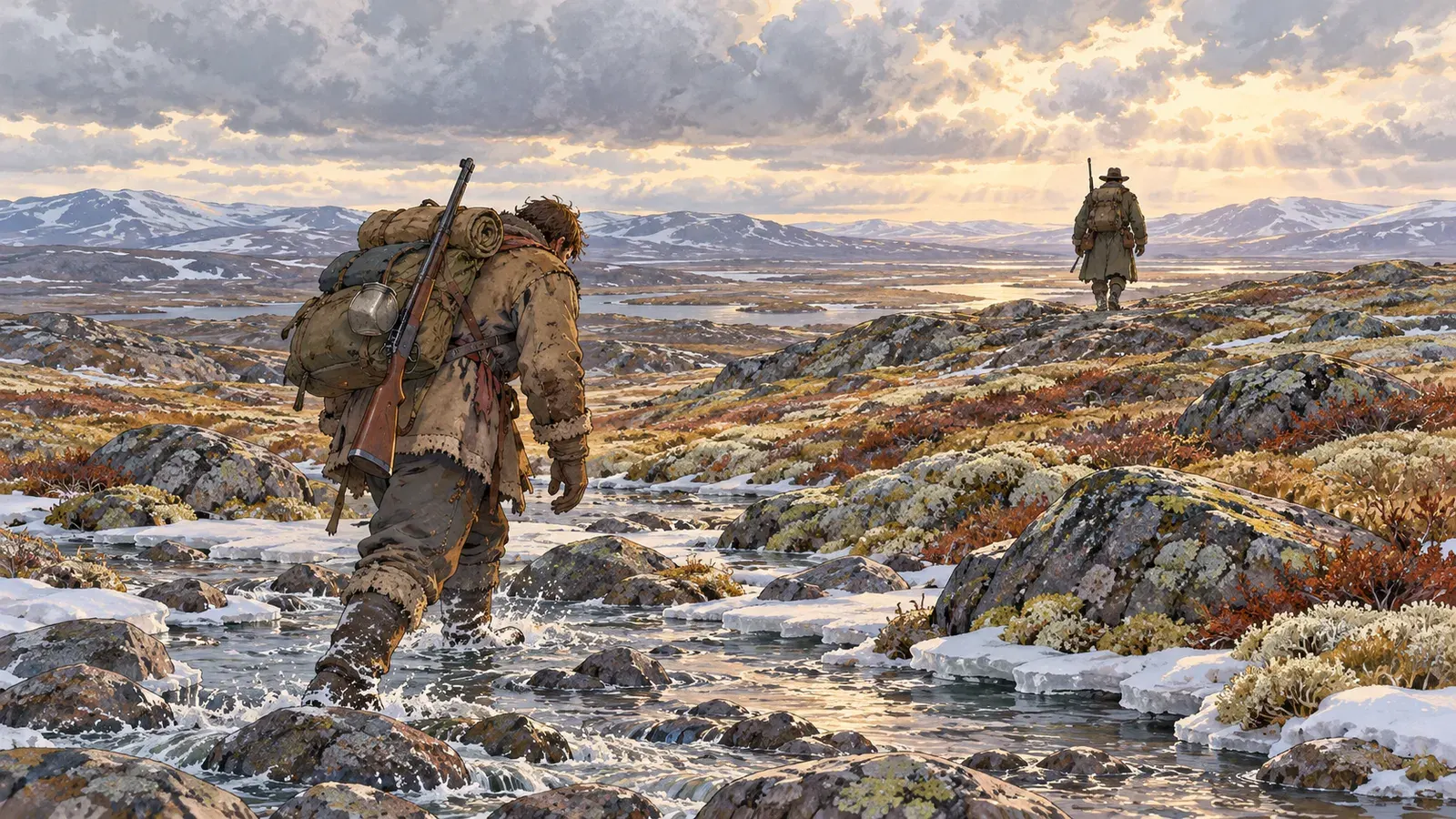
They limped painfully down the bank, and once the foremost of the two men staggered among the rough-strewn rocks. They were tired and weak, and their faces had the drawn expression of patience which comes of hardship long endured. They were heavily burdened with blanket packs which were strapped to their shoulders. Head-straps, passing across the forehead, helped support these packs. Each man carried a rifle. They walked in a stooped posture, the shoulders well forward, the head still farther forward, the eyes bent upon the ground.
二人の男が、足を引きずりながら、苦しげに土手をおりていった。一度、前を行く男が、ごろごろと散らばる岩のあいだでよろめいた。二人とも疲れきって、弱っていた。その顔には、長いあいだ苦しみに耐えてきた者の、やつれた、じっとこらえる表情が浮かんでいた。肩には毛布で包んだ荷を、ひもでくくって背負っていた。荷は重く、額にまわしたひもが、その重みを支える助けになっていた。めいめいが銃を一丁ずつ持っていた。二人は前かがみになって歩いていた。肩をぐっと前に出し、頭はさらに前に突き出し、目を地面に落としていた。
"I wish we had just about two of them cartridges that's layin' in that cache of ourn," said the second man.
「あの隠し場所に置いてきた弾が、せめて二発ばかりありゃあなあ」と、後ろの男が言った。
His voice was utterly and drearily expressionless. He spoke without enthusiasm; and the first man, limping into the milky stream that foamed over the rocks, vouchsafed no reply.
その声には、まるで、うんざりするほど張りがなかった。気のない言い方だった。前の男は、岩の上で泡立っている乳白色の流れに足を引きずって入っていきながら、返事ひとつしなかった。
The other man followed at his heels. They did not remove their foot-gear, though the water was icy cold—so cold that their ankles ached and their feet went numb. In places the water dashed against their knees, and both men staggered for footing.
後ろの男も、すぐあとに続いた。水は氷のように冷たかった。足首が痛み、足の感覚がなくなるほど冷たかった。それでも二人は、はき物を脱がなかった。ところどころで水がひざにぶつかり、二人とも足場を探してよろめいた。
The man who followed slipped on a smooth boulder, nearly fell, but recovered himself with a violent effort, at the same time uttering a sharp exclamation of pain. He seemed faint and dizzy and put out his free hand while he reeled, as though seeking support against the air. When he had steadied himself he stepped forward, but reeled again and nearly fell. Then he stood still and looked at the other man, who had never turned his head.
後ろの男が、つるつるした丸石に足をすべらせた。あやうく倒れかけたが、必死に踏んばって持ちこたえた。同時に、痛みに鋭い声をあげた。気が遠くなり、めまいがしたらしい。よろめきながら、空いているほうの手を伸ばした。まるで空気につかまろうとするかのようだった。体勢を立て直すと、一歩踏み出したが、またよろめいて、あやうく倒れかけた。それから男はじっと立ち止まり、もう一人の男を見た。その男は一度も振り返っていなかった。
The man stood still for fully a minute, as though debating with himself. Then he called out:
男はたっぷり一分ほど、自分と言い争ってでもいるように、じっと立っていた。それから呼びかけた。
"I say, Bill, I've sprained my ankle."
「おい、ビル、足首をくじいちまった」
Bill staggered on through the milky water. He did not look around. The man watched him go, and though his face was expressionless as ever, his eyes were like the eyes of a wounded deer.
ビルは乳白色の水の中を、よろよろと進んでいった。振り返りはしなかった。男はビルが行くのを見ていた。顔はあいかわらず無表情だったが、目は傷ついた鹿の目のようだった。
The other man limped up the farther bank and continued straight on without looking back. The man in the stream watched him. His lips trembled a little, so that the rough thatch of brown hair which covered them was visibly agitated. His tongue even strayed out to moisten them.
ビルは足を引きずりながら向こう岸をのぼり、振り返りもせずにまっすぐ進み続けた。流れの中の男はそれを見ていた。唇が少しふるえ、それを覆う茶色のもじゃもじゃの口ひげが、目に見えて揺れた。舌までがのぞいて、唇をしめらせた。
"Bill!" he cried out.
「ビル!」と男は叫んだ。
It was the pleading cry of a strong man in distress, but Bill's head did not turn. The man watched him go, limping grotesquely and lurching forward with stammering gait up the slow slope toward the soft sky-line of the low-lying hill. He watched him go till he passed over the crest and disappeared. Then he turned his gaze and slowly took in the circle of the world that remained to him now that Bill was gone.
困りはてた強い男の、すがるような叫びだった。だがビルは振り向かなかった。男はビルが行くのを見ていた。ぶざまに足を引きずり、つっかえつっかえ前のめりによろめきながら、低い丘のやわらかな稜線に向かって、ゆるやかな坂をのぼっていった。ビルが尾根を越えて見えなくなるまで、男はその姿を見送った。それから目を移し、ビルがいなくなったいま、自分に残された世界をぐるりと、ゆっくり見わたした。
Near the horizon the sun was smouldering dimly, almost obscured by formless mists and vapors, which gave an impression of mass and density without outline or tangibility. The man pulled out his watch, the while resting his weight on one leg. It was four o'clock, and as the season was near the last of July or first of August,—he did not know the precise date within a week or two,—he knew that the sun roughly marked the northwest. He looked to the south and knew that somewhere beyond those bleak hills lay the Great Bear Lake; also, he knew that in that direction the Arctic Circle cut its forbidding way across the Canadian Barrens. This stream in which he stood was a feeder to the Coppermine River, which in turn flowed north and emptied into Coronation Gulf and the Arctic Ocean. He had never been there, but he had seen it, once, on a Hudson Bay Company chart.
地平線の近くで、太陽がぼんやりとくすぶっていた。形のない霧ともやに、ほとんど覆い隠されていた。そのもやには輪郭も手ざわりもないのに、どっしりとした重さと濃さが感じられた。男は片脚に体重をかけて休みながら、時計を取り出した。四時だった。季節は七月の終わりか、八月の初めごろだった。正確な日付は、一、二週間のずれがあってもわからなかった。だから、太陽はだいたい北西にあるのだとわかった。南を見た。あの荒涼とした丘の向こうのどこかに、グレート・ベア湖があるはずだった。その方角では、北極圏の線が、カナダの不毛地帯を横切って、寒々とした道を引いていることも知っていた。いま立っているこの流れは、コッパーマイン川の支流だった。コッパーマイン川はさらに北へ流れ、コロネーション湾と北極海に注いでいる。そこへ行ったことはなかったが、一度、ハドソン湾会社の地図で見たことがあった。
Again his gaze completed the circle of the world about him. It was not a heartening spectacle. Everywhere was soft sky-line. The hills were all low-lying. There were no trees, no shrubs, no grasses—naught but a tremendous and terrible desolation that sent fear swiftly dawning into his eyes.
男の目は、もう一度まわりの世界をぐるりと見わたした。心を励ましてくれるような景色ではなかった。どこを見ても、やわらかな稜線ばかりだった。丘はどれも低かった。木もなく、茂みもなく、草もない。あるのはただ、とてつもなく恐ろしい荒涼ばかりで、それを見ると、たちまち男の目に恐怖の色が浮かんだ。
"Bill!" he whispered, once and twice; "Bill!"
「ビル!」と男は一度、二度、ささやいた。「ビル!」
He cowered in the midst of the milky water, as though the vastness were pressing in upon him with overwhelming force, brutally crushing him with its complacent awfulness. He began to shake as with an ague-fit, till the gun fell from his hand with a splash. This served to rouse him. He fought with his fear and pulled himself together, groping in the water and recovering the weapon. He hitched his pack farther over on his left shoulder, so as to take a portion of its weight from off the injured ankle. Then he proceeded, slowly and carefully, wincing with pain, to the bank.
男は乳白色の水のまんなかで身をすくめた。この果てしない広がりが、圧倒的な力で迫ってきて、平然とした恐ろしさで、自分を容赦なく押しつぶそうとしているかのようだった。男はおこりにかかったようにふるえだし、とうとう銃が手から落ちて、ばしゃりと音を立てた。その音で、男はわれに返った。恐怖と闘い、気を取り直して、水の中を手探りして銃を拾い上げた。荷をさらに左肩へずらし、くじいた足首にかかる重みを少しでも減らそうとした。それから、痛みに顔をしかめながら、ゆっくり、用心深く、岸へ向かって進んだ。
He did not stop. With a desperation that was madness, unmindful of the pain, he hurried up the slope to the crest of the hill over which his comrade had disappeared—more grotesque and comical by far than that limping, jerking comrade. But at the crest he saw a shallow valley, empty of life. He fought with his fear again, overcame it, hitched the pack still farther over on his left shoulder, and lurched on down the slope.
男は立ち止まらなかった。狂ったように必死になって、痛みもかまわず、相棒の消えた丘の尾根まで、坂を急いでのぼっていった。足を引きずり、ぎくしゃく歩いていたあの相棒よりも、はるかにぶざまで、滑稽な姿だった。だが尾根に着くと、目に入ったのは、生き物の影ひとつない、浅い谷だった。男はまた恐怖と闘い、それに打ち勝った。荷をさらに左肩へずらし、よろめきながら坂をおりていった。
The bottom of the valley was soggy with water, which the thick moss held, spongelike, close to the surface. This water squirted out from under his feet at every step, and each time he lifted a foot the action culminated in a sucking sound as the wet moss reluctantly released its grip. He picked his way from muskeg to muskeg, and followed the other man's footsteps along and across the rocky ledges which thrust like islets through the sea of moss.
谷底は水でぐしょぐしょだった。厚い苔が、スポンジのように、地面のすぐ下に水をたっぷり含んでいたのだ。一歩踏み出すたびに、足の下から水がぴゅっと噴き出した。足を持ち上げるたびに、ぬれた苔がしぶしぶ足を放し、ずぼっと吸いつくような音がした。男は湿地から湿地へと足場を選んで進み、苔の海に小島のように突き出た岩棚に沿って、あるいは岩棚を横切って、ビルの足跡をたどっていった。
Though alone, he was not lost. Farther on he knew he would come to where dead spruce and fir, very small and weazened, bordered the shore of a little lake, the titchin-nichilie, in the tongue of the country, the "land of little sticks." And into that lake flowed a small stream, the water of which was not milky. There was rush-grass on that stream—this he remembered well—but no timber, and he would follow it till its first trickle ceased at a divide. He would cross this divide to the first trickle of another stream, flowing to the west, which he would follow until it emptied into the river Dease, and here he would find a cache under an upturned canoe and piled over with many rocks. And in this cache would be ammunition for his empty gun, fish-hooks and lines, a small net—all the utilities for the killing and snaring of food. Also, he would find flour,—not much,—a piece of bacon, and some beans.
ひとりぼっちではあったが、道に迷ってはいなかった。もっと先へ行けば、小さな湖に出る。岸には、ひどく小さくしなびたトウヒやモミが、枯れて立ち並んでいる。そこは土地の言葉で「ティッチン・ニチリー」、つまり「小枝の国」と呼ばれていた。男はそれを知っていた。その湖には小さな流れが注ぎこんでいて、その水は乳白色ではない。その流れにはイグサが生えていた。それはよく覚えていた。だが、木は生えていない。その流れを、水が分水嶺でちょろちょろと途切れるところまでたどっていこう。分水嶺を越えれば、西へ流れる別の流れの源に出る。それをたどっていけば、やがてディーズ川に注ぐ。そこに、隠し場所があるはずだった。ひっくり返したカヌーの下に隠して、上にたくさんの石を積み上げてある。その隠し場所には、空になった銃の弾や、釣り針や、釣り糸や、小さな網がある。獲物を仕留めたり、罠にかけたりする道具が、みなそろっているのだ。それに小麦粉もある。たいした量ではないが。ベーコンもひと切れあるし、豆も少しある。
Bill would be waiting for him there, and they would paddle away south down the Dease to the Great Bear Lake. And south across the lake they would go, ever south, till they gained the Mackenzie. And south, still south, they would go, while the winter raced vainly after them, and the ice formed in the eddies, and the days grew chill and crisp, south to some warm Hudson Bay Company post, where timber grew tall and generous and there was grub without end.
ビルはそこで待っていてくれるだろう。そして二人でカヌーをこいでディーズ川を南へ下り、グレート・ベア湖まで行くのだ。湖を南へ渡り、どこまでも南へ、マッケンジー川に着くまで行く。そしてさらに南へ、なおも南へ行く。冬はむなしく二人を追いかけ、よどみには氷が張り、日ごとに冷たく、きりりと冷えこんでいく。そうやって南へ、どこか暖かいハドソン湾会社の交易所まで行くのだ。そこでは木が高く、たっぷりと茂り、食い物はいくらでもある。
These were the thoughts of the man as he strove onward. But hard as he strove with his body, he strove equally hard with his mind, trying to think that Bill had not deserted him, that Bill would surely wait for him at the cache. He was compelled to think this thought, or else there would not be any use to strive, and he would have lain down and died. And as the dim ball of the sun sank slowly into the northwest he covered every inch—and many times—of his and Bill's flight south before the downcoming winter. And he conned the grub of the cache and the grub of the Hudson Bay Company post over and over again. He had not eaten for two days; for a far longer time he had not had all he wanted to eat. Often he stooped and picked pale muskeg berries, put them into his mouth, and chewed and swallowed them. A muskeg berry is a bit of seed enclosed in a bit of water. In the mouth the water melts away and the seed chews sharp and bitter. The man knew there was no nourishment in the berries, but he chewed them patiently with a hope greater than knowledge and defying experience.
必死に進みながら、男はそんなことを考えていた。だが体で必死にもがくのと同じくらい、心でも必死にもがいていた。ビルは自分を見捨てたのではない。ビルはきっと、隠し場所で待っていてくれる。そう考えようとしていたのだ。そう考えずにはいられなかった。そうでなければ、もがいても何の意味もない。横になって死んでしまっただろう。ぼんやりとした太陽の玉が、ゆっくりと北西に沈んでいくあいだ、男は、迫ってくる冬を前にして自分とビルが南へ逃げていく道のりを、一インチ残らず、何度もたどってみた。そして、隠し場所の食い物と、ハドソン湾会社の交易所の食い物のことを、何度も何度も思い浮かべた。もう二日も何も食べていなかった。腹いっぱい食べたのは、それよりずっと前のことだった。男はたびたびかがんで、湿地に生える色の薄い木の実を摘み、口に入れて、噛んで飲みこんだ。湿地の木の実というのは、ほんの少しの水に、ほんの少しの種がくるまれたものだ。口に入れると水は消え、種は噛むと鋭く苦い。この実には何の栄養もないことを、男は知っていた。それでも、知っていることよりも大きな、これまでの経験を無視するような望みをいだいて、根気よく噛み続けた。
At nine o'clock he stubbed his toe on a rocky ledge, and from sheer weariness and weakness staggered and fell. He lay for some time, without movement, on his side. Then he slipped out of the pack-straps and clumsily dragged himself into a sitting posture. It was not yet dark, and in the lingering twilight he groped about among the rocks for shreds of dry moss. When he had gathered a heap he built a fire,—a smouldering, smudgy fire,—and put a tin pot of water on to boil.
九時に、男は岩棚につま先をぶつけ、ただもう疲れはて、弱りきっていたので、よろめいて倒れた。しばらく横向きに倒れたまま、身動きもしなかった。それから荷のひもから体を抜き、ぎこちなく体を引きずって起き上がり、座った。まだ暗くはなかった。なごりの薄明かりの中で、男は岩のあいだを手探りして、乾いた苔のきれはしを探した。ひと山集めると火をおこした。くすぶって煙ばかり出る火だった。そしてブリキの鍋に水を入れ、火にかけて湯を沸かした。
He unwrapped his pack and the first thing he did was to count his matches. There were sixty-seven. He counted them three times to make sure. He divided them into several portions, wrapping them in oil paper, disposing of one bunch in his empty tobacco pouch, of another bunch in the inside band of his battered hat, of a third bunch under his shirt on the chest. This accomplished, a panic came upon him, and he unwrapped them all and counted them again. There were still sixty-seven.
男は荷をほどいた。まっさきにしたのは、マッチを数えることだった。六十七本あった。確かめるために三度数えた。それをいくつかに分けて油紙に包んだ。ひと束は空になったたばこ入れに、もうひと束はくたびれた帽子の内側の帯に、三つ目の束はシャツの下の胸のところに入れた。それがすむと、急に不安でたまらなくなり、全部の包みをほどいて、もう一度数えた。やはり六十七本だった。
He dried his wet foot-gear by the fire. The moccasins were in soggy shreds. The blanket socks were worn through in places, and his feet were raw and bleeding. His ankle was throbbing, and he gave it an examination. It had swollen to the size of his knee. He tore a long strip from one of his two blankets and bound the ankle tightly. He tore other strips and bound them about his feet to serve for both moccasins and socks. Then he drank the pot of water, steaming hot, wound his watch, and crawled between his blankets.
男はぬれたはき物を火で乾かした。モカシンはぐしょぐしょで、ずたずたになっていた。毛布地の靴下はところどころすり切れて穴があき、足は皮がむけて血が出ていた。足首がずきずきと脈打っていたので、調べてみた。ひざほどの太さに腫れあがっていた。男は二枚ある毛布の一枚から長い帯を裂きとって、足首をきつくしばった。さらに別の帯を裂いて足に巻き、モカシンと靴下のかわりにした。それから湯気の立つ熱い湯を、鍋ごと飲みほし、時計のねじを巻いて、毛布のあいだにもぐりこんだ。
He slept like a dead man. The brief darkness around midnight came and went. The sun arose in the northeast—at least the day dawned in that quarter, for the sun was hidden by gray clouds.
男は死んだように眠った。真夜中ごろの、つかのまの暗闇が来て、去った。太陽は北東から昇った。少なくとも、その方角から夜が明けた。太陽は灰色の雲に隠れていたのだ。
At six o'clock he awoke, quietly lying on his back. He gazed straight up into the gray sky and knew that he was hungry. As he rolled over on his elbow he was startled by a loud snort, and saw a bull caribou regarding him with alert curiosity. The animal was not mere than fifty feet away, and instantly into the man's mind leaped the vision and the savor of a caribou steak sizzling and frying over a fire. Mechanically he reached for the empty gun, drew a bead, and pulled the trigger. The bull snorted and leaped away, his hoofs rattling and clattering as he fled across the ledges.
六時に、男は仰向けに静かに寝たまま目を覚ました。灰色の空をまっすぐ見上げ、腹が減っているのに気づいた。ひじをついて寝返りを打とうとしたとき、大きな鼻息にぎょっとした。見ると、雄のカリブーが、油断なく、ふしぎそうにこちらを見ていた。五十フィートと離れていなかった。たちまち男の頭に、火の上でじゅうじゅう焼けるカリブーのステーキの姿と香りが浮かんだ。男は思わず空の銃に手を伸ばし、狙いをつけて、引き金を引いた。雄のカリブーは鼻を鳴らして跳びのき、岩棚を横切って逃げていった。ひづめが、がらがら、かたかたと鳴った。
The man cursed and flung the empty gun from him. He groaned aloud as he started to drag himself to his feet. It was a slow and arduous task.
男は悪態をついて、空の銃を放り出した。体を引きずって立ち上がろうとしながら、大声でうめいた。のろのろとした、骨の折れる仕事だった。
His joints were like rusty hinges. They worked harshly in their sockets, with much friction, and each bending or unbending was accomplished only through a sheer exertion of will. When he finally gained his feet, another minute or so was consumed in straightening up, so that he could stand erect as a man should stand.
関節は錆びついた蝶番のようだった。ぎしぎしときしみながらでないと動かなかった。曲げるのも伸ばすのも、ただ意志の力をふりしぼって、やっとできることだった。ようやく立ち上がっても、人間らしくまっすぐ立てるように背を伸ばすのに、さらに一分ほどかかった。
He crawled up a small knoll and surveyed the prospect. There were no trees, no bushes, nothing but a gray sea of moss scarcely diversified by gray rocks, gray lakelets, and gray streamlets. The sky was gray. There was no sun nor hint of sun. He had no idea of north, and he had forgotten the way he had come to this spot the night before. But he was not lost. He knew that. Soon he would come to the land of the little sticks. He felt that it lay off to the left somewhere, not far—possibly just over the next low hill.
男は小さな丘を這いのぼって、あたりを見わたした。木もなく、茂みもなく、あるのはただ灰色の苔の海ばかりだった。灰色の岩、灰色の小さな湖、灰色の小川が、わずかに単調さを破っているだけだった。空も灰色だった。太陽はなく、太陽の気配さえなかった。北がどちらなのか見当もつかず、ゆうべこの場所へどうやって来たのかも忘れていた。だが、道に迷ってはいなかった。それはわかっていた。もうすぐ小枝の国に着くはずだ。それは左手のどこか、遠くないところにある。ひょっとすると、次の低い丘のすぐ向こうかもしれない。そんな気がした。
He went back to put his pack into shape for travelling. He assured himself of the existence of his three separate parcels of matches, though he did not stop to count them. But he did linger, debating, over a squat moose-hide sack. It was not large. He could hide it under his two hands. He knew that it weighed fifteen pounds,—as much as all the rest of the pack,—and it worried him. He finally set it to one side and proceeded to roll the pack. He paused to gaze at the squat moose-hide sack. He picked it up hastily with a defiant glance about him, as though the desolation were trying to rob him of it; and when he rose to his feet to stagger on into the day, it was included in the pack on his back.
男は戻って、旅に出られるように荷をととのえた。三つに分けたマッチの包みがあることを確かめたが、立ち止まって数えはしなかった。だが、ずんぐりしたヘラジカの革袋の前では、迷って、ぐずぐずした。大きなものではなかった。両手で覆い隠せるくらいだった。だが十五ポンドの重さがある。ほかの荷を全部合わせたのと同じくらいだ。それが悩みの種だった。男はとうとうそれをわきへ置き、荷を巻きはじめた。そして手を止めて、ずんぐりした革袋を見つめた。荒野がそれを奪いとろうとしているかのように、挑むような目であたりを見まわしながら、男は急いでそれを拾い上げた。そして立ち上がって、よろめきながらその日の旅に出たとき、それは背中の荷の中に入っていた。
He bore away to the left, stopping now and again to eat muskeg berries. His ankle had stiffened, his limp was more pronounced, but the pain of it was as nothing compared with the pain of his stomach. The hunger pangs were sharp. They gnawed and gnawed until he could not keep his mind steady on the course he must pursue to gain the land of little sticks. The muskeg berries did not allay this gnawing, while they made his tongue and the roof of his mouth sore with their irritating bite.
男は左のほうへ進んでいき、ときどき立ち止まっては、湿地の木の実を食べた。足首はこわばり、足の引きずり方はますますひどくなった。だがその痛みは、胃の痛みにくらべれば何でもなかった。ひもじさの痛みは鋭かった。かじって、かじって、かじり続けた。小枝の国に着くために進まなければならない道に、気持ちを集中していられないほどだった。湿地の木の実は、このかじられるような痛みをやわらげてはくれなかった。それどころか、ひりひりする刺激で、舌と上あごを痛めた。
He came upon a valley where rock ptarmigan rose on whirring wings from the ledges and muskegs. Ker—ker—ker was the cry they made. He threw stones at them, but could not hit them. He placed his pack on the ground and stalked them as a cat stalks a sparrow. The sharp rocks cut through his pants' legs till his knees left a trail of blood; but the hurt was lost in the hurt of his hunger. He squirmed over the wet moss, saturating his clothes and chilling his body; but he was not aware of it, so great was his fever for food. And always the ptarmigan rose, whirring, before him, till their ker—ker—ker became a mock to him, and he cursed them and cried aloud at them with their own cry.
ある谷に出ると、ライチョウが岩棚や湿地から、羽音を立てて飛び立った。ケル、ケル、ケル、と鳴いた。男は石を投げつけたが、当たらなかった。荷を地面に置き、猫がスズメに忍び寄るように、ライチョウに忍び寄った。とがった岩がズボンの脚を切り裂き、ひざから血の跡が続いた。だがその痛みは、飢えの痛みにまぎれてしまった。男はぬれた苔の上を這いずりまわり、服はびしょぬれになり、体は冷えきった。だが、食べ物を求める熱があまりに激しかったので、気づきもしなかった。そしていつも、ライチョウは目の前で羽音を立てて飛び立った。とうとうそのケル、ケル、ケルという声が、自分をあざ笑っているように思えてきた。男はライチョウをののしり、その鳴き声をまねて、大声で叫び返した。
Once he crawled upon one that must have been asleep. He did not see it till it shot up in his face from its rocky nook. He made a clutch as startled as was the rise of the ptarmigan, and there remained in his hand three tail-feathers. As he watched its flight he hated it, as though it had done him some terrible wrong. Then he returned and shouldered his pack.
一度、眠っていたらしい一羽に這い寄った。岩のくぼみから顔めがけて飛び上がるまで、その鳥に気づかなかった。ライチョウが飛び立ったのと同じくらいぎょっとして、男はつかみかかった。手の中には、尾羽が三本残った。飛んでいく鳥を見つめながら、男は、何かひどい仕打ちでも受けたかのように、その鳥を憎んだ。それから引き返して、荷を背負った。
As the day wore along he came into valleys or swales where game was more plentiful. A band of caribou passed by, twenty and odd animals, tantalizingly within rifle range. He felt a wild desire to run after them, a certitude that he could run them down. A black fox came toward him, carrying a ptarmigan in his mouth. The man shouted. It was a fearful cry, but the fox, leaping away in fright, did not drop the ptarmigan.
日が進むにつれて、男は獲物の多い谷や低地に入っていった。二十頭あまりのカリブーの群れが、銃の届くところを、じれったいほどすぐそばを通り過ぎていった。群れを追いかけて走りたい、狂おしい気持ちがわいた。走って追いつめられる、という確信があった。黒いキツネが、口にライチョウをくわえて、こちらへやって来た。男は叫んだ。恐ろしい叫び声だった。だがキツネは、驚いて跳びのきはしたものの、ライチョウを落とさなかった。
Late in the afternoon he followed a stream, milky with lime, which ran through sparse patches of rush-grass. Grasping these rushes firmly near the root, he pulled up what resembled a young onion-sprout no larger than a shingle-nail. It was tender, and his teeth sank into it with a crunch that promised deliciously of food. But its fibers were tough. It was composed of stringy filaments saturated with water, like the berries, and devoid of nourishment. He threw off his pack and went into the rush-grass on hands and knees, crunching and munching, like some bovine creature.
午後遅く、男は石灰で乳白色に濁った流れをたどっていった。流れは、まばらに生えたイグサのあいだを流れていた。そのイグサを根もとのあたりでしっかりつかんで引き抜くと、若いタマネギの芽のようなものが出てきた。屋根板を打つ釘ほどの大きさしかない。やわらかくて、歯を立てるとさくりと音がした。いかにもおいしい食べ物のように思えた。だが、筋が硬かった。木の実と同じように、水を含んだ筋ばかりで、栄養はまるでなかった。男は荷を放り出し、四つんばいになってイグサの中に入っていき、牛か何かのように、ばりばり、むしゃむしゃと噛んだ。
He was very weary and often wished to rest—to lie down and sleep; but he was continually driven on—not so much by his desire to gain the land of little sticks as by his hunger. He searched little ponds for frogs and dug up the earth with his nails for worms, though he knew in spite that neither frogs nor worms existed so far north.
男はひどく疲れていて、休みたい、横になって眠りたいと、たびたび思った。だがいつも駆り立てられていた。小枝の国に着きたいという願いよりも、むしろ飢えに駆り立てられていたのだ。男は小さな池をのぞいてカエルを探し、爪で土を掘ってミミズを探した。こんな北の果てには、カエルもミミズもいないとわかっていたのに。
He looked into every pool of water vainly, until, as the long twilight came on, he discovered a solitary fish, the size of a minnow, in such a pool. He plunged his arm in up to the shoulder, but it eluded him. He reached for it with both hands and stirred up the milky mud at the bottom. In his excitement he fell in, wetting himself to the waist. Then the water was too muddy to admit of his seeing the fish, and he was compelled to wait until the sediment had settled.
男は水たまりを片っぱしからのぞきこんだが、むだだった。だが長い夕暮れが近づいてきたころ、そんな水たまりのひとつに、小魚ほどの大きさの魚が一匹だけいるのを見つけた。肩まで腕を突っこんだが、魚はするりと逃げた。両手を伸ばしてつかもうとして、底の乳白色の泥をかきまわしてしまった。夢中になるあまり、水たまりに落ちて、腰までぬれた。そうなると水が濁って魚が見えない。泥が沈むまで待たなければならなかった。
The pursuit was renewed, till the water was again muddied. But he could not wait. He unstrapped the tin bucket and began to bale the pool. He baled wildly at first, splashing himself and flinging the water so short a distance that it ran back into the pool. He worked more carefully, striving to be cool, though his heart was pounding against his chest and his hands were trembling. At the end of half an hour the pool was nearly dry. Not a cupful of water remained. And there was no fish. He found a hidden crevice among the stones through which it had escaped to the adjoining and larger pool—a pool which he could not empty in a night and a day. Had he known of the crevice, he could have closed it with a rock at the beginning and the fish would have been his.
男はまた魚を追いかけたが、また水が濁った。もう待っていられなかった。ブリキのバケツを荷からはずし、水たまりの水をかい出しはじめた。初めはがむしゃらにかい出したので、自分に水をはねかけてしまった。それに、水をほんの近くにしか捨てられないので、水はまた水たまりに流れ戻った。胸の中で心臓が激しく打ち、手はふるえていた。それでも落ちつこうと努めて、もっとていねいに作業した。三十分たつと、水たまりはほとんど干上がった。カップ一杯ほどの水も残っていない。そして、魚はいなかった。石のあいだに隠れた割れ目が見つかった。魚はそこから、隣のもっと大きな水たまりへ逃げていったのだ。ひと晩とひと昼かけても、かい出せないような水たまりへ。割れ目のことを知っていたら、初めに石でふさいでおけたのに。そうすれば、魚は自分のものだったのに。
Thus he thought, and crumpled up and sank down upon the wet earth. At first he cried softly to himself, then he cried loudly to the pitiless desolation that ringed him around; and for a long time after he was shaken by great dry sobs.
そう思うと、男はくずおれて、ぬれた地面にへたりこんだ。初めは小さな声で泣いていたが、やがて、自分を取り巻く無慈悲な荒野に向かって、大声で泣いた。そしてそのあと長いあいだ、涙も出ない激しいすすり泣きに、身をふるわせていた。
He built a fire and warmed himself by drinking quarts of hot water, and made camp on a rocky ledge in the same fashion he had the night before. The last thing he did was to see that his matches were dry and to wind his watch. The blankets were wet and clammy. His ankle pulsed with pain. But he knew only that he was hungry, and through his restless sleep he dreamed of feasts and banquets and of food served and spread in all imaginable ways.
男は火をおこし、熱い湯を何クォートも飲んで体を温め、前の晩と同じように、岩棚の上で野宿した。最後に、マッチが乾いているかを確かめ、時計のねじを巻いた。毛布はぬれて、じっとりと冷たかった。足首は痛みに脈打っていた。だが男にわかっているのは、腹が減っているということだけだった。寝苦しい眠りの中で、ごちそうや宴会の夢を見た。思いつくかぎりのやり方で出され、並べられた食べ物の夢を見た。
He awoke chilled and sick. There was no sun. The gray of earth and sky had become deeper, more profound. A raw wind was blowing, and the first flurries of snow were whitening the hilltops. The air about him thickened and grew white while he made a fire and boiled more water. It was wet snow, half rain, and the flakes were large and soggy. At first they melted as soon as they came in contact with the earth, but ever more fell, covering the ground, putting out the fire, spoiling his supply of moss-fuel.
目を覚ますと、体は冷えきり、気分が悪かった。太陽は出ていなかった。地面と空の灰色は、いっそう深く、濃くなっていた。冷たい風が吹き、初雪がちらちらと舞って、丘のてっぺんを白く染めていた。男が火をおこして湯をまた沸かしているあいだに、まわりの空気は濃く、白くなっていった。なかば雨のような湿った雪で、雪片は大きく、水っぽかった。初めは地面にふれるとすぐにとけていたが、次から次へと降ってきて、地面を覆い、火を消し、燃料にする苔を台なしにした。
This was a signal for him to strap on his pack and stumble onward, he knew not where. He was not concerned with the land of little sticks, nor with Bill and the cache under the upturned canoe by the river Dease. He was mastered by the verb "to eat." He was hunger-mad. He took no heed of the course he pursued, so long as that course led him through the swale bottoms. He felt his way through the wet snow to the watery muskeg berries, and went by feel as he pulled up the rush-grass by the roots. But it was tasteless stuff and did not satisfy. He found a weed that tasted sour and he ate all he could find of it, which was not much, for it was a creeping growth, easily hidden under the several inches of snow.
それを合図に、男は荷を背負い、どこへともなく、よろめきながら進んでいった。小枝の国のことも、ビルのことも、ディーズ川のほとりの、ひっくり返したカヌーの下の隠し場所のことも、もう頭になかった。頭にあるのは「食べる」という動詞だけだった。男は飢えで気が狂っていた。低地の底を通っているかぎり、どの道をたどろうとおかまいなしだった。湿った雪の中を手探りして、水っぽい湿地の木の実を探し、手ざわりだけをたよりにイグサを根こそぎ引き抜いた。だが、どれも味がなく、腹は満たされなかった。酸っぱい味のする草を見つけて、見つかるかぎり全部食べた。だがたいした量ではなかった。地を這う草で、数インチの雪の下に、たやすく隠れてしまうのだ。
He had no fire that night, nor hot water, and crawled under his blanket to sleep the broken hunger-sleep. The snow turned into a cold rain. He awakened many times to feel it falling on his upturned face. Day came—a gray day and no sun. It had ceased raining. The keenness of his hunger had departed. Sensibility, as far as concerned the yearning for food, had been exhausted. There was a dull, heavy ache in his stomach, but it did not bother him so much. He was more rational, and once more he was chiefly interested in the land of little sticks and the cache by the river Dease.
その夜は、火もなく、熱い湯もなかった。男は毛布の下にもぐりこみ、飢えた者の、とぎれとぎれの眠りについた。雪は冷たい雨に変わった。男は何度も目を覚まし、上を向いた顔に雨が降りかかるのを感じた。夜が明けた。灰色の日で、太陽は出なかった。雨はやんでいた。飢えの鋭さは消えていた。食べ物をほしがる感覚は、すっかり使いはたされてしまったのだ。胃には鈍い、重い痛みがあったが、それほど気にはならなかった。男は前より頭がはっきりしていて、ふたたび、小枝の国とディーズ川のほとりの隠し場所のことを、何より気にかけるようになっていた。
He ripped the remnant of one of his blankets into strips and bound his bleeding feet. Also, he recinched the injured ankle and prepared himself for a day of travel. When he came to his pack, he paused long over the squat moose-hide sack, but in the end it went with him.
男は毛布の一枚の残りを裂いて帯にし、血の出ている足をしばった。くじいた足首もしばり直し、一日の旅の支度をした。荷のところへ来ると、ずんぐりした革袋の前で長いあいだためらった。だが結局、それも一緒に持っていった。
The snow had melted under the rain, and only the hilltops showed white. The sun came out, and he succeeded in locating the points of the compass, though he knew now that he was lost. Perhaps, in his previous days' wanderings, he had edged away too far to the left. He now bore off to the right to counteract the possible deviation from his true course.
雪は雨でとけ、丘のてっぺんだけが白く見えていた。太陽が出てきたので、方角を見定められた。もっとも、自分が道に迷っていることは、いまではわかっていた。たぶん、この何日かさまよっているうちに、左に寄りすぎてしまったのだろう。本来の道からそれた分を取り戻そうと、今度は右へ向かって進んだ。
Though the hunger pangs were no longer so exquisite, he realized that he was weak. He was compelled to pause for frequent rests, when he attacked the muskeg berries and rush-grass patches. His tongue felt dry and large, as though covered with a fine hairy growth, and it tasted bitter in his mouth. His heart gave him a great deal of trouble. When he had travelled a few minutes it would begin a remorseless thump, thump, thump, and then leap up and away in a painful flutter of beats that choked him and made him go faint and dizzy.
ひもじさの痛みは、もう前ほど激しくはなかった。だが、自分が弱っていることはわかった。たびたび立ち止まって休まなければならなかった。そのたびに、湿地の木の実やイグサの茂みに飛びついた。舌は乾いて、大きくなったように感じられた。細かい毛でも生えているようで、口の中が苦かった。心臓がひどく男を苦しめた。数分歩くと、心臓は容赦なく、どきん、どきん、どきんと打ちはじめる。それから跳ね上がって、苦しいほどばたばたと打ち、男は息が詰まって、気が遠くなり、めまいがした。
In the middle of the day he found two minnows in a large pool. It was impossible to bale it, but he was calmer now and managed to catch them in his tin bucket. They were no longer than his little finger, but he was not particularly hungry. The dull ache in his stomach had been growing duller and fainter. It seemed almost that his stomach was dozing. He ate the fish raw, masticating with painstaking care, for the eating was an act of pure reason. While he had no desire to eat, he knew that he must eat to live.
昼ごろ、男は大きな水たまりに小魚を二匹見つけた。水をかい出すことはできなかった。だがいまは前より落ちついていたので、ブリキのバケツでなんとか二匹ともすくいとった。小指ほどの長さもなかった。だが男は、それほど腹が減っているわけではなかった。胃の鈍い痛みは、だんだん鈍く、かすかになってきていた。まるで胃がうたた寝しているようだった。男は魚を生のまま、念入りに噛んで食べた。食べることは、頭で考えてするだけのことになっていたのだ。食べたいとは思わなかった。だが生きるためには食べなければならないと、わかっていた。
In the evening he caught three more minnows, eating two and saving the third for breakfast. The sun had dried stray shreds of moss, and he was able to warm himself with hot water. He had not covered more than ten miles that day; and the next day, travelling whenever his heart permitted him, he covered no more than five miles. But his stomach did not give him the slightest uneasiness. It had gone to sleep. He was in a strange country, too, and the caribou were growing more plentiful, also the wolves. Often their yelps drifted across the desolation, and once he saw three of them slinking away before his path.
夕方、男はさらに三匹の小魚をつかまえ、二匹を食べて、三匹目は朝食にとっておいた。日の光が苔の切れはしを乾かしていたので、湯を沸かして体を温められた。その日は十マイルも進めなかった。次の日は、心臓が許すかぎり歩いたが、五マイルしか進めなかった。だが、胃は少しも苦しくなかった。眠ってしまったのだ。それに、男は見知らぬ土地に来ていた。カリブーがだんだん多くなり、狼も多くなってきた。狼の吠える声が、たびたび荒野を渡って聞こえてきた。一度は、三匹の狼が行く手からこそこそと逃げていくのを見た。
Another night; and in the morning, being more rational, he untied the leather string that fastened the squat moose-hide sack. From its open mouth poured a yellow stream of coarse gold-dust and nuggets. He roughly divided the gold in halves, caching one half on a prominent ledge, wrapped in a piece of blanket, and returning the other half to the sack. He also began to use strips of the one remaining blanket for his feet. He still clung to his gun, for there were cartridges in that cache by the river Dease.
また夜が来た。そして朝、前より頭がはっきりしていた男は、ずんぐりした革袋の口をしばっている革ひもをほどいた。開いた口から、粗い砂金と金の塊が、黄色い流れになってこぼれ出た。男は金をおおざっぱに半分に分けた。半分を毛布の切れはしに包んで、目立つ岩棚に隠し、残りの半分を袋に戻した。そして、残った一枚の毛布も、帯に裂いて足に巻くようになった。銃はまだ手放さなかった。ディーズ川のほとりのあの隠し場所には、弾があったからだ。