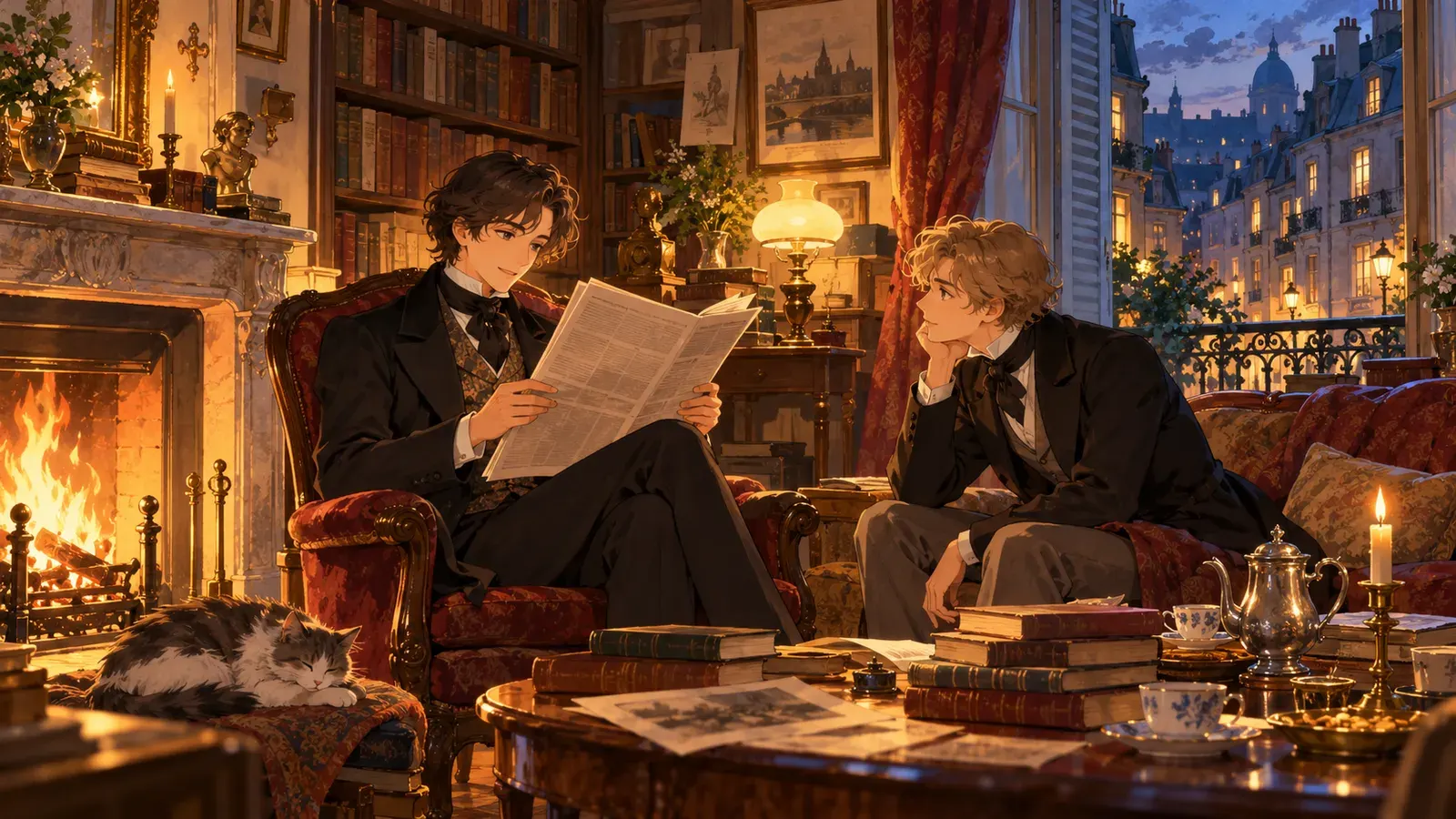
"The next question is that of the mode of descent. Upon this point I had been satisfied in my walk with you around the building. About five feet and a half from the casement in question there runs a lightning-rod. From this rod it would have been impossible for any one to reach the window itself, to say nothing of entering it. I observed, however, that the shutters of the fourth story were of the peculiar kind called by Parisian carpenters ferrades—a kind rarely employed at the present day, but frequently seen upon very old mansions at Lyons and Bordeaux. They are in the form of an ordinary door (a single, not a folding door), except that the lower half is latticed or worked in open trellis—thus affording an excellent hold for the hands. In the present instance these shutters are fully three feet and a half broad. When we saw them from the rear of the house, they were both about half open—that is to say, they stood off at right angles from the wall. It is probable that the police, as well as myself, examined the back of the tenement; but, if so, in looking at these ferrades in the line of their breadth (as they must have done), they did not perceive this great breadth itself, or, at all events, failed to take it into due consideration. In fact, having once satisfied themselves that no egress could have been made in this quarter, they would naturally bestow here a very cursory examination. It was clear to me, however, that the shutter belonging to the window at the head of the bed, would, if swung fully back to the wall, reach to within two feet of the lightning-rod. It was also evident that, by exertion of a very unusual degree of activity and courage, an entrance into the window, from the rod, might have been thus effected. By reaching to the distance of two feet and a half (we now suppose the shutter open to its whole extent) a robber might have taken a firm grasp upon the trellis-work. Letting go, then, his hold upon the rod, placing his feet securely against the wall, and springing boldly from it, he might have swung the shutter so as to close it, and, if we imagine the window open at the time, might even have swung himself into the room.
「次の問題は、どうやって下へおりたかだ。この点は、きみと建物のまわりを歩いたときに、もうわかっていた。問題の窓から五フィート半ほど離れたところに、避雷針が通っている。この避雷針からでは、窓に入るどころか、窓に手を届かせることさえ、誰にもできなかっただろう。ところがぼくは、四階のよろい戸が特殊なものだということに気づいた。パリの大工がフェラードと呼んでいる種類だ。今ではめったに使われないが、リヨンやボルドーのとても古い屋敷ではよく見かける。形はふつうの扉と同じで(両開きではなく片開きだ)、ただ下半分が格子、つまり透かしの格子細工になっている。だから手でつかむにはもってこいなんだ。この家のよろい戸は、幅がたっぷり三フィート半ある。ぼくたちが家の裏手から見たとき、よろい戸はどちらも半分ほど開いていた。つまり、壁から直角につきでていた。警察も、ぼくと同じように建物の裏を調べたのだろう。だがそうだとしても、彼らはきっとこのよろい戸を真横から見たんだ。そのせいで、この幅の広さそのものに気づかなかったか、少なくとも、それをきちんと考えに入れなかった。じっさい、こちらから逃げたはずはないと一度思いこんでしまえば、ここの調べがいいかげんになるのは当然だ。だがぼくには、はっきりわかった。寝台の頭のほうにある窓のよろい戸を、壁までいっぱいに開けば、避雷針から二フィートのところまで届く。そして、よほど並はずれた身軽さと度胸があれば、避雷針からこうして窓に入ることもできただろう。それも明らかだった。二フィート半ほど手をのばせば(よろい戸がいっぱいに開いていたとしてだ)、泥棒は格子をしっかりつかむことができただろう。それから避雷針から手をはなし、足を壁にしっかりつけて、思いきって壁をけって跳べば、よろい戸ごと体を振って、よろい戸を閉めることができたかもしれない。そしてもしそのとき窓が開いていたとすれば、その勢いで部屋のなかへ飛びこむことさえできたかもしれない。
"I wish you to bear especially in mind that I have spoken of a very unusual degree of activity as requisite to success in so hazardous and so difficult a feat. It is my design to show you, first, that the thing might possibly have been accomplished:—but, secondly and chiefly, I wish to impress upon your understanding the very extraordinary—the almost præternatural character of that agility which could have accomplished it.
「とくに覚えておいてほしいのは、これほど危なく、難しい離れわざをやってのけるには、よほど並はずれた身軽さがいる、とぼくが言ったことだ。ぼくがまず示したいのは、こんなことが、もしかするとできたかもしれない、ということだ。だがそれ以上に、何よりきみの頭にしっかり入れておいてほしいのは、それをやってのけた身軽さが、まったく並はずれた、ほとんど人間わざとは思えない種類のものだということなんだ。
"You will say, no doubt, using the language of the law, that 'to make out my case,' I should rather undervalue, than insist upon a full estimation of the activity required in this matter. This may be the practice in law, but it is not the usage of reason. My ultimate object is only the truth. My immediate purpose is to lead you to place in juxtaposition, that very unusual activity of which I have just spoken with that very peculiar shrill (or harsh) and unequal voice, about whose nationality no two persons could be found to agree, and in whose utterance no syllabification could be detected."
「きみはきっと、法律家のような言い方をするだろうね。『自分の主張を通す』には、この件で必要な身軽さを大きく言いたてるより、むしろ小さく見積もっておくべきだ、と。法廷ではそうするのかもしれない。だが、理性の流儀はちがう。ぼくの最後の目的は、ただ真実だけだ。そして今の目的は、きみに二つのことを並べて考えてもらうことなんだ。ひとつは、今話した、並はずれた身軽さ。もうひとつは、あのひどく特異な、甲高い(あるいはがさがさした)、ばらばらな調子の声だ。どこの国の人の声か、ふたりとして意見の合う者がなく、言葉の区切りがまるで聞きとれなかった声さ」
At these words a vague and half-formed conception of the meaning of Dupin flitted over my mind. I seemed to be upon the verge of comprehension without power to comprehend—as men, at times, find themselves upon the brink of remembrance without being able, in the end, to remember. My friend went on with his discourse.
この言葉を聞いて、デュパンの言おうとしていることが、ぼんやりと、なかば形になって、私の頭をかすめた。わかりかけているのに、わかる力がない。そんな気がした。ときどき、思い出せそうで、とうとう思い出せないことがあるが、あれと同じだった。友人は話をつづけた。
"You will see," he said, "that I have shifted the question from the mode of egress to that of ingress. It was my design to convey the idea that both were effected in the same manner, at the same point. Let us now revert to the interior of the room. Let us survey the appearances here. The drawers of the bureau, it is said, had been rifled, although many articles of apparel still remained within them. The conclusion here is absurd. It is a mere guess—a very silly one—and no more. How are we to know that the articles found in the drawers were not all these drawers had originally contained? Madame L'Espanaye and her daughter lived an exceedingly retired life—saw no company—seldom went out—had little use for numerous changes of habiliment. Those found were at least of as good quality as any likely to be possessed by these ladies. If a thief had taken any, why did he not take the best—why did he not take all? In a word, why did he abandon four thousand francs in gold to encumber himself with a bundle of linen? The gold was abandoned. Nearly the whole sum mentioned by Monsieur Mignaud, the banker, was discovered, in bags, upon the floor. I wish you, therefore, to discard from your thoughts the blundering idea of motive, engendered in the brains of the police by that portion of the evidence which speaks of money delivered at the door of the house. Coincidences ten times as remarkable as this (the delivery of the money, and murder committed within three days upon the party receiving it), happen to all of us every hour of our lives, without attracting even momentary notice. Coincidences, in general, are great stumbling-blocks in the way of that class of thinkers who have been educated to know nothing of the theory of probabilities—that theory to which the most glorious objects of human research are indebted for the most glorious of illustration. In the present instance, had the gold been gone, the fact of its delivery three days before would have formed something more than a coincidence. It would have been corroborative of this idea of motive. But, under the real circumstances of the case, if we are to suppose gold the motive of this outrage, we must also imagine the perpetrator so vacillating an idiot as to have abandoned his gold and his motive together.
「気づいただろうが」と彼は言った。「ぼくは問題を、どうやって出ていったかから、どうやって入ってきたかへ移した。出るのも入るのも、同じやり方で、同じ場所からだった。そう伝えたかったんだ。さて、部屋のなかへもどろう。ここのようすを見わたしてみよう。整理だんすの引き出しは物色されていた、と言われている。なかにはまだ服がたくさん残っていたというのにだ。この結論はばかげている。ただの当て推量、それもひどくまぬけな当て推量にすぎない。引き出しで見つかった品物が、もともと入っていた全部ではなかったと、どうしてわかるんだ? レスパネー夫人と娘は、ひどく人目をさけて暮らしていた。客にも会わず、めったに外出もしなかった。服をたくさん持っている必要などなかったんだ。見つかった服は、少なくとも、このふたりが持っていそうなどの服にも負けないくらい、上等なものだった。泥棒が何か持っていったのなら、なぜいちばん上等なのを持っていかなかったのか。なぜ全部持っていかなかったのか。ひとことで言えば、なぜ四千フランもの金貨を置きざりにして、布の包みなど背負いこんだのか。金貨は置きざりにされていた。銀行家のミニョー氏が言った金額のほとんど全部が、袋に入ったまま、床の上で見つかったんだ。だから、動機についてのとんちんかんな考えは、頭から捨ててほしい。家の戸口でお金が手わたされたという証言があったせいで、警察の頭に生まれた考えさ。偶然の一致なら、これ(お金が手わたされ、それを受けとった人が三日のうちに殺されたこと)の十倍も目立つことが、ぼくたちの身には、毎日、毎時間のように起きている。それでも、誰も一瞬たりとも気にとめはしない。偶然の一致というのは、たいてい、ある種の人たちにとって大きなつまずきの石になる。確率論というものを何も知らないように教えこまれてきた人たちだ。人間の研究のなかでも、いちばんすばらしい分野のいくつかは、いちばんすばらしい解明を、この確率論に負っているというのにね。今度の事件で、もし金貨がなくなっていたのなら、三日前にそれが手わたされたことは、ただの偶然の一致ではすまなかっただろう。お金めあてだったという考えを、裏づけることになっただろう。だが、事件の実際のようすから見れば、もし金貨めあての凶行だったと考えるなら、犯人は、金貨もろとも動機まで置きざりにしていった、とんでもなく優柔不断なまぬけだったと考えなければならなくなる。
"Keeping now steadily in mind the points to which I have drawn your attention—that peculiar voice, that unusual agility, and that startling absence of motive in a murder so singularly atrocious as this—let us glance at the butchery itself. Here is a woman strangled to death by manual strength, and thrust up a chimney, head downward. Ordinary assassins employ no such modes of murder as this. Least of all, do they thus dispose of the murdered. In the manner of thrusting the corpse up the chimney, you will admit that there was something excessively outré—something altogether irreconcilable with our common notions of human action, even when we suppose the actors the most depraved of men. Think, too, how great must have been that strength which could have thrust the body up such an aperture so forcibly that the united vigor of several persons was found barely sufficient to drag it down!
「さて、ぼくがきみの注意を向けたことを、しっかり頭に置いておいてほしい。あの特異な声、あの並はずれた身軽さ、そしてこれほどたぐいのない残虐な殺人に、まったく動機がないという驚くべき事実だ。それを頭に置いて、殺し方そのものを見てみよう。ここに、素手でしめ殺され、頭を下にして煙突に押しこまれた女がいる。ふつうの人殺しは、こんな殺し方はしない。まして、殺した相手をこんなふうに始末したりはしない。死体を煙突に押しこんだやり方には、何かひどく常識はずれなところがある。それはきみも認めるだろう。人間のふるまいについての、ぼくたちのふつうの考えとは、まったくあいいれない何かだ。犯人が人間のなかでいちばん堕落した者だと考えてさえ、そうなんだ。それに、考えてもみたまえ。何人もの人が力をあわせて、やっと引きおろせたほどきつく、あんなせまい穴に体を押しこむ力が、どれほど大きなものだったかを!
"Turn, now, to other indications of the employment of a vigor most marvellous. On the hearth were thick tresses—very thick tresses—of grey human hair. These had been torn out by the roots. You are aware of the great force necessary in tearing thus from the head even twenty or thirty hairs together. You saw the locks in question as well as myself. Their roots (a hideous sight!) were clotted with fragments of the flesh of the scalp—sure token of the prodigious power which had been exerted in uprooting perhaps half a million of hairs at a time. The throat of the old lady was not merely cut, but the head absolutely severed from the body: the instrument was a mere razor. I wish you also to look at the brutal ferocity of these deeds. Of the bruises upon the body of Madame L'Espanaye I do not speak. Monsieur Dumas, and his worthy coadjutor Monsieur Etienne, have pronounced that they were inflicted by some obtuse instrument; and so far these gentlemen are very correct. The obtuse instrument was clearly the stone pavement in the yard, upon which the victim had fallen from the window which looked in upon the bed. This idea, however simple it may now seem, escaped the police for the same reason that the breadth of the shutters escaped them—because, by the affair of the nails, their perceptions had been hermetically sealed against the possibility of the windows having ever been opened at all.
「では、とてつもない力が使われたことを示す、ほかのしるしに目を向けよう。暖炉の前に、白髪まじりの人間の髪の、太い、ひどく太い房が落ちていた。これは根もとから引きぬかれたものだった。頭から髪をこんなふうに引きぬくには、たとえ二、三十本まとめてぬくだけでも、大変な力がいることは知っているだろう。問題の髪の房は、ぼくと同じように、きみも見た。その根もとには(ぞっとする光景だ!)、頭の皮の肉のかけらがこびりついていた。たぶん五十万本もの髪をいっぺんに引きぬいたんだ。そのとてつもない力の、たしかなしるしさ。老婦人の喉は、ただ切られていただけじゃない。首が胴体からすっかり切りはなされていた。しかも凶器は、ただのかみそりだったんだ。こうしたふるまいの、けだもののような凶暴さにも目を向けてほしい。レスパネー夫人の体のあざについては、とやかく言うまい。デュマ氏と、そのりっぱな協力者エティエンヌ氏は、それは何か先のとがっていない凶器でつけられたものだと断言した。そこまでは、このおふたりはまったく正しい。先のとがっていない凶器とは、明らかに中庭の石畳のことだったんだ。被害者は、寝台に面した窓から、その上に落ちたのさ。こう言うと、今は単純な話に思えるかもしれない。だが警察は、これを見のがした。よろい戸の幅を見のがしたのと同じ理由でね。つまり、釘のことがあったせいで、窓が開けられたことがあるかもしれないという考えが、彼らの頭からすっかり締めだされてしまっていたんだ。
"If now, in addition to all these things, you have properly reflected upon the odd disorder of the chamber, we have gone so far as to combine the ideas of an agility astounding, a strength superhuman, a ferocity brutal, a butchery without motive, a grotesquerie in horror absolutely alien from humanity, and a voice foreign in tone to the ears of men of many nations, and devoid of all distinct or intelligible syllabification. What result, then, has ensued? What impression have I made upon your fancy?"
「さて、こうしたことすべてに加えて、部屋の奇妙な荒れようをよく考えてみたなら、ぼくたちは、いくつもの考えを結びつけるところまで来たことになる。驚くべき身軽さ。人間ばなれした力。けだもののような凶暴さ。動機のない殺戮。人間らしさとはまるで無縁な、グロテスクな恐ろしさ。そして、多くの国の人々の耳に外国の声と聞こえ、はっきりした、聞きとれる言葉の区切りがまったくない声。では、それで何が見えてきたか? きみの頭には、どんなものが浮かんだかね?」
I felt a creeping of the flesh as Dupin asked me the question. "A madman," I said, "has done this deed—some raving maniac, escaped from a neighboring Maison de Santé."
デュパンにそうたずねられて、私は鳥肌が立つのを感じた。「狂人だ」と私は言った。「狂人がやったんだ。近くの精神病院(メゾン・ド・サンテ)から逃げだした、荒れくるう狂人が」
"In some respects," he replied, "your idea is not irrelevant. But the voices of madmen, even in their wildest paroxysms, are never found to tally with that peculiar voice heard upon the stairs. Madmen are of some nation, and their language, however incoherent in its words, has always the coherence of syllabification. Besides, the hair of a madman is not such as I now hold in my hand. I disentangled this little tuft from the rigidly clutched fingers of Madame L'Espanaye. Tell me what you can make of it."
「ある点では」と彼は答えた。「きみの考えは的はずれじゃない。だが狂人の声は、どんなに激しい発作を起こしていても、階段で聞こえたあの特異な声とは似ても似つかないものだ。狂人だって、どこかの国の人間だ。言うことがどんなにめちゃくちゃでも、言葉の区切りは、いつもちゃんとしている。それに、狂人の髪は、今ぼくが手にしているようなものじゃない。この小さな毛の房は、レスパネー夫人がかたく握りしめていた指から、ぼくがほどいてとったものだ。これを見て、どう思うか言ってくれたまえ」
"Dupin!" I said, completely unnerved; "this hair is most unusual—this is no human hair."
「デュパン!」私はすっかり取りみだして言った。「この毛は、まったくふつうじゃない。人間の髪じゃないぞ」
"I have not asserted that it is," said he; "but, before we decide this point, I wish you to glance at the little sketch I have here traced upon this paper. It is a fac-simile drawing of what has been described in one portion of the testimony as 'dark bruises, and deep indentations of finger nails,' upon the throat of Mademoiselle L'Espanaye, and in another (by Messrs. Dumas and Etienne,) as a 'series of livid spots, evidently the impression of fingers.'
「人間の髪だとは言っていないよ」と彼は言った。「だが、それを決める前に、ぼくがこの紙に写した、ちょっとした図を見てほしい。レスパネー嬢の喉にあったあとを、そっくりそのまま写したものだ。証言のある部分では『黒ずんだあざと、爪が深くくいこんだあと』と書かれ、別の部分では(デュマ氏とエティエンヌ氏が)『青黒いあざが点々と並んでいた。どう見ても指のあとだった』と言っているものさ。
"You will perceive," continued my friend, spreading out the paper upon the table before us, "that this drawing gives the idea of a firm and fixed hold. There is no slipping apparent. Each finger has retained—possibly until the death of the victim—the fearful grasp by which it originally imbedded itself. Attempt, now, to place all your fingers, at the same time, in the respective impressions as you see them."
「わかるだろうが」と友人は、私たちの前のテーブルに紙を広げながらつづけた。「この図を見ると、しっかりつかんで、手がまったく動かなかったことがわかる。すべったあとは見えない。どの指も、最初にくいこんだときの恐ろしい握り方を、そのままくずさなかったんだ。たぶん、被害者が死ぬまでね。さあ、きみの指を全部、いっぺんに、見たとおりにそれぞれのあとに当ててみたまえ」
I made the attempt in vain.
私はやってみたが、うまくいかなかった。
"We are possibly not giving this matter a fair trial," he said. "The paper is spread out upon a plane surface; but the human throat is cylindrical. Here is a billet of wood, the circumference of which is about that of the throat. Wrap the drawing around it, and try the experiment again."
「これでは、公平なためし方になっていないかもしれないな」と彼は言った。「紙は平らなところに広げてある。だが人間の喉は、筒の形をしている。ここに、まわりの長さがだいたいのどと同じくらいの薪がある。図をこれに巻きつけて、もう一度やってみたまえ」
I did so; but the difficulty was even more obvious than before. "This," I said, "is the mark of no human hand."
言われたとおりにしてみたが、さっきよりもっと、無理だということがはっきりした。「これは」と私は言った。「人間の手のあとじゃない」
"Read now," replied Dupin, "this passage from Cuvier."
「では、キュヴィエのこの一節を読んでみたまえ」とデュパンは答えた。
It was a minute anatomical and generally descriptive account of the large fulvous Ourang-Outang of the East Indian Islands. The gigantic stature, the prodigious strength and activity, the wild ferocity, and the imitative propensities of these mammalia are sufficiently well known to all. I understood the full horrors of the murder at once.
それは、東インド諸島にすむ、黄褐色の大きなオランウータンについての文章だった。体のつくりをくわしく説明し、全体のようすも書いてあった。この動物の巨大な体、とてつもない力と身軽さ、荒々しい凶暴さ、そして人のまねをしたがる性質は、誰もがよく知っているとおりである。私はたちまち、この殺人の恐ろしさのすべてを悟った。
"The description of the digits," said I, as I made an end of reading, "is in exact accordance with this drawing. I see that no animal but an Ourang-Outang, of the species here mentioned, could have impressed the indentations as you have traced them. This tuft of tawny hair, too, is identical in character with that of the beast of Cuvier. But I cannot possibly comprehend the particulars of this frightful mystery. Besides, there were two voices heard in contention, and one of them was unquestionably the voice of a Frenchman."
「指についての説明は」と、私は読み終えて言った。「この図とぴったり合っている。ここに書いてある種類のオランウータンでなければ、きみが写したようなあとはつけられなかっただろう。この黄褐色の毛の房も、キュヴィエの書いている獣の毛と同じものだ。だが、この恐ろしい謎のくわしいいきさつが、ぼくにはどうしてもわからない。それに、言いあらそう声は二つ聞こえたんだ。そのひとつは、まちがいなくフランス人の声だった」
"True; and you will remember an expression attributed almost unanimously, by the evidence, to this voice,—the expression, 'mon Dieu!' This, under the circumstances, has been justly characterized by one of the witnesses (Montani, the confectioner,) as an expression of remonstrance or expostulation. Upon these two words, therefore, I have mainly built my hopes of a full solution of the riddle. A Frenchman was cognizant of the murder. It is possible—indeed it is far more than probable—that he was innocent of all participation in the bloody transactions which took place. The Ourang-Outang may have escaped from him. He may have traced it to the chamber; but, under the agitating circumstances which ensued, he could never have re-captured it. It is still at large. I will not pursue these guesses—for I have no right to call them more—since the shades of reflection upon which they are based are scarcely of sufficient depth to be appreciable by my own intellect, and since I could not pretend to make them intelligible to the understanding of another. We will call them guesses then, and speak of them as such. If the Frenchman in question is indeed, as I suppose, innocent of this atrocity, this advertisement which I left last night, upon our return home, at the office of 'Le Monde' (a paper devoted to the shipping interest, and much sought by sailors), will bring him to our residence."
「そのとおり。そしてきみも覚えているだろう。証人たちがほとんど口をそろえて、その声が言ったとしている言葉がある。『モン・デュー(ああ神さま)!』という言葉だ。証人のひとり(菓子職人のモンターニ)は、その場のようすから、これを、何かをいさめるか、とがめる言葉だと言った。そのとおりだと思う。だからぼくは、謎をすっかり解く望みを、おもにこの二つの言葉にかけたんだ。あるフランス人が、この殺人のことを知っていた。そのフランス人は、あそこで起きた血なまぐさい出来事に、まったく手を貸していなかったかもしれない。いや、かもしれない、どころか、その見こみはずっと大きい。オランウータンは、その男のところから逃げだしたのかもしれない。男はそれを追って、あの部屋まで来たのかもしれない。だが、そのあとの騒ぎのなかでは、とてもつかまえなおすことはできなかっただろう。オランウータンは、まだ逃げたままだ。こうした推測は、これ以上追うのはやめておこう。推測以上のものと呼ぶ資格は、ぼくにはないからね。もとになっている考えのかげりは、ぼく自身の頭でもほとんど感じとれないほどかすかなものだし、それをほかの人にわからせることができるなどと、言うつもりもない。だから推測と呼び、推測として話すことにしよう。もし問題のフランス人が、ぼくの考えるとおり、本当にこの凶行に関わっていないのなら、この広告が、彼をここへ連れてくるはずだ。ゆうべ家へ帰るとちゅう、『ル・モンド』紙の事務所に出しておいたんだ。海運の新聞で、船乗りたちがよく読んでいる」
He handed me a paper, and I read thus:
彼が紙を一枚わたしてよこしたので、私は読んでみた。こう書いてあった。
CAUGHT—In the Bois de Boulogne, early in the morning of the ——inst., (the morning of the murder), a very large, tawny Ourang-Outang of the Bornese species. The owner (who is ascertained to be a sailor, belonging to a Maltese vessel) may have the animal again, upon identifying it satisfactorily, and paying a few charges arising from its capture and keeping. Call at No. ——, Rue ——, Faubourg St. Germain—au troisième.
捕獲。今月――日早朝(殺人のあった朝である)、ブローニュの森にて、ボルネオ種のきわめて大きな黄褐色のオランウータン一頭。持ち主(マルタ船籍の船の船員と判明している)は、本人の持ち物だと十分に確かめられ、捕獲と飼育にかかったわずかな費用を支払えば、引きとることができる。フォーブール・サン=ジェルマン、――街――番地、四階(オ・トロワジエム)まで来られたし。
"How was it possible," I asked, "that you should know the man to be a sailor, and belonging to a Maltese vessel?"
「どうしてわかったんだ」と私はたずねた。「その男が船乗りで、マルタの船に乗っているなんて」
"I do not know it," said Dupin. "I am not sure of it. Here, however, is a small piece of ribbon, which from its form, and from its greasy appearance, has evidently been used in tying the hair in one of those long queues of which sailors are so fond. Moreover, this knot is one which few besides sailors can tie, and is peculiar to the Maltese. I picked the ribbon up at the foot of the lightning-rod. It could not have belonged to either of the deceased. Now if, after all, I am wrong in my induction from this ribbon, that the Frenchman was a sailor belonging to a Maltese vessel, still I can have done no harm in saying what I did in the advertisement. If I am in error, he will merely suppose that I have been misled by some circumstance into which he will not take the trouble to inquire. But if I am right, a great point is gained. Cognizant although innocent of the murder, the Frenchman will naturally hesitate about replying to the advertisement—about demanding the Ourang-Outang. He will reason thus:—'I am innocent; I am poor; my Ourang-Outang is of great value—to one in my circumstances a fortune of itself—why should I lose it through idle apprehensions of danger? Here it is, within my grasp. It was found in the Bois de Boulogne—at a vast distance from the scene of that butchery. How can it ever be suspected that a brute beast should have done the deed? The police are at fault—they have failed to procure the slightest clew. Should they even trace the animal, it would be impossible to prove me cognizant of the murder, or to implicate me in guilt on account of that cognizance. Above all, I am known. The advertiser designates me as the possessor of the beast. I am not sure to what limit his knowledge may extend. Should I avoid claiming a property of so great value, which it is known that I possess, I will render the animal at least, liable to suspicion. It is not my policy to attract attention either to myself or to the beast. I will answer the advertisement, get the Ourang-Outang, and keep it close until this matter has blown over.'"
「わかってはいないよ」とデュパンは言った。「たしかじゃないんだ。だが、ここに小さなリボンの切れはしがある。この形と、脂じみたようすからすると、船乗りたちが好んで結う、あの長いおさげ髪を結ぶのに使ったものにちがいない。おまけに、この結び目は、船乗りのほかにはほとんど誰も結べないもので、しかもマルタの船乗りに特有の結び方なんだ。このリボンは、避雷針の根もとで拾った。亡くなったふたりのどちらのものでもありえない。さて、もしこのリボンから、そのフランス人がマルタ船の船乗りだと推しはかったのがまちがいだったとしても、広告にああ書いたことで、何も困ることはない。ぼくがまちがっていれば、男はただ、ぼくが何かの事情で思いちがいをしたのだと思うだけで、わざわざ問いただしたりはしないだろう。だがもしぼくが正しければ、大きな一歩をかせいだことになる。そのフランス人は、殺人のことは知っているが、手は下していない。当然、広告に応じるのを、つまりオランウータンを引きとりにくるのを、ためらうだろう。そしてこう考えるはずだ。『おれは何もしていない。おれは貧乏だ。おれのオランウータンは、とても値打ちがある。おれみたいな者には、あれだけでひと財産だ。危ないかもしれないなんて、つまらない心配をして、どうしてそれを手ばなさなきゃならないんだ。あいつは、手を出せばとどくところにいる。見つかったのはブローニュの森だ。あの殺しの現場からは、ずいぶん遠い。けだものが殺しをやったなんて、誰が疑うもんか。警察はお手あげで、手がかりひとつつかんでいない。たとえあいつをつきとめたって、おれが殺しのことを知っていたなんて証明できやしない。知っていたからといって、おれを罪に引きずりこむこともできやしない。何より、おれのことはもう知られている。広告を出したやつは、おれをあの獣の持ち主だと名ざししている。そいつがどこまで知っているのかわからない。おれが持っていると知られている、これほど値打ちのある財産を引きとりにいかなかったら、少なくとも、あいつのほうがあやしまれることになる。おれにしても獣にしても、人目をひくのはまずい。広告に応じて、オランウータンを引きとり、ほとぼりがさめるまで、しっかり隠しておこう』」
At this moment we heard a step upon the stairs.
ちょうどそのとき、階段に足音が聞こえた。
"Be ready," said Dupin, "with your pistols, but neither use them nor show them until at a signal from myself."
「ピストルを用意しておいてくれ」とデュパンは言った。「だが、ぼくが合図するまで、撃つのも見せるのもだめだよ」
The front door of the house had been left open, and the visitor had entered, without ringing, and advanced several steps upon the staircase. Now, however, he seemed to hesitate. Presently we heard him descending. Dupin was moving quickly to the door, when we again heard him coming up. He did not turn back a second time, but stepped up with decision, and rapped at the door of our chamber.
家の玄関は開けたままになっていたので、客は呼び鈴を鳴らさずに入ってきて、階段を何段かのぼってきた。だが、そこでためらったようだった。やがて、おりていく足音が聞こえた。デュパンがすばやくドアのほうへ向かいかけたとき、また足音がのぼってくるのが聞こえた。今度は引きかえさず、きっぱりとのぼってきて、私たちの部屋のドアをノックした。
"Come in," said Dupin, in a cheerful and hearty tone.
「どうぞ」とデュパンは、明るく、親しみのこもった声で言った。
A man entered. He was a sailor, evidently,—a tall, stout, and muscular-looking person, with a certain dare-devil expression of countenance, not altogether unprepossessing. His face, greatly sunburnt, was more than half hidden by whisker and mustachio. He had with him a huge oaken cudgel, but appeared to be otherwise unarmed. He bowed awkwardly, and bade us "good evening," in French accents, which, although somewhat Neufchatelish, were still sufficiently indicative of a Parisian origin.
男がひとり入ってきた。ひと目で船乗りとわかった。背が高く、がっしりとして、筋骨たくましそうな男だった。どこか向こう見ずな顔つきをしていたが、感じが悪いというほどではなかった。ひどく日焼けした顔は、頬ひげと口ひげで半分以上かくれていた。大きなオークのこん棒を持っていたが、ほかには武器を持っていないようだった。男はぎこちなくおじぎをして、フランス語で「こんばんは」と言った。なまりは少しヌーシャテル風だったが、それでもパリの生まれであることは十分にわかった。
"Sit down, my friend," said Dupin. "I suppose you have called about the Ourang-Outang. Upon my word, I almost envy you the possession of him; a remarkably fine, and no doubt a very valuable animal. How old do you suppose him to be?"
「おかけなさい」とデュパンは言った。「オランウータンのことで来たんだろうね。いや、まったく、きみがあれの持ち主だなんて、うらやましいくらいだ。じつにみごとな、そしてきっと大変値打ちのある動物だね。あれは何歳くらいだと思うかね?」
The sailor drew a long breath, with the air of a man relieved of some intolerable burden, and then replied, in an assured tone:
船乗りは、耐えがたい重荷をおろした人のように、長く息をついた。そして、自信のある口調で答えた。
"I have no way of telling—but he can't be more than four or five years old. Have you got him here?"
「たしかなことはわかりませんが、四つか五つより上ってことはないでしょう。ここにいるんですか?」
"Oh no, we had no conveniences for keeping him here. He is at a livery stable in the Rue Dubourg, just by. You can get him in the morning. Of course you are prepared to identify the property?"
「いや、いや、ここには飼っておく場所がなかったんでね。すぐそこのデュブール街の貸し馬屋にあずけてある。朝になったら引きとれるよ。もちろん、自分の持ち物だと確かめる用意はできているんだろうね?」
"To be sure I am, sir."
「そりゃあもちろんですとも、だんな」
"I shall be sorry to part with him," said Dupin.
「手ばなすのは残念だなあ」とデュパンは言った。
"I don't mean that you should be at all this trouble for nothing, sir," said the man. "Couldn't expect it. Am very willing to pay a reward for the finding of the animal—that is to say, any thing in reason."
「だんなに、こんなお手間をただでかけさせるつもりはありませんよ」と男は言った。「そんなことは思っちゃいません。見つけてくださったお礼は、喜んでお払いします。つまり、無理のないものなら何でも」
"Well," replied my friend, "that is all very fair, to be sure. Let me think!—what should I have? Oh! I will tell you. My reward shall be this. You shall give me all the information in your power about these murders in the Rue Morgue."
「なるほど」と友人は答えた。「それはまったく、もっともな話だ。そうだな、何をもらおうか。ああ、そうだ、こうしよう。お礼はこれにしてもらおう。モルグ街の殺人事件について、きみの知っていることを、すっかり話してくれたまえ」
Dupin said the last words in a very low tone, and very quietly. Just as quietly, too, he walked toward the door, locked it and put the key in his pocket. He then drew a pistol from his bosom and placed it, without the least flurry, upon the table.
デュパンは最後の言葉を、とても低い声で、ひどく静かに言った。そして同じように静かにドアのほうへ歩いていき、鍵をかけて、その鍵をポケットに入れた。それから胸のポケットからピストルを取りだし、少しもあわてずに、テーブルの上に置いた。
The sailor's face flushed up as if he were struggling with suffocation. He started to his feet and grasped his cudgel, but the next moment he fell back into his seat, trembling violently, and with the countenance of death itself. He spoke not a word. I pitied him from the bottom of my heart.
船乗りの顔は、息がつまってもがいているかのように、まっ赤になった。男ははじかれたように立ちあがり、こん棒をつかんだ。だが次の瞬間には、椅子にくずれるように座りこんだ。激しくふるえ、まるで死人のような顔をしていた。ひと言も口をきかなかった。私は心の底から、男が気の毒になった。
"My friend," said Dupin, in a kind tone, "you are alarming yourself unnecessarily—you are indeed. We mean you no harm whatever. I pledge you the honor of a gentleman, and of a Frenchman, that we intend you no injury. I perfectly well know that you are innocent of the atrocities in the Rue Morgue. It will not do, however, to deny that you are in some measure implicated in them. From what I have already said, you must know that I have had means of information about this matter—means of which you could never have dreamed. Now the thing stands thus. You have done nothing which you could have avoided—nothing, certainly, which renders you culpable. You were not even guilty of robbery, when you might have robbed with impunity. You have nothing to conceal. You have no reason for concealment. On the other hand, you are bound by every principle of honor to confess all you know. An innocent man is now imprisoned, charged with that crime of which you can point out the perpetrator."
「きみ」とデュパンはやさしく言った。「必要もないのに、おびえているね。本当だよ。ぼくたちは、きみに何の危害も加えるつもりはない。紳士として、フランス人として、名誉にかけて誓う。きみを傷つけるつもりはないんだ。きみがモルグ街の凶行に手を下していないことは、ぼくはよく知っている。だが、きみがいくらか関わっていることは、否定できないよ。今まで言ったことから、ぼくがこの件について、ある方法で情報をつかんでいたことはわかるだろう。きみが夢にも思わなかったような方法でね。さて、事情はこうだ。きみは、避けられたはずのことは何もしていない。少なくとも、罪に問われるようなことは何もしていない。とがめられずに盗むこともできたのに、盗みさえしなかった。きみには、隠すことなど何もない。隠す理由もない。そのかわり、きみは名誉にかけて、知っていることを洗いざらい打ちあけなければならない。罪のない男が、今、牢に入れられているんだ。その罪をおかした張本人を、きみは指さすことができるというのにね」
The sailor had recovered his presence of mind, in a great measure, while Dupin uttered these words; but his original boldness of bearing was all gone.
デュパンがこう話しているあいだに、船乗りはかなり落ちつきをとりもどしていた。だが、入ってきたときのふてぶてしい態度は、すっかり消えていた。
"So help me God!" said he, after a brief pause, "I will tell you all I know about this affair;—but I do not expect you to believe one half I say—I would be a fool indeed if I did. Still, I am innocent, and I will make a clean breast if I die for it."
「神さまに誓って!」と、男は少し間をおいて言った。「このことで知っていることは、全部お話しします。でも、おれの言うことの半分だって、信じてもらえるとは思っちゃいません。信じてもらえると思うようなら、それこそ大ばか者です。それでも、おれは何もしちゃいません。たとえ死ぬことになっても、洗いざらい打ちあけます」
What he stated was, in substance, this. He had lately made a voyage to the Indian Archipelago. A party, of which he formed one, landed at Borneo, and passed into the interior on an excursion of pleasure. Himself and a companion had captured the Ourang-Outang. This companion dying, the animal fell into his own exclusive possession. After great trouble, occasioned by the intractable ferocity of his captive during the home voyage, he at length succeeded in lodging it safely at his own residence in Paris, where, not to attract toward himself the unpleasant curiosity of his neighbors, he kept it carefully secluded, until such time as it should recover from a wound in the foot, received from a splinter on board ship. His ultimate design was to sell it.
男が話したことは、だいたい次のようなことだった。男は最近、インド諸島へ航海してきた。男をふくむ一行がボルネオに上陸し、遊びがてら奥地へ入っていった。そこで男と仲間のひとりが、このオランウータンをつかまえた。仲間が死んだので、獣は男ひとりのものになった。帰りの航海のあいだ、つかまえた獣が手に負えないほど凶暴で、男はひどく苦労した。それでもどうにか、パリの自分の住まいまで無事に連れてくることができた。近所の人たちにあれこれ詮索されるのはいやなので、男は獣を人目にふれないよう、注意ぶかく閉じこめて飼っていた。船の上で木のとげが刺さって足にけがをしていたので、それが治るまでのつもりだった。最後には売るつもりでいた。
Returning home from some sailors' frolic the night, or rather in the morning of the murder, he found the beast occupying his own bed-room, into which it had broken from a closet adjoining, where it had been, as was thought, securely confined. Razor in hand, and fully lathered, it was sitting before a looking-glass, attempting the operation of shaving, in which it had no doubt previously watched its master through the key-hole of the closet. Terrified at the sight of so dangerous a weapon in the possession of an animal so ferocious, and so well able to use it, the man, for some moments, was at a loss what to do. He had been accustomed, however, to quiet the creature, even in its fiercest moods, by the use of a whip, and to this he now resorted. Upon sight of it, the Ourang-Outang sprang at once through the door of the chamber, down the stairs, and thence, through a window, unfortunately open, into the street.
殺人のあった夜、いや、明け方のことである。船乗り仲間とどんちゃん騒ぎをして帰ってくると、獣が男の寝室に入りこんでいた。隣の物置にしっかり閉じこめておいたつもりだったのに、そこを破って出てきたのだ。獣はかみそりを手に、顔じゅうに石けんの泡を塗りたくり、鏡の前に座って、ひげをそろうとしていた。きっと前に、物置の鍵穴から、主人がひげをそるのをのぞいていたのだろう。あれほど凶暴で、しかもそれを使いこなせる動物が、あんな危ない刃物を持っているのを見て、男はふるえあがり、しばらくはどうしていいかわからなかった。だが男は、獣がどんなに荒れくるっているときでも、鞭を使っておとなしくさせるのに慣れていた。そこで今度も鞭を持ちだした。鞭を見たとたん、オランウータンはさっと部屋のドアから飛びだし、階段を駆けおりた。そして、運悪く開いていた窓から、通りへ逃げだしてしまった。
The Frenchman followed in despair; the ape, razor still in hand, occasionally stopping to look back and gesticulate at its pursuer, until the latter had nearly come up with it. It then again made off. In this manner the chase continued for a long time. The streets were profoundly quiet, as it was nearly three o'clock in the morning. In passing down an alley in the rear of the Rue Morgue, the fugitive's attention was arrested by a light gleaming from the open window of Madame L'Espanaye's chamber, in the fourth story of her house. Rushing to the building, it perceived the lightning rod, clambered up with inconceivable agility, grasped the shutter, which was thrown fully back against the wall, and, by its means, swung itself directly upon the headboard of the bed. The whole feat did not occupy a minute. The shutter was kicked open again by the Ourang-Outang as it entered the room.
フランス人は、必死になってあとを追った。猿はかみそりを手にしたまま、ときどき立ちどまってはふりかえり、追ってくる男に向かって身ぶりをしてみせた。そして男が追いつきそうになると、また逃げだした。こうして、追いかけっこは長いことつづいた。明け方の三時近くだったので、通りはしんと静まりかえっていた。モルグ街の裏の路地を通りかかったとき、逃げていた獣は、ある明かりに目をひかれた。レスパネー夫人の家の四階の、夫人の部屋の開いた窓から、明かりがもれていたのだ。獣は建物に駆けよると、避雷針に目をつけ、信じられないほどの身軽さでよじのぼった。そして壁までいっぱいに開いていたよろい戸をつかみ、それを使って、寝台の頭板の上へ、まっすぐ飛びこんだ。このすべてに、一分もかからなかった。部屋に入るとき、オランウータンはよろい戸をけって、また開けた。
The sailor, in the meantime, was both rejoiced and perplexed. He had strong hopes of now recapturing the brute, as it could scarcely escape from the trap into which it had ventured, except by the rod, where it might be intercepted as it came down. On the other hand, there was much cause for anxiety as to what it might do in the house. This latter reflection urged the man still to follow the fugitive. A lightning rod is ascended without difficulty, especially by a sailor; but, when he had arrived as high as the window, which lay far to his left, his career was stopped; the most that he could accomplish was to reach over so as to obtain a glimpse of the interior of the room. At this glimpse he nearly fell from his hold through excess of horror. Now it was that those hideous shrieks arose upon the night, which had startled from slumber the inmates of the Rue Morgue. Madame L'Espanaye and her daughter, habited in their night clothes, had apparently been occupied in arranging some papers in the iron chest already mentioned, which had been wheeled into the middle of the room. It was open, and its contents lay beside it on the floor. The victims must have been sitting with their backs toward the window; and, from the time elapsing between the ingress of the beast and the screams, it seems probable that it was not immediately perceived. The flapping-to of the shutter would naturally have been attributed to the wind.
そのあいだ、船乗りは、喜びもしたが、困りもした。獣は自分からわなに飛びこんだようなものだ。避雷針を伝うほかには、逃げだしようがない。避雷針をおりてくるところを待ちぶせれば、今度こそつかまえられるだろう。そう思って、大いに望みを持った。だがそのいっぽうで、獣が家のなかで何をしでかすか、ひどく心配でもあった。その心配に背中を押されて、男はなおも獣のあとを追った。避雷針をのぼるのは、わけもないことだ。とりわけ船乗りにとってはそうである。だが窓の高さまでのぼってみると、窓はずっと左のほうにあって、それ以上は進めなかった。せいぜい身を乗りだして、部屋のなかをちらりとのぞくことしかできなかった。そのひと目で、男はあまりの恐ろしさに、あやうく手をはなして落ちそうになった。モルグ街の人々を眠りから飛びおきさせた、あの恐ろしい悲鳴が夜の闇に響きわたったのは、まさにこのときだった。レスパネー夫人と娘は、寝間着姿で、前に話した鉄の金庫のなかの書類を整理していたらしかった。金庫は部屋のまんなかに引きだしてあった。ふたはあいていて、中身はそのそばの床に置いてあった。ふたりは窓に背を向けて座っていたにちがいない。そして、獣が入ってから悲鳴があがるまでに少し時間があったことからすると、ふたりはすぐには獣に気づかなかったらしい。よろい戸がばたんと鳴ったのは、風のせいだと思ったのだろう。
As the sailor looked in, the gigantic animal had seized Madame L'Espanaye by the hair, (which was loose, as she had been combing it,) and was flourishing the razor about her face, in imitation of the motions of a barber. The daughter lay prostrate and motionless; she had swooned. The screams and struggles of the old lady (during which the hair was torn from her head) had the effect of changing the probably pacific purposes of the Ourang-Outang into those of wrath. With one determined sweep of its muscular arm it nearly severed her head from her body. The sight of blood inflamed its anger into phrenzy. Gnashing its teeth, and flashing fire from its eyes, it flew upon the body of the girl, and imbedded its fearful talons in her throat, retaining its grasp until she expired. Its wandering and wild glances fell at this moment upon the head of the bed, over which the face of its master, rigid with horror, was just discernible. The fury of the beast, who no doubt bore still in mind the dreaded whip, was instantly converted into fear. Conscious of having deserved punishment, it seemed desirous of concealing its bloody deeds, and skipped about the chamber in an agony of nervous agitation; throwing down and breaking the furniture as it moved, and dragging the bed from the bedstead. In conclusion, it seized first the corpse of the daughter, and thrust it up the chimney, as it was found; then that of the old lady, which it immediately hurled through the window headlong.
船乗りがのぞきこんだとき、巨大な獣は、レスパネー夫人の髪をつかんでいた(髪をとかしていたところで、ほどいてあった)。そして床屋の手つきをまねて、夫人の顔のまわりで、かみそりを振りまわしていた。娘はうつぶせに倒れたまま、動かなかった。気を失っていたのだ。老婦人は悲鳴をあげ、もがいた(そのときに、髪が頭から引きぬかれた)。それで、たぶんはじめはおだやかだったオランウータンの気持ちが、怒りに変わってしまった。獣はたくましい腕をひと振りして、夫人の首を胴体からほとんど切りはなした。血を見て、獣の怒りは狂ったように燃えあがった。歯をむきだし、目から火花を散らしながら、獣は娘の体に飛びかかった。そして恐ろしい爪を娘の喉にくいこませ、娘が息絶えるまではなさなかった。そのとき、獣のぎょろぎょろとさまよう荒々しい目が、寝台の頭のほうに向いた。その向こうに、恐怖にこわばった主人の顔が、かすかに見えたのだ。獣は、あの恐ろしい鞭のことを、まだ覚えていたにちがいない。獣の怒りは、たちまち恐れに変わった。罰を受けるようなことをしたとわかって、獣は血なまぐさい自分のしわざを隠したくなったらしい。ひどくうろたえて、部屋じゅうを跳ねまわった。跳ねまわりながら家具をひっくりかえしてはこわし、寝台から寝具を引きずりおろした。そしてしまいに、まず娘の死体をつかんで、見つかったときのように、煙突に押しこんだ。次に老婦人の死体をつかんで、すぐさま窓から、まっさかさまに投げ落としたのだ。
As the ape approached the casement with its mutilated burden, the sailor shrank aghast to the rod, and, rather gliding than clambering down it, hurried at once home—dreading the consequences of the butchery, and gladly abandoning, in his terror, all solicitude about the fate of the Ourang-Outang. The words heard by the party upon the staircase were the Frenchman's exclamations of horror and affright, commingled with the fiendish jabberings of the brute.
猿が、むごたらしく傷つけた死体をかかえて窓に近づいてきたとき、船乗りはぞっとして、避雷針にしがみついて身をちぢめた。そして、よじおりるというより、すべりおりるようにして、まっすぐ家へ逃げかえった。この殺戮がどんな結果を招くかと恐ろしくてならず、こわさのあまり、オランウータンがどうなろうと、もうかまわないと思ったのだ。むしろ、ほっとしたくらいだった。階段にいた一行が聞いたのは、このフランス人が恐ろしさにおびえてあげた叫び声と、獣の悪魔のようなわめき声とが、入りまじったものだったのである。
I have scarcely anything to add. The Ourang-Outang must have escaped from the chamber, by the rod, just before the breaking of the door. It must have closed the window as it passed through it. It was subsequently caught by the owner himself, who obtained for it a very large sum at the Jardin des Plantes. Le Bon was instantly released, upon our narration of the circumstances (with some comments from Dupin) at the bureau of the Prefect of Police. This functionary, however well disposed to my friend, could not altogether conceal his chagrin at the turn which affairs had taken, and was fain to indulge in a sarcasm or two, about the propriety of every person minding his own business.
もうつけ加えることは、ほとんどない。オランウータンは、ドアが打ちやぶられる直前に、避雷針を伝って部屋から逃げたにちがいない。窓を通りぬけるとき、窓を閉めたのだろう。獣はのちに、持ち主自身の手でつかまった。持ち主は、パリ植物園に大変な高値で売りつけた。私たちが警視総監の役所に行って、ことのいきさつを話すと(デュパンがいくらか意見をつけ加えた)、ル・ボンはすぐに釈放された。警視総監は、私の友人に好意を持ってはいたが、事件がこういうなりゆきになったのが、くやしくてならないらしかった。それを隠しきれずに、人はそれぞれ自分の仕事に精を出していればいいものだ、などと、ひとつふたつ皮肉を言わずにはいられなかった。
"Let him talk," said Dupin, who had not thought it necessary to reply. "Let him discourse; it will ease his conscience, I am satisfied with having defeated him in his own castle. Nevertheless, that he failed in the solution of this mystery, is by no means that matter for wonder which he supposes it; for, in truth, our friend the Prefect is somewhat too cunning to be profound. In his wisdom is no stamen. It is all head and no body, like the pictures of the Goddess Laverna,—or, at best, all head and shoulders, like a codfish. But he is a good creature after all. I like him especially for one master stroke of cant, by which he has attained his reputation for ingenuity. I mean the way he has 'de nier ce qui est, et d'expliquer ce qui n'est pas.'"
「言わせておけばいいさ」とデュパンは言った。わざわざ言いかえすまでもないと思っていたのだ。「しゃべらせておけばいい。そのほうが、あの人も気がすむだろう。ぼくは、相手の城に乗りこんで打ち負かしたんだから、それで満足だよ。とはいえ、あの人がこの謎を解けなかったのは、本人が思っているほど驚くようなことじゃない。じつのところ、われらが警視総監どのは、ずる賢すぎて、深くものを考えられないんだ。あの人の知恵には、しんがない。女神ラウェルナの絵のように、頭ばかりで胴体がないんだ。せいぜい、鱈みたいに、頭と肩ばかりさ。だが、なんだかんだ言っても、あの人はいい人だよ。ぼくがとりわけ気に入っているのは、あの人が切れ者だという評判をとるもとになった、みごとな口先の芸さ。つまり、『あるものを否定し、ないものを説明する』というやり方だよ」