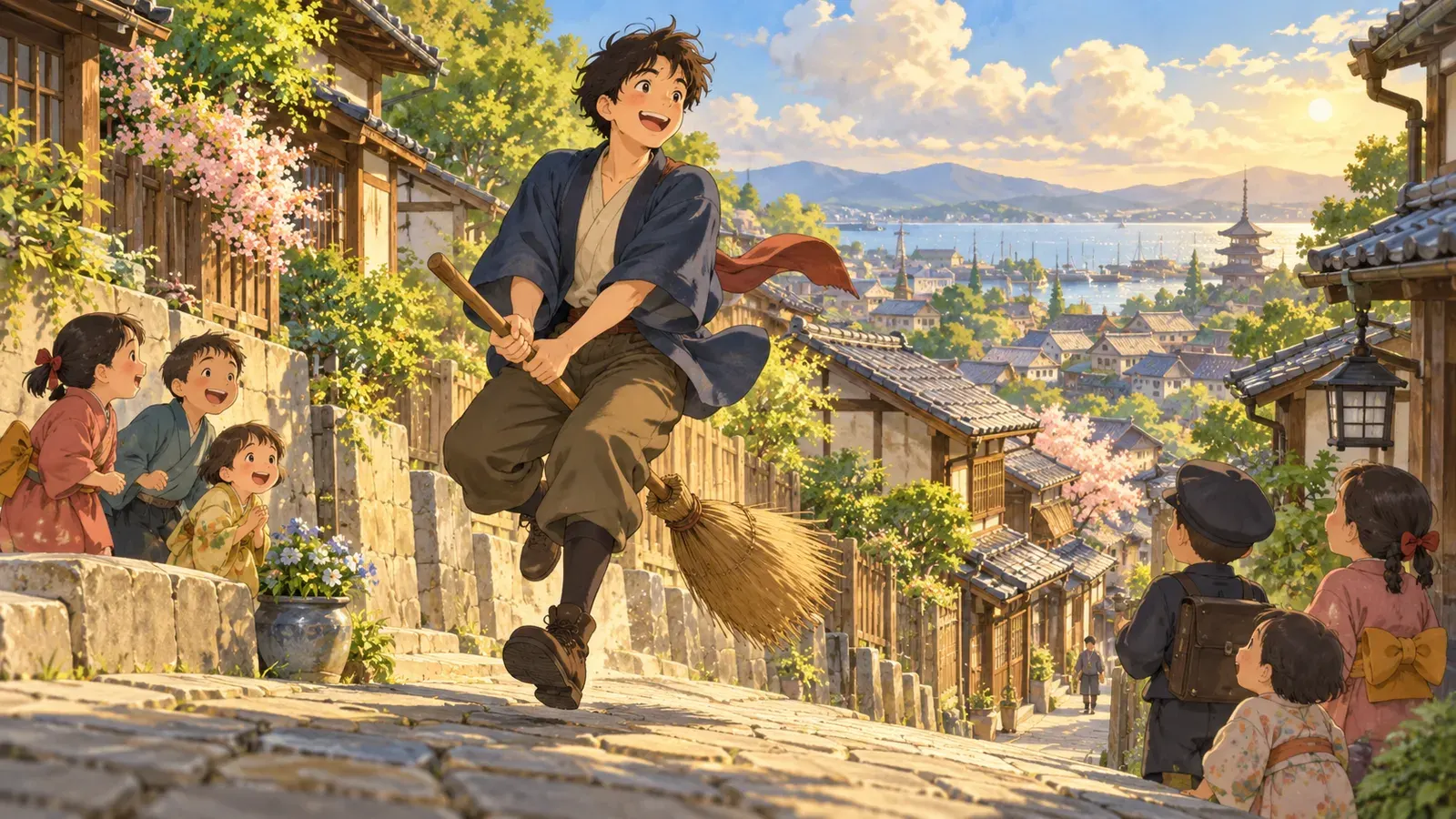
His name was Riki, signifying Strength; but the people called him Riki-the-Simple, or Riki-the-Fool,—"Riki-Baka,"—because he had been born into perpetual childhood. For the same reason they were kind to him,—even when he set a house on fire by putting a lighted match to a mosquito-curtain, and clapped his hands for joy to see the blaze. At sixteen years he was a tall, strong lad; but in mind he remained always at the happy age of two, and therefore continued to play with very small children. The bigger children of the neighborhood, from four to seven years old, did not care to play with him, because he could not learn their songs and games. His favorite toy was a broomstick, which he used as a hobby-horse; and for hours at a time he would ride on that broomstick, up and down the slope in front of my house, with amazing peals of laughter. But at last he became troublesome by reason of his noise; and I had to tell him that he must find another playground. He bowed submissively, and then went off,—sorrowfully trailing his broomstick behind him. Gentle at all times, and perfectly harmless if allowed no chance to play with fire, he seldom gave anybody cause for complaint. His relation to the life of our street was scarcely more than that of a dog or a chicken; and when he finally disappeared, I did not miss him. Months and months passed by before anything happened to remind me of Riki.
その子の名は力(りき)といった。「ちから」という意味である。けれども人々は、「おつむの弱い力」とか「ばかの力」、つまり「力ばか」と呼んでいた。生まれつき、いつまでたっても幼い子どものままだったからである。同じわけで、人々は力にやさしかった。火のついたマッチを蚊帳に近づけて家を一軒焼いてしまい、燃え上がる炎を見て手をたたいて喜んだときでさえ、そうだった。十六になると、力は背の高い、たくましい若者になった。けれども心は、いつまでも二つという幸せな年ごろのままだった。それで、ずっと小さな子どもたちとばかり遊んでいた。近所の大きい子ども、四つから七つくらいの子どもたちは、力と遊びたがらなかった。力は、その子たちの歌も遊びも覚えられなかったからである。力のお気に入りのおもちゃは、ほうきの柄だった。それを馬にして、何時間もまたがって、私の家の前の坂を上ったり下ったりしていた。そのあいだじゅう、びっくりするような大声で笑っていた。けれども、あまりやかましいので、とうとう私もこまってしまい、どこかよそで遊んでくれと言わなければならなかった。力はおとなしく頭を下げ、ほうきを後ろに引きずりながら、しょんぼりと行ってしまった。いつもおだやかで、火遊びさえさせなければ何の害もなかったので、力が人から文句を言われることはめったになかった。この通りの暮らしの中で、力は、犬や鶏とたいして変わらない存在だった。だから、とうとう力の姿が見えなくなっても、私は寂しいとも思わなかった。それから何か月も何か月もたって、ようやく力のことを思い出すような出来事があったのである。
"What has become of Riki?" I then asked the old woodcutter who supplies our neighborhood with fuel. I remembered that Riki had often helped him to carry his bundles.
「力はどうしたのかね」。そのとき私は、このあたりに薪を売りに来る年寄りの木こりに尋ねた。力がよく、この木こりの薪の束を運ぶのを手伝っていたのを思い出したのだ。
"Riki-Baka?" answered the old man. "Ah, Riki is dead—poor fellow!... Yes, he died nearly a year ago, very suddenly; the doctors said that he had some disease of the brain. And there is a strange story now about that poor Riki.
「力ばかですかい」と老人は答えた。「ああ、力は死にましたよ。かわいそうに……。ええ、一年ほど前に、そりゃもう急に死んじまいましてね。医者の話じゃ、頭の病だったそうで。それで今、あのかわいそうな力のことで、不思議な話があるんでさ。
"When Riki died, his mother wrote his name, 'Riki-Baka,' in the palm of his left hand,—putting 'Riki' in the Chinese character, and 'Baka' in kana. And she repeated many prayers for him,—prayers that he might be reborn into some more happy condition.
「力が死んだとき、おふくろさんが、あいつの左の手のひらに名前を書いたんです。『力ばか』とね。『力』は漢字で、『ばか』は仮名で書いたんでさ。そうして、あいつのためにお祈りをたんとしたんです。今度は、もっと幸せな身の上に生まれ変われますように、ってね。
"Now, about three months ago, in the honorable residence of Nanigashi-Sama, in Kojimachi, a boy was born with characters on the palm of his left hand; and the characters were quite plain to read,—'RIKI-BAKA'!
「ところがね、三月(みつき)ばかり前に、麹町の何某(なにがし)様のお屋敷で、左の手のひらに字のある男の子が生まれたんです。その字が、はっきり読めたっていうんでさ。『力ばか』とね!
"So the people of that house knew that the birth must have happened in answer to somebody's prayer; and they caused inquiry to be made everywhere. At last a vegetable-seller brought word to them that there used to be a simple lad, called Riki-Baka, living in the Ushigomé quarter, and that he had died during the last autumn; and they sent two men-servants to look for the mother of Riki.
「それでお屋敷の人たちは、こりゃあ誰かのお祈りが聞き届けられて生まれてきたにちがいない、と思ったわけです。そこで、ほうぼう手をつくして調べさせた。とうとう八百屋が知らせを持ってきましてね。牛込に力ばかという頭の足りない若いのが住んでいたが、去年の秋に死んだ、と。それでお屋敷じゃ、力のおふくろさんを探しに、下男を二人よこしたんでさ。
"Those servants found the mother of Riki, and told her what had happened; and she was glad exceedingly—for that Nanigashi house is a very rich and famous house. But the servants said that the family of Nanigashi-Sama were very angry about the word 'Baka' on the child's hand. 'And where is your Riki buried?' the servants asked. 'He is buried in the cemetery of Zendōji,' she told them. 'Please to give us some of the clay of his grave,' they requested.
「下男たちは力のおふくろさんを見つけて、わけを話した。おふくろさんは、そりゃあ大喜びでしたよ。なにしろ何某様のお家といえば、たいそうなお金持ちで、名の通ったお家ですからね。ところが下男たちが言うには、何某様のご一家は、子どもの手にある『ばか』の字に、たいそうお腹立ちだっていうんです。『それで、あんたの力はどこに葬ってあるのかね』と下男たちはききました。『善導寺の墓地に葬ってあります』とおふくろさんが答えると、『その墓の土を少し分けてもらいたい』と頼んだんでさ。
"So she went with them to the temple Zendōji, and showed them Riki's grave; and they took some of the grave-clay away with them, wrapped up in a furoshiki.... They gave Riki's mother some money,—ten yen."...
「それでおふくろさんは、下男たちと一緒に善導寺へ行って、力の墓を教えてやった。下男たちは墓の土を少し、風呂敷に包んで持って帰ったそうで……。おふくろさんには、いくらかお金をくれたそうです。十円ね」……
"But what did they want with that clay?" I inquired.
「だが、その土を何にしようというのだね」と私は尋ねた。
"Well," the old man answered, "you know that it would not do to let the child grow up with that name on his hand. And there is no other means of removing characters that come in that way upon the body of a child: you must rub the skin with clay taken from the grave of the body of the former birth."...
「そりゃあ、旦那」と老人は答えた。「子どもの手にあんな名前をつけたまま、大きくさせるわけにはいかないでしょう。それに、そんなふうに子どもの体に出てきた字を消すには、ほかに手がないんでさ。前の世で生きていた体を埋めた、その墓の土で、肌をこするしかないんですよ」……