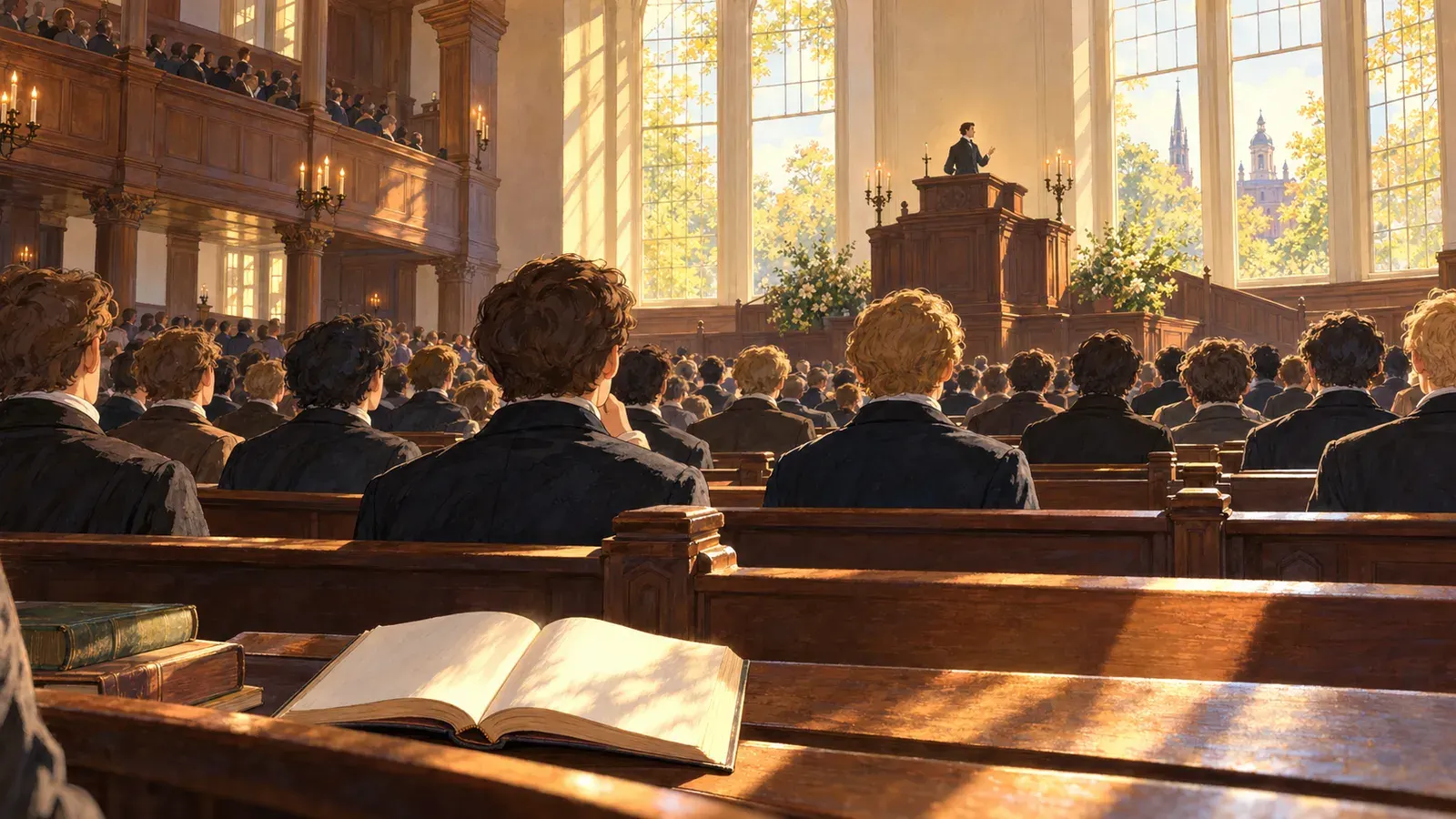
Mr. President and Gentlemen,
会長、ならびに紳士諸君。
I greet you on the recommencement of our literary year. Our anniversary is one of hope, and, perhaps, not enough of labor. We do not meet for games of strength or skill, for the recitation of histories, tragedies, and odes, like the ancient Greeks; for parliaments of love and poesy, like the Troubadours; nor for the advancement of science, like our contemporaries in the British and European capitals. Thus far, our holiday has been simply a friendly sign of the survival of the love of letters amongst a people too busy to give to letters any more. As such, it is precious as the sign of an indestructible instinct. Perhaps the time is already come, when it ought to be, and will be, something else; when the sluggard intellect of this continent will look from under its iron lids, and fill the postponed expectation of the world with something better than the exertions of mechanical skill. Our day of dependence, our long apprenticeship to the learning of other lands, draws to a close. The millions, that around us are rushing into life, cannot always be fed on the sere remains of foreign harvests. Events, actions arise, that must be sung, that will sing themselves. Who can doubt, that poetry will revive and lead in a new age, as the star in the constellation Harp, which now flames in our zenith, astronomers announce, shall one day be the pole-star for a thousand years?
学問の新しい年の始まりにあたり、みなさんにごあいさつ申し上げます。私たちのこの記念日は、希望の日です。ただ、もしかすると、汗を流す努力のほうはまだ足りないかもしれません。私たちが集まるのは、古代ギリシャ人のように力や技を競い、歴史や悲劇や頌歌を朗誦するためではありません。吟遊詩人トルバドゥールのように、恋と詩を語り合う集いを開くためでもありません。イギリスやヨーロッパの首都にいる同時代の人々のように、科学を進めるためでもありません。これまでのところ、この祝いの日は、ささやかなしるしにすぎませんでした。この国の人々は忙しすぎて、学問にそれ以上の時間を割けません。それでも学問を愛する心はまだ生きている。そのことを示す、親しみのこもったしるしです。そういうしるしとして、これは尊いものです。どうしても滅びない本能があることを示しているからです。しかし、もしかすると、この日が別のものになるべきとき、そして実際に別のものになるときが、もう来ているのかもしれません。この大陸の眠たげな知性が、重い鉄のまぶたを上げて外を見る。そして、待たされてきた世界の期待に、機械の腕前よりもすぐれたもので応える。そういうときです。私たちがよその国に頼ってきた時代、よその国の学問に長く弟子入りしてきた時代は、終わりに近づいています。私たちのまわりでは、何百万もの人々が次々に生まれ、人生へと飛びこんでいます。その人たちを、いつまでも外国の畑の枯れた落ち穂で養うことはできません。歌にうたわれるべき出来事や行いが、いま起こりつつあります。放っておいても、おのずと歌になるような出来事です。天文学者によれば、いま私たちの頭の真上に燃えていること座の星は、いつの日か北極星となり、千年のあいだその座にとどまるといいます。それと同じように、詩がよみがえって新しい時代を導くことを、誰が疑えるでしょうか。
In this hope, I accept the topic which not only usage, but the nature of our association, seem to prescribe to this day,--the AMERICAN SCHOLAR. Year by year, we come up hither to read one more chapter of his biography. Let us inquire what light new days and events have thrown on his character, and his hopes.
この希望を胸に、今日の題目をお引き受けします。「アメリカの学者」です。慣例からいっても、私たちの会の性格からいっても、今日はこの題目がふさわしいと思われます。私たちは毎年ここに集まり、この学者の伝記をもう一章ずつ読んできました。新しい時代と新しい出来事は、学者の人柄と希望を、どのように照らし出したでしょうか。それを考えてみましょう。
It is one of those fables, which, out of an unknown antiquity, convey an unlooked-for wisdom, that the gods, in the beginning, divided Man into men, that he might be more helpful to himself; just as the hand was divided into fingers, the better to answer its end.
遠い昔から伝わる寓話には、思いがけない知恵を伝えてくれるものがあります。これもその一つです。はじめに神々は、「人間」というひとつのものを、たくさんの人々に分けました。人間が自分で自分をもっとよく助けられるようにするためです。ちょうど、手が指に分けられて、手としての役目をよりよく果たせるようになったのと同じです。
The old fable covers a doctrine ever new and sublime; that there is One Man,--present to all particular men only partially, or through one faculty; and that you must take the whole society to find the whole man. Man is not a farmer, or a professor, or an engineer, but he is all. Man is priest, and scholar, and statesman, and producer, and soldier. In the divided or social state, these functions are parcelled out to individuals, each of whom aims to do his stint of the joint work, whilst each other performs his. The fable implies, that the individual, to possess himself, must sometimes return from his own labor to embrace all the other laborers. But, unfortunately, this original unit, this fountain of power, has been so distributed to multitudes, has been so minutely subdivided and peddled out, that it is spilled into drops, and cannot be gathered. The state of society is one in which the members have suffered amputation from the trunk, and strut about so many walking monsters,--a good finger, a neck, a stomach, an elbow, but never a man.
この古い寓話には、いつの時代にも新しい、崇高な教えがこめられています。この世には、ただひとりの「人間」がいる。けれども、一人ひとりの個人の中には、その一部分しか現れていない。ある人には、一つの能力として現れているだけだ。だから、人間の全体を見たければ、社会全体を見なければならない。そういう教えです。人間とは、農夫でも、教授でも、技術者でもありません。そのすべてなのです。人間は聖職者であり、学者であり、政治家であり、ものを作る者であり、兵士でもあります。ところが、分業で成り立つ社会では、こうした役目が一人ひとりに割り振られます。めいめいが共同の仕事のうち自分の持ち分をこなし、ほかの人はほかの持ち分をこなします。寓話が言おうとしているのは、こういうことです。個人が本当の自分を取り戻すには、ときどき自分の仕事を離れて、ほかのすべての働き手と一つにならなければならない。しかし残念なことに、もとは一つだったこの力の泉は、あまりにも多くの人に分け与えられ、あまりにも細かく切り分けられ、切り売りされてしまいました。そのため、しずくとなって飛び散り、もう集めることができません。いまの社会では、人々は手足を胴体から切り落とされ、歩く怪物となって、そこらじゅうを得意げに歩き回っています。りっぱな指もあれば、首も、胃袋も、ひじもあります。けれども、一人の人間はどこにもいないのです。
Man is thus metamorphosed into a thing, into many things. The planter, who is Man sent out into the field to gather food, is seldom cheered by any idea of the true dignity of his ministry. He sees his bushel and his cart, and nothing beyond, and sinks into the farmer, instead of Man on the farm. The tradesman scarcely ever gives an ideal worth to his work, but is ridden by the routine of his craft, and the soul is subject to dollars. The priest becomes a form; the attorney, a statute-book; the mechanic, a machine; the sailor, a rope of the ship.
こうして人間は、物に、それもたくさんの物に変えられてしまいます。畑で働く人は、本来なら、食べ物を集めるために畑へ送り出された「人間」です。しかし、自分の務めがどれほど尊いものかを思って励まされることは、めったにありません。目に入るのは穀物の升と荷車だけで、その先は見えません。そうして、「畑にいる人間」ではなく、ただの農夫になり下がってしまいます。商人も、自分の仕事に理想としての値打ちを認めることは、まずありません。商売の決まりきった手順に追いまくられ、魂はドルに支配されます。聖職者はただの形式に、弁護士は法律書に、職人は機械に、船乗りは船のロープになってしまうのです。
In this distribution of functions, the scholar is the delegated intellect. In the right state, he is, Man Thinking. In the degenerate state, when the victim of society, he tends to become a mere thinker, or, still worse, the parrot of other men’s thinking.
このように役目が分けられた中で、学者は、社会から知性の役目を任された者です。正しい状態にあれば、学者とは「考える人間」です。ところが、堕落して社会の犠牲になると、学者はただの思想家になりがちです。もっと悪ければ、他人の考えをくり返すだけのオウムになってしまいます。
In this view of him, as Man Thinking, the theory of his office is contained. Him nature solicits with all her placid, all her monitory pictures; him the past instructs; him the future invites. Is not, indeed, every man a student, and do not all things exist for the student’s behoof? And, finally, is not the true scholar the only true master? But the old oracle said, ‘All things have two handles: beware of the wrong one.’ In life, too often, the scholar errs with mankind and forfeits his privilege. Let us see him in his school, and consider him in reference to the main influences he receives.
学者を「考える人間」と見る。この見方の中に、学者の務めとは何かという答えが、すべて含まれています。自然は、穏やかな景色や、何かを教えさとすような景色のすべてを見せて、学者を誘います。過去は学者に教え、未来は学者を招きます。考えてみれば、人はみな学ぶ者ではないでしょうか。そして、あらゆるものは学ぶ者のためにあるのではないでしょうか。だとすれば、真の学者こそ、ただひとりの真の主人なのではないでしょうか。しかし、古い神託にこうあります。「すべての物には取っ手が二つある。間違ったほうに気をつけよ」。実際の人生では、学者もほかの人々と同じ過ちをおかし、せっかくの特権を失ってしまうことが、あまりにも多いのです。そこで、学者を学びの場に置いて、学者が受ける主な影響ごとに考えてみましょう。
Books are the best of things, well used; abused, among the worst. What is the right use? What is the one end, which all means go to effect? They are for nothing but to inspire. I had better never see a book, than to be warped by its attraction clean out of my own orbit, and made a satellite instead of a system. The one thing in the world, of value, is the active soul. This every man is entitled to; this every man contains within him, although, in almost all men, obstructed, and as yet unborn. The soul active sees absolute truth; and utters truth, or creates. In this action, it is genius; not the privilege of here and there a favorite, but the sound estate of every man. In its essence, it is progressive. The book, the college, the school of art, the institution of any kind, stop with some past utterance of genius. This is good, say they,--let us hold by this. They pin me down. They look backward and not forward. But genius looks forward: the eyes of man are set in his forehead, not in his hindhead: man hopes: genius creates. Whatever talents may be, if the man create not, the pure efflux of the Deity is not his;--cinders and smoke there may be, but not yet flame. There are creative manners, there are creative actions, and creative words; manners, actions, words, that is, indicative of no custom or authority, but springing spontaneous from the mind’s own sense of good and fair.
本は、うまく使えば何よりもよいものです。使い方を誤れば、最悪のものの一つになります。では、正しい使い方とは何でしょう。あらゆる手段が目指している、ただ一つの目的とは何でしょう。本は、人の心に火をつけるためだけにあるのです。本に引き寄せられて自分の軌道からすっかり外れ、自分を中心とする太陽系ではなく、他人のまわりを回る衛星にされてしまう。そんなことになるくらいなら、本など一冊も見ないほうがましです。この世で価値のあるものは、ただ一つ、活動する魂です。これは誰もが持つ権利のあるものです。誰もが自分の中に持っているものです。ただし、ほとんどの人の中では、それはふさがれたままで、まだ生まれてもいないのです。活動する魂は、絶対の真理を見ます。そして真理を語ります。つまり、創造するのです。このように働くとき、魂は天才となります。天才とは、あちこちにいる一部の恵まれた人だけに許された特権ではありません。すべての人に本来そなわっている、健やかなありかたなのです。天才はその本質からして、前へ進むものです。ところが、本も、大学も、美術学校も、どんな種類の制度も、過去のある天才が残した言葉のところで止まってしまいます。「これはよい。これを守っていこう」と言うのです。そうして私を押さえつけます。彼らは前ではなく、後ろを見ています。しかし天才は前を見ます。人の目は額についているのであって、後頭部についているのではありません。人は希望を抱き、天才は創造します。どんな才能を持っていようと、創造しない人には、神から流れ出る清らかなものは宿っていません。燃えかすや煙はあるかもしれませんが、まだ炎にはなっていないのです。創造的な振る舞いがあり、創造的な行いがあり、創造的な言葉があります。慣習や権威に従ったものではなく、何がよく何が美しいかを感じとる心そのものから、おのずとわき出てくる振る舞いであり、行いであり、言葉です。
Undoubtedly there is a right way of reading, so it be sternly subordinated. Man Thinking must not be subdued by his instruments. Books are for the scholar’s idle times. When he can read God directly, the hour is too precious to be wasted in other men’s transcripts of their readings. But when the intervals of darkness come, as come they must,--when the sun is hid, and the stars withdraw their shining,--we repair to the lamps which were kindled by their ray, to guide our steps to the East again, where the dawn is. We hear, that we may speak. The Arabian proverb says, “A fig tree, looking on a fig tree, becometh fruitful.”
もちろん、読書には正しいやり方があります。ただし、読書はあくまで脇役として、厳しくその地位にとどめておかなければなりません。「考える人間」が、自分の道具に支配されてはならないのです。本は、学者が手のあいたときに読むものです。神をじかに読めるときには、その時間はあまりにも貴重です。他人が読みとったことを他人が書き写したものに、費やすわけにはいきません。しかし、暗い時期はやって来ます。必ずやって来るものです。太陽が隠れ、星々も輝きを引っこめてしまう。そのとき私たちは、かつてその光でともされたランプのもとへ行きます。そして、夜明けのある東へと、もう一度足を導いてもらうのです。私たちは、語るために聞くのです。アラビアのことわざに「いちじくの木は、いちじくの木を見て実をつける」とあります。
Another sign of our times, also marked by an analogous political movement, is, the new importance given to the single person. Every thing that tends to insulate the individual,--to surround him with barriers of natural respect, so that each man shall feel the world is his, and man shall treat with man as a sovereign state with a sovereign state;--tends to true union as well as greatness. “I learned,” said the melancholy Pestalozzi, “that no man in God’s wide earth is either willing or able to help any other man.” Help must come from the bosom alone. The scholar is that man who must take up into himself all the ability of the time, all the contributions of the past, all the hopes of the future. He must be an university of knowledges. If there be one lesson more than another, which should pierce his ear, it is, The world is nothing, the man is all; in yourself is the law of all nature, and you know not yet how a globule of sap ascends; in yourself slumbers the whole of Reason; it is for you to know all, it is for you to dare all. Mr. President and Gentlemen, this confidence in the unsearched might of man belongs, by all motives, by all prophecy, by all preparation, to the American Scholar. We have listened too long to the courtly muses of Europe. The spirit of the American freeman is already suspected to be timid, imitative, tame. Public and private avarice make the air we breathe thick and fat. The scholar is decent, indolent, complaisant. See already the tragic consequence. The mind of this country, taught to aim at low objects, eats upon itself. There is no work for any but the decorous and the complaisant. Young men of the fairest promise, who begin life upon our shores, inflated by the mountain winds, shined upon by all the stars of God, find the earth below not in unison with these,--but are hindered from action by the disgust which the principles on which business is managed inspire, and turn drudges, or die of disgust,--some of them suicides. What is the remedy? They did not yet see, and thousands of young men as hopeful now crowding to the barriers for the career, do not yet see, that, if the single man plant himself indomitably on his instincts, and there abide, the huge world will come round to him. Patience,--patience;--with the shades of all the good and great for company; and for solace, the perspective of your own infinite life; and for work, the study and the communication of principles, the making those instincts prevalent, the conversation of the world. Is it not the chief disgrace in the world, not to be an unit;--not to be reckoned one character;--not to yield that peculiar fruit which each man was created to bear, but to be reckoned in the gross, in the hundred, or the thousand, of the party, the section, to which we belong; and our opinion predicted geographically, as the north, or the south? Not so, brothers and friends,--please God, ours shall not be so. We will walk on our own feet; we will work with our own hands; we will speak our own minds. The study of letters shall be no longer a name for pity, for doubt, and for sensual indulgence. The dread of man and the love of man shall be a wall of defence and a wreath of joy around all. A nation of men will for the first time exist, because each believes himself inspired by the Divine Soul which also inspires all men.
私たちの時代を示すもう一つのしるしは、一人の個人が新しく重んじられるようになったことです。同じような動きは、政治の世界にも表れています。個人を独立させるものは、すべて、偉大さにつながるだけでなく、真の結びつきにもつながります。自然な敬意という垣根で個人を囲み、誰もが世界は自分のものだと感じ、人と人とが独立国どうしのように対等に向き合えるようにするものです。憂いに沈んだペスタロッチは、こう言いました。「私は思い知った。神の広い大地の上で、ほかの人を助けようとする者も、助けることのできる者も、ひとりもいないのだと」。助けは、自分の胸の内からしか来ないのです。学者とは、その時代のあらゆる能力、過去のあらゆる貢献、未来のあらゆる希望を、自分の中に取りこまなければならない人です。学者は、一人で知識の大学とならなければなりません。何よりも学者の耳に突き刺さるべき教えがあるとすれば、それはこうです。世界は無にひとしく、人間こそがすべてである。自然のあらゆる法則は、あなたの中にある。それなのに、樹液の一滴がどのようにして木を上っていくのかさえ、あなたはまだ知らない。理性のすべてが、あなたの中に眠っている。すべてを知るのはあなただ。すべてに挑むのもあなただ。会長、ならびに紳士諸君。まだ誰も確かめたことのない人間の力を、こうして信じること。それは、どんな動機から見ても、どんな予言から見ても、どんな備えから見ても、アメリカの学者にこそふさわしいのです。私たちは、ヨーロッパの宮廷風の詩神たちの声に、あまりにも長く耳を傾けてきました。アメリカの自由な市民の精神は、もう、臆病で、まねばかりで、飼いならされているのではないかと疑われています。社会全体の強欲と一人ひとりの強欲が、私たちの吸う空気を重く濁らせています。学者は上品で、怠け者で、人に逆らいません。すでにその悲しい結果が表れています。この国の精神は、低い目標をめざすよう教えこまれ、自分で自分を食いつぶしています。上品で人に逆らわない者でなければ、仕事にありつけません。この国の岸辺で人生を歩みはじめる若者たちは、誰よりも有望です。山の風に胸をふくらませ、神のすべての星に照らされています。ところが、足もとの大地は、その胸の思いと少しもかみ合っていません。商売を動かしている考え方にうんざりして、行動を起こせなくなるのです。そうして、ただこき使われるだけの人間になるか、うんざりしたまま死んでいきます。中には自ら命を絶つ者もいます。どうすれば救えるのでしょうか。その若者たちには、まだ見えていませんでした。そして今、同じように有望な何千人もの若者が、世に出ようと門の前に押しよせていますが、彼らにもまだ見えていません。一人の人間が自分の本能にしっかりと足をすえ、そこを動かなければ、この巨大な世界のほうが、やがてその人のもとへめぐってくるのだということが。忍耐です。忍耐です。過去のすべての善き人、偉大な人の霊を友とし、自分自身の無限の生命を見わたして心の慰めとするのです。そして、原理を学び、それを人に伝え、その本能を世に広め、世界を変えていくことを、自分の仕事とするのです。一個の独立した人間でないこと。一人の人格として数えられないこと。人はそれぞれ、自分だけの実を結ぶために造られたのに、その実を結ばないこと。自分の属する党派や地方の一員として、百人、千人単位でひとまとめに数えられ、北部の人間だから、南部の人間だからと、意見まで住む場所で決めつけられること。これこそ、この世で最大の恥ではないでしょうか。兄弟たち、友人たち、そうであってはなりません。神のお許しがあれば、私たちは決してそうはなりません。私たちは自分の足で歩きます。自分の手で働きます。自分の心を語ります。学問はもはや、哀れみや、疑いや、快楽にふけることの代名詞ではなくなるでしょう。人を畏れ敬う心と、人を愛する心が、すべての人をとりまく守りの壁となり、喜びの花冠となるでしょう。そのとき初めて、人間の国が生まれるのです。すべての人に霊感を与えている神の魂から、自分もまた霊感を受けていると、一人ひとりが信じるからです。