When I glance over my notes and records of the Sherlock Holmes cases between the years '82 and '90, I am faced by so many which present strange and interesting features that it is no easy matter to know which to choose and which to leave. Some, however, have already gained publicity through the papers, and others have not offered a field for those peculiar qualities which my friend possessed in so high a degree, and which it is the object of these papers to illustrate. Some, too, have baffled his analytical skill, and would be, as narratives, beginnings without an ending, while others have been but partially cleared up, and have their explanations founded rather upon conjecture and surmise than on that absolute logical proof which was so dear to him. There is, however, one of these last which was so remarkable in its details and so startling in its results that I am tempted to give some account of it in spite of the fact that there are points in connection with it which never have been, and probably never will be, entirely cleared up.
一八八二年から一八九〇年までのシャーロック・ホームズの事件について、覚え書きや記録を見返してみると、奇妙で興味深い事件があまりにも多い。どれを選び、どれを省くか、決めるのは簡単ではない。ただ、そのうちのいくつかは、すでに新聞で世に知られている。また、わが友はたぐいまれな資質を持っていたが、それを発揮する場面がなかった事件もある。この記録はその資質を伝えるためのものだから、そういう事件は向かない。さらに、ホームズの分析の腕をもってしても解けなかった事件もある。それを書けば、始まりだけで終わりのない話になってしまう。部分的にしか解けず、ホームズがあれほど大切にした厳密な論理の証明ではなく、推測や憶測で説明するしかない事件もある。ところが、この最後の種類の中に、細かな点が実に驚くべきもので、結末もじつに衝撃的な事件が一つある。いまだにすっかりは解明されておらず、おそらくこの先も解明されないだろう点がいくつか残っている。それでも私は、そのいきさつを書いてみたいという気持ちを抑えられないのである。
The year '87 furnished us with a long series of cases of greater or less interest, of which I retain the records. Among my headings under this one twelve months I find an account of the adventure of the Paradol Chamber, of the Amateur Mendicant Society, who held a luxurious club in the lower vault of a furniture warehouse, of the facts connected with the loss of the British barque Sophy Anderson, of the singular adventures of the Grice Patersons in the island of Uffa, and finally of the Camberwell poisoning case. In the latter, as may be remembered, Sherlock Holmes was able, by winding up the dead man's watch, to prove that it had been wound up two hours before, and that therefore the deceased had gone to bed within that time—a deduction which was of the greatest importance in clearing up the case. All these I may sketch out at some future date, but none of them present such singular features as the strange train of circumstances which I have now taken up my pen to describe.
一八八七年には、大なり小なり興味深い事件が次々に起こり、私はその記録をとってある。この一年の見出しを見ると、こんな事件が並んでいる。パラドール・チェンバーの事件。家具倉庫の地下室にぜいたくなクラブを構えていた素人乞食協会の事件。イギリスの帆船ソフィー・アンダーソン号の遭難をめぐる事実。アッファ島でのグライス・パターソン一家の奇妙な冒険。そして最後に、カンバーウェルの毒殺事件。覚えている読者もいるだろうが、この毒殺事件では、シャーロック・ホームズは死んだ男の時計のねじを巻いてみて、それが二時間前に巻かれていたことを証明した。つまり、故人はその二時間のあいだに床についたことになる。この推理が、事件を解決するうえで何より重要だった。これらの事件も、いずれ書くことがあるかもしれない。だが、どれ一つとして、いま私が筆をとって書こうとしている奇怪な出来事ほど、異様なものではない。
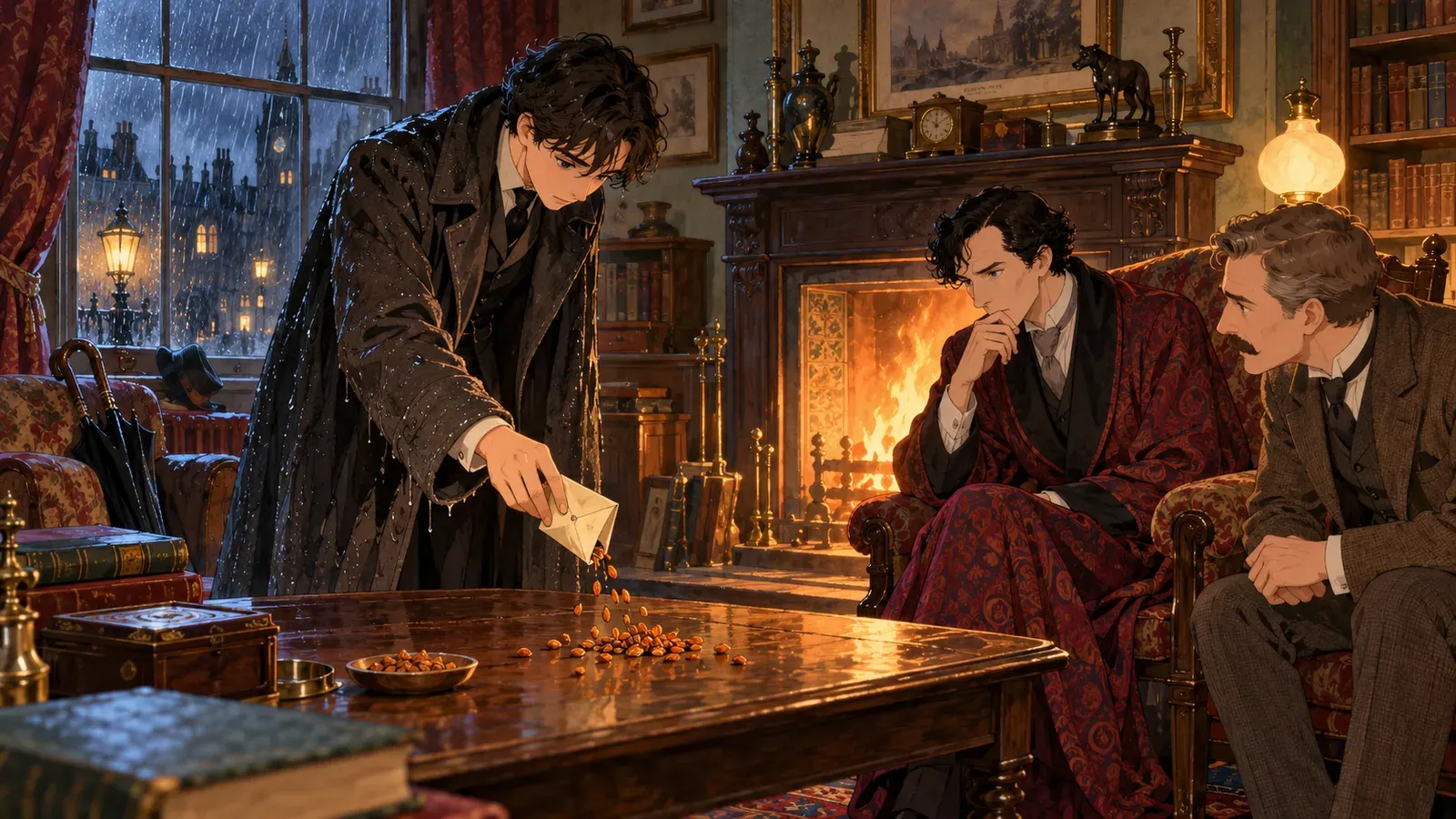
It was in the latter days of September, and the equinoctial gales had set in with exceptional violence. All day the wind had screamed and the rain had beaten against the windows, so that even here in the heart of great, hand-made London we were forced to raise our minds for the instant from the routine of life and to recognise the presence of those great elemental forces which shriek at mankind through the bars of his civilisation, like untamed beasts in a cage. As evening drew in, the storm grew higher and louder, and the wind cried and sobbed like a child in the chimney. Sherlock Holmes sat moodily at one side of the fireplace cross-indexing his records of crime, while I at the other was deep in one of Clark Russell's fine sea-stories until the howl of the gale from without seemed to blend with the text, and the splash of the rain to lengthen out into the long swash of the sea waves. My wife was on a visit to her mother's, and for a few days I was a dweller once more in my old quarters at Baker Street.
九月も終わりに近いころで、秋分の嵐がいつになく激しく吹き荒れはじめていた。一日じゅう風は金切り声をあげ、雨は窓を打ちつけていた。人の手で築かれた大都会ロンドンのただ中にいても、私たちはしばし日々の暮らしを忘れて、大自然の力を感じずにはいられなかった。檻の中の猛獣のように、文明という鉄格子ごしに、人間に向かって吠えたてる力である。夕方になると、嵐はいっそう激しく、騒がしくなり、風は煙突の中で子どものように泣きじゃくった。シャーロック・ホームズは暖炉の片側にむっつりと座り、犯罪記録の索引を作っていた。私は反対側で、クラーク・ラッセルのすぐれた海洋小説に読みふけっていた。そのうち、外で吠える嵐の音が本の文章と溶け合い、雨のしぶきの音が、寄せては返す長い波の音のように聞こえてきた。妻が母親のところへ出かけていたので、私は数日のあいだ、昔のようにベイカー街の下宿で暮らしていたのである。
"Why," said I, glancing up at my companion, "that was surely the bell. Who could come to-night? Some friend of yours, perhaps?"
「おや」私は友を見上げて言った。「いまのは確かに呼び鈴だね。こんな夜に誰が来るんだろう。きみの友だちかな?」
"Except yourself I have none," he answered. "I do not encourage visitors."
「きみのほかに友だちなんていないよ」とホームズは答えた。「人が訪ねてくるのは好きじゃないんでね」
"A client, then?"
「じゃあ、依頼人かな?」
"If so, it is a serious case. Nothing less would bring a man out on such a day and at such an hour. But I take it that it is more likely to be some crony of the landlady's."
「もしそうなら、重大な事件だ。そうでもなければ、こんな日のこんな時刻に、わざわざ出てくる者はいない。だが、どちらかといえば、おかみさんの茶飲み友だちだろうと思うね」
Sherlock Holmes was wrong in his conjecture, however, for there came a step in the passage and a tapping at the door. He stretched out his long arm to turn the lamp away from himself and towards the vacant chair upon which a newcomer must sit.
ところが、シャーロック・ホームズの推測ははずれた。廊下に足音がして、ドアをノックする音がしたのである。ホームズは長い腕を伸ばしてランプの向きを変え、自分ではなく、客が座るはずの空いた椅子のほうを照らすようにした。
"Come in!" said he.
「どうぞ!」とホームズは言った。
The man who entered was young, some two-and-twenty at the outside, well-groomed and trimly clad, with something of refinement and delicacy in his bearing. The streaming umbrella which he held in his hand, and his long shining waterproof told of the fierce weather through which he had come. He looked about him anxiously in the glare of the lamp, and I could see that his face was pale and his eyes heavy, like those of a man who is weighed down with some great anxiety.
入ってきたのは若い男だった。せいぜい二十二歳といったところで、身なりはきちんとしていて、こざっぱりした服を着ていた。物腰にはどこか上品で繊細なところがあった。手にした傘からはしずくがしたたり、長いレインコートはぬれて光っていた。どれほどの嵐の中をやって来たのかがよくわかった。男はランプのまぶしい光の中で、不安そうにあたりを見まわした。その顔は青ざめ、目はどんよりとしていた。何か大きな心配ごとに押しつぶされている人の顔だった。
"I owe you an apology," he said, raising his golden pince-nez to his eyes. "I trust that I am not intruding. I fear that I have brought some traces of the storm and rain into your snug chamber."
「おわびしなければなりません」と男は、金縁の鼻めがねを目に当てながら言った。「おじゃまでなければいいのですが。この居心地のいいお部屋に、嵐と雨を少し持ちこんでしまったようで」
"Give me your coat and umbrella," said Holmes. "They may rest here on the hook and will be dry presently. You have come up from the south-west, I see."
「コートと傘をこちらへ」とホームズは言った。「ここのフックにかけておけば、じきに乾きます。南西のほうからおいでになったのですね」
"Yes, from Horsham."
「ええ、ホーシャムからです」
"That clay and chalk mixture which I see upon your toe caps is quite distinctive."
「靴のつま先についている、粘土と白亜のまじった泥は、ひどく特徴がありますからね」
"I have come for advice."
「ご助言をいただきにまいりました」
"That is easily got."
「それならたやすいことです」
"And help."
「それから、お力ぞえも」
"That is not always so easy."
「そちらは、いつもたやすいとはかぎりません」
"I have heard of you, Mr. Holmes. I heard from Major Prendergast how you saved him in the Tankerville Club scandal."
「ホームズさん、おうわさはうかがっています。タンカーヴィル・クラブの醜聞のとき、あなたがプレンダーガスト少佐を救ってくださったと、少佐ご本人から聞きました」
"Ah, of course. He was wrongfully accused of cheating at cards."
「ああ、そうでした。少佐はカードでいかさまをしたと、ぬれぎぬを着せられたのです」
"He said that you could solve anything."
「少佐は、あなたならどんなことでも解決できるとおっしゃっていました」
"He said too much."
「それは言いすぎですね」
"That you are never beaten."
「一度も負けたことがない、とも」
"I have been beaten four times—three times by men, and once by a woman."
「四回負けたことがありますよ。男に三回、女に一回」
"But what is that compared with the number of your successes?"
「でも、成功なさった数に比べたら、そんなのは何でもないでしょう」
"It is true that I have been generally successful."
「確かに、たいていはうまくいっています」
"Then you may be so with me."
「それなら、私の場合もうまくいくかもしれません」
"I beg that you will draw your chair up to the fire and favour me with some details as to your case."
「どうか椅子を火のそばに寄せて、あなたの事件を詳しく聞かせてください」
"It is no ordinary one."
「ありきたりの事件ではないのです」
"None of those which come to me are. I am the last court of appeal."
「わたしのところへ来る事件に、ありきたりのものはありません。わたしは最後の駆けこみ寺ですから」
"And yet I question, sir, whether, in all your experience, you have ever listened to a more mysterious and inexplicable chain of events than those which have happened in my own family."
「それでも、これほどのご経験をお持ちのあなたでも、私の一家に起こった出来事ほど不可解で、説明のつかない話は、お聞きになったことがないのではないでしょうか」
"You fill me with interest," said Holmes. "Pray give us the essential facts from the commencement, and I can afterwards question you as to those details which seem to me to be most important."
「ますます興味がわいてきました」とホームズは言った。「どうか初めから、大事な事実を話してください。そのあとで、わたしが特に重要だと思う細かい点について、お尋ねしますから」
The young man pulled his chair up and pushed his wet feet out towards the blaze.
若い男は椅子を引き寄せ、ぬれた足を炎のほうへ突き出した。
"My name," said he, "is John Openshaw, but my own affairs have, as far as I can understand, little to do with this awful business. It is a hereditary matter; so in order to give you an idea of the facts, I must go back to the commencement of the affair.
「私の名前は」と男は言った。「ジョン・オープンショーといいます。ですが、私にわかるかぎり、私自身のことは、この恐ろしい出来事とはほとんど関係がありません。これは親から子へ受け継がれてきた問題なのです。ですから、事情をわかっていただくために、事の始まりまでさかのぼってお話ししなければなりません。
"You must know that my grandfather had two sons—my uncle Elias and my father Joseph. My father had a small factory at Coventry, which he enlarged at the time of the invention of bicycling. He was a patentee of the Openshaw unbreakable tire, and his business met with such success that he was able to sell it and to retire upon a handsome competence.
「まず申しあげておきますと、祖父には息子が二人いました。伯父のイライアスと、父のジョゼフです。父はコヴェントリーで小さな工場をやっていましたが、自転車が発明されたころに工場を広げました。父はオープンショー式の破れないタイヤの特許を持っていて、商売は大当たりしました。おかげで工場を売り払い、十分な財産を手にして引退することができたのです。
"My uncle Elias emigrated to America when he was a young man and became a planter in Florida, where he was reported to have done very well. At the time of the war he fought in Jackson's army, and afterwards under Hood, where he rose to be a colonel. When Lee laid down his arms my uncle returned to his plantation, where he remained for three or four years. About 1869 or 1870 he came back to Europe and took a small estate in Sussex, near Horsham. He had made a very considerable fortune in the States, and his reason for leaving them was his aversion to the negroes, and his dislike of the Republican policy in extending the franchise to them. He was a singular man, fierce and quick-tempered, very foul-mouthed when he was angry, and of a most retiring disposition. During all the years that he lived at Horsham, I doubt if ever he set foot in the town. He had a garden and two or three fields round his house, and there he would take his exercise, though very often for weeks on end he would never leave his room. He drank a great deal of brandy and smoked very heavily, but he would see no society and did not want any friends, not even his own brother.
「伯父のイライアスは若いころにアメリカへ渡り、フロリダで農園主になりました。たいそう成功したという話でした。南北戦争のときは南軍のジャクソン将軍の軍で戦い、のちにフッド将軍の下で戦って、大佐にまでなりました。リー将軍が降伏すると、伯父は農園に戻り、そこで三、四年暮らしました。そして一八六九年か一八七〇年ごろにヨーロッパへ帰ってきて、サセックスのホーシャムの近くに小さな地所を手に入れました。合衆国で大きな財産を築いていたのですが、向こうを離れたのは、黒人を嫌っていたからです。黒人にも選挙権を広げようとする共和党の政策が気に入らなかったのです。伯父は風変わりな人でした。気性が荒く、短気で、怒るとひどく口汚くなり、しかも極端に人づきあいを避けていました。ホーシャムに住んでいたあいだ、町へ足を踏み入れたことが一度でもあったかどうか、あやしいものです。家のまわりに庭と二つ三つの畑があって、そこで体を動かしてはいましたが、何週間も続けて自分の部屋から一歩も出ないことも、よくありました。ブランデーを浴びるように飲み、たばこもひどく吸いましたが、人とは会おうとせず、友人もほしがりませんでした。実の弟でさえ、寄せつけなかったのです。
"He didn't mind me; in fact, he took a fancy to me, for at the time when he saw me first I was a youngster of twelve or so. This would be in the year 1878, after he had been eight or nine years in England. He begged my father to let me live with him and he was very kind to me in his way. When he was sober he used to be fond of playing backgammon and draughts with me, and he would make me his representative both with the servants and with the tradespeople, so that by the time that I was sixteen I was quite master of the house. I kept all the keys and could go where I liked and do what I liked, so long as I did not disturb him in his privacy. There was one singular exception, however, for he had a single room, a lumber-room up among the attics, which was invariably locked, and which he would never permit either me or anyone else to enter. With a boy's curiosity I have peeped through the keyhole, but I was never able to see more than such a collection of old trunks and bundles as would be expected in such a room.
「ただ、私のことは嫌がりませんでした。それどころか、かわいがってくれたのです。伯父が初めて私に会ったとき、私は十二歳かそこらの子どもでした。一八七八年のことで、伯父がイギリスに来て八、九年たったころです。伯父は私を一緒に住まわせてくれと父に頼みこみ、伯父なりにとてもやさしくしてくれました。しらふのときは、私を相手にバックギャモンやチェッカーをするのが好きでした。召使いや出入りの商人との応対も私に任せたので、十六歳になるころには、私はすっかり家の主人のようになっていました。鍵はすべて私が預かっていて、伯父が一人でいるのを邪魔しないかぎり、どこへ行こうと何をしようと自由でした。ただ、一つだけ妙な例外がありました。屋根裏に物置部屋が一つあって、そこにはいつも鍵がかかっていたのです。伯父は、私にもほかの誰にも、けっしてそこへ入ることを許しませんでした。子どもらしい好奇心から鍵穴をのぞいたこともありますが、そういう部屋によくある古いトランクや包みが積んであるのが見えただけでした。
"One day—it was in March, 1883—a letter with a foreign stamp lay upon the table in front of the colonel's plate. It was not a common thing for him to receive letters, for his bills were all paid in ready money, and he had no friends of any sort. 'From India!' said he as he took it up, 'Pondicherry postmark! What can this be?' Opening it hurriedly, out there jumped five little dried orange pips, which pattered down upon his plate. I began to laugh at this, but the laugh was struck from my lips at the sight of his face. His lip had fallen, his eyes were protruding, his skin the colour of putty, and he glared at the envelope which he still held in his trembling hand, 'K. K. K.!' he shrieked, and then, 'My God, my God, my sins have overtaken me!'
「ある日のことです。一八八三年の三月でした。外国の切手をはった手紙が一通、朝食のテーブルの、大佐の皿の前に置いてありました。伯父が手紙を受け取るのは珍しいことでした。支払いはすべて現金ですませていましたし、友人と呼べる人も一人もいなかったからです。『インドからだ!』と伯父は手紙を手に取って言いました。『ポンディシェリの消印だ! いったい何だろう』急いで封を切ると、中から干からびた小さなオレンジの種が五つ飛び出して、皿の上にぱらぱらと落ちました。私は思わず笑いだしかけましたが、伯父の顔を見たとたん、笑いは消えてしまいました。伯父はあんぐりと口を開け、目は飛び出しそうで、顔はパテのような灰色になっていました。そして、震える手にまだ持っている封筒をにらみつけていました。『K・K・K!』と伯父は金切り声をあげ、それから叫びました。『ああ、なんということだ、とうとう罪の報いが追いついてきた!』
"'What is it, uncle?' I cried.
「『どうしたの、伯父さん?』と私は叫びました。
"'Death,' said he, and rising from the table he retired to his room, leaving me palpitating with horror. I took up the envelope and saw scrawled in red ink upon the inner flap, just above the gum, the letter K three times repeated. There was nothing else save the five dried pips. What could be the reason of his overpowering terror? I left the breakfast-table, and as I ascended the stair I met him coming down with an old rusty key, which must have belonged to the attic, in one hand, and a small brass box, like a cashbox, in the other.
「『死だ』伯父はそう言うと、テーブルを立って自分の部屋に引きこもってしまいました。残された私は、恐ろしさで胸がどきどきしていました。封筒を手に取ってみると、内側の折り返し、ちょうどのりのすぐ上に、赤いインクでKの字が三つ書きなぐってありました。干からびた種が五つ入っていたほかには、何もありません。伯父があれほどおびえたのは、いったいなぜなのか。朝食のテーブルを離れて階段を上っていくと、下りてくる伯父と出くわしました。片手には、屋根裏部屋のものらしい古い錆びた鍵を、もう片方の手には、手提げ金庫のような小さな真鍮の箱を持っていました。
"'They may do what they like, but I'll checkmate them still,' said he with an oath. 'Tell Mary that I shall want a fire in my room to-day, and send down to Fordham, the Horsham lawyer.'
「『やつらは好きなようにするがいい。だが、それでもわしは、やつらの裏をかいてやる』と伯父は悪態をつきながら言いました。『メアリーに、今日はわしの部屋に火をたいてくれと伝えろ。それから、ホーシャムの弁護士のフォーダムを呼びにやってくれ』
"I did as he ordered, and when the lawyer arrived I was asked to step up to the room. The fire was burning brightly, and in the grate there was a mass of black, fluffy ashes, as of burned paper, while the brass box stood open and empty beside it. As I glanced at the box I noticed, with a start, that upon the lid was printed the treble K which I had read in the morning upon the envelope.
「私は言われたとおりにしました。弁護士が来ると、私も部屋へ上がるように言われました。暖炉には火があかあかと燃えていて、炉の中には、紙を燃やしたような黒くふわふわした灰が山になっていました。そのそばに真鍮の箱が、ふたを開けて空っぽのまま置いてありました。箱に目をやって、私ははっとしました。その朝封筒で見たのと同じKの三文字が、ふたに印刷してあったのです。
"'I wish you, John,' said my uncle, 'to witness my will. I leave my estate, with all its advantages and all its disadvantages, to my brother, your father, whence it will, no doubt, descend to you. If you can enjoy it in peace, well and good! If you find you cannot, take my advice, my boy, and leave it to your deadliest enemy. I am sorry to give you such a two-edged thing, but I can't say what turn things are going to take. Kindly sign the paper where Mr. Fordham shows you.'
「『ジョン』と伯父は言いました。『わしの遺言の証人になってほしい。わしは地所を、得になることも損になることもひっくるめて、弟に、つまりおまえの父親に遺す。そうすれば、いずれはおまえのものになるだろう。おまえが穏やかに暮らせるなら、それでいい! だが、そうはいかないとわかったら、いいか、ぼうず、そんなものはおまえのいちばん憎い敵にくれてやれ。こんなもろ刃の剣のようなものを渡してすまないが、この先どうなるか、わしにもわからんのだ。フォーダムさんが示すところに署名してくれ』
"I signed the paper as directed, and the lawyer took it away with him. The singular incident made, as you may think, the deepest impression upon me, and I pondered over it and turned it every way in my mind without being able to make anything of it. Yet I could not shake off the vague feeling of dread which it left behind, though the sensation grew less keen as the weeks passed and nothing happened to disturb the usual routine of our lives. I could see a change in my uncle, however. He drank more than ever, and he was less inclined for any sort of society. Most of his time he would spend in his room, with the door locked upon the inside, but sometimes he would emerge in a sort of drunken frenzy and would burst out of the house and tear about the garden with a revolver in his hand, screaming out that he was afraid of no man, and that he was not to be cooped up, like a sheep in a pen, by man or devil. When these hot fits were over, however, he would rush tumultuously in at the door and lock and bar it behind him, like a man who can brazen it out no longer against the terror which lies at the roots of his soul. At such times I have seen his face, even on a cold day, glisten with moisture, as though it were new raised from a basin.
「私は言われたとおり書類に署名し、弁護士はそれを持って帰りました。お察しのとおり、この奇妙な出来事は、私の心に深く焼きつきました。あれこれ考えをめぐらせてみましたが、何もわかりませんでした。それでも、あとに残った、ぼんやりとした恐ろしさは、どうしても振り払えませんでした。とはいえ、何週間たっても、ふだんの暮らしを乱すようなことは何も起こらなかったので、その恐ろしさも少しずつ薄れていきました。けれども、伯父が変わったことはわかりました。前よりもっと酒を飲むようになり、人づきあいもますます嫌がるようになりました。たいていは内側から鍵をかけた部屋にこもっていましたが、ときどき、酔って半狂乱になって出てくることがありました。家から飛び出し、拳銃を手に庭を駆けまわって、わめきちらすのです。誰もこわくなんかない、人間だろうと悪魔だろうと、囲いの中の羊のように閉じこめられてたまるか、と。けれども、そういう発作がおさまると、伯父はあわてふためいてドアから駆けこんできて、後ろ手に鍵をかけ、かんぬきを下ろすのでした。心の奥底にひそむ恐怖に、もう強がっていられなくなった人のようでした。そんなとき、寒い日でさえ、伯父の顔が、いま洗面器から上げたばかりのように汗でぎらぎら光っているのを見たことがあります。
"Well, to come to an end of the matter, Mr. Holmes, and not to abuse your patience, there came a night when he made one of those drunken sallies from which he never came back. We found him, when we went to search for him, face downward in a little green-scummed pool, which lay at the foot of the garden. There was no sign of any violence, and the water was but two feet deep, so that the jury, having regard to his known eccentricity, brought in a verdict of 'suicide.' But I, who knew how he winced from the very thought of death, had much ado to persuade myself that he had gone out of his way to meet it. The matter passed, however, and my father entered into possession of the estate, and of some £ 14,000, which lay to his credit at the bank."
「さて、ホームズさん、あまりお時間をとらせないように、話を結論まで進めます。ある夜、伯父はそうして酔って飛び出していったきり、二度と戻ってきませんでした。捜しに行ってみると、伯父は庭のはずれにある、緑の藻が浮いた小さな池に、うつぶせに倒れていました。乱暴された跡はまったくなく、水の深さはたった二フィート(約六十センチ)ほどでした。そこで検死陪審は、伯父の奇行が知られていたことも考え合わせて、『自殺』と評決しました。けれども、伯父が死を思っただけでどれほどおびえていたかを、私は知っていました。その伯父がわざわざ自分から死を迎えに行ったとは、とても思えませんでした。それでも事件はそれで片づき、父がその地所と、銀行に預けてあった一万四千ポンドほどのお金を受け継ぎました」
"One moment," Holmes interposed, "your statement is, I foresee, one of the most remarkable to which I have ever listened. Let me have the date of the reception by your uncle of the letter, and the date of his supposed suicide."
「ちょっと待ってください」とホームズが口をはさんだ。「あなたのお話は、わたしがこれまでに聞いた中でも、指折りの驚くべきものになりそうですね。伯父さんが手紙を受け取った日付と、自殺したとされる日付を教えてください」
"The letter arrived on March 10, 1883. His death was seven weeks later, upon the night of May 2nd."
「手紙が届いたのは一八八三年三月十日です。伯父が死んだのはその七週間後、五月二日の夜でした」
"Thank you. Pray proceed."
「ありがとう。どうぞ続けてください」
"When my father took over the Horsham property, he, at my request, made a careful examination of the attic, which had been always locked up. We found the brass box there, although its contents had been destroyed. On the inside of the cover was a paper label, with the initials of K. K. K. repeated upon it, and 'Letters, memoranda, receipts, and a register' written beneath. These, we presume, indicated the nature of the papers which had been destroyed by Colonel Openshaw. For the rest, there was nothing of much importance in the attic save a great many scattered papers and note-books bearing upon my uncle's life in America. Some of them were of the war time and showed that he had done his duty well and had borne the repute of a brave soldier. Others were of a date during the reconstruction of the Southern states, and were mostly concerned with politics, for he had evidently taken a strong part in opposing the carpet-bag politicians who had been sent down from the North.
「父はホーシャムの屋敷を引き継ぐと、私の頼みで、いつも鍵がかかっていた屋根裏部屋を念入りに調べてくれました。あの真鍮の箱はそこにありましたが、中身は処分されていました。ふたの内側に紙のラベルがはってあり、K・K・Kの頭文字がくり返し書かれ、その下に『手紙、覚え書き、領収書、名簿』と書いてありました。オープンショー大佐が処分した書類が何だったのか、これでわかるのではないかと私たちは考えています。ほかには、屋根裏部屋にたいして大事なものはありませんでした。アメリカでの伯父の暮らしに関する書類やノートが、たくさん散らばっていただけです。いくつかは戦争中のもので、伯父がりっぱに務めを果たし、勇敢な兵士として知られていたことがわかりました。ほかは戦後、南部の諸州を立て直していた時代のもので、ほとんどが政治に関するものでした。北部から送りこまれてきた、いわゆる『カーペットバッガー』の政治家たちに、伯父は激しく反対していたようです。
"Well, it was the beginning of '84 when my father came to live at Horsham, and all went as well as possible with us until the January of '85. On the fourth day after the new year I heard my father give a sharp cry of surprise as we sat together at the breakfast-table. There he was, sitting with a newly opened envelope in one hand and five dried orange pips in the outstretched palm of the other one. He had always laughed at what he called my cock-and-bull story about the colonel, but he looked very scared and puzzled now that the same thing had come upon himself.
「さて、父がホーシャムに移り住んだのは一八八四年の初めで、一八八五年の一月までは、何もかもこのうえなく順調でした。新年を迎えて四日目、二人で朝食のテーブルについていたとき、父が驚いて鋭い叫び声をあげました。見ると、父は片手に封を切ったばかりの封筒を持ち、もう片方の手のひらに、干からびたオレンジの種を五つのせていたのです。父はいつも、大佐の話を私のでたらめな作り話だと笑っていました。ところが、同じことがわが身にふりかかってみると、ひどくおびえ、とまどった顔をしていました。
"'Why, what on earth does this mean, John?' he stammered.
「『おい、ジョン、いったいこれはどういうことだ?』と父はつっかえながら言いました。
"My heart had turned to lead. 'It is K. K. K.,' said I.
「私の心は鉛のように重く沈みました。『K・K・Kです』と私は言いました。
"He looked inside the envelope. 'So it is,' he cried. 'Here are the very letters. But what is this written above them?'
「父は封筒の中をのぞきこみました。『本当だ』と父は叫びました。『まさにその文字だ。だが、その上に書いてあるのは何だ?』
"'Put the papers on the sundial,' I read, peeping over his shoulder.
「『書類を日時計の上に置け』私は父の肩ごしにのぞきこんで読みあげました。
"'What papers? What sundial?' he asked.
「『何の書類だ? どの日時計だ?』と父は尋ねました。
"'The sundial in the garden. There is no other,' said I; 'but the papers must be those that are destroyed.'
「『庭の日時計ですよ。ほかにはありませんから』と私は言いました。『でも、書類というのは、焼かれてしまったものに違いありません』
"'Pooh!' said he, gripping hard at his courage. 'We are in a civilised land here, and we can't have tomfoolery of this kind. Where does the thing come from?'
「『ふん!』父は懸命に勇気をふるい起こして言いました。『ここは文明国だぞ。こんなふざけたまねが許されてたまるか。これはどこから来たんだ?』
"'From Dundee,' I answered, glancing at the postmark.
「『ダンディーからです』と、私は消印を見て答えました。
"'Some preposterous practical joke,' said he. 'What have I to do with sundials and papers? I shall take no notice of such nonsense.'
「『何かくだらない悪ふざけだろう』と父は言いました。『日時計だの書類だの、わしに何の関係がある? こんなたわごとは相手にせんぞ』
"'I should certainly speak to the police,' I said.
「『やはり警察に知らせたほうがいいと思います』と私は言いました。
"'And be laughed at for my pains. Nothing of the sort.'
「『そして、わざわざ笑いものになりに行くのか。ごめんだね』
"'Then let me do so?'
「『では、私が知らせてもいいですか?』
"'No, I forbid you. I won't have a fuss made about such nonsense.'
「『いや、だめだ。こんなたわごとで騒ぎを起こすのはごめんだ』
"It was in vain to argue with him, for he was a very obstinate man. I went about, however, with a heart which was full of forebodings.
「父はひどく頑固な人でしたから、言い争ってもむだでした。けれども私は、いやな予感で胸がいっぱいでした。
"On the third day after the coming of the letter my father went from home to visit an old friend of his, Major Freebody, who is in command of one of the forts upon Portsdown Hill. I was glad that he should go, for it seemed to me that he was farther from danger when he was away from home. In that, however, I was in error. Upon the second day of his absence I received a telegram from the major, imploring me to come at once. My father had fallen over one of the deep chalk-pits which abound in the neighbourhood, and was lying senseless, with a shattered skull. I hurried to him, but he passed away without having ever recovered his consciousness. He had, as it appears, been returning from Fareham in the twilight, and as the country was unknown to him, and the chalk-pit unfenced, the jury had no hesitation in bringing in a verdict of 'death from accidental causes.' Carefully as I examined every fact connected with his death, I was unable to find anything which could suggest the idea of murder. There were no signs of violence, no footmarks, no robbery, no record of strangers having been seen upon the roads. And yet I need not tell you that my mind was far from at ease, and that I was well-nigh certain that some foul plot had been woven round him.
「手紙が来て三日目、父は家を出て、古い友人のフリーボディ少佐を訪ねていきました。少佐は、ポーツダウン・ヒルにある砦の一つを指揮している人です。私は父が出かけるのをうれしく思いました。家を離れていたほうが、危険から遠ざかっていられるように思えたからです。ところが、それは間違いでした。父が出かけて二日目に、少佐から、すぐ来てほしいという電報が届いたのです。父は、あのあたりにたくさんある深い白亜の採掘穴の一つに落ち、頭の骨を砕かれて、意識のないまま倒れていました。私は急いで駆けつけましたが、父は一度も意識を取り戻さずに息を引き取りました。どうやら父は、夕暮れどきにフェアラムから帰る途中だったようです。土地に不案内だったうえ、採掘穴には柵もなかったので、検死陪審はためらうことなく『事故死』と評決しました。私は父の死に関わる事実を一つ残らず念入りに調べましたが、殺されたと思わせるようなものは何ひとつ見つかりませんでした。乱暴された跡も、足跡もなく、盗まれた物もなく、見知らぬ者が道で見かけられたという話もありません。それでも、言うまでもなく、私の心はまったく落ち着きませんでした。何か卑劣なたくらみが父のまわりにめぐらされていたのだと、ほとんど確信していたのです。
"In this sinister way I came into my inheritance. You will ask me why I did not dispose of it? I answer, because I was well convinced that our troubles were in some way dependent upon an incident in my uncle's life, and that the danger would be as pressing in one house as in another.
「こうして不吉ないきさつで、私は遺産を受け継ぐことになりました。なぜそれを手放さなかったのか、とお思いでしょう。お答えします。私たちの災いは、何らかの形で伯父の人生のある出来事に関わっていて、どこの家に住んでも、危険は同じように迫ってくるだろうと、固く信じていたからです。
"It was in January, '85, that my poor father met his end, and two years and eight months have elapsed since then. During that time I have lived happily at Horsham, and I had begun to hope that this curse had passed away from the family, and that it had ended with the last generation. I had begun to take comfort too soon, however; yesterday morning the blow fell in the very shape in which it had come upon my father."
「気の毒な父が死んだのは一八八五年の一月で、それから二年と八か月がたちました。そのあいだ私はホーシャムで幸せに暮らし、この呪いはもう一家から去り、前の代で終わったのだと思いはじめていました。けれども、安心するのが早すぎたのです。きのうの朝、父を襲ったのとまったく同じ形で、私にも災いが降りかかってきたのです」
The young man took from his waistcoat a crumpled envelope, and turning to the table he shook out upon it five little dried orange pips.
若い男はチョッキのポケットからしわくちゃの封筒を取り出し、テーブルの上で振って、干からびた小さなオレンジの種を五つ落とした。
"This is the envelope," he continued. "The postmark is London—eastern division. Within are the very words which were upon my father's last message: 'K. K. K.'; and then 'Put the papers on the sundial.'"
「これがその封筒です」と男は続けた。「消印はロンドンの東地区です。中には、父が受け取った最後の手紙とまったく同じ言葉が書いてあります。『K・K・K』、そして『書類を日時計の上に置け』と」
"What have you done?" asked Holmes.
「それで、あなたはどうしたのです?」とホームズは尋ねた。
"Nothing."
「何も」
"Nothing?"
「何も?」
"To tell the truth"—he sank his face into his thin, white hands—"I have felt helpless. I have felt like one of those poor rabbits when the snake is writhing towards it. I seem to be in the grasp of some resistless, inexorable evil, which no foresight and no precautions can guard against."
「本当のことを申しますと」と言って、男はやせた白い両手に顔をうずめた。「どうしていいかわからないのです。蛇が身をくねらせて近づいてくるときの、あのかわいそうなウサギになったような気持ちです。何か逃れようのない、情け容赦のない悪の手につかまれていて、どんなに先を読んでも、どんなに用心しても、防ぎようがないように思えるのです」
"Tut! tut!" cried Sherlock Holmes. "You must act, man, or you are lost. Nothing but energy can save you. This is no time for despair."
「ちっ、ちっ!」とシャーロック・ホームズは叫んだ。「動かなければだめです。さもないと助かりませんよ。あなたを救えるのは、あなた自身の気力だけです。絶望している場合ではありません」
"I have seen the police."
「警察には行きました」
"Ah!"
「ほう!」
"But they listened to my story with a smile. I am convinced that the inspector has formed the opinion that the letters are all practical jokes, and that the deaths of my relations were really accidents, as the jury stated, and were not to be connected with the warnings."
「でも、警察は私の話をにやにやしながら聞くだけでした。警部は、手紙はどれも悪ふざけで、親族が死んだのは陪審の言ったとおり本当に事故で、警告とは関係ないと思いこんでいるに違いありません」
Holmes shook his clenched hands in the air. "Incredible imbecility!" he cried.
ホームズはにぎりしめたこぶしを宙で振った。「信じられないほどの間抜けぶりだ!」とホームズは叫んだ。
"They have, however, allowed me a policeman, who may remain in the house with me."
「それでも、警官を一人つけてくれまして、私と一緒に家にいてくれることになっています」
"Has he come with you to-night?"
「その警官は、今夜あなたと一緒に来ましたか?」
"No. His orders were to stay in the house."
「いいえ。家にいるように命じられていますので」
Again Holmes raved in the air.
ホームズはまた宙に向かって怒りをぶちまけた。
"Why did you come to me?" he said, "and, above all, why did you not come at once?"
「なぜわたしのところへ来たのです?」とホームズは言った。「いや、それより、なぜすぐに来なかったのです?」
"I did not know. It was only to-day that I spoke to Major Prendergast about my troubles and was advised by him to come to you."
「存じあげなかったのです。今日になって初めて、プレンダーガスト少佐に困っていることを話したら、あなたのところへ行くよう勧められたのです」
"It is really two days since you had the letter. We should have acted before this. You have no further evidence, I suppose, than that which you have placed before us—no suggestive detail which might help us?"
「手紙を受け取ってから、もう二日もたっているのですよ。もっと前に手を打つべきでした。いま見せてくださったもののほかには、証拠は何もないのでしょうね。何か手がかりになりそうな細かいことは?」
"There is one thing," said John Openshaw. He rummaged in his coat pocket, and, drawing out a piece of discoloured, blue-tinted paper, he laid it out upon the table. "I have some remembrance," said he, "that on the day when my uncle burned the papers I observed that the small, unburned margins which lay amid the ashes were of this particular colour. I found this single sheet upon the floor of his room, and I am inclined to think that it may be one of the papers which has, perhaps, fluttered out from among the others, and in that way has escaped destruction. Beyond the mention of pips, I do not see that it helps us much. I think myself that it is a page from some private diary. The writing is undoubtedly my uncle's."
「一つだけあります」とジョン・オープンショーは言った。上着のポケットをかきまわし、色あせた青みがかった紙きれを取り出して、テーブルの上に広げた。「覚えているのですが」とオープンショーは言った。「伯父が書類を燃やした日、灰の中に、燃え残った小さな紙の端がまじっていて、それがちょうどこういう色をしていたのです。この一枚は、伯父の部屋の床で見つけました。もしかすると、ほかの書類のあいだからひらりと落ちて、それで燃やされずにすんだのではないかと思うのです。種のことが書いてあるほかは、あまり役に立つとは思えません。私自身は、私的な日記の一ページではないかと思っています。筆跡は間違いなく伯父のものです」
Holmes moved the lamp, and we both bent over the sheet of paper, which showed by its ragged edge that it had indeed been torn from a book. It was headed, "March, 1869," and beneath were the following enigmatical notices:
ホームズがランプを動かし、私たちは二人でその紙をのぞきこんだ。端がぎざぎざになっているところを見ると、確かに帳面から破りとったものだった。いちばん上に「一八六九年三月」とあり、その下に、次のような謎めいた書きこみがあった。
"4th. Hudson came. Same old platform.
「四日 ハドソン来る。相変わらずの主張。
"7th. Set the pips on McCauley, Paramore, and John Swain of St. Augustine.
「七日 マコーリー、パラモア、セント・オーガスティンのジョン・スウェインに種を送る。
"9th. McCauley cleared.
「九日 マコーリー片づく。
"10th. John Swain cleared.
「十日 ジョン・スウェイン片づく。
"12th. Visited Paramore. All well."
「十二日 パラモアを訪ねる。異状なし」
"Thank you!" said Holmes, folding up the paper and returning it to our visitor. "And now you must on no account lose another instant. We cannot spare time even to discuss what you have told me. You must get home instantly and act."
「ありがとう!」とホームズは言い、紙をたたんで客に返した。「さあ、もう一刻もむだにしてはいけません。いまのお話について、ゆっくり話し合っている暇さえない。すぐに家に帰って、行動しなければなりません」
"What shall I do?"
「どうすればいいのでしょう?」
"There is but one thing to do. It must be done at once. You must put this piece of paper which you have shown us into the brass box which you have described. You must also put in a note to say that all the other papers were burned by your uncle, and that this is the only one which remains. You must assert that in such words as will carry conviction with them. Having done this, you must at once put the box out upon the sundial, as directed. Do you understand?"
「することはただ一つです。それも、すぐにしなければなりません。いま見せてくださったこの紙きれを、話に出てきた真鍮の箱に入れるのです。それから、メモも一枚入れておくこと。ほかの書類はすべて伯父さんが燃やしてしまい、残っているのはこれ一枚だけだ、と書くのです。相手が信じるような言い方で、はっきりと書かなければいけません。それがすんだら、すぐに指示どおり、箱を日時計の上に出しておきなさい。わかりましたか?」
"Entirely."
「よくわかりました」
"Do not think of revenge, or anything of the sort, at present. I think that we may gain that by means of the law; but we have our web to weave, while theirs is already woven. The first consideration is to remove the pressing danger which threatens you. The second is to clear up the mystery and to punish the guilty parties."
「いまは仕返しだの何だのと考えないことです。それは法の力で果たせると思います。ですが、相手はもう網を張り終えているのに、こちらはこれから網を張らなければならない。まず第一に、あなたに迫っている危険を取りのぞくこと。第二に、謎を解いて、罪を犯した者たちを罰することです」
"I thank you," said the young man, rising and pulling on his overcoat. "You have given me fresh life and hope. I shall certainly do as you advise."
「ありがとうございます」と若い男は言い、立ち上がって外套を着た。「おかげで生き返った気持ちです。希望がわいてきました。必ずおっしゃるとおりにいたします」
"Do not lose an instant. And, above all, take care of yourself in the meanwhile, for I do not think that there can be a doubt that you are threatened by a very real and imminent danger. How do you go back?"
「一刻もむだにしないように。そして何よりも、それまでのあいだ、身辺によく気をつけてください。あなたが本物の、差し迫った危険にさらされていることは、まず疑いようがありませんから。どうやって帰るのです?」
"By train from Waterloo."
「ウォータールー駅から汽車で帰ります」
"It is not yet nine. The streets will be crowded, so I trust that you may be in safety. And yet you cannot guard yourself too closely."
「まだ九時前です。通りは人でいっぱいでしょうから、たぶん安全でしょう。それでも、用心しすぎるということはありません」
"I am armed."
「武器を持っています」
"That is well. To-morrow I shall set to work upon your case."
「それはけっこう。あしたから、あなたの事件に取りかかります」
"I shall see you at Horsham, then?"
「では、ホーシャムでお目にかかれますか?」
"No, your secret lies in London. It is there that I shall seek it."
「いいえ、あなたの秘密はロンドンにあります。わたしはそこで手がかりを探します」
"Then I shall call upon you in a day, or in two days, with news as to the box and the papers. I shall take your advice in every particular." He shook hands with us and took his leave. Outside the wind still screamed and the rain splashed and pattered against the windows. This strange, wild story seemed to have come to us from amid the mad elements—blown in upon us like a sheet of sea-weed in a gale—and now to have been reabsorbed by them once more.
「では、一日か二日のうちに、箱と書類がどうなったかお知らせにうかがいます。何から何まで、おっしゃるとおりにいたします」男は私たちと握手をして帰っていった。外では相変わらず風が金切り声をあげ、雨が窓にばしゃばしゃと打ちつけていた。この奇妙で荒々しい話は、荒れ狂う嵐のただ中からやって来たように思えた。強風に吹かれた海藻のように私たちのもとへ舞いこみ、そしてまた嵐の中へ吸いこまれていったのだ。