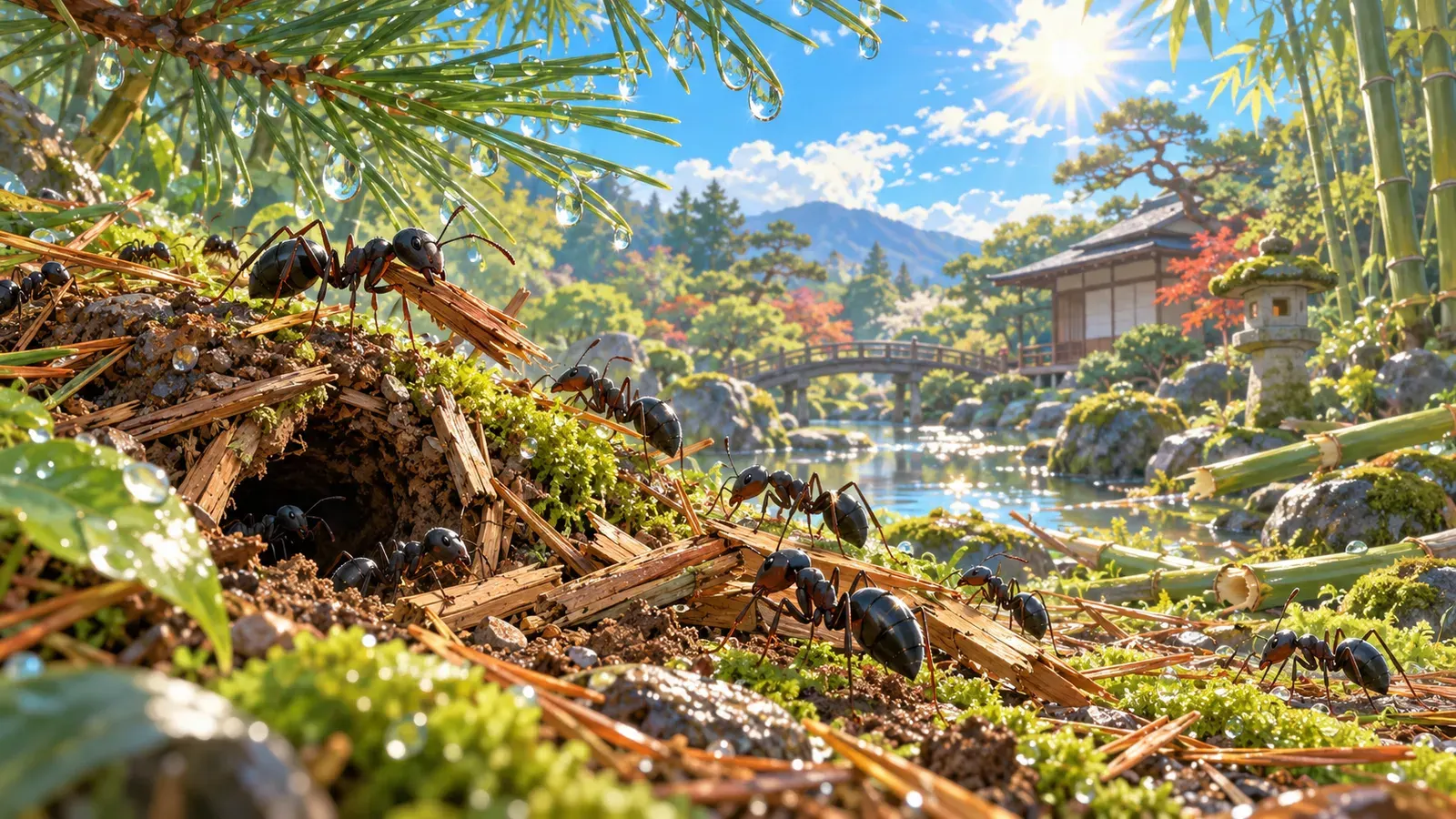
This morning sky, after the night's tempest, is a pure and dazzling blue. The air—the delicious air!—is full of sweet resinous odors, shed from the countless pine-boughs broken and strewn by the gale. In the neighboring bamboo-grove I hear the flute-call of the bird that praises the Sûtra of the Lotos; and the land is very still by reason of the south wind. Now the summer, long delayed, is truly with us: butterflies of queer Japanese colors are flickering about; semi are wheezing; wasps are humming; gnats are dancing in the sun; and the ants are busy repairing their damaged habitations... I bethink me of a Japanese poem:—
夜通し吹き荒れた嵐が去って、今朝の空は、澄みきったまぶしい青である。空気は、ああ、なんとおいしい空気だろう! 大風に折られて散らばった無数の松の枝から、松やにの甘い香りがただよってくる。となりの竹やぶからは、法華経をたたえる鳥、つまりうぐいすの、笛のような声が聞こえる。南風のせいで、あたりはしんと静まりかえっている。長いこと待たされた夏が、いよいよ本当にやってきたのだ。日本らしい不思議な色の蝶がちらちらと舞い、蝉がじいじいと鳴き、蜂がぶんぶんとうなり、羽虫が日ざしの中で踊っている。そして蟻たちは、壊れた住まいの修繕に忙しい……。ふと、ある日本の句を思い出す。
Yuku é naki: Ari no sumai ya! Go-getsu amé.
行方なき 蟻の住まいや! 五月雨
[Now the poor creature has nowhere to go!... Alas for the dwellings of the ants in this rain of the fifth month!]
〔かわいそうに、もう行くところもない!……ああ、五月雨にうたれる蟻の住まいよ!〕
But those big black ants in my garden do not seem to need any sympathy. They have weathered the storm in some unimaginable way, while great trees were being uprooted, and houses blown to fragments, and roads washed out of existence. Yet, before the typhoon, they took no other visible precaution than to block up the gates of their subterranean town. And the spectacle of their triumphant toil to-day impels me to attempt an essay on Ants.
けれども、私の庭のあの大きな黒い蟻たちには、同情などまるでいらないようだ。大木が根こそぎ倒れ、家がこっぱみじんに吹き飛ばされ、道が跡形もなく流されてしまったというのに、蟻たちは、想像もつかないやり方で嵐を乗りきったのである。それでいて、台風の前に蟻たちがした用心といえば、見たところ、地下の町の門をふさいだことくらいだった。今日、蟻たちが勝ちほこったように働いているのを見ていると、蟻について一文を書いてみたくなる。
I should have liked to preface my disquisitions with something from the old Japanese literature,—something emotional or metaphysical. But all that my Japanese friends were able to find for me on the subject,—excepting some verses of little worth,—was Chinese. This Chinese material consisted chiefly of strange stories; and one of them seems to me worth quoting,—faute de mieux.
できれば、この一文のはじめに、日本の古い文学から何か引いてきたかった。心にしみるものか、深い思索をさそうものを。ところが、日本の友人たちがこの題について探してくれたものは、つまらない句がいくつかあったほかは、みな中国のものだった。中国のものは、ほとんどが不思議な話だった。その中にひとつ、ほかに適当なものがないので、引いておく値打ちのありそうな話がある。
In the province of Taishū, in China, there was a pious man who, every day, during many years, fervently worshiped a certain goddess. One morning, while he was engaged in his devotions, a beautiful woman, wearing a yellow robe, came into his chamber and stood before him. He, greatly surprised, asked her what she wanted, and why she had entered unannounced. She answered: "I am not a woman: I am the goddess whom you have so long and so faithfully worshiped; and I have now come to prove to you that your devotion has not been in vain... Are you acquainted with the language of Ants?" The worshiper replied: "I am only a low-born and ignorant person,—not a scholar; and even of the language of superior men I know nothing." At these words the goddess smiled, and drew from her bosom a little box, shaped like an incense box. She opened the box, dipped a finger into it, and took therefrom some kind of ointment with which she anointed the ears of the man. "Now," she said to him, "try to find some Ants, and when you find any, stoop down, and listen carefully to their talk. You will be able to understand it; and you will hear of something to your advantage... Only remember that you must not frighten or vex the Ants." Then the goddess vanished away.
中国の台州(たいしゅう)という地方に、信心深い男がいた。男は何年ものあいだ、毎日、ある女神を熱心に拝んでいた。ある朝、男がお勤めをしていると、黄色い衣を着た美しい女が部屋に入ってきて、男の前に立った。男はたいそう驚いて、何の用か、なぜ断りもなく入ってきたのか、と尋ねた。女は答えた。「わたしは人間の女ではありません。あなたが長いあいだ、あれほど心をこめて拝んできた女神です。あなたの信心がむだではなかったことを教えるために、やってきたのです……。あなたは、蟻の言葉を知っていますか」。男は答えた。「わたくしは、生まれの卑しい無学な者でございます。学者ではございません。えらい方々の言葉さえ、何ひとつ存じません」。それを聞くと、女神はほほえんで、ふところから香合のような形の小箱を取り出した。そして箱を開けて指をひたし、何か膏薬のようなものをすくい取って、男の耳に塗った。「さあ」と女神は言った。「蟻を探してごらんなさい。見つけたら、かがみこんで、蟻の話をよく聞くのです。蟻の言うことがわかるはずです。あなたのためになることが聞けるでしょう……。ただ、蟻をおどかしたり、怒らせたりしてはいけませんよ」。そう言うと、女神は消えてしまった。
The man immediately went out to look for some Ants. He had scarcely crossed the threshold of his door when he perceived two Ants upon a stone supporting one of the house-pillars. He stooped over them, and listened; and he was astonished to find that he could hear them talking, and could understand what they said. "Let us try to find a warmer place," proposed one of the Ants. "Why a warmer place?" asked the other;—"what is the matter with this place?" "It is too damp and cold below," said the first Ant; "there is a big treasure buried here; and the sunshine cannot warm the ground about it." Then the two Ants went away together, and the listener ran for a spade.
男はすぐに外へ出て、蟻を探した。戸口の敷居をまたいだかと思うと、もう、家の柱を支える礎石の上に、蟻が二匹いるのが目に入った。男はかがみこんで、耳をすました。すると驚いたことに、蟻たちの話し声が聞こえ、その言っていることがわかるのだった。「どこか、もっと暖かいところを探そうよ」と一匹の蟻が言った。「どうして、もっと暖かいところなんだい」ともう一匹が聞いた。「ここの何がいけないのさ」。「下がじめじめして寒すぎるんだよ」とはじめの蟻が言った。「ここには大きな宝が埋まっていて、そのまわりの土は、日が当たっても暖まらないんだ」。それから二匹の蟻は連れだって行ってしまった。話を聞いていた男は、鋤を取りに走った。
By digging in the neighborhood of the pillar, he soon found a number of large jars full of gold coin. The discovery of this treasure made him a very rich man.
柱のあたりを掘ってみると、まもなく、金貨のぎっしりつまった大きな甕がいくつも出てきた。この宝を見つけて、男はたいそうな金持ちになった。
Afterwards he often tried to listen to the conversation of Ants. But he was never again able to hear them speak. The ointment of the goddess had opened his ears to their mysterious language for only a single day.
その後も、男はたびたび蟻の話を聞こうとした。けれども、蟻の話し声が聞こえることは二度となかった。女神の膏薬が、蟻の不思議な言葉に男の耳を開いてくれたのは、たった一日だけのことだったのである。
Now I, like that Chinese devotee, must confess myself a very ignorant person, and naturally unable to hear the conversation of Ants. But the Fairy of Science sometimes touches my ears and eyes with her wand; and then, for a little time, I am able to hear things inaudible, and to perceive things imperceptible.
さて、私も、あの中国の信心深い男と同じく、たいそう無学な人間であることを白状しなければならない。もちろん、蟻の話し声など聞こえるはずがない。けれども、ときどき科学の妖精が、杖で私の耳と目にふれてくれる。するとしばらくのあいだ、私にも、聞こえないはずのものが聞こえ、見えないはずのものが見えるのである。
For the same reason that it is considered wicked, in sundry circles, to speak of a non-Christian people having produced a civilization ethically superior to our own, certain persons will not be pleased by what I am going to say about ants. But there are men, incomparably wiser than I can ever hope to be, who think about insects and civilizations independently of the blessings of Christianity; and I find encouragement in the new Cambridge Natural History, which contains the following remarks by Professor David Sharp, concerning ants:—
キリスト教徒でない民族が、道徳の面で私たちの文明よりすぐれた文明を生み出した、などと言うと、方々で、けしからんことだと言われる。それと同じ理由で、私がこれから蟻について言うことを、こころよく思わない人もいるだろう。だが、私などとは比べものにならないほど賢い人たちの中にも、キリスト教のありがたい教えとは関わりなく、虫や文明について考える人がいる。新しい『ケンブリッジ博物誌』を読んで、私は心強く思った。そこには、デイヴィッド・シャープ教授が、蟻についてこう書いているのである。
"Observation has revealed the most remarkable phenomena in the lives of these insects. Indeed we can scarcely avoid the conclusion that they have acquired, in many respects, the art of living together in societies more perfectly than our own species has; and that they have anticipated us in the acquisition of some of the industries and arts that greatly facilitate social life."
「観察によって、これらの昆虫の生活に、まことに驚くべき現象のあることが明らかになった。じっさい、こう結論せざるをえない。蟻は多くの点で、社会をつくってともに生きる術を、われわれ人類よりも完全に身につけている。また、社会生活を大いに楽にする産業や技術のいくつかを、われわれより先に手に入れているのである」
I suppose that a few well-informed persons will dispute this plain statement by a trained specialist. The contemporary man of science is not apt to become sentimental about ants or bees; but he will not hesitate to acknowledge that, in regard to social evolution, these insects appear to have advanced "beyond man." Mr. Herbert Spencer, whom nobody will charge with romantic tendencies, goes considerably further than Professor Sharp; showing us that ants are, in a very real sense, ethically as well as economically in advance of humanity,—their lives being entirely devoted to altruistic ends. Indeed, Professor Sharp somewhat needlessly qualifies his praise of the ant with this cautious observation:—
専門の訓練を積んだ学者がこれほどはっきりと言っているのに、それに異をとなえる物知りも、少しはいるだろう。今の科学者は、蟻や蜜蜂のことで感傷的になったりはしない。それでも、社会の進化という点では、これらの虫が「人間より先へ」進んでいるらしいことを、ためらわずに認めるだろう。ハーバート・スペンサー氏は、ロマンティックな傾きがあるなどとは誰からも言われない人だが、シャープ教授よりもずっと踏みこんでいる。蟻は、まったく本当の意味で、経済の面だけでなく道徳の面でも人類より進んでいる、とスペンサー氏は示しているのだ。蟻の一生は、すべて、自分以外のもののためにささげられているからである。じっさいシャープ教授は、蟻をほめたあとで、いくらか余計なことに、次のような用心深い但し書きをつけている。
"The competence of the ant is not like that of man. It is devoted to the welfare of the species rather than to that of the individual, which is, as it were, sacrificed or specialized for the benefit of the community."
「蟻の能力は、人間の能力とは異なる。それは個体の幸せよりも、むしろ種全体の幸せのためにささげられている。個体は、いわば共同体の利益のために、犠牲にされたり、特定の役目だけに作りかえられたりしているのである」
—The obvious implication,—that any social state, in which the improvement of the individual is sacrificed to the common welfare, leaves much to be desired,—is probably correct, from the actual human standpoint. For man is yet imperfectly evolved; and human society has much to gain from his further individualization. But in regard to social insects the implied criticism is open to question. "The improvement of the individual," says Herbert Spencer, "consists in the better fitting of him for social cooperation; and this, being conducive to social prosperity, is conducive to the maintenance of the race." In other words, the value of the individual can be only in relation to the society; and this granted, whether the sacrifice of the individual for the sake of that society be good or evil must depend upon what the society might gain or lose through a further individualization of its members... But as we shall presently see, the conditions of ant-society that most deserve our attention are the ethical conditions; and these are beyond human criticism, since they realize that ideal of moral evolution described by Mr. Spencer as "a state in which egoism and altruism are so conciliated that the one merges into the other." That is to say, a state in which the only possible pleasure is the pleasure of unselfish action. Or, again to quote Mr. Spencer, the activities of the insect-society are "activities which postpone individual well-being so completely to the well-being of the community that individual life appears to be attended to only just so far as is necessary to make possible due attention to social life,... the individual taking only just such food and just such rest as are needful to maintain its vigor."
――この言葉には、はっきりと、ある意味がこめられている。個体が向上することよりも、全体の幸せのほうを優先するような社会は、物足りないところが多い、というのである。今の人間の立場から見れば、それはおそらく正しいだろう。人間はまだ進化の途中で、不完全であり、人間の社会は、一人一人がもっと個性をのばすことで、得るものが多いからである。けれども、社会をつくる昆虫について言えば、この批判が当たっているかどうかは疑わしい。ハーバート・スペンサーは言う。「個体の向上とは、個体を社会の協力にいっそうふさわしいものにすることである。そしてそれは社会の繁栄に役立つから、種の存続にも役立つのである」。言いかえれば、個体の値打ちは、社会との関わりの中にしかありえない。そう認めるなら、社会のために個体を犠牲にすることがよいか悪いかは、その社会が、成員の個性をもっとのばすことで、何を得て何を失うかによって決まることになる……。だが、これから見ていくように、蟻の社会でいちばん注目すべきなのは、その道徳のありかたである。そしてそれは、人間があれこれ批判できるようなものではない。蟻の社会は、スペンサー氏が道徳の進化の理想として描いたものを、そのまま実現しているからである。スペンサー氏の言葉を借りれば、それは「利己心と利他心がすっかり調和して、一方が他方に溶けこんでしまった状態」である。つまり、人のためにする行いのほかに、喜びというものがありえない状態だ。もう一度スペンサー氏の言葉を引けば、昆虫の社会の活動は、「個体の幸せを、共同体の幸せのあとに、すっかり回してしまう活動である。個体の生活は、社会の生活にきちんと尽くすのに必要なかぎりでしか、かえりみられていないように見える……。個体は、元気を保つのにちょうど必要なだけの食べ物と休息しか、とらないのである」。
I hope my reader is aware that ants practise horticulture and agriculture; that they are skillful in the cultivation of mushrooms; that they have domesticated (according to present knowledge) five hundred and eighty-four different kinds of animals; that they make tunnels through solid rock; that they know how to provide against atmospheric changes which might endanger the health of their children; and that, for insects, their longevity is exceptional,—members of the more highly evolved species living for a considerable number of years.
蟻が庭仕事や畑仕事をすることは、読者もご存じだろう。きのこを上手に育てることも、(今わかっているかぎりでは)五百八十四種類もの動物を飼いならしていることも、硬い岩にトンネルを掘ることも知っているだろう。子どもたちの体にさわるような天気の変化に、ちゃんと備えるすべを知っていることも、虫としては並はずれて長生きであることも知っているだろう。進化の進んだ種類の蟻は、何年も生きるのである。
But it is not especially of these matters that I wish to speak. What I want to talk about is the awful propriety, the terrible morality, of the ant. Our most appalling ideals of conduct fall short of the ethics of the ant,—as progress is reckoned in time,—by nothing less than millions of years!... When I say "the ant," I mean the highest type of ant,—not, of course, the entire ant-family. About two thousand species of ants are already known; and these exhibit, in their social organizations, widely varying degrees of evolution. Certain social phenomena of the greatest biological importance, and of no less importance in their strange relation to the subject of ethics, can be studied to advantage only in the existence of the most highly evolved societies of ants.
けれども、私がとくに話したいのは、そういうことではない。私が話したいのは、蟻の、おそろしいほどの行いの正しさ、すさまじいまでの道徳についてである。私たち人間が思いつく、もっともおそろしく厳しい行いの理想でさえ、蟻の道徳にははるかに及ばない。進歩を時間で測るなら、なんと何百万年も遅れているのだ!……。ここで「蟻」というのは、いちばん進んだ種類の蟻のことで、もちろん、蟻の仲間すべてのことではない。今までにわかっている蟻は、およそ二千種類ある。その社会のしくみは、種類によって進化の度合いがまるで違う。生物学のうえでとても大切で、しかも道徳の問題と不思議なつながりがある点でも劣らず大切な、ある種の社会のありさまがある。それをよく調べることができるのは、いちばん進化した蟻の社会においてだけなのである。
After all that has been written of late years about the probable value of relative experience in the long life of the ant, I suppose that few persons would venture to deny individual character to the ant. The intelligence of the little creature in meeting and overcoming difficulties of a totally new kind, and in adapting itself to conditions entirely foreign to its experience, proves a considerable power of independent thinking. But this at least is certain: that the ant has no individuality capable of being exercised in a purely selfish direction;—I am using the word "selfish" in its ordinary acceptation. A greedy ant, a sensual ant, an ant capable of any one of the seven deadly sins, or even of a small venial sin, is unimaginable. Equally unimaginable, of course, a romantic ant, an ideological ant, a poetical ant, or an ant inclined to metaphysical speculations. No human mind could attain to the absolute matter-of-fact quality of the ant-mind;—no human being, as now constituted, could cultivate a mental habit so impeccably practical as that of the ant. But this superlatively practical mind is incapable of moral error. It would be difficult, perhaps, to prove that the ant has no religious ideas. But it is certain that such ideas could not be of any use to it. The being incapable of moral weakness is beyond the need of "spiritual guidance."
蟻は長生きなので、一生のあいだに積んだ経験が役に立つのではないか。近ごろはそういうことがいろいろと書かれているので、蟻に一匹ずつの個性があることを、あえて否定する人はほとんどいないだろう。この小さな生き物は、まったく新しい種類の困難にぶつかっても、それを乗りこえる。まるで経験したことのない状況にも、ちゃんと合わせていく。その知恵を見れば、蟻が自分でものを考える力をかなり持っていることがわかる。けれども、少なくともこれだけは確かである。蟻には、ひたすら自分のためだけに使われるような個性はない。――ここで「自分のため」というのは、ふつうの意味で言っている。欲ばりな蟻、快楽にふける蟻、七つの大罪のどれかひとつでも犯す蟻など、想像もできない。小さな、許される程度の罪を犯す蟻さえ、想像できない。もちろん、ロマンティックな蟻も、理屈をこねる蟻も、詩的な蟻も、形而上学の思索にふけりたがる蟻も、やはり想像できない。蟻の心は、どこまでも現実的である。人間の心は、とてもそこまでいけない。今の人間のつくりのままでは、蟻のように非の打ちどころなく実際的な心の習慣を身につけることなど、できはしない。そして、このどこまでも実際的な心は、道徳の過ちを犯すことがないのである。蟻に宗教心がないと証明するのは、おそらくむずかしいだろう。だが、たとえあったとしても、蟻にとって何の役にも立たないことは確かである。道徳の弱さを持たない者に、「魂の導き」などいらないのだから。
Only in a vague way can we conceive the character of ant-society, and the nature of ant-morality; and to do even this we must try to imagine some yet impossible state of human society and human morals. Let us, then, imagine a world full of people incessantly and furiously working,—all of whom seem to be women. No one of these women could be persuaded or deluded into taking a single atom of food more than is needful to maintain her strength; and no one of them ever sleeps a second longer than is necessary to keep her nervous system in good working-order. And all of them are so peculiarly constituted that the least unnecessary indulgence would result in some derangement of function.
蟻の社会がどんなものか、蟻の道徳がどんな性質のものか、私たちにはぼんやりとしか思い描けない。それさえ、人間の社会や道徳が、今はまだありえないような姿になったところを想像してみなければならない。では、想像してみよう。ある世界に、休みなく猛烈に働く人々があふれている。見たところ、みな女ばかりである。この女たちは誰一人として、体力を保つのに必要な量より、ほんのひとかけらでも多く食べることはない。どれほどすすめられても、だまされても、決して食べない。また誰一人として、神経をきちんと働かせておくのに必要な時間より、一秒でも長く眠ることはない。しかもみな、ほんの少しでも余計な楽しみにふければ、体のどこかがおかしくなってしまうという、特別なつくりをしているのである。
The work daily performed by these female laborers comprises road-making, bridge-building, timber-cutting, architectural construction of numberless kinds, horticulture and agriculture, the feeding and sheltering of a hundred varieties of domestic animals, the manufacture of sundry chemical products, the storage and conservation of countless food-stuffs, and the care of the children of the race. All this labor is done for the commonwealth—no citizen of which is capable even of thinking about "property," except as a res publica;—and the sole object of the commonwealth is the nurture and training of its young,—nearly all of whom are girls. The period of infancy is long: the children remain for a great while, not only helpless, but shapeless, and withal so delicate that they must be very carefully guarded against the least change of temperature. Fortunately their nurses understand the laws of health: each thoroughly knows all that she ought to know in regard to ventilation, disinfection, drainage, moisture, and the danger of germs,—germs being as visible, perhaps, to her myopic sight as they become to our own eyes under the microscope. Indeed, all matters of hygiene are so well comprehended that no nurse ever makes a mistake about the sanitary conditions of her neighborhood.
この女の働き手たちが毎日する仕事は、さまざまである。道を造り、橋をかけ、木を切り、数えきれないほどいろいろな建物を建てる。庭仕事も畑仕事もする。百種類もの家畜にえさをやり、すみかを与えて世話をする。いろいろな化学製品をこしらえる。数えきれないほどの食べ物をたくわえ、傷まないように保存する。そして一族の子どもたちを育てる。こうした仕事はすべて、国全体のために行われる。この国の民は誰一人として、「財産」といえば、みんなのものだとしか考えられない。そしてこの国のただひとつの目的は、幼い者たちを養い育てることである。その幼い者たちは、ほとんどみな女の子だ。幼い時期は長い。子どもたちは長いあいだ、自分では何もできないばかりか、まだ形さえ定まっていない。そのうえ、たいそうか弱いので、ほんのわずかな温度の変化からも、細心の注意を払って守ってやらなければならない。さいわい、子守りたちは健康の法則をよく心得ている。風通し、消毒、水はけ、湿り気、ばい菌の危険について、知っておくべきことを、一人一人がすべて知りつくしている。ばい菌は、近目の子守りたちの目には、私たちが顕微鏡でのぞいたときと同じくらい、よく見えるのかもしれない。じっさい、衛生のことはすみずみまでよく心得ているので、まわりの衛生状態について思いちがいをする子守りは、一人もいないのである。
In spite of this perpetual labor no worker remains unkempt: each is scrupulously neat, making her toilet many times a day. But as every worker is born with the most beautiful of combs and brushes attached to her wrists, no time is wasted in the toilet-room. Besides keeping themselves strictly clean, the workers must also keep their houses and gardens in faultless order, for the sake of the children. Nothing less than an earthquake, an eruption, an inundation, or a desperate war, is allowed to interrupt the daily routine of dusting, sweeping, scrubbing, and disinfecting.
これほど休みなく働いているのに、身なりをだらしなくしている働き手は一人もいない。誰もがきちょうめんなほど身ぎれいで、日に何度も身づくろいをする。とはいえ、働き手はみな、このうえなく美しいくしとブラシを手首につけて生まれてくるので、身づくろいに時間をむだにすることはない。働き手は、自分の体をきびしく清潔にしておくだけでなく、子どもたちのために、家や庭も一点のすきもなく整えておかなければならない。ほこりを払い、掃き、こすり洗いをし、消毒する。この毎日の決まった仕事を休んでよいのは、地震か、噴火か、洪水か、命がけの戦でもあったときだけである。
Now for stranger facts:—
さて、もっと不思議な話に移ろう。
This world of incessant toil is a more than Vestal world. It is true that males can sometimes be perceived in it; but they appear only at particular seasons, and they have nothing whatever to do with the workers or with the work. None of them would presume to address a worker,—except, perhaps, under extraordinary circumstances of common peril. And no worker would think of talking to a male;—for males, in this queer world, are inferior beings, equally incapable of fighting or working, and tolerated only as necessary evils. One special class of females,—the Mothers-Elect of the race,—do condescend to consort with males, during a very brief period, at particular seasons. But the Mothers-Elect do not work; and they must accept husbands. A worker could not even dream of keeping company with a male,—not merely because such association would signify the most frivolous waste of time, nor yet because the worker necessarily regards all males with unspeakable contempt; but because the worker is incapable of wedlock. Some workers, indeed, are capable of parthenogenesis, and give birth to children who never had fathers. As a general rule, however, the worker is truly feminine by her moral instincts only: she has all the tenderness, the patience, and the foresight that we call "maternal;" but her sex has disappeared, like the sex of the Dragon-Maiden in the Buddhist legend.
休みなく働くこの世界は、神に仕える処女の巫女たちの世界よりも、なお清らかな世界である。たしかに、ときには雄の姿を見かけることもある。だが雄は決まった季節にしか現れず、働き手とも仕事とも、まったく何の関わりもない。雄が働き手に話しかけるような出すぎたまねをすることはない。みんなが同じ危険にさらされるような、よほどのときは別かもしれないが。働き手のほうも、雄に話しかけようなどとは思いもしない。この奇妙な世界では、雄は劣った者なのだ。戦うこともできず、働くこともできず、仕方のないものとして、大目に見てもらっているにすぎない。雌の中の特別な一団、一族の母として選ばれた者たちだけが、決まった季節のごく短いあいだ、雄と連れそうことを受け入れる。だが選ばれた母たちは働かない。そして夫を迎えなければならない。働き手は、雄とつきあうことなど夢にも考えられない。そんなつきあいはとんでもない時間のむだだから、というだけではない。働き手が雄をみな、言いようもなく見くだしているから、というだけでもない。働き手には、そもそも結婚する力がないのである。もっとも、働き手の中には、雄なしで子を産めるものもいて、父親のいない子どもを産む。けれども、ふつう働き手が本当に女らしいのは、その心の本能においてだけである。働き手は、私たちが「母性」と呼ぶやさしさや、忍耐づよさや、先を見通す力を、すべてそなえている。けれども、その性は消えてしまっている。仏教の言い伝えに出てくる竜女(りゅうにょ)の性が、消えてしまったように。
For defense against creatures of prey, or enemies of the state, the workers are provided with weapons; and they are furthermore protected by a large military force. The warriors are so much bigger than the workers (in some communities, at least) that it is difficult, at first sight, to believe them of the same race. Soldiers one hundred times larger than the workers whom they guard are not uncommon. But all these soldiers are Amazons,—or, more correctly speaking, semi-females. They can work sturdily; but being built for fighting and for heavy pulling chiefly, their usefulness is restricted to those directions in which force, rather than skill, is required.
獲物をねらう生き物や、国の敵から身を守るために、働き手は武器をそなえている。そのうえ、大きな軍隊にも守られている。兵隊は(少なくともいくつかの国では)働き手よりずっと大きく、ひと目見ただけでは、同じ一族とは思えないほどである。守っている働き手の百倍も大きい兵隊も珍しくない。だが、この兵隊もみな、女だけの戦士たち、アマゾンなのだ。もっと正確に言えば、半分だけの雌である。兵隊もたくましく働くことはできる。だが、もともと戦うことと重いものを引くことに向いた体のつくりなので、役に立つのは、器用さよりも力のいる仕事にかぎられる。
[Why females, rather than males, should have been evolutionally specialized into soldiery and laborers may not be nearly so simple a question as it appears. I am very sure of not being able to answer it. But natural economy may have decided the matter. In many forms of life, the female greatly exceeds the male in bulk and in energy;—perhaps, in this case, the larger reserve of life-force possessed originally by the complete female could be more rapidly and effectively utilized for the development of a special fighting-caste. All energies which, in the fertile female, would be expended in the giving of life seem here to have been diverted to the evolution of aggressive power, or working-capacity.]
〔なぜ雄ではなく雌が、進化の中で兵隊や働き手に作りかえられたのか。これは見かけほど単純な問題ではないかもしれない。私に答えられないことは、よくわかっている。だが、自然のやりくりがそう決めたのかもしれない。多くの生き物では、雌のほうが雄よりも体が大きく、力も強い。この場合もおそらく、雌がもともと持っていた大きな生命力のたくわえのほうが、戦うための特別な階級を作るのに、すばやく、うまく使えたのだろう。子を産める雌なら、命を生み出すために使うはずの力が、ここではすべて、攻める力や働く力を進化させるほうへ回されたように見えるのである。〕
Of the true females,—the Mothers-Elect,—there are very few indeed; and these are treated like queens. So constantly and so reverentially are they waited upon that they can seldom have any wishes to express. They are relieved from every care of existence,—except the duty of bearing offspring. Night and day they are cared for in every possible manner. They alone are superabundantly and richly fed:—for the sake of the offspring they must eat and drink and repose right royally; and their physiological specialization allows of such indulgence ad libitum. They seldom go out, and never unless attended by a powerful escort; as they cannot be permitted to incur unnecessary fatigue or danger. Probably they have no great desire to go out. Around them revolves the whole activity of the race: all its intelligence and toil and thrift are directed solely toward the well-being of these Mothers and of their children.
本当の雌、つまり選ばれた母たちは、ほんのわずかしかいない。そして女王のように扱われる。いつも、うやうやしく世話をされているので、口に出して何かを望むことなど、めったにないだろう。子を産むというつとめのほかは、生きていくうえでのあらゆる苦労から解きはなたれている。昼も夜も、考えられるかぎりの方法で大事にされる。あり余るほどたっぷりと食べ物をもらえるのは、母たちだけである。子孫のために、母たちはまさに王族のように、食べ、飲み、休まなければならない。体がそのように特別にできているので、いくら食べても休んでもかまわないのだ。母たちはめったに外へ出ない。出るときは、必ず強い護衛をつける。余計な疲れや危険を招くことは許されないからである。そもそも外へ出たいとも、それほど思わないのだろう。一族のあらゆる活動は、母たちを中心に回っている。一族の知恵も、苦労も、倹約も、すべてはひたすら、母たちとその子どもたちの幸せのためにあるのだ。
But last and least of the race rank the husbands of these Mothers,—the necessary Evils,—the males. They appear only at a particular season, as I have already observed; and their lives are very short. Some cannot even boast of noble descent, though destined to royal wedlock; for they are not royal offspring, but virgin-born,—parthenogenetic children,—and, for that reason especially, inferior beings, the chance results of some mysterious atavism. But of any sort of males the commonwealth tolerates but few,—barely enough to serve as husbands for the Mothers-Elect, and these few perish almost as soon as their duty has been done. The meaning of Nature's law, in this extraordinary world, is identical with Ruskin's teaching that life without effort is crime; and since the males are useless as workers or fighters, their existence is of only momentary importance. They are not, indeed, sacrificed,—like the Aztec victim chosen for the festival of Tezcatlipoca, and allowed a honeymoon of twenty days before his heart was torn out. But they are scarcely less unfortunate in their high fortune. Imagine youths brought up in the knowledge that they are destined to become royal bridegrooms for a single night,—that after their bridal they will have no moral right to live,—that marriage, for each and all of them, will signify certain death,—and that they cannot even hope to be lamented by their young widows, who will survive them for a time of many generations...!
そして一族のいちばん最後、いちばん下に位置するのが、この母たちの夫、仕方のない厄介者、つまり雄である。前にも言ったように、雄は決まった季節にしか現れず、その命はたいそう短い。王族と結婚する運命にありながら、高貴な生まれを誇ることさえできない雄もいる。王族の子ではなく、処女から生まれた子、つまり雄なしで生まれた子だからである。とりわけそのために、雄は劣った者とされる。何か不思議な先祖がえりで、たまたま生まれてきたものだというのだ。しかも、どんな雄であれ、この国が許しておく雄の数は、ほんのわずかである。選ばれた母たちの夫として、やっと足りるくらいの数でしかない。そのわずかな雄も、つとめを果たすと、ほとんどすぐに死んでしまう。この不思議な世界での自然の掟は、努力なしに生きるのは罪である、というラスキンの教えとまったく同じなのだ。雄は働き手としても戦士としても役に立たないので、その命はほんのいっときしか意味を持たない。たしかに雄は、アステカの生贄のように殺されるわけではない。アステカでは、テスカトリポカという神の祭りのために若者が選ばれ、二十日間の蜜月を楽しんだあと、心臓をえぐり出されたのだ。だが雄たちも、その輝かしい運命の中で、それに劣らず不幸である。想像してみるがよい。若者たちが、こう教えられて育つのだ。おまえたちは、たった一夜だけの王族の花婿になる。婚礼がすめば、もう生きている資格はない。結婚は、おまえたち一人残らずにとって、確かな死を意味する。しかも若い妻たちは、おまえたちが死んだあと何世代ものあいだ生き続けるが、おまえたちの死を悲しんでくれることさえ望めないのだ……!
But all the foregoing is no more than a proem to the real "Romance of the Insect-World."
けれども、これまで話してきたことはすべて、本当の「昆虫世界のロマンス」の前置きにすぎない。
—By far the most startling discovery in relation to this astonishing civilization is that of the suppression of sex. In certain advanced forms of ant-life sex totally disappears in the majority of individuals;—in nearly all the higher ant-societies sex-life appears to exist only to the extent absolutely needed for the continuance of the species. But the biological fact in itself is much less startling than the ethical suggestion which it offers;—for this practical suppression, or regulation, of sex-faculty appears to be voluntary! Voluntary, at least, so far as the species is concerned. It is now believed that these wonderful creatures have learned how to develop, or to arrest the development, of sex in their young,—by some particular mode of nutrition. They have succeeded in placing under perfect control what is commonly supposed to be the most powerful and unmanageable of instincts. And this rigid restraint of sex-life to within the limits necessary to provide against extinction is but one (though the most amazing) of many vital economies effected by the race. Every capacity for egoistic pleasure—in the common meaning of the word "egoistic"—has been equally repressed through physiological modification. No indulgence of any natural appetite is possible except to that degree in which such indulgence can directly or indirectly benefit the species;—even the indispensable requirements of food and sleep being satisfied only to the exact extent necessary for the maintenance of healthy activity. The individual can exist, act, think, only for the communal good; and the commune triumphantly refuses, in so far as cosmic law permits, to let itself be ruled either by Love or Hunger.
――この驚くべき文明について、何よりも驚くべき発見は、性がおさえこまれているということである。ある種の進んだ蟻では、ほとんどの個体で、性がまったく消えてしまっている。高度な蟻の社会のほとんどすべてで、性の営みは、種が絶えないために、どうしても必要なだけしか行われていないようだ。だが、この生物学の事実そのものより、それが道徳について教えてくれることのほうが、はるかに驚くべきである。というのも、このように性の力を実際におさえ、調節しているのは、蟻自身の意志によるらしいからだ! 少なくとも、種全体として見れば、意志によるものなのである。今では、こう考えられている。この驚くべき生き物は、ある特別な食べ物の与え方によって、幼い者の性を育てたり、その成長を止めたりするすべを身につけたのだ、と。ふつう、もっとも強く、もっとも手に負えないと思われている本能を、蟻は完全に支配することに成功したのである。種が絶えないために必要な範囲にまで、性の営みをきびしくおさえこむ。それは、この一族がなしとげた、命のやりくりのひとつにすぎない(もっとも、いちばん驚くべきものではあるが)。自分のための快楽、ふつうの意味でいう「利己的な」快楽を求める力も、すべて同じように、体の変化によっておさえこまれてきた。生まれつきの欲望を満たしてよいのは、それが、直接にせよ間接にせよ、種のためになる範囲だけである。食べ物と眠りという、なくてはならないものでさえ、元気に働き続けるのにちょうど必要な分しか満たされない。個体は、みんなのためにしか生きられず、動けず、考えられない。そして共同体は、宇宙の法則が許すかぎり、恋にも飢えにも支配されることを、堂々と拒んでいるのである。
Most of us have been brought up in the belief that without some kind of religious creed—some hope of future reward or fear of future punishment—no civilization could exist. We have been taught to think that in the absence of laws based upon moral ideas, and in the absence of an effective police to enforce such laws, nearly everybody would seek only his or her personal advantage, to the disadvantage of everybody else. The strong would then destroy the weak; pity and sympathy would disappear; and the whole social fabric would fall to pieces... These teachings confess the existing imperfection of human nature; and they contain obvious truth. But those who first proclaimed that truth, thousands and thousands of years ago, never imagined a form of social existence in which selfishness would be naturally impossible. It remained for irreligious Nature to furnish us with proof positive that there can exist a society in which the pleasure of active beneficence makes needless the idea of duty,—a society in which instinctive morality can dispense with ethical codes of every sort,—a society of which every member is born so absolutely unselfish, and so energetically good, that moral training could signify, even for its youngest, neither more nor less than waste of precious time.
私たちの多くは、こう信じるように育てられてきた。何かの宗教の教え、つまり、あの世でむくわれるという希望や、あの世で罰を受けるという恐れがなければ、どんな文明も成り立たない、と。道徳にもとづく法律がなく、その法律を守らせる頼りになる警察もなければ、ほとんど誰もが、ほかの人を押しのけて、自分の得だけを求めるようになる、と教えられてきた。そうなれば、強い者が弱い者を滅ぼし、あわれみも思いやりも消えて、社会のしくみ全体がばらばらに崩れてしまう、と……。こうした教えは、人間の本性がいまだに不完全であることを認めたものであり、たしかに真理をふくんでいる。だが、何千年も何千年も前に、はじめてその真理をとなえた人たちは、利己心などそもそもありえないような社会を、思い描いたことはなかった。そのような社会がありうることを、確かな証拠で示してくれたのは、宗教を持たない自然だった。進んで人のためにつくす喜びがあるので、義務という考えがいらない社会。本能が道徳そのものなので、どんな道徳の掟もいらない社会。すべての成員が、生まれながらにまったく私心がなく、いきいきと善良なので、道徳を教えこむことなど、いちばん幼い者にとってさえ、貴重な時間のむだでしかないような社会。それがありうることを、自然が教えてくれたのである。
To the Evolutionist such facts necessarily suggest that the value of our moral idealism is but temporary; and that something better than virtue, better than kindness, better than self-denial,—in the present human meaning of those terms,—might, under certain conditions, eventually replace them. He finds himself obliged to face the question whether a world without moral notions might not be morally better than a world in which conduct is regulated by such notions. He must even ask himself whether the existence of religious commandments, moral laws, and ethical standards among ourselves does not prove us still in a very primitive stage of social evolution. And these questions naturally lead up to another: Will humanity ever be able, on this planet, to reach an ethical condition beyond all its ideals,—a condition in which everything that we now call evil will have been atrophied out of existence, and everything that we call virtue have been transmuted into instinct;—a state of altruism in which ethical concepts and codes will have become as useless as they would be, even now, in the societies of the higher ants.
進化論を信じる者にとって、こうした事実は、どうしても次のことを思わせる。私たちの道徳の理想は、いっときの値打ちしか持たないのではないか。今の人間が考えている意味での徳よりも、親切よりも、自分をおさえることよりも、もっとすぐれた何かが、ある条件のもとでは、いずれそれらに取って代わるのではないか。進化論者は、こういう問いに向き合わざるをえなくなる。道徳という考えのない世界のほうが、道徳という考えで行いをしばっている世界よりも、道徳的にすぐれているのではないか。さらに、こう自問しなければならない。私たちのあいだに、宗教の戒めや、道徳の掟や、善悪の物差しがあること自体が、私たちがまだ社会の進化のごく原始的な段階にいる証拠なのではないか。そしてこうした問いは、当然、もうひとつの問いにつながっていく。人類はいつか、この地球の上で、あらゆる理想を越えた道徳の状態にたどりつけるだろうか。今、私たちが悪と呼んでいるものがすべて、しなびて消えてしまい、徳と呼んでいるものがすべて、本能に変わってしまった状態。人のために生きることがあたりまえになり、道徳という考えも掟も、いらなくなった状態。高度な蟻の社会では、今でさえ、道徳の考えや掟など何の役にも立たないのと同じように。
The giants of modern thought have given some attention to this question; and the greatest among them has answered it—partly in the affirmative. Herbert Spencer has expressed his belief that humanity will arrive at some state of civilization ethically comparable with that of the ant:—
現代の思想の巨人たちも、この問いにいくらか目を向けてきた。そして、その中のいちばん偉大な人は、この問いに答えている。ある程度までは、そうなると答えているのだ。ハーバート・スペンサーは、人類はいつか、道徳の面で蟻の文明に肩をならべるような文明にたどりつくだろう、と信じていることを述べている。
"If we have, in lower orders of creatures, cases in which the nature is constitutionally so modified that altruistic activities have become one with egoistic activities, there is an irresistible implication that a parallel identification will, under parallel conditions, take place among human beings. Social insects furnish us with instances completely to the point,—and instances showing us, indeed, to what a marvelous degree the life of the individual may be absorbed in subserving the lives of other individuals... Neither the ant nor the bee can be supposed to have a sense of duty, in the acceptation we give to that word; nor can it be supposed that it is continually undergoing self-sacrifice, in the ordinary acceptation of that word... [The facts] show us that it is within the possibilities of organization to produce a nature which shall be just as energetic in the pursuit of altruistic ends, as is in other cases shown in the pursuit of egoistic ends;—and they show that, in such cases, these altruistic ends are pursued in pursuing ends which, on their other face, are egoistic. For the satisfaction of the needs of the organization, these actions, conducive to the welfare of others, must be carried on...
「下等な生き物の中に、その本性が体のつくりから変わってしまい、人のためにする活動が、自分のためにする活動と一つになってしまった例があるとする。そうであれば、同じような条件のもとでは、人間のあいだでも同じような一体化が起こると考えずにはいられない。社会をつくる昆虫は、まさにぴったりの例を示してくれる。個体の生活が、ほかの個体の生活に仕えることに、じつに驚くべき程度まで吸いこまれうることを、示してくれるのである……。蟻も蜜蜂も、われわれが言う意味での義務感を持っているとは考えられない。ふつうの意味で、たえず自分を犠牲にしているとも考えられない……。〔これらの事実が〕示しているのは、次のことである。ほかの場合には自分のための目的を追うのに見せるのと同じくらいの熱心さで、人のための目的を追う本性を生み出すことは、生き物のつくりとして十分にありうる。そして、そのような場合には、人のための目的は、裏から見れば自分のための目的を追うことによって、追い求められているのである。生き物が自分の体の求めを満たすためにこそ、ほかの者の幸せに役立つこれらの行いが、続けられなければならないのである……。
"So far from its being true that there must go on, throughout all the future, a condition in which self-regard is to be continually subjected by the regard for others, it will, contrari-wise, be the case that a regard for others will eventually become so large a source of pleasure as to overgrow the pleasure which is derivable from direct egoistic gratification... Eventually, then, there will come also a state in which egoism and altruism are so conciliated that the one merges in the other."
「この先いつまでも、自分を大事にする心が、たえず人を大事にする心に従わされる状態が続くにちがいない、というのは本当ではない。それどころか逆に、人を大事にする心が、やがては大きな喜びのみなもととなり、自分を直接満足させることから得られる喜びを、しのぐほどになるだろう……。そうしてついには、利己心と利他心がすっかり調和して、一方が他方に溶けこんでしまう状態も、やってくるであろう」
Of course the foregoing prediction does not imply that human nature will ever undergo such physiological change as would be represented by structural specializations comparable to those by which the various castes of insect societies are differentiated. We are not bidden to imagine a future state of humanity in which the active majority would consist of semi-female workers and Amazons toiling for an inactive minority of selected Mothers. Even in his chapter, "Human Population in the Future," Mr. Spencer has attempted no detailed statement of the physical modifications inevitable to the production of higher moral types,—though his general statement in regard to a perfected nervous system, and a great diminution of human fertility, suggests that such moral evolution would signify a very considerable amount of physical change. If it be legitimate to believe in a future humanity to which the pleasure of mutual beneficence will represent the whole joy of life, would it not also be legitimate to imagine other transformations, physical and moral, which the facts of insect-biology have proved to be within the range of evolutional possibility?... I do not know. I most worshipfully reverence Herbert Spencer as the greatest philosopher who has yet appeared in this world; and I should be very sorry to write down anything contrary to his teaching, in such wise that the reader could imagine it to have been inspired by Synthetic Philosophy. For the ensuing reflections, I alone am responsible; and if I err, let the sin be upon my own head.
もちろん、この予言は、人間の本性がいつか、昆虫の社会のさまざまな階級を分けているような体のつくりの違いを生むほど、大きく変わるだろうという意味ではない。働く大多数が、半分だけの雌の働き手とアマゾンであり、働かない少数の選ばれた母たちのために汗を流している。そんな人類の未来を想像せよと言われているわけではない。スペンサー氏は「未来の人口」という章でさえ、より高い道徳を持つ人間が生まれるために避けられない体の変化について、くわしく述べようとはしていない。とはいえ、神経のしくみが完成し、人間の子を産む力が大きく減っていく、という大まかな説明からすれば、そのような道徳の進化には、体のかなりの変化がともなうと考えられる。たがいに善をなす喜びが、人生の喜びのすべてになる。そんな未来の人類を信じてよいのなら、ほかの変化を想像してもよいのではないか。昆虫の生物学の事実が、進化として十分にありうることを証明している、体と心の別の変化を……。私にはわからない。私はハーバート・スペンサーを、これまでこの世に現れたもっとも偉大な哲学者として、心から崇めている。その教えに反することを書いて、読者にそれがスペンサーの総合哲学から出た考えだと思われてしまったら、大変申し訳ない。これから述べることは、すべて私一人の責任である。もし私がまちがっているなら、その罪はこの私が負おう。
I suppose that the moral transformations predicted by Mr. Spencer, could be effected only with the aid of physiological change, and at a terrible cost. Those ethical conditions manifested by insect-societies can have been reached only through effort desperately sustained for millions of years against the most atrocious necessities. Necessities equally merciless may have to be met and mastered eventually by the human race. Mr. Spencer has shown that the time of the greatest possible human suffering is yet to come, and that it will be concomitant with the period of the greatest possible pressure of population. Among other results of that long stress, I understand that there will be a vast increase in human intelligence and sympathy; and that this increase of intelligence will be effected at the cost of human fertility. But this decline in reproductive power will not, we are told, be sufficient to assure the very highest of social conditions: it will only relieve that pressure of population which has been the main cause of human suffering. The state of perfect social equilibrium will be approached, but never quite reached, by mankind—
スペンサー氏が予言した道徳の変化は、体の変化の助けを借りなければ、なしとげられないと私は思う。しかも、おそろしい代償を払わなければならないだろう。昆虫の社会に見られるような道徳の状態は、何百万年ものあいだ、このうえなく残酷な必要にさらされながら、必死に努力を続けて、ようやくたどりついたものにちがいない。人類も、いずれは同じように容赦のない必要にぶつかり、それを乗りこえなければならないかもしれない。スペンサー氏は、人類がもっとも苦しむ時代はまだこれからで、それは人口がもっともふくれあがって、人々がもっとも追いつめられる時代と重なるだろう、と示した。その長い苦しみの結果、人間の知恵と思いやりは大いに増すだろう、と私は理解している。そして、その知恵が増すかわりに、人間の子を産む力は減っていくだろう、と。けれども、子を産む力が減るだけでは、最高の社会を約束するには足りないそうだ。それはただ、人間の苦しみの主な原因だった人口の重圧を、やわらげるにすぎない。人類は、完全につりあいのとれた社会に近づきはするだろうが、決してそこまではたどりつけないだろう。
Unless there be discovered some means of solving economic problems, just as social insects have solved them, by the suppression of sex-life.
ただし、社会をつくる昆虫と同じように、性の営みをおさえることで、暮らしの問題を解決する方法が見つかれば、話は別である。
Supposing that such a discovery were made, and that the human race should decide to arrest the development of sex in the majority of its young,—so as to effect a transferrence of those forces, now demanded by sex-life to the development of higher activities,—might not the result be an eventual state of polymorphism, like that of ants? And, in such event, might not the Coming Race be indeed represented in its higher types,—through feminine rather than masculine evolution,—by a majority of beings of neither sex?
かりに、そのような方法が見つかったとしよう。そして人類が、今は性の営みのために使われている力を、もっと高い活動をのばすほうへ回そうと決め、幼い者の大多数で、性の成長を止めることにしたとしよう。そうなれば、やがて人類も、蟻のように、ひとつの種の中にいくつもの姿かたちの者が生まれるようになるのではないだろうか。そしてその場合、来たるべき人類の、すぐれた者たちの大多数は、男の進化ではなく、むしろ女の進化をへて、男でも女でもない者になるのではないだろうか。
Considering how many persons, even now, through merely unselfish (not to speak of religious) motives, sentence themselves to celibacy, it should not appear improbable that a more highly evolved humanity would cheerfully sacrifice a large proportion of its sex-life for the common weal, particularly in view of certain advantages to be gained. Not the least of such advantages—always supposing that mankind were able to control sex-life after the natural manner of the ants—would be a prodigious increase of longevity. The higher types of a humanity superior to sex might be able to realize the dream of life for a thousand years.
今でさえ、宗教のためはもちろん、ただ人のためという私心のない思いから、自ら一生独り身でいることを選ぶ人が、どれほど多いことか。それを考えれば、もっと進化した人類が、みんなの幸せのために、性の営みの大部分を進んで捨てるとしても、ありえないことではあるまい。とりわけ、それによって得られるものがあるとすれば、なおさらである。その得られるものの中で、決して小さくないのは、寿命がとてつもなくのびることだろう。もっとも、人類が蟻のように、自然なやり方で性の営みを支配できるとしての話だが。性を越えた人類のすぐれた者たちは、千年生きるという夢を、かなえられるかもしれない。
Already we find lives too short for the work we have to do; and with the constantly accelerating progress of discovery, and the never-ceasing expansion of knowledge, we shall certainly find more and more reason to regret, as time goes on, the brevity of existence. That Science will ever discover the Elixir of the Alchemists' hope is extremely unlikely. The Cosmic Powers will not allow us to cheat them. For every advantage which they yield us the full price must be paid: nothing for nothing is the everlasting law. Perhaps the price of long life will prove to be the price that the ants have paid for it. Perhaps, upon some elder planet, that price has already been paid, and the power to produce offspring restricted to a caste morphologically differentiated, in unimaginable ways, from the rest of the species...
すでに私たちは、なすべき仕事に比べて、人生は短すぎると感じている。発見はどんどん速く進み、知識はとどまることなく広がっていく。だから時がたつにつれて、人生の短さを嘆く理由は、きっとますます増えていくだろう。科学が、錬金術師たちの夢見た不老不死の霊薬を見つけ出すことは、まずありえない。宇宙の力は、私たちにごまかしを許してはくれないだろう。宇宙の力が私たちに何かを与えてくれるときには、必ずその代価を全部支払わなければならない。ただで手に入るものは何もない。それが永遠の掟なのだ。もしかすると、長生きの代価とは、蟻がそのために払ったのと同じ代価なのかもしれない。もしかすると、どこかもっと古い星の上では、その代価がすでに支払われているのかもしれない。そして子を産む力は、ほかの者たちとは想像もつかないほど姿かたちの違う、ひとつの階級だけにかぎられているのかもしれない……。
But while the facts of insect-biology suggest so much in regard to the future course of human evolution, do they not also suggest something of largest significance concerning the relation of ethics to cosmic law? Apparently, the highest evolution will not be permitted to creatures capable of what human moral experience has in all areas condemned. Apparently, the highest possible strength is the strength of unselfishness; and power supreme never will be accorded to cruelty or to lust. There may be no gods; but the forces that shape and dissolve all forms of being would seem to be much more exacting than gods. To prove a "dramatic tendency" in the ways of the stars is not possible; but the cosmic process seems nevertheless to affirm the worth of every human system of ethics fundamentally opposed to human egoism.
だが、昆虫の生物学の事実は、人類のこれからの進化について、これほど多くのことを考えさせてくれるだけではない。道徳と宇宙の法則とのつながりについても、何かきわめて大きな意味を持つことを教えてくれるのではないだろうか。どうやら、人間の道徳の経験が、どこでもいつの時代でも悪として責めてきたことをするような生き物は、最高の進化をとげることを許されないらしい。どうやら、ありうるかぎり最高の強さとは、私心のない強さであるらしい。最高の力が、残酷さや情欲に与えられることは、決してないらしい。神々はいないのかもしれない。けれども、あらゆる生き物の形を作り、またそれを崩していく力は、神々よりもはるかにきびしいもののようだ。星々の動きに、劇のような筋書きがあることを証明するのは、できない相談である。それでも、宇宙の動きは、人間の利己心と根本からぶつかる人間の道徳は、どれも値打ちがあると、認めているように見えるのである。