It was the night of the third of November, 1886. Seventeen-year-old Akiko was climbing the wide staircase of the Rokumeikan with her bald-headed father. The Rokumeikan was a grand Western-style hall in Tokyo, where the leaders of the new Japan held balls to show foreign guests that their country had become modern. Huge chrysanthemums, so perfect that they looked almost artificial, lined both sides of the staircase like three low walls of flowers: pale pink at the back, deep yellow in the middle, and pure white in front, their petals hanging loose like fringes. From the ballroom at the top of the stairs came the cheerful sound of an orchestra, flowing out without a pause, like a sigh of happiness that could not be held back.
明治十九年十一月三日の夜のことだった。十七歳の明子は、頭のはげた父親と一緒に、鹿鳴館の広い階段を上っていた。鹿鳴館は東京にある西洋風の壮麗な建物で、新しい日本の指導者たちが、わが国も近代国家になったのだと外国の客に示すために、舞踏会を開いていた。階段の両側には、作り物かと思うほどみごとな大輪の菊が、三重の低い垣根のように並んでいた。いちばん奥はうす紅、中ほどは濃い黄色、いちばん手前はまっ白で、その花びらが房飾りのように乱れていた。階段を上りきった先の舞踏室からは、陽気な管弦楽の音が、おさえきれない幸福のため息のように、休みなくあふれてきていた。
Akiko had been taught French and Western dancing since she was a child, but this was her very first real ball. In the carriage, she had been so nervous that she gave only absent-minded answers to her father's questions. Again and again, she had looked restlessly out of the window at the few dim lights of the Tokyo streets passing by.
明子は子どものころから、フランス語と西洋のダンスを習ってきた。けれども、本式の舞踏会に出るのは、今夜が生まれてはじめてだった。馬車の中でも胸がどきどきして、父親に話しかけられても、上の空の返事しかできなかった。明子は何度も、落ち着かない目で、窓の外を流れていく東京の町のとぼしい明かりをながめた。
But soon after she entered the building, something happened that made her forget her fear. Halfway up the stairs, they caught up with a Chinese official. The fat old man stepped aside to let them pass, and he stared at Akiko in wonder. She was wearing a fresh rose-colored ball gown, with a pale blue ribbon around her neck and a single fragrant rose in her dark hair. That night she had all the beauty of a girl of the new, modern Japan. Then a young Japanese man in evening dress came hurrying down the stairs. As he passed them, he turned back for a moment to look at her, too.
ところが鹿鳴館に入ると、まもなく、不安を忘れさせるような出来事があった。階段のちょうど中ほどで、二人は先を上っていく清国の高官に追いついた。太ったその老人は、道をあけて二人を先に通しながら、目をみはって明子を見つめた。明子は、初々しいばら色の舞踏服を着て、首には水色のリボンをかけ、黒い髪にはかおりのよいばらの花を一輪さしていた。その夜の明子は、文明開化の日本の少女の美しさを、残らずそなえていたのである。続いて、燕尾服を着た日本の若い男が、いそぎ足で階段を下りてきた。すれちがいざまに、この男もちょっとふり返って、明子を見た。
At the top of the stairs, the host, a count with gray whiskers and medals on his chest, was greeting his guests together with his wife, the countess. Akiko noticed that even this sly old count showed a moment of innocent surprise when he saw her. Her good-natured father smiled happily and introduced her. Akiko felt both shy and proud. Even so, she had time to notice that there was something a little vulgar in the proud countess's face.
階段を上りきると、半白のほおひげをたくわえ、胸にいくつも勲章をつけた主催者の伯爵が、伯爵夫人と並んで客を迎えていた。明子は、このずる賢そうな伯爵でさえ、自分の姿を見たとたん、一瞬、無邪気な驚きの色を浮かべたのを見のがさなかった。人のいい父親は、うれしそうにほほえみながら、娘を紹介した。明子は、恥ずかしさと得意な気持ちとを、かわるがわる味わった。それでも、気位の高い伯爵夫人の顔だちに、どこか品のないところがあるのに気づくだけのゆとりはあった。
The ballroom, too, was full of chrysanthemums. Everywhere, the lace and flowers and ivory fans of ladies waiting for partners moved like silent waves in the fresh smell of perfume. Akiko left her father and joined a group of girls of her own age, all in similar dresses of pale blue or rose. They chattered around her like little birds and praised her beauty.
舞踏室の中にも、いたるところに菊の花が咲きみだれていた。そして、相手を待つ婦人たちのレースや花や象牙の扇が、さわやかな香水のかおりの中で、音のない波のように揺れていた。明子は父親と別れて、同じ年ごろの少女たちの一団に加わった。みな、水色やばら色の、同じような舞踏服を着ていた。少女たちは小鳥のようにさえずりながら明子を迎え、口々に、今夜の明子は美しいとほめそやした。
As soon as she joined them, a French naval officer whom she did not know walked quietly up to her. He let his arms hang at his sides and bowed politely in the Japanese way. Akiko felt the color rising to her cheeks. She knew at once what the bow meant, so she turned to hand her fan to the girl beside her. Then, to her surprise, the officer smiled a little and said clearly, in Japanese with a strange accent, "Will you dance with me?"
明子がその仲間に入るやいなや、見知らぬフランスの海軍将校が、どこからか静かに歩み寄ってきた。そして両腕をたらしたまま、ていねいに日本風のおじぎをした。明子は、ほおに血がのぼるのを感じた。おじぎの意味は、聞くまでもなかった。そこで明子は、手にしていた扇を預かってもらおうと、隣の少女のほうをふり向いた。すると思いがけないことに、その将校はちらりとほほえみ、妙ななまりのある日本語で、はっきりとこう言ったのである。「一緒に踊ってはくださいませんか」
A moment later, she was dancing a waltz with him to "The Blue Danube." He was a man with a sunburned face, clear features and a thick mustache. Akiko was almost too short to rest her gloved hand on his shoulder, but he was used to balls, and he guided her lightly through the crowd. Now and then he whispered friendly compliments to her in French.
まもなく明子は、その将校と「美しく青きドナウ」のワルツを踊っていた。相手は日焼けした顔に、くっきりとした目鼻立ちの、濃い口ひげをはやした男だった。明子は背が低くて、長い手袋をはめた手を相手の肩にかけるのがやっとだった。けれども舞踏会に慣れた将校は、たくみに明子をリードして、軽々と人ごみの中を踊っていった。そしてときおり、愛想のいいフランス語のお世辞を、明子の耳にささやいた。
Akiko knew that the officer's eyes were following every movement she made. It showed how curious this stranger to Japan was about her lively dancing. "Does a pretty girl like this really live like a doll in a house of paper and bamboo?" his eyes seemed to ask. "Does she eat rice with thin metal sticks from a tiny cup painted with blue flowers?" Akiko found this funny, and at the same time it made her proud. Whenever his curious eyes fell to her feet, her small rose-colored dancing shoes slid even more lightly across the smooth floor.
明子には、将校の目が自分の一挙一動を追っているのがわかった。日本に慣れないこの外国人が、明子の生き生きとした踊りぶりに、どれほど興味をもっているかの表れだった。こんなに美しいお嬢さんも、やはり紙と竹でできた家に、人形のように住んでいるのだろうか。細い金属の箸で、青い花の描かれた小さな茶碗から、ご飯をつまんで食べているのだろうか。将校の目は、そう問いかけているようだった。明子はそれがおかしくもあり、同時に誇らしくもあった。物めずらしそうな相手の視線が足もとに落ちるたびに、明子の小さなばら色の踊り靴は、なめらかな床の上を、いっそう軽やかにすべっていった。
At last the officer noticed that she seemed tired. "Shall we dance some more?" he asked kindly. "Non, merci," answered Akiko, breathing fast. So he led her, still waltzing, to a chair beside the flowers, and bowed again in the Japanese way.
やがて将校は、明子が疲れたらしいのに気づいた。「もっと続けて踊りましょうか」と、将校はいたわるようにたずねた。「ノン・メルシイ」と、明子は息をはずませながら答えた。そこで将校は、ワルツの足どりのまま明子を花のそばの椅子へ連れていき、またうやうやしく日本風のおじぎをした。
Later, after a polka and a mazurka, they went arm in arm down to a large room below. There, on tables covered with silver and glass, stood towers of sandwiches and ice cream and pyramids of fruit. Akiko saw her father there, smoking a cigar with a gentleman of his own age. He gave her a satisfied little nod, and then turned back to his friend.
そのあと、ポルカやマズルカを踊ってから、二人は腕を組んで、階下の広い部屋へ下りていった。そこには銀やガラスの食器が並んだ食卓がいくつもあり、サンドイッチやアイスクリームが塔のように盛り上げられ、果物がピラミッドのように積まれていた。明子はそこで、葉巻をくわえて同じ年ごろの紳士と話している父親に出会った。父親は明子の姿を見ると、満足そうにちょっとうなずいた。けれども、それきりまた連れのほうを向いてしまった。
The officer and Akiko sat at a table and ate ice cream together. Akiko noticed that his eyes often rested on her hands, her hair, and the blue ribbon at her neck. She did not mind it at all, but for a moment a girl's small doubt crossed her mind. So when a young German-looking woman passed by with a red camellia on her black velvet dress, Akiko said, to test him, "Western ladies are truly beautiful, aren't they?"
将校と明子は食卓につき、一緒にアイスクリームを食べた。そのあいだも明子は、相手の目がときおり、自分の手や髪や、水色のリボンをかけた首もとに注がれるのに気づいていた。少しもいやな気はしなかった。けれども、ふと、娘らしい疑いが心をかすめた。そこで、黒いビロードの胸に赤い椿の花をつけた、ドイツ人らしい若い婦人がそばを通ったとき、明子はためすようにこう言った。「西洋の女の方は、ほんとうにお美しうございますこと」
The officer shook his head, more seriously than she expected. "Japanese ladies are beautiful too. Especially you." "Oh, that isn't true." "It is not a compliment," he said. "You could go to a ball in Paris just as you are, and everyone would be amazed. You look like a princess in a painting by Watteau."
将校は、思いのほかまじめに首を振った。「日本の女の方も美しいです。ことに、あなたなどは」「そんなことはございませんわ」「いえ、お世辞ではありません。そのまますぐに、パリの舞踏会へも出られます。そうしたら、みんなが驚くでしょう。ワトーの絵の中のお姫様のようですから」
Akiko did not know who Watteau was. Still, she held on to the one subject that was left. "I would like to go to a ball in Paris, too," she said.
明子はワトーを知らなかった。それでも明子は、たった一つ残った話題にすがった。「私もパリの舞踏会へ行ってみとうございますわ」
"No, a ball in Paris is exactly the same as this one," the officer answered. He looked around at the crowd and the chrysanthemums, and a faintly ironic smile moved deep in his eyes. Then he stopped his spoon and added, half to himself, "Not only in Paris. Balls are the same everywhere."
「いえ、パリの舞踏会も、まったくこれと同じです」と将校は答えた。そして二人のまわりの人波と菊の花を見まわしたが、そのひとみの奥に、かすかに皮肉な笑いが動いた。それから将校はアイスクリームのさじを止めて、なかばひとりごとのように言い添えた。「パリばかりではありません。舞踏会はどこでも同じことです」
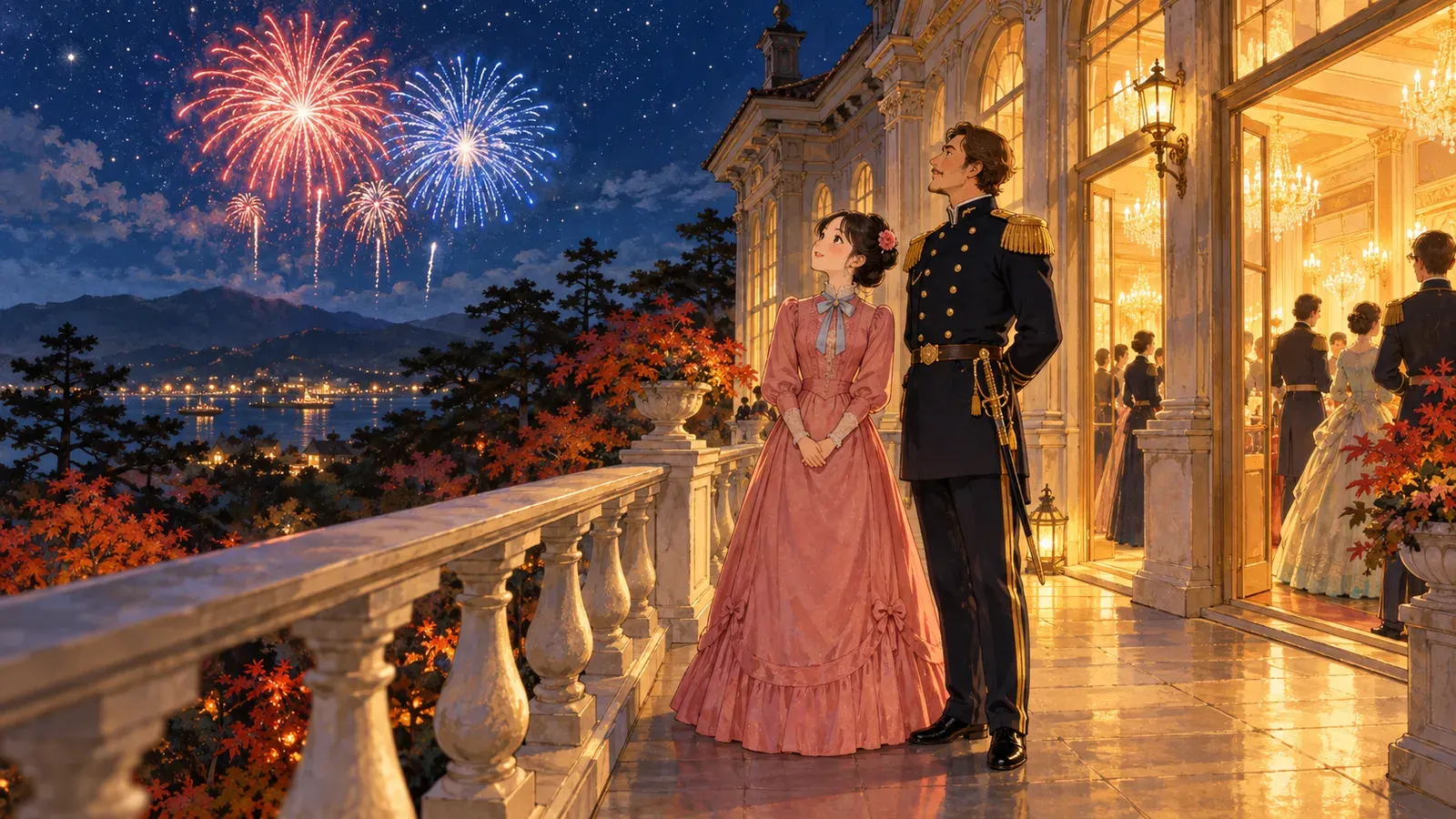
An hour later, they were standing arm in arm on the balcony under the starry sky, among many other guests. Beyond the railing, the dark pine trees of the garden stood quietly, with paper lanterns glowing here and there among their branches. In the cool air, the smell of moss and fallen leaves rose faintly from below, like the lonely breath of autumn. Behind them, in the ballroom, the waves of lace and flowers went on moving to the wild music.
一時間ののち、明子と将校は腕を組んだまま、大勢の客にまじって、星月夜のバルコニーにたたずんでいた。手すりの向こうでは、庭の黒い松の木々がひっそりと枝をかわし、そのこずえのあちこちに、ほおずき提灯の灯がすけて見えていた。冷たい空気の中を、下の庭から苔のにおいや落ち葉のにおいがかすかにのぼってきて、さびしい秋の息づかいのようだった。背後の舞踏室では、レースや花の波が、はげしい音楽に合わせて、あいかわらず揺れ動いていた。
Akiko had been chatting happily with some of her friends. But then she noticed that the officer, still giving her his arm, was gazing silently up at the night sky above the garden. He seemed to be feeling homesick. Akiko looked up into his face and asked, half teasing, "You are thinking of your own country, aren't you?" The officer turned to her with smiling eyes, and instead of saying "Non," he shook his head like a child. "But you seem to be thinking about something," she said. "Can you guess what it is?" he answered.
明子はさっきから、そこにいた親しい令嬢たちと、気軽におしゃべりをしていた。けれども、ふと気がつくと、あの将校は明子に腕を貸したまま、庭の上の星空を黙って見つめていた。明子には、それがなんとなく、故郷を恋しがっているように見えた。そこで明子は将校の顔を下からそっとのぞきこみ、なかばいたずらっぽくたずねた。「お国のことを思っていらっしゃるのでしょう」将校はほほえみを含んだ目で、静かに明子をふり返った。そして「ノン」と答えるかわりに、子どものように首を振ってみせた。「でも、何か考えていらっしゃるようでございますわ」「何だか当ててごらんなさい」
Just then, a murmur rose again among the people on the balcony. Akiko and the officer stopped talking and looked up at the night sky. Red and blue fireworks were spreading through the darkness like the legs of a spider, and were just about to fade away. For some reason, Akiko found them so beautiful that it almost made her sad. After a while, the officer looked down at her kindly and said, as if he were teaching her something, "I was thinking about the fireworks. Fireworks that are like our life."
そのとき、バルコニーに集まった人々のあいだに、またひとしきりざわめきが起こった。明子と将校は、申し合わせたように話をやめて、夜空を見上げた。ちょうど赤と青の花火が、くもの足のように闇の中へ広がり、今にも消えようとするところだった。明子にはなぜか、その花火が、悲しくなるほど美しく思われた。しばらくして将校は、やさしく明子の顔を見下ろし、教えさとすような調子でこう言った。「私は花火のことを考えていたのです。われわれの生のような花火のことを」
Many years later, in the autumn of 1918, Akiko was on a train to her house in Kamakura when she happened to meet a young novelist she knew slightly. On the rack above his seat, he had placed a bunch of chrysanthemums, a gift for a friend in Kamakura. Akiko, now known as the elderly Madame H., said that chrysanthemums always reminded her of a certain story. Then she told him all about the ball at the Rokumeikan. The young man was very interested to hear it from her own lips.
それから長い年月がたった。大正七年の秋、明子は鎌倉の別荘へ向かう汽車の中で、少し面識のある若い小説家と偶然一緒になった。青年は網棚の上に、鎌倉の知人に贈る菊の花束をのせていた。今ではH老夫人と呼ばれる明子は、菊の花を見るたびに思い出す話があると言って、鹿鳴館の舞踏会のことを詳しく話して聞かせた。青年は、その思い出を本人の口から聞けることに、大きな興味を感じた。
When she had finished, he asked casually, "Do you happen to know the name of that French officer?" Madame H. gave an unexpected answer. "Of course I do. His name was Julien Viaud." "Then it was Loti!" cried the young man, delighted. "It was Pierre Loti, who wrote Madame Chrysanthemum!"
話が終わると、青年は何気なくたずねた。「奥様は、そのフランスの海軍将校の名前をご存じではありませんか」すると、H老夫人は思いがけない返事をした。「存じておりますとも。ジュリアン・ヴィオとおっしゃる方でございました」「では、ロチだったのですね」と青年は声をはずませた。「あの『お菊さん』を書いた、ピエール・ロチだったのですね」
But Madame H. only looked at him in puzzlement, and murmured again and again, "No, his name was not Loti. It was Julien Viaud."
けれどもH老夫人は、ふしぎそうに青年の顔を見ながら、何度もこうつぶやくばかりだった。「いいえ、ロチとおっしゃる方ではございませんよ。ジュリアン・ヴィオとおっしゃる方でございますよ」