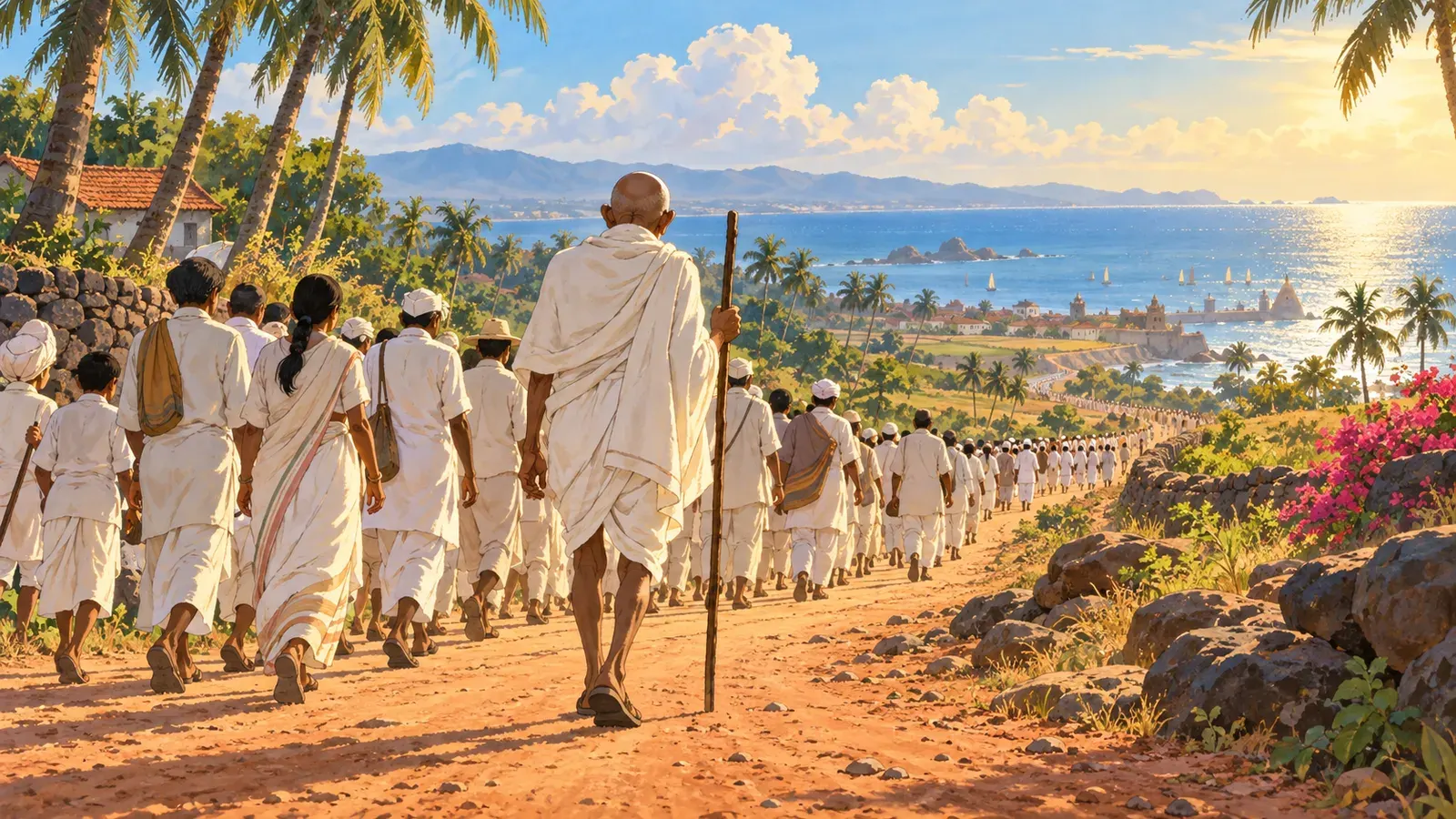
In March 1930, a thin, sixty-year-old man wrapped in simple white cloth began to walk. Behind him came seventy-eight followers. Day after day, they walked from village to village across western India, and more and more people joined them. After twenty-four days and about 385 kilometers, they reached the sea at a small town called Dandi. There, the old man bent down and picked up a handful of salty mud from the shore. With this small action, Mohandas Gandhi challenged the most powerful empire in the world.
1930年3月、質素な白い布を身にまとった、やせた60歳の男が歩きはじめました。その後ろには、78人の仲間が続きました。一行は来る日も来る日も、インド西部の村から村へと歩きつづけ、加わる人はどんどん増えていきました。24日間、およそ385キロを歩いて、一行はダンディという小さな町の海辺にたどり着きました。そこで老人は身をかがめ、浜辺の塩を含んだ泥をひとつかみ、すくい上げました。このささやかな行動で、モーハンダース・ガンディーは、世界でもっとも強大な帝国に立ち向かったのです。
Why salt? At that time, India was ruled by Britain. The British government did not allow Indians to collect or sell their own salt, and it charged a tax on it. Salt is something everyone needs, even the poorest people. By picking up salt, Gandhi showed, in a way that everyone could understand, that the law was unfair. Soon, people all over India began making salt from seawater. Tens of thousands of people, including Gandhi himself, were arrested. The world began to pay attention.
なぜ、塩だったのでしょうか。当時、インドはイギリスに支配されていました。イギリス政府は、インドの人々が自分たちで塩をとったり売ったりすることを禁じ、塩に税金をかけていました。塩は、誰もが必要とするものです。どんなに貧しい人でも、塩なしでは生きられません。ガンディーは、塩を拾うという誰にでもわかるやり方で、この法律が不公平であることを示したのです。まもなく、インド中の人々が、海水から塩を作りはじめました。ガンディー本人を含め、何万人もの人が逮捕されました。世界が、この動きに注目しはじめました。
Gandhi had not always been a brave leader. He was born in 1869 in Porbandar, a town on the west coast of India. According to his own story, he was so shy as a boy that he ran home as soon as school ended, so that he would not have to talk to anyone. Following the custom of the time, he was married at thirteen to a girl named Kasturba. At eighteen, he went to London to study law. For a while he tried to live like an English gentleman, taking dancing and violin lessons, but he soon decided that it was not for him.
ガンディーは、初めから勇敢な指導者だったわけではありません。ガンディーは1869年、インド西海岸の町、ポールバンダルで生まれました。本人の話によると、子どものころはひどく内気で、誰とも話さずにすむように、学校が終わるとすぐに走って家に帰っていたそうです。当時のならわしに従って、13歳でカストゥルバという少女と結婚しました。18歳のとき、法律を学ぶためロンドンへ渡りました。しばらくは、ダンスやバイオリンを習って、イギリスの紳士のように暮らそうとしました。けれども、まもなく、それは自分には合わないと悟りました。
When he returned to India as a lawyer, he did not do well. In his first case in court, he was so nervous that he could not say a word, and he had to sit down. In 1893, unable to find enough work, he accepted a job in South Africa, which was also under British rule.
弁護士としてインドに戻っても、ガンディーはうまくいきませんでした。初めて法廷に立ったときには、緊張のあまりひと言も話せず、そのまま席に座りこんでしまいました。1893年、十分な仕事が見つからなかったガンディーは、南アフリカでの仕事を引き受けました。南アフリカも、イギリスの支配下にありました。
In South Africa, something happened that changed his life. Gandhi had a first-class train ticket, but a white passenger complained about sharing the compartment with an Indian. Gandhi was told to move to a lower class. When he refused, he was pushed off the train at Pietermaritzburg station. He spent the whole cold night in the waiting room, thinking. Should he go back to India, or stay and fight against this injustice? He decided to stay.
南アフリカで、ガンディーの人生を変える出来事が起こりました。ガンディーは1等車の切符を持っていました。ところが、ある白人の乗客が、インド人と同じ客室にいるのはいやだ、と文句を言ったのです。ガンディーは、下の等級の車両に移るよう命じられました。それを断ると、ピーターマリッツバーグ駅で、列車から放り出されてしまいました。ガンディーは、寒い待合室で一晩じゅう考えました。インドに帰るべきか。それとも、ここにとどまって、この不正と戦うべきか。ガンディーは、とどまることを選びました。
Gandhi lived in South Africa for about twenty-one years. He fought for the rights of Indians there, and he developed a new way of fighting. He called it satyagraha, which means something like holding on to truth. The idea was to resist unfair laws without using violence. People would refuse to obey such laws, accept punishment calmly and try to change the hearts of their opponents instead of hurting them. Gandhi was put in prison several times, but his movement won some important changes.
ガンディーは、南アフリカでおよそ21年間暮らしました。そこでインドの人々の権利のために戦い、新しい戦い方を生み出しました。ガンディーは、それを「サティヤーグラハ」と名づけました。「真理を固く守ること」といった意味です。暴力を使わずに、不公平な法律に抵抗するという考え方でした。そうした法律には従わない。罰は静かに受け入れる。そして、相手を傷つけるのではなく、相手の心を変えようとする。ガンディーは何度も刑務所に入れられましたが、この運動によって、いくつかの大切な改革が実現しました。
In 1915, Gandhi returned to India. People began to call him Mahatma, which means great soul. He traveled across the country by train and on foot to understand the lives of ordinary people, especially poor farmers. He decided to live as simply as they did. He wore homespun cotton cloth and spent time every day spinning thread on a small spinning wheel. The spinning wheel became a symbol of the struggle for independence, because it showed that Indians could make their own cloth instead of buying it from British factories.
1915年、ガンディーはインドに帰りました。人々はガンディーを「マハトマ」、つまり「偉大な魂」と呼ぶようになりました。ガンディーは、ふつうの人々、とくに貧しい農民の暮らしを知るために、列車や徒歩で国じゅうを旅しました。そして、自分も農民たちと同じように質素に暮らそうと決めました。手でつむいで織った木綿の布を身にまとい、毎日、小さな糸車で糸をつむぐ時間をとりました。糸車は、独立を目指す戦いのシンボルになりました。イギリスの工場から布を買わなくても、インド人は自分たちで布を作れる。糸車は、そのことを示していたからです。
Over the next thirty years, Gandhi led many campaigns against British rule. He asked Indians to stop buying British goods, to leave British schools and courts, and to refuse to cooperate with the government. He also fought against unfair treatment inside Indian society. For example, he worked to end discrimination against the people who were then called untouchables, and he wanted Hindus and Muslims to live together as brothers.
それから30年にわたって、ガンディーはイギリスの支配に反対する運動を、いくつも率いました。イギリスの製品を買うのをやめよう。イギリスの学校や裁判所から離れよう。政府に協力するのをやめよう。ガンディーは、インドの人々にそう呼びかけました。インドの社会の中にある不公平な扱いとも戦いました。たとえば、当時「不可触民」と呼ばれていた人々への差別をなくそうと力を尽くしました。また、ヒンドゥー教徒とイスラム教徒が、兄弟のようにともに暮らすことを願いました。
Gandhi often used fasting, refusing to eat for many days, to protest or to stop violence. In total, he spent several years of his life in prison. In 1942, he started the Quit India movement, demanding that Britain leave India immediately. He and his wife, Kasturba, were arrested again. Kasturba died in 1944 while they were both still being held by the British.
ガンディーは、抗議のため、あるいは暴力を止めるために、たびたび断食をしました。何日も、何も食べずに過ごすのです。合わせると、人生のうち何年もの月日を刑務所で過ごしました。1942年、ガンディーは「インドから出ていけ」運動を始め、イギリスにただちにインドから立ち去るよう求めました。ガンディーと妻のカストゥルバは、また逮捕されました。1944年、二人ともまだイギリスにとらわれているあいだに、カストゥルバは亡くなりました。
On August 15, 1947, India finally became independent. But it was not the happy ending that Gandhi had hoped for. The land was divided into two nations, India and Pakistan. Terrible violence broke out between Hindus, Muslims and Sikhs, and hundreds of thousands of people were killed. Millions had to leave their homes. Gandhi was heartbroken. Instead of celebrating, he went to places where the violence was happening and fasted for peace.
1947年8月15日、インドはついに独立を果たしました。けれども、それはガンディーが願っていたような、幸せな結末ではありませんでした。国土は、インドとパキスタンという二つの国に分かれてしまったのです。ヒンドゥー教徒、イスラム教徒、シク教徒のあいだで恐ろしい暴力が起こり、何十万人もの人が殺されました。何百万もの人が、家を捨てなければなりませんでした。ガンディーは深く心を痛めました。独立を祝う代わりに、暴力が起きている土地へ出かけていき、平和を求めて断食をしました。
On January 30, 1948, as Gandhi was walking to an evening prayer meeting in Delhi, a Hindu extremist who was angry about his efforts to protect Muslims shot him. Gandhi died at the age of seventy-eight. Millions of people in India and around the world mourned him.
1948年1月30日、ガンディーはデリーで、夕方の祈りの集まりに向かって歩いていました。そこへ、ヒンドゥー教の過激派の男が銃を撃ちました。ガンディーがイスラム教徒を守ろうとしていることに、腹を立てていたのです。ガンディーは78歳で亡くなりました。インドの、そして世界中の何百万もの人が、その死を悲しみました。
Gandhi never held a government position, and he never won the Nobel Peace Prize, although he was nominated several times. But his ideas spread around the world. Martin Luther King Jr. in the United States and Nelson Mandela in South Africa both learned from his example. Today, his birthday, October 2, is the International Day of Non-Violence.
ガンディーは、政府の役職についたことは一度もありません。ノーベル平和賞の候補には何度もあがりましたが、受賞することはありませんでした。それでも、ガンディーの考えは世界中に広がりました。アメリカのマーティン・ルーサー・キング・ジュニアも、南アフリカのネルソン・マンデラも、ガンディーの生き方から学びました。今では、ガンディーの誕生日の10月2日は「国際非暴力デー」になっています。
Gandhi was not perfect, and he wrote openly about his own mistakes. But his life shows something powerful. A shy young lawyer who could not speak in court became a leader who moved millions of people. And he did it not with weapons, but with truth, patience and the courage to suffer rather than to hurt others.
ガンディーは完璧な人ではありませんでした。自分の過ちについても、包み隠さず書いています。それでも、その一生は、私たちに大切なことを力強く教えてくれます。法廷でひと言も話せなかった内気な若い弁護士が、何百万もの人を動かす指導者になったのです。しかも、武器を使ったのではありません。真理と、忍耐と、人を傷つけるより自分が苦しむほうを選ぶ勇気によって、それをなしとげたのです。
 ▶