
 日英くらべビミョー
「じゅういち」と「eleven」で数の力に差がつく? ベトナムの幼児104人が示した意外な限界
 2026.10.06
 English Corner(A2〜B2・4択クイズ)
 読む前に予想してみよう!
数の言葉が規則的な言語(日本語・中国語など)の子どもは、算数のあらゆる力で英語圏の子より有利になる
差が出やすいのは主に数え上げなど一部の力。ベトナムとベルギーの幼児の比較では、ベトナムの子が有利だったのは数え上げだけだった。
 研究カード(どんな研究?)
- 対象
- 中国・日本・韓国・米国・ベトナム・ベルギーなどの幼児〜小学1年生
- 規模
- 最近の比較研究で208人(ベトナム104人・ベルギー104人)
- 研究の種類
- 国際比較研究(観察研究)とレビュー
- 確かさ
- ★★★☆☆
「十一=じゅういち」のように数の言葉が規則的な言語の子は、数を早く数えられる。ただし差が出るのは主に「数え上げ」で、算数の力全体の差は言葉だけでは説明できない。
ひとことで言うと「じゅういち」は数えるのにちょっと有利。でも算数が得意になるかは別の話!
日本語の「じゅういち」は、そのまま「10と1」。「にじゅう」は「2つの10」です。
ところが英語の eleven や twelve には、10 も 1 も見えません。thirteen は「3と10」の順で、twenty-one は「20と1」の順。順番まで途中で入れ替わります。
「だから東アジアの子どもは数の仕組みを早くつかみ、算数が得意になる」——教育の世界で何十年も語られてきたこの説。調べてみると、半分ホントで、半分は言いすぎでした。
01数の言葉、どれだけ違う?
ざっと並べてみましょう。
- 日本語:じゅういち(10+1)、にじゅうさん(2×10+3)
- 中国語:shí-yī(10+1)、èr-shí-sān(2×10+3)
- 英語:eleven, twelve は特別な単語。13〜19 は -teen で「1の位が先」
- フランス語:11〜16 は onze 〜 seize という特別な単語。さらに 80 は quatre-vingts(4×20)、90 は quatre-vingt-dix(4×20+10)
英語の 11〜19 は、聞いても「10のまとまり」が見えにくいのです。明日話せるネタ:フランス語で「90」は「4×20+10」と言う。(フランスの場合。ベルギーやスイスのフランス語では 90 を nonante と言います)
02古典的研究:アジアの子は「10の棒」を使った
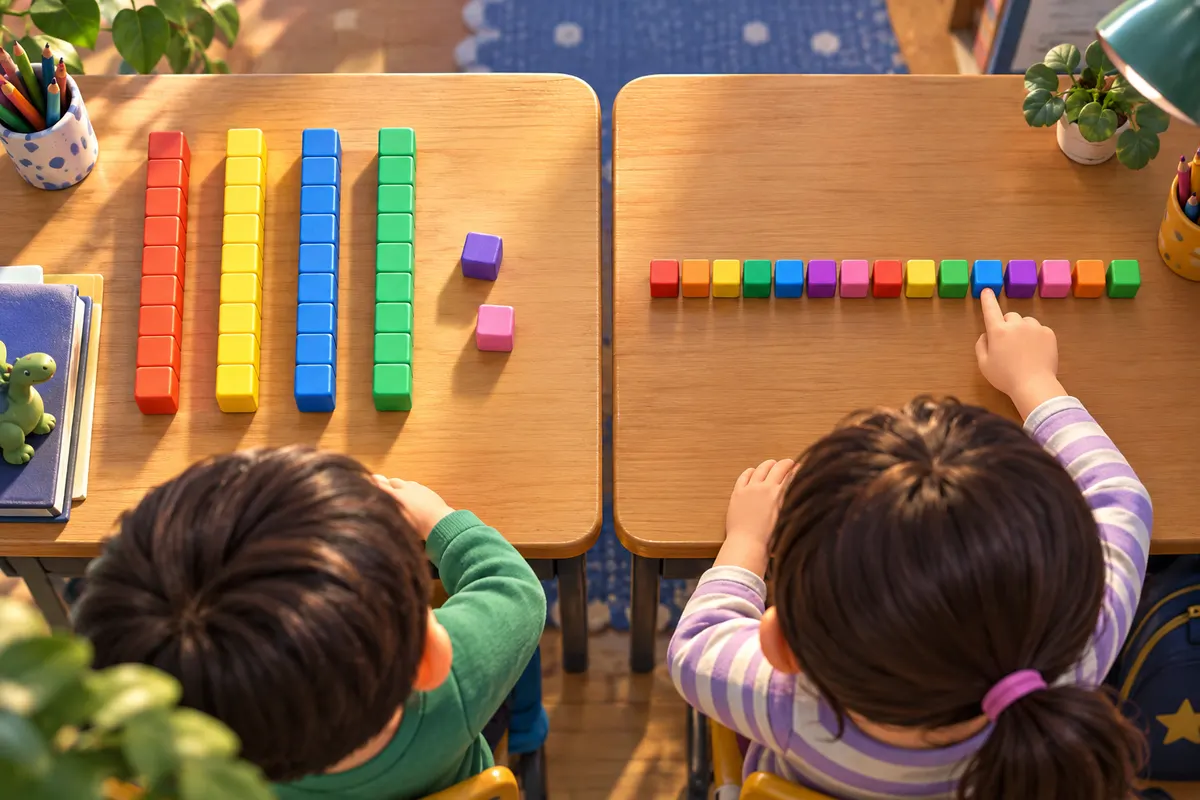
日本語・中国語・韓国語を話す子は、たとえば 42 を「10の棒4本と、ばら2個」のように10のまとまりで表しやすい。英語圏の子は、ばらのブロックを1個ずつ並べがち——というのが、この研究の流れで報告されてきた違いです。
03どんでん返し①:実験の「やり方」で変わった
1997年、イギリスのタウズ(Towse)さんとサクストン(Saxton)さんは、この積み木課題そのものに疑問を投げかけました。
5歳半〜7歳半の子どもを対象にした彼らの実験では、10の棒を目立たせたり、「こう使うこともできるよ」と例を見せたりするだけで、10の棒を使う子が増えたのです。著者らは、課題の結果は子どもが課題の意図をどう受け取ったかにも左右されており、「言語が数の概念を変える」証拠とは言い切れない、と指摘しました。
04どんでん返し②:有利だったのは「数え上げ」だけ
2020年、ベルギーのルーヴァン・カトリック大学のレー(Lê)さんらは、ベトナム語に注目しました。ベトナム語も 11 を「10-1」、30 を「3-10」と言う、とても規則的な言語です。
これまでの研究をまとめて見直した論文(レビュー)も同じ方向です。2010年のレビューは、中国語の数詞が算数を有利にするという証拠は決定的ではなく、文化や学校、家庭などの要因がますます重視されていると整理しました。ただし、言語が幼いころの差に一役買っている可能性は残る、ともしています。
05まとめ
「じゅういち」は、たしかに数えるのを少しラクにしてくれます。でも、それだけで算数が得意になるわけではありません。教え方、家での遊び、まわりの大人の関わり方——数の力は、ことばとそれ以外の合わせ技で育つようです。
英語で数を言うときは、日本語と違う「クセ」を意識するのが近道です。
この研究を英語で読もう原田英語の English CornerNumber words in Japanese, Chinese and Vietnamese follow a simple rule. 音声
音声 4択クイズ9問A2・B1・B2タップして開く
原田英語の English Corner
この研究を英語で読もう
In Japanese, the word for 11 is "juuichi." It means "ten-one." The word for 20 means "two tens." In English, "eleven" and "twelve" do not show the ten.
Some scientists thought this helps Asian children learn numbers faster. A 2020 study compared 104 young children in Vietnam with 104 young children in Belgium.
Vietnamese number words are regular, like Japanese. The Vietnamese children could count about ten numbers higher. But they were not better at the other number tasks.
79 words ・ CEFR A2
和訳を見る
日本語で11を表す言葉は「じゅういち」です。それは「10と1」という意味です。20を表す言葉は「2つの10」という意味です。英語では、eleven や twelve には10が見えません。
この違いがアジアの子どもが数を早く覚える助けになると考えた科学者もいました。2020年のある研究は、ベトナムの幼い子ども104人とベルギーの幼い子ども104人を比べました。
ベトナム語の数の言葉は、日本語のように規則的です。ベトナムの子どもたちは、約10だけ先まで数えることができました。しかし、ほかの数の課題では上手ではありませんでした。
4択リーディングクイズ
Q1. What is the passage mainly about?
数の言葉の規則性が子どもの数の力を助けるかどうかを扱っているので B。
Q2. How many children from Vietnam were in the 2020 study?
compared 104 young children in Vietnam with 104 young children in Belgium とあるので C。
Q3. In this passage, "regular" means ...
Vietnamese number words are regular, like Japanese とあり、「10と1」のように規則に従っているという意味なので A。
Number words in Japanese, Chinese and Vietnamese follow a simple rule. Eleven is "ten-one" and thirty is "three-ten." English and French are less regular, with special words like "eleven" and "twelve."
Researchers have long asked whether this gives East Asian children an early edge in math. A 1995 study found that the gap between Chinese and American children appeared before school, and it was mostly seen in learning to count.
Language made no difference when children counted small groups of objects or solved simple problems. In 2020, a team in Belgium tested 104 Vietnamese and 104 Belgian preschoolers on eight number tasks. The Vietnamese children counted about ten numbers further. On the other seven tasks, the Vietnamese children did no better.
121 words ・ CEFR B1
和訳を見る
日本語、中国語、ベトナム語の数の言葉は単純な規則に従っている。11は「10-1」、30は「3-10」だ。英語やフランス語はそれほど規則的でなく、eleven や twelve のような特別な単語がある。
研究者たちは長年、この違いが東アジアの子どもに算数で早い時期の有利さを与えるのかを問い続けてきた。1995年の研究では、中国とアメリカの子どもの差は就学前に現れ、主に数を数えることを覚える場面で見られた。
少ない物の集まりを数えたり簡単な問題を解いたりするときには、言語による差はなかった。2020年、ベルギーの研究チームは、ベトナムの幼児104人とベルギーの幼児104人に、8種類の数の課題を行った。ベトナムの子どもたちは約10だけ先まで数えられた。ほかの7つの課題では、ベトナムの子どもたちのほうがよくできるということはなかった。
4択リーディングクイズ
Q1. What makes English number words less regular?
English and French are less regular, with special words like "eleven" and "twelve" とあるので B。
Q2. According to the 1995 study, when did language make no difference?
Language made no difference when children counted small groups of objects or solved simple problems とあるので B。
Q3. What does the 2020 study suggest?
数え上げではベトナムの子が約10先まで数えられたが、ほかの7つの課題ではベトナムの子のほうがよくできることはなかったので A。
Ask a six-year-old in Tokyo or Seoul to build the number 42 out of blocks, and you may see four ten-blocks and two single cubes. Studies by Irene Miura and her colleagues in the late 1980s and early 1990s reported that first graders who spoke East Asian languages tended to build numbers this way, while many children in France, Sweden and the United States counted out single cubes. The researchers saw this as strong evidence that language may affect how children picture numbers.
Later work pushed back. In 1997, two UK researchers showed that children aged five to seven used ten-blocks more often when those blocks were made easier to notice or when an example was given, so the task partly measured how children read the instructions. A 2010 review concluded that the evidence for a language advantage is mixed and that cultural and other background factors are getting more attention as explanations, though language may still play a part in early gaps. A clear recent test came in 2020. Vietnamese preschoolers, whose number words are very regular, counted about ten numbers further than Belgian children, but they showed no clear advantage on seven other number tasks.
197 words ・ CEFR B2
和訳を見る
東京やソウルの6歳児に積み木で42を作ってもらうと、10個分の棒4本とばらの立方体2個を使う姿が見られるかもしれない。アイリーン・ミウラさんらの1980年代後半から1990年代前半の研究は、東アジアの言語を話す1年生はこのように数を作る傾向があり、フランス、スウェーデン、アメリカの子どもの多くはばらの立方体を数えて並べたと報告した。研究者たちは、これを、言語が子どもの数のイメージに影響しているかもしれないことを示す強い証拠と考えた。
その後の研究は反論した。1997年、イギリスの2人の研究者は、10の棒を目立たせたり、使い方の例を見せたりすると、5〜7歳の子どもが10の棒をより多く使うことを示した。つまり、この課題は子どもが指示をどう読み取るかを部分的に測っていたのだ。2010年のレビューは、言語による有利さの証拠はまちまちで、文化やその他の背景要因が説明としてより注目されていると結論づけたが、言語が幼いころの差に一役買っている可能性もあるとした。最近のはっきりした検証は2020年に行われた。数の言葉がとても規則的なベトナムの幼児は、ベルギーの子どもより約10だけ先まで数えられたが、ほかの7つの数の課題でははっきりした有利さを示さなかった。
4択リーディングクイズ
Q1. What did Miura and her colleagues report?
first graders who spoke East Asian languages tended to build numbers this way(10の棒とばらの組み合わせ)とあるので A。
Q2. What did the 1997 study show?
blocks were made easier to notice or when an example ... was given で10の棒の使用が増えたので B。
Q3. Which statement best matches the author's view?
数え上げには差が出たがほかの課題では差がなく、レビューも文化などほかの要因に注目していることから C。
重要単語
- transparentB2形容詞透明な;(仕組みが)わかりやすいJapanese number words are transparent because "ten-one" shows how 11 is made.
 数の言葉の研究では transparent number-naming system(規則的でわかりやすい数詞)という言い方をする。反対は opaque(不透明な)。
 - irregularB1形容詞不規則な"Eleven" and "twelve" are irregular number words. ir-(否定)+regular。irregular verbs(不規則動詞)でおなじみ。
- place valueB2名詞位取りPlace value tells us that the 4 in 42 means four tens. 算数用語。ones place(一の位)、tens place(十の位)もセットで覚える。
- preschoolerB2名詞未就学児、幼児The study tested preschoolers in Vietnam and Belgium. pre-(前)+school+-er。preschool は「幼稚園・保育園」。
- numeracyC1名詞数を扱う基礎的な力Board games can build early numeracy. literacy(読み書きの力)の数版。home numeracy は「家庭での数の経験」。
- account forB2句動詞(原因などを)説明する;(割合を)占めるLanguage alone cannot account for the gap in math scores. 早稲田大の英語の長文(10学部分)のうち7学部で使われていた。「〜の割合を占める」の意味(account for 30 percent)も重要。
- push backB2句動詞反論する、押し返すLater studies pushed back against the old idea. push back against ~ で「~に反対する」。予定を「遅らせる」の意味もある。
このネタ、誰かに教えたくなった?
日本語の「じゅういち」は「10と1」。英語の eleven には10が見えない。だから東アジアの子は数を早く覚える…という有名な説、半分ホントだった。ベトナムとベルギーの幼児を比べると、ベトナムの子が有利だったのは数え上げだけ。
押すと「マジかリスト」に保存されます
 出典・参考文献(6件)タップで表示
- Miura, Okamoto, Kim, Steere & Fayol (1993) First graders' cognitive representation of number and understanding of place value, Journal of Educational Psychologydoi.org
- Miller, Smith, Zhu & Zhang (1995) Preschool origins of cross-national differences in mathematical competence: The role of number-naming systems, Psychological Sciencedoi.org
- Towse & Saxton (1997) Linguistic influences on children's number concepts: Methodological and theoretical considerations, Journal of Experimental Child Psychologydoi.org
- Ng & Rao (2010) Chinese number words, culture, and mathematics learning, Review of Educational Researchdoi.org
- Mark & Dowker (2015) Linguistic influence on mathematical development is specific rather than pervasive: revisiting the Chinese Number Advantage in Chinese and English children, Frontiers in Psychologydoi.org
- Lê & Noël (2020) Transparent number-naming system gives only limited advantage for preschooler's numerical development, PLOS ONEdoi.org

※本記事は上記の研究・公開資料をもとに、原田英語が独自の言葉で解説したものです。引用は著作権法第32条の範囲で行い、出典を明記しています。画像はすべてオリジナルのイメージです。研究結果には限界や個人差があります。誤りのご指摘は原田英語のお問い合わせフォームから。
本館
マジカ!?サイエンスで読む、ことばの研究
論文でウラ取りした科学の「マジか!?」。言語・脳・学習の研究も
 これも「マジか!?」

 日英くらべ
日英くらべ
Thursday は雷神ソーの日。たどると「木曜日」と同じ木星(ジュピター)の日だった
 日英くらべ
日英くらべ
「トレーナー」はイギリスでは“靴”。服のトレーナーは日本語だけの使い方だった
 日英くらべ
日英くらべ
英語で小文字の japan は「漆」。漆かぶれの成分 urushiol は日本語の「うるし」から
 日英くらべ
日英くらべ
うっかり事故を“He broke it”のように「だれが」入りで言うのは、英語で7割・日本語で5割。「だれがやったか」の記憶にも小さな差
 日英くらべ
日英くらべ
「5文型」の元祖は1889年のイギリスの文法書。本場では広まらず、日本で100年以上
 日英くらべ
日英くらべ