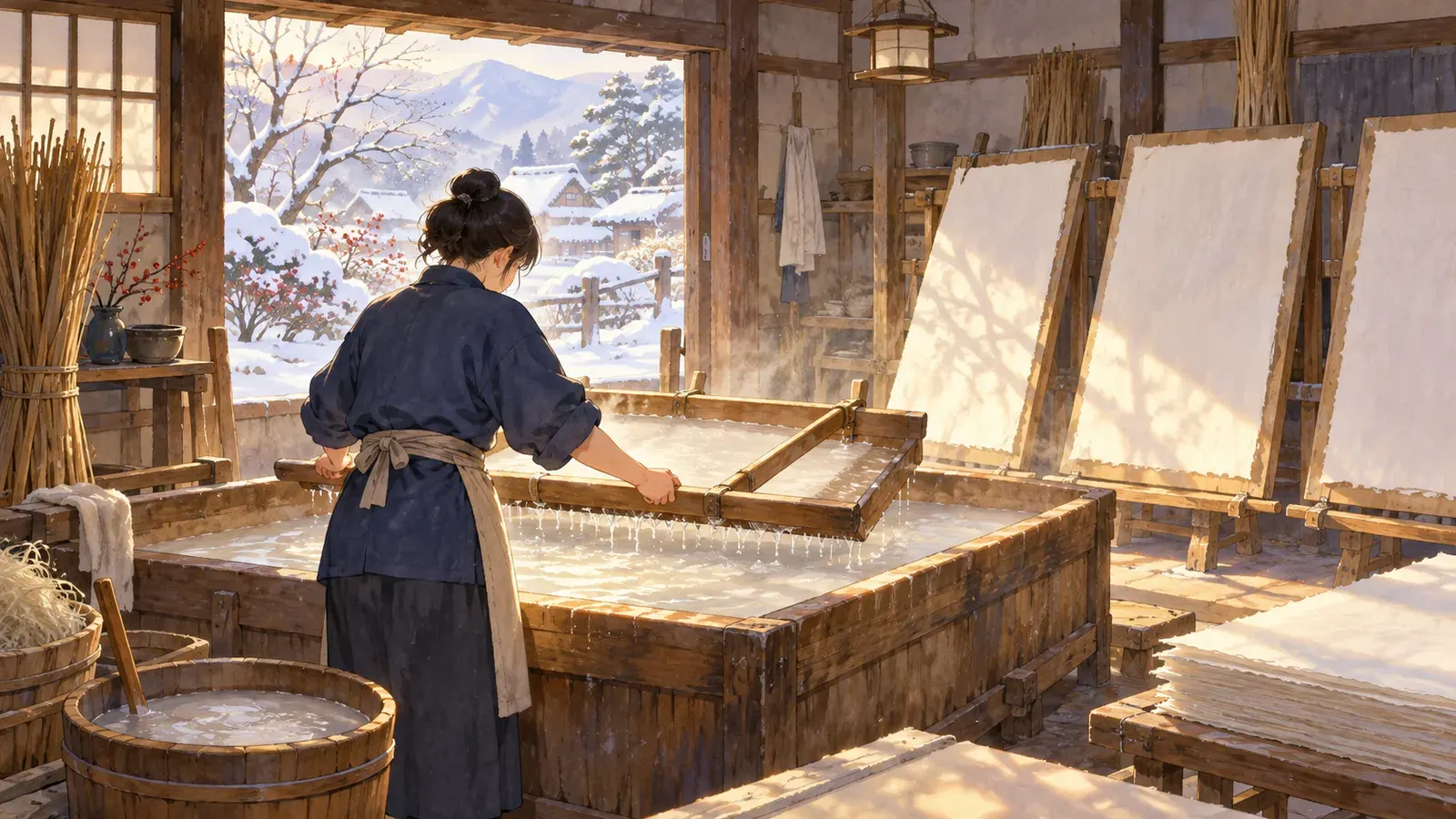
On a cold winter morning in a mountain village, a papermaker stands at a wooden tub filled with icy water and floating white fibers. She dips a wooden frame holding a fine bamboo screen into the tub and scoops up some of the milky liquid. Then she rocks the frame back and forth, again and again, in a steady rhythm. The water runs away through the screen, and a thin, even layer of fibers is left behind. Her hands are red from the cold, but she does not stop. This is how washi, Japanese paper, has been made for well over a thousand years.
山あいの村の、冷えこんだ冬の朝です。紙すき職人が、木の槽の前に立っています。槽には氷のように冷たい水が張られ、白い繊維がただよっています。職人は、細い竹のすだれをはめた木の枠を槽にひたし、乳白色の液をすくい上げます。そして、枠を前後にゆすります。何度も何度も、一定のリズムで。水はすだれのすき間から流れ落ち、あとには薄く均一な繊維の層が残ります。冷たさで手は真っ赤ですが、職人は手を止めません。和紙、つまり日本の紙は、こうして千年をはるかにこえる間、作られてきました。
Paper was invented in China, and the art of making it reached Japan by way of the Korean Peninsula. According to the Nihon Shoki, an ancient history of Japan, a Buddhist monk from Goguryeo, a kingdom in Korea, brought the knowledge of making paper and ink to Japan in the year 610. Some historians think paper arrived even earlier. The oldest paper that survives in Japan is a set of family registers from the year 702, made in the area of Mino, in present-day Gifu. They are kept at the Shosoin treasure house in Nara, and they can still be read more than thirteen hundred years later.
紙は中国で発明され、その作り方は朝鮮半島を通って日本に伝わりました。日本の古い歴史書『日本書紀』によると、610年に、朝鮮の国、高句麗の僧が、紙と墨の作り方を日本に伝えたとされています。紙はもっと早く伝わっていたと考える歴史家もいます。日本に残るいちばん古い紙は、702年の戸籍です。今の岐阜県にあたる美濃の地方で作られた紙です。奈良の正倉院におさめられていて、1300年以上たった今でも読むことができます。
Washi is usually made from the inner bark of shrubs, most often kozo, a kind of mulberry. Making it takes a great deal of work. The branches are cut and steamed, and the bark is stripped off. The dark outer skin is scraped away, and the white inner bark is boiled, washed in clean water and laid out in the sun. Workers then pick out tiny dark specks by hand, one by one. Finally, the fibers are beaten until they come apart into a soft mass.
和紙はふつう、低い木の内側の皮から作られます。いちばんよく使われるのは、クワの仲間の楮です。和紙づくりには大変な手間がかかります。枝を切って蒸し、皮をはぎ取ります。黒っぽい外側の皮をこそげ落とし、白い内側の皮を煮て、きれいな水で洗い、日に当てます。それから職人が、小さな黒いちりを手で一つ一つ取りのぞきます。最後に繊維をたたいてほぐし、やわらかいかたまりにします。
The real secret lies in the tub. Along with the fibers, the papermaker adds a slippery liquid taken from the root of a plant related to the hibiscus. This liquid lets the long fibers float evenly in the water instead of sinking into clumps. Because of it, the maker can rock the screen many times and lay down the fibers in thin, crossing layers. This method developed in Japan and is quite different from papermaking in other countries. Winter is considered the best season for papermaking, because the slippery liquid works better in cold water, and the cold also keeps it from spoiling.
本当の秘密は、槽の中にあります。紙すき職人は、繊維といっしょに、ハイビスカスの仲間の植物の根からとった、ぬるぬるした液を加えます。この液のおかげで、長い繊維は固まって沈むことなく、水の中に均一に浮かんでいられます。だから、何度もすだれをゆすって、繊維を薄く、交差させながら重ねていくことができるのです。この方法は日本で発達したもので、ほかの国の紙づくりとは大きく違います。紙すきにいちばんよい季節は冬だとされています。ぬるぬるした液は冷たい水の中のほうがよく働きますし、寒さのおかげで傷むこともないからです。
The result is paper that is thin, light and surprisingly strong. Because its fibers are long and tangled together, washi can be folded, wetted and crumpled without falling apart. In traditional houses, it covered sliding doors called shoji, letting in soft light while giving privacy. It was used for umbrellas, lanterns, fans and even clothing. It is said that when fire broke out, Edo merchants threw their account books into the well. After the fire, they pulled the books out, dried them and kept using them.
こうしてできあがる紙は、薄くて軽く、それでいて驚くほど丈夫です。繊維が長く、からみ合っているので、和紙は折っても、ぬらしても、くしゃくしゃにしても、ばらばらになりません。昔ながらの家では、障子という引き戸に和紙が張られ、やわらかな光を通しながら、外からの目をさえぎりました。和紙は傘やちょうちん、扇、さらには着るものにまで使われました。火事が起きると、江戸の商人は帳簿を井戸に投げこんだと言われています。火事がおさまると、帳簿を引き上げて乾かし、そのまま使いつづけたのだそうです。
Paper is even worn as clothing in one famous ceremony. Every spring, monks at Todaiji temple in Nara carry out a long ritual called Omizutori, and during it they wear robes made of washi. Japanese banknotes, too, are made partly from the fibers of mitsumata, one of the shrubs used for washi, which helps make them strong and hard to copy.
ある有名な儀式では、紙を身にまとうことさえあります。毎年春、奈良の東大寺では、僧たちが「お水取り」という長い行事をつとめますが、その間、和紙で作った衣を着るのです。日本のお札も、和紙に使われる低木の一つ、三椏の繊維を一部に使って作られています。そのおかげで、お札は丈夫で、偽物が作りにくいのです。
Washi is still valued around the world. Museums and libraries in many countries use very thin Japanese paper to repair old books, maps and paintings, because it is strong, lasts a long time and can be removed later if necessary. In 2014, UNESCO added the craft of making three kinds of handmade washi to its list of intangible cultural heritage: Sekishu-banshi from Shimane, Hon-minoshi from Gifu and Hosokawa-shi from Saitama.
和紙は、今も世界中で大切にされています。多くの国の博物館や図書館では、古い本や地図、絵画を修理するのに、とても薄い和紙を使っています。和紙は丈夫で長もちし、必要になれば、あとで取り外すこともできるからです。2014年、ユネスコは、三つの手すき和紙を作る技術を無形文化遺産に登録しました。島根県の石州半紙、岐阜県の本美濃紙、埼玉県の細川紙です。
Where there is paper, there is writing. Shodo, the "way of writing," is the Japanese art of calligraphy. It uses four basic tools, traditionally called the four treasures of the study: the brush, the ink stick, the inkstone and the paper. The ink stick is made from soot and glue. The writer adds a few drops of water to the inkstone and slowly rubs the stick against it until the ink is dark. This takes time, and many people say that grinding ink is a way to calm the mind before writing.
紙があるところには、文字を書く営みがあります。書道、つまり「書の道」は、日本で文字を美しく書く芸術です。書道では、昔から「文房四宝」と呼ばれる四つの基本の道具を使います。筆、墨、硯、そして紙です。墨は、すすとにかわを固めて作ります。書く人は、硯に水を数滴たらし、墨をゆっくりとすって、濃い墨にしていきます。これには時間がかかります。墨をするのは、書く前に心を落ち着けるためでもある、と言う人もたくさんいます。
There are several styles of writing. In the standard style, every stroke is clear and separate, almost like print. In the semi-cursive style, the strokes flow into each other. In the cursive style, the characters are written so freely that people without training often cannot read them at all. Hiragana itself grew out of quickly written kanji in the Heian period. Writers of that age copied out poems in flowing kana on beautifully decorated paper, and their works are still treasured as art.
書き方には、いくつかの書体があります。楷書では、一画一画がはっきりと分かれていて、ほとんど活字のようです。行書では、点や線が流れるようにつながります。草書になると、文字があまりに自由にくずして書かれるので、習ったことのない人にはまったく読めないこともよくあります。ひらがなそのものも、平安時代に漢字を速くくずして書いたところから生まれました。そのころの人々は、美しく飾られた紙に、流れるような仮名で歌を書き写しました。その作品は、今も芸術として大切にされています。
Learners spend years on the basic strokes. Teachers pay close attention to how each stroke ends. Some end with a firm stop, some with a quick upward flick, and some with a long sweep that fades away like a tail. A single character may contain all three, and getting them right is the first step toward writing beautifully.
書道を習う人は、何年もかけて基本の筆づかいを練習します。先生がとくに注意して見るのは、一画一画の終わり方です。しっかりと止める終わり方もあれば、すばやく上にはね上げる終わり方も、しっぽのように細くなって消えていく長いはらいもあります。一つの字に三つとも入っていることもあり、それを正しく書けることが、美しい字への第一歩なのです。
The monk Kukai, also known as Kobo Daishi, is remembered as one of the greatest calligraphers in Japanese history. There is a famous saying about him: "Even Kobo sometimes makes a slip of the brush." It means that even experts make mistakes, rather like the English saying that even Homer sometimes nods. According to one legend, Kukai once wrote a large sign for a gate in the capital and forgot a dot. The sign was already hanging high above the gate, so he threw his brush at it, and the brush placed the dot perfectly. Another saying, "Kobo does not choose his brush," means that a true master can do fine work with any tool.
僧の空海は弘法大師とも呼ばれ、日本の歴史で最も偉大な書家の一人として知られています。空海については、「弘法も筆の誤り」という有名なことわざがあります。名人でもまちがえることがある、という意味で、英語の「ホメロスでさえ居眠りをする」ということわざに少し似ています。ある伝説によると、空海は都のある門にかける大きな額を書いたとき、点を一つ書き忘れてしまいました。額はもう門の高いところにかけられていたので、空海は額に向かって筆を投げつけました。すると筆は、点をみごとに書き入れたのだそうです。「弘法筆を選ばず」ということわざもあります。本当の名人は、どんな道具でもすばらしい仕事をする、という意味です。
Washi and the brush work together in a special way. The paper drinks in the ink the instant the brush touches it. You cannot erase a stroke, and if you go over it again, it shows. So each line records the speed, the pressure and even the feeling of a single moment. The empty white space matters as much as the black ink. Many people believe that a person's character can be seen in their brushwork.
和紙と筆は、特別な形で力を合わせます。筆が紙にふれた瞬間、紙は墨を吸いこみます。一度書いた線は消せませんし、上からなぞれば、それがわかってしまいます。だから一本一本の線には、筆の速さや力の入れ具合、さらにはその瞬間の気持ちまでが記録されるのです。何も書かれていない白い部分も、黒い墨と同じくらい大切です。筆づかいには書いた人の人柄が表れる、と信じている人はたくさんいます。
Most Japanese children learn calligraphy at school. In the first days of the New Year, many people take part in kakizome, the first writing of the year. They write hopeful words such as "dream" or "new spring" with a large brush. In some areas, these papers are later burned in a bonfire at a mid-January festival. People say that if your burning paper flies up high, your handwriting will improve.
日本の子どもの多くは、学校で書道を習います。新年のはじめには、多くの人が「書き初め」をします。その年に初めて筆で字を書くことです。「夢」や「新春」のような、希望にあふれる言葉を大きな筆で書きます。地域によっては、書き初めの紙を、1月なかばの行事でたき火にくべて燃やします。燃えた紙が高く舞い上がると、字が上手になると言われています。
Brush writing still appears at important moments. On April 1, 2019, when the Japanese government announced the name of the new era, Reiwa, an official held up a board on which the two characters had been written by hand with a brush and black ink. The picture appeared on television and in newspapers across the country. Even in the age of computers, Japan chose a brush for one of its most important words.
筆で書いた文字は、今も大切な場面に登場します。2019年4月1日、日本政府が新しい元号「令和」を発表したとき、担当者が掲げた額には、二つの文字が筆と黒い墨で手書きされていました。その写真は、テレビや新聞を通じて全国に伝えられました。コンピューターの時代になっても、日本は、最も大切な言葉の一つを筆で書くことを選んだのです。
In Shikokuchuo, a city in Ehime that is one of Japan's biggest paper-making towns, paper and brush come together on a grand scale. In 2008, local high school students started a contest called Shodo Performance Koshien to bring life back to their hometown. Today, teams from all over Japan take part. Moving to music, they write giant characters with brushes as big as mops on a single sheet of paper four meters tall and six meters wide, all within six minutes. It began with only three schools, but now more than a hundred enter every year.
愛媛県の四国中央市は、日本でも有数の紙の町です。ここでは、紙と筆が大きな舞台で一つになります。2008年、地元の高校生たちが、ふるさとに活気を取りもどそうと、「書道パフォーマンス甲子園」という大会を始めました。今では日本中からチームが参加しています。チームは音楽に合わせて体を動かしながら、モップほどもある大きな筆で、縦4メートル、横6メートルの一枚の紙に大きな文字を書いていきます。持ち時間はわずか6分です。最初の大会に出たのは3校だけでしたが、今では毎年100校以上が参加を申しこんでいます。
How to explain it in English: "Washi is traditional Japanese paper, usually made by hand from the bark of a kind of mulberry tree. It is thin but very strong, and it can last for a thousand years. Shodo is Japanese calligraphy. We write with a brush and black ink, and because we cannot correct a stroke, each line shows the feeling of that moment."
英語で説明してみよう:「和紙は日本の伝統的な紙で、ふつうはクワの仲間の木の皮から手作りされます。薄いのにとても丈夫で、千年ももつことがあります。書道は日本の書の芸術です。筆と黒い墨で書きます。一度書いた線は直せないので、一本一本の線に、その瞬間の気持ちが表れるのです。」