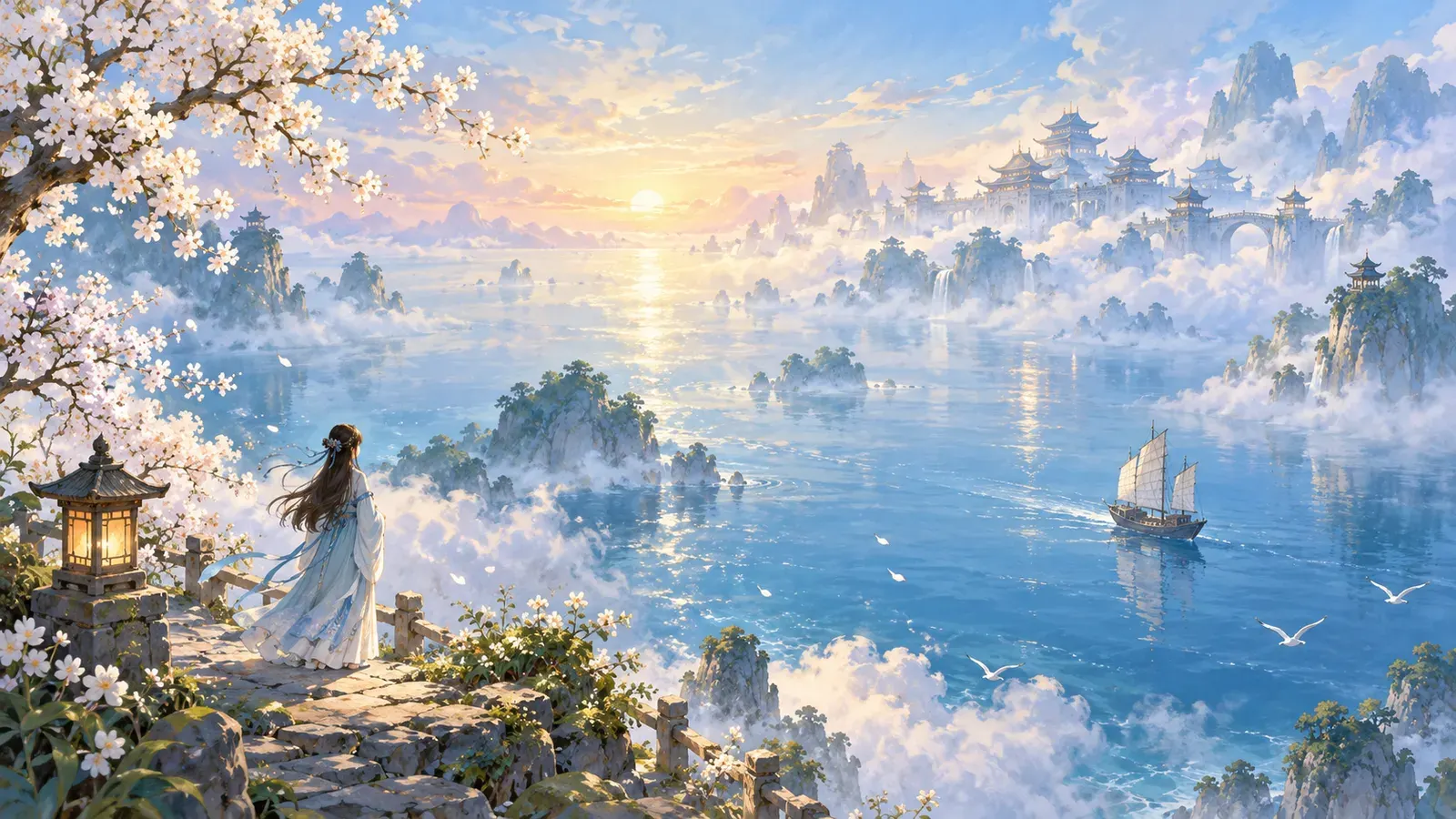
Blue vision of depth lost in height,—sea and sky interblending through luminous haze. The day is of spring, and the hour morning.
見わたすかぎりの青。深みはそのまま高みに溶けこみ、光る霞の中で、海と空とがひとつに混じり合っている。季節は春、時刻は朝である。
Only sky and sea,—one azure enormity... In the fore, ripples are catching a silvery light, and threads of foam are swirling. But a little further off no motion is visible, nor anything save color: dim warm blue of water widening away to melt into blue of air. Horizon there is none: only distance soaring into space,—infinite concavity hollowing before you, and hugely arching above you,—the color deepening with the height. But far in the midway-blue there hangs a faint, faint vision of palace towers, with high roofs horned and curved like moons,—some shadowing of splendor strange and old, illumined by a sunshine soft as memory.
あるのは空と海だけ。ただひとつの、果てしない青である……。手前では、さざ波が銀色の光をはね返し、白い泡の筋が渦を巻いている。だが少し沖へ目をやると、もう動くものは何も見えない。見えるのは色だけだ。水のほのかな暖かい青が遠くへ広がり、そのまま空の青に溶けていく。水平線はない。遠くがそのまま空へと舞い上がっているだけだ。目の前には限りなく深い空がくぼみ、頭の上には巨大な丸天井が弧を描いている。高くなるほど、青は深くなる。そして、はるか中空の青の中に、宮殿の塔が、ほのかに、ほのかに浮かんで見える。高い屋根は、三日月のように反り返って角を立てている。思い出のようにやわらかな日の光に照らされた、不思議な、古い栄華の影である。
...What I have thus been trying to describe is a kakémono,—that is to say, a Japanese painting on silk, suspended to the wall of my alcove;—and the name of it is SHINKIRŌ, which signifies "Mirage." But the shapes of the mirage are unmistakable. Those are the glimmering portals of Hōrai the blest; and those are the moony roofs of the Palace of the Dragon-King;—and the fashion of them (though limned by a Japanese brush of to-day) is the fashion of things Chinese, twenty-one hundred years ago...
……私がこうして描こうとしてきたのは、一幅の掛物である。絹に描かれた日本の絵で、私の家の床の間に掛けてある。題は「蜃気楼(しんきろう)」、つまり「ミラージュ」という意味だ。けれども、そこに浮かぶものの形は、見まちがえようがない。あのほのかに光る門は、祝福された島、蓬莱の門である。あの月のような屋根は、竜王の宮殿の屋根である。描いたのは今の日本の絵筆だが、その形は、二千百年前の中国のものの形なのである……。
Thus much is told of the place in the Chinese books of that time:—
その時代の中国の書物には、蓬莱についてこう書かれている。
In Hōrai there is neither death nor pain; and there is no winter. The flowers in that place never fade, and the fruits never fail; and if a man taste of those fruits even but once, he can never again feel thirst or hunger. In Hōrai grow the enchanted plants So-rin-shi, and Riku-gō-aoi, and Ban-kon-tō, which heal all manner of sickness;—and there grows also the magical grass Yō-shin-shi, that quickens the dead; and the magical grass is watered by a fairy water of which a single drink confers perpetual youth. The people of Hōrai eat their rice out of very, very small bowls; but the rice never diminishes within those bowls,—however much of it be eaten,—until the eater desires no more. And the people of Hōrai drink their wine out of very, very small cups; but no man can empty one of those cups,—however stoutly he may drink,—until there comes upon him the pleasant drowsiness of intoxication.
蓬莱には、死も苦しみもなく、冬もない。花は決してしぼまず、木の実は決して尽きることがない。その実を一度でも口にした者は、二度と渇きも飢えも感じない。蓬莱には、相憐子(そうりんし)、六合葵(りくごうあおい)、万根湯(ばんこんとう)という不思議な草が生えていて、どんな病でも治してしまう。死者をよみがえらせる不思議な草、養神子(ようしんし)も生えている。この草には仙人の水がそそがれていて、その水をひと口飲めば、いつまでも若いままでいられる。蓬莱の人々は、とても、とても小さな椀でご飯を食べる。けれども、いくら食べても、食べる人がもういらないと思うまで、椀の中のご飯は少しも減らない。また蓬莱の人々は、とても、とても小さな杯で酒を飲む。けれども、どれほどぐいぐい飲んでも、ほろ酔いの心地よい眠気がやってくるまで、誰もその杯を飲みほすことはできない。
All this and more is told in the legends of the time of the Shin dynasty. But that the people who wrote down those legends ever saw Hōrai, even in a mirage, is not believable. For really there are no enchanted fruits which leave the eater forever satisfied,—nor any magical grass which revives the dead,—nor any fountain of fairy water,—nor any bowls which never lack rice,—nor any cups which never lack wine. It is not true that sorrow and death never enter Hōrai;—neither is it true that there is not any winter. The winter in Hōrai is cold;—and winds then bite to the bone; and the heaping of snow is monstrous on the roofs of the Dragon-King.
こうしたことが、まだまだたくさん、秦の時代の言い伝えには書かれている。だが、その言い伝えを書きとめた人々が、たとえ蜃気楼の中にでも、蓬莱を見たことがあったとは思えない。なぜなら本当は、食べた人をいつまでも満ち足りさせる不思議な木の実などない。死者をよみがえらせる不思議な草もない。仙人の水がわく泉もない。ご飯の尽きない椀も、酒の尽きない杯もないからである。悲しみや死が蓬莱には決して入りこまない、というのも本当ではない。冬がない、というのも本当ではない。蓬莱の冬は寒い。そのころには風が骨までしみ、竜王の宮殿の屋根には、雪がおそろしいほど高く積もるのである。
Nevertheless there are wonderful things in Hōrai; and the most wonderful of all has not been mentioned by any Chinese writer. I mean the atmosphere of Hōrai. It is an atmosphere peculiar to the place; and, because of it, the sunshine in Hōrai is whiter than any other sunshine,—a milky light that never dazzles,—astonishingly clear, but very soft. This atmosphere is not of our human period: it is enormously old,—so old that I feel afraid when I try to think how old it is;—and it is not a mixture of nitrogen and oxygen. It is not made of air at all, but of ghost,—the substance of quintillions of quintillions of generations of souls blended into one immense translucency,—souls of people who thought in ways never resembling our ways. Whatever mortal man inhales that atmosphere, he takes into his blood the thrilling of these spirits; and they change the sense within him,—reshaping his notions of Space and Time,—so that he can see only as they used to see, and feel only as they used to feel, and think only as they used to think. Soft as sleep are these changes of sense; and Hōrai, discerned across them, might thus be described:—
それでも蓬莱には、すばらしいものがある。いちばんすばらしいものについては、中国の書き手は誰ひとり書いていない。それは蓬莱の大気である。この土地にしかない大気で、そのために蓬莱の日の光は、ほかのどこの日の光よりも白い。乳のように白い光で、少しもまぶしくない。驚くほど澄んでいながら、たいそうやわらかい。この大気は、私たち人間の時代のものではない。途方もなく古い。どれほど古いのか考えようとすると、こわくなるほど古いのだ。そして、窒素と酸素がまじり合ったものでもない。そもそも空気でできてはいない。霊でできているのである。気の遠くなるほど多くの世代の魂が溶け合って、ひとつの巨大な、透きとおったものになっている。それは、私たちとはまるで違う考え方をしていた人々の魂である。この大気を吸いこんだ人間は誰でも、その霊たちのおののきを、自分の血の中に取りこむことになる。すると霊たちは、その人の感じ方を変えてしまう。空間や時間についての考えまで、作り変えてしまうのだ。その人は、昔その霊たちが見たようにしか見ず、感じたようにしか感じず、考えたようにしか考えなくなる。この変化は、眠りのようにやわらかく訪れる。そして、そうして変わった目で見ると、蓬莱はこんなふうに見えるだろう。
—Because in Hōrai there is no knowledge of great evil, the hearts of the people never grow old. And, by reason of being always young in heart, the people of Hōrai smile from birth until death—except when the Gods send sorrow among them; and faces then are veiled until the sorrow goes away. All folk in Hōrai love and trust each other, as if all were members of a single household;—and the speech of the women is like birdsong, because the hearts of them are light as the souls of birds;—and the swaying of the sleeves of the maidens at play seems a flutter of wide, soft wings. In Hōrai nothing is hidden but grief, because there is no reason for shame;—and nothing is locked away, because there could not be any theft;—and by night as well as by day all doors remain unbarred, because there is no reason for fear. And because the people are fairies—though mortal—all things in Hōrai, except the Palace of the Dragon-King, are small and quaint and queer;—and these fairy-folk do really eat their rice out of very, very small bowls, and drink their wine out of very, very small cups....
――蓬莱の人々は、大きな悪というものを知らない。だから、心が決して年をとらない。いつも心が若いので、蓬莱の人々は生まれてから死ぬまで、ほほえんでいる。ただ、神々が悲しみを送ってよこしたときだけは別で、そのときは悲しみが去るまで、顔をおおって隠す。蓬莱の人々はみな、ひとつの家族のように、たがいに愛し合い、信じ合っている。女たちの話し声は、鳥のさえずりのようだ。その心が、鳥の魂のように軽いからである。遊ぶ娘たちの袖がひらひらと揺れるさまは、やわらかく大きな翼がはばたいているように見える。蓬莱では、悲しみのほかには何ひとつ隠されていない。恥じることが何もないからである。錠をかけてしまっておくものもない。盗みなどありえないからである。夜も昼も、戸にかんぬきをかけることはない。恐れることが何もないからである。そして蓬莱の人々は、いずれは死ぬ身ではあるけれど、妖精なのだ。だから、竜王の宮殿のほかは、蓬莱のものは何もかも小さく、古風で、風変わりである。この妖精の人々は、本当に、とても、とても小さな椀でご飯を食べ、とても、とても小さな杯で酒を飲むのである……。
—Much of this seeming would be due to the inhalation of that ghostly atmosphere—but not all. For the spell wrought by the dead is only the charm of an Ideal, the glamour of an ancient hope;—and something of that hope has found fulfillment in many hearts,—in the simple beauty of unselfish lives,—in the sweetness of Woman...
――こう見えるのは、多くはあの霊の大気を吸いこんだせいだろう。だが、それだけではない。死者のかける魔法とは、じつは、ひとつの理想の魅力であり、古くからの希望の輝きにすぎない。そしてその希望は、多くの人の心の中で、いくらかはかなえられてきたのだ。私心のない暮らしの、素朴な美しさの中に。女性のやさしさの中に……。
—Evil winds from the West are blowing over Hōrai; and the magical atmosphere, alas! is shrinking away before them. It lingers now in patches only, and bands,—like those long bright bands of cloud that train across the landscapes of Japanese painters. Under these shreds of the elfish vapor you still can find Hōrai—but not everywhere... Remember that Hōrai is also called Shinkirō, which signifies Mirage,—the Vision of the Intangible. And the Vision is fading,—never again to appear save in pictures and poems and dreams...
――今、西洋からの悪い風が、蓬莱に吹きつけている。そして、ああ、あの不思議な大気は、その風に吹かれて、しだいに消えていこうとしている。今ではもう、ところどころに、帯のように残っているだけだ。日本の画家が描く風景の上に長くたなびく、あの明るい雲の帯のように。この妖しい霞の切れ端の下でなら、今でも蓬莱を見つけることができる。だが、どこにでもあるわけではない……。忘れないでほしい。蓬莱は、蜃気楼とも呼ばれていることを。それは、手でふれることのできないものの幻なのだ。そしてその幻は、薄れていこうとしている。絵と詩と夢の中のほかには、もう二度と現れることはないだろう……。