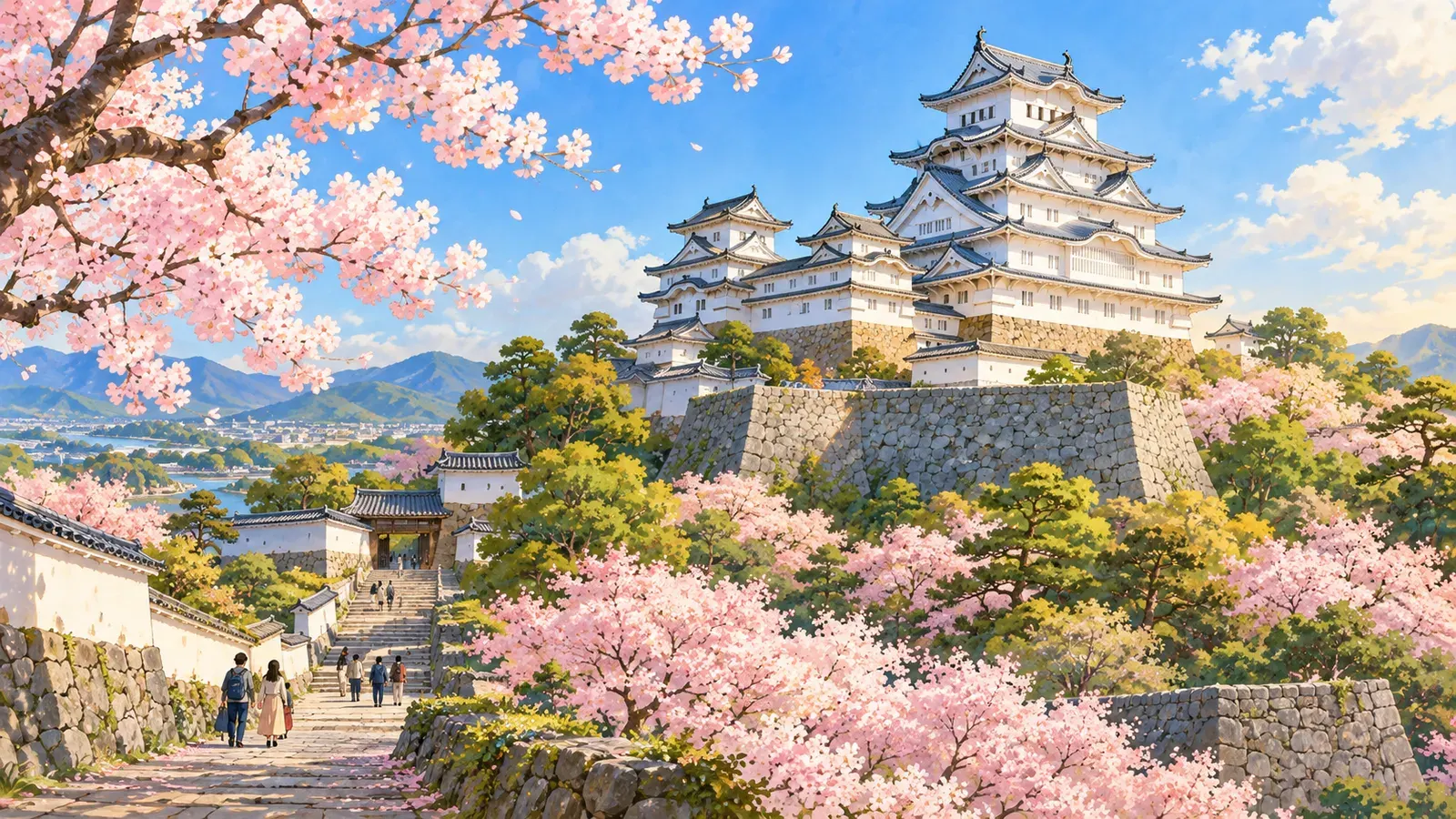
Walk out of Himeji Station in western Japan and look straight up the main street. At the far end, on a low hill, a castle rises above the city, its white walls shining in the sun. Its roofs are layered one above another, and their gentle curves look like the wings of a bird about to take off. That is why people call it Shirasagijo, or White Heron Castle. Built more than four hundred years ago, it is the largest and most famous original castle in Japan.
西日本の姫路駅を出て、大通りをまっすぐ見通してみてください。そのつきあたりの低い丘の上に、町を見下ろすように城がそびえ、白い壁が日の光に輝いています。屋根はいくつも重なり合い、そのゆるやかな曲線は、今にも飛び立とうとする鳥のつばさのようです。そのため、この城は「白鷺城」と呼ばれています。400年以上前に建てられた姫路城は、昔のまま残る日本の城の中で、いちばん大きく、いちばん有名な城です。
Many Japanese cities have a castle in the center. But most of the castle towers you see today are not original. Only twelve main towers, called tenshu, have survived from before the end of the Edo period. Himeji is one of them, and together with Matsumoto, Inuyama, Hikone and Matsue, it is a National Treasure. Many of the rest were rebuilt in the twentieth century, some of them in concrete, with elevators and museums inside.
日本には、町の中心に城がある都市がたくさんあります。けれども、今見られる天守の多くは、当時のものではありません。江戸時代の終わりより前から残っている天守は、わずか12しかないのです。姫路城はその一つで、松本城、犬山城、彦根城、松江城とともに国宝に指定されています。それ以外の多くは20世紀に建て直されたもので、中にはコンクリート造りで、エレベーターや博物館をそなえたものもあります。
The first Japanese castles looked nothing like Himeji. In the Middle Ages, a castle was usually a simple fort on top of a mountain, protected by wooden fences and deep ditches. Then came the Warring States period of the fifteenth and sixteenth centuries, when local lords fought each other almost without end. Guns arrived from Europe in 1543, and warfare changed quickly. Castles grew larger and stronger, with high stone walls and wide moats. Many also moved down from the mountains to hills and plains, where they could control towns and roads.
最初のころの日本の城は、姫路城とは似ても似つかないものでした。中世の城といえば、たいていは山の上の簡単なとりでで、木の柵と深い堀で守られていました。やがて15世紀から16世紀にかけての戦国時代がやってきます。各地の大名が、ほとんど休むことなく戦い合った時代です。1543年にヨーロッパから鉄砲が伝わると、戦い方は急速に変わりました。城はより大きく、より強くなり、高い石垣と広い堀をそなえるようになります。また、多くの城が山から下りて、丘や平地に移りました。そこなら、町や道をおさえることができたからです。
The warlord Oda Nobunaga took this change further. From 1576 he built Azuchi Castle beside Lake Biwa, with a tall, richly decorated main tower that showed his power to everyone who saw it. Azuchi burned down in 1582, soon after Nobunaga's death, but other lords copied its style. Around 1600 there was a great castle-building boom. Himeji's present tower was completed in 1609 by Ikeda Terumasa, a lord who had been given the castle as a reward for supporting Tokugawa Ieyasu at the Battle of Sekigahara.
武将の織田信長は、この変化をさらに推し進めました。信長は1576年から琵琶湖のほとりに安土城を築き、高くきらびやかな天守で、見る者すべてに自分の力を示したのです。安土城は信長の死の直後、1582年に焼け落ちてしまいましたが、ほかの大名たちがその様式をまねました。1600年ごろには、城づくりの一大ブームが起こります。今の姫路城の天守は、1609年に池田輝政が完成させたものです。輝政は、関ヶ原の戦いで徳川家康の味方をしたほうびとして、この城を与えられた大名でした。
A castle like Himeji was built to be beautiful, but above all it was a machine for war. Paths inside the castle twist and turn like a maze. Some seem to lead toward the main tower but actually lead away from it, and attackers would have had to pass through gate after gate while soldiers fired down on them.
姫路城のような城は、美しく見えるようにも作られましたが、何よりもまず戦いのための機械でした。城の中の道は、迷路のようにくねくねと曲がっています。天守に向かっているように見えて、実は遠ざかっていく道もあります。攻めこんだ敵は、上から兵たちに撃たれながら、門をいくつもくぐり抜けなければならなかったはずです。
The walls are full of small holes, shaped like circles, triangles and squares, for guns and arrows. In some places, the walls stick out over the stone base, with openings in the floor through which defenders could drop stones or shoot at enemies climbing below. Even the white plaster had a purpose. It helped protect the wooden building from fire.
壁には、丸や三角や四角の小さな穴がたくさんあいています。鉄砲や矢を放つための穴です。ところどころで壁が石垣の上に張り出していて、その床に開いた口から、石垣をよじ登ってくる敵に石を落としたり、鉄砲を撃ったりできるようになっています。白いしっくいにさえ役目がありました。木造の建物を火から守ってくれたのです。
The stone walls are a marvel in themselves. They were built without cement by skilled masons, who fitted large rough stones together so that each one held the others in place. At the corners, long stones were laid in alternating directions to make them strong. At Kumamoto Castle in Kyushu, the walls curve gently at the bottom and grow steeper and steeper toward the top, almost like a wave about to break. It is said that this curve made them impossible for enemy soldiers to climb.
石垣は、それだけでも驚くべきものです。石垣はセメントを使わず、腕のいい石工たちが積み上げました。大きな自然の石を、それぞれがほかの石を支え合うように組み合わせたのです。角の部分には細長い石を、向きを交互に変えながら積んで、強くしました。九州の熊本城の石垣は、下のほうはゆるやかで、上へ行くほどどんどん急になります。まるで今にもくだけようとする波のようです。この反りのせいで、敵の兵は登ることができなかったと言われています。
Yet here is a surprising fact. Most of these great castles never saw a battle. In 1615, the Tokugawa family destroyed its last major rival at Osaka, and a long peace began. The new government ordered that each lord could keep only one castle, and even repairs needed permission. Castles turned into offices and symbols of power. Merchants and craftsmen gathered around them, and these castle towns grew into many of the cities that are prefectural capitals today.
ところが、ここで意外な事実があります。こうした立派な城のほとんどは、一度も戦いを経験しなかったのです。1615年、徳川家は大坂で最後の大きな敵をほろぼし、長い平和の時代が始まりました。幕府は、大名が持てる城は一つだけと定め、修理をするにも許可がいるようにしました。城は政治を行う役所となり、権力の象徴になりました。城のまわりには商人や職人が集まり、こうした城下町が、今の県庁所在地の多くへと発展していったのです。
Matsumoto Castle in Nagano shows how times changed. Its main tower was built in the 1590s, when war was still a real danger, and its black walls have earned it the nickname Crow Castle. Then, around 1634, the lord added a small wing with sliding doors that open on three sides and a veranda painted red. It is a room for viewing the moon. It is said that it was built for a visit by the shogun Tokugawa Iemitsu, who never came after all, because a rockslide forced him to take a different road. A fortress built for war had gained a room for poetry and moonlight.
長野の松本城を見ると、時代の移り変わりがよくわかります。松本城の天守が建てられたのは1590年代、まだ戦が現実の危険だったころです。黒い壁から、「烏城」というあだ名でも呼ばれています。その後、1634年ごろ、城主が小さな建物を付け加えました。三方の戸を開け放つことができ、赤く塗られた縁側がついています。月を眺めるための部屋です。将軍徳川家光を迎えるために建てられたと言われていますが、家光は結局やって来ませんでした。がけ崩れのために、別の道を通らなければならなくなったのです。戦いのために建てられたとりでに、詩歌と月の光を楽しむ部屋が加わったのでした。
Castles have their legends, too. Inside the grounds of Himeji stands an old stone well known as Okiku's Well. According to a famous ghost story, a young servant named Okiku was blamed for losing one of ten precious plates, and she lost her life in a well. Ever since, it is said, a sad voice can be heard at night, slowly counting plates, one, two, three, up to nine, and then crying. Several places in Japan claim this story, but the well at Himeji is the best known.
城には伝説もあります。姫路城の敷地には、「お菊井戸」と呼ばれる古い石の井戸があります。有名な怪談によると、お菊という若い女中が、大切な10枚の皿のうち1枚をなくしたと責められ、井戸で命を落としました。それ以来、夜になると、悲しげな声がゆっくりと皿を数えるのが聞こえるといいます。一枚、二枚、三枚……九枚まで数えると、泣き出すのだそうです。この話は日本のいくつもの土地に伝わっていますが、いちばんよく知られているのは姫路城の井戸です。
The biggest danger to castles came later, in peacetime. After the Meiji Restoration of 1868, the new government saw castles as symbols of the old samurai age. From 1873, many were taken down or sold, sometimes for little more than the value of their wood. It is said that even Himeji Castle was once sold at auction for a tiny sum, but the buyer gave up when he realized how much it would cost to take it apart.
城にとって最大の危機は、そのあと、平和な時代にやってきました。1868年の明治維新のあと、新しい政府は、城を古い武士の時代の象徴とみなしました。1873年からは、多くの城が取り壊されたり、売り払われたりしました。木材としての値段とほとんど変わらない額で売られたこともあります。姫路城でさえ、一度はわずかな金額で競売にかけられたと言われています。けれども買い手は、取り壊すのにどれほどお金がかかるかに気づいて、あきらめたのだそうです。
Then came the Second World War. In 1945, bombing raids destroyed the towers of Nagoya, Okayama, Wakayama and other castles, and Hiroshima Castle was lost to the atomic bomb. The city of Himeji was badly burned, too. A firebomb even struck the top floor of the castle, but it did not explode, and the castle survived. After the war, many cities rebuilt their castle towers as a sign of hope and recovery.
やがて第二次世界大戦がやってきます。1945年、空襲によって名古屋城、岡山城、和歌山城などの天守が焼け落ち、広島城は原子爆弾で失われました。姫路の町もひどく焼かれました。焼夷弾が城の最上階に命中したことさえありましたが、爆発しなかったので、城は無事でした。戦後、多くの都市が、希望と復興のしるしとして天守を建て直しました。
On the roofs of many castles sits a pair of shachihoko, imaginary creatures with the head of a tiger and the body of a fish. People believed that they could call up water and protect the building from fire. The pair on top of Nagoya Castle were covered with gold and became the symbol of the city. They were lost in the fire of 1945, but new golden ones were made when the tower was rebuilt in 1959.
多くの城の屋根の上には、一対の「しゃちほこ」がのっています。頭はトラ、体は魚という想像上の生き物です。しゃちほこは水を呼んで、建物を火事から守ってくれると信じられていました。名古屋城のしゃちほこは金でおおわれ、町のシンボルになりました。1945年の火災で失われましたが、1959年に天守が再建されたとき、新しい金のしゃちほこが作られました。
Even an original castle needs constant care. From 2009 to 2015, Himeji Castle went through a major restoration. The main tower was covered by a huge temporary building, and visitors could watch through windows as workers replaced roof tiles and put fresh white plaster on the walls. When the cover finally came off, the castle was so brilliantly white that some people jokingly called it Shirosugijo, the "Too White Castle." Over the following years, the color softened a little, as plaster always does.
昔のまま残る城も、たえず手入れが必要です。2009年から2015年にかけて、姫路城では大がかりな修理が行われました。天守は巨大な仮の建物ですっぽりおおわれ、見学者は窓ごしに、職人たちが屋根瓦をふき替え、壁に新しい白いしっくいを塗る様子を見ることができました。おおいがやっと外されると、城はまぶしいほど真っ白でした。そこで「白すぎ城」とからかう人もいたほどです。しっくいはいつもそうですが、その後の数年で、色は少し落ち着きました。
Castles still face danger from nature. In April 2016, two powerful earthquakes struck Kumamoto. Large parts of the castle's famous stone walls collapsed into piles of rubble. One five-story corner tower lost almost all the wall beneath it, yet it did not fall. It stood balanced on a narrow column of corner stones, and people began to call that column the "miracle stone wall."
城は、自然の脅威にもさらされています。2016年4月、熊本を二度の大きな地震がおそいました。熊本城の名高い石垣は、あちこちで大きく崩れ、がれきの山になりました。角に建つ五階建ての櫓の一つは、下の石垣をほとんど失いながらも、倒れませんでした。角の石が細い柱のように残り、その上でバランスを保って立っていたのです。人々はその石の柱を、「奇跡の一本石垣」と呼ぶようになりました。
For the people of Kumamoto, it became a symbol of hope. Workers numbered and recorded thousands of fallen stones so that each could be returned to its original place. The main tower reopened in 2021, but repairing all the walls is expected to take decades.
熊本の人々にとって、それは希望のシンボルになりました。作業員たちは、崩れた何千もの石に番号をつけて記録し、一つ一つをもとの場所に戻せるようにしました。天守は2021年に再び公開されましたが、すべての石垣を直すには、何十年もかかると見こまれています。
When you visit an original castle tower, be ready for a climb. You take off your shoes, and the wooden stairs are so steep that they feel almost like ladders. Hold the handrail, and be careful in socks on the smooth, polished floors. As you go up, look for the gun holes in the walls and the openings for dropping stones. At the top, you will see what the lord once saw: the whole town spread out below, and the mountains beyond.
昔のままの天守を訪ねるなら、登る覚悟をしておきましょう。靴を脱いで上がると、木の階段はとても急で、はしごのように感じられるほどです。手すりにつかまり、つるつるにみがかれた床では、靴下ですべらないよう気をつけてください。登りながら、壁の鉄砲を撃つ穴や、石を落とすための口を探してみましょう。最上階に着けば、かつての城主が見ていた景色が広がります。足もとに広がる町全体と、その向こうの山々です。
How to explain it in English: "Japanese castles were built mainly in the late 1500s and early 1600s. They look elegant, but they were made for defense, with stone walls, moats and maze-like paths. Only twelve original main towers survive today. The most famous is Himeji Castle, which is called White Heron Castle because of its white walls."
英語で説明してみよう:「日本の城は、おもに1500年代の終わりから1600年代のはじめに建てられました。優雅に見えますが、守りのために作られたもので、石垣や堀、迷路のような道があります。昔のまま残っている天守は、今では12しかありません。いちばん有名なのは姫路城で、白い壁から『白鷺城』と呼ばれています。」