Today, sushi is famous around the world as an elegant Japanese food, served in expensive restaurants and on conveyor belts in busy cities. Many people think of it as raw fish on rice. But for most of its long history, sushi was something very different. It began not as a fancy meal, but as a way to keep fish from going bad.
今、すしは上品な日本料理として世界中で有名です。高級レストランでも、にぎやかな都市の回転ずし店でも出されています。多くの人は、すしといえば、ごはんに生の魚をのせたものだと思っています。でも、その長い歴史のほとんどの間、すしはまったく違うものでした。ぜいたくな料理ではなく、魚を傷ませないための方法として始まったのです。
The earliest form of sushi is called narezushi. It probably came to Japan from Southeast Asia, by way of China, more than a thousand years ago. Fish was cleaned, salted, and packed in cooked rice. Over months, the rice fermented, producing acid that kept the fish from rotting. When the fish was ready, people ate the fish and threw the rice away. A version of this old sushi, called funazushi, is still made today around Lake Biwa in Shiga Prefecture. It has a very strong smell and a sour taste, and some people compare it to strong cheese.
いちばん古い形のすしは、なれずしと呼ばれます。おそらく千年以上前に、東南アジアから中国を経て日本に伝わりました。魚をさばいて塩をし、炊いたごはんの中に詰めます。何か月もたつうちに、ごはんが発酵して酸ができ、その酸が魚が腐るのを防いだのです。魚が食べられるようになると、人々は魚だけを食べて、ごはんは捨てていました。この昔のすしの一種、ふなずしは、今でも滋賀県の琵琶湖の周りで作られています。とても強いにおいとすっぱい味があり、においの強いチーズにたとえる人もいます。
Over time, people became impatient. Around the fifteenth and sixteenth centuries, they began to eat the fish after a shorter time, when the rice was only lightly sour, so that they could eat the rice too. Then, in the Edo period, people discovered a much faster way. Instead of waiting for the rice to ferment, they simply added vinegar to it. This new "quick sushi" could be eaten on the same day it was made.
時がたつにつれて、人々は待ちきれなくなりました。15世紀から16世紀ごろには、もっと早い時期、ごはんがほんのりすっぱくなったころに食べるようになりました。そうすれば、ごはんも一緒に食べられます。そして江戸時代になると、もっとずっと早い方法が見つかりました。ごはんが発酵するのを待つかわりに、ごはんに酢を混ぜたのです。この新しい「早ずし」は、作ったその日に食べられました。
The sushi most people know today, nigiri-zushi, was born in Edo, now Tokyo, in the early nineteenth century. A sushi chef named Hanaya Yohei is often said to have made it popular in the 1820s. Instead of pressing fish and rice in a box and waiting, chefs shaped a small ball of vinegared rice by hand, put a slice of fish on top, and served it right away. It was fresh, quick, and convenient. It was the fast food of Edo.
今ほとんどの人が知っているすし、にぎりずしは、19世紀のはじめに江戸(今の東京)で生まれました。1820年代に、華屋与兵衛というすし職人がにぎりずしを広めた、とよく言われます。魚とごはんを箱に詰めて押し、発酵するのを待つのではありません。職人は酢めしを手で小さくにぎり、その上に魚の切り身をのせて、すぐに出したのです。新鮮で、早くて、手軽。にぎりずしは江戸のファストフードでした。
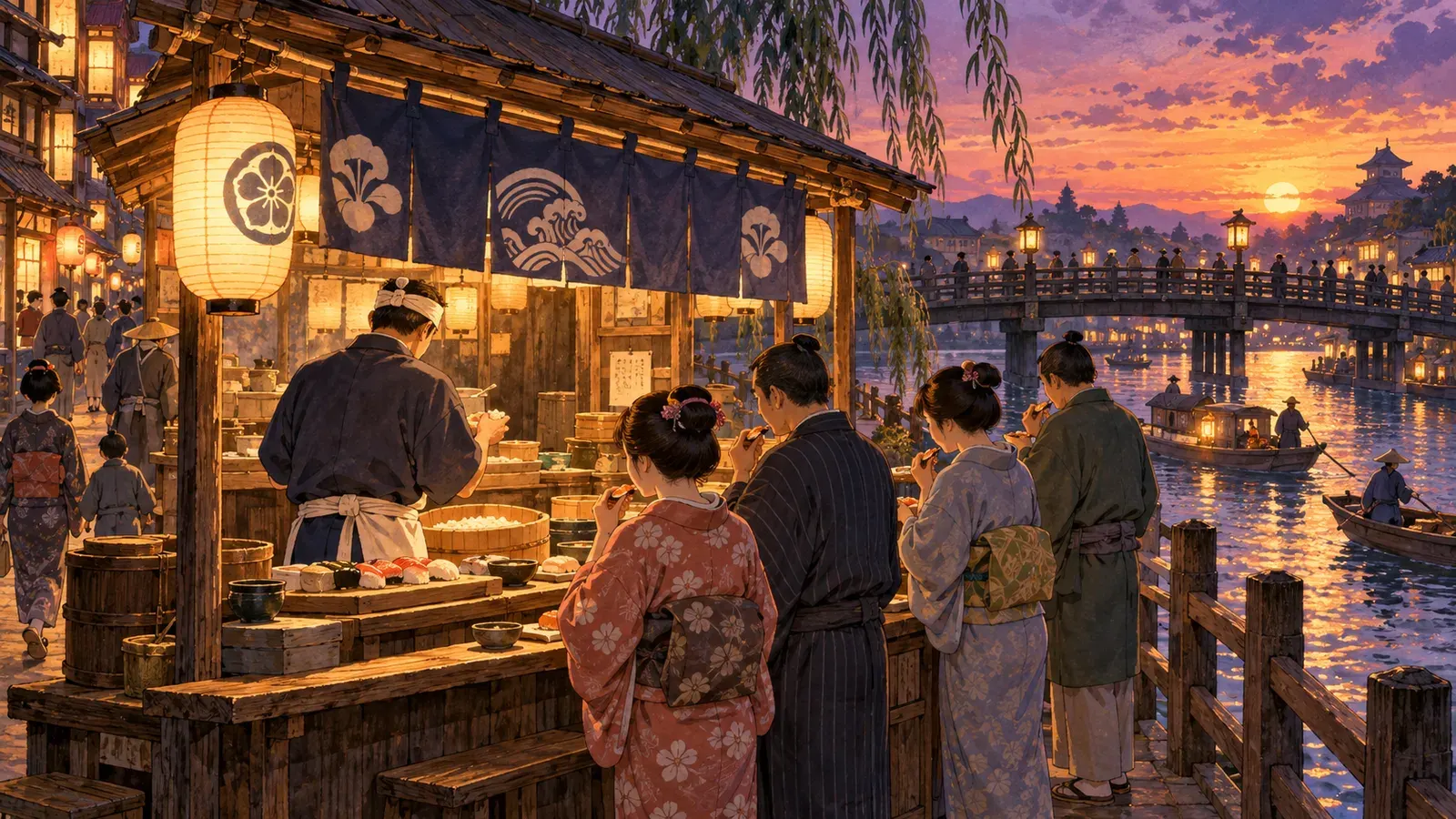
In those days, sushi was sold from street stalls, called yatai. Busy workers stopped at a stall, ate a few pieces standing up, and went back to work. The pieces are said to have been two or three times bigger than they are today. Without refrigerators, chefs used clever ways to keep fish safe and tasty. They marinated tuna in soy sauce, cured some fish with salt and vinegar, and simmered others, like conger eel. Fish caught in the bay in front of Edo was called Edomae, meaning "in front of Edo," and the name "Edomae sushi" is still used today for this style.
当時、すしは屋台で売られていました。忙しく働く人たちが屋台に立ち寄り、立ったままいくつかつまんで、また仕事に戻っていきました。一つ一つのすしは、今の2倍から3倍の大きさだったと言われています。冷蔵庫がなかったので、職人たちは魚を傷ませず、おいしく保つための工夫を凝らしました。マグロはしょうゆにつけこみ、塩と酢でしめる魚もあれば、アナゴのように煮る魚もありました。江戸の前の海でとれた魚は「江戸前」と呼ばれました。「江戸前ずし」という名前は、今でもこのスタイルのすしに使われています。
For a long time, raw fish like tuna was not considered very special. Fatty tuna, which is now one of the most expensive types of sushi, was once so cheap that many people did not want it. It went bad quickly and was thought to be low-class food. Only in the twentieth century, as refrigeration improved and tastes changed, did fatty tuna become a luxury.
長い間、マグロのような生の魚は、それほど特別なものとは思われていませんでした。トロは、今ではすしの中でもいちばん高価なネタの一つです。ところが、かつてはとても安く、食べたがらない人が多かったのです。いたみやすく、下等な食べ物だと考えられていました。冷蔵技術が進み、人々の好みが変わった20世紀になって、トロはようやく高級品になったのです。
In the 1940s and 1950s, new rules about food safety pushed sushi stalls off the streets and into shops. Better refrigeration also made it possible to serve many kinds of raw fish safely. Sushi slowly became a food for special occasions, and sometimes a very expensive one.
1940年代から1950年代にかけて、食品の安全についての新しい決まりができ、すしの屋台は通りから姿を消して、店の中へと移りました。冷蔵技術が進んだおかげで、いろいろな種類の生の魚を安全に出せるようにもなりました。すしは少しずつ特別な日のごちそうになり、ときにはとても高価なものになりました。
Then, in 1958, a restaurant owner in Osaka named Yoshiaki Shiraishi opened the first conveyor-belt sushi restaurant. It is said that he got the idea after seeing beer bottles moving on a conveyor belt at a beer factory. With plates traveling around the counter, customers could take whatever they wanted, and fewer chefs were needed. Conveyor-belt sushi became very popular after it was shown at the 1970 World Expo in Osaka, and it made sushi a cheap, fun food for families once again. Today, many of these restaurants use touch screens for ordering, and some even send plates to your seat on a special express lane.
そして1958年、大阪のレストラン経営者、白石義明が、最初の回転ずしの店を開きました。ビール工場で、ビール瓶がベルトコンベヤーで運ばれていくのを見て、思いついたと言われています。カウンターの周りを皿が回るので、客は好きなものを取れますし、職人も少なくてすみます。回転ずしは1970年の大阪万博で紹介されて、大人気になりました。こうしてすしは、再び家族で楽しめる、安くて楽しい食べ物になったのです。今では、こうした店の多くはタッチパネルで注文でき、特別な高速レーンで席まで皿を届けてくれる店まであります。
Sushi also traveled abroad. In the United States in the 1960s and 1970s, Japanese chefs started to change sushi to suit local tastes. The California roll, for example, uses avocado instead of fatty tuna, and it is made "inside out," with the rice on the outside, so that people who were not used to seaweed would feel more comfortable. Today, you can find sushi in almost every big city in the world, with local styles that might surprise people in Japan.
すしは海外にも広まりました。1960年代から1970年代のアメリカで、日本人の職人たちが、すしを現地の人の好みに合わせて変え始めました。たとえばカリフォルニアロールは、トロのかわりにアボカドを使います。また、ごはんを外側にした「裏巻き」になっています。のりに慣れていない人でも、抵抗なく食べられるようにするためです。今では、世界のほとんどの大都市にすしがあり、日本の人がおどろくような、その土地ならではのスタイルも生まれています。
If you eat sushi in Japan, here are a few tips. It is fine to eat nigiri with your fingers as well as with chopsticks. When you use soy sauce, turn the piece over a little and dip the fish side, not the rice, so that the rice does not fall apart. Pickled ginger, called gari, is served to refresh your mouth between different kinds of fish. And at a traditional sushi counter, you can say "Omakase," which means "I'll leave it to you." The chef will then choose the best fish of the day for you.
日本ですしを食べるなら、いくつかコツがあります。にぎりずしは、箸だけでなく指で食べてもかまいません。しょうゆをつけるときは、すしを少し傾けて、ごはんではなく魚のほうをつけると、ごはんが崩れません。「ガリ」と呼ばれる甘酢しょうがは、違う種類の魚を食べる合間に口の中をさっぱりさせるために出されます。そして昔ながらのすしのカウンターでは、「おまかせ」と言うことができます。「あなたに任せます」という意味です。そうすると、職人がその日いちばんの魚を選んでくれます。
From a smelly way to keep fish, to the fast food of Edo, to a luxury meal, and then to a fun, affordable family restaurant, sushi has changed many times in its long history. And it is still changing today.
魚を長持ちさせるための、においの強い保存法。江戸のファストフード。高級な料理。そして、手ごろで楽しい家族向けのレストラン。すしは長い歴史の中で、何度も姿を変えてきました。そして今も、変わり続けているのです。
How to explain it in English: "Sushi started as a way to keep fish by packing it in rice. The nigiri sushi we know today was created in Edo, old Tokyo, about two hundred years ago, as a kind of fast food. Conveyor-belt sushi was invented in Osaka in 1958."
英語で説明してみよう:「すしは、魚をごはんに詰めて長持ちさせる方法として始まりました。今わたしたちが知っているにぎりずしは、約200年前に、今の東京にあたる江戸で、一種のファストフードとして生まれました。回転ずしは1958年に大阪で発明されました。」