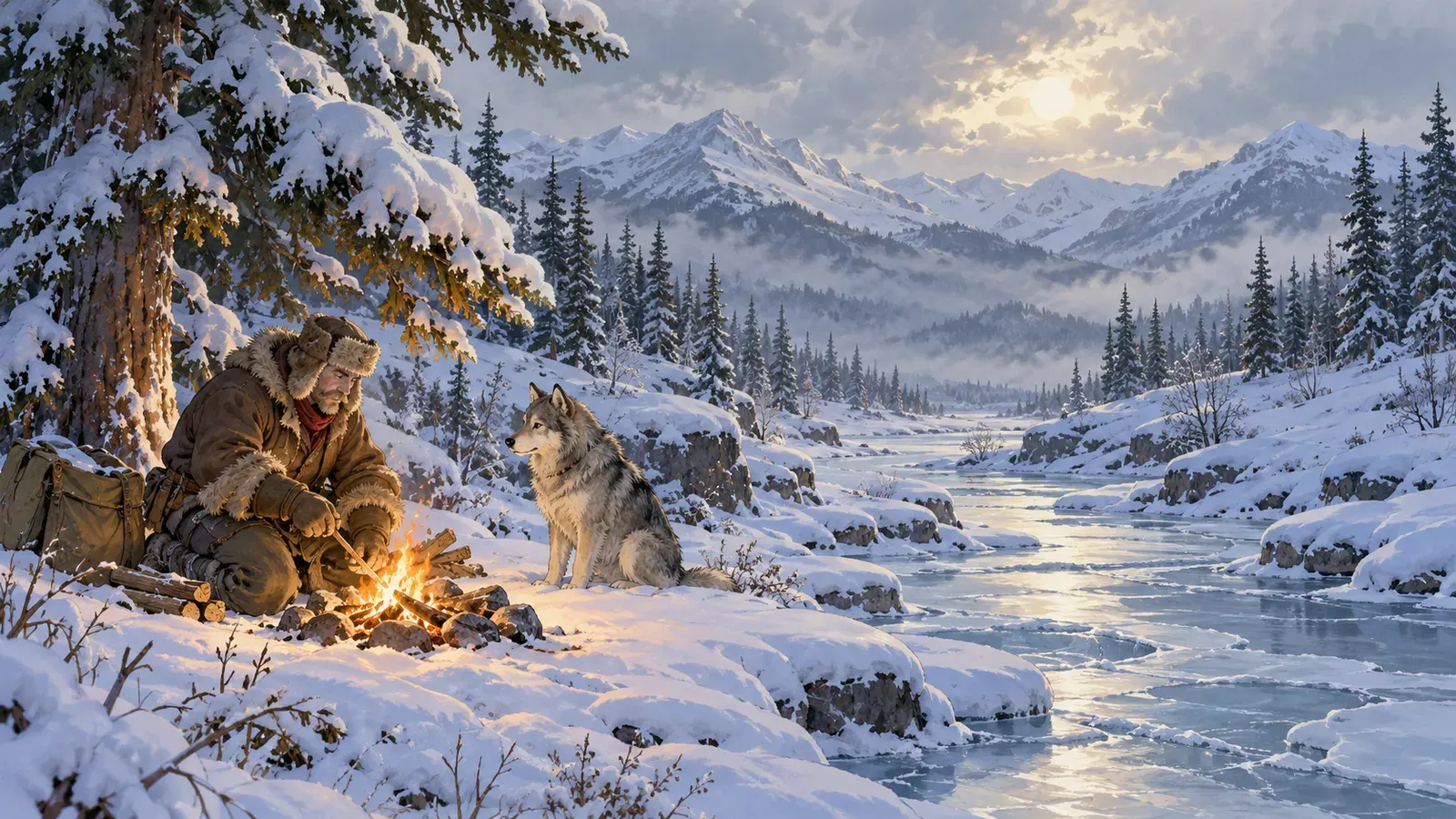
Day had broken cold and grey, exceedingly cold and grey, when the man turned aside from the main Yukon trail and climbed the high earth-bank, where a dim and little-travelled trail led eastward through the fat spruce timberland. It was a steep bank, and he paused for breath at the top, excusing the act to himself by looking at his watch. It was nine o'clock. There was no sun nor hint of sun, though there was not a cloud in the sky. It was a clear day, and yet there seemed an intangible pall over the face of things, a subtle gloom that made the day dark, and that was due to the absence of sun. This fact did not worry the man. He was used to the lack of sun. It had been days since he had seen the sun, and he knew that a few more days must pass before that cheerful orb, due south, would just peep above the sky-line and dip immediately from view.
夜は明けたが、寒く、灰色の日だった。ひどく寒く、ひどく灰色だった。男はユーコンの本道からわきへそれ、高い土手をよじのぼった。土手の上には、よく茂ったトウヒの森を抜けて東へ向かう、かすかな、ほとんど人の通らない道が続いていた。急な土手だったので、男はのぼりきったところで息をついた。立ち止まったのを自分にごまかすように、時計を見た。九時だった。空には雲ひとつないのに、太陽はなく、その気配さえなかった。晴れているのに、あたりのものの上に、目に見えない幕がかかっているようだった。かすかな陰りが昼を暗くしていた。太陽がないせいだった。男はそれを気にしなかった。太陽のないのには慣れていた。最後に太陽を見てから、もう何日もたっていた。あの陽気な天体が真南の地平線からちょっと顔をのぞかせ、すぐにまた沈むようになるまでには、まだ何日かかかることも知っていた。
The man flung a look back along the way he had come. The Yukon lay a mile wide and hidden under three feet of ice. On top of this ice were as many feet of snow. It was all pure white, rolling in gentle undulations where the ice-jams of the freeze-up had formed. North and south, as far as his eye could see, it was unbroken white, save for a dark hair-line that curved and twisted from around the spruce-covered island to the south, and that curved and twisted away into the north, where it disappeared behind another spruce-covered island. This dark hair-line was the trail—the main trail—that led south five hundred miles to the Chilcoot Pass, Dyea, and salt water; and that led north seventy miles to Dawson, and still on to the north a thousand miles to Nulato, and finally to St. Michael on Bering Sea, a thousand miles and half a thousand more.
男は来た道を振り返った。ユーコン川は幅一マイルに広がり、三フィートの氷の下に隠れていた。その氷の上には、また三フィートの雪が積もっていた。一面まっ白で、凍りはじめに氷がせめぎ合ってできた起伏が、ゆるやかにうねっていた。北も南も、見わたすかぎり白一色が続いていた。ただ一本、髪の毛のように細い黒い線があった。南の、トウヒに覆われた島のまわりから曲がりくねって現れ、北へ曲がりくねって伸び、別のトウヒの島の陰に消えている。この細い黒い線が道、本道だった。南へ五百マイル行けば、チルクート峠、ダイイー、そして海に出る。北へ七十マイル行けばドーソン、さらに北へ千マイルでヌラトー、そして最後は千五百マイル先の、ベーリング海のセント・マイケルに着く。
But all this—the mysterious, far-reaching hairline trail, the absence of sun from the sky, the tremendous cold, and the strangeness and weirdness of it all—made no impression on the man. It was not because he was long used to it. He was a new-comer in the land, a chechaquo, and this was his first winter. The trouble with him was that he was without imagination. He was quick and alert in the things of life, but only in the things, and not in the significances. Fifty degrees below zero meant eighty odd degrees of frost. Such fact impressed him as being cold and uncomfortable, and that was all. It did not lead him to meditate upon his frailty as a creature of temperature, and upon man's frailty in general, able only to live within certain narrow limits of heat and cold; and from there on it did not lead him to the conjectural field of immortality and man's place in the universe. Fifty degrees below zero stood for a bite of frost that hurt and that must be guarded against by the use of mittens, ear-flaps, warm moccasins, and thick socks. Fifty degrees below zero was to him just precisely fifty degrees below zero. That there should be anything more to it than that was a thought that never entered his head.
だが、こうしたことはみな、男の心に何の印象も残さなかった。はるか遠くまで延びる、謎めいた細い道。空に太陽がないこと。恐ろしいほどの寒さ。そして、そのすべての異様さ、不気味さ。それに長く慣れていたからではない。男はこの土地の新参者、いわゆる「チェチャクオ」で、これが初めての冬だった。困ったことに、男には想像力がなかった。暮らしの中のことにはすばやく、抜け目なかった。だがそれはことがらそのものについてだけで、その意味にまでは及ばなかった。零下五十度とは、氷点下八十度あまりということだ。男にとってその事実は、寒くて不快だというだけのことで、それ以上ではなかった。人間は温度に左右される生き物で、暑さ寒さのごく狭い範囲の中でしか生きられない。自分も、人間というものもそういうもろいものだ。男はそんなふうに思いをめぐらすことはなかった。まして、そこから、不死や、宇宙の中での人間の位置といった、とりとめのない考えに進むこともなかった。零下五十度とは、痛い寒さのことだった。ミトンや、耳当てや、温かいモカシンや、厚い靴下で防がなければならないもの。それだけだった。男にとって零下五十度は、まさに零下五十度でしかなかった。それ以上の何かがあるかもしれないなどとは、一度も考えたことがなかった。
As he turned to go on, he spat speculatively. There was a sharp, explosive crackle that startled him. He spat again. And again, in the air, before it could fall to the snow, the spittle crackled. He knew that at fifty below spittle crackled on the snow, but this spittle had crackled in the air. Undoubtedly it was colder than fifty below—how much colder he did not know. But the temperature did not matter. He was bound for the old claim on the left fork of Henderson Creek, where the boys were already. They had come over across the divide from the Indian Creek country, while he had come the roundabout way to take a look at the possibilities of getting out logs in the spring from the islands in the Yukon. He would be in to camp by six o'clock; a bit after dark, it was true, but the boys would be there, a fire would be going, and a hot supper would be ready. As for lunch, he pressed his hand against the protruding bundle under his jacket. It was also under his shirt, wrapped up in a handkerchief and lying against the naked skin. It was the only way to keep the biscuits from freezing. He smiled agreeably to himself as he thought of those biscuits, each cut open and sopped in bacon grease, and each enclosing a generous slice of fried bacon.
歩きだそうと向き直ったとき、男はためしにつばを吐いた。鋭い、はじけるような音がして、男はぎくりとした。もう一度吐いた。するとまた、つばが雪に落ちる前に、空中でぱちっと鳴った。零下五十度なら、つばは雪の上でぱちっと鳴る。それは知っていた。だがこのつばは、空中で鳴ったのだ。零下五十度より寒いのは間違いなかった。どれくらい寒いのかはわからなかった。だが、気温などどうでもよかった。男が向かっているのは、ヘンダーソン・クリークの左の支流にある古い採掘地で、仲間たちはもうそこに着いていた。仲間たちはインディアン・クリークのほうから分水嶺を越えて行った。男は、春にユーコン川の島々から丸太を切り出せそうか見てまわるために、遠回りをしてきたのだ。六時には野営地に着くだろう。たしかに日が暮れて少したってからになるが、仲間たちはそこにいて、火は燃えていて、温かい夕食ができているはずだ。昼飯のことを思って、男は上着の下でふくらんでいる包みを手で押さえた。包みはシャツの下に入れてあり、ハンカチにくるまれて、素肌にじかにあたっていた。ビスケットを凍らせないには、そうするしかなかった。そのビスケットのことを思うと、男はひとりでに満足げな笑みを浮かべた。どれも二つに割ってベーコンの脂にひたしてあり、どれにも焼いたベーコンが一枚、厚く切ってはさんであった。
He plunged in among the big spruce trees. The trail was faint. A foot of snow had fallen since the last sled had passed over, and he was glad he was without a sled, travelling light. In fact, he carried nothing but the lunch wrapped in the handkerchief. He was surprised, however, at the cold. It certainly was cold, he concluded, as he rubbed his numbed nose and cheek-bones with his mittened hand. He was a warm-whiskered man, but the hair on his face did not protect the high cheek-bones and the eager nose that thrust itself aggressively into the frosty air.
男は大きなトウヒの木々の中へ踏みこんだ。道はかすかだった。最後の橇が通ってから、雪が一フィート積もっていた。橇を引かず、身軽に旅をしていてよかった、と男は思った。じっさい、ハンカチに包んだ昼飯のほかには、何も持っていなかった。それにしても、この寒さには驚いた。ミトンをはめた手で、かじかんだ鼻と頬骨をこすりながら、たしかに寒い、と男は思った。男はたっぷりとひげを生やしていたが、顔の毛も、高い頬骨と、凍てつく空気の中へぐいと突き出した鼻までは、守ってくれなかった。
At the man's heels trotted a dog, a big native husky, the proper wolf-dog, grey-coated and without any visible or temperamental difference from its brother, the wild wolf. The animal was depressed by the tremendous cold. It knew that it was no time for travelling. Its instinct told it a truer tale than was told to the man by the man's judgment. In reality, it was not merely colder than fifty below zero; it was colder than sixty below, than seventy below. It was seventy-five below zero. Since the freezing-point is thirty-two above zero, it meant that one hundred and seven degrees of frost obtained. The dog did not know anything about thermometers. Possibly in its brain there was no sharp consciousness of a condition of very cold such as was in the man's brain. But the brute had its instinct. It experienced a vague but menacing apprehension that subdued it and made it slink along at the man's heels, and that made it question eagerly every unwonted movement of the man as if expecting him to go into camp or to seek shelter somewhere and build a fire. The dog had learned fire, and it wanted fire, or else to burrow under the snow and cuddle its warmth away from the air.
男のかかとのすぐ後ろを、一匹の犬が小走りについてきた。大きな、この土地のハスキーで、正真正銘の狼犬だった。毛は灰色で、見た目にも気性にも、兄弟分の野生の狼とまるで違いがなかった。犬はすさまじい寒さにまいっていた。旅などしている時ではないとわかっていたのだ。犬の本能は、男の判断が男に告げるよりも、ずっと正しいことを犬に告げていた。じつは、零下五十度より寒いどころではなかった。零下六十度より、零下七十度より寒かった。零下七十五度だった。氷点は三十二度だから、氷点下百七度の寒さということになる。犬は温度計のことなど何も知らなかった。犬の頭の中には、男の頭の中にあるような、ひどく寒いというはっきりした意識はなかったかもしれない。だが、獣には本能がある。ぼんやりとした、だが不気味な不安が、犬をおとなしくさせていた。犬は男のかかとについて、こそこそと歩いた。男がいつもと違う動きをするたびに、熱心にうかがった。野営するのか、どこかに身を寄せて火をたくのかと期待していたのだ。犬は火を知っていて、火がほしかった。でなければ、雪の下にもぐりこみ、外の空気から身を離して、体のぬくもりを抱いて丸くなりたかった。
The frozen moisture of its breathing had settled on its fur in a fine powder of frost, and especially were its jowls, muzzle, and eyelashes whitened by its crystalled breath. The man's red beard and moustache were likewise frosted, but more solidly, the deposit taking the form of ice and increasing with every warm, moist breath he exhaled. Also, the man was chewing tobacco, and the muzzle of ice held his lips so rigidly that he was unable to clear his chin when he expelled the juice. The result was that a crystal beard of the colour and solidity of amber was increasing its length on his chin. If he fell down it would shatter itself, like glass, into brittle fragments. But he did not mind the appendage. It was the penalty all tobacco-chewers paid in that country, and he had been out before in two cold snaps. They had not been so cold as this, he knew, but by the spirit thermometer at Sixty Mile he knew they had been registered at fifty below and at fifty-five.
犬の吐く息の湿り気が凍って、細かい霜の粉となって毛に積もっていた。とくに頬や鼻づらやまつげは、凍った息でまっ白になっていた。男の赤いあごひげと口ひげにも同じように霜がついていたが、こちらはもっと固く、氷になってこびりつき、温かく湿った息を吐くたびに厚くなっていった。そのうえ男は噛みたばこを噛んでいたので、口のまわりの氷が唇をがっちり固めてしまい、汁を吐くときに、あごを汚さずにはいられなかった。そのせいで、琥珀のような色と固さの、氷のひげが、あごの先でだんだん伸びていった。転べば、それはガラスのように、もろいかけらに砕けてしまうだろう。だが男は、このおまけを気にしなかった。この土地で噛みたばこをやる者なら、誰でも払わされる罰金のようなものだ。男はこれまでにも二度、寒波の中を出歩いたことがあった。あれほどの寒さでなかったことはわかっていた。だがシックスティ・マイルのアルコール温度計で、零下五十度と零下五十五度を記録したことは知っていた。
He held on through the level stretch of woods for several miles, crossed a wide flat of nigger-heads, and dropped down a bank to the frozen bed of a small stream. This was Henderson Creek, and he knew he was ten miles from the forks. He looked at his watch. It was ten o'clock. He was making four miles an hour, and he calculated that he would arrive at the forks at half-past twelve. He decided to celebrate that event by eating his lunch there.
男は平らな森の中を何マイルも進み続け、谷地坊主(原文は当時の差別的な呼び方)が一面に盛り上がった平地を横切り、土手をおりて、小さな川の凍った川床に出た。これがヘンダーソン・クリークで、分岐点まであと十マイルだとわかっていた。時計を見た。十時だった。一時間に四マイルの速さで進んでいたから、分岐点には十二時半に着くだろうと計算した。着いたら、そのお祝いに、そこで昼飯を食べることにした。
The dog dropped in again at his heels, with a tail drooping discouragement, as the man swung along the creek-bed. The furrow of the old sled-trail was plainly visible, but a dozen inches of snow covered the marks of the last runners. In a month no man had come up or down that silent creek. The man held steadily on. He was not much given to thinking, and just then particularly he had nothing to think about save that he would eat lunch at the forks and that at six o'clock he would be in camp with the boys. There was nobody to talk to and, had there been, speech would have been impossible because of the ice-muzzle on his mouth. So he continued monotonously to chew tobacco and to increase the length of his amber beard.
男が川床を大またに歩きだすと、犬はまたそのかかとについてきた。しょげたように尻尾を垂れていた。古い橇の通ったわだちは、はっきり見えた。だが最後の滑り木の跡は、一フィートほどの雪に埋もれていた。この一か月、静まりかえったその川を、のぼった者も、くだった者もいなかったのだ。男は着実に進み続けた。もともとあまりものを考えるたちではなかった。とくにいまは、分岐点で昼飯を食べ、六時には野営地で仲間たちと一緒になる、ということのほかに、考えることは何もなかった。話し相手もいなかった。いたとしても、口のまわりの氷のせいで、話すことはできなかっただろう。それで男は、ただ黙々と噛みたばこを噛み、琥珀のひげを伸ばし続けた。
Once in a while the thought reiterated itself that it was very cold and that he had never experienced such cold. As he walked along he rubbed his cheek-bones and nose with the back of his mittened hand. He did this automatically, now and again changing hands. But rub as he would, the instant he stopped his cheek-bones went numb, and the following instant the end of his nose went numb. He was sure to frost his cheeks; he knew that, and experienced a pang of regret that he had not devised a nose-strap of the sort Bud wore in cold snaps. Such a strap passed across the cheeks, as well, and saved them. But it didn't matter much, after all. What were frosted cheeks? A bit painful, that was all; they were never serious.
ときどき、ひどく寒い、こんな寒さは味わったことがない、という考えがくりかえし浮かんだ。歩きながら、男はミトンをはめた手の甲で、頬骨と鼻をこすった。知らず知らずそうして、ときどき手を替えた。だが、いくらこすっても、手を止めたとたんに頬骨がしびれ、次の瞬間には鼻の先がしびれた。頬に凍傷を負うのは間違いなかった。男はそれがわかっていて、バドが寒波のときにつけていたような鼻当てを作っておかなかったのを、ちょっと悔やんだ。ああいう鼻当てなら、頬にもかかるので、頬も守ってくれるのだ。だが、結局たいしたことではない。頬の凍傷がなんだというのだ。少し痛いだけで、それ以上のことはない。大ごとになったためしはないのだ。
Empty as the man's mind was of thoughts, he was keenly observant, and he noticed the changes in the creek, the curves and bends and timber-jams, and always he sharply noted where he placed his feet. Once, coming around a bend, he shied abruptly, like a startled horse, curved away from the place where he had been walking, and retreated several paces back along the trail. The creek he knew was frozen clear to the bottom—no creek could contain water in that arctic winter—but he knew also that there were springs that bubbled out from the hillsides and ran along under the snow and on top the ice of the creek. He knew that the coldest snaps never froze these springs, and he knew likewise their danger. They were traps. They hid pools of water under the snow that might be three inches deep, or three feet. Sometimes a skin of ice half an inch thick covered them, and in turn was covered by the snow. Sometimes there were alternate layers of water and ice-skin, so that when one broke through he kept on breaking through for a while, sometimes wetting himself to the waist.
男の頭には考えらしい考えは何もなかったが、目はよく利いた。川のようすの変わり目、曲がりやうねりや流木のたまりに気づいたし、いつも、足をどこに置くかをしっかり見定めていた。一度、曲がり角をまわったところで、男はおびえた馬のようにいきなり飛びのき、歩いていた場所から弧を描いてそれて、道を何歩か後ずさりした。この川が底まで凍りついていることは知っていた。この北極の冬に、水をたたえていられる川などない。だが、山腹から湧き出して、雪の下、川の氷の上を流れる泉があることも知っていた。どんなにひどい寒波でも、こうした泉は凍らない。そしてその危険も知っていた。それは罠だった。雪の下に水たまりを隠していて、深さは三インチのこともあれば、三フィートのこともある。厚さ半インチの薄い氷がその上を覆い、さらにその上を雪が覆っていることもある。水と薄い氷が何層も重なっていることもあり、そうなると、一度踏み抜くと続けて踏み抜いて、ときには腰までぬれてしまうのだ。
That was why he had shied in such panic. He had felt the give under his feet and heard the crackle of a snow-hidden ice-skin. And to get his feet wet in such a temperature meant trouble and danger. At the very least it meant delay, for he would be forced to stop and build a fire, and under its protection to bare his feet while he dried his socks and moccasins. He stood and studied the creek-bed and its banks, and decided that the flow of water came from the right. He reflected awhile, rubbing his nose and cheeks, then skirted to the left, stepping gingerly and testing the footing for each step. Once clear of the danger, he took a fresh chew of tobacco and swung along at his four-mile gait.
男があれほどあわてて飛びのいたのは、そのためだった。足の下がたわむのを感じ、雪に隠れた薄い氷がぱりっと鳴るのを聞いたのだ。こんな気温で足をぬらすのは、厄介で、危ないことだった。少なくとも、時間をとられる。立ち止まって火をたき、その火に守られながら素足になって、靴下とモカシンを乾かさなければならないからだ。男は立ち止まって川床と両岸をよく調べ、水は右から流れてきていると判断した。鼻と頬をこすりながら、しばらく考えた。それから左へ回り道をした。一歩ごとに足場を確かめながら、そろそろと進んだ。危ないところを抜けると、たばこを新しく口に入れ、一時間四マイルの足どりで、大またに歩きだした。
In the course of the next two hours he came upon several similar traps. Usually the snow above the hidden pools had a sunken, candied appearance that advertised the danger. Once again, however, he had a close call; and once, suspecting danger, he compelled the dog to go on in front. The dog did not want to go. It hung back until the man shoved it forward, and then it went quickly across the white, unbroken surface. Suddenly it broke through, floundered to one side, and got away to firmer footing. It had wet its forefeet and legs, and almost immediately the water that clung to it turned to ice. It made quick efforts to lick the ice off its legs, then dropped down in the snow and began to bite out the ice that had formed between the toes. This was a matter of instinct. To permit the ice to remain would mean sore feet. It did not know this. It merely obeyed the mysterious prompting that arose from the deep crypts of its being. But the man knew, having achieved a judgment on the subject, and he removed the mitten from his right hand and helped tear out the ice-particles. He did not expose his fingers more than a minute, and was astonished at the swift numbness that smote them. It certainly was cold. He pulled on the mitten hastily, and beat the hand savagely across his chest.
それからの二時間で、男は似たような罠にいくつも出くわした。たいていは、隠れた水たまりの上の雪がくぼんで、砂糖菓子のような見かけになっていて、それが危険を知らせていた。それでも一度、また危ないところだった。また一度は、危ないと思って、犬をむりやり先に行かせた。犬は行きたがらなかった。男が押しやるまで後ずさりしていたが、押されると、白く平らな雪の上を急いで渡っていった。いきなり、犬は踏み抜いた。横へもがいて、もっと固い足場へ逃れた。前足と脚をぬらしてしまい、体についた水はほとんどすぐに氷になった。犬は急いで脚の氷をなめとろうとし、それから雪の上に伏せて、指のあいだにできた氷を噛みとりはじめた。これは本能のなせるわざだった。氷をそのままにしておけば、足を痛める。犬はそれを知っていたわけではない。ただ、自分のいちばん奥深いところからわき上がる、ふしぎなうながしに従っただけだった。だが男は知っていた。そのことについて、前に考えたことがあったからだ。男は右手のミトンをはずして、氷のかけらをむしりとるのを手伝ってやった。指を出していたのは一分もなかったが、あっというまに指がしびれたのには驚いた。たしかに寒い。男は急いでミトンをはめ、その手を胸に激しくたたきつけた。
At twelve o'clock the day was at its brightest. Yet the sun was too far south on its winter journey to clear the horizon. The bulge of the earth intervened between it and Henderson Creek, where the man walked under a clear sky at noon and cast no shadow. At half-past twelve, to the minute, he arrived at the forks of the creek. He was pleased at the speed he had made. If he kept it up, he would certainly be with the boys by six. He unbuttoned his jacket and shirt and drew forth his lunch. The action consumed no more than a quarter of a minute, yet in that brief moment the numbness laid hold of the exposed fingers. He did not put the mitten on, but, instead, struck the fingers a dozen sharp smashes against his leg. Then he sat down on a snow-covered log to eat. The sting that followed upon the striking of his fingers against his leg ceased so quickly that he was startled, he had had no chance to take a bite of biscuit. He struck the fingers repeatedly and returned them to the mitten, baring the other hand for the purpose of eating. He tried to take a mouthful, but the ice-muzzle prevented. He had forgotten to build a fire and thaw out. He chuckled at his foolishness, and as he chuckled he noted the numbness creeping into the exposed fingers. Also, he noted that the stinging which had first come to his toes when he sat down was already passing away. He wondered whether the toes were warm or numbed. He moved them inside the moccasins and decided that they were numbed.
十二時、一日のうちでいちばん明るい時刻になった。それでも、冬の旅路で南へ遠く離れすぎている太陽は、地平線の上に出てこられなかった。地球のふくらみが、太陽とヘンダーソン・クリークのあいだに立ちはだかっていた。男は真昼の晴れた空の下を、影ひとつ落とさずに歩いた。十二時半きっかりに、男は川の分岐点に着いた。思ったとおりの速さで来られたのに満足した。この調子を保てば、六時にはまちがいなく仲間たちと一緒になれる。男は上着とシャツのボタンをはずし、昼飯を取り出した。それにかかったのは十五秒もなかった。だがそのわずかなあいだに、むき出しの指がしびれた。男はミトンをはめずに、指を脚に十回あまり、激しくたたきつけた。それから、雪をかぶった倒木に腰をおろして食べようとした。指を脚にたたきつけたあとのうずきが、あまりにも早く消えたので、男はぎょっとした。まだビスケットをひと口かじる暇もなかったのだ。男は何度も指をたたきつけてからミトンに戻し、食べるために、もう一方の手を出した。ひと口ほおばろうとしたが、口のまわりの氷がじゃまをした。火をたいて氷をとかすのを忘れていたのだ。男は自分のまぬけさにくすくす笑った。笑いながら、むき出しの指にしびれが忍びこんでくるのに気づいた。それに、腰をおろしたとき足の指に来たうずきが、もう消えかけていることにも気づいた。足の指は温かいのだろうか、それともしびれているのだろうか。モカシンの中で指を動かしてみて、しびれているのだとわかった。
He pulled the mitten on hurriedly and stood up. He was a bit frightened. He stamped up and down until the stinging returned into the feet. It certainly was cold, was his thought. That man from Sulphur Creek had spoken the truth when telling how cold it sometimes got in the country. And he had laughed at him at the time! That showed one must not be too sure of things. There was no mistake about it, it was cold. He strode up and down, stamping his feet and threshing his arms, until reassured by the returning warmth. Then he got out matches and proceeded to make a fire. From the undergrowth, where high water of the previous spring had lodged a supply of seasoned twigs, he got his firewood. Working carefully from a small beginning, he soon had a roaring fire, over which he thawed the ice from his face and in the protection of which he ate his biscuits. For the moment the cold of space was outwitted. The dog took satisfaction in the fire, stretching out close enough for warmth and far enough away to escape being singed.
男は急いでミトンをはめて立ち上がった。少し怖くなっていた。足にうずきが戻ってくるまで、足を踏みならしながら行ったり来たりした。たしかに寒い、と男は思った。サルファー・クリークから来たあの男は、この土地がときにどれほど寒くなるかを話したとき、本当のことを言っていたのだ。それなのに、あのとき自分はあいつを笑ったのだ! ものごとをあまり決めつけてはいけない、ということだ。間違いない、寒いのだ。男は大またに行ったり来たりし、足を踏みならし、腕を振りまわした。ぬくもりが戻ってきて、ようやく安心した。それからマッチを取り出して、火をおこしにかかった。前の年の春の増水で、乾いた小枝がたっぷり引っかかっている下草のあたりから、たきぎを集めた。小さな火から、ていねいに育てていくと、まもなく火はごうごうと燃え上がった。男はその火で顔の氷をとかし、火に守られてビスケットを食べた。さしあたり、宇宙の寒さを出し抜いたのだ。犬も火に満足して、暖まるのには十分近く、毛を焦がさないくらいには離れたところに、長々と寝そべった。
When the man had finished, he filled his pipe and took his comfortable time over a smoke. Then he pulled on his mittens, settled the ear-flaps of his cap firmly about his ears, and took the creek trail up the left fork. The dog was disappointed and yearned back toward the fire. This man did not know cold. Possibly all the generations of his ancestry had been ignorant of cold, of real cold, of cold one hundred and seven degrees below freezing-point. But the dog knew; all its ancestry knew, and it had inherited the knowledge. And it knew that it was not good to walk abroad in such fearful cold. It was the time to lie snug in a hole in the snow and wait for a curtain of cloud to be drawn across the face of outer space whence this cold came. On the other hand, there was no keen intimacy between the dog and the man. The one was the toil-slave of the other, and the only caresses it had ever received were the caresses of the whip-lash and of harsh and menacing throat-sounds that threatened the whip-lash. So the dog made no effort to communicate its apprehension to the man. It was not concerned in the welfare of the man; it was for its own sake that it yearned back toward the fire. But the man whistled, and spoke to it with the sound of whip-lashes, and the dog swung in at the man's heels and followed after.
食べ終わると、男はパイプにたばこを詰め、のんびりと一服した。それからミトンをはめ、帽子の耳当てを耳にしっかりかぶせて、左の支流をさかのぼる川ぞいの道をたどりはじめた。犬はがっかりして、火のほうを恋しがった。この男は寒さを知らなかった。たぶん男の先祖も代々、寒さを、本当の寒さを、氷点下百七度の寒さを知らなかったのだろう。だが犬は知っていた。犬の先祖はみな知っていて、犬はその知恵を受け継いでいた。こんな恐ろしい寒さの中を出歩くのはよくない、と犬は知っていた。いまは雪の穴の中でぬくぬくと寝そべり、待つべきときなのだ。この寒さは外の宇宙からやって来る。その宇宙の顔に、雲の幕が引かれるのを待つべきなのだ。とはいえ、犬と男のあいだに、親しい心の通い合いなどなかった。犬は男にこき使われる奴隷だった。犬がこれまでに受けた愛撫といえば、鞭の愛撫と、鞭をちらつかせる、荒々しい、脅すような声の愛撫だけだった。だから犬は、自分の不安を男に伝えようとはしなかった。男の身を案じていたわけではない。火を恋しがったのは、自分のためだった。だが男が口笛を吹き、鞭の音のような声で呼ぶと、犬は男のかかとのところへ戻って、あとについていった。
The man took a chew of tobacco and proceeded to start a new amber beard. Also, his moist breath quickly powdered with white his moustache, eyebrows, and lashes. There did not seem to be so many springs on the left fork of the Henderson, and for half an hour the man saw no signs of any. And then it happened. At a place where there were no signs, where the soft, unbroken snow seemed to advertise solidity beneath, the man broke through. It was not deep. He wetted himself half-way to the knees before he floundered out to the firm crust.
男はたばこを口に入れ、新しい琥珀のひげをつくりはじめた。湿った息が、たちまち口ひげや眉やまつげを白い粉で覆った。ヘンダーソン・クリークの左の支流には、泉はそれほど多くないようだった。三十分のあいだ、男はひとつも見かけなかった。そして、それは起きた。何のしるしもない場所だった。やわらかな、平らな雪が、下は固いぞと告げているように見える場所だった。そこで男は踏み抜いたのだ。深くはなかった。固い雪の上にもがき出るまでに、すねの半分ほどまでぬれた。