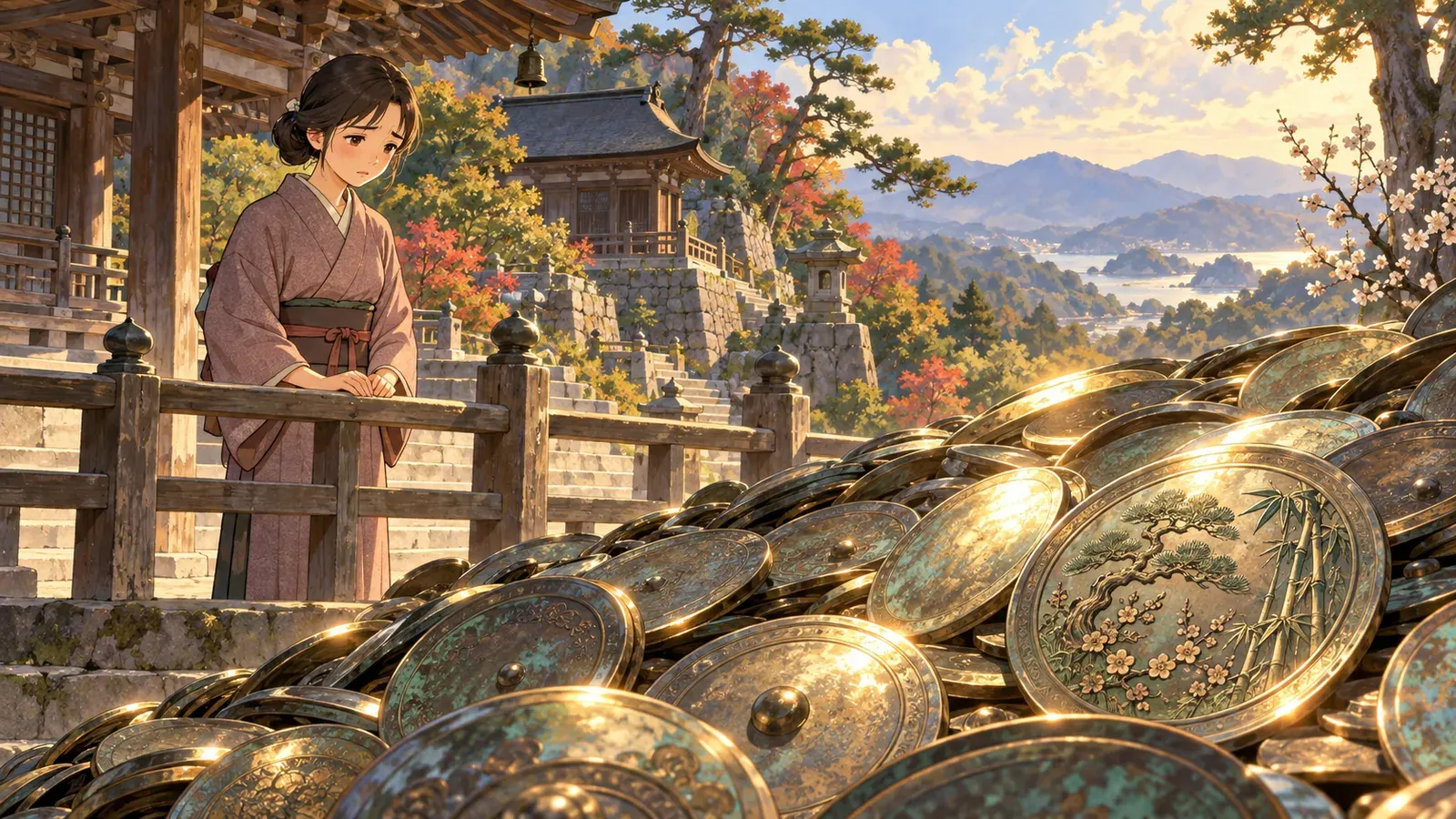
Eight centuries ago, the priests of Mugenyama, in the province of Tōtōmi, wanted a big bell for their temple; and they asked the women of their parish to help them by contributing old bronze mirrors for bell-metal.
八百年前のこと、遠江(とおとうみ)の国の無間山(むげんやま)の僧たちは、寺に大きな釣り鐘がほしいと思った。そこで、檀家の女たちに、鐘の地金にするために古い青銅の鏡を寄進してくれるよう頼んだ。
[Even to-day, in the courts of certain Japanese temples, you may see heaps of old bronze mirrors contributed for such a purpose. The largest collection of this kind that I ever saw was in the court of a temple of the Jōdo sect, at Hakata, in Kyūshū: the mirrors had been given for the making of a bronze statue of Amida, thirty-three feet high.]
〔今でも、日本のいくつかの寺の境内には、こうした目的で寄進された古い青銅の鏡が、山のように積まれているのを見ることができる。私が見た中でいちばん多かったのは、九州の博多にある浄土宗の寺の境内だった。その鏡は、高さ三十三フィートの阿弥陀仏の銅像を造るために、寄進されたものだった。〕
There was at that time a young woman, a farmer's wife, living at Mugenyama, who presented her mirror to the temple, to be used for bell-metal. But afterwards she much regretted her mirror. She remembered things that her mother had told her about it; and she remembered that it had belonged, not only to her mother but to her mother's mother and grandmother; and she remembered some happy smiles which it had reflected. Of course, if she could have offered the priests a certain sum of money in place of the mirror, she could have asked them to give back her heirloom. But she had not the money necessary. Whenever she went to the temple, she saw her mirror lying in the court-yard, behind a railing, among hundreds of other mirrors heaped there together. She knew it by the Shō-Chiku-Bai in relief on the back of it,—those three fortunate emblems of Pine, Bamboo, and Plumflower, which delighted her baby-eyes when her mother first showed her the mirror. She longed for some chance to steal the mirror, and hide it,—that she might thereafter treasure it always. But the chance did not come; and she became very unhappy,—felt as if she had foolishly given away a part of her life. She thought about the old saying that a mirror is the Soul of a Woman—(a saying mystically expressed, by the Chinese character for Soul, upon the backs of many bronze mirrors),—and she feared that it was true in weirder ways than she had before imagined. But she could not dare to speak of her pain to anybody.
そのころ無間山に、ある百姓の妻で、若い女が住んでいた。女は、鐘の地金に使ってもらおうと、自分の鏡を寺に差し出した。ところが、あとになって、その鏡が惜しくてたまらなくなった。母がその鏡について話してくれたことが、思い出された。その鏡は、母のものだっただけでなく、母の母のものでもあり、そのまた母のものでもあった。その鏡に映った幸せなほほえみの数々も、思い出された。もちろん、鏡のかわりにいくらかのお金を僧たちに差し出せれば、家宝の鏡を返してもらうよう頼むこともできただろう。けれども、女にはそれだけのお金がなかった。寺へ行くたびに、女は自分の鏡を見た。鏡は境内の柵の向こうに、何百というほかの鏡と一緒に積まれていた。鏡の裏に浮き彫りにされた松竹梅の模様で、すぐに自分のものとわかった。松と竹と梅の花という、三つのめでたいしるしである。母がはじめてその鏡を見せてくれたとき、幼かった女は、その模様を見て大喜びしたものだった。何とかして鏡を盗み出して隠し、それからはずっと大事にしまっておきたい。女はその機会をしきりに願った。けれども、機会は来なかった。女はひどくふさぎこんだ。まるで、自分の命の一部を愚かにも手放してしまったような気がした。鏡は女の魂である、という古い言い伝えがある。(多くの青銅の鏡の裏に、「魂」という漢字が刻まれているのは、この言い伝えを神秘的に表したものである。)女はその言い伝えのことを考えた。そして、それがこれまで思っていたよりも、もっと不気味な意味で本当なのではないかと、おそろしくなった。けれども、その苦しみを誰かに打ち明ける勇気はなかった。
Now, when all the mirrors contributed for the Mugenyama bell had been sent to the foundry, the bell-founders discovered that there was one mirror among them which would not melt. Again and again they tried to melt it; but it resisted all their efforts. Evidently the woman who had given that mirror to the temple must have regretted the giving. She had not presented her offering with all her heart; and therefore her selfish soul, remaining attached to the mirror, kept it hard and cold in the midst of the furnace.
さて、無間山の鐘のために寄進された鏡が、すべて鋳物場に送られた。すると鋳物師たちは、その中に一枚だけ、どうしても溶けない鏡があることに気づいた。何度も何度も溶かそうとしたが、鏡はどうやっても溶けなかった。その鏡を寺に寄進した女が、寄進したことを悔やんでいたにちがいない。女は、心の底から鏡をささげたのではなかった。だから、鏡に未練を残した女の身勝手な魂が、炉の真ん中でも、鏡を硬く冷たいままにしていたのである。
Of course everybody heard of the matter, and everybody soon knew whose mirror it was that would not melt. And because of this public exposure of her secret fault, the poor woman became very much ashamed and very angry. And as she could not bear the shame, she drowned herself, after having written a farewell letter containing these words:—
もちろん、このことはみなの耳に入った。そして、溶けないのが誰の鏡なのかも、すぐに知れわたってしまった。人に知られたくない過ちが、世間にさらされてしまったのである。かわいそうに、女はひどく恥じ入り、ひどく腹を立てた。そして恥ずかしさに耐えきれず、こう書いた書き置きを残して、身を投げてしまった。
"When I am dead, it will not be difficult to melt the mirror and to cast the bell. But, to the person who breaks that bell by ringing it, great wealth will be given by the ghost of me."
「わたしが死ねば、鏡を溶かして鐘を鋳るのは、たやすいことでしょう。けれども、その鐘をついて割った者には、わたしの霊が大きな富を授けましょう」
—You must know that the last wish or promise of anybody who dies in anger, or performs suicide in anger, is generally supposed to possess a supernatural force. After the dead woman's mirror had been melted, and the bell had been successfully cast, people remembered the words of that letter. They felt sure that the spirit of the writer would give wealth to the breaker of the bell; and, as soon as the bell had been suspended in the court of the temple, they went in multitude to ring it. With all their might and main they swung the ringing-beam; but the bell proved to be a good bell, and it bravely withstood their assaults. Nevertheless, the people were not easily discouraged. Day after day, at all hours, they continued to ring the bell furiously,—caring nothing whatever for the protests of the priests. So the ringing became an affliction; and the priests could not endure it; and they got rid of the bell by rolling it down the hill into a swamp. The swamp was deep, and swallowed it up,—and that was the end of the bell. Only its legend remains; and in that legend it is called the Mugen-Kané, or Bell of Mugen.
――知っておいてほしいのだが、怒りを抱いて死んだ者や、怒りのあまり自ら命を絶った者が最後に残した願いや約束には、ふつう、人の力を超えた力があると考えられている。死んだ女の鏡が溶かされ、鐘がうまく鋳上がると、人々はあの書き置きの言葉を思い出した。書いた女の霊が、鐘を割った者に富を授けてくれるにちがいない。そう信じこんだ人々は、鐘が寺の境内につるされるやいなや、大勢で鐘をつきに押しかけた。人々は、力のかぎり撞木をふるった。けれども、鐘はよくできた鐘で、どんなに打たれてもびくともしなかった。それでも人々は、なかなかあきらめなかった。来る日も来る日も、昼も夜もおかまいなしに、狂ったように鐘をつきつづけた。僧たちがやめてくれと言っても、まるで聞かなかった。とうとう鐘の音は、たまらない苦しみの種になった。僧たちはもうがまんできなくなり、鐘を山の上から沼へ転がり落として、始末してしまった。沼は深く、鐘をのみこんでしまった。こうして鐘はなくなった。残っているのは言い伝えだけで、その言い伝えの中で、鐘は「無間の鐘」と呼ばれている。
Now there are queer old Japanese beliefs in the magical efficacy of a certain mental operation implied, though not described, by the verb nazoraëru. The word itself cannot be adequately rendered by any English word; for it is used in relation to many kinds of mimetic magic, as well as in relation to the performance of many religious acts of faith. Common meanings of nazoraëru, according to dictionaries, are "to imitate," "to compare," "to liken;" but the esoteric meaning is to substitute, in imagination, one object or action for another, so as to bring about some magical or miraculous result.
ところで日本には、ある心のはたらきに、魔法のような効き目があるという、風変わりな古い信仰がある。そのはたらきは、「なぞらえる」という動詞の意味の中にふくまれている。もっとも、言葉そのものが、それを説明しているわけではない。この言葉は、どんな英語でもうまく言い表せない。いろいろな種類の、まねをすることでかけるまじないにも使われるし、いろいろな信心の行いにも使われるからである。辞書によれば、「なぞらえる」のふつうの意味は、「まねる」「くらべる」「たとえる」である。けれども、その奥にひそむ意味は、こうである。何か魔法のような、奇跡のような結果を起こすために、想像の中で、ある物や行いを、別の物や行いに置きかえるのである。
For example:—you cannot afford to build a Buddhist temple; but you can easily lay a pebble before the image of the Buddha, with the same pious feeling that would prompt you to build a temple if you were rich enough to build one. The merit of so offering the pebble becomes equal, or almost equal, to the merit of erecting a temple... You cannot read the six thousand seven hundred and seventy-one volumes of the Buddhist texts; but you can make a revolving library, containing them, turn round, by pushing it like a windlass. And if you push with an earnest wish that you could read the six thousand seven hundred and seventy-one volumes, you will acquire the same merit as the reading of them would enable you to gain... So much will perhaps suffice to explain the religious meanings of nazoraëru.
たとえば、あなたには寺を建てるだけのお金がないとしよう。けれども、仏像の前に小石をひとつ置くことなら、たやすくできる。もし寺を建てられるほどお金持ちなら寺を建てただろう、という同じ信心の気持ちで、小石を置くのである。すると、そうして小石をささげた功徳は、寺を建てた功徳と同じか、ほとんど同じになる……。あなたは、六千七百七十一巻もある仏教の経典を読むことはできない。けれども、経典をおさめた回転式の書庫を、巻き上げ機のように押して回すことはできる。そして、六千七百七十一巻を読めたらいいのに、と心から願いながら押すなら、経典を読んだのと同じ功徳が得られるのである……。「なぞらえる」の宗教の面での意味は、これくらい説明すれば十分だろう。
The magical meanings could not all be explained without a great variety of examples; but, for present purposes, the following will serve. If you should make a little man of straw, for the same reason that Sister Helen made a little man of wax,—and nail it, with nails not less than five inches long, to some tree in a temple-grove at the Hour of the Ox,—and if the person, imaginatively represented by that little straw man, should die thereafter in atrocious agony,—that would illustrate one signification of nazoraëru... Or, let us suppose that a robber has entered your house during the night, and carried away your valuables. If you can discover the footprints of that robber in your garden, and then promptly burn a very large moxa on each of them, the soles of the feet of the robber will become inflamed, and will allow him no rest until he returns, of his own accord, to put himself at your mercy. That is another kind of mimetic magic expressed by the term nazoraëru. And a third kind is illustrated by various legends of the Mugen-Kané.
まじないの面での意味を全部説明するには、いろいろな例をたくさん挙げなければならない。だが、ここでは次の例で間に合うだろう。シスター・ヘレンが、のろう相手に見立てて小さなろう人形を作ったように、あなたが小さなわら人形を作ったとする。そして丑の刻に、どこかの寺の森の木に、五寸より短くない釘で打ちつけたとする。その後、そのわら人形に見立てた人が、むごたらしく苦しみながら死んだとすれば、それが「なぞらえる」のひとつの意味の例になる……。あるいは、夜のうちに泥棒が家に入り、大事なものを盗んでいったとしよう。庭で泥棒の足跡を見つけて、すぐにその足跡のひとつひとつに、とても大きなもぐさをすえて焼いたとする。すると泥棒の足の裏が焼けるように痛みだし、泥棒が自分から戻ってきてあなたに許しを請うまで、少しも休ませてくれない。これも、「なぞらえる」という言葉で表される、まねのまじないの別の種類である。そして三つめの種類は、無間の鐘にまつわる、さまざまな言い伝えに見ることができる。
After the bell had been rolled into the swamp, there was, of course, no more chance of ringing it in such wise as to break it. But persons who regretted this loss of opportunity would strike and break objects imaginatively substituted for the bell,—thus hoping to please the spirit of the owner of the mirror that had made so much trouble. One of these persons was a woman called Umégaë,—famed in Japanese legend because of her relation to Kajiwara Kagesue, a warrior of the Heiké clan. While the pair were traveling together, Kajiwara one day found himself in great straits for want of money; and Umégaë, remembering the tradition of the Bell of Mugen, took a basin of bronze, and, mentally representing it to be the bell, beat upon it until she broke it,—crying out, at the same time, for three hundred pieces of gold. A guest of the inn where the pair were stopping made inquiry as to the cause of the banging and the crying, and, on learning the story of the trouble, actually presented Umégaë with three hundred ryō in gold. Afterwards a song was made about Umégaë's basin of bronze; and that song is sung by dancing girls even to this day:—
鐘が沼に転がり落とされてからは、もちろん、割れるまでつく機会はなくなってしまった。けれども、それを残念に思う人たちは、想像の中で何かを鐘に見立て、それを打って割った。そうすることで、あれほど騒ぎを起こした鏡の持ち主の霊を、喜ばせようとしたのである。そういう人のひとりに、梅が枝(うめがえ)という女がいた。平家の武士、梶原景季(かじわらかげすえ)とのかかわりで、日本の伝説に名高い女である。二人が一緒に旅をしていたとき、ある日、梶原はお金がなくて、ひどく困ってしまった。そこで梅が枝は、無間の鐘の言い伝えを思い出した。そして青銅の手水鉢(ちょうずばち)を持ってきて、それを心の中で鐘に見立て、割れるまで打ちつづけた。打ちながら、三百両の金貨をくださいと叫んだ。二人が泊まっていた宿の客が、何の音で、何を叫んでいるのかとたずねた。そして、二人が困っているわけを聞くと、本当に梅が枝に三百両の金を贈ってくれたのである。のちに、梅が枝の青銅の手水鉢をうたった歌が作られた。その歌は、今でも芸者たちに歌われている。
Umégaë no chōzubachi tataïté O-kané ga déru naraba Mina San mi-uké wo Sōré tanomimasu
梅が枝の 手水鉢(ちょうずばち) たたいて お金が出るならば みなさん身請けを そうれ頼みます
["If, by striking upon the wash-basin of Umégaë, I could make honorable money come to me, then would I negotiate for the freedom of all my girl-comrades."]
〔梅が枝の手水鉢をたたいて、ありがたいお金が出てくるのなら、仲間の娘たちみんなを、身請けして自由にしてやりたいものだ〕
After this happening, the fame of the Mugen-Kané became great; and many people followed the example of Umégaë,—thereby hoping to emulate her luck. Among these folk was a dissolute farmer who lived near Mugenyama, on the bank of the Ōïgawa. Having wasted his substance in riotous living, this farmer made for himself, out of the mud in his garden, a clay-model of the Mugen-Kané; and he beat the clay-bell, and broke it,—crying out the while for great wealth.
このことがあってから、無間の鐘はたいそう有名になった。梅が枝の幸運にあやかろうと、大勢の人がそのまねをした。その中に、無間山の近く、大井川のほとりに住む、身持ちの悪い百姓がいた。遊びほうけて財産を使いはたしてしまったこの百姓は、庭の泥で、無間の鐘の形をした土の鐘をこしらえた。そして、大金をくださいと叫びながら、その土の鐘を打って、割ってしまった。
Then, out of the ground before him, rose up the figure of a white-robed woman, with long loose-flowing hair, holding a covered jar. And the woman said: "I have come to answer your fervent prayer as it deserves to be answered. Take, therefore, this jar." So saying, she put the jar into his hands, and disappeared.
すると、目の前の地面から、白い着物の女の姿が現れた。女は長い髪をゆったりと垂らし、ふたのついた壺を抱えていた。女は言った。「おまえの熱心な願いに、ふさわしい答えをしに来た。さあ、この壺を受け取るがよい」。そう言うと、女は男の手に壺を渡して、消えてしまった。
Into his house the happy man rushed, to tell his wife the good news. He set down in front of her the covered jar,—which was heavy,—and they opened it together. And they found that it was filled, up to the very brim, with...
男は大喜びで家に駆けこみ、このよい知らせを妻に話した。そして、ふたのついた重い壺を妻の前に置き、二人で一緒にふたを開けた。すると壺の中には、ふちまでいっぱいに、つまっていたのは……。
But no!—I really cannot tell you with what it was filled.
いや、だめだ! 何がつまっていたかは、とても言えない。