Inexorably Sam Galloway saddled his pony. He was going away from the Rancho Altito at the end of a three-months' visit. It is not to be expected that a guest should put up with wheat coffee and biscuits yellow-streaked with saleratus for longer than that. Nick Napoleon, the big Negro man cook, had never been able to make good biscuits. Once before, when Nick was cooking at the Willow Ranch, Sam had been forced to fly from his cuisine, after only a six-weeks' sojourn.
サム・ギャロウェイは、もう決めたことだと言わんばかりに、ポニーに鞍を置いた。三か月泊まったアルティート牧場を、出ていくところだった。客たるもの、小麦で作った代用コーヒーや、ふくらし粉の黄色い筋が入ったビスケットに、それ以上長く我慢しろというのは無理な話である。料理番のニック・ナポレオンは、黒人の大男で、うまいビスケットを焼けたためしがなかった。前にニックがウィロー牧場で料理番をしていたときも、サムはその料理に耐えられず、たった六週間で逃げ出したことがあった。
On Sam's face was an expression of sorrow, deepened with regret and slightly tempered by the patient forgiveness of a connoisseur who cannot be understood. But very firmly and inexorably he buckled his saddle-cinches, looped his stake-rope and hung it to his saddle-horn, tied his slicker and coat on the cantle, and looped his quirt on his right wrist. The Merrydews (householders of the Rancho Altito), men, women, children, and servants, vassals, visitors, employés, dogs, and casual callers were grouped in the "gallery" of the ranch house, all with faces set to the tune of melancholy and grief. For, as the coming of Sam Galloway to any ranch, camp, or cabin between the rivers Frio or Bravo del Norte aroused joy, so his departure caused mourning and distress.
サムの顔には、悲しそうな表情が浮かんでいた。名残惜しさで、その悲しみはいっそう深かった。それでも、誰にもわかってもらえない食通が、辛抱強く相手を許してやるときのような、少しやわらいだ表情でもあった。だが、サムはきっぱりと、ためらいもせずに支度を進めた。鞍の腹帯を締め、馬をつなぐ綱を輪にして鞍の前の角にかけ、雨合羽と上着を鞍のうしろに結びつけ、乗馬用の鞭の輪を右の手首にかけた。アルティート牧場の主であるメリデュー家の人々が、母屋のベランダに集まっていた。男も女も子どもも、召使いも、家来も、泊まり客も、雇い人も、犬も、たまたま立ち寄った人も、みんなそろって憂いと悲しみに沈んだ顔をしていた。フリオ川からリオ・グランデ川までのあいだなら、どこの牧場でも、野営地でも、小屋でも、サム・ギャロウェイがやって来るとみんな大喜びした。そして、サムが去っていくときには、みんな嘆き悲しんだのである。
And then, during absolute silence, except for the bumping of a hind elbow of a hound dog as he pursued a wicked flea, Sam tenderly and carefully tied his guitar across his saddle on top of his slicker and coat. The guitar was in a green duck bag; and if you catch the significance of it, it explains Sam.
それから、あたりはしんと静まりかえった。聞こえるのは、猟犬が憎いノミを追いかけて、後ろ足でどんどんと床をたたく音だけだった。その静けさの中で、サムはギターを、鞍の上の雨合羽と上着の上に、優しく、ていねいに結わえつけた。ギターは緑色の布袋に入っていた。このことの意味がおわかりなら、サムがどういう男かはもうおわかりだろう。
Sam Galloway was the Last of the Troubadours. Of course you know about the troubadours. The encyclopædia says they flourished between the eleventh and the thirteenth centuries. What they flourished doesn't seem clear—you may be pretty sure it wasn't a sword: maybe it was a fiddlebow, or a forkful of spaghetti, or a lady's scarf. Anyhow, Sam Galloway was one of 'em.
サム・ギャロウェイは、最後の吟遊詩人だった。吟遊詩人のことは、もちろんご存じだろう。百科事典によれば、十一世紀から十三世紀にかけて、大いに腕を振るったという。何を振るったのかは、どうもはっきりしない。剣でなかったことはまず確かだろう。バイオリンの弓か、フォークに巻いたスパゲッティか、ご婦人のスカーフだったのかもしれない。とにかく、サム・ギャロウェイはその仲間のひとりだった。
Sam put on a martyred expression as he mounted his pony. But the expression on his face was hilarious compared with the one on his pony's. You see, a pony gets to know his rider mighty well, and it is not unlikely that cow ponies in pastures and at hitching racks had often guyed Sam's pony for being ridden by a guitar player instead of by a rollicking, cussing, all-wool cowboy. No man is a hero to his saddle-horse. And even an escalator in a department store might be excused for tripping up a troubadour.
サムは、殉教者のような顔をしてポニーにまたがった。だが、その顔も、ポニーの顔にくらべれば陽気なものだった。なにしろ、ポニーというものは乗り手のことを実によく知るようになる。それに、牧場やつなぎ柵のところで、ほかの牛追い用のポニーたちから、サムのポニーはさんざんからかわれていたにちがいないのだ。おまえの乗り手は、威勢がよくて口の悪い、本物のカウボーイじゃない、ただのギター弾きじゃないか、と。召使いの目には英雄なし、ということわざがあるが、乗り馬の目にも英雄はいないのである。それに、デパートのエスカレーターだって、吟遊詩人をつまずかせたくらいなら、大目に見てもらえるだろう。
Oh, I know I'm one; and so are you. You remember the stories you memorize and the card tricks you study and that little piece on the piano—how does it go?—ti-tum-te-tum-ti-tum—those little Arabian Ten Minute Entertainments that you furnish when you go up to call on your rich Aunt Jane. You should know that omnæ personæ in tres partes divisæ sunt. Namely: Barons, Troubadours, and Workers. Barons have no inclination to read such folderol as this; and Workers have no time: so I know you must be a Troubadour, and that you will understand Sam Galloway. Whether we sing, act, dance, write, lecture, or paint, we are only troubadours; so let us make the worst of it.
ああ、私も吟遊詩人のひとりだということはわかっている。あなただってそうだ。思い出してごらんなさい。覚えこんだ笑い話、練習したトランプの手品、ピアノで弾くあの小曲、どんな曲だったか、ティ・タム・テ・タム・ティ・タム。お金持ちのジェーンおばさんを訪ねるとき、ちょっとしたお楽しみにと披露する、あの十分間の余興のことだ。人間というものは、みな三つに分けられる。すなわち、男爵と、吟遊詩人と、働き手である。男爵は、こんなくだらない話を読む気などない。働き手には読む暇がない。だから、これを読んでいるあなたは吟遊詩人にちがいない。そして、サム・ギャロウェイのこともわかってくださるだろう。歌っても、演じても、踊っても、書いても、講演しても、絵を描いても、私たちはただの吟遊詩人にすぎない。だから、せいぜい開きなおって、とことんやろうではないか。
The pony with the Dante Alighieri face, guided by the pressure of Sam's knees, bore that wandering minstrel sixteen miles southeastward. Nature was in her most benignant mood. League after league of delicate, sweet flowerets made fragrant the gently undulating prairie. The east wind tempered the spring warmth; wool-white clouds flying in from the Mexican Gulf hindered the direct rays of the April sun. Sam sang songs as he rode. Under his pony's bridle he had tucked some sprigs of chaparral to keep away the deer flies. Thus crowned, the long-faced quadruped looked more Dantesque than before, and, judging by his countenance, seemed to think of Beatrice.
ダンテ・アリギエーリのような顔をしたポニーは、サムのひざの合図に従って、このさすらいの楽人を乗せ、南東へ二十五キロあまり進んだ。自然は、このうえなく優しい顔を見せていた。なだらかに起伏する大草原が、どこまでも、可憐な甘い小さな花でかぐわしかった。東風が春の暖かさをやわらげ、メキシコ湾から飛んでくる羊毛のように白い雲が、四月の日ざしをさえぎっていた。サムは馬に揺られながら歌を歌った。ポニーのくつわの下には、アブよけに低木の小枝を何本か差してあった。この冠をいただいて、顔の長い四つ足は、ますますダンテらしく見えた。その顔つきからすると、恋人ベアトリーチェのことでも思っているようだった。
Straight as topography permitted, Sam rode to the sheep ranch of old man Ellison. A visit to a sheep ranch seemed to him desirable just then. There had been too many people, too much noise, argument, competition, confusion, at Rancho Altito. He had never conferred upon old man Ellison the favour of sojourning at his ranch; but he knew he would be welcome. The troubadour is his own passport everywhere. The Workers in the castle let down the drawbridge to him, and the Baron sets him at his left hand at table in the banquet hall. There ladies smile upon him and applaud his songs and stories, while the Workers bring boars' heads and flagons. If the Baron nods once or twice in his carved oaken chair, he does not do it maliciously.
地形が許すかぎりまっすぐに、サムはエリソン老人の羊牧場へ向かった。いまは羊牧場に行くのがいい、と思えたのだ。アルティート牧場は、人が多すぎた。騒がしく、言い争いや、張り合いや、ごたごたが多すぎた。サムはこれまで、エリソン老人の牧場に泊まってやるという恩恵をほどこしたことはなかった。だが、歓迎されることはわかっていた。吟遊詩人は、どこへ行っても、自分自身が通行証なのだ。城の働き手たちは跳ね橋をおろして迎え入れ、男爵は大広間の宴で自分の左隣に座らせる。貴婦人たちはほほえみかけ、歌や物語に拍手を送る。そのあいだ、働き手たちは猪の頭の料理や、酒の大瓶を運んでくる。男爵が、彫刻をほどこした樫の椅子で一、二度こっくりしたとしても、それは悪気があってのことではないのだ。
Old man Ellison welcomed the troubadour flatteringly. He had often heard praises of Sam Galloway from other ranchmen who had been complimented by his visits, but had never aspired to such an honour for his own humble barony. I say barony because old man Ellison was the Last of the Barons. Of course, Mr. Bulwer-Lytton lived too early to know him, or he wouldn't have conferred that sobriquet upon Warwick. In life it is the duty and the function of the Baron to provide work for the Workers and lodging and shelter for the Troubadours.
エリソン老人は、吟遊詩人を下にも置かずにもてなした。老人は、サムに泊まってもらって鼻を高くしたほかの牧場主たちから、サム・ギャロウェイのうわさをよく聞いていた。だが、自分のささやかな男爵領にそんな名誉が訪れるとは、思ってもみなかったのだ。男爵領と言ったのは、エリソン老人が最後の男爵だったからである。もちろん、小説家のブルワー=リットン氏は、生まれるのが早すぎて、この老人を知らなかった。もし知っていたら、『最後の男爵』という呼び名をウォリック伯に与えたりはしなかっただろう。働き手に仕事を与え、吟遊詩人に宿とねぐらを与えること。それこそが、この世における男爵の務めであり、役目なのだ。
Old man Ellison was a shrunken old man, with a short, yellow-white beard and a face lined and seamed by past-and-gone smiles. His ranch was a little two-room box house in a grove of hackberry trees in the lonesomest part of the sheep country. His household consisted of a Kiowa Indian man cook, four hounds, a pet sheep, and a half-tamed coyote chained to a fence-post. He owned 3,000 sheep, which he ran on two sections of leased land and many thousands of acres neither leased nor owned. Three or four times a year some one who spoke his language would ride up to his gate and exchange a few bald ideas with him. Those were red-letter days to old man Ellison. Then in what illuminated, embossed, and gorgeously decorated capitals must have been written the day on which a troubadour—a troubadour who, according to the encyclopædia, should have flourished between the eleventh and the thirteenth centuries—drew rein at the gates of his baronial castle!
エリソン老人は、しなびた小柄な年寄りだった。黄ばんだ白いひげを短く生やし、顔には、遠い昔に浮かべたほほえみの名残りのしわが、深く刻まれていた。牧場といっても、羊の放牧地帯でもいちばんさびしいあたりの、エノキの木立の中にある、ふた部屋きりの箱のような小さな家だった。家族といえば、カイオワ族の料理番の男がひとりと、猟犬が四匹と、ペットの羊が一頭と、柵の柱に鎖でつないだ、半分なついたコヨーテが一匹だけだった。羊は三千頭いて、借りている二区画の土地と、借りても持ってもいない何千エーカーもの土地で放し飼いにしていた。年に三、四回、話の通じる誰かが門の前まで馬でやって来て、ありきたりの話を二つ三つしていった。エリソン老人にとっては、それが特別な、めでたい日だった。だとすれば、吟遊詩人が男爵の城の門で手綱を引いた日は、どれほど華やかな、金文字の飾り文字でカレンダーに書きこまれたことだろう! なにしろ、百科事典によれば、十一世紀から十三世紀に活躍していたはずの吟遊詩人なのである。
Old man Ellison's smiles came back and filled his wrinkles when he saw Sam. He hurried out of the house in his shuffling, limping way to greet him.
サムの姿を見ると、エリソン老人のしわに、ほほえみが戻ってきた。老人は足をひきずりながら、急いで家から出てきてサムを迎えた。
"Hello, Mr. Ellison," called Sam cheerfully. "Thought I'd drop over and see you a while. Notice you've had fine rains on your range. They ought to make good grazing for your spring lambs."
「やあ、エリソンさん」とサムは陽気に呼びかけた。「ちょっと寄って、しばらくお邪魔しようと思いましてね。お宅の放牧地にはいい雨が降ったようですな。春生まれの子羊たちには、いい草場になるでしょう」
"Well, well, well," said old man Ellison. "I'm mighty glad to see you, Sam. I never thought you'd take the trouble to ride over to as out-of-the-way an old ranch as this. But you're mighty welcome. 'Light. I've got a sack of new oats in the kitchen—shall I bring out a feed for your hoss?"
「いやはや、いやはや」とエリソン老人は言った。「よく来てくれたな、サム。こんな辺鄙な古い牧場まで、わざわざ来てくれるとは思ってもみなかったよ。だが、大歓迎だ。さあ、降りてくれ。台所に新しいオート麦がひと袋あるんだが、馬に食わせるのを持ってこようか?」
"Oats for him?" said Sam, derisively. "No, sir-ee. He's as fat as a pig now on grass. He don't get rode enough to keep him in condition. I'll just turn him in the horse pasture with a drag rope on if you don't mind."
「こいつにオート麦ですって?」とサムは、ばかにしたように言った。「とんでもない。こいつは草だけで、もう豚みたいに太ってるんです。乗ってやる回数が少ないもんで、締まりがなくなっちまって。よろしければ、引き綱をつけて、馬の放牧場に放しておきますよ」
I am positive that never during the eleventh and thirteenth centuries did Baron, Troubadour, and Worker amalgamate as harmoniously as their parallels did that evening at old man Ellison's sheep ranch. The Kiowa's biscuits were light and tasty and his coffee strong. Ineradicable hospitality and appreciation glowed on old man Ellison's weather-tanned face. As for the troubadour, he said to himself that he had stumbled upon pleasant places indeed. A well-cooked, abundant meal, a host whom his lightest attempt to entertain seemed to delight far beyond the merits of the exertion, and the reposeful atmosphere that his sensitive soul at that time craved united to confer upon him a satisfaction and luxurious ease that he had seldom found on his tours of the ranches.
十一世紀から十三世紀にかけても、男爵と吟遊詩人と働き手が、この晩のエリソン老人の羊牧場ほど仲よくとけあったことはなかったと、私は確信している。カイオワ族の男が焼いたビスケットは、軽くておいしく、コーヒーは濃かった。エリソン老人の日焼けした顔には、心からのもてなしの気持ちと、ありがたいという思いが、消しようもなく輝いていた。吟遊詩人のほうは、まったくいいところに転がりこんだものだ、と心の中でつぶやいた。よく料理された、たっぷりの食事。ちょっと楽しませようとしただけで、その手間にふさわしい以上に喜んでくれる主人。そして、サムの繊細な心がちょうど求めていた、のんびりした雰囲気。それがみなそろって、サムに満足と、ぜいたくなくつろぎを与えてくれた。牧場をめぐり歩く旅でも、めったに味わえないものだった。
After the delectable supper, Sam untied the green duck bag and took out his guitar. Not by way of payment, mind you—neither Sam Galloway nor any other of the true troubadours are lineal descendants of the late Tommy Tucker. You have read of Tommy Tucker in the works of the esteemed but often obscure Mother Goose. Tommy Tucker sang for his supper. No true troubadour would do that. He would have his supper, and then sing for Art's sake.
おいしい夕食のあと、サムは緑の布袋のひもをほどいて、ギターを取り出した。いいかね、食事のお礼のつもりではない。サム・ギャロウェイも、ほかのどんな本物の吟遊詩人も、トミー・タッカーの子孫などではないのだ。トミー・タッカーのことは、立派だが、ときどき何を言っているのかわからないマザー・グースの作品で読んだことがあるだろう。トミー・タッカーは、夕食にありつくために歌った。本物の吟遊詩人なら、そんなことはしない。まず夕食をいただいて、それから芸術のために歌うのだ。
Sam Galloway's repertoire comprised about fifty funny stories and between thirty and forty songs. He by no means stopped there. He could talk through twenty cigarettes on any topic that you brought up. And he never sat up when he could lie down; and never stood when he could sit. I am strongly disposed to linger with him, for I am drawing a portrait as well as a blunt pencil and a tattered thesaurus will allow.
サム・ギャロウェイの持ちネタは、おかしな話が五十ばかりと、歌が三十から四十ほどだった。だが、それだけではとても終わらなかった。どんな話題を持ち出しても、紙巻きたばこを二十本吸うあいだ、しゃべりつづけることができた。それに、寝ころべるときには決して座らず、座れるときには決して立たなかった。私は、もう少しこの男のことを語っていたい。ちびた鉛筆と、ぼろぼろの類語辞典で描けるかぎり、この男の肖像を描いているところなのだから。
I wish you could have seen him: he was small and tough and inactive beyond the power of imagination to conceive. He wore an ultramarine-blue woollen shirt laced down the front with a pearl-gray, exaggerated sort of shoestring, indestructible brown duck clothes, inevitable high-heeled boots with Mexican spurs, and a Mexican straw sombrero.
あなたにも、サムを見せたかった。小柄で、たくましく、想像もつかないほど動くのが嫌いな男だった。群青色のウールのシャツを着て、その胸もとを、真珠色の大げさな靴ひものようなもので編みあげていた。すり切れることのない茶色の木綿の服に、お決まりの、メキシコ風の拍車のついたかかとの高い長靴をはき、メキシコの麦わらのソンブレロをかぶっていた。
That evening Sam and old man Ellison dragged their chairs out under the hackberry trees. They lighted cigarettes; and the troubadour gaily touched his guitar. Many of the songs he sang were the weird, melancholy, minor-keyed canciones that he had learned from the Mexican sheep herders and vaqueros. One, in particular, charmed and soothed the soul of the lonely baron. It was a favourite song of the sheep herders, beginning: "Huile, huile, palomita," which being translated means, "Fly, fly, little dove." Sam sang it for old man Ellison many times that evening.
その晩、サムとエリソン老人は、エノキの木の下に椅子を持ち出した。ふたりは紙巻きたばこに火をつけ、吟遊詩人は楽しそうにギターをつまびいた。歌の多くは、メキシコ人の羊飼いや牛追いから覚えた、ふしぎな、もの悲しい短調の歌だった。中でもある一曲が、さびしい男爵の心をとらえ、なぐさめた。羊飼いたちが好んで歌う歌で、「ウイレ、ウイレ、パロミータ」という歌い出しで始まる。訳せば、「飛べ、飛べ、小鳩よ」という意味である。サムはその晩、エリソン老人のために、何度もこの歌を歌った。
The troubadour stayed on at the old man's ranch. There was peace and quiet and appreciation there, such as he had not found in the noisy camps of the cattle kings. No audience in the world could have crowned the work of poet, musician, or artist with more worshipful and unflagging approval than that bestowed upon his efforts by old man Ellison. No visit by a royal personage to a humble woodchopper or peasant could have been received with more flattering thankfulness and joy.
吟遊詩人は、老人の牧場にそのまま居ついた。そこには、牛の王たちの騒がしい牧場では見つからなかった、平和と静けさと、わかってくれる人がいた。詩人や音楽家や芸術家の仕事を、エリソン老人ほど、あがめるように、いつまでも飽きずにほめたたえる聴き手は、世界中どこにもいなかっただろう。王さまが貧しい木こりや農夫の家を訪ねたとしても、これほどありがたがられ、喜ばれることはなかっただろう。
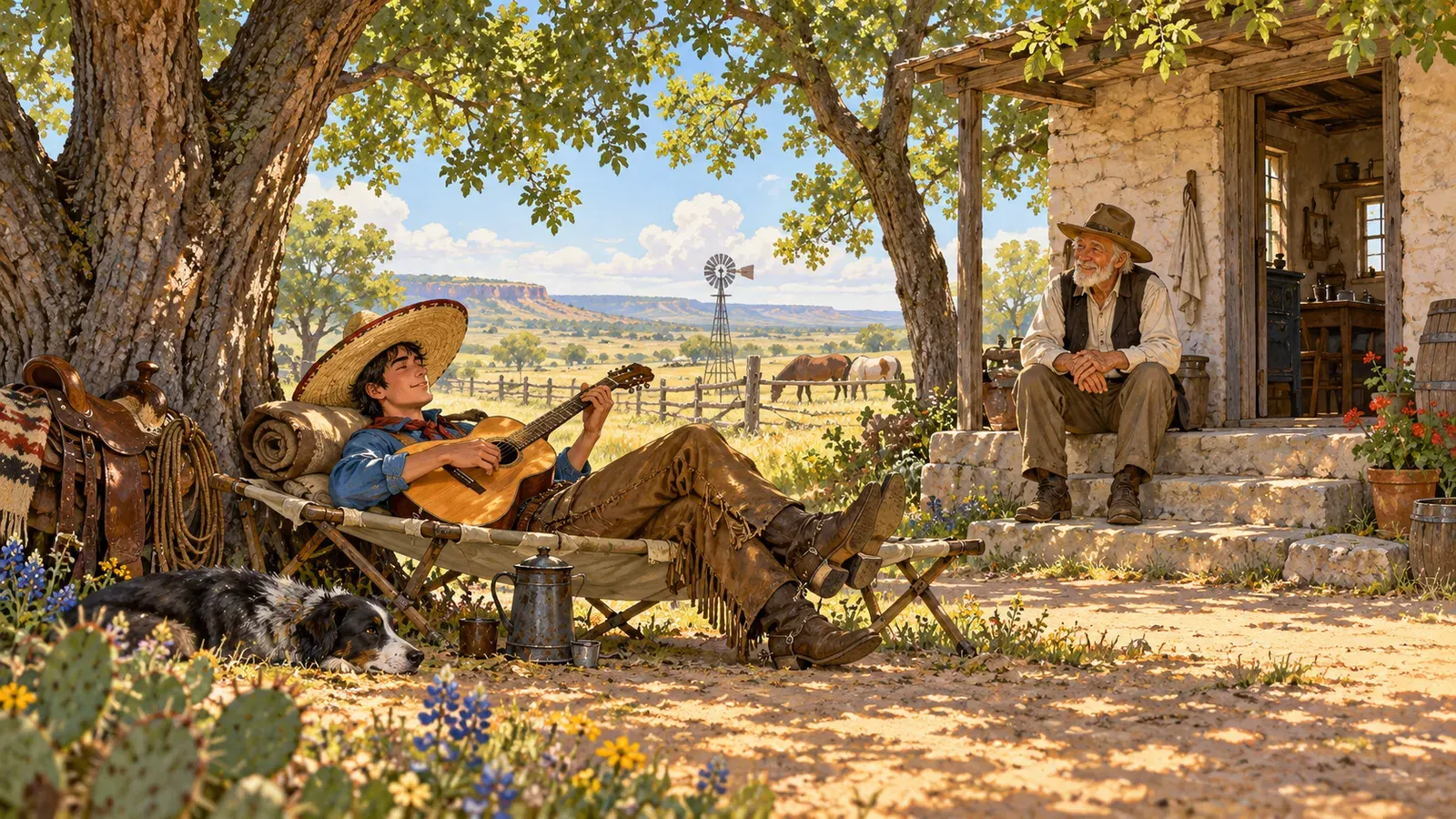
On a cool, canvas-covered cot in the shade of the hackberry trees Sam Galloway passed the greater part of his time. There he rolled his brown paper cigarettes, read such tedious literature as the ranch afforded, and added to his repertoire of improvisations that he played so expertly on his guitar. To him, as a slave ministering to a great lord, the Kiowa brought cool water from the red jar hanging under the brush shelter, and food when he called for it. The prairie zephyrs fanned him mildly; mocking-birds at morn and eve competed with but scarce equalled the sweet melodies of his lyre; a perfumed stillness seemed to fill all his world. While old man Ellison was pottering among his flocks of sheep on his mile-an-hour pony, and while the Kiowa took his siesta in the burning sunshine at the end of the kitchen, Sam would lie on his cot thinking what a happy world he lived in, and how kind it is to the ones whose mission in life it is to give entertainment and pleasure. Here he had food and lodging as good as he had ever longed for; absolute immunity from care or exertion or strife; an endless welcome, and a host whose delight at the sixteenth repetition of a song or a story was as keen as at its initial giving. Was there ever a troubadour of old who struck upon as royal a castle in his wanderings? While he lay thus, meditating upon his blessings, little brown cottontails would shyly frolic through the yard; a covey of white-topknotted blue quail would run past, in single file, twenty yards away; a paisano bird, out hunting for tarantulas, would hop upon the fence and salute him with sweeping flourishes of its long tail. In the eighty-acre horse pasture the pony with the Dantesque face grew fat and almost smiling. The troubadour was at the end of his wanderings.
サム・ギャロウェイは、ほとんど一日じゅう、エノキの木陰の、涼しい布張りの簡易ベッドの上で過ごした。そこで茶色の紙でたばこを巻き、牧場にあるかぎりの退屈な読み物を読み、ギターで見事に弾いてみせる即興の曲を増やしていった。大貴族に仕える奴隷のように、カイオワ族の男が、柴の日よけの下につるした赤い水がめから冷たい水を運び、呼べば食べ物を持ってきた。大草原のそよ風が、穏やかにサムをあおいだ。朝な夕な、マネシツグミが、サムの奏でる甘い調べと腕を競ったが、とてもかなわなかった。かぐわしい静けさが、サムの世界をすっかり満たしているようだった。エリソン老人が、時速一マイルしか出ないポニーに乗って、羊の群れのあいだでこまごまと働いているあいだ、そしてカイオワ族の男が、台所の端で焼けつく日ざしを浴びて昼寝をしているあいだ、サムはベッドに寝ころんで考えるのだった。自分はなんと幸せな世界に住んでいるのだろう。そして、人を楽しませ、喜ばせることを生きる務めにしている者に、この世はなんと親切なのだろう。ここには、これまで望んだこともないほどの食事と寝床があった。心配も、骨折りも、争いも、まったくない。いつまでも歓迎してもらえる。主人は、同じ歌や話を十六回くりかえしても、初めて聞いたときと同じくらい喜んでくれる。昔の吟遊詩人で、さすらいの旅の途中に、これほど王侯のような城にめぐりあった者がいただろうか? サムがこうして寝ころんで、自分の幸せをかみしめていると、茶色の小さなウサギが、おずおずと庭をはねまわる。白い冠毛の青いウズラの群れが、二十メートルほど先を一列になって走っていく。タランチュラを狩りに出てきたミチバシリが柵の上に飛びのり、長い尾を大きく振ってサムにあいさつする。広い馬の放牧場では、ダンテのような顔のポニーがまるまる太って、いまにもほほえみそうだった。吟遊詩人のさすらいの旅は、ここで終わったのだ。
Old man Ellison was his own vaciero. That means that he supplied his sheep camps with wood, water, and rations by his own labours instead of hiring a vaciero. On small ranches it is often done.
エリソン老人は、羊飼いたちへの物資運びを自分でやっていた。つまり、人を雇わずに、自分で羊の野営地に薪や水や食料を届けていたのである。小さな牧場では、よくそうするのだ。
One morning he started for the camp of Incarnación Felipe de la Cruz y Monte Piedras (one of his sheep herders) with the week's usual rations of brown beans, coffee, meal, and sugar. Two miles away on the trail from old Fort Ewing he met, face to face, a terrible being called King James, mounted on a fiery, prancing, Kentucky-bred horse.
ある朝、老人は、羊飼いのひとりであるインカルナシオン・フェリペ・デ・ラ・クルス・イ・モンテ・ピエドラスの野営地へ出かけた。いつものように、一週間分の茶色の豆、コーヒー、トウモロコシ粉、砂糖を持っていた。三キロほど行った、古いユーイング砦からの道で、老人は恐ろしい男と真正面から出くわした。キング・ジェイムズと呼ばれる男で、気の荒い、跳ねまわるケンタッキー産の馬に乗っていた。
King James's real name was James King; but people reversed it because it seemed to fit him better, and also because it seemed to please his majesty. King James was the biggest cattleman between the Alamo plaza in San Antone and Bill Hopper's saloon in Brownsville. Also he was the loudest and most offensive bully and braggart and bad man in southwest Texas. And he always made good whenever he bragged; and the more noise he made the more dangerous he was. In the story papers it is always the quiet, mild-mannered man with light blue eyes and a low voice who turns out to be really dangerous; but in real life and in this story such is not the case. Give me my choice between assaulting a large, loudmouthed rough-houser and an inoffensive stranger with blue eyes sitting quietly in a corner, and you will see something doing in the corner every time.
キング・ジェイムズの本名は、ジェイムズ・キングだった。だが、人々は名前を逆にして、キング・ジェイムズ、つまりジェイムズ王と呼んでいた。そのほうがこの男にぴったりだったし、陛下ご自身もそれを喜んでいるようだったからだ。キング・ジェイムズは、サンアントニオのアラモ広場から、ブラウンズヴィルのビル・ホッパーの酒場までのあいだで、いちばん大きな牧場主だった。そして、テキサス南西部でいちばん声が大きく、いちばん無礼な乱暴者で、ほら吹きで、悪党だった。しかも、大口をたたいたことは、必ずやってのけた。騒ぎたてればたてるほど、危険な男だった。大衆向けの小説では、本当に危ないのは決まって、薄青い目をして、低い声で話す、物静かでおとなしい男ということになっている。だが、現実の人生でも、この物語でも、そうではない。大口をたたく大柄な乱暴者と、隅で静かに座っている、青い目のおとなしいよそ者。どちらかに殴りかかれと言われたら、私は迷わず隅のほうへ向かうだろう。
King James, as I intended to say earlier, was a fierce, two-hundred-pound, sunburned, blond man, as pink as an October strawberry, and with two horizontal slits under shaggy red eyebrows for eyes. On that day he wore a flannel shirt that was tan-coloured, with the exception of certain large areas which were darkened by transudations due to the summer sun. There seemed to be other clothing and garnishings about him, such as brown duck trousers stuffed into immense boots, and red handkerchiefs and revolvers; and a shotgun laid across his saddle and a leather belt with millions of cartridges shining in it—but your mind skidded off such accessories; what held your gaze was just the two little horizontal slits that he used for eyes.
前にも言おうと思っていたのだが、キング・ジェイムズは、九十キロもある獰猛な男だった。日焼けした金髪の大男で、顔は十月のイチゴのように赤かった。もじゃもじゃの赤い眉の下には、目のかわりに、横に細い切れこみが二本あるだけだった。その日は、黄褐色のネルのシャツを着ていた。夏の日ざしで汗がにじみ出て、ところどころ大きく黒ずんでいた。ほかにも、いろいろ身につけているようだった。大きな長靴に突っこんだ茶色の木綿のズボン、赤いハンカチ、拳銃。鞍の上には散弾銃が横たえてあり、何百万発もの弾がきらきら光る革のベルトもしめていた。だが、そんなものはみな、目にとまらずに素通りしてしまう。目をくぎづけにするのは、目のかわりの、あの二本の小さな横の切れこみだけだった。
This was the man that old man Ellison met on the trail; and when you count up in the baron's favour that he was sixty-five and weighed ninety-eight pounds and had heard of King James's record and that he (the baron) had a hankering for the vita simplex and had no gun with him and wouldn't have used it if he had, you can't censure him if I tell you that the smiles with which the troubadour had filled his wrinkles went out of them and left them plain wrinkles again. But he was not the kind of baron that flies from danger. He reined in the mile-an-hour pony (no difficult feat), and saluted the formidable monarch.
エリソン老人が道で出くわしたのは、こういう男だった。男爵のために、勘定に入れておいてあげてほしい。老人は六十五歳で、体重は四十五キロもなかった。キング・ジェイムズの悪名も聞いて知っていた。それに男爵は、静かで簡素な暮らしを好んでいて、銃も持っていなかったし、持っていても使わなかっただろう。それを考えれば、吟遊詩人がしわに満たしてくれたほほえみがすっと消え、しわがまたただのしわに戻ってしまったとしても、老人を責めることはできないだろう。だが、老人は、危険から逃げ出すような男爵ではなかった。時速一マイルのポニーの手綱を引いて止め(むずかしいことではない)、恐るべき君主にあいさつをした。
King James expressed himself with royal directness. "You're that old snoozer that's running sheep on this range, ain't you?" said he. "What right have you got to do it? Do you own any land, or lease any?"
キング・ジェイムズは、王者らしく、遠慮なしに言った。「おまえが、この放牧地で羊を飼ってる、あの老いぼれだな?」とジェイムズは言った。「どんな権利があってそんなことをしてるんだ? 土地を持ってるのか、それとも借りてるのか?」
"I have two sections leased from the state," said old man Ellison, mildly.
「州から二区画借りております」とエリソン老人は穏やかに言った。
"Not by no means you haven't," said King James. "Your lease expired yesterday; and I had a man at the land office on the minute to take it up. You don't control a foot of grass in Texas. You sheep men have got to git. Your time's up. It's a cattle country, and there ain't any room in it for snoozers. This range you've got your sheep on is mine. I'm putting up a wire fence, forty by sixty miles; and if there's a sheep inside of it when it's done it'll be a dead one. I'll give you a week to move yours away. If they ain't gone by then, I'll send six men over here with Winchesters to make mutton out of the whole lot. And if I find you here at the same time this is what you'll get."
「いいや、とんでもねえ、借りちゃいねえよ」とキング・ジェイムズは言った。「おまえの借地の期限はきのうで切れた。おれは土地管理局に人をやって、切れたその瞬間に借りとらせたんだ。テキサスの草なんぞ、もう一本だっておまえのもんじゃねえ。おまえら羊飼いは、出ていくしかねえんだ。もう時間切れだ。ここは牛の国で、老いぼれの居場所なんぞねえ。おまえが羊を放してるこの放牧地は、おれのもんだ。縦六十キロ、横百キロの針金の柵を張るつもりだ。柵ができあがったとき、中に羊が一頭でもいたら、そいつは死んだ羊になる。一週間やるから、羊をよそへ移せ。それまでにいなくなってなかったら、ライフルを持った男を六人よこして、一頭残らず羊肉にしてやる。そしてそのとき、おまえがここにいたら、おまえが食らうのはこいつだ」
King James patted the breech of his shot-gun warningly.
キング・ジェイムズは、脅すように散弾銃の銃尾をぽんとたたいた。
Old man Ellison rode on to the camp of Incarnación. He sighed many times, and the wrinkles in his face grew deeper. Rumours that the old order was about to change had reached him before. The end of Free Grass was in sight. Other troubles, too, had been accumulating upon his shoulders. His flocks were decreasing instead of growing; the price of wool was declining at every clip; even Bradshaw, the storekeeper at Frio City, at whose store he bought his ranch supplies, was dunning him for his last six months' bill and threatening to cut him off. And so this last greatest calamity suddenly dealt out to him by the terrible King James was a crusher.
エリソン老人は、インカルナシオンの野営地へ向かった。何度もため息をつき、顔のしわはいっそう深くなった。古いやり方が変わろうとしている、といううわさは、前から耳に入っていた。誰でも自由に草地を使えた時代は、もう終わろうとしていたのだ。それに、ほかの苦労も、老人の肩に積み重なっていた。羊の群れは、増えるどころか減っていた。羊毛の値段は、毛を刈るたびに下がっていった。牧場の品物を買っているフリオ・シティの店の主人ブラッドショーまでが、この半年分のつけを払えと催促し、払わなければもう売らないと脅していた。そこへ、恐ろしいキング・ジェイムズから、いきなりこの最後の、いちばん大きな災難を突きつけられたのだ。とどめを刺されたようなものだった。
When the old man got back to the ranch at sunset he found Sam Galloway lying on his cot, propped against a roll of blankets and wool sacks, fingering his guitar.
日暮れに老人が牧場に戻ると、サム・ギャロウェイはベッドに寝ころんで、丸めた毛布と羊毛の袋に寄りかかり、ギターをつまびいていた。
"Hello, Uncle Ben," the troubadour called, cheerfully. "You rolled in early this evening. I been trying a new twist on the Spanish Fandango to-day. I just about got it. Here's how she goes—listen."
「やあ、ベンおじさん」と吟遊詩人は陽気に呼びかけた。「今夜は早いお帰りですね。きょうはスパニッシュ・ファンダンゴに、新しいひねりを加えてみてたんです。だいたいものになりましたよ。こんなふうなんです。聞いてください」
"That's fine, that's mighty fine," said old man Ellison, sitting on the kitchen step and rubbing his white, Scotch-terrier whiskers. "I reckon you've got all the musicians beat east and west, Sam, as far as the roads are cut out."
「すばらしい、じつにすばらしい」とエリソン老人は、台所の上がり段に腰をおろし、スコッチテリアのような白いひげをこすりながら言った。「サム、道の続くかぎり、東でも西でも、あんたにかなう音楽家はいないと思うよ」
"Oh, I don't know," said Sam, reflectively. "But I certainly do get there on variations. I guess I can handle anything in five flats about as well as any of 'em. But you look kind of fagged out, Uncle Ben—ain't you feeling right well this evening?"
「さあ、どうですかね」とサムは考え深げに言った。「でも、変奏にかけちゃ、たしかにちょっとしたもんですよ。フラットが五つもつく難しい曲だって、たいていの連中に負けないくらい弾けると思いますね。でも、ベンおじさん、なんだかお疲れのようですね。今夜は具合が悪いんですか?」
"Little tired; that's all, Sam. If you ain't played yourself out, let's have that Mexican piece that starts off with: 'Huile, huile, palomita.' It seems that that song always kind of soothes and comforts me after I've been riding far or anything bothers me."
「ちょっと疲れただけだよ、サム。くたびれていなけりゃ、あのメキシコの曲を聞かせてくれないか。『ウイレ、ウイレ、パロミータ』で始まるやつだ。遠くまで馬で出かけたあとや、何か気にかかることがあるときには、あの歌がいつも心を落ち着かせて、なぐさめてくれるような気がするんだ」
"Why, seguramente, señor," said Sam. "I'll hit her up for you as often as you like. And before I forget about it, Uncle Ben, you want to jerk Bradshaw up about them last hams he sent us. They're just a little bit strong."
「ええ、もちろんですとも、セニョール」とサムは言った。「お望みなら、何べんでも弾いてさしあげますよ。それと、忘れないうちに言っておきますがね、ベンおじさん、この前ブラッドショーが送ってきたハムのことで、ひとこと言ってやったほうがいいですよ。ほんのちょっと、匂いがきついんです」
A man sixty-five years old, living on a sheep ranch and beset by a complication of disasters, cannot successfully and continuously dissemble. Moreover, a troubadour has eyes quick to see unhappiness in others around him—because it disturbs his own ease. So, on the next day, Sam again questioned the old man about his air of sadness and abstraction. Then old man Ellison told him the story of King James's threats and orders and that pale melancholy and red ruin appeared to have marked him for their own. The troubadour took the news thoughtfully. He had heard much about King James.
羊牧場に住み、いくつもの災難にいっぺんに見舞われている六十五歳の男が、うまく、いつまでも本心を隠しとおせるものではない。それに、吟遊詩人というものは、まわりの人の不幸にすぐ気がつく。自分の気楽な暮らしが乱されるからだ。そこで次の日、サムは老人に、どうしてそんなに悲しそうで、上の空なのかと、もう一度たずねた。するとエリソン老人は、キング・ジェイムズに脅され、命令されたことを話した。そして、暗い憂いと破滅が、自分に狙いをつけたらしいと打ち明けた。吟遊詩人は、考えこみながらその話を聞いた。キング・ジェイムズのことは、いろいろと耳にしていたのだ。
On the third day of the seven days of grace allowed him by the autocrat of the range, old man Ellison drove his buckboard to Frio City to fetch some necessary supplies for the ranch. Bradshaw was hard but not implacable. He divided the old man's order by two, and let him have a little more time. One article secured was a new, fine ham for the pleasure of the troubadour.
放牧地の独裁者がくれた七日間の猶予のうち、三日目のことだった。エリソン老人は、牧場に必要な品物を仕入れるため、軽い馬車を走らせてフリオ・シティへ行った。ブラッドショーは厳しかったが、情け容赦のない男ではなかった。老人の注文を半分に減らして、支払いの期限を少し延ばしてくれた。手に入れた品物の中には、上等の新しいハムが一本あった。吟遊詩人に喜んでもらうためのハムである。
Five miles out of Frio City on his way home the old man met King James riding into town. His majesty could never look anything but fierce and menacing, but to-day his slits of eyes appeared to be a little wider than they usually were.
帰り道、フリオ・シティから八キロほど来たところで、老人は、町へ向かうキング・ジェイムズと出会った。陛下は、どうしたって獰猛で恐ろしい顔にしか見えなかったが、その日は、細い切れこみのような目が、いつもより少しだけ大きく開いているように見えた。
"Good day," said the king, gruffly. "I've been wanting to see you. I hear it said by a cowman from Sandy yesterday that you was from Jackson County, Mississippi, originally. I want to know if that's a fact."
「やあ」と王はぶっきらぼうに言った。「会いたいと思ってたんだ。きのう、サンディーから来た牛飼いが言ってたんだが、おまえはもとはミシシッピ州のジャクソン郡の出だそうだな。そいつは本当か?」
"Born there," said old man Ellison, "and raised there till I was twenty-one."
「あそこで生まれました」とエリソン老人は言った。「二十一になるまで、あそこで育ちました」
"This man says," went on King James, "that he thinks you was related to the Jackson County Reeveses. Was he right?"
「その男が言うには」とキング・ジェイムズは続けた。「おまえは、ジャクソン郡のリーヴズ家と親戚じゃないかってことだ。そいつは当たってるのか?」
"Aunt Caroline Reeves," said the old man, "was my half-sister."
「キャロライン・リーヴズおばさんは」と老人は言った。「わたしと半分だけ血のつながった姉でした」
"She was my aunt," said King James. "I run away from home when I was sixteen. Now, let's re-talk over some things that we discussed a few days ago. They call me a bad man; and they're only half right. There's plenty of room in my pasture for your bunch of sheep and their increase for a long time to come. Aunt Caroline used to cut out sheep in cake dough and bake 'em for me. You keep your sheep where they are, and use all the range you want. How's your finances?"
「その人は、おれのおばさんだった」とキング・ジェイムズは言った。「おれは十六のときに家出したんだ。さて、二、三日前に話したことを、もう一度話しなおそうじゃねえか。みんなはおれを悪党と呼ぶが、そいつは半分しか当たっちゃいねえ。おれの牧草地は広い。おまえの羊の群れと、これから先ずっと増えていく分を入れたって、たっぷり余裕がある。キャロラインおばさんは、よくケーキの生地を羊の形に切り抜いて、焼いてくれたもんだ。羊はいまのところに置いておけ。放牧地も好きなだけ使え。懐ぐあいはどうなんだ?」
The old man related his woes in detail, dignifiedly, with restraint and candour.
老人は、威厳を保ち、控えめに、しかし包み隠さず、自分の苦しい事情をくわしく話した。
"She used to smuggle extra grub into my school basket—I'm speaking of Aunt Caroline," said King James. "I'm going over to Frio City to-day, and I'll ride back by your ranch to-morrow. I'll draw $2,000 out of the bank there and bring it over to you; and I'll tell Bradshaw to let you have everything you want on credit. You are bound to have heard the old saying at home, that the Jackson County Reeveses and Kings would stick closer by each other than chestnut burrs. Well, I'm a King yet whenever I run across a Reeves. So you look out for me along about sundown to-morrow, and don't worry about nothing. Shouldn't wonder if the dry spell don't kill out the young grass."
「おばさんは、よく学校の弁当かごに、こっそり余分な食べ物を入れてくれたもんだ。キャロラインおばさんのことだがな」とキング・ジェイムズは言った。「おれはこれからフリオ・シティへ行く。あした、帰りにおまえの牧場へ寄ろう。あそこの銀行で二千ドルおろして、持っていってやる。それから、ブラッドショーには、おまえのほしいものは何でもつけで渡してやれと言っておく。郷里の古いことわざを、おまえも聞いたことがあるだろう。ジャクソン郡のリーヴズ家とキング家は、栗のいがよりぴったりくっついて離れない、ってな。おれは、リーヴズ家の人間に出くわしたら、いまでもキング家の人間なんだ。だから、あしたの日暮れごろには、おれを待っててくれ。何も心配するな。この日照りで若草が枯れちまわなけりゃいいがな」
Old man Ellison drove happily ranchward. Once more the smiles filled out his wrinkles. Very suddenly, by the magic of kinship and the good that lies somewhere in all hearts, his troubles had been removed.
エリソン老人は、幸せな気分で牧場へ馬車を走らせた。ふたたび、しわにほほえみが満ちた。まったく突然に、血のつながりという魔法と、誰の心のどこかにもある善い心のおかげで、老人の苦労は消えてなくなったのである。
On reaching the ranch he found that Sam Galloway was not there. His guitar hung by its buckskin string to a hackberry limb, moaning as the gulf breeze blew across its masterless strings.
牧場に着くと、サム・ギャロウェイの姿がなかった。ギターが、鹿革のひもでエノキの枝からつりさげられていた。主のいない弦を湾からのそよ風が吹きぬけるたびに、ギターはうめくような音を立てた。
The Kiowa endeavoured to explain.
カイオワ族の男が、わけを話そうとした。
"Sam, he catch pony," said he, "and say he ride to Frio City. What for no can damn sabe. Say he come back to-night. Maybe so. That all."
「サム、ポニーつかまえた」と男は言った。「フリオ・シティ行く、言った。何しに行く、ぜんぜんわからない。今夜帰る、言った。たぶんそう。それだけ」
As the first stars came out the troubadour rode back to his haven. He pastured his pony and went into the house, his spurs jingling martially.
最初の星が出はじめたころ、吟遊詩人は、自分のやすらぎの場所へ馬で戻ってきた。ポニーを放牧場に放すと、拍車を勇ましくちゃりちゃり鳴らしながら、家に入った。
Old man Ellison sat at the kitchen table, having a tin cup of before-supper coffee. He looked contented and pleased.
エリソン老人は台所のテーブルについて、夕食前のコーヒーをブリキのカップで飲んでいた。満ちたりて、うれしそうな様子だった。
"Hello, Sam," said he. "I'm darned glad to see ye back. I don't know how I managed to get along on this ranch, anyhow, before ye dropped in to cheer things up. I'll bet ye've been skylarking around with some of them Frio City gals, now, that's kept ye so late."
「やあ、サム」と老人は言った。「帰ってきてくれて、本当にうれしいよ。あんたが来て、何もかも明るくしてくれる前は、いったいどうやってこの牧場でやってきたのか、わからないくらいだ。きっと、フリオ・シティの娘さんたちとはしゃぎまわってて、こんなに遅くなったんだろう」
And then old man Ellison took another look at Sam's face and saw that the minstrel had changed to the man of action.
そのとき、エリソン老人は、もう一度サムの顔を見た。そして、楽人が行動の男に変わっていることに気がついた。
And while Sam is unbuckling from his waist old man Ellison's six-shooter, that the latter had left behind when he drove to town, we may well pause to remark that anywhere and whenever a troubadour lays down the guitar and takes up the sword trouble is sure to follow. It is not the expert thrust of Athos nor the cold skill of Aramis nor the iron wrist of Porthos that we have to fear—it is the Gascon's fury—the wild and unacademic attack of the troubadour—the sword of D'Artagnan.
サムは、腰から六連発の拳銃をはずしていた。エリソン老人が町へ出かけるときに置いていった拳銃である。そのあいだに、ちょっと立ち止まって、こんなことを言っておいてもいいだろう。いつ、どこであれ、吟遊詩人がギターを置いて剣を取れば、必ず騒ぎが起こるものなのだ。私たちが恐れなければならないのは、三銃士の、アトスの見事な突きでもなければ、アラミスの冷ややかな技でも、ポルトスの鉄の手首でもない。恐ろしいのは、ガスコーニュ生まれの男の怒りである。吟遊詩人の、型にはまらない、むちゃくちゃな攻撃。ダルタニャンの剣なのだ。
"I done it," said Sam. "I went over to Frio City to do it. I couldn't let him put the skibunk on you, Uncle Ben. I met him in Summers's saloon. I knowed what to do. I said a few things to him that nobody else heard. He reached for his gun first—half a dozen fellows saw him do it—but I got mine unlimbered first. Three doses I gave him—right around the lungs, and a saucer could have covered up all of 'em. He won't bother you no more."
「やっちまいましたよ」とサムは言った。「そのためにフリオ・シティへ行ったんです。あいつにあなたを追い出させるわけにはいきませんからね、ベンおじさん。サマーズの酒場で、あいつに会いました。どうすればいいかはわかってました。ほかの誰にも聞こえないように、あいつにちょっとばかり言ってやったんです。先に銃に手を伸ばしたのは、あいつのほうでした。六人ばかりの連中が、それを見てます。でも、ぼくのほうが先に抜いたんです。三発くらわせてやりました。ちょうど肺のあたりに、三つとも、受け皿一枚で隠れるくらい固まってね。もう、あいつがあなたに迷惑をかけることはありませんよ」
"This—is—King—James—you speak—of?" asked old man Ellison, while he sipped his coffee.
「その……男は……キング……ジェイムズの……ことか?」とエリソン老人は、コーヒーをすすりながらたずねた。
"You bet it was. And they took me before the county judge; and the witnesses what saw him draw his gun first was all there. Well, of course, they put me under $300 bond to appear before the court, but there was four or five boys on the spot ready to sign the bail. He won't bother you no more, Uncle Ben. You ought to have seen how close them bullet holes was together. I reckon playing a guitar as much as I do must kind of limber a fellow's trigger finger up a little, don't you think, Uncle Ben?"
「そのとおりですよ。それで、郡の判事の前に連れていかれましたけど、あいつが先に銃を抜くのを見た証人たちが、みんなそろってましたからね。まあ、もちろん、裁判に出るまでの保証金として三百ドルを課されましたけど、その場に保釈の署名をしてくれる仲間が四、五人いましたから。もう、あいつがあなたに迷惑をかけることはありませんよ、ベンおじさん。弾の穴がどれだけくっついてたか、見せたかったなあ。ぼくみたいにしょっちゅうギターを弾いてると、引き金にかける指も、いくらか柔らかくなるんじゃないかと思うんですが、どう思います、ベンおじさん?」
Then there was a little silence in the castle except for the spluttering of a venison steak that the Kiowa was cooking.
それから、城の中に、少しのあいだ沈黙がおりた。聞こえるのは、カイオワ族の男が焼いている鹿肉のステーキが、じゅうじゅういう音だけだった。
"Sam," said old man Ellison, stroking his white whiskers with a tremulous hand, "would you mind getting the guitar and playing that 'Huile, huile, palomita' piece once or twice? It always seems to be kind of soothing and comforting when a man's tired and fagged out."
「サム」とエリソン老人は、ふるえる手で白いひげをなでながら言った。「ギターを取ってきて、あの『ウイレ、ウイレ、パロミータ』を一、二回弾いてくれないか? 人が疲れて、くたびれはてているときには、あれがいつも、心を落ち着かせて、なぐさめてくれるような気がするんだ」
There is no more to be said, except that the title of the story is wrong. It should have been called "The Last of the Barons." There never will be an end to the troubadours; and now and then it does seem that the jingle of their guitars will drown the sound of the muffled blows of the pickaxes and trip hammers of all the Workers in the world.
もう言うことはない。ただ、この物語の題名は間違っていた、ということのほかは。これは『最後の男爵』と呼ぶべきだったのだ。吟遊詩人は、決して絶えることがない。それどころか、ときには、彼らのかき鳴らすギターの音が、世界じゅうの働き手が振るうつるはしや蒸気ハンマーの、にぶい響きをかき消してしまうようにさえ思えるのである。