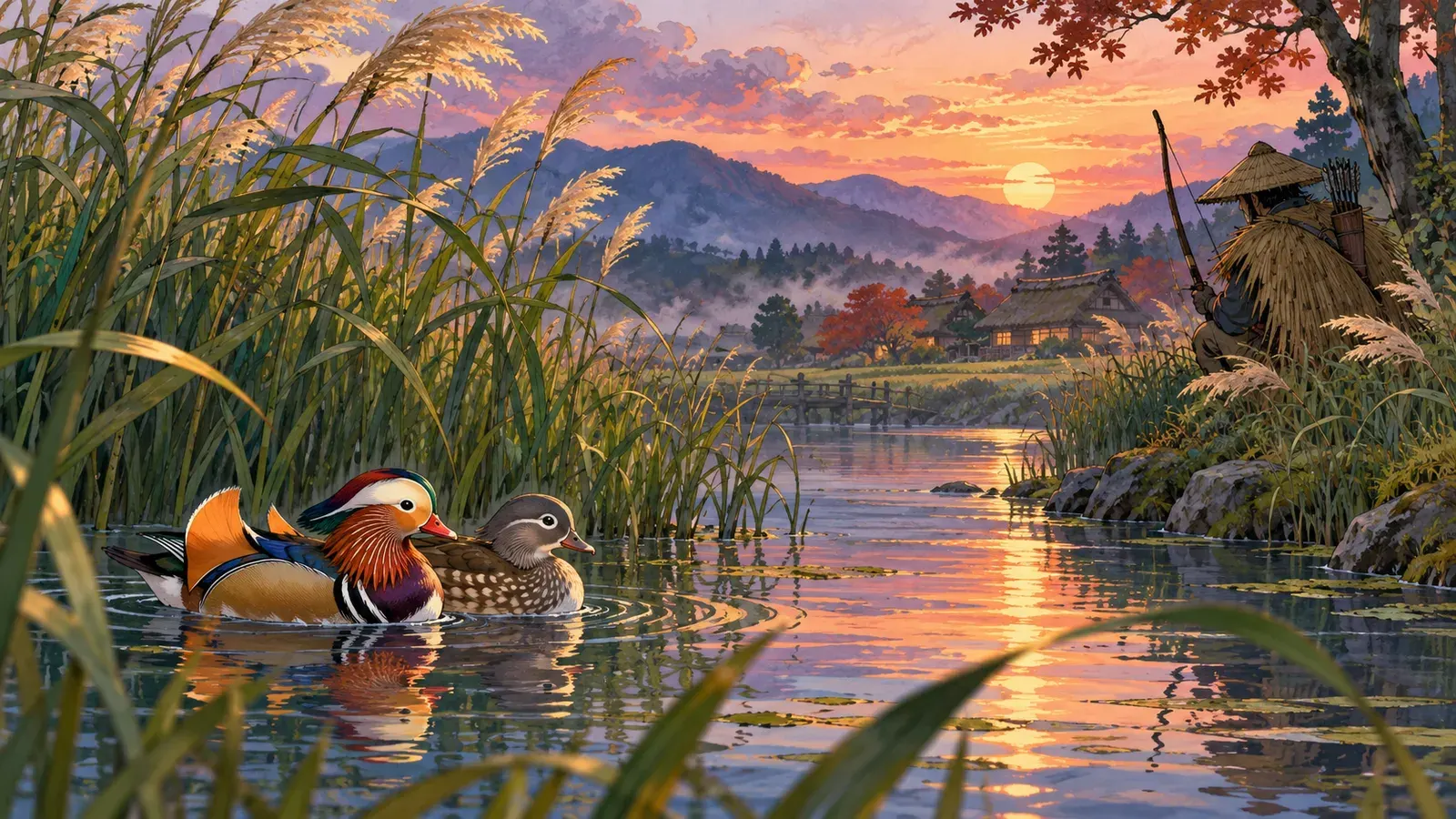
There was a falconer and hunter, named Sonjō, who lived in the district called Tamura-no-Gō, of the province of Mutsu. One day he went out hunting, and could not find any game. But on his way home, at a place called Akanuma, he perceived a pair of oshidori (mandarin-ducks), swimming together in a river that he was about to cross. To kill oshidori is not good; but Sonjō happened to be very hungry, and he shot at the pair. His arrow pierced the male: the female escaped into the rushes of the further shore, and disappeared. Sonjō took the dead bird home, and cooked it.
陸奥の国、田村の郷というところに、尊允(そんじょう)という鷹匠がいた。狩人でもあった。ある日、尊允は狩りに出たが、獲物が一つも見つからなかった。ところが帰り道、赤沼というところで、渡ろうとしていた川に、おしどりのつがいが仲よく並んで泳いでいるのが目に入った。おしどりを殺すのはよくないこととされている。けれどもそのとき尊允はひどく腹をすかせていたので、つがいをめがけて矢を放った。矢は雄を射ぬいた。雌は向こう岸の葦の茂みに逃げこみ、見えなくなった。尊允は死んだ鳥を家に持ち帰り、料理した。
That night he dreamed a dreary dream. It seemed to him that a beautiful woman came into his room, and stood by his pillow, and began to weep. So bitterly did she weep that Sonjō felt as if his heart were being torn out while he listened. And the woman cried to him: "Why,—oh! why did you kill him?—of what wrong was he guilty?... At Akanuma we were so happy together,—and you killed him!... What harm did he ever do you? Do you even know what you have done?—oh! do you know what a cruel, what a wicked thing you have done?... Me too you have killed,—for I will not live without my husband!... Only to tell you this I came."... Then again she wept aloud,—so bitterly that the voice of her crying pierced into the marrow of the listener's bones;—and she sobbed out the words of this poem:—
その夜、尊允は暗く悲しい夢を見た。美しい女が部屋に入ってきて、枕もとに立ち、泣きだしたのである。その泣き声があまりに悲しいので、聞いている尊允は、胸をえぐられるような気がした。女は尊允に向かって叫んだ。「なぜ、ああ、なぜあの人を殺したのですか。あの人に何の罪があったのですか……。赤沼で、わたしたちはあんなに幸せに暮らしていたのに、あなたはあの人を殺してしまった……。あの人が、あなたに何か悪いことをしたとでもいうのですか。ご自分が何をしたのか、わかっているのですか。ああ、どれほどむごい、どれほど罪深いことをしたのか、わかっているのですか……。あなたはわたしまで殺したのです。夫がいなくては、わたしは生きていくつもりはありませんから……。ただそれを言うために、ここへ来たのです」……。そう言うと、女はまた声をあげて泣いた。その泣き声は、聞く者の骨の髄までしみとおるほど悲しかった。そして女は、しゃくりあげながら、この歌を詠んだ。
Hi kururéba Sasoëshi mono wo— Akanuma no Makomo no kuré no Hitori-né zo uki!
日暮るれば 誘ひしものを―― 赤沼の 真菰がくれの ひとり寝ぞ憂き!
["At the coming of twilight I invited him to return with me—! Now to sleep alone in the shadow of the rushes of Akanuma—ah! what misery unspeakable!"]
〔「日が暮れれば、いつもあの人を誘って、一緒にねぐらへ帰ったものを――! 今は赤沼の真菰のかげで、ひとりで寝なければならない。ああ、なんというつらさでしょう!」〕
And after having uttered these verses she exclaimed:—"Ah, you do not know—you cannot know what you have done! But to-morrow, when you go to Akanuma, you will see,—you will see..." So saying, and weeping very piteously, she went away.
歌を詠み終えると、女は叫んだ。「ああ、あなたはわかっていない。自分が何をしたのか、わかるはずがない。でも明日、赤沼へ行けば、わかるでしょう。わかるでしょう……」。そう言うと、女はたいそう哀れに泣きながら去っていった。
When Sonjō awoke in the morning, this dream remained so vivid in his mind that he was greatly troubled. He remembered the words:—"But to-morrow, when you go to Akanuma, you will see,—you will see." And he resolved to go there at once, that he might learn whether his dream was anything more than a dream.
朝になって目をさましても、夢はありありと心に残っていて、尊允はひどく胸さわぎがした。あの言葉が思い出された。「でも明日、赤沼へ行けば、わかるでしょう。わかるでしょう」。あれはただの夢だったのか、それとも夢ではなかったのか。それを確かめるために、尊允はすぐに赤沼へ行ってみることにした。
So he went to Akanuma; and there, when he came to the river-bank, he saw the female oshidori swimming alone. In the same moment the bird perceived Sonjō; but, instead of trying to escape, she swam straight towards him, looking at him the while in a strange fixed way. Then, with her beak, she suddenly tore open her own body, and died before the hunter's eyes...
こうして尊允は赤沼へ行った。川岸に着くと、雌のおしどりが一羽きりで泳いでいるのが見えた。同時に、鳥のほうも尊允に気づいた。ところが鳥は逃げようとはせず、まっすぐ尊允のほうへ泳いできた。そのあいだずっと、奇妙なほどじっと尊允を見すえていた。そして近くまで来ると、いきなり自分のくちばしで自分の体を引き裂き、狩人の目の前で死んでしまった……。
Sonjō shaved his head, and became a priest.
尊允は頭を剃り、僧になった。