Restless, shifting, fugacious as time itself is a certain vast bulk of the population of the red brick district of the lower West Side. Homeless, they have a hundred homes. They flit from furnished room to furnished room, transients forever—transients in abode, transients in heart and mind. They sing "Home, Sweet Home" in ragtime; they carry their lares et penates in a bandbox; their vine is entwined about a picture hat; a rubber plant is their fig tree.
ロウアー・ウエストサイドの赤れんが街には、時の流れそのもののように落ち着きなく、移ろい、すぐに消えていく大勢の人々が住んでいる。家はない。そのかわり、百の家がある。家具つきの貸し部屋から貸し部屋へと渡り歩く、永遠の仮住まいの人々だ。住まいも仮なら、心も頭も仮住まい。「埴生の宿(ホーム・スウィート・ホーム)」をラグタイムの調子で歌い、家の守り神は帽子箱に入れて持ち歩く。彼らにとっての「ぶどうの木」は、飾り帽子にからませたつるであり、「いちじくの木」は、ゴムの木の鉢植えなのだ。
Hence the houses of this district, having had a thousand dwellers, should have a thousand tales to tell, mostly dull ones, no doubt; but it would be strange if there could not be found a ghost or two in the wake of all these vagrant guests.
だから、千人の住人を迎えてきたこの地区の家々には、千の物語があるはずだ。たいていは退屈な話にちがいない。だが、これほど多くのさすらいの客が通り過ぎていったのだから、その跡に幽霊の一人や二人いないほうが、むしろふしぎだろう。
One evening after dark a young man prowled among these crumbling red mansions, ringing their bells. At the twelfth he rested his lean hand-baggage upon the step and wiped the dust from his hatband and forehead. The bell sounded faint and far away in some remote, hollow depths.
ある晩、暗くなってから、一人の若い男が、崩れかけた赤れんがの屋敷が並ぶあたりをうろつき、一軒一軒呼び鈴を鳴らしていた。十二軒目で、男は中身の少ない手さげかばんを玄関の段に置き、帽子のリボンと額のほこりをぬぐった。呼び鈴は、どこか遠くのがらんとした奥のほうで、かすかに鳴った。
To the door of this, the twelfth house whose bell he had rung, came a housekeeper who made him think of an unwholesome, surfeited worm that had eaten its nut to a hollow shell and now sought to fill the vacancy with edible lodgers.
十二軒目のこの家の戸口に出てきたのは、女の家主だった。それを見て男は、一匹の虫を思い浮かべた。木の実の中身を食べつくして殻だけにしてしまい、今度はその空っぽの殻を、食べられる下宿人で埋めようとしている、食べ過ぎて不健康にふくれた虫だ。
He asked if there was a room to let.
男は、貸し部屋はあるかとたずねた。
"Come in," said the housekeeper. Her voice came from her throat; her throat seemed lined with fur. "I have the third floor back, vacant since a week back. Should you wish to look at it?"
「お入りなさい」と家主は言った。声はのどの奥から出てきて、そののどには毛皮でも張ってあるようだった。「三階の裏の部屋が、一週間前から空いてますよ。ごらんになります?」
The young man followed her up the stairs. A faint light from no particular source mitigated the shadows of the halls. They trod noiselessly upon a stair carpet that its own loom would have forsworn. It seemed to have become vegetable; to have degenerated in that rank, sunless air to lush lichen or spreading moss that grew in patches to the staircase and was viscid under the foot like organic matter. At each turn of the stairs were vacant niches in the wall. Perhaps plants had once been set within them. If so they had died in that foul and tainted air. It may be that statues of the saints had stood there, but it was not difficult to conceive that imps and devils had dragged them forth in the darkness and down to the unholy depths of some furnished pit below.
若い男は家主について階段を上った。どこからともなく差すかすかな光が、廊下の暗がりをわずかにやわらげている。階段の敷物はひどいもので、それを織った機械でさえ、自分の作ったものだとは認めないだろう。二人はその上を音もなく歩いた。敷物は、まるで植物になってしまったかのようだった。日の差さない、むっとする空気の中で、生い茂る地衣類か、はびこる苔のようなものに成り果て、階段のあちこちにまだらに生えていた。踏むと、生き物の体のようにぬるりとした。階段の曲がり角ごとに、壁にからっぽのくぼみがあった。昔は鉢植えでも置いてあったのかもしれない。もしそうなら、このよどんだ汚い空気の中で枯れてしまったのだ。聖人の像が立っていたのかもしれない。だが、それなら、小鬼や悪魔が闇にまぎれて像を引きずり出し、どこか地下にある家具つきの地獄の底へ連れ去ったのだろう。そう想像するのは、むずかしくなかった。
"This is the room," said the housekeeper, from her furry throat. "It's a nice room. It ain't often vacant. I had some most elegant people in it last summer—no trouble at all, and paid in advance to the minute. The water's at the end of the hall. Sprowls and Mooney kept it three months. They done a vaudeville sketch. Miss B'retta Sprowls—you may have heard of her—Oh, that was just the stage names—right there over the dresser is where the marriage certificate hung, framed. The gas is here, and you see there is plenty of closet room. It's a room everybody likes. It never stays idle long."
「この部屋ですよ」と家主は毛皮ののどで言った。「いい部屋でしょう。めったに空かないんですよ。この夏は、とても上品な人たちが入ってましてね。まったく手がかからなくて、家賃はきっちり前払い。水は廊下の突き当たりです。スプロールズとムーニーが三か月借りてたんです。寄席で寸劇をやってましてね。ミス・ブレッタ・スプロールズって、お聞きになったことがあるかしら。いえ、それは芸名で、ほら、そこの鏡台の上に、結婚証明書が額に入れてかけてあったんですよ。ガスはここ。押し入れもたっぷりあるでしょう。誰にでも気に入られる部屋でね。空いたままになってることは、まずありませんよ」
"Do you have many theatrical people rooming here?" asked the young man.
「ここには、芝居の関係の人がたくさん住んでいるんですか?」と若い男はたずねた。
"They comes and goes. A good proportion of my lodgers is connected with the theatres. Yes, sir, this is the theatrical district. Actor people never stays long anywhere. I get my share. Yes, they comes and they goes."
「来ては出ていきますよ。うちの下宿人は、かなりの人が劇場に関わってますね。ええ、ここは芝居の町ですから。役者さんは、どこにも長くはいないものでね。うちにもそれなりに来ますよ。ええ、来ては出ていくんです」
He engaged the room, paying for a week in advance. He was tired, he said, and would take possession at once. He counted out the money. The room had been made ready, she said, even to towels and water. As the housekeeper moved away he put, for the thousandth time, the question that he carried at the end of his tongue.
男は一週間分を前払いして、部屋を借りることにした。疲れているので、すぐに入りたいと言って、金を数えて渡した。部屋の用意はできています、タオルも水もそろってますよ、と家主は言った。家主が立ち去りかけたとき、男は、いつも舌の先に用意している質問を、もう千回目になるだろうか、また口にした。
"A young girl—Miss Vashner—Miss Eloise Vashner—do you remember such a one among your lodgers? She would be singing on the stage, most likely. A fair girl, of medium height and slender, with reddish, gold hair and a dark mole near her left eyebrow."
「若い娘さんなんですが。ミス・ヴァシュナー、ミス・エロイーズ・ヴァシュナーという人です。下宿人のなかに、そういう人はいませんでしたか? たぶん、舞台で歌っていると思うんです。色白で、中くらいの背丈で、ほっそりしていて、赤みがかった金髪で、左の眉の近くに黒いほくろがあります」
"No, I don't remember the name. Them stage people has names they change as often as their rooms. They comes and they goes. No, I don't call that one to mind."
「いいえ、そんな名前は覚えてませんね。ああいう舞台の人たちは、部屋を変えるのと同じくらいしょっちゅう名前も変えるんです。来ては出ていきますからね。いいえ、そういう人は思い出せませんねえ」
No. Always no. Five months of ceaseless interrogation and the inevitable negative. So much time spent by day in questioning managers, agents, schools and choruses; by night among the audiences of theatres from all-star casts down to music halls so low that he dreaded to find what he most hoped for. He who had loved her best had tried to find her. He was sure that since her disappearance from home this great, water-girt city held her somewhere, but it was like a monstrous quicksand, shifting its particles constantly, with no foundation, its upper granules of to-day buried to-morrow in ooze and slime.
いいえ。いつも、いいえだ。五か月間、休みなくたずね回って、返ってくる答えは決まって「いいえ」だった。昼は、劇場の支配人や芸能の代理人、芸事の学校、合唱団をたずね歩く。夜は劇場の客席にまぎれてさがす。スターぞろいの一流の舞台から、いちばん望んでいるものをそこで見つけてしまうのがこわくなるような、いかがわしい安寄席まで。彼女をだれよりも愛していた男が、彼女をさがし続けてきたのだ。彼女が家から姿を消してから、この水に囲まれた大都会のどこかにいることは、まちがいないと思っていた。だが、この町は巨大な流砂のようなものだった。砂粒はたえず動き、底というものがない。きょう表面にあった粒も、あしたには泥とへどろの下に沈んでいる。
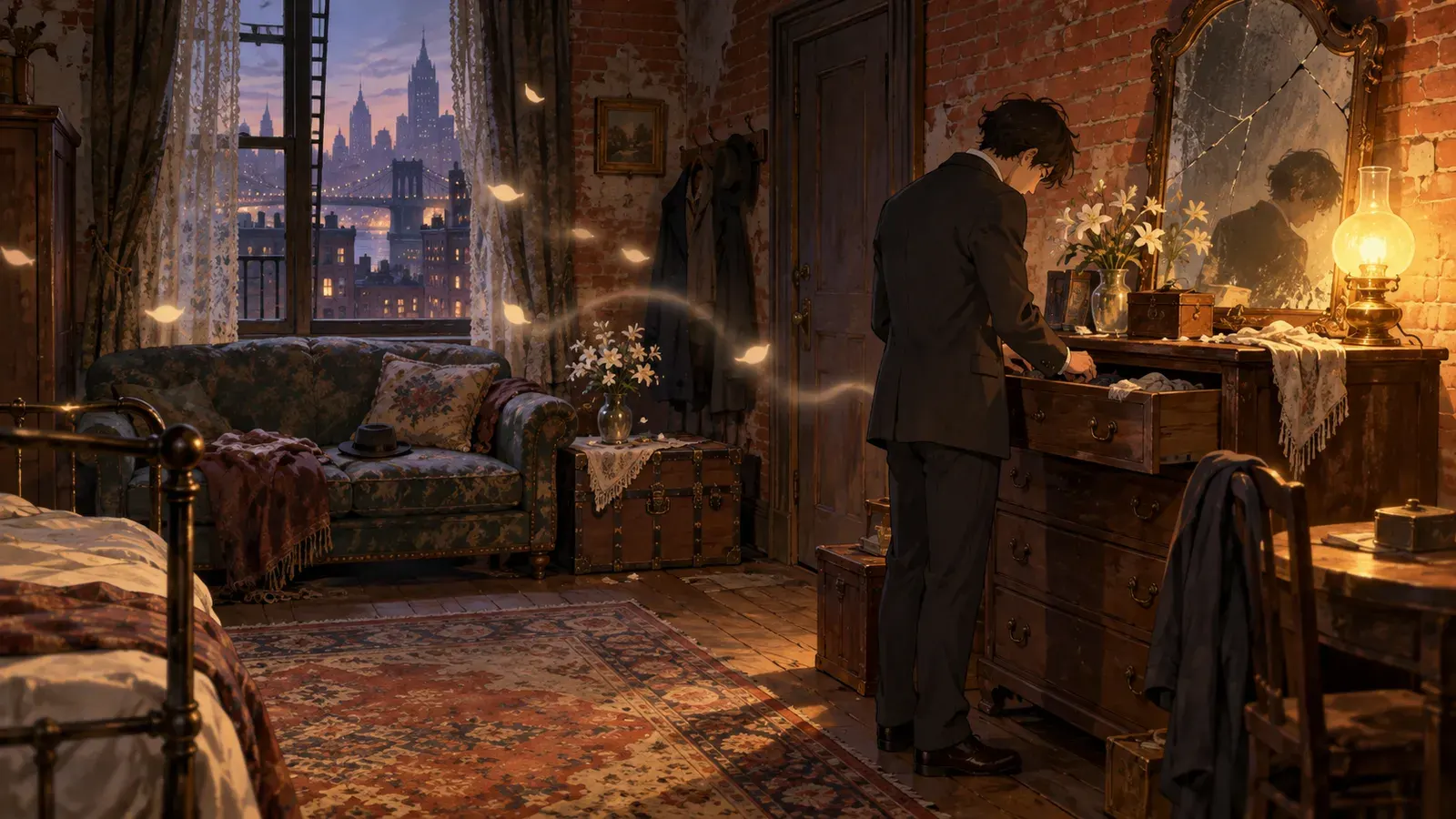
The furnished room received its latest guest with a first glow of pseudo-hospitality, a hectic, haggard, perfunctory welcome like the specious smile of a demirep. The sophistical comfort came in reflected gleams from the decayed furniture, the ragged brocade upholstery of a couch and two chairs, a foot-wide cheap pier glass between the two windows, from one or two gilt picture frames and a brass bedstead in a corner.
家具つきの部屋は、新しい客を、うわべだけのもてなしで迎えた。最初だけは明るく見えるが、身持ちの悪い女のつくり笑いのように、熱っぽく、やつれた、おざなりの歓迎だった。見せかけの居心地のよさは、照り返す光から生まれていた。朽ちかけた家具、ソファと二脚の椅子の、すり切れた錦織りの張り地、二つの窓のあいだにかかった幅一フィートの安物の姿見、金めっきの額縁が一つ二つ、それに隅の真鍮のベッド。そういうものが、にぶく光を返しているだけだった。
The guest reclined, inert, upon a chair, while the room, confused in speech as though it were an apartment in Babel, tried to discourse to him of its divers tenantry.
客はぐったりと椅子に身を沈めた。部屋は、まるでバベルの塔の一室のように、いろいろな言葉をごちゃまぜにして、これまでのさまざまな住人のことを語りかけてきた。
A polychromatic rug like some brilliant-flowered rectangular, tropical islet lay surrounded by a billowy sea of soiled matting. Upon the gay-papered wall were those pictures that pursue the homeless one from house to house—The Huguenot Lovers, The First Quarrel, The Wedding Breakfast, Psyche at the Fountain. The mantel's chastely severe outline was ingloriously veiled behind some pert drapery drawn rakishly askew like the sashes of the Amazonian ballet. Upon it was some desolate flotsam cast aside by the room's marooned when a lucky sail had borne them to a fresh port—a trifling vase or two, pictures of actresses, a medicine bottle, some stray cards out of a deck.
色とりどりのじゅうたんが、汚れたござの波立つ海に囲まれて、華やかな花の咲く四角い熱帯の小島のように敷かれていた。派手な柄の壁紙には、家のない人を家から家へと追いかけてくる、あのおなじみの絵がかかっていた。『ユグノーの恋人たち』『はじめてのけんか』『結婚の朝食』『泉のほとりのプシュケ』。暖炉の上の棚は、本来はきりりとした品のいい形をしているのに、こましゃくれた布が、アマゾネスのバレエの飾り帯みたいにだらしなく斜めにかけてあって、台なしになっていた。棚の上には、わびしい漂流物がのっていた。この部屋に島流しにされていた人たちが、運よく船に拾われて新しい港へ去っていくとき、置いていったものだ。つまらない花瓶が一つ二つ、女優の写真、薬びん、ばらばらになったトランプの札が何枚か。
One by one, as the characters of a cryptograph become explicit, the little signs left by the furnished room's procession of guests developed a significance. The threadbare space in the rug in front of the dresser told that lovely woman had marched in the throng. Tiny finger prints on the wall spoke of little prisoners trying to feel their way to sun and air. A splattered stain, raying like the shadow of a bursting bomb, witnessed where a hurled glass or bottle had splintered with its contents against the wall. Across the pier glass had been scrawled with a diamond in staggering letters the name "Marie." It seemed that the succession of dwellers in the furnished room had turned in fury—perhaps tempted beyond forbearance by its garish coldness—and wreaked upon it their passions. The furniture was chipped and bruised; the couch, distorted by bursting springs, seemed a horrible monster that had been slain during the stress of some grotesque convulsion. Some more potent upheaval had cloven a great slice from the marble mantel. Each plank in the floor owned its particular cant and shriek as from a separate and individual agony. It seemed incredible that all this malice and injury had been wrought upon the room by those who had called it for a time their home; and yet it may have been the cheated home instinct surviving blindly, the resentful rage at false household gods that had kindled their wrath. A hut that is our own we can sweep and adorn and cherish.
暗号の文字が一つずつ読み解けていくように、この部屋を通り過ぎていった客たちの残した小さなしるしが、意味を持ちはじめた。鏡台の前のじゅうたんがすり切れているのは、美しい女たちもこの行列に加わっていたしるしだ。壁についた小さな指のあとは、日の光と外の空気を求めて手さぐりした、小さな囚人たちのことを語っていた。炸裂した爆弾の影のように放射状に飛び散ったしみは、投げつけられたコップかびんが、中身もろとも壁にぶつかって砕けた場所を示していた。姿見には、ダイヤモンドでよろよろと「マリー」という名前が刻みつけてあった。この部屋の住人たちは、代々、怒りにかられて、部屋に感情をぶつけてきたらしい。けばけばしいくせに冷たいこの部屋に、がまんできなくなったのかもしれない。家具は欠けたり、へこんだりしていた。ソファはばねが飛び出してゆがみ、何かおぞましい発作のさなかに殺された怪物の死体のようだった。もっと激しい騒ぎもあったのだろう、大理石の炉棚からは大きなかけらが割り取られていた。床板は一枚一枚が、それぞれに別の苦しみを味わっているかのように、てんでに傾き、てんでに悲鳴のようにきしんだ。これほどの悪意と傷が、たとえひとときでもこの部屋をわが家と呼んだ人たちの手で加えられたとは、信じがたいことだった。だが、彼らの怒りに火をつけたのは、まさにそれだったのかもしれない。わが家を求める本能が、だまされながらも、やみくもに生き残っていたのだ。そして、にせものの家の守り神に腹を立てたのだ。自分のものなら、たとえ小屋でも、人は掃除し、飾り、大切にするものだから。
The young tenant in the chair allowed these thoughts to file, soft-shod, through his mind, while there drifted into the room furnished sounds and furnished scents. He heard in one room a tittering and incontinent, slack laughter; in others the monologue of a scold, the rattling of dice, a lullaby, and one crying dully; above him a banjo tinkled with spirit. Doors banged somewhere; the elevated trains roared intermittently; a cat yowled miserably upon a back fence. And he breathed the breath of the house—a dank savour rather than a smell—a cold, musty effluvium as from underground vaults mingled with the reeking exhalations of linoleum and mildewed and rotten woodwork.
椅子に座った若い借り手は、こうした思いが足音を忍ばせて心の中を通り過ぎていくにまかせていた。そのあいだにも、部屋には、家具つきの物音と、家具つきのにおいがただよいこんできた。ある部屋からは、くすくす笑いと、だらしなくしまりのない笑い声。ほかの部屋からは、がみがみ小言を言い続ける声、さいころの転がる音、子守歌、誰かがすすり泣く声。上の階では、バンジョーが威勢よくかき鳴らされていた。どこかでドアがバタンと閉まり、高架鉄道がときおり轟音をたて、裏の塀の上では猫がみじめな声で鳴いていた。そして男は、この家の吐く息を吸いこんだ。においというより、じっとりと舌にまとわりつく味だった。地下の納骨堂から立ちのぼるような、冷たくかび臭い気配に、リノリウムのむっとするにおいと、かびて腐った木材のにおいがまじっていた。
Then, suddenly, as he rested there, the room was filled with the strong, sweet odour of mignonette. It came as upon a single buffet of wind with such sureness and fragrance and emphasis that it almost seemed a living visitant. And the man cried aloud: "What, dear?" as if he had been called, and sprang up and faced about. The rich odour clung to him and wrapped him around. He reached out his arms for it, all his senses for the time confused and commingled. How could one be peremptorily called by an odour? Surely it must have been a sound. But, was it not the sound that had touched, that had caressed him?
そうして休んでいると、突然、部屋がモクセイソウの強く甘い香りで満たされた。ひと吹きの風が運んできたかのように、あまりにもはっきりと、かぐわしく、力強くやってきたので、まるで生きた人が訪ねてきたかのようだった。男は、呼ばれでもしたように「なんだい、きみ?」と声をあげ、はね起きて振り返った。濃い香りが男にまとわりつき、体を包みこんだ。男は香りに向かって両腕を伸ばした。そのひととき、あらゆる感覚が入りまじって、わけがわからなくなっていた。香りに、有無を言わせず呼ばれることなどあるだろうか? きっと音だったにちがいない。だが、男にふれ、男をやさしくなでたのは、その音だったのではないか?
"She has been in this room," he cried, and he sprang to wrest from it a token, for he knew he would recognize the smallest thing that had belonged to her or that she had touched. This enveloping scent of mignonette, the odour that she had loved and made her own—whence came it?
「彼女はこの部屋にいたんだ」と男は叫んだ。そして、何か彼女のしるしを見つけ出そうと飛びついた。彼女のものだった物、彼女がふれた物なら、どんなに小さな物でも見分けられる自信があった。自分を包みこむ、このモクセイソウの香り。彼女が愛し、自分の香りにしていたこの香りは、いったいどこから来るのだろう?
The room had been but carelessly set in order. Scattered upon the flimsy dresser scarf were half a dozen hairpins—those discreet, indistinguishable friends of womankind, feminine of gender, infinite of mood and uncommunicative of tense. These he ignored, conscious of their triumphant lack of identity. Ransacking the drawers of the dresser he came upon a discarded, tiny, ragged handkerchief. He pressed it to his face. It was racy and insolent with heliotrope; he hurled it to the floor. In another drawer he found odd buttons, a theatre programme, a pawnbroker's card, two lost marshmallows, a book on the divination of dreams. In the last was a woman's black satin hair bow, which halted him, poised between ice and fire. But the black satin hair-bow also is femininity's demure, impersonal, common ornament, and tells no tales.
部屋は、ざっと片づけてあるだけだった。薄っぺらな鏡台かけの上に、ヘアピンが五、六本散らばっていた。ヘアピンというのは、女たちの口のかたい、見分けのつかない友だちだ。性は女性、気分はさまざま、そして時制については何も語らない。どれも勝ちほこったように身元を明かさないとわかっていたから、男は見向きもしなかった。鏡台の引き出しをかき回すと、捨てられた小さなぼろぼろのハンカチが出てきた。顔に押し当ててみると、ヘリオトロープの香りが、つんと生意気に鼻をついた。男はそれを床にたたきつけた。別の引き出しには、はんぱなボタン、劇場のプログラム、質屋の札、置き忘れられたマシュマロが二つ、夢占いの本。最後の引き出しには、女物の黒いしゅすの髪のリボンがあった。男は、氷と炎のあいだで宙づりになったように、はっと手を止めた。だが、黒いしゅすの髪のリボンもまた、女ならだれでも使う、つつましい、ありふれた飾りだ。何の物語も語ってはくれない。
And then he traversed the room like a hound on the scent, skimming the walls, considering the corners of the bulging matting on his hands and knees, rummaging mantel and tables, the curtains and hangings, the drunken cabinet in the corner, for a visible sign, unable to perceive that she was there beside, around, against, within, above him, clinging to him, wooing him, calling him so poignantly through the finer senses that even his grosser ones became cognisant of the call. Once again he answered loudly: "Yes, dear!" and turned, wild-eyed, to gaze on vacancy, for he could not yet discern form and colour and love and outstretched arms in the odour of mignonette. Oh, God! whence that odour, and since when have odours had a voice to call? Thus he groped.
それから男は、獲物のにおいを追う猟犬のように、部屋じゅうをさがし回った。壁をなで、四つんばいになって、ござのふくらんだ隅々を調べた。炉棚やテーブル、カーテンや壁かけ、隅で酔っぱらいのように傾いている戸棚まで、ひっかき回した。目に見えるしるしがほしかったのだ。彼女はそこにいた。男のそばに、まわりに、男に寄りそい、男の中に、男の上にいて、男にまとわりつき、男に言い寄り、繊細な感覚を通して切ないほどに呼びかけていた。その呼び声は、鈍いほうの感覚にまで届くほどだった。なのに、男にはそれがわからなかった。もう一度、男は大声で「なんだい、きみ!」と答え、血走った目で振り返った。だが、そこには何もない。モクセイソウの香りの中に、姿や色や、愛や、差しのべられた腕を見てとることは、男にはまだできなかったのだ。ああ、神よ! あの香りはどこから来るのか。香りが声を出して呼ぶなどということが、いつからあったのか。こうして男は手さぐりを続けた。
He burrowed in crevices and corners, and found corks and cigarettes. These he passed in passive contempt. But once he found in a fold of the matting a half-smoked cigar, and this he ground beneath his heel with a green and trenchant oath. He sifted the room from end to end. He found dreary and ignoble small records of many a peripatetic tenant; but of her whom he sought, and who may have lodged there, and whose spirit seemed to hover there, he found no trace.
男はすき間や隅に手をつっこみ、コルク栓や紙巻きたばこを見つけた。そんなものには、さげすむように目もくれなかった。だが一度、ござのひだの中から吸いかけの葉巻が出てきたときには、激しい嫉妬にかられて口汚くののしり、かかとで踏みにじった。男は部屋の端から端まで、ふるいにかけるように調べた。渡り歩いていった大勢の借り手たちの、わびしく、みすぼらしい小さな記録は見つかった。だが、さがしている人の痕跡は、何一つ見つからなかった。ここに泊まっていたかもしれない人。その魂が、いまもここにただよっているように思える人の痕跡は。
And then he thought of the housekeeper.
そのとき、男は家主のことを思い出した。
He ran from the haunted room downstairs and to a door that showed a crack of light. She came out to his knock. He smothered his excitement as best he could.
男は取りつかれたような部屋を飛び出して階段を駆け下り、すき間から明かりのもれているドアの前に立った。ノックすると家主が出てきた。男は高ぶる気持ちを、できるかぎり押し殺した。
"Will you tell me, madam," he besought her, "who occupied the room I have before I came?"
「教えていただけませんか」と男はすがるように言った。「わたしの前に、あの部屋にいたのは誰ですか?」
"Yes, sir. I can tell you again. 'Twas Sprowls and Mooney, as I said. Miss B'retta Sprowls it was in the theatres, but Missis Mooney she was. My house is well known for respectability. The marriage certificate hung, framed, on a nail over—"
「ええ、いいですよ。もう一度言いましょうか。さっき言ったとおり、スプロールズとムーニーですよ。劇場ではミス・ブレッタ・スプロールズでしたけど、本当はミセス・ムーニーでした。うちはきちんとした家だって評判なんですよ。結婚証明書がちゃんと額に入れて、釘にかけてあったんですから。ちょうど……」
"What kind of a lady was Miss Sprowls—in looks, I mean?"
「ミス・スプロールズは、どんな人でしたか? 見た目のことですが」
"Why, black-haired, sir, short, and stout, with a comical face. They left a week ago Tuesday."
「そうですねえ、黒い髪で、背が低くて、太っていて、ひょうきんな顔をしてましたよ。先週の火曜日に出ていきました」
"And before they occupied it?"
「その人たちの前は?」
"Why, there was a single gentleman connected with the draying business. He left owing me a week. Before him was Missis Crowder and her two children, that stayed four months; and back of them was old Mr. Doyle, whose sons paid for him. He kept the room six months. That goes back a year, sir, and further I do not remember."
「ええと、荷馬車の運送屋で働いてる独り者の男の人がいましたよ。家賃を一週間分ためたまま出ていきましたっけ。その前はミセス・クラウダーと子どもが二人で、四か月いました。その前はドイルじいさんで、家賃は息子さんたちが払ってました。あの人は六か月いましたね。それで一年前までさかのぼります。それより前のことは覚えてませんよ」
He thanked her and crept back to his room. The room was dead. The essence that had vivified it was gone. The perfume of mignonette had departed. In its place was the old, stale odour of mouldy house furniture, of atmosphere in storage.
男は礼を言い、そっと自分の部屋へ戻った。部屋は死んでいた。部屋に命を吹きこんでいたものは、去ってしまった。モクセイソウの香りは消えていた。かわりにあるのは、かびた家具と、閉じこめられた空気の、古くよどんだにおいだけだった。
The ebbing of his hope drained his faith. He sat staring at the yellow, singing gaslight. Soon he walked to the bed and began to tear the sheets into strips. With the blade of his knife he drove them tightly into every crevice around windows and door. When all was snug and taut he turned out the light, turned the gas full on again and laid himself gratefully upon the bed.
希望が引いていくと、信じる気持ちも流れ出てしまった。男は座ったまま、黄色い光を放ってしゅうしゅう鳴るガス灯を見つめていた。やがてベッドのところへ行き、シーツを細く裂きはじめた。それをナイフの刃で、窓とドアのまわりのすき間というすき間に、ぎっちりと押しこんだ。すっかりふさがると、男は明かりを消した。そしてもう一度ガスの栓をいっぱいに開き、ほっとしたようにベッドに横たわった。
It was Mrs. McCool's night to go with the can for beer. So she fetched it and sat with Mrs. Purdy in one of those subterranean retreats where house-keepers foregather and the worm dieth seldom.
その晩は、ミセス・マックールが缶を持ってビールを買いにいく番だった。それで彼女はビールを買ってきて、ミセス・パーディと地下の部屋に腰をすえた。家主のおかみさんたちが寄り集まる、あの地下の隠れ家だ。地獄と同じで、ここではうじ虫もめったに死なない。
"I rented out my third floor, back, this evening," said Mrs. Purdy, across a fine circle of foam. "A young man took it. He went up to bed two hours ago."
「今晩、うちの三階の裏の部屋を貸したんですよ」とミセス・パーディは、きめの細かい泡の輪ごしに言った。「若い男の人が借りてね。二時間前に寝に上がっていきましたよ」
"Now, did ye, Mrs. Purdy, ma'am?" said Mrs. McCool, with intense admiration. "You do be a wonder for rentin' rooms of that kind. And did ye tell him, then?" she concluded in a husky whisper, laden with mystery.
「まあ、そうなの、パーディさん?」とミセス・マックールは、ほとほと感心して言った。「ああいう部屋を貸すことにかけちゃ、あんたはたいしたもんだねえ。それで、その人に話したのかい?」と、最後はなぞめいた、かすれたささやき声になった。
"Rooms," said Mrs. Purdy, in her furriest tones, "are furnished for to rent. I did not tell him, Mrs. McCool."
「部屋ってものはね」とミセス・パーディは、いちばん毛皮っぽい声で言った。「貸すために家具をそろえてあるんですよ。話してなんかいませんよ、マックールさん」
"'Tis right ye are, ma'am; 'tis by renting rooms we kape alive. Ye have the rale sense for business, ma'am. There be many people will rayjict the rentin' of a room if they be tould a suicide has been after dyin' in the bed of it."
「そりゃ、あんたの言うとおりだ。部屋を貸して、あたしらは食べてるんだからね。あんたには本物の商売の勘があるよ。そのベッドで自殺した人がいるなんて聞かされたら、借りるのをやめちまう人はたくさんいるもの」
"As you say, we has our living to be making," remarked Mrs. Purdy.
「おっしゃるとおり、わたしたちは暮らしを立てなきゃなりませんからね」とミセス・パーディは言った。
"Yis, ma'am; 'tis true. 'Tis just one wake ago this day I helped ye lay out the third floor, back. A pretty slip of a colleen she was to be killin' herself wid the gas—a swate little face she had, Mrs. Purdy, ma'am."
「ほんとにそうだねえ。ちょうど一週間前のきょう、三階の裏の部屋で、あたしはあんたを手伝って亡きがらを整えたんだっけ。ガスで死ぬなんて、ほっそりしたかわいい娘さんだったのにねえ。かわいい顔をしてたよ、パーディさん」
"She'd a-been called handsome, as you say," said Mrs. Purdy, assenting but critical, "but for that mole she had a-growin' by her left eyebrow. Do fill up your glass again, Mrs. McCool."
「たしかに、器量よしと言われたでしょうね」とミセス・パーディは、うなずきながらも、けちをつけるように言った。「左の眉のそばに、あのほくろさえなけりゃね。さあ、マックールさん、もう一杯おつぎなさいな」