I. One Does Not Always Eat What Is on the Table
一 食卓にのっているものを食べるとはかぎらない
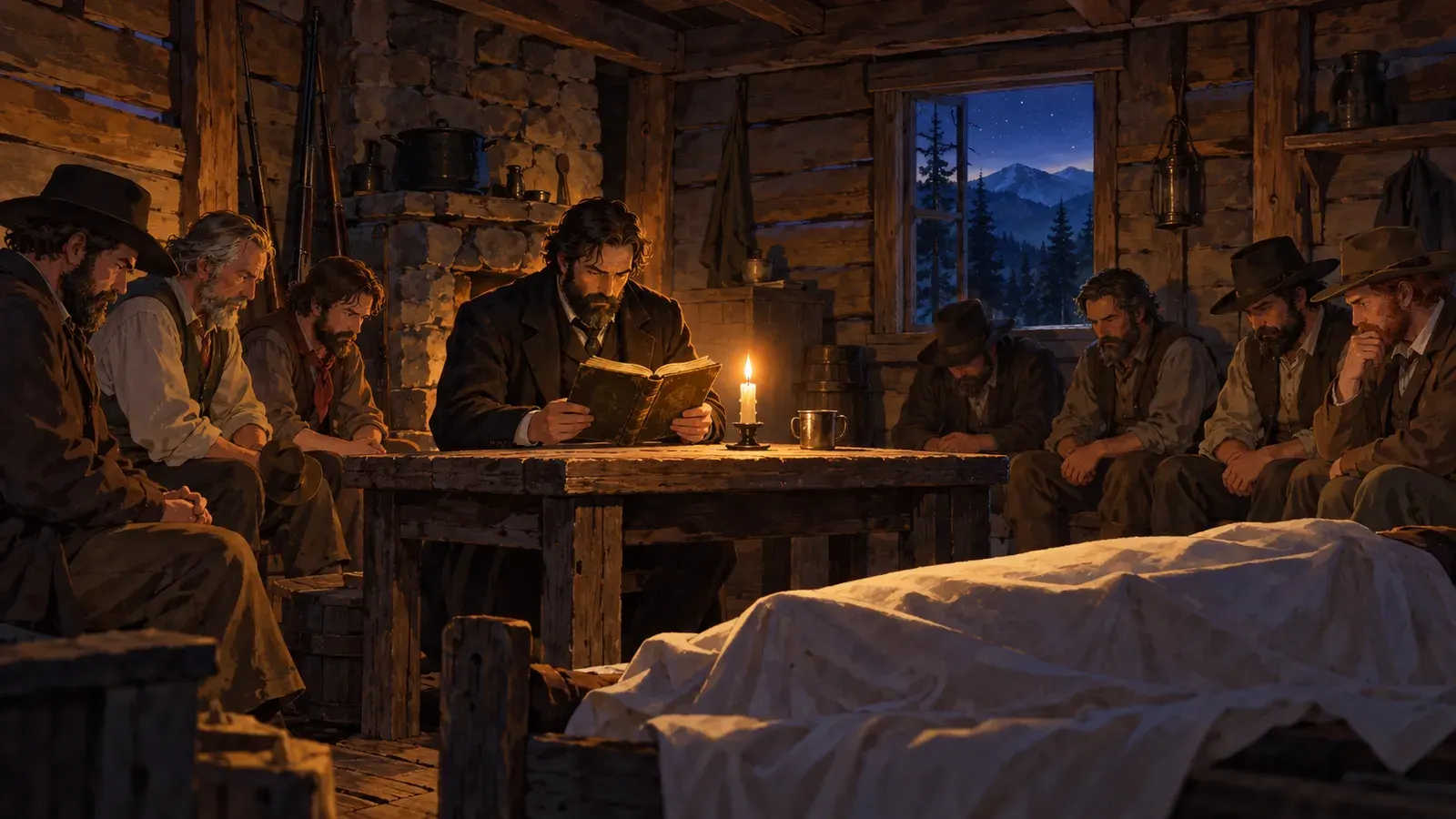
By the light of a tallow candle which had been placed on one end of a rough table a man was reading something written in a book. It was an old account book, greatly worn; and the writing was not, apparently, very legible, for the man sometimes held the page close to the flame of the candle to get a stronger light on it. The shadow of the book would then throw into obscurity a half of the room, darkening a number of faces and figures; for besides the reader, eight other men were present. Seven of them sat against the rough log walls, silent, motionless, and the room being small, not very far from the table. By extending an arm any one of them could have touched the eighth man, who lay on the table, face upward, partly covered by a sheet, his arms at his sides. He was dead.
粗末なテーブルの片端に獣脂のろうそくが立ててあり、その明かりで、一人の男が帳面に書かれたものを読んでいた。古い出納帳で、ひどくすり切れている。字はあまり読みやすくないらしく、男はときどきページをろうそくの炎に近づけて、明るく照らそうとした。そのたびに帳面の影が部屋の半分を闇に沈め、いくつもの顔や姿を暗くした。読んでいる男のほかに、八人の男がそこにいたのである。そのうち七人は、ごつごつした丸太の壁ぎわに腰をおろし、黙りこくって身じろぎもしなかった。部屋が狭いので、テーブルからそう遠くはない。誰でも腕を伸ばせば、八人目の男に手が届いただろう。八人目の男はテーブルの上に仰向けに寝かされ、体の半分をシーツで覆われ、両腕を脇につけていた。死んでいたのである。
The man with the book was not reading aloud, and no one spoke; all seemed to be waiting for something to occur; the dead man only was without expectation. From the blank darkness outside came in, through the aperture that served for a window, all the ever unfamiliar noises of night in the wilderness—the long nameless note of a distant coyote; the stilly pulsing thrill of tireless insects in trees; strange cries of night birds, so different from those of the birds of day; the drone of great blundering beetles, and all that mysterious chorus of small sounds that seem always to have been but half heard when they have suddenly ceased, as if conscious of an indiscretion. But nothing of all this was noted in that company; its members were not overmuch addicted to idle interest in matters of no practical importance; that was obvious in every line of their rugged faces—obvious even in the dim light of the single candle. They were evidently men of the vicinity—farmers and woodsmen.
帳面の男は声に出して読んではおらず、誰も口をきかなかった。誰もが何かが起こるのを待っているようだった。何も待っていないのは、死人だけだった。窓がわりの穴から、外の真っ暗闇の中から、荒野の夜の物音がのこらず入ってきた。いつまでたっても耳慣れない音ばかりだ。遠くのコヨーテの、名づけようのない、長く尾を引く声。木々の中で疲れを知らずに鳴く虫たちの、ひっそりと脈打つような震え声。昼の鳥とはまるで違う、夜の鳥たちの奇妙な叫び。あちこちにぶつかって飛ぶ大きな甲虫の、ぶうんという羽音。そして小さな音たちの、謎めいた合唱。この合唱は、うっかりしゃべりすぎたと気づいたかのように、ふっとやむことがある。やんでみると、それまでは半分しか耳に入っていなかったような気がするものだ。だが、その場の誰も、そんな音には気をとめなかった。暮らしの役に立たないことに暇つぶしの興味を持つような連中ではなかったのである。それは、たった一本のろうそくの薄明かりの中でも、いかつい顔のどの線にもはっきりと表れていた。このあたりの住人、つまり農夫や木こりであることは、見ればわかった。
The person reading was a trifle different; one would have said of him that he was of the world, worldly, albeit there was that in his attire which attested a certain fellowship with the organisms of his environment. His coat would hardly have passed muster in San Francisco; his foot-gear was not of urban origin, and the hat that lay by him on the floor (he was the only one uncovered) was such that if one had considered it as an article of mere personal adornment he would have missed its meaning. In countenance the man was rather prepossessing, with just a hint of sternness; though that he may have assumed or cultivated, as appropriate to one in authority. For he was a coroner. It was by virtue of his office that he had possession of the book in which he was reading; it had been found among the dead man's effects—in his cabin, where the inquest was now taking place.
読んでいる男は少し違っていた。世間を知った、世慣れた人と言ってよかっただろう。もっとも服装には、このあたりで暮らす生きものたちと、いくらか仲間であることを示すところもあった。上着はサンフランシスコではとても通用しなかっただろうし、靴も都会でつくられたものではない。かたわらの床に置いた帽子は(その場で帽子を脱いでいるのはこの男だけだった)、ただの身なりの飾りと見たら、その意味を取り違えるようなしろものだった。顔立ちはなかなか感じがよく、ほんの少しいかめしさがあった。だがそれは、権威のある人間にふさわしいように、わざとつくったか、身につけたかしたものかもしれない。というのも、この男は検死官だったのである。いま読んでいる帳面を持っているのも、その役目のためだった。帳面は死んだ男の持ち物の中から見つかったものだ。見つかった場所は男の小屋、つまりいま検死審問が開かれているこの小屋である。
When the coroner had finished reading he put the book into his breast pocket. At that moment the door was pushed open and a young man entered. He, clearly, was not of mountain birth and breeding: he was clad as those who dwell in cities. His clothing was dusty, however, as from travel. He had, in fact, been riding hard to attend the inquest.
読み終えると、検死官は帳面を胸のポケットにしまった。そのとき扉が押し開けられ、若い男が入ってきた。山の生まれでも、山育ちでもないことは、ひと目でわかった。都会の人間のような服を着ていたのだ。ただ、その服は旅をしてきたようにほこりまみれだった。じっさい、審問に間に合うよう、馬を飛ばしてきたのである。
The coroner nodded; no one else greeted him.
検死官はうなずいた。ほかには誰も挨拶しなかった。
"We have waited for you," said the coroner. "It is necessary to have done with this business to-night."
「お待ちしていました」と検死官は言った。「この件は今夜のうちに片づけなければなりませんのでね」
The young man smiled. "I am sorry to have kept you," he said. "I went away, not to evade your summons, but to post to my newspaper an account of what I suppose I am called back to relate."
若い男はほほえんだ。「お待たせしてすみません」と男は言った。「出かけていたのは、呼び出しから逃げるためではありません。新聞社に記事を送りに行っていたのです。たぶん、その記事に書いたことを話すために呼び戻されたのだと思いますが」
The coroner smiled.
検死官はほほえんだ。
"The account that you posted to your newspaper," he said, "differs, probably, from that which you will give here under oath."
「新聞社に送った記事は」と検死官は言った。「おそらく、ここで宣誓してから話していただく証言とは、違うものでしょうな」
"That," replied the other, rather hotly and with a visible flush, "is as you please. I used manifold paper and have a copy of what I sent. It was not written as news, for it is incredible, but as fiction. It may go as a part of my testimony under oath."
「それは」と相手は、いくらかむっとして、目に見えて顔を赤くしながら答えた。「どうお考えになろうとご自由です。私は複写紙を使ったので、送った記事の写しがあります。あれはニュースとして書いたのではありません。とても信じられない話ですからね。小説として書いたのです。でも、宣誓証言の一部にしていただいてかまいません」
"But you say it is incredible."
「しかし、信じられない話だとおっしゃる」
"That is nothing to you, sir, if I also swear that it is true."
「私がそれを本当だと誓うのなら、あなたには関係のないことでしょう」
The coroner was silent for a time, his eyes upon the floor. The men about the sides of the cabin talked in whispers, but seldom withdrew their gaze from the face of the corpse. Presently the coroner lifted his eyes and said: "We will resume the inquest."
検死官はしばらく黙って、床に目を落としていた。小屋の壁ぎわの男たちはひそひそ声で話していたが、死体の顔からはほとんど目を離さなかった。やがて検死官は目を上げて言った。「審問を再開します」
The men removed their hats. The witness was sworn.
男たちは帽子を脱いだ。証人は宣誓した。
"What is your name?" the coroner asked.
「お名前は?」と検死官は尋ねた。
"William Harker."
「ウィリアム・ハーカー」
"Age?"
「年は?」
"Twenty-seven."
「二十七歳」
"You knew the deceased, Hugh Morgan?"
「亡くなったヒュー・モーガンとは知り合いでしたね?」
"Yes."
「はい」
"You were with him when he died?"
「亡くなったとき、一緒にいましたか?」
"Near him."
「近くにいました」
"How did that happen—your presence, I mean?"
「どういういきさつで、あなたはその場にいたのですか」
"I was visiting him at this place to shoot and fish. A part of my purpose, however, was to study him and his odd, solitary way of life. He seemed a good model for a character in fiction. I sometimes write stories."
「狩りと釣りをしに、ここへ彼を訪ねて来ていたのです。でも目的の一部は、彼という人間と、その風変わりな、ひとりきりの暮らしぶりを観察することでした。小説の登場人物にちょうどいいモデルだと思えたので。私はときどき小説を書くのです」
"I sometimes read them."
「私もときどき読みますよ」
"Thank you."
「ありがとうございます」
"Stories in general—not yours."
「小説というものをね。あなたのではなく」
Some of the jurors laughed. Against a sombre background humor shows high lights. Soldiers in the intervals of battle laugh easily, and a jest in the death chamber conquers by surprise.
陪審員の何人かが笑った。陰気な背景の前では、ユーモアがひときわ明るく見える。兵士は戦いの合間によく笑うものだし、死者の部屋での冗談は、思いがけないぶん、たやすく人を笑わせるのだ。
"Relate the circumstances of this man's death," said the coroner. "You may use any notes or memoranda that you please."
「この男が死んだときの様子を話してください」と検死官は言った。「メモや覚え書きは、何を見ながらでもかまいません」
The witness understood. Pulling a manuscript from his breast pocket he held it near the candle and turning the leaves until he found the passage that he wanted began to read.
証人はその意味を察した。胸のポケットから原稿を取り出してろうそくに近づけ、ページをめくって目当ての箇所を見つけると、読みはじめた。
II. What May Happen in a Field of Wild Oats
二 カラスムギの原で起こりうること
"... The sun had hardly risen when we left the house. We were looking for quail, each with a shotgun, but we had only one dog. Morgan said that our best ground was beyond a certain ridge that he pointed out, and we crossed it by a trail through the chaparral. On the other side was comparatively level ground, thickly covered with wild oats. As we emerged from the chaparral Morgan was but a few yards in advance. Suddenly we heard, at a little distance to our right and partly in front, a noise as of some animal thrashing about in the bushes, which we could see were violently agitated.
「……私たちが家を出たとき、日はまだ昇りきっていなかった。二人とも散弾銃を持ってウズラを探しに出たのだが、犬は一匹しか連れていなかった。モーガンは、いちばんいい猟場はあの尾根の向こうだと言って指さした。私たちは灌木の茂みを抜ける小道をたどって、その尾根を越えた。向こう側はわりあい平らな土地で、野生のカラスムギがびっしり生い茂っていた。茂みから出たとき、モーガンは私の数ヤード先にいた。とつぜん、右手の少し離れたところ、やや前のほうで、何かの獣が茂みの中で暴れまわっているような音がした。見ると、茂みが激しく揺れていた。
"'We've started a deer,' I said. 'I wish we had brought a rifle.'
『鹿を追い出したな』と私は言った。『ライフルを持ってくればよかった』
"Morgan, who had stopped and was intently watching the agitated chaparral, said nothing, but had cocked both barrels of his gun and was holding it in readiness to aim. I thought him a trifle excited, which surprised me, for he had a reputation for exceptional coolness, even in moments of sudden and imminent peril.
モーガンは立ち止まって、揺れている茂みを食い入るように見つめていた。何も言わなかったが、銃の撃鉄を二つとも起こし、いつでも狙えるように構えていた。少し興奮しているようだった。私は驚いた。モーガンは、急に危険が迫ったときでさえ並はずれて冷静だという評判の男だったからだ。
"'O, come,' I said. 'You are not going to fill up a deer with quail-shot, are you?'
『おいおい』と私は言った。『鹿にウズラ用の散弾をぶちこむつもりじゃないだろうね?』
"Still he did not reply; but catching a sight of his face as he turned it slightly toward me I was struck by the intensity of his look. Then I understood that we had serious business in hand and my first conjecture was that we had 'jumped' a grizzly. I advanced to Morgan's side, cocking my piece as I moved.
それでもモーガンは答えなかった。だが、少しこちらへ顔を向けたとき、その顔が見えた。あまりにすさまじい表情に、私ははっとした。これはただごとではないと、そのときわかった。最初に思ったのは、ハイイログマを驚かせて飛び出させたのだろう、ということだった。私は自分の銃の撃鉄を起こしながら、モーガンの横へ進み出た。
"The bushes were now quiet and the sounds had ceased, but Morgan was as attentive to the place as before.
茂みはもう静まり、音もやんでいた。だがモーガンは、前と同じようにその場所をじっと見すえていた。
"'What is it? What the devil is it?' I asked.
『何だ? いったい何なんだ?』と私は聞いた。
"'That Damned Thing!' he replied, without turning his head. His voice was husky and unnatural. He trembled visibly.
『あのいまいましいやつだ!』とモーガンは、振り向きもせずに答えた。声はかすれ、いつもの声ではなかった。体が震えているのが見てとれた。
"I was about to speak further, when I observed the wild oats near the place of the disturbance moving in the most inexplicable way. I can hardly describe it. It seemed as if stirred by a streak of wind, which not only bent it, but pressed it down—crushed it so that it did not rise; and this movement was slowly prolonging itself directly toward us.
さらに何か言おうとしたとき、騒ぎのあった場所の近くのカラスムギが、なんとも説明のつかない動き方をしているのに気づいた。うまく言いあらわせない。ひと筋の風が吹き抜けたかのようだった。だがその風は、ムギをなびかせるだけでなく、押し倒し、押しつぶして、起き上がれなくしていた。そしてその動きが、ゆっくりと、まっすぐこちらへ延びてきていたのだ。
"Nothing that I had ever seen had affected me so strangely as this unfamiliar and unaccountable phenomenon, yet I am unable to recall any sense of fear. I remember—and tell it here because, singularly enough, I recollected it then—that once in looking carelessly out of an open window I momentarily mistook a small tree close at hand for one of a group of larger trees at a little distance away. It looked the same size as the others, but being more distinctly and sharply defined in mass and detail seemed out of harmony with them. It was a mere falsification of the law of aërial perspective, but it startled, almost terrified me. We so rely upon the orderly operation of familiar natural laws that any seeming suspension of them is noted as a menace to our safety, a warning of unthinkable calamity. So now the apparently causeless movement of the herbage and the slow, undeviating approach of the line of disturbance were distinctly disquieting. My companion appeared actually frightened, and I could hardly credit my senses when I saw him suddenly throw his gun to his shoulder and fire both barrels at the agitated grain! Before the smoke of the discharge had cleared away I heard a loud savage cry—a scream like that of a wild animal—and flinging his gun upon the ground Morgan sprang away and ran swiftly from the spot. At the same instant I was thrown violently to the ground by the impact of something unseen in the smoke—some soft, heavy substance that seemed thrown against me with great force.
これまで見たどんなものも、この見たこともない、わけのわからない出来事ほど、私を奇妙な気持ちにさせたことはなかった。それでいて、怖いと思った覚えはない。ふと思い出したことがある。妙なことに、そのとき思い出したので、ここに書いておく。以前、開いた窓から何気なく外を眺めていて、すぐそばの小さな木を、少し離れたところに並ぶ大きな木々の一本と、ほんの一瞬見間違えたことがあった。その木はほかの木と同じ大きさに見えたが、形も細かいところもずっとくっきり見えたので、まわりとちぐはぐに感じられた。遠くのものはかすんで見える、というきまりが、ちょっと狂っただけのことだ。それなのに私はぎょっとして、ほとんど恐ろしくなった。私たちは、おなじみの自然の法則がきちんと働いてくれることに、すっかり頼りきっている。だから、それが少しでも止まったように見えると、身に迫る危険、とんでもない災いの前ぶれと感じてしまうのだ。だからこのときも、草がわけもなく動き、乱れの線がゆっくりと、まっすぐに近づいてくるのは、なんとも不安だった。連れは本当におびえているようだった。そして、いきなり銃を肩にあて、揺れているムギめがけて二発とも撃ったのを見て、私はわが目を疑った。煙が晴れないうちに、大きな、荒々しい叫び声が聞こえた。獣のような絶叫だった。モーガンは銃を地面に投げ捨て、跳びのいて、一目散に駆けだした。同じ瞬間、私は煙の中で目に見えない何かにぶつかられ、地面に激しくたたきつけられた。何かやわらかくて重いものが、ものすごい勢いで投げつけられたようだった。
"Before I could get upon my feet and recover my gun, which seemed to have been struck from my hands, I heard Morgan crying out as if in mortal agony, and mingling with his cries were such hoarse, savage sounds as one hears from fighting dogs. Inexpressibly terrified, I struggled to my feet and looked in the direction of Morgan's retreat; and may Heaven in mercy spare me from another sight like that! At a distance of less than thirty yards was my friend, down upon one knee, his head thrown back at a frightful angle, hatless, his long hair in disorder and his whole body in violent movement from side to side, backward and forward. His right arm was lifted and seemed to lack the hand—at least, I could see none. The other arm was invisible. At times, as my memory now reports this extraordinary scene, I could discern but a part of his body; it was as if he had been partly blotted out—I cannot otherwise express it—then a shifting of his position would bring it all into view again.
立ち上がる暇もなく、手からはじき飛ばされたらしい銃を拾う暇もないうちに、モーガンの叫び声が聞こえた。死ぬほど苦しんでいるような声だった。その声に混じって、けんかをしている犬のような、しゃがれた荒々しい唸り声がした。言いようのない恐ろしさに襲われ、私はもがくように立ち上がって、モーガンが逃げたほうを見た。ああ、天のお慈悲で、あんな光景を二度と見ずにすみますように。三十ヤードと離れていないところに、友がいた。片膝をつき、頭は恐ろしい角度で後ろへのけぞっている。帽子はなく、長い髪は乱れ、体全体が、右へ左へ、前へ後ろへと、激しく揺れていた。右腕は上がっていたが、手がないように見えた。少なくとも、私には見えなかった。もう片方の腕は見えなかった。このとんでもない光景を思い出してみると、ときどき体の一部しか見えないことがあった。まるで体の一部が、塗りつぶされて消えたかのようだった。ほかに言いようがない。そしてモーガンが体の向きを変えると、また全身が見えるのだった。
"All this must have occurred within a few seconds, yet in that time Morgan assumed all the postures of a determined wrestler vanquished by superior weight and strength. I saw nothing but him, and him not always distinctly. During the entire incident his shouts and curses were heard, as if through an enveloping uproar of such sounds of rage and fury as I had never heard from the throat of man or brute!
これはみな、数秒のうちに起きたことにちがいない。それなのにそのあいだに、モーガンは、重さでも力でもかなわない相手に組み伏せられていく、必死のレスラーのありとあらゆる格好をした。私に見えたのはモーガンだけで、そのモーガンさえ、いつもはっきり見えたわけではない。そのあいだじゅう、モーガンの叫びとののしりが聞こえていた。それは、怒り狂った唸り声の渦に包まれて、その向こうから聞こえてくるようだった。人間ののどからも、獣ののどからも、あんな声は聞いたことがない。
"For a moment only I stood irresolute, then throwing down my gun I ran forward to my friend's assistance. I had a vague belief that he was suffering from a fit, or some form of convulsion. Before I could reach his side he was down and quiet. All sounds had ceased, but with a feeling of such terror as even these awful events had not inspired I now saw again the mysterious movement of the wild oats, prolonging itself from the trampled area about the prostrate man toward the edge of a wood. It was only when it had reached the wood that I was able to withdraw my eyes and look at my companion. He was dead."
ほんの一瞬、私はどうしていいかわからず立ちつくした。それから銃を放り出し、友を助けに駆け寄った。何かの発作か、ひきつけでも起こしているのだろうと、ぼんやり思っていた。私がそばに着く前に、モーガンは倒れて静かになった。物音はすっかりやんでいた。だがそのとき、私はまたあのカラスムギの奇妙な動きを見た。倒れた男のまわりの踏み荒らされた場所から、森のはずれへと延びていく。これまでの恐ろしい出来事でさえ感じなかったほどの恐怖を、私はそのとき感じた。その動きが森に着いて、ようやく私は目を離し、連れを見ることができた。モーガンは死んでいた」
III. A Man Though Naked May Be in Rags
三 裸でも、ぼろをまとっていることがある
The coroner rose from his seat and stood beside the dead man. Lifting an edge of the sheet he pulled it away, exposing the entire body, altogether naked and showing in the candle-light a claylike yellow. It had, however, broad maculations of bluish black, obviously caused by extravasated blood from contusions. The chest and sides looked as if they had been beaten with a bludgeon. There were dreadful lacerations; the skin was torn in strips and shreds.
検死官は席を立ち、死者のそばに立った。シーツの端を持ち上げて引きはがすと、体がすっかりあらわになった。一糸まとわぬ裸で、ろうそくの明かりの中で、粘土のような黄色に見えた。だが体には、青黒い大きなあざがいくつもあった。打ち身で内出血したものにちがいない。胸と脇腹は、棍棒でめった打ちにされたように見えた。ひどい裂け傷があった。皮膚が細長く、ずたずたに引き裂かれていた。
The coroner moved round to the end of the table and undid a silk handkerchief which had been passed under the chin and knotted on the top of the head. When the handkerchief was drawn away it exposed what had been the throat. Some of the jurors who had risen to get a better view repented their curiosity and turned away their faces. Witness Harker went to the open window and leaned out across the sill, faint and sick. Dropping the handkerchief upon the dead man's neck the coroner stepped to an angle of the room and from a pile of clothing produced one garment after another, each of which he held up a moment for inspection. All were torn, and stiff with blood. The jurors did not make a closer inspection. They seemed rather uninterested. They had, in truth, seen all this before; the only thing that was new to them being Harker's testimony.
検死官はテーブルの端へまわり、あごの下に通して頭のてっぺんで結んである絹のハンカチをほどいた。ハンカチを取ると、かつてのどだったものがあらわになった。よく見ようと立ち上がっていた陪審員の何人かは、好奇心を出したことを悔やんで顔をそむけた。証人のハーカーは開いた窓のところへ行き、窓枠から身を乗り出した。気が遠くなり、吐き気がしたのだ。検死官はハンカチを死者の首の上に落とすと、部屋の隅へ行き、衣類の山から一着また一着と取り出しては、少しのあいだ掲げてみせた。どれも引き裂かれ、血でこわばっていた。陪審員たちは、それ以上よく見ようとはしなかった。あまり興味がないようだった。じつは、こうしたものはみな前に見ていたのだ。この人たちにとって目新しいのは、ハーカーの証言だけだった。
"Gentlemen," the coroner said, "we have no more evidence, I think. Your duty has been already explained to you; if there is nothing you wish to ask you may go outside and consider your verdict."
「皆さん」と検死官は言った。「証拠はもうこれだけだと思います。皆さんの務めはすでにご説明しました。何もお尋ねになることがなければ、外に出て評決を話し合ってください」
The foreman rose—a tall, bearded man of sixty, coarsely clad.
陪審長が立ち上がった。粗末な身なりの、背の高い、ひげ面の六十がらみの男だった。
"I should like to ask one question, Mr. Coroner," he said. "What asylum did this yer last witness escape from?"
「ひとつ聞きてえことがあるんですがね、検死官さん」と陪審長は言った。「この最後の証人は、どこの精神病院から逃げてきたんで?」
"Mr. Harker," said the coroner, gravely and tranquilly, "from what asylum did you last escape?"
「ハーカーさん」と検死官は、まじめな顔で、落ち着きはらって言った。「あなたはこのあいだ、どこの精神病院から逃げてきたのです?」
Harker flushed crimson again, but said nothing, and the seven jurors rose and solemnly filed out of the cabin.
ハーカーはまた真っ赤になったが、何も言わなかった。七人の陪審員は立ち上がり、おごそかに一列になって小屋から出ていった。
"If you have done insulting me, sir," said Harker, as soon as he and the officer were left alone with the dead man, "I suppose I am at liberty to go?"
「私を侮辱するのがお済みでしたら」と、死者のほかには役人と二人きりになるとすぐ、ハーカーは言った。「もう帰ってもいいのでしょうね?」
"Yes."
「どうぞ」
Harker started to leave, but paused, with his hand on the door latch. The habit of his profession was strong in him—stronger than his sense of personal dignity. He turned about and said:
ハーカーは出ていこうとしたが、扉の掛け金に手をかけたところで立ち止まった。仕事柄の癖が強く働いたのだ。自分の体面を気にする気持ちよりも強かった。ハーカーは振り返って言った。
"The book that you have there—I recognize it as Morgan's diary. You seemed greatly interested in it; you read in it while I was testifying. May I see it? The public would like—"
「そこにお持ちの帳面ですが、モーガンの日記ですね。見ればわかります。ずいぶん興味がおありのようでした。私が証言しているあいだも読んでいらした。見せていただけませんか? 世間の人たちはきっと……」
"The book will cut no figure in this matter," replied the official, slipping it into his coat pocket; "all the entries in it were made before the writer's death."
「この帳面は、この件には何の役にも立ちませんよ」と役人は、帳面を上着のポケットにすべりこませながら答えた。「書いてあることは、どれも書いた本人が死ぬ前に書かれたものですから」
As Harker passed out of the house the jury reentered and stood about the table, on which the now covered corpse showed under the sheet with sharp definition. The foreman seated himself near the candle, produced from his breast pocket a pencil and scrap of paper and wrote rather laboriously the following verdict, which with various degrees of effort all signed:
ハーカーが家から出ていくと、陪審員たちが戻ってきて、テーブルのまわりに立った。テーブルの上の死体は、いまはシーツに覆われていたが、その下にくっきりと形が浮かんでいた。陪審長はろうそくのそばに腰をおろし、胸のポケットから鉛筆と紙切れを取り出して、次のような評決を書いた。かなり骨の折れる仕事だった。全員が、それぞれ程度の差はあれ苦労しながら、それに署名した。
"We, the jury, do find that the remains come to their death at the hands of a mountain lion, but some of us thinks, all the same, they had fits."
「わしら陪審は、この亡骸はピューマにやられて死んだと認める。だけんど、わしらのうち何人かは、やっぱり発作を起こしたんだと思っとる」
IV. An Explanation from the Tomb
四 墓の中からの説明
In the diary of the late Hugh Morgan are certain interesting entries having, possibly, a scientific value as suggestions. At the inquest upon his body the book was not put in evidence; possibly the coroner thought it not worth while to confuse the jury. The date of the first of the entries mentioned cannot be ascertained; the upper part of the leaf is torn away; the part of the entry remaining follows:
故ヒュー・モーガンの日記には、興味深い書きこみがいくつかある。何かを示すものとして、ひょっとすると科学的な値打ちがあるかもしれない。モーガンの遺体の検死審問では、この帳面は証拠として出されなかった。わざわざ陪審員を混乱させることはないと、検死官は考えたのだろう。その書きこみのうち、最初のものの日付はわからない。そのページの上のほうが破り取られているのだ。残っている部分は次のとおりである。
"... would run in a half-circle, keeping his head turned always toward the centre, and again he would stand still, barking furiously. At last he ran away into the brush as fast as he could go. I thought at first that he had gone mad, but on returning to the house found no other alteration in his manner than what was obviously due to fear of punishment.
「……頭をいつも円の中心のほうへ向けたまま、半円を描いて走りまわる。かと思うとまた立ち止まり、猛烈に吠えたてる。とうとう、全速力で藪の中へ逃げていってしまった。初めは気が狂ったのかと思った。だが家に帰ってみると、叱られるのを怖がっている様子のほかには、何も変わったところはなかった。
"Can a dog see with his nose? Do odors impress some cerebral centre with images of the thing that emitted them? . . .
犬は鼻で見ることができるのだろうか。においは、脳のどこかに、そのにおいを出したものの姿を映し出すのだろうか……
"Sept. 2.—Looking at the stars last night as they rose above the crest of the ridge east of the house, I observed them successively disappear—from left to right. Each was eclipsed but an instant, and only a few at the same time, but along the entire length of the ridge all that were within a degree or two of the crest were blotted out. It was as if something had passed along between me and them; but I could not see it, and the stars were not thick enough to define its outline. Ugh! I don't like this." . . .
九月二日 ゆうべ、家の東の尾根の稜線の上に昇ってくる星を眺めていて、星が左から右へ、順々に消えていくのに気づいた。どの星も、隠れたのはほんの一瞬で、同時に消えるのはほんの数個だけだった。だが尾根の端から端まで、稜線から一、二度以内にある星は、のこらず消された。何かが私と星とのあいだを通り過ぎていったかのようだった。だが私にはそれが見えなかったし、星はその輪郭がわかるほどたくさん出てはいなかった。ああ、いやだ、気味が悪い」……
Several weeks' entries are missing, three leaves being torn from the book.
それから数週間分の書きこみが抜けている。帳面から三枚が破り取られているのだ。
"Sept. 27.—It has been about here again—I find evidences of its presence every day. I watched again all last night in the same cover, gun in hand, double-charged with buckshot. In the morning the fresh footprints were there, as before. Yet I would have sworn that I did not sleep—indeed, I hardly sleep at all. It is terrible, insupportable! If these amazing experiences are real I shall go mad; if they are fanciful I am mad already.
「九月二十七日 あれがまたこのあたりに来ている。毎日、あれがいた跡が見つかる。ゆうべもまた、同じ物陰で夜どおし見張った。銃には大粒の散弾を二倍こめて、手に持っていた。朝になると、前と同じように新しい足跡があった。それなのに、眠らなかったと誓ってもいい。じっさい、ほとんど眠れないのだ。恐ろしい、耐えられない! この信じられない出来事が本当なら、私は気が狂ってしまうだろう。気のせいなら、私はもう狂っているのだ。
"Oct. 3.—I shall not go—it shall not drive me away. No, this is my house, my land. God hates a coward . . .
十月三日 私は出ていかない。あんなやつに追い出されてたまるか。そうとも、ここは私の家、私の土地だ。神は臆病者を憎まれる……
"Oct. 5.—I can stand it no longer; I have invited Harker to pass a few weeks with me—he has a level head. I can judge from his manner if he thinks me mad.
十月五日 もう耐えられない。ハーカーに、何週間か泊まりに来てくれと頼んだ。あの男は頭がしっかりしている。あの男の態度を見れば、私を狂っていると思っているかどうか、わかるだろう。
"Oct. 7.—I have the solution of the mystery; it came to me last night—suddenly, as by revelation. How simple—how terribly simple!
十月七日 謎が解けた。ゆうべ、ふいに、天のお告げのようにひらめいたのだ。なんと単純なことか。なんと恐ろしいほど単純なことか!
"There are sounds that we cannot hear. At either end of the scale are notes that stir no chord of that imperfect instrument, the human ear. They are too high or too grave. I have observed a flock of blackbirds occupying an entire tree-top—the tops of several trees—and all in full song. Suddenly—in a moment—at absolutely the same instant—all spring into the air and fly away. How? They could not all see one another—whole tree-tops intervened. At no point could a leader have been visible to all. There must have been a signal of warning or command, high and shrill above the din, but by me unheard. I have observed, too, the same simultaneous flight when all were silent, among not only blackbirds, but other birds—quail, for example, widely separated by bushes—even on opposite sides of a hill.
世の中には、私たちに聞こえない音がある。音階の両端には、人間の耳という不完全な楽器の弦を、まるで震わせない音がある。高すぎるか、低すぎるのだ。私は、ムクドリモドキの群れが木のてっぺんをすっかり埋めているのを見たことがある。何本もの木のてっぺんだ。みないっせいにさえずっている。それが不意に、一瞬で、寸分たがわぬ同じ瞬間に、みな空へ飛び上がって飛び去る。どうしてそんなことができるのか。互いの姿がみな見えていたはずはない。あいだに木のてっぺんがまるごとあったのだから。どこにいたとしても、群れのリーダーが全員から見えたはずはない。さえずりの騒がしさより高い、鋭い、警告か命令の合図があったにちがいない。だが私には聞こえなかった。ムクドリモドキに限らず、ほかの鳥たちでも、同じようにいっせいに飛び立つのを見たことがある。みな黙っているときにだ。たとえばウズラだ。藪で遠く隔てられていても、丘の反対側にいてさえ、いっせいに飛び立つ。
"It is known to seamen that a school of whales basking or sporting on the surface of the ocean, miles apart, with the convexity of the earth between, will sometimes dive at the same instant—all gone out of sight in a moment. The signal has been sounded—too grave for the ear of the sailor at the masthead and his comrades on the deck—who nevertheless feel its vibrations in the ship as the stones of a cathedral are stirred by the bass of the organ.
船乗りのあいだでは知られていることだが、クジラの群れが何マイルも離れて海面で日を浴びたり遊んだりしているとき、あいだに地球のふくらみをはさんでいるのに、同じ瞬間にいっせいに潜ることがある。一瞬でみな見えなくなるのだ。合図が鳴らされたのである。マストの上の見張りにも、甲板の仲間たちにも聞こえないほど低い合図だ。それでも船乗りたちは、船の中でその震えを感じる。大聖堂の石が、オルガンの低い音に揺さぶられるように。
"As with sounds, so with colors. At each end of the solar spectrum the chemist can detect the presence of what are known as 'actinic' rays. They represent colors—integral colors in the composition of light—which we are unable to discern. The human eye is an imperfect instrument; its range is but a few octaves of the real 'chromatic scale.' I am not mad; there are colors that we cannot see.
音と同じことが、色にも言える。太陽の光を虹の色に分けると、その両端に、化学者は『化学線』と呼ばれるものがあることを突きとめられる。それは光をつくっている色の一部で、欠かせないものなのに、私たちには見分けられないのだ。人間の目は不完全な道具である。見える範囲は、本当の『色の音階』のうち、ほんの数オクターブにすぎない。私は狂ってはいない。私たちに見えない色というものがあるのだ。
"And, God help me! the Damned Thing is of such a color!"
そして、ああ、神さま! あのいまいましいやつは、そういう色をしているのだ!」