I will tell you a story that was told me when I was a little boy. Every time I thought of this story, it seemed to me more and more charming; for it is with stories as it is with many people—they become better as they grow older.
わたしが小さな子どもだったころに聞いたお話をしましょう。このお話は、思い出すたびに、ますます好きになりました。お話というものは、多くの人間と同じで、年をとるほど味わいが増していくものなのです。
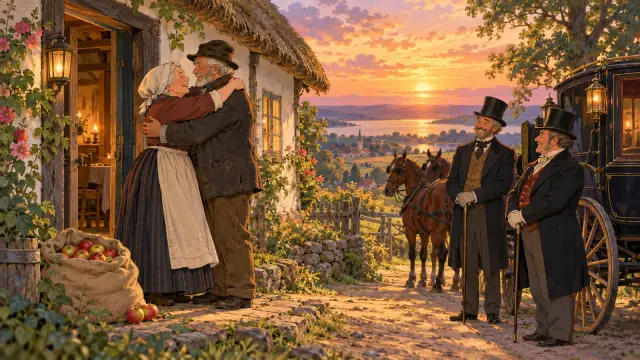
I have no doubt that you have been in the country, and seen a very old farmhouse, with a thatched roof, and mosses and small plants growing wild upon it. There is a stork's nest on the ridge of the gable, for we cannot do without the stork. The walls of the house are sloping, and the windows are low, and only one of the latter is made to open. The baking-oven sticks out of the wall like a great knob. An elder-tree hangs over the palings; and beneath its branches, at the foot of the paling, is a pool of water, in which a few ducks are disporting themselves. There is a yard-dog too, who barks at all corners. Just such a farmhouse as this stood in a country lane; and in it dwelt an old couple, a peasant and his wife. Small as their possessions were, they had one article they could not do without, and that was a horse, which contrived to live upon the grass which it found by the side of the high road. The old peasant rode into the town upon this horse, and his neighbors often borrowed it of him, and paid for the loan of it by rendering some service to the old couple. After a time they thought it would be as well to sell the horse, or exchange it for something which might be more useful to them. But what might this something be?
みなさんもいなかへ行って、とても古い農家を見たことがあるでしょう。わらぶき屋根で、屋根の上にはコケや小さな草が勝手に生えています。切妻のてっぺんにはコウノトリの巣があります。コウノトリがいなくては困るのです。壁はかたむいていて、窓は低く、開けられるのはそのうちの一つだけです。パン焼きがまが、大きなこぶのように壁からつき出しています。ニワトコの木が垣根の上にかぶさり、その枝の下、垣根のすそには池があって、アヒルが何羽か遊んでいます。番犬もいて、なんにでもほえかかります。ちょうどそんな農家が、いなかの小道に立っていました。そこには、年とった夫婦が住んでいました。お百姓とそのおかみさんです。ほとんど何も持っていない二人でしたが、どうしても手放せないものが一つだけありました。それは一頭の馬で、街道ばたの草を食べて、なんとか暮らしていました。年とったお百姓は、この馬に乗って町へ行きました。近所の人たちもよくこの馬を借りていき、借り賃のかわりに、老夫婦の仕事を手伝ってくれました。けれどもしばらくして、二人は、馬を売るか、何かもっと役に立つものと取りかえたほうがいいのではないかと考えました。でも、その何かとは、いったい何でしょう。
"You'll know best, old man," said the wife. "It is fair-day to-day; so ride into town, and get rid of the horse for money, or make a good exchange; whichever you do will be right to me, so ride to the fair." And she fastened his neckerchief for him; for she could do that better than he could, and she could also tie it very prettily in a double bow. She also smoothed his hat round and round with the palm of her hand, and gave him a kiss. Then he rode away upon the horse that was to be sold or bartered for something else. Yes, the old man knew what he was about. The sun shone with great heat, and not a cloud was to be seen in the sky. The road was very dusty; for a number of people, all going to the fair, were driving, riding, or walking upon it. There was no shelter anywhere from the hot sunshine. Among the rest a man came trudging along, and driving a cow to the fair. The cow was as beautiful a creature as any cow could be.
「それは父さんが一番よくわかってるでしょう」と、おかみさんは言いました。「今日は市の立つ日だから、馬に乗って町へ行って、お金にかえるか、何かいいものと取りかえておいでなさいな。父さんのすることなら、どっちだってわたしはかまいませんよ。さあ、市へ行っておいで」おかみさんは、おじいさんのネッカチーフを結んでやりました。結ぶのはおかみさんのほうが上手で、二重のちょう結びにかわいらしく結ぶこともできたのです。帽子も手のひらでぐるりとなでて形を整え、キスをしてやりました。それからおじいさんは、売るか何かと取りかえるかするはずの馬に乗って、出かけていきました。そう、おじいさんは、自分のしていることがちゃんとわかっていたのです。お日さまはかんかんに照りつけ、空には雲一つありませんでした。道はひどくほこりっぽくなっていました。市へ向かう大勢の人が、馬車に乗ったり、馬に乗ったり、歩いたりして、その道を進んでいたからです。暑い日ざしをさけられる場所は、どこにもありませんでした。その人たちにまじって、雌牛を引いて市へとぼとぼ歩いていく男がいました。その雌牛は、これ以上はないというほど見事な牛でした。
"She gives good milk, I am certain," said the peasant to himself. "That would be a very good exchange: the cow for the horse. Hallo there! you with the cow," he said. "I tell you what; I dare say a horse is of more value than a cow; but I don't care for that,—a cow will be more useful to me; so, if you like, we'll exchange." "To be sure I will," said the man.
「あれならきっと、いい乳を出すぞ」と、お百姓は独り言を言いました。「あの雌牛とこの馬を取りかえたら、いい取りかえっこになるな。おーい、そこの牛を連れた人!」と、お百姓は呼びかけました。「ちょっと話があるんだがね。まあ、馬のほうが牛より値打ちがあるんだろうが、そんなことはかまわない。わしには牛のほうが役に立つんだ。どうだい、よかったら取りかえっこしないかね」「ええ、いいですとも」と、男は答えました。
Accordingly the exchange was made; and as the matter was settled, the peasant might have turned back; for he had done the business he came to do. But, having made up his mind to go to the fair, he determined to do so, if only to have a look at it; so on he went to the town with his cow. Leading the animal, he strode on sturdily, and, after a short time, overtook a man who was driving a sheep. It was a good fat sheep, with a fine fleece on its back.
こうして取りかえっこがすみました。話はついたのですから、お百姓はそこで引き返してもよかったのです。出かけてきた用事は、もうすんだのですから。けれども、市へ行くと決めていたので、ちょっとのぞくだけでもと思って、雌牛を連れて町へ向かいました。牛を引いて元気よく大またに歩いていくと、まもなく、羊を追っていく男に追いつきました。よく太った羊で、背中には見事な毛がふさふさと生えていました。
"I should like to have that fellow," said the peasant to himself. "There is plenty of grass for him by our palings, and in the winter we could keep him in the room with us. Perhaps it would be more profitable to have a sheep than a cow. Shall I exchange?" The man with the sheep was quite ready, and the bargain was quickly made. And then our peasant continued his way on the high-road with his sheep. Soon after this, he overtook another man, who had come into the road from a field, and was carrying a large goose under his arm.
「あいつがほしいなあ」と、お百姓は独り言を言いました。「うちの垣根のそばには草がたっぷりあるし、冬になったら、家の中でわしらと一緒に置いておける。牛より羊のほうが得かもしれないぞ。取りかえようか」羊を連れた男はすぐに承知し、取引はすぐにまとまりました。こうしてお百姓は、羊を連れて街道をさらに進んでいきました。まもなく、また別の男に追いつきました。畑から街道に出てきたその男は、大きなガチョウを小わきにかかえていました。
"What a heavy creature you have there!" said the peasant; "it has plenty of feathers and plenty of fat, and would look well tied to a string, or paddling in the water at our place. That would be very useful to my old woman; she could make all sorts of profits out of it. How often she has said, 'If now we only had a goose!' Now here is an opportunity, and, if possible, I will get it for her. Shall we exchange? I will give you my sheep for your goose, and thanks into the bargain."
「ずいぶん重そうなのを持っていなさるね」と、お百姓は言いました。「羽はたっぷり、脂もたっぷりだ。ひもでつないでおいても、うちの池でパチャパチャ泳がせても、さぞ見ばえがするだろう。うちのばあさんには大助かりだ。あれこれ役立てられるからな。ガチョウが一羽いたらねえと、ばあさんは何度も言っていたっけ。ちょうどいい折だ。なんとか手に入れて、ばあさんにやりたいもんだ。どうだい、取りかえっこしないかね。この羊とそのガチョウを取りかえよう。おまけにお礼も言うよ」
The other had not the least objection, and accordingly the exchange was made, and our peasant became possessor of the goose. By this time he had arrived very near the town. The crowd on the high road had been gradually increasing, and there was quite a rush of men and cattle. The cattle walked on the path and by the palings, and at the turnpike-gate they even walked into the toll-keeper's potato-field, where one fowl was strutting about with a string tied to its leg, for fear it should take fright at the crowd, and run away and get lost. The tail-feathers of the fowl were very short, and it winked with both its eyes, and looked very cunning, as it said "Cluck, cluck." What were the thoughts of the fowl as it said this I cannot tell you; but directly our good man saw it, he thought, "Why that's the finest fowl I ever saw in my life; it's finer than our parson's brood hen, upon my word. I should like to have that fowl. Fowls can always pick up a few grains that lie about, and almost keep themselves. I think it would be a good exchange if I could get it for my goose. Shall we exchange?" he asked the toll-keeper. "Exchange," repeated the man; "well, it would not be a bad thing."
相手には少しも異存がなく、取りかえっこがすんで、お百姓はガチョウの持ち主になりました。そのころには、町のすぐ近くまで来ていました。街道の人ごみはだんだんふくれあがり、人も家畜もひしめき合っていました。家畜は小道を歩いたり、垣根ぞいを歩いたりして、通行料を取る門のところでは、門番のジャガイモ畑にまで入りこんでいました。その畑では、一羽のめんどりが、足にひもを結ばれて歩き回っていました。人ごみに驚いて逃げ出し、迷子にならないようにと結ばれていたのです。めんどりは尾羽がとても短く、両目でぱちぱちまばたきをして、いかにもずるがしこそうな顔で「コッコッ」と鳴きました。そう鳴きながら何を考えていたのかは、わたしにはわかりません。けれども、わたしたちのお百姓は、めんどりを見たとたんに思いました。「こいつは、生まれてこのかた見たこともない、見事なめんどりだ。うちの牧師さんのところの、卵を抱くめんどりより立派だぞ。まったくだ。あのめんどりがほしいなあ。めんどりなら、そこらに落ちている穀物の粒をつついて、ほとんど自分で食っていける。このガチョウと取りかえられたら、いい取りかえっこになるだろう」「取りかえっこしないかね」と、お百姓は門番に尋ねました。「取りかえっこだって」と、門番はくり返しました。「そうだね、悪くない話だ」
And so they made an exchange,—the toll-keeper at the turnpike-gate kept the goose, and the peasant carried off the fowl. Now he had really done a great deal of business on his way to the fair, and he was hot and tired. He wanted something to eat, and a glass of ale to refresh himself; so he turned his steps to an inn. He was just about to enter when the ostler came out, and they met at the door. The ostler was carrying a sack. "What have you in that sack?" asked the peasant. "Rotten apples," answered the ostler; "a whole sackful of them. They will do to feed the pigs with."
こうして取りかえっこがすみました。門番がガチョウを受け取り、お百姓はめんどりを連れていきました。さて、お百姓は市へ行く途中で、本当にたくさんの取引をしたわけです。暑くて、くたびれてしまいました。何か食べて、エールを一杯飲んで元気をつけたくなったので、宿屋のほうへ足を向けました。ちょうど入ろうとしたとき、宿屋の馬番が出てきて、二人は戸口で鉢合わせしました。馬番は袋をかついでいました。「その袋には何が入っているんだい」と、お百姓は尋ねました。「腐ったリンゴですよ」と、馬番は答えました。「袋にいっぱいです。豚のえさにはなるでしょう」
"Why that will be terrible waste," he replied; "I should like to take them home to my old woman. Last year the old apple-tree by the grass-plot only bore one apple, and we kept it in the cupboard till it was quite withered and rotten. It was always property, my old woman said; and here she would see a great deal of property—a whole sackful; I should like to show them to her." "What will you give me for the sackful?" asked the ostler. "What will I give? Well, I will give you my fowl in exchange."
「そいつはひどくもったいない」と、お百姓は言いました。「うちのばあさんに持って帰ってやりたいなあ。去年、草地のそばの古いリンゴの木には、たった一つしか実がならなかった。わしらはそれを戸棚にしまって、すっかりしなびて腐るまで取っておいたんだ。それでも財産は財産だと、ばあさんは言っておった。ここには財産がどっさりある。袋いっぱいだ。ばあさんに見せてやりたいもんだ」「この袋いっぱいと、何を取りかえてくれます」と、馬番は尋ねました。「何と取りかえるかって。そうだな、このめんどりと取りかえよう」
So he gave up the fowl, and received the apples, which he carried into the inn parlor. He leaned the sack carefully against the stove, and then went to the table. But the stove was hot, and he had not thought of that. Many guests were present—horse dealers, cattle drovers, and two Englishmen. The Englishmen were so rich that their pockets quite bulged out and seemed ready to burst; and they could bet too, as you shall hear. "Hiss-s-s, hiss-s-s." What could that be by the stove? The apples were beginning to roast. "What is that?" asked one.
こうしてお百姓は、めんどりを渡してリンゴを受け取り、宿屋の食堂へ運びこみました。袋をストーブにそっと立てかけてから、テーブルにつきました。けれどもストーブは熱くなっていたのに、お百姓はそのことを考えていませんでした。食堂には大勢の客がいました。馬の商人や牛追い、それに二人のイギリス人です。イギリス人たちはとてもお金持ちで、ポケットがふくらんで、今にもはち切れそうでした。それに、これからお話しするように、賭けごとも好きでした。「シューッ、シューッ」ストーブのそばで、いったい何の音でしょう。リンゴが焼けはじめていたのです。「あれは何だい」と、一人が尋ねました。
"Why, do you know"—said our peasant. And then he told them the whole story of the horse, which he had exchanged for a cow, and all the rest of it, down to the apples. "Well, your old woman will give it you well when you get home," said one of the Englishmen. "Won't there be a noise?" "What! Give me what?" said the peasant. "Why, she will kiss me, and say, 'what the old man does is always right.'"
「いや、実はですな……」と、お百姓は話しだしました。そして、馬を雌牛と取りかえたことから始めて、リンゴにいたるまでの一部始終を話して聞かせました。「やれやれ、家に帰ったら、おかみさんにたっぷりお見舞いされるだろうね」と、イギリス人の一人が言いました。「大騒ぎになるんじゃないかな」「なんですって。何をお見舞いしてくれるんです」と、お百姓は言いました。「なに、ばあさんはわしにキスをして、『父さんのすることはいつもよし』と言いますよ」
"Let us lay a wager on it," said the Englishmen. "We'll wager you a ton of coined gold, a hundred pounds to the hundred-weight." "No; a bushel will be enough," replied the peasant. "I can only set a bushel of apples against it, and I'll throw myself and my old woman into the bargain; that will pile up the measure, I fancy." "Done! taken!" and so the bet was made.
「それなら賭けをしよう」と、イギリス人たちは言いました。「金貨を一トン賭けよう。ポンド金貨を目方で量ってね」「いや、ます一ぱいでたくさんです」と、お百姓は答えました。「こっちが賭けられるのは、リンゴがます一ぱいだけですからね。そのかわり、わしとばあさんもおまけにつけましょう。それで、ますは山盛りになるでしょう」「よし、乗った!決まりだ!」こうして賭けが成立しました。
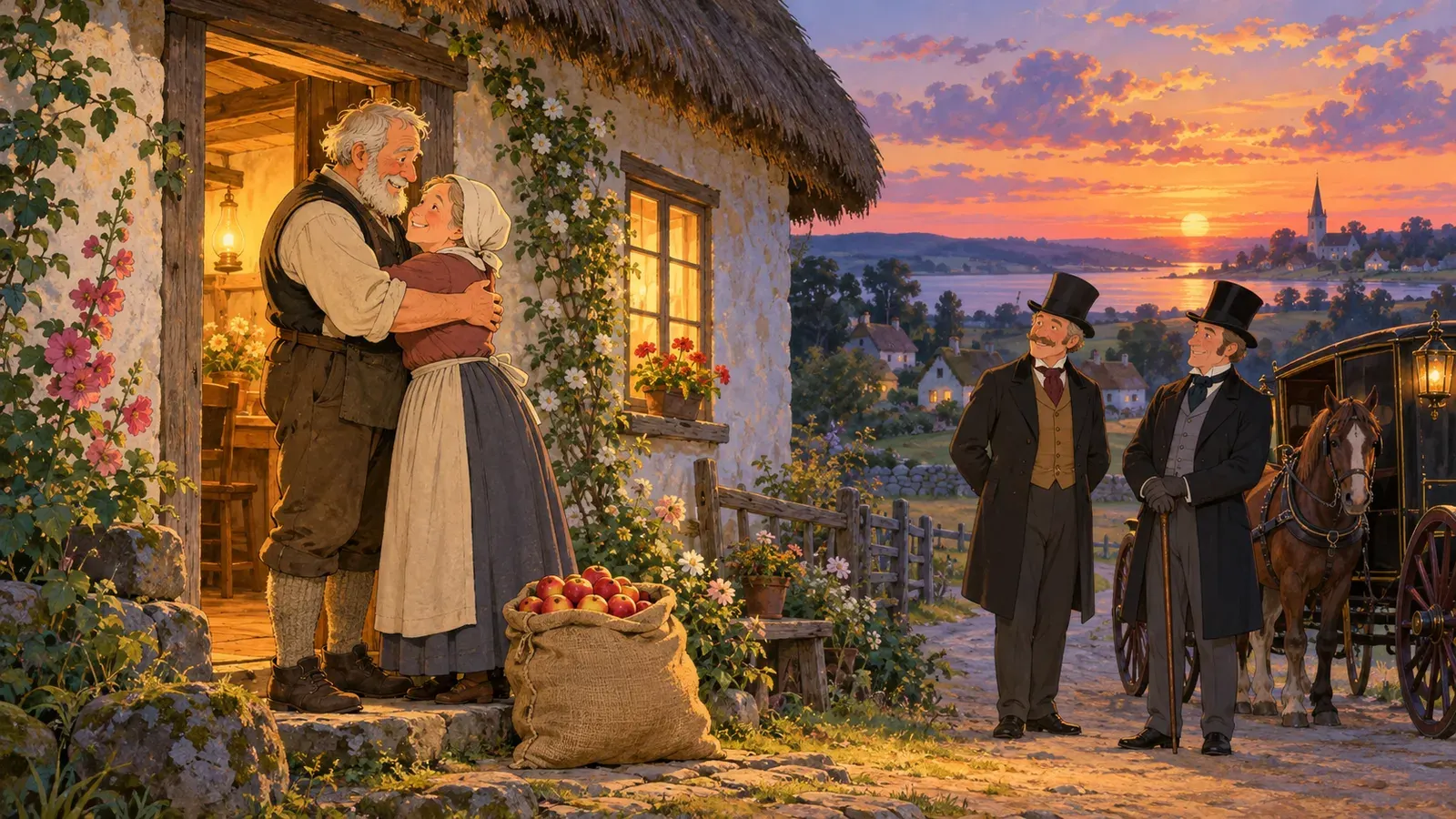
Then the landlord's coach came to the door, and the two Englishmen and the peasant got in, and away they drove, and soon arrived and stopped at the peasant's hut. "Good evening, old woman." "Good evening, old man." "I've made the exchange." "Ah, well, you understand what you're about," said the woman. Then she embraced him, and paid no attention to the strangers, nor did she notice the sack.
それから宿屋の主人の馬車が戸口に回され、二人のイギリス人とお百姓が乗りこみました。馬車は走りだし、まもなくお百姓の小さな家の前にとまりました。「ただいま、母さん」「おかえり、父さん」「取りかえっこをしてきたよ」「まあ、父さんのことだもの、ちゃんとわかってしたんでしょう」と、おかみさんは言いました。そして、おじいさんを抱きしめました。よその人たちには目もくれず、袋にも気がつきませんでした。
"I got a cow in exchange for the horse." "Thank Heaven," said she. "Now we shall have plenty of milk, and butter, and cheese on the table. That was a capital exchange." "Yes, but I changed the cow for a sheep." "Ah, better still!" cried the wife. "You always think of everything; we have just enough pasture for a sheep. Ewe's milk and cheese, woollen jackets and stockings! The cow could not give all these, and her hair only falls off. How you think of everything!"
「馬を雌牛と取りかえたんだ」「まあ、ありがたい」と、おかみさんは言いました。「これで牛乳もバターもチーズも、たっぷり食卓にのせられるわ。すばらしい取りかえっこだこと」「ああ、だが、その牛を羊と取りかえたんだ」「まあ、もっといいわ!」と、おかみさんは叫びました。「父さんはいつも、なんでもよく考えてくれるのね。うちには、羊一頭にちょうどいいだけの牧草があるもの。羊の乳にチーズ、それに毛糸の上着に靴下!牛じゃあ、こうはいかないわ。牛の毛は抜けるだけだもの。父さんはほんとに、なんでもよく考えてくれるのね!」
"But I changed away the sheep for a goose." "Then we shall have roast goose to eat this year. You dear old man, you are always thinking of something to please me. This is delightful. We can let the goose walk about with a string tied to her leg, so she will be fatter still before we roast her." "But I gave away the goose for a fowl." "A fowl! Well, that was a good exchange," replied the woman. "The fowl will lay eggs and hatch them, and we shall have chickens; we shall soon have a poultry-yard. Oh, this is just what I was wishing for."
「でも、その羊をガチョウと取りかえたんだ」「それなら、今年はガチョウの丸焼きが食べられるわね。やさしい父さん、いつもわたしを喜ばせることを考えてくれるのね。うれしいわ。ガチョウは足にひもを結んで歩かせておきましょう。そうすれば、焼く前にもっと太るわ」「でも、そのガチョウをめんどりと取りかえたんだ」「めんどりですって!まあ、いい取りかえっこだこと」と、おかみさんは答えました。「めんどりは卵を産んで、ひなをかえすわ。そうしたらひよこがふえて、すぐに鶏小屋ができるわね。ああ、これこそわたしがほしかったものよ」
"Yes, but I exchanged the fowl for a sack of shrivelled apples." "What! I really must give you a kiss for that!" exclaimed the wife. "My dear, good husband, now I'll tell you something. Do you know, almost as soon as you left me this morning, I began to think of what I could give you nice for supper this evening, and then I thought of fried eggs and bacon, with sweet herbs; I had eggs and bacon, but I wanted the herbs; so I went over to the schoolmaster's: I knew they had plenty of herbs, but the schoolmistress is very mean, although she can smile so sweetly. I begged her to lend me a handful of herbs. 'Lend!' she exclaimed, 'I have nothing to lend; nothing at all grows in our garden, not even a shrivelled apple; I could not even lend you a shrivelled apple, my dear woman.' But now I can lend her ten, or a whole sackful, which I'm very glad of; it makes me laugh to think about it;" and then she gave him a hearty kiss.
「ああ、だが、そのめんどりを、しなびたリンゴひと袋と取りかえたんだ」「なんですって!それはもう、キスをしてあげなくちゃ!」と、おかみさんは叫びました。「やさしい、いい父さん。じゃあ、わたしからも話があるの。あのね、けさ父さんが出かけたすぐあとで、今夜の晩ごはんに何かおいしいものを作ってあげようと考えたの。それで、香草をそえたベーコンエッグがいいと思いついたのよ。卵とベーコンはあったけれど、香草がなかった。だから、学校の先生の家へ行ったの。あそこには香草がどっさりあるのを知っていたから。でも先生の奥さんは、とてもけちなのよ。にっこり笑うのは、とても上手なんだけれどね。香草を一つかみ貸してくださいと頼んだら、奥さんはこう言ったの。『貸すですって!貸せるものなんか何もありませんよ。うちの庭には何も生えないんですもの。しなびたリンゴ一つだってね。しなびたリンゴ一つだって、お貸しできませんわ、奥さん』ってね。でも今なら、十個だって、ひと袋まるごとだって貸してあげられる。本当にうれしいわ。考えただけで笑っちゃう」そう言って、おかみさんはおじいさんに心のこもったキスをしました。
"Well, I like all this," said both the Englishmen; "always going down the hill, and yet always merry; it's worth the money to see it." So they paid a hundred-weight of gold to the peasant, who, whatever he did, was not scolded but kissed. Yes, it always pays best when the wife sees and maintains that her husband knows best, and whatever he does is right. That is a story which I heard when I was a child; and now you have heard it too, and know that "What the old man does is always right."
「いやあ、気に入った」と、二人のイギリス人は言いました。「坂を転げ落ちるように損ばかりしているのに、いつでも楽しそうだ。これはお金を払って見るだけの値打ちがある」そこで二人は、何をしてもしかられずにキスしてもらえるお百姓に、百ポンド以上(五十キロあまり)もの金貨を払いました。そうなのです。夫が一番よくわかっていて、夫のすることはなんでも正しい。妻がそう思って、そう言い張るなら、それがいつだって一番得になるのです。これは、わたしが子どものころに聞いたお話です。今、みなさんも聞きましたね。そして、「父さんのすることはいつもよし」ということが、わかったでしょう。