About two thousand years ago, wealthy people in Rome loved to wear silk. It was light, smooth and beautiful, and it was extremely expensive. Some Roman writers complained that silk clothes were so thin that they hardly covered the body, and that too much Roman money was flowing to the East to pay for them. Yet few Romans knew exactly where silk came from. They knew only that it came from a distant land far to the east, carried by many hands across mountains and deserts. That land was China, and the routes the silk traveled along are now known as the Silk Road.
今からおよそ2000年前、ローマのお金持ちたちは絹の服を好んで着ていました。絹は軽く、なめらかで美しく、そしてとてつもなく高価でした。ローマの文筆家の中には、文句を言う人もいました。絹の服は薄すぎて、体がほとんどかくれていない。しかも、その代金として、ローマのお金があまりにもたくさん東へ流れ出ている、というのです。ところが、絹がどこから来るのかを正確に知っているローマ人は、ほとんどいませんでした。分かっていたのは、はるか東の遠い国から、山や砂漠をこえ、たくさんの人の手をへて運ばれてくる、ということだけです。その国とは中国でした。そして、絹が運ばれてきた道は、今ではシルクロードと呼ばれています。
The name itself is surprisingly modern. It was created in 1877 by a German geographer, Ferdinand von Richthofen. And the Silk Road was never a single road. It was a huge network of routes connecting China with Central Asia, India, Persia, the Middle East and the Mediterranean. There were also sea routes linking ports across the Indian Ocean. For this reason, many historians today prefer to speak of the Silk Roads.
じつは、シルクロードという名前は意外に新しく、1877年にドイツの地理学者フェルディナント・フォン・リヒトホーフェンがつけたものです。それに、シルクロードは一本の道だったわけではありません。中国と、中央アジア、インド、ペルシャ、中東、地中海とを結ぶ、巨大な道の網の目だったのです。インド洋のあちこちの港を結ぶ、海の道もありました。そのため、今では多くの歴史家が、複数形で「シルクローズ(Silk Roads)」と呼ぶほうを好んでいます。
In China, the story of the Silk Road often begins with a brave traveler named Zhang Qian. In the second century BC, the Han emperor Wu sent him west to find allies against the Xiongnu, a powerful group of horse-riding people who often attacked China from the north. On the way, Zhang Qian was captured by the Xiongnu and held for about ten years. He married there and had a child, but he never forgot his mission. Eventually, he escaped and continued west. He did not win the alliance he wanted, but when he finally returned home, about thirteen years after he had left, he brought back something more valuable: detailed knowledge of the kingdoms of Central Asia, their markets and their wonderful horses.
中国では、シルクロードの物語は、張騫(ちょうけん)という勇敢な旅人から語られることがよくあります。紀元前2世紀、漢の武帝は張騫を西へ送り出しました。目的は、匈奴(きょうど)と戦うための仲間を見つけることです。匈奴は馬に乗って暮らす強い民族で、北からたびたび中国に攻めこんでいました。ところが張騫は、旅の途中で匈奴につかまり、10年ほどとらわれの身になってしまいます。そこで結婚し、子どもも生まれましたが、自分の使命は決して忘れませんでした。やがて張騫は逃げ出し、さらに西へと進みました。結局、めざしていた同盟は結べませんでした。それでも、出発から13年ほどたってようやく帰国したとき、張騫はもっと価値のあるものを持ち帰ったのです。中央アジアの国々や、その市場、そしてすばらしい馬についての、くわしい知識でした。
The emperor was especially interested in those horses. The horses of the Ferghana Valley, in Central Asia, were larger and faster than Chinese horses, and the Chinese called them "heavenly horses." China wanted horses, and the peoples of the West wanted silk. Trade along the routes grew steadily, and the Han government extended its walls and built watchtowers to protect parts of the route through the desert.
武帝がとくに心をひかれたのは、その馬でした。中央アジアのフェルガナ盆地の馬は、中国の馬よりも大きくて速く、中国の人々はこれを「天馬」と呼びました。中国は馬をほしがり、西の人々は絹をほしがりました。こうして、道ぞいの交易は着実にさかんになっていきました。漢の政府は、長城をのばしたり見張り台を建てたりして、砂漠を通る道の一部を守りました。
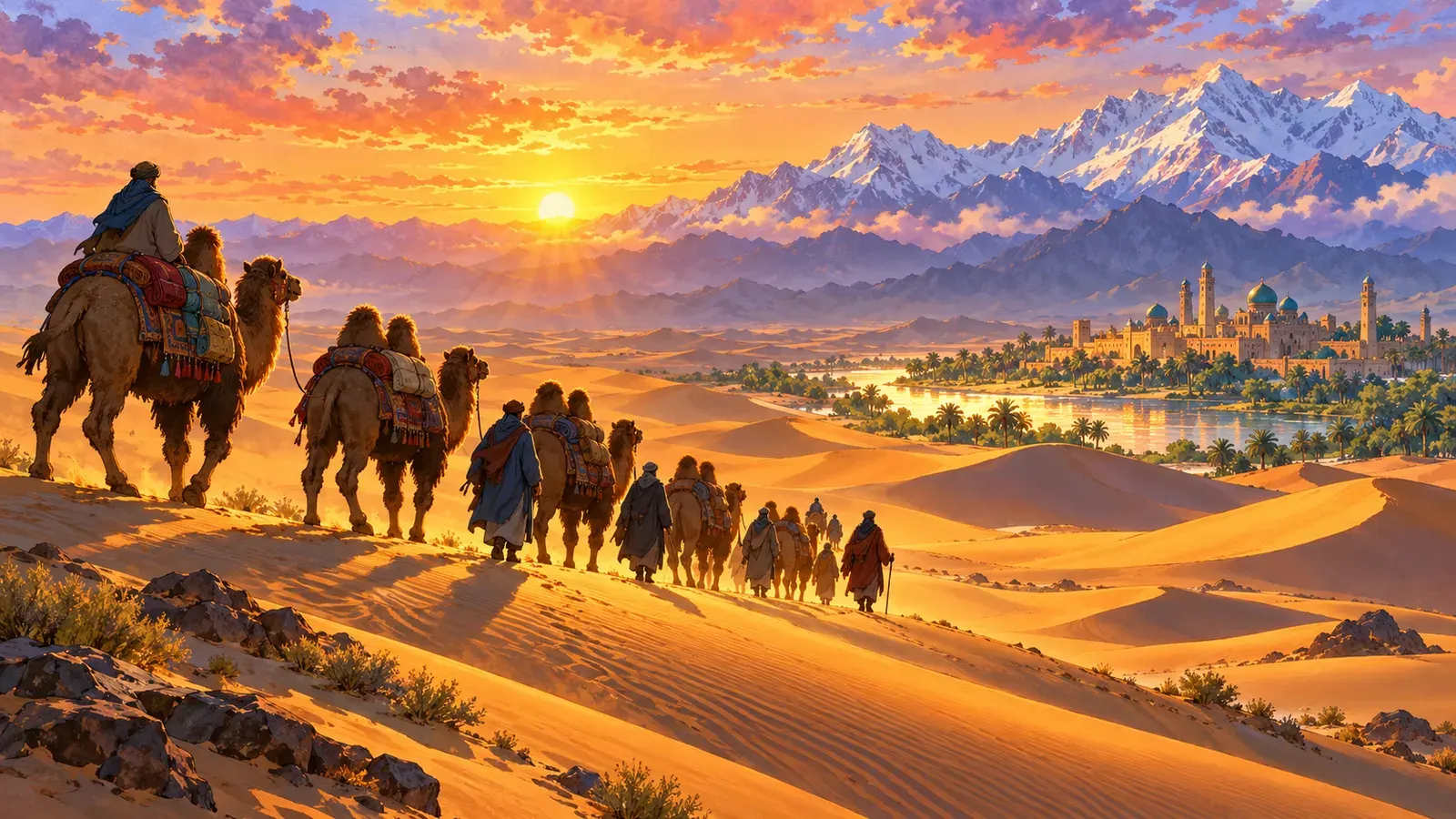
Traveling the Silk Road was hard and dangerous. One of the most feared areas was the Taklamakan Desert in western China, a sea of sand where summer days were burning hot and winter nights were freezing. Travelers moved in groups called caravans, often with Bactrian camels, which have two humps, can survive both heat and cold, and can go a long time without water. Along the way, they stopped at oasis cities such as Dunhuang, Turpan, Kashgar and Samarkand, where they could rest, find water and trade.
シルクロードの旅は、つらく危険なものでした。とくに恐れられていたのが、中国の西部にあるタクラマカン砂漠です。見わたすかぎり砂の海で、夏の昼は焼けつくように暑く、冬の夜はこごえるほど寒くなります。旅人たちは、キャラバン(隊商)と呼ばれる集団を組んで進みました。いっしょに連れていくのは、たいていフタコブラクダです。こぶが二つあり、暑さにも寒さにも強く、長いあいだ水を飲まなくても平気なのです。旅の途中、一行は敦煌、トルファン、カシュガル、サマルカンドといったオアシスの町に立ち寄りました。そこで体を休め、水を手に入れ、商売をしたのです。
Very few people traveled the whole route. Most merchants carried goods only part of the way and then sold them to other merchants, who carried them farther. A roll of silk might change hands many times between China and the Mediterranean, becoming more expensive at each step. This is one reason why the Romans and the Chinese knew so little about each other. Among the most important traders were the Sogdians, a people from the area around Samarkand, who built trading communities all along the routes and were famous for their business skills.
道をはじめから終わりまで旅する人は、ほとんどいませんでした。たいていの商人は、品物を途中まで運ぶと、別の商人に売りわたします。その商人が、さらに先まで運んでいくのです。一巻きの絹が、中国から地中海に着くまでに何度も持ち主を変え、そのたびに値段が上がっていくこともあったでしょう。ローマ人と中国人がお互いのことをほとんど知らなかったのは、ひとつにはそのためです。とくに大きな役割を果たした商人に、ソグド人がいます。サマルカンドのあたりに住んでいた人たちで、道ぞいのあちこちに交易の拠点となる居留地を築き、商売のうまさで知られていました。
Silk was only one of many goods. Over the centuries, porcelain, tea, paper and lacquer traveled west from China. Horses, glass, silver, gold, wool and new plants such as grapes traveled east. Spices, jewels and medicines moved in every direction.
絹は、たくさんある品物のひとつにすぎませんでした。何百年ものあいだに、中国からは陶磁器、茶、紙、漆器が西へ運ばれました。東へは、馬、ガラス、銀、金、羊毛、そしてブドウのような新しい植物が運ばれました。香辛料や宝石や薬は、あらゆる方向へ行き来しました。
For a long time, China kept the method of making silk a closely guarded secret. Silk comes from the cocoons of silkworms, which feed on mulberry leaves, and producing it requires special knowledge and skill. According to a story told by Byzantine writers, in the sixth century, monks smuggled silkworm eggs out of Asia, hidden inside hollow canes, and brought them to the Byzantine emperor Justinian. Whether or not every detail is true, silk production did begin in the Byzantine Empire around that time.
中国は長いあいだ、絹の作り方をかたく秘密にしていました。絹は、桑の葉を食べて育つカイコのまゆからとれます。絹を作るには、特別な知識と技術が必要なのです。ビザンティン帝国の文筆家たちが伝える話では、6世紀に、修道士たちが中が空洞になった杖にカイコの卵をかくして、アジアからこっそり持ち出したといいます。そして、ビザンティン皇帝ユスティニアヌスのもとへ届けたというのです。話のこまかいところまで本当かどうかは分かりません。それでも、ちょうどそのころ、ビザンティン帝国で絹づくりが始まったのはたしかです。
The most important things that traveled along the Silk Road, however, were not goods but ideas. Buddhism, which began in India, spread along the trade routes into Central Asia and China, carried by monks and merchants. From China, it later spread to Korea and Japan. Huge cave temples were carved along the routes, such as the Mogao Caves near Dunhuang, where hundreds of caves are filled with Buddhist paintings and statues. In 1900, a hidden room was discovered in one of these caves. It was packed with tens of thousands of old documents in many languages, including a printed Buddhist text from the year 868, one of the oldest dated printed books in the world. In the seventh century, a Chinese monk named Xuanzang traveled along the Silk Road all the way to India to collect Buddhist texts, a journey that took many years. His adventures later inspired the famous Chinese novel Journey to the West, the story of the Monkey King, known in Japan as Saiyuki.
けれども、シルクロードを通って運ばれたもので最も大切なのは、品物ではなく、思想でした。インドで生まれた仏教は、僧や商人たちによって、交易の道をたどって中央アジアや中国へ広まりました。そして中国から、のちに朝鮮や日本へ伝わったのです。道ぞいには、岩をほって作った巨大な寺院がいくつも造られました。敦煌の近くの莫高窟(ばっこうくつ)もそのひとつで、何百もの洞窟が、仏教の絵や仏像でうめつくされています。1900年、その洞窟のひとつで、かくし部屋が見つかりました。中には、さまざまな言葉で書かれた古い文書が、何万点もぎっしり詰まっていました。その中には、868年に印刷された仏教の経典もありました。印刷された年が分かっている本としては、世界で最も古いもののひとつです。7世紀には、玄奘(げんじょう)という中国の僧が、仏教の経典を求めて、シルクロードをはるばるインドまで旅しました。何年もかかった旅です。その冒険は、のちに中国の有名な小説『西遊記』のもとになりました。孫悟空が活やくする物語です。
Other religions also traveled along these paths, including Christianity and Islam, together with music, art, mathematics and medicine. Technologies traveled too. Paper was invented in China, and the knowledge of how to make it slowly moved west. A famous story says that Chinese papermakers were captured in a battle in 751 and taught their craft in Samarkand, although historians now think the real story was more gradual. By around 800, paper was being made in Baghdad, and from the Islamic world, it later reached Europe.
この道を通って伝わった宗教は、仏教だけではありません。キリスト教やイスラム教も伝わり、音楽や美術、数学や医学もいっしょに伝わりました。技術も伝わりました。紙は中国で発明され、その作り方はゆっくりと西へ伝わっていきました。有名な話では、751年の戦いで中国の紙職人たちが捕虜になり、サマルカンドで紙すきの技術を教えたといわれます。けれども今の歴史家は、本当はもっと少しずつ伝わったのだろうと考えています。800年ごろには、バグダッドで紙が作られるようになっていました。そしてイスラム世界から、のちにヨーロッパへ伝わったのです。
In the 1200s, the Mongol Empire, founded by Genghis Khan, conquered most of the land along the Silk Road. Under Mongol rule, travel across Asia became safer than it had been for centuries, and trade flourished. It was during this period that the Venetian merchant Marco Polo traveled to China. The book about his journeys made Europeans dream about the riches of the East. But the routes carried dangers as well. In the 1300s, the terrible disease known as the Black Death is believed to have spread from Central Asia toward Europe partly along trade routes, killing a huge part of the population.
1200年代、チンギス・ハンが築いたモンゴル帝国が、シルクロードぞいの土地のほとんどを征服しました。モンゴルの支配のもとで、アジアを横切る旅は、それまでの何百年でいちばん安全になり、交易は大いに栄えました。ヴェネツィアの商人マルコ・ポーロが中国へ旅したのも、この時代のことです。その旅について書かれた本を読んで、ヨーロッパの人々は東の国の富にあこがれました。けれども、道が運んだのは、よいものばかりではありませんでした。1300年代、黒死病と呼ばれるおそろしい病気が、中央アジアからヨーロッパへ広がりました。その広がりには、交易の道も一役買ったと考えられています。この病気で、人口のとても大きな割合が命を落としました。
After the 1400s, the land routes became less important. The Mongol Empire had broken apart, and European sailors found sea routes around Africa to India and East Asia. Ships could carry far more goods, far more cheaply, than camels could. Many oasis cities slowly declined, and over the centuries, some old settlements were abandoned and buried by sand.
1400年代をすぎると、陸の道はあまり使われなくなりました。モンゴル帝国はばらばらになり、ヨーロッパの船乗りたちが、アフリカを回ってインドや東アジアへ行く海の道を見つけたからです。船なら、ラクダよりはるかにたくさんの品物を、はるかに安く運べます。多くのオアシスの町は少しずつさびれていきました。何百年もたつうちに、人がいなくなり、砂にうもれてしまった古い町もあります。
Japan is sometimes called the eastern end of the Silk Road. In the Shosoin, the treasure house of Todaiji Temple in Nara, there are objects from the eighth century that show how far goods and ideas traveled. Among them are a beautifully decorated five-stringed lute, a kind of instrument that came from India through China, and a cut-glass bowl that is believed to have been made in Persia. These objects crossed deserts, mountains and seas before arriving in Nara more than twelve hundred years ago.
日本は、シルクロードの東の終点と呼ばれることがあります。奈良の東大寺の宝物庫、正倉院には、8世紀の品々が収められています。それを見れば、品物や思想がどれほど遠くまで旅をしたかが分かります。たとえば、美しくかざられた五弦の琵琶。インドから中国をへて伝わった楽器の一種です。また、ペルシャで作られたと考えられている、カットガラスのうつわもあります。こうした品々は、砂漠や山や海をこえて、1200年以上も前に奈良にたどり着いたのです。
In 2014, part of the Silk Road network across China, Kazakhstan and Kyrgyzstan was named a UNESCO World Heritage Site. But the greatest legacy of the Silk Road is not any single place. It is the idea that people who lived far apart, spoke different languages and believed different things could still trade, learn from each other and change each other's lives. In a world connected by the internet, that idea feels very modern, but it is more than two thousand years old.
2014年、中国、カザフスタン、キルギスにまたがるシルクロードの道の一部が、ユネスコの世界遺産に登録されました。けれども、シルクロードが残した最大の遺産は、どこかひとつの場所ではありません。遠く離れて暮らし、違う言葉を話し、違うものを信じている人たちでも、品物を売り買いし、お互いに学び合い、互いの暮らしを変えることができる。その考え方こそが、最大の遺産なのです。インターネットで世界がつながった今、この考え方はとても現代的に思えます。けれども、それは2000年以上も前からあるものなのです。