Every time you use a smartphone to play music, translate a sentence, or edit a photo, you are using a machine that works with much more than numbers. In 1843, long before any computer existed, a young woman wrote that a machine might one day work with music and other symbols as well as numbers. Her name was Ada Lovelace. Today she is often called the first computer programmer, though, as we will see, that title is still debated.
スマートフォンで音楽をかけたり、文を翻訳したり、写真を加工したりするたびに、私たちは、数字だけでなくさまざまな情報を扱う機械を使っています。コンピューターがまだどこにもなかった1843年、ある若い女性が、機械はいつか数字だけでなく、音楽やほかの記号も扱えるようになるかもしれない、と書きました。その人の名は、エイダ・ラブレス。今日、エイダは世界で最初のプログラマーと呼ばれることがよくあります。ただし、あとで見るように、この呼び名には今も議論があります。
Ada was born in London on December 10, 1815. Her father was Lord Byron, one of the most famous poets in Europe, known for his brilliant writing and his wild, scandalous life. Her mother, Annabella Milbanke, was a well-educated woman with a strong interest in mathematics. Byron once jokingly called her the "Princess of Parallelograms."
エイダは1815年12月10日、ロンドンで生まれました。父はバイロン卿。ヨーロッパでもっとも有名な詩人の一人で、すばらしい作品と、奔放でスキャンダルだらけの暮らしぶりで知られていました。母のアナベラ・ミルバンクは高い教育を受けた女性で、数学に強い関心を持っていました。バイロンはふざけて、妻を「平行四辺形のお姫さま」と呼んだことがあります。
The marriage was unhappy. When Ada was only five weeks old, her mother left with her. A few months later, Byron left England for ever. Ada never saw him again. He died in Greece in 1824, when she was eight.
二人の結婚は、不幸なものでした。エイダが生まれてわずか5週間のとき、母はエイダを連れて家を出ました。その数か月後、バイロンはイギリスを去り、二度と戻りませんでした。エイダが父に会うことは、その後一度もありませんでした。バイロンは1824年、ギリシャで亡くなりました。エイダが8歳のときです。
Her mother was determined that Ada should not become like her father. She arranged for Ada to be taught mathematics, science, and logic, partly in the hope that these subjects would keep her away from dangerous emotions and wild imagination. Ada was a lively, curious child. At about twelve, she decided that she wanted to fly. She studied the bodies of birds, tried to work out what materials could be used for wings, and planned to write a book about it, which she called Flyology.
母は、エイダを父親のようにはさせまいと固く決めていました。そこで、エイダに数学や科学、論理学を学ばせました。こうした科目が、危うい感情や、とりとめのない想像からエイダを遠ざけてくれるのではないか。そんな期待もあったのです。エイダは元気で、好奇心いっぱいの子どもでした。12歳ごろ、エイダは空を飛びたいと思い立ちます。鳥の体のつくりを調べ、翼にはどんな材料が使えるかを考え、そのことについて本を書く計画まで立てました。本の題は『フライオロジー(飛行学)』でした。
Her health was often poor. In 1829, after an attack of measles, she became paralyzed and had to stay in bed for nearly a year. It was not until 1831 that she could walk again, and even then she needed crutches. During these long months, she continued to study. Her mind seemed to grow stronger while her body was weak.
エイダは、よく体をこわしました。1829年には、はしかにかかったあと体がまひし、1年近くもベッドで寝たきりになりました。ふたたび歩けるようになったのは1831年のことで、それでも松葉杖が必要でした。この長い月日のあいだも、エイダは勉強を続けました。体が弱っているあいだに、心はかえってたくましく育っていったかのようでした。
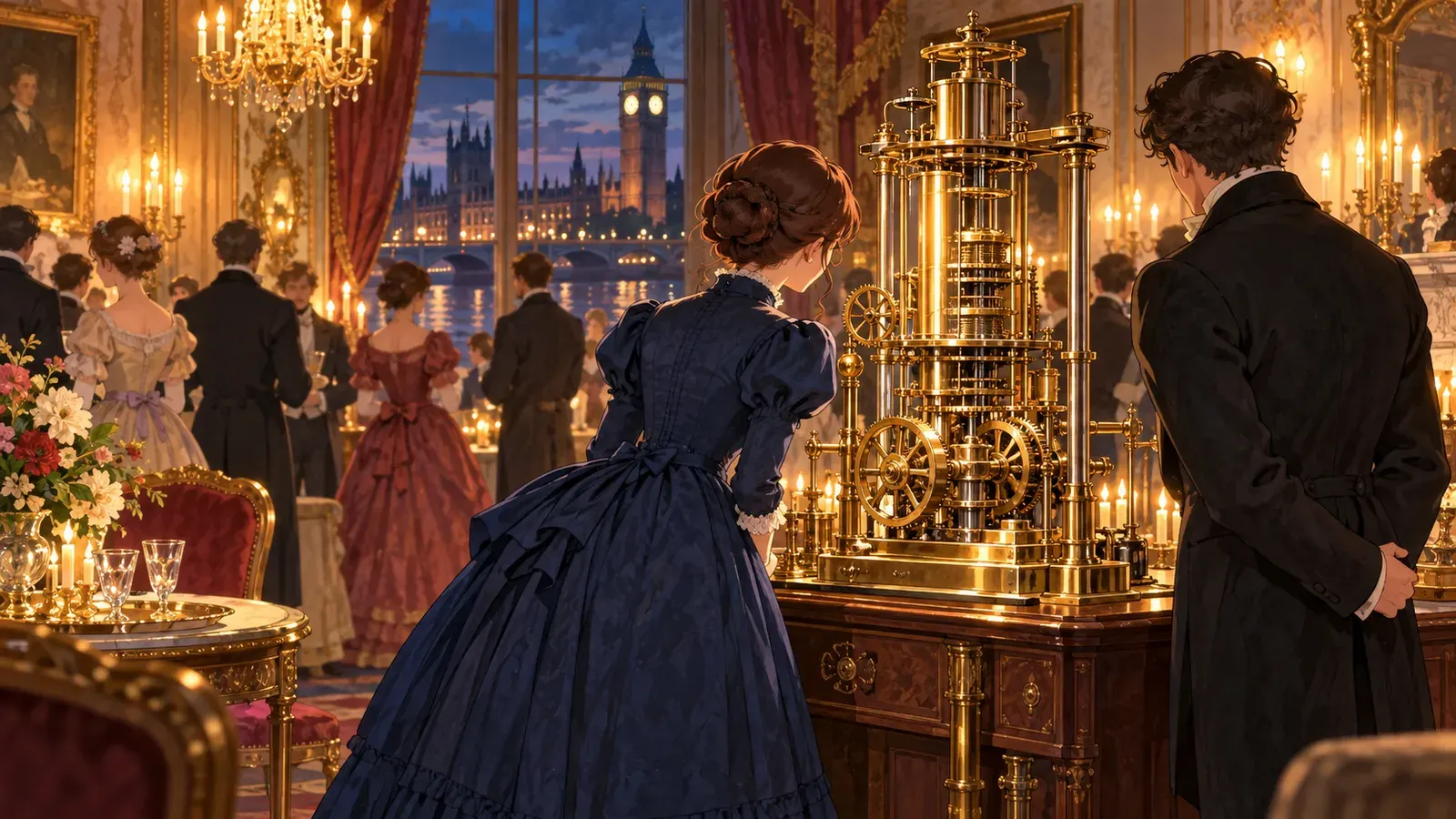
In June 1833, at the age of seventeen, Ada went to a party at the home of Charles Babbage, a mathematician and inventor. There she saw part of his Difference Engine, a large machine made of metal gears that could calculate tables of numbers automatically. Many guests saw it as a curious toy. Ada understood what it was doing and was fascinated. She and Babbage became friends, and they kept writing to each other for the rest of her life.
1833年6月、17歳のエイダは、数学者で発明家のチャールズ・バベッジの家で開かれたパーティーに出かけました。そこでエイダは、バベッジの「階差機関」の一部を目にします。金属の歯車でできた大きな機械で、数表を自動で計算することができました。客の多くは、これを珍しいおもちゃのように見ていました。けれどもエイダは、この機械が何をしているのかを理解し、すっかり心を奪われたのです。エイダとバベッジは友だちになり、エイダが亡くなるまで手紙のやりとりを続けました。
Babbage was impressed by the young woman's quick mind. Years later, in a letter, he called her the "Enchantress of Number." Ada, for her part, was confident of her own abilities. She believed that with enough study, she could make a real contribution to science, and she was not shy about saying so.
バベッジは、この若い女性の頭の回転の速さに感心しました。何年もあとには、手紙の中でエイダを「数の魔法使い」と呼んでいます。エイダのほうも、自分の能力に自信を持っていました。しっかり学べば、科学に本当の貢献ができる。エイダはそう信じていて、それを口にすることもためらいませんでした。
Ada continued her studies with excellent teachers, including the scientist Mary Somerville, and later the mathematician Augustus De Morgan, who taught her advanced mathematics by letter. In 1835, she married William King, who later became the Earl of Lovelace, so she became the Countess of Lovelace. They had three children between 1836 and 1839. Being a mother and a member of high society took much of her time, but she never gave up her studies.
エイダはその後も、すぐれた先生たちについて勉強を続けました。科学者のメアリー・サマヴィル、のちには数学者のオーガスタス・ド・モルガンです。ド・モルガンは、手紙を通して高度な数学を教えてくれました。1835年、エイダはウィリアム・キングと結婚しました。キングはのちにラブレス伯爵となり、エイダはラブレス伯爵夫人になりました。二人のあいだには、1836年から1839年までに3人の子どもが生まれました。母として、また上流社会の一員として時間の多くをとられましたが、エイダは決して勉強をやめませんでした。
Meanwhile, Babbage had begun to design an even more ambitious machine, the Analytical Engine. It would not only follow one fixed method of calculating. It could be given different instructions.
そのころバベッジは、さらに大がかりな機械、「解析機関」の設計を始めていました。この機械は、決まった一つの計算方法に従うだけではありません。いろいろな命令を与えることができるのです。
These instructions would be fed into the machine on punched cards, an idea he borrowed from the Jacquard loom, a machine that used cards with holes in them to weave complex patterns into cloth. The design included a part to store numbers and a part to work on them, much like the memory and processor of a modern computer. Sadly, the Analytical Engine was never built. It was too complicated and expensive to build with the technology and funding available at the time.
命令は、穴をあけたカード、つまりパンチカードで機械に読みこませる仕組みでした。これは、バベッジがジャカード織機から借りたアイデアです。ジャカード織機は、穴のあいたカードを使って、布に複雑な模様を織りこむ機械でした。設計には、数をたくわえておく部分と、数を処理する部分がありました。今のコンピューターのメモリーとプロセッサーによく似ています。残念なことに、解析機関が実際に作られることはありませんでした。当時の技術と資金で作るには、あまりにも複雑で、費用もかかりすぎたのです。
Babbage admired the Jacquard loom so much that he owned a portrait of Jacquard, woven in silk on such a loom. It looked so much like a fine print that visitors often could not believe it was made of thread. The picture had been woven with the help of thousands of punched cards. To Babbage and Ada, it was proof that cards with holes could control very complex work.
バベッジはジャカード織機にすっかりほれこんでいて、この織機で絹に織り上げたジャカードの肖像画まで持っていました。それは細かな版画にしか見えなかったので、客たちは、糸で織ったものだとはなかなか信じられませんでした。この絵は、何千枚ものパンチカードを使って織られていました。バベッジとエイダにとって、それは、穴のあいたカードでとても複雑な仕事を操れるという証拠だったのです。
In 1840, Babbage gave a talk about the engine in Turin, Italy. An Italian engineer, Luigi Menabrea, wrote an article about it in French, which was published in 1842. Ada was asked to translate it into English. She did more than translate. With Babbage's encouragement, she added her own notes, labeled A to G, which together were about three times as long as the article itself. They were published in 1843 and signed only with her initials, A.A.L.
1840年、バベッジはイタリアのトリノで、解析機関について講演しました。イタリアの技術者ルイジ・メナブレアがそれをもとにフランス語で論文を書き、1842年に発表されました。エイダは、この論文を英語に訳すよう頼まれました。けれども、エイダがしたのは翻訳だけではありませんでした。バベッジにはげまされて、AからGまでの自分の注釈をつけ加えたのです。注釈を合わせると、もとの論文のおよそ3倍の長さになりました。翻訳と注釈は1843年に発表され、署名はエイダの頭文字「A.A.L.」だけでした。
The work took her about nine months. She and Babbage sent many letters back and forth, checking details and arguing over points. Neither of them was always easy to work with. At one point, Babbage wanted to add an unsigned statement to the article, attacking the British government for not supporting his engine. Ada refused, because she did not want her work to become part of his quarrel, and the article was published without it.
この仕事には、9か月ほどかかりました。エイダとバベッジは何通もの手紙をやりとりして、細かい点を確かめ合い、意見をぶつけ合いました。二人とも、いつも一緒に仕事のしやすい相手というわけではありませんでした。あるときバベッジは、自分の機械を支援しないイギリス政府を攻撃する文章を、署名なしで論文に添えようとしました。エイダはこれを断りました。自分の仕事を、バベッジの争いに巻きこまれたくなかったのです。論文は、その文章なしで発表されました。
In the last note, Note G, Ada showed step by step how the engine could calculate a complicated series of numbers called the Bernoulli numbers. She laid out the operations in a table, showing where each value would be stored and how it would change at each stage. Because of this, she is often called the first computer programmer. However, historians point out that Babbage had already written some programs for his engine, though they were never published. They also debate how much of Note G was Ada's own work. What is clear is that she published the first detailed program of its kind.
最後の注釈、注釈Gで、エイダは、ベルヌーイ数と呼ばれる複雑な数の列を解析機関で計算する方法を、一歩ずつ示しました。計算の手順を表にまとめ、それぞれの値がどこにたくわえられ、各段階でどう変わっていくかを示したのです。このため、エイダはよく世界初のプログラマーと呼ばれます。けれども歴史家たちは、それより前にバベッジが、発表こそしなかったものの、解析機関のためのプログラムをいくつか書いていたことを指摘しています。注釈Gのどこまでがエイダ自身の仕事なのかについても、議論が続いています。はっきりしているのは、この種のくわしいプログラムを初めて世に出したのがエイダだった、ということです。
Even more remarkable was her understanding of what the engine could become. Babbage saw it mainly as a powerful calculator. Ada saw further. She realized that if numbers could stand for other things, such as letters or musical notes, the machine could work with them too. She wrote that the engine might "compose elaborate and scientific pieces of music of any degree of complexity or extent." She also wrote, in a beautiful image, that the engine "weaves algebraical patterns just as the Jacquard-loom weaves flowers and leaves."
さらに驚くべきなのは、この機械が何になりうるかを、エイダが見抜いていたことです。バベッジは解析機関を、おもに強力な計算機だと考えていました。エイダは、その先を見ていました。数が、文字や音符のような別のものを表せるなら、機械はそれも扱えるはずだ。エイダはそう気づいたのです。この機械は「どれほど複雑で長い、精密で科学的な音楽でも作曲できる」かもしれない、とエイダは書きました。また、美しいたとえを使って、こうも書いています。解析機関は「ジャカード織機が花や葉を織るように、代数の模様を織る」のだ、と。
At the same time, she was careful not to promise too much. She wrote that the Analytical Engine "has no pretensions whatever to originate anything." It could only do what people knew how to order it to do. More than a hundred years later, Alan Turing discussed this idea in his famous 1950 paper about whether machines can think, and called it "Lady Lovelace's Objection." Her words are still part of the debate about artificial intelligence today.
その一方で、エイダは期待をふくらませすぎないよう気をつけていました。解析機関には「何かを自分から生み出すつもりなど、まったくない」とエイダは書いています。機械にできるのは、人間が命じ方を知っていることだけだ、というのです。100年以上たった1950年、アラン・チューリングは、機械は考えることができるかを論じた有名な論文の中でこの考えを取り上げ、「ラブレス夫人の反論」と名づけました。エイダの言葉は、今も人工知能をめぐる議論の一部になっています。
Ada described her own way of thinking as "poetical science." She believed that imagination was not the enemy of mathematics, but an important part of it. In a way, she brought together the two sides of her family: her father's imagination and her mother's love of logic.
エイダは、自分の考え方を「詩的な科学」と呼びました。想像力は数学の敵ではなく、数学の大切な一部だと信じていたのです。ある意味でエイダは、両親から受け継いだ二つのもの、つまり父の想像力と母の論理への愛を、一つに結びつけたのだといえます。
Her later life, however, was troubled. She suffered from repeated illnesses and often took strong painkillers, including medicines made from opium, as was common at the time. In the late 1840s, she began betting on horse races. With a group of friends, she even tried to create a mathematical system for betting. It failed, and she fell deeply into debt, which she had to confess to her husband.
けれども、晩年のエイダは苦しみの多い日々を送りました。病気をくり返し、強い痛み止めを飲むこともたびたびでした。その中には、当時よく使われていた、アヘンから作った薬もありました。1840年代の終わりには、競馬の賭けに手を出すようになります。友人たちと一緒に、数学を使って賭けに勝つ方法を作ろうとさえしました。けれどもそれは失敗し、エイダは多額の借金を抱えこみました。そして、そのことを夫に打ち明けなければならなくなったのです。
In 1852, she became seriously ill with cancer. Her last months were very painful. She died on November 27, 1852, at the age of thirty-six, the same age at which her father had died. At her own request, she was buried next to him in a small church in Nottinghamshire, beside the father she had never known.
1852年、エイダはがんで重い病の床につきました。最後の数か月は、ひどい痛みとの闘いでした。1852年11月27日、エイダは36歳で亡くなりました。父バイロンが亡くなったのと同じ年齢でした。エイダ自身の願いで、遺体はノッティンガムシャーの小さな教会に、父と並べて葬られました。一度も会ったことのない、父のかたわらにです。
For a long time, Ada's work was almost forgotten. In the twentieth century, as real computers were built, people began to read her notes again and were amazed at how much she had foreseen. In 1980, a computer programming language developed for the United States Department of Defense was named Ada. Since 2009, Ada Lovelace Day has been held every October to celebrate women in science, technology, engineering, and mathematics.
エイダの仕事は、長いあいだほとんど忘れられていました。20世紀になって本物のコンピューターが作られるようになると、人々はエイダの注釈を読み直し、エイダがどれほど先を見通していたかに驚きました。1980年、アメリカ国防総省のために開発されたプログラミング言語が、「エイダ」と名づけられました。2009年からは、毎年10月に「エイダ・ラブレスの日」がもうけられ、科学・技術・工学・数学の分野で活躍する女性たちをたたえています。
Ada Lovelace's life was short, and it was not free of mistakes or sadness. Her exact role in the history of computing may continue to be debated. But she saw something that even the inventor of the machine did not fully see: that a machine for numbers could become a machine for ideas. That leap of imagination is the reason she is remembered today.
エイダ・ラブレスの生涯は短く、あやまちや悲しみとも無縁ではありませんでした。コンピューターの歴史の中でエイダがどんな役割を果たしたのかは、これからも議論が続くかもしれません。それでもエイダは、機械を発明した本人でさえはっきりとは見ていなかったものを見ていました。数を扱う機械は、考えを扱う機械にもなりうる、ということです。この大きな想像力の飛躍こそが、今もエイダが記憶されている理由なのです。