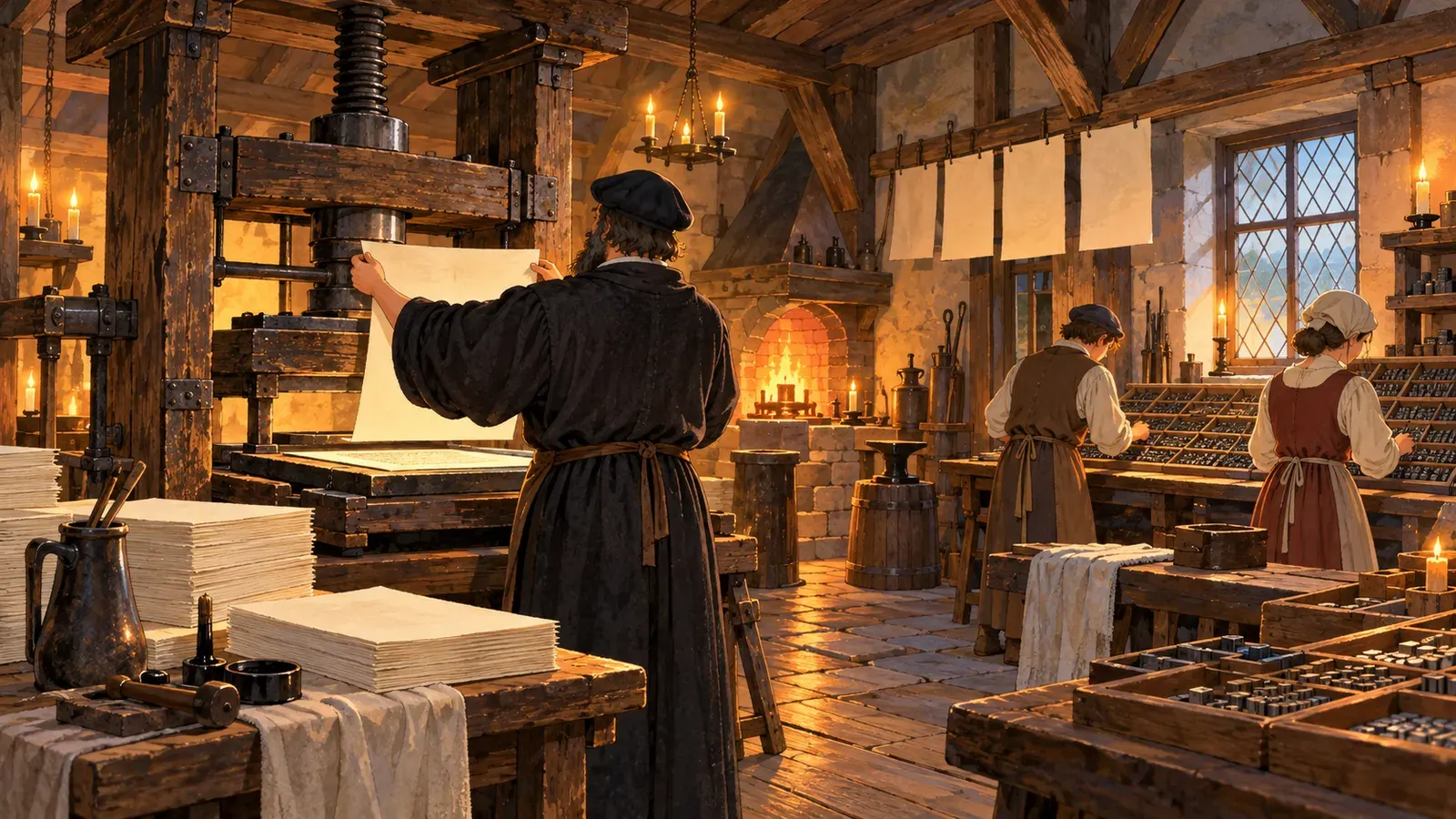
Around the year 1450, in the German city of Mainz, a man and his workers were doing something that must have seemed strange to their neighbors. They were making thousands of tiny pieces of metal, each with a single letter on its end, and arranging them in rows to print pages. The man was Johannes Gutenberg. His invention would change the way knowledge spread across the world. Yet he made little money from it, apparently lost control of much of his printing operation to his partner, and left behind so few records that much of his life is still a mystery.
1450年ごろ、ドイツの町マインツで、ある男と職人たちが、近所の人の目にはさぞ奇妙に映ったであろう作業をしていました。何千もの小さな金属のかけらを作り、その先に文字を一つずつつけて、それを列に並べ、ページを印刷していたのです。男の名は、ヨハネス・グーテンベルク。その発明は、知識が世界に広がるあり方を変えることになります。けれども本人はほとんどお金をもうけられず、印刷の仕事の大部分も、共同経営者の手に渡ってしまったようです。記録もわずかしか残っていないため、その生涯の多くは今も謎に包まれています。
Before Gutenberg, books in Europe were copied by hand. A skilled scribe, often a monk, might spend many months, or even years, copying a single large book such as the Bible. Books were therefore rare and very expensive. Some pictures and short texts were printed from carved wooden blocks. But carving a whole block for every page was slow, and a block could not be reused for a different page.
グーテンベルク以前のヨーロッパでは、本は手で書き写されていました。腕のよい写字生、多くは修道士が、聖書のような大きな本を1冊写すのに、何か月も、ときには何年もかかることがありました。そのため本は数が少なく、とても高価でした。絵や短い文章を、彫った木の板で刷ることもありました。けれども、ページごとに板を1枚まるごと彫るのは手間がかかりますし、一度彫った板を別のページに使い回すことはできませんでした。
Gutenberg was born in Mainz, probably around 1400, though the exact year is unknown. His family belonged to the city's wealthy upper class, and his father was a merchant. The family name was Gensfleisch, but they took the name Gutenberg from a house they owned in the city. Mainz at that time was troubled by struggles between the old ruling families and the craftsmen's guilds, and more than once the family had to leave the city for a while. Almost nothing is known about his education.
グーテンベルクは、おそらく1400年ごろにマインツで生まれましたが、正確な年は分かっていません。一家は町の裕福な上流階級に属し、父は商人でした。家の名はゲンスフライシュといいましたが、町に持っていた家の名前をとって、グーテンベルクと名のるようになりました。当時のマインツは、昔からの支配層の家々と職人のギルドとの争いでゆれていて、一家は何度か、しばらく町を離れなければなりませんでした。どんな教育を受けたのかは、ほとんど分かっていません。
By 1434, Gutenberg was living in Strasbourg, a city on the Rhine River. There he seems to have worked with metal and with polishing stones for jewelry. Around 1438, he formed a business with several partners to make small metal mirrors for pilgrims who were going to visit holy objects in the city of Aachen. Pilgrims believed that the mirrors could catch some of the holy power of these objects. The pilgrimage was delayed, and the partners turned to another, secret project.
1434年には、グーテンベルクはライン川沿いの町、ストラスブールに住んでいました。そこで、金属の細工や、宝石にする石をみがく仕事をしていたようです。1438年ごろ、グーテンベルクは何人かの仲間と事業を始めました。アーヘンの町へ聖なる品々を拝みに行く巡礼者たちのために、小さな金属の鏡を作る仕事です。巡礼者たちは、この鏡に聖なる品々の力を写しとれると信じていました。ところが巡礼が延期になり、仲間たちは別の、秘密の計画に取りかかりました。
We know about this secret only because of a lawsuit. When one of the partners, Andreas Dritzehn, died at the end of 1438, his brothers went to court to demand a share of the business. Witnesses spoke of a press, of things made of lead, and of "forms" that Gutenberg had asked to be taken apart so that no one could see how they worked. Many historians believe that he was already experimenting with printing, but the records do not say so clearly.
この秘密が分かっているのは、ある訴訟があったからにすぎません。1438年の終わりに仲間の一人、アンドレアス・ドリッツェーンが亡くなると、その兄弟たちが、事業の分け前を求めて裁判を起こしたのです。証人たちは、プレス機のことや、鉛で作られた品々のこと、そして「型」のことを語りました。グーテンベルクは、その型の仕組みを誰にも見られないよう、ばらばらにしておくように頼んでいたというのです。多くの歴史家は、グーテンベルクがこのころすでに印刷の実験をしていたと考えています。けれども、記録にははっきりとそう書かれてはいません。
By 1448, Gutenberg was back in Mainz. He borrowed money from a relative and, around 1450, from a wealthy businessman named Johann Fust, who lent him eight hundred guilders, a very large sum. A couple of years later, Fust lent him another eight hundred. Gutenberg needed this money for metal, paper, ink, and workers, and for vellum, an expensive material made from animal skin. His plan was bold: to print the whole Bible in Latin.
1448年には、グーテンベルクはマインツに戻っていました。親類から金を借り、1450年ごろには、ヨハン・フストという裕福な商人からも金を借りました。フストが貸したのは800グルデン、とても大きな金額です。その2年ほどあとにも、フストはさらに800グルデンを貸しました。この金は、金属や紙、インク、職人の手間賃、そして動物の皮から作る高価な皮紙のために必要でした。グーテンベルクの計画は大胆なものでした。ラテン語の聖書を、まるごと印刷しようというのです。
The idea at the heart of his system was movable type. Instead of carving a whole page, the printer made separate letters. They could be arranged into words and lines, used to print a page, and then taken apart and used again for the next page.
グーテンベルクのやり方の中心にあったのは、活字という考えでした。ページ全体を彫るのではなく、一つ一つばらばらの文字を作るのです。文字は単語や行に組み、1ページを刷ったら、ばらして次のページにまた使うことができました。
Gutenberg is traditionally given credit for several inventions that made this practical. He used a mixture of metals, mainly lead and tin, which melted easily, cooled quickly, and was hard enough to last. He cast large numbers of identical letters with a hand-held mold, though some researchers now question exactly how his type was made. He developed an oil-based ink that stuck to metal better than the inks used for wooden blocks. And he used a screw press, similar to the presses used to make wine or olive oil, to press the paper evenly onto the type.
この方法を実用的なものにしたいくつかの発明は、昔からグーテンベルクの功績とされてきました。グーテンベルクは、おもに鉛とすずをまぜた金属を使いました。この金属は溶けやすく、すぐに冷えて固まり、しかも長く使えるだけのかたさがありました。手に持って使う鋳型で、同じ形の文字を大量に作りました。もっとも、活字が実際にどう作られたのかについては、疑問を投げかける研究者もいます。また、木版に使うインクよりも金属によくつく、油性のインクを作り出しました。そして、ぶどう酒やオリーブ油をしぼるのに使われていたのと同じようなねじ式のプレス機で、紙を活字にむらなく押しつけたのです。
The work was slow and demanding. To imitate the beautiful handwriting of scribes, his workshop used nearly three hundred different pieces of type, including special shapes for letters joined together and for shortened words. Each page had two columns of forty-two lines, which is why the book is sometimes called the Forty-Two-Line Bible. After printing, colored capital letters and decorations were often added by hand, so no two copies look exactly the same.
作業は時間がかかり、骨の折れるものでした。写字生の美しい手書き文字をまねるために、工房では300種類近くの活字を使いました。その中には、つながった文字や、言葉を短くした略字のための特別な形もありました。どのページも2段組みで、1段が42行でした。そのため、この聖書は「42行聖書」と呼ばれることもあります。刷り上がったあとで、色のついた大きな頭文字や飾りが手で描き加えられることが多かったので、まったく同じ見た目の本は2冊とありません。
Printing a page took several steps. A worker picked the letters one by one from a case and set them in lines. The page of type was then locked into a frame and covered with ink. A sheet of slightly damp paper was laid on top, and the press was pulled to push the paper down onto the type. Then the type was cleaned, ready for the next sheet.
1ページを刷るには、いくつもの手順が必要でした。まず職人が、文字の入った箱から活字を一つずつ拾い、行に並べます。組み上がった1ページ分の活字は枠に固定され、インクがぬられます。その上に少ししめらせた紙をのせ、プレス機のレバーを引いて、紙を活字に押しつけます。最後に活字をきれいにして、次の紙を刷る準備をしました。
In 1454, some pages of the unfinished Bible were shown at a fair in Frankfurt. A churchman named Enea Silvio Piccolomini, who later became Pope, saw them and wrote about them to a cardinal. The letters, he said, were so clean and clear that they could be read without glasses. He also reported that every copy had already found a buyer before the book was finished.
1454年、まだ完成していない聖書の何ページかが、フランクフルトの見本市で披露されました。エネア・シルヴィオ・ピッコローミニという聖職者がそれを見て、ある枢機卿にあてて手紙を書きました。ピッコローミニは、のちにローマ教皇になる人物です。文字はとてもきれいではっきりしていて、眼鏡なしでも読めるほどだ、と手紙には書かれていました。また、本が完成する前から、すべての本に買い手がついている、とも伝えています。
The Bible was completed around 1455. About one hundred and eighty copies were printed, most on paper and some on vellum. Today about forty-eight copies survive, many of them incomplete, and they are among the most valuable books in the world. One volume of a copy is kept in Japan, at Keio University in Tokyo.
聖書は1455年ごろに完成しました。およそ180部が刷られ、そのほとんどは紙に、一部は皮紙に印刷されました。今残っているのは48部ほどで、その多くは完全なものではありません。それでも、世界でもっとも価値の高い本の一つに数えられています。そのうちの1部の1巻が、日本の東京にある慶應義塾大学に所蔵されています。
But at the very moment of his greatest success, Gutenberg lost much of what he had built. In 1455, Fust took him to court, demanding the return of his loans with interest, a total of more than two thousand guilders. Gutenberg could not pay. The surviving record does not tell us every detail of the judgment, but Gutenberg seems to have had to hand over at least part of the printing business and some of its equipment to Fust.
ところが、もっとも大きな成功をおさめたまさにそのとき、グーテンベルクは、きずき上げてきたものの多くを失いました。1455年、フストは貸した金を利子をつけて返すよう求め、グーテンベルクを訴えたのです。その額は、合わせて2000グルデンを超えていました。グーテンベルクには払えませんでした。残っている記録からは、判決のくわしい中身までは分かりません。しかし、グーテンベルクは少なくとも印刷の仕事の一部と、設備のいくらかを、フストに引きわたさなければならなかったようです。
Fust then continued the business with Peter Schoeffer, a skilled worker who had learned the craft in Gutenberg's workshop and who later married Fust's daughter. In 1457, Fust and Schoeffer published a beautiful book of psalms, the first printed book to name its printers and the date. Gutenberg's name was not mentioned.
フストはその後、ペーター・シェッファーと組んで事業を続けました。シェッファーは、グーテンベルクの工房で技術を身につけた腕のいい職人で、のちにフストの娘と結婚した人物です。1457年、フストとシェッファーは美しい詩編の本を出版しました。印刷した人の名前と日付が入った、最初の印刷本です。そこに、グーテンベルクの名前はありませんでした。
Was Fust simply greedy, or had Gutenberg failed to use the money as promised? We do not know. Only Fust's side of the story is recorded in detail. Some historians think that Fust saw that printing was about to become profitable and wanted the business for himself. Others point out that Gutenberg was often in debt and may have spent money on other projects. Either way, the man who made the new printing possible did not become rich from it.
フストはただ欲が深かったのでしょうか。それとも、グーテンベルクが約束どおりに金を使わなかったのでしょうか。それは分かりません。くわしく記録に残っているのは、フストの側の言い分だけなのです。印刷がもうすぐもうかる商売になると見て、フストが事業を自分のものにしようとしたのだ、と考える歴史家もいます。一方で、グーテンベルクはいつも借金を抱えていて、ほかの計画に金を使ったのかもしれない、と指摘する歴史家もいます。いずれにせよ、新しい印刷を生み出した人は、それで豊かになることはありませんでした。
Gutenberg seems to have continued printing on a smaller scale, though it is hard to know which works were his. In 1462, Mainz was attacked and plundered during a war between two rival archbishops. Many printers fled the city and took their skills with them to other places. In this way, a disaster helped printing to spread. In 1465, the archbishop of Mainz gave the aging Gutenberg an honored position at his court, with a yearly gift of clothing, grain, and wine, free of tax. At last, he had some security.
グーテンベルクは、その後も小さな規模で印刷を続けていたようです。ただ、どの作品が本人の手によるものかを知るのは困難です。1462年、二人の大司教が争った戦いの中で、マインツは攻撃を受け、略奪されました。多くの印刷職人が町から逃げ出し、その技術をよその土地へと持っていきました。こうして、災難がかえって印刷の広まりを助けることになったのです。1465年、マインツの大司教は、年老いたグーテンベルクに宮廷での名誉ある地位を与えました。毎年、衣服や穀物、ぶどう酒が税なしで贈られるという待遇でした。グーテンベルクは、ようやく安心して暮らせるようになったのです。
Gutenberg died in Mainz in 1468. He was buried in a church that was later destroyed, and his grave has been lost. No picture of him was made during his lifetime. The famous portraits of a bearded man in a fur hat were created long after his death and are almost certainly imaginary.
グーテンベルクは、1468年にマインツで亡くなりました。葬られた教会はのちに失われ、墓の場所も分からなくなってしまいました。生きているあいだに描かれた肖像は、一枚もありません。毛皮の帽子をかぶったひげの男の有名な肖像画は、亡くなってからずっとあとに描かれたもので、ほぼまちがいなく想像の産物です。
It is important to remember that Gutenberg was not the first person in the world to print with movable type. In China, a man named Bi Sheng made movable type from baked clay in the eleventh century. In Korea, metal type was used to print a Buddhist book in 1377, more than seventy years before Gutenberg's Bible. Gutenberg probably knew nothing of these earlier inventions. His achievement was to combine several techniques into a practical system that suited European alphabets, with their small number of letters, and the growing demand for books in Europe.
忘れてはならないのは、活字で印刷したのはグーテンベルクが世界で初めてではない、ということです。中国では11世紀に、畢昇という人が、焼いた粘土で活字を作っていました。朝鮮半島の高麗では1377年に、金属の活字で仏教の本が印刷されています。グーテンベルクの聖書より、70年以上も前のことです。グーテンベルクは、こうした先の発明については、おそらく何も知らなかったでしょう。グーテンベルクがなしとげたのは、いくつもの技術を組み合わせ、実際に使える一つの仕組みにまとめあげたことでした。それは、文字の数が少ないヨーロッパのアルファベットにも、ヨーロッパで高まっていた本への需要にも、よく合ったものだったのです。
The results were enormous. By the year 1500, printing presses were working in more than two hundred towns across Europe, and millions of books had been printed. Books became cheaper, and more people learned to read. Scientists could share their findings quickly and accurately. After 1517, the ideas of Martin Luther spread across Germany with amazing speed through printed pamphlets, helping to start the Reformation. Printing also made it easier to spread false stories and attacks on others, a problem that feels very familiar in our own age of the internet.
その影響は、はかりしれないものでした。1500年までに、ヨーロッパの200を超える町で印刷機が動き、何百万冊もの本が刷られていました。本は安くなり、字を読める人もふえていきました。科学者たちは、自分の発見を早く正確に伝え合えるようになりました。1517年からは、マルティン・ルターの考えが、印刷された小冊子によって驚くほどの速さでドイツじゅうに広まり、宗教改革のきっかけとなりました。その一方で、印刷のおかげで、うその話や人への攻撃も広めやすくなりました。インターネットの時代に生きる私たちには、とても身近に感じられる問題です。
Johannes Gutenberg's life was full of debts, lawsuits, and unanswered questions. He did not become rich, and he lost control of his greatest work. Yet the invention he built changed the world far more than the fortunes of the merchants who lent him money. Every time we open a printed book, we are holding a small piece of his idea.
ヨハネス・グーテンベルクの生涯は、借金と訴訟と、答えの出ない謎に満ちていました。豊かにはなれず、自分のいちばん大きな仕事も人の手に渡ってしまいました。それでも、グーテンベルクが作り上げた発明は、金を貸した商人たちの財産などよりはるかに大きく、世界を変えました。印刷された本を開くたびに、私たちはグーテンベルクのアイデアの小さなかけらを手にしているのです。