Ask people who invented the light bulb, and many will say, "Thomas Edison." It is a simple answer, but the real story is more interesting. Edison did not make the first electric light. What he and his team did was solve a group of problems that had stopped others from bringing electric light into ordinary homes. And he did not do it alone.
電球を発明したのはだれかとたずねれば、多くの人が「トーマス・エジソン」と答えるでしょう。分かりやすい答えですが、本当の話はもっとおもしろいのです。最初の電灯を作ったのは、エジソンではありません。エジソンとそのチームがなしとげたのは、電灯を一般の家庭に届けるうえで、それまでほかの人たちがつまずいていたいくつもの問題を解決することでした。しかも、エジソンはそれを一人でやったわけではないのです。
In the early 1800s, people lit their homes with candles and oil lamps, and in some cities, with gas lamps. Gas light was bright, but it was smelly and could cause fires and explosions. Around the same time, the English scientist Humphry Davy showed that electricity could create light. By passing a strong electric current between two pieces of carbon, he produced a brilliant arc of light. Later, arc lamps like this were used to light streets and large buildings, but they were far too bright and harsh for a living room.
1800年代の初め、人々はろうそくや油のランプで家を照らしていました。都市によっては、ガス灯も使われていました。ガス灯は明るいのですが、においがきつく、火事や爆発の原因にもなりました。同じころ、イギリスの科学者ハンフリー・デービーが、電気で光を生み出せることを示しました。2本の炭素の棒のあいだに強い電流を流し、まばゆい弧のような光(アーク光)を作り出したのです。のちに、こうしたアーク灯は通りや大きな建物を照らすのに使われるようになりました。けれども、家の居間で使うには、明るすぎるし、光がきつすぎたのです。
The idea of an incandescent bulb, a lamp in which a thin thread called a filament glows when electricity passes through it, was not new either. Many inventors in different countries worked on it for decades. The main difficulty was that the filament quickly burned up. To slow this down, the air had to be removed from the glass bulb, and the filament had to be made of the right material.
白熱電球のアイデアも、新しいものではありませんでした。白熱電球とは、フィラメントという細い糸に電気を流して光らせるランプです。いろいろな国の多くの発明家が、何十年も前からこれに取り組んでいました。いちばんの難題は、フィラメントがすぐに焼き切れてしまうことです。それを防ぐには、ガラス球の中の空気を抜き、しかもフィラメントにぴったりの材料を見つけなければなりませんでした。
One of the most important of these inventors was Joseph Swan, an English chemist. Swan had experimented with carbon filaments for years. Better vacuum pumps helped him make real progress, and in early 1879, he showed a working light bulb to audiences in Newcastle, England. His house was one of the first in the world to be lit by electric light bulbs.
そうした発明家の中で、特に重要な一人が、イギリスの化学者ジョゼフ・スワンです。スワンは何年も、炭素のフィラメントで実験を続けていました。性能のよい真空ポンプが手に入ったことで研究は大きく進み、1879年の初めには、イギリスのニューカッスルで、ちゃんと光る電球を人々の前で披露しました。スワンの家は、電球で明かりをともした、世界で最初の家のひとつです。
Meanwhile, in the United States, Thomas Edison was already famous. He had already improved the telephone, and he had invented the phonograph, a machine that could record and play back sound, and people called him "the Wizard of Menlo Park," after the village in New Jersey where he had his laboratory. Menlo Park was itself a kind of invention. It was a place where a team of skilled workers, machine builders and scientists worked together on new ideas. In 1878, Edison announced that he would make a practical electric light, and investors gave him money to do it.
そのころアメリカでは、トーマス・エジソンがすでに有名人になっていました。電話を改良し、音を録音して再生できる機械「蓄音機」を発明していたのです。人々はエジソンを「メンロパークの魔術師」と呼んでいました。メンロパークとは、研究所があったニュージャージー州の村の名前です。このメンロパークそのものが、一種の発明でした。腕のいい職人や機械の技術者、科学者たちがチームを組み、一緒に新しいアイデアに取り組む場所だったのです。1878年、エジソンは実用的な電灯を作ってみせると発表し、投資家たちがそのための資金を出しました。
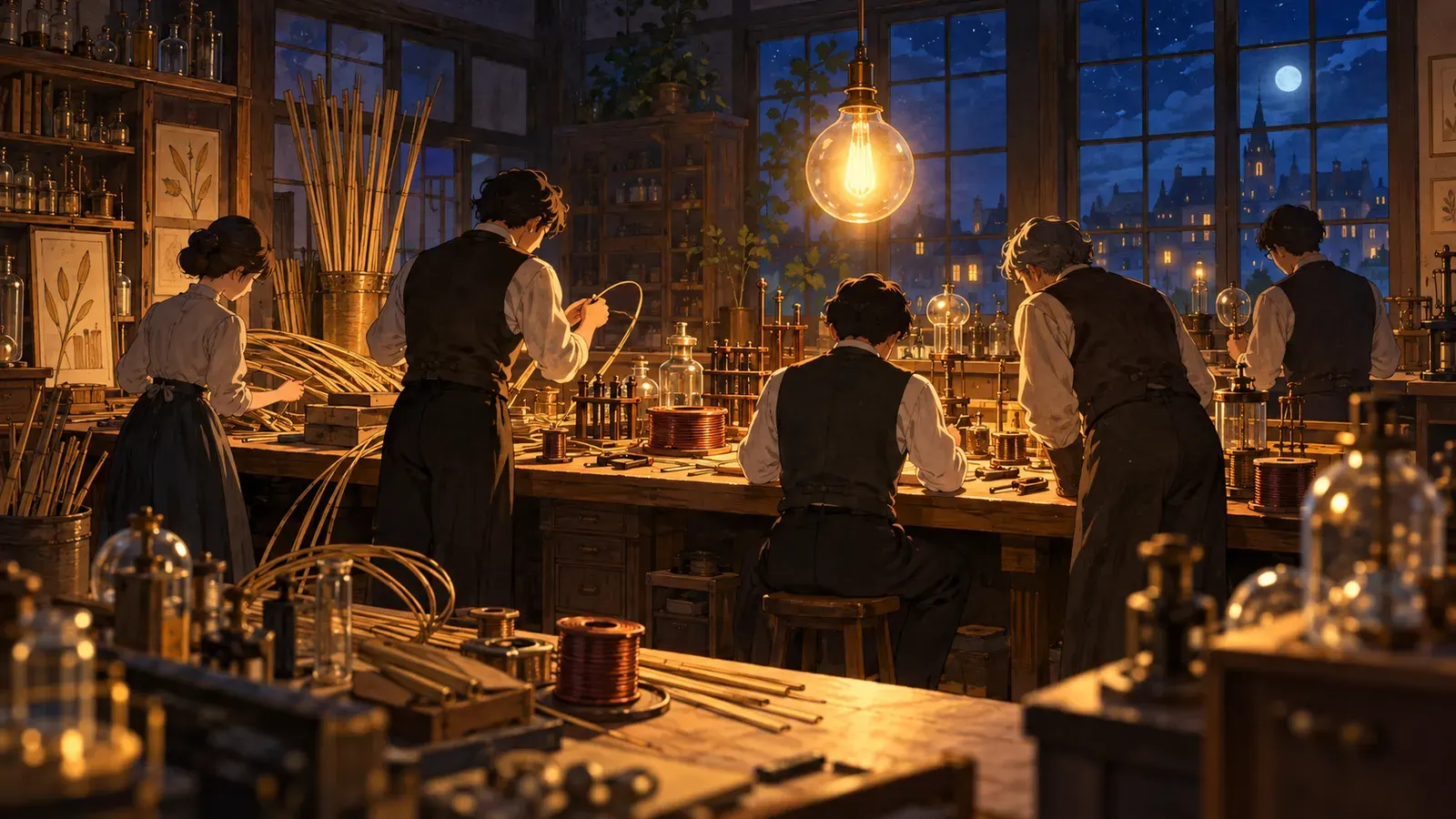
Edison's team tested thousands of materials for the filament, from metals to plant fibers. In October 1879, they made a bulb with a filament of carbonized cotton thread, which glowed for more than thirteen hours. It was a big step. Later, they found that carbonized bamboo worked even better. They tested bamboo from many places, and one of the best types came from Japan, from an area near Kyoto. For several years, bulbs with Japanese bamboo filaments lit homes and streets in many parts of the world.
エジソンのチームは、金属から植物の繊維まで、何千種類もの材料をフィラメントに試しました。1879年10月、木綿の糸を炭にしたフィラメントで電球を作ると、13時間以上光りつづけました。大きな前進です。その後、炭にした竹のほうがもっとよいことが分かりました。チームは世界各地の竹を試し、最もすぐれたもののひとつが、日本の京都の近くでとれる竹でした。それから数年のあいだ、日本の竹をフィラメントにした電球が、世界のあちこちで家や通りを照らしたのです。
Edison's greatest achievement, however, was not the bulb itself. He understood that a light bulb is useless without electricity, and in those days, almost no homes had it. So his team designed a whole system: generators to make electricity, underground wires to carry it, switches and safety devices, and meters to measure how much each customer used. In 1882, Edison opened the Pearl Street Station in New York City. It sent electricity to customers in a small area of Manhattan, and it showed that electric light could be a real business, not just a scientific trick.
けれども、エジソンのいちばんの功績は、電球そのものではありませんでした。電気がなければ電球は役に立ちません。そして当時は、電気が通っている家などほとんどなかったのです。エジソンはそのことをよく分かっていました。そこでチームは、しくみ全体を設計しました。電気を作る発電機、電気を運ぶ地下の電線、スイッチや安全装置、そして家ごとの電気の使用量をはかるメーターです。1882年、エジソンはニューヨークにパールストリート発電所を開きました。マンハッタンの小さな地区に電気を送ったこの発電所は、電灯がただの科学の見せ物ではなく、商売として成り立つことを示したのです。
What about Swan? In Britain, Swan held important patents, and the two men could have fought in court for years. Instead, in 1883, their companies joined together to form one company, often called Ediswan, to make light bulbs in Britain. Historians today usually say that both men, along with others, deserve credit.
では、スワンはどうなったのでしょう? イギリスでは、スワンが大事な特許を持っていました。二人は何年も裁判で争うことになってもおかしくありませんでした。ところが、そうはなりませんでした。1883年、二人の会社はひとつになり、イギリスで電球を作りはじめたのです。この会社は「エディスワン」とも呼ばれています。今の歴史家の多くは、この二人にも、ほかの人たちにも、それぞれの功績があると考えています。
Edison was a brilliant inventor and organizer, but he was not perfect. He could be very stubborn. Later, he fought hard against alternating current, or AC, a system supported by his rivals, including George Westinghouse and Nikola Tesla. Edison preferred direct current, or DC. In the end, AC won, because it could carry electricity over long distances much more efficiently. Most of the electricity in our homes today is AC.
エジソンはすばらしい発明家であり、人をまとめる力にもすぐれていました。けれども、完璧ではありませんでした。とても頑固なところがあったのです。のちにエジソンは、交流(AC)という方式に激しく反対しました。交流を推していたのは、ジョージ・ウェスティングハウスやニコラ・テスラといったライバルたちです。エジソンは直流(DC)がよいと考えていました。結局、勝ったのは交流でした。交流のほうが、遠くまでずっと効率よく電気を送れたからです。今、わたしたちの家に届いている電気も、ほとんどが交流です。
Carbon filaments were later replaced by tungsten, a metal that can survive very high temperatures. In recent years, most old-style bulbs have been replaced by LEDs, which use much less energy. But the basic idea that Edison's team proved, that electricity could be made, sent and sold to everyone, is still the system we live with today.
炭素のフィラメントは、のちにタングステンに取ってかわられました。タングステンは、とても高い温度にも耐えられる金属です。さらに最近では、昔ながらの電球のほとんどが、ずっと少ない電気ですむLEDに置きかわっています。それでも、電気を作り、送り、みんなに売る、というエジソンのチームが実現した考え方は、今もそのまま、わたしたちの暮らしを支えるしくみになっています。
So who invented the light bulb? The honest answer is many people. Davy, Swan, Edison, his team at Menlo Park, and others each added an important piece. The story of the light bulb reminds us that great inventions are rarely the work of one genius alone in a room. They are usually built step by step, by many people learning from each other's successes and failures.
では、電球を発明したのはだれなのでしょう? 正直に答えるなら、たくさんの人たちです。デービー、スワン、エジソン、メンロパークのチーム、そしてほかの人たちが、それぞれ大切なピースを加えたのです。すばらしい発明が、部屋にこもったたった一人の天才から生まれることは、めったにありません。たいていは、たくさんの人がおたがいの成功や失敗から学び合い、一歩一歩積み上げていくものなのです。電球の物語は、そのことを思い出させてくれます。