


 約8分
 全訳つき
 まずは原文をチェック
 音声は準備中です。もうしばらくお待ちください。
 お道具箱
 読書ラウンジ
The monkey who took the crab's rice ball was finally killed by the crab in revenge. The crab, with the help of a mortar, a bee, and an egg, killed his enemy, the monkey. There is no need to tell that story again. But it is necessary to tell what happened to the crab and his friends after that. Why? Because the fairy tale says nothing at all about it.
蟹の握り飯を奪った猿は、とうとう蟹に仇を取られた。蟹は臼・蜂・卵の助けを借りて、にくい敵の猿を殺したのである。その話は、いまさらするまでもない。しかし、猿をしとめたあと、蟹と仲間たちがどうなったか。それは話しておく必要がある。なぜなら、おとぎ話はそのことを、まったく話していないからである。
In fact, the fairy tale pretends that they all lived peacefully ever after: the crab in his hole, the mortar in a corner of the kitchen, the bee in its nest under the roof, and the egg in a box of rice husks.
それどころか、おとぎ話は、みんながその後ずっと平和に暮らしたかのような顔をしている。蟹は穴の中で、臼は台所の隅で、蜂は軒先の巣で、卵はもみ殻の箱の中で。
But that is a lie. After their revenge, they were all arrested by the police and put in prison. After many trials, the crab, as the leader of the crime, was sentenced to death. The mortar, the bee, and the egg were sent to prison for life. Readers who only know the fairy tale may be surprised. But this is a fact. There is not the slightest doubt about it.
しかし、それはうそである。仇を取ったあと、彼らはみな警察につかまり、監獄に入れられた。そして裁判を重ねた結果、主犯の蟹は死刑になり、臼・蜂・卵は無期懲役を言いわたされた。おとぎ話しか知らない読者は、驚くかもしれない。しかし、これは事実である。少しの疑いもない事実である。
According to the crab, he traded his rice ball for persimmons. But the monkey did not give him ripe persimmons. He gave him only green ones, and he even threw them hard at the crab to hurt him. However, the crab had no written contract with the monkey. Besides, the crab only said he traded his rice ball for persimmons. He never said they had to be ripe ones. And there was not enough proof that the monkey had meant to hurt him with the green persimmons.
蟹自身の話によれば、蟹は握り飯を柿と取りかえた。ところが猿は熟した柿をくれず、青い柿ばかりよこした。そればかりか、蟹にけがをさせようと、その柿をさんざん投げつけたという。しかし、蟹は猿とのあいだに、一通の証書も取りかわしていなかった。それに蟹は、握り飯を柿と取りかえたと言っているだけで、熟した柿とはことわっていない。また、猿が青い柿で蟹を傷つけるつもりだったという証拠も、十分ではなかった。
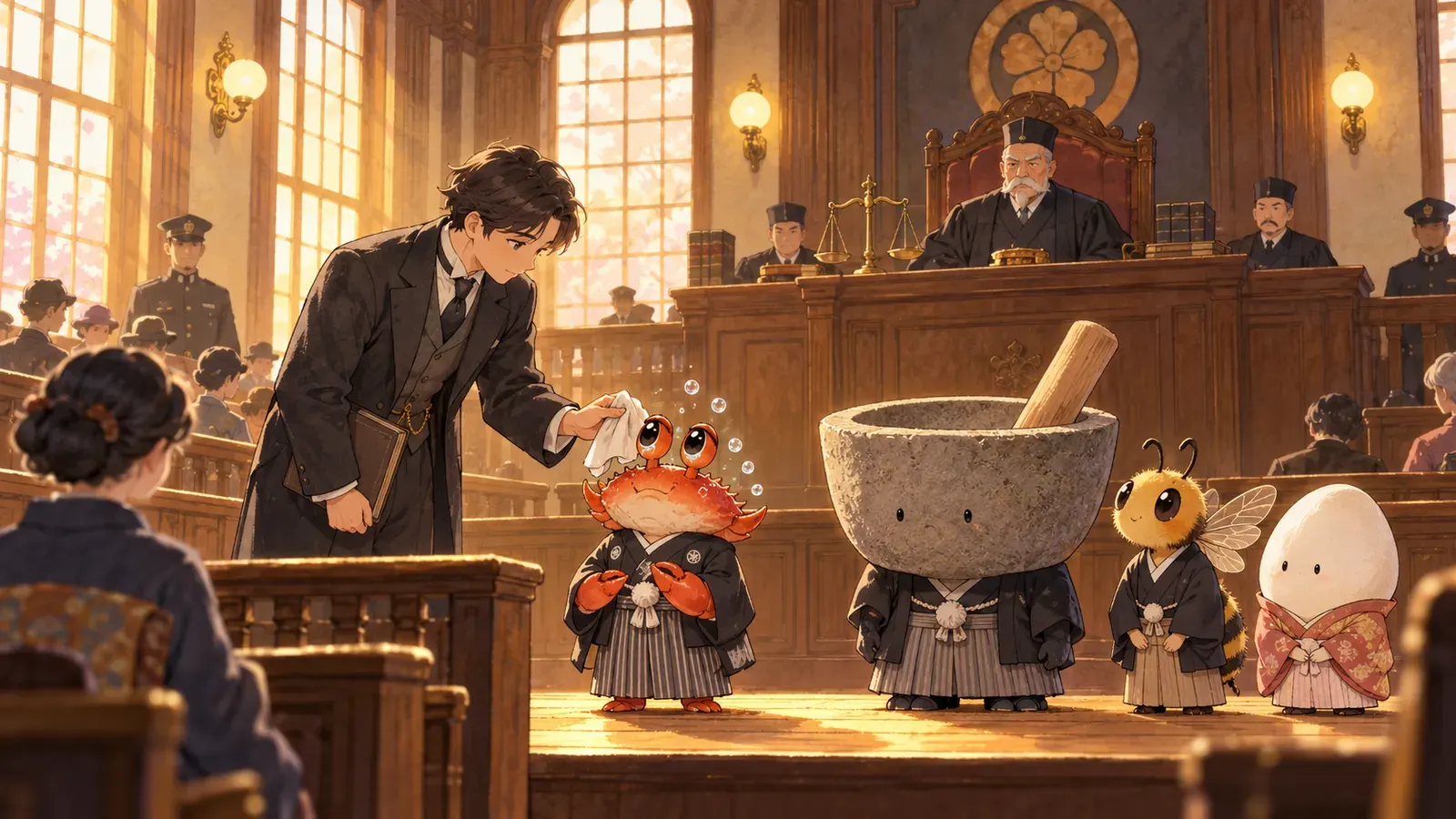
So even the famous lawyer who defended the crab could do nothing but ask the judge for pity. They say the lawyer wiped the bubbles from the crab's mouth and said kindly, "You must give up." But no one can say whether he meant "Give up, because you will be put to death," or "Give up, because you have paid me so much money."
だから、蟹の弁護をした有名な弁護士も、裁判官の同情にすがるほかに、手の打ちようがなかったらしい。その弁護士は蟹の口の泡を拭いてやりながら、やさしく「あきらめたまえ」と言ったそうである。もっとも、この「あきらめたまえ」が、死刑になることをあきらめろという意味だったのか、弁護士に大金をとられたことをあきらめろという意味だったのか、それはだれにもわからない。
Newspapers and magazines did not feel sorry for the crab either. Many said, "The crab killed the monkey only out of personal anger. He lost to the monkey because of his own foolishness, and he was simply angry about it. In this world, the strong win and the weak lose. Anyone who complains about that is either a fool or a madman." A certain baron, the head of the city's business leaders, said much the same thing. He added that the crab had probably caught the dangerous new ideas of the day. After the crab's revenge, they say, the baron kept ten bulldogs as well as his bodyguards.
新聞や雑誌も、蟹に同情しなかった。多くはこう書いた。「蟹が猿を殺したのは、個人的な恨みからにすぎない。自分の愚かさのせいで猿に負け、それを腹立たしく思っただけではないか。この世の中は、強い者が勝ち、弱い者が負けるものだ。それに文句を言うのは、愚か者でなければ、正気を失った者である。」町の実業家たちのかしらである、ある男爵も、だいたい同じ意見を述べた。そのうえ、蟹はおそらく当時はやりの危険思想にかぶれたのだろうと言った。蟹の仇討ち以来、この男爵は、用心棒のほかに、ブルドッグを十頭飼うようになったそうである。
Wise people did not praise the crab's revenge either. A university professor said that the crab acted out of a wish for revenge, and revenge cannot be called good. The leader of a socialist group said that the crab cared too much about private property, such as rice balls and persimmons. A Buddhist priest said, "If the crab had known the mercy of the Buddha, he would have pitied the monkey instead of hating him. Oh, I wish he had heard my sermon just once!"
学のある人々も、蟹の仇討ちをほめはしなかった。ある大学教授は、蟹が猿を殺したのは復讐の気持ちからであり、復讐は善とは言いがたいと言った。ある社会主義者のかしらは、蟹は握り飯や柿のような私有財産を大事にしすぎていたと言った。ある仏教の僧は、こう言った。「蟹が仏の慈悲を知っていたら、猿を憎むかわりに、かえってあわれんだでしょう。ああ、一度でいいから、わたしの説教を聞かせたかった!」
Only one man spoke up for the crab. He was a politician who loved drinking and writing poems. He said that the crab's revenge was in the spirit of bushido, the way of the samurai. But no one listened to such an old-fashioned opinion. Besides, according to newspaper gossip, a monkey at the zoo had once peed on him, and he still held a grudge against monkeys.
蟹の肩を持ったのは、たった一人だけだった。酒好きで詩も書く、ある政治家である。この政治家は、蟹の仇討ちは武士道の精神にかなっていると言った。しかし、こんな時代遅れの意見に、耳を貸す者はいなかった。おまけに新聞のゴシップによると、この政治家は以前、動物園で猿におしっこをかけられたことがあり、今もそれを根に持っていたそうである。
Readers who know only the fairy tale may cry for the poor crab. But the crab's death was only natural. Feeling sorry for him is nothing but the soft heart of women and children. The whole world agreed that his death was right. On the night of the execution, they say, the judge, the lawyers, the prison guards, and the priest all slept soundly for forty-eight hours. In their dreams, they all saw the gate of heaven. According to them, heaven looks like a department store built like an old castle.
おとぎ話しか知らない読者は、かわいそうな蟹のために涙を流すかもしれない。しかし、蟹が死んだのは当然である。それを気の毒に思うのは、女子どもの感傷にすぎない。世の中はみな、蟹の死を正しいとした。死刑が行われた夜、裁判官も、弁護士も、看守も、僧も、四十八時間ぐっすり眠ったそうである。そして皆、夢の中で天国の門を見たという。彼らの話では、天国は、昔の城に似たデパートのようなところらしい。
Let me also tell you a little about the crab's family after his death. His eldest son, in the words of the newspapers, "turned over a new leaf." Now he works as a clerk for a stockbroker or something like that. Once, this crab dragged a hurt friend into his hole to eat him. The famous thinker Kropotkin wrote that crabs take care of their hurt friends. The example he gave was this very crab.
ついでに、蟹が死んだあと、その家族がどうなったかも少し書いておこう。長男は、新聞の言葉を借りれば「心を入れかえた」。今では、株屋の番頭か何かをしているという。この蟹は以前、けがをした仲間を、その肉を食べるために自分の穴へ引きずりこんだことがある。有名な思想家クロポトキンは、蟹はけがをした仲間をいたわると書いた。そのとき例にあげたのが、ほかならぬこの蟹である。
The second son became a novelist. Being a novelist, of course, he does nothing but fall in love with women. He only uses his father's life as an example and writes clever but careless things like "Good is just another name for evil."
次男は小説家になった。もちろん小説家だから、女にほれるほかは何もしない。ただ父親の一生を例にあげて、「善とは悪の別名である」などと、もっともらしいが、いいかげんな皮肉を並べている。
The third son was a fool, so he could not become anything but a crab. One day, as he was walking sideways, he found a rice ball on the ground. Rice balls were his favorite food. He picked it up with the tip of his big claw. Then, at the top of a tall persimmon tree, there was a monkey picking bugs out of its fur... There is no need to tell the rest.
三男は愚か者だったので、蟹よりほかのものにはなれなかった。ある日、この蟹が横歩きをしていると、握り飯が一つ落ちていた。握り飯は彼の大好物だった。三男は大きなはさみの先で、その獲物を拾いあげた。すると、高い柿の木のてっぺんで、猿が一匹、毛の中の虫を取っていた……。その先は、話す必要はあるまい。
In any case, one thing is certain. Once a crab fights a monkey, the crab will surely be killed by the world. Let me say this to all my readers: most of you are crabs too, you know.
とにかく、一つだけ確かなことがある。猿と戦ったが最後、蟹は必ず世の中に殺されるのである。天下の読者諸君に、一言申し上げよう。君たちもたいてい蟹なんですよ。
 3段落目に「the crab, as the leader of the crime, was sentenced to death.」(カニは犯罪の首謀者として死刑を言い渡された)とあります。

 原田英語の究極の英単語帳(CEFR-J 6,868語)
 聞くだけモードで、文字を見ずに内容がわかるか試す。
 1文リピートで音読・シャドーイングも。




 自己啓発の名著

 名作文学