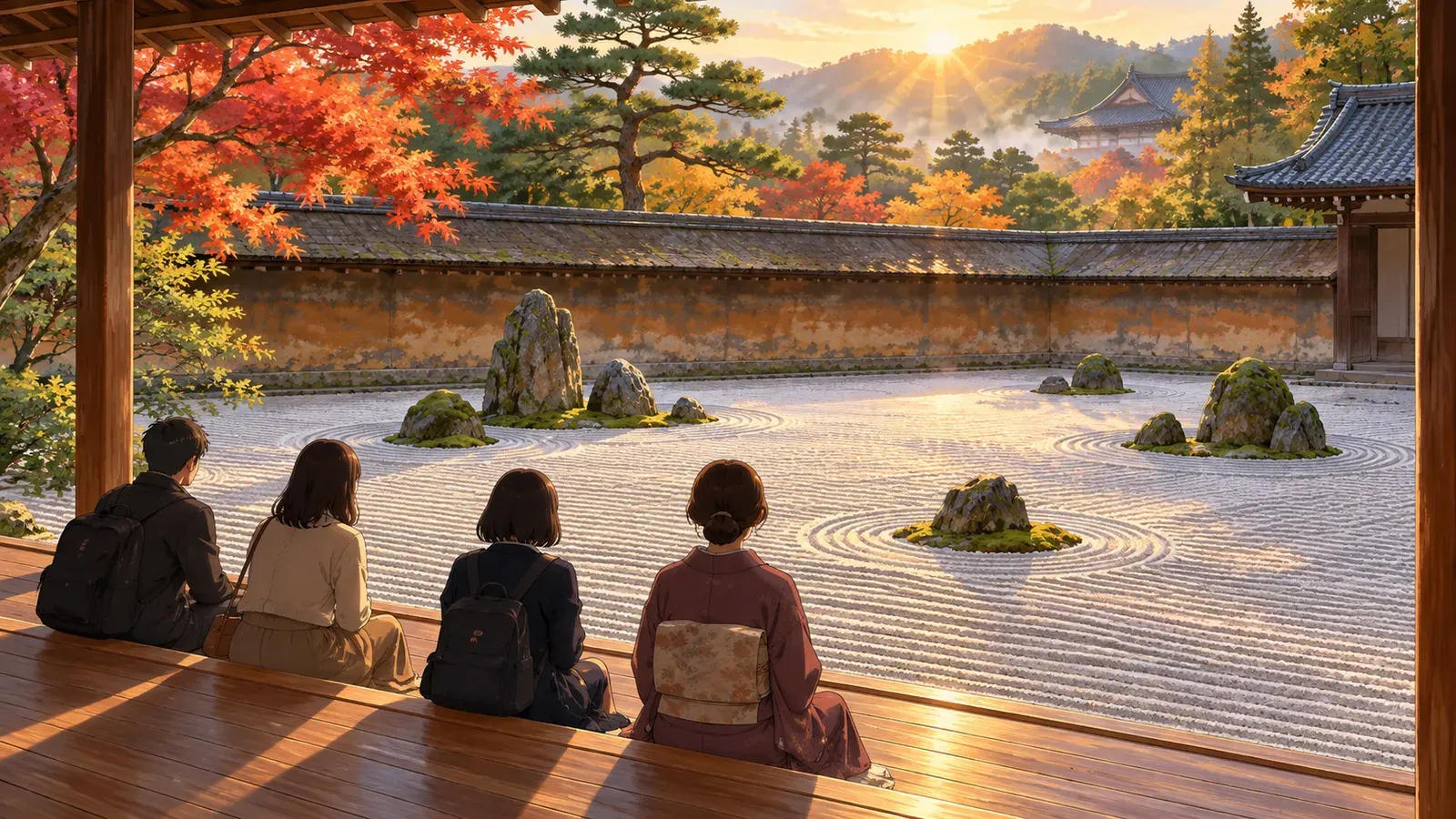
Early in the morning at Ryoanji, a Zen temple in the northwest of Kyoto, visitors sit in a row on a wooden veranda. In front of them lies a rectangle of white gravel, about twenty-five meters long and ten meters wide. On two sides it is closed in by a low clay wall, stained brown and orange by the years. Fifteen stones sit on the gravel in five groups, each with a little green moss around its base. There are no flowers, no water and no trees inside the garden. People sit and look for a long time, and almost no one speaks.
京都の北西にある禅寺、龍安寺。朝早く、訪れた人たちが木の縁側に一列に並んで座っています。目の前には、白い砂利を敷きつめた長方形の庭が広がっています。長さはおよそ25メートル、幅は10メートルほどです。二方を低い土塀が囲み、その壁は長い年月のうちに茶色やオレンジ色に染まっています。砂利の上には15個の石が五つのまとまりに分かれて置かれ、どの石の根もとにも少し緑の苔が生えています。庭の中には、花も水も木もありません。人々は長い間じっと庭を見つめ、口を開く人はほとんどいません。
Then someone begins to count. One, two, three, and on up to fourteen. She leans to the left and counts again. Still fourteen.
やがて、だれかが石を数えはじめます。一つ、二つ、三つ……十四。体を左に傾けて、もう一度数えます。やはり十四です。
This is one of the garden's famous puzzles. From anywhere on the veranda, at least one of the fifteen stones is always hidden behind another. Some people explain this with a Buddhist idea: in this world, nothing can ever be seen completely. Others say it is simply clever design. No one knows for certain who made the garden, or even exactly when it took its present form. The mystery is part of its charm.
これが、この庭の有名な謎の一つです。縁側のどこから見ても、15個の石のうち少なくとも一つは、必ずほかの石の陰に隠れてしまうのです。これを仏教の考え方で説明する人もいます。この世では、何ものも完全に見ることはできない、というのです。単に巧みな設計だ、と言う人もいます。この庭をだれが作ったのか、いつ今の形になったのかさえ、確かなことはわかっていません。その謎もまた、この庭の魅力なのです。
Ryoanji is the best-known example of karesansui, which means "dry mountains and water." In this style of garden there is no real water at all. Stones stand for mountains or islands, and raked gravel or sand stands for water. The long parallel lines in the gravel look like the waves of a sea or the current of a river, and the circles drawn around a stone look like ripples around an island. It is a whole landscape made from almost nothing, and the viewer's imagination does the rest.
龍安寺は、「枯山水」と呼ばれる庭のいちばん有名な例です。この様式の庭には、本物の水がまったくありません。石が山や島を表し、熊手でならした砂利や砂が水を表します。砂利に引かれた長い平行の線は、海の波や川の流れのように見えます。石のまわりに描かれた輪は、島のまわりに広がる波紋のようです。ほとんど何もないところから一つの風景をまるごと作りあげ、あとは見る人の想像力にまかせるのです。
Dry gardens developed in the fourteenth and fifteenth centuries, when Zen Buddhism was closely tied to the samurai class. Zen teaches that a quiet, focused mind can understand the truth directly, without long explanations. A dry garden was not a place for walking or picnics. It was made to be looked at from inside a building, calmly, in the way one might look at a painting. In fact, many dry gardens resemble the black ink landscape paintings that Zen monks brought back from China.
枯山水が発達したのは14世紀から15世紀にかけてです。そのころ、禅宗は武士と深く結びついていました。禅は、静かに集中した心であれば、長い説明などなくても真理をじかにつかめる、と教えます。枯山水は、歩きまわったり、お弁当を広げたりする場所ではありませんでした。建物の中から、絵を眺めるように、心静かに見るための庭だったのです。実際、枯山水の多くは、禅僧たちが中国から持ち帰った墨絵の山水画によく似ています。
One of the great garden makers of this age was Muso Soseki, a Zen monk who lived in the fourteenth century. He is said to have designed the garden of Tenryuji in Kyoto, where a pond in front of the temple seems to flow into the wooded hills of Arashiyama behind it. Muso believed that a garden could help people train their minds. For him, making a garden and practicing Zen were not two separate things.
この時代の偉大な作庭家の一人が、14世紀の禅僧、夢窓疎石です。夢窓は、京都の天龍寺の庭を設計したと言われています。寺の前の池が、背後にある嵐山の木々におおわれた山へと、そのまま続いていくように見える庭です。夢窓は、庭は人が心をきたえる助けになると考えていました。夢窓にとって、庭を作ることと禅の修行とは、別々のものではなかったのです。
At Daisen-in, a small temple inside the large Daitokuji temple in Kyoto, a dry garden even tells a story. In one corner, tall stones stand for steep mountains. From them a "waterfall" of white gravel pours down and becomes a river. The river flows under a stone bridge and carries along a stone shaped like a boat. At last it opens out into a wide "ocean" of white sand. Many visitors see in it the journey of a human life, from the rushing energy of youth to the calm of old age.
京都の大きな寺、大徳寺の中にある小さな寺、大仙院には、物語を語る枯山水まであります。庭の一角では、高く立った石がけわしい山を表しています。そこから白い砂利の「滝」が流れ落ち、川になります。川は石の橋の下をくぐり、舟の形をした石を運んでいきます。そしてついには、白い砂の広い「大海」へと注ぎます。この庭に人の一生の旅を重ねて見る人も、たくさんいます。勢いよくほとばしる若いころから、穏やかな老年へと向かう旅です。
Footprints, fallen leaves, wind and rain all spoil the patterns, so the gravel must be raked again and again. At many temples, monks or gardeners do this with heavy wooden rakes. Drawing straight lines and smooth curves around the stones without a single mistake takes great skill. For Zen monks, raking is not just cleaning. It is a kind of practice, like meditation done with the whole body.
足あと、落ち葉、風、雨。どれも砂紋を乱してしまうので、砂利は何度も何度もならし直さなければなりません。多くの寺では、僧や庭師が重い木の熊手を使ってこの仕事をします。石のまわりに、まっすぐな線やなめらかな曲線を一つのまちがいもなく引くには、大変な技術がいります。禅僧にとって、砂利をならすことはただの掃除ではありません。体全体で行う座禅のような、修行の一つなのです。
Dry gardens are only one kind of Japanese garden. Long before them, in the Heian period, nobles in Kyoto built gardens around large ponds, where they floated in boats, played music and wrote poems. The oldest known book on gardens in Japan, the Sakuteiki, was written in that era, nearly a thousand years ago. One of its key ideas is that a garden maker should "follow the request" of each stone. In other words, he should study its natural shape and place it where it seems to want to be.
日本庭園は、枯山水だけではありません。それよりずっと前の平安時代、京都の貴族たちは大きな池を中心に庭を作り、舟を浮かべ、音楽を奏で、歌を詠みました。日本で知られているいちばん古い庭づくりの本『作庭記』も、そのころ、千年近く前に書かれたものです。その大切な考え方の一つに、作庭家は一つ一つの石の「乞わんに従う」べきだ、というものがあります。つまり、石の自然な形をよく見て、石が置かれたがっているように見える場所に置け、ということです。
In the Edo period, powerful lords created large stroll gardens, in which visitors follow a path around a pond. The view changes at every turn: a small hill, a teahouse, an arched bridge, a tiny copy of a famous place. Kenrokuen in Kanazawa, Korakuen in Okayama and Kairakuen in Mito are often called the three great gardens of Japan. At Kenrokuen, in late autumn, gardeners tie ropes from the top of tall poles down to the branches of the pine trees, so that each tree looks like a giant umbrella. These ropes, called yukitsuri, keep the branches from breaking under heavy snow, and they have become a famous winter sight.
江戸時代になると、力のある大名たちが大きな回遊式庭園を作りました。池のまわりの道をたどって歩く庭です。角を曲がるたびに景色が変わります。小さな山、茶屋、太鼓橋、名所を小さく写した景色。金沢の兼六園、岡山の後楽園、水戸の偕楽園は、よく日本三名園と呼ばれます。兼六園では晩秋になると、庭師たちが高い柱のてっぺんから松の枝へと縄を張り、一本一本の木が巨大な傘のような姿になります。この縄は「雪吊り」と呼ばれ、重い雪で枝が折れないように守るものです。今では冬の名物の景色になっています。
A third kind of garden is the roji, the small garden path that leads to a tea house. Its purpose is to prepare guests for the tea ceremony. Walking slowly over stepping stones, past a stone lantern and through quiet green moss, guests leave the noise of the outside world behind. Before entering, they stop at a low stone basin and wash their hands and mouth with fresh water. Bright flowers are usually avoided in the roji, so that the single flower waiting inside the tea room will stand out.
三つめの種類が「露地」です。茶室へと続く、小さな庭の小道のことです。露地の役目は、客に茶会への心の準備をさせることです。飛び石の上をゆっくりと歩き、石灯籠のそばを過ぎ、静かな緑の苔の間を進むうちに、客は外の世界のざわめきを後にします。茶室に入る前には、低い石の手水鉢の前で足を止め、清らかな水で手と口を清めます。露地には、ふつう華やかな花は植えません。茶室の中で待っている一輪の花を、引き立てるためです。
Japanese gardens use some clever tricks. One is shakkei, or "borrowed scenery." The garden maker includes a distant mountain or a line of hills as part of the view, so the garden seems to go on far beyond its walls.
日本庭園には、いくつかの巧みな工夫があります。その一つが「借景」、つまり景色を借りることです。作庭家は、遠くの山や連なる丘を景色の一部に取りこみます。そうすると、庭が塀をこえて、ずっと遠くまで続いているように見えるのです。
Another is to hide and then reveal. A path curves, or a hedge blocks the view, so that a beautiful scene appears suddenly. Stepping stones are often set a little unevenly, which makes you watch your feet as you walk. When you finally look up, the view feels like a gift.
もう一つは、隠しておいて、あとで見せるという工夫です。道が曲がっていたり、生け垣が視界をさえぎっていたりするので、美しい景色が不意にあらわれます。飛び石は、わざと少し不ぞろいに置かれていることがよくあります。そのため、歩くときには足もとを見ていなければなりません。やっと顔を上げたとき、目の前の景色は贈り物のように感じられるのです。
Gardeners shape nature with enormous care, while trying to make it look as if no one has touched it. Pine trees are trimmed by hand every year, and in some gardens workers pull out old needles one by one so that the branches look light and open. At Saihoji in Kyoto, often called the Moss Temple, more than a hundred kinds of moss cover the ground like a soft green carpet. A Japanese garden is never really finished. It changes with every season and every year, and it lives only because people look after it day after day.
庭師は、だれも手を加えていないように見せながら、大変な手間をかけて自然を形づくります。松の木は毎年、手作業で刈りこまれます。古い葉を一本一本手で抜き取って、枝を軽やかに、すっきりと見せる庭もあります。「苔寺」の名で知られる京都の西芳寺では、百種類以上の苔が、やわらかな緑のじゅうたんのように地面をおおっています。日本庭園は、本当の意味で完成することはありません。季節ごと、年ごとに姿を変え、毎日毎日手入れをする人がいるからこそ、生きつづけるのです。
Because they change so much, it is worth visiting the same garden in different seasons. In spring, a few cherry trees may bloom beside an old wall. In autumn, maple leaves turn red and gold and float on the dark surface of a pond. On the rare days when snow falls in Kyoto, a dry garden becomes a perfect black-and-white picture, and people hurry to the temples early in the morning to see it before the snow melts.
これほど姿が変わるのですから、同じ庭を季節を変えて何度も訪ねてみる価値があります。春には、古い塀のそばで桜が数本咲いているかもしれません。秋には、もみじが赤や金色に染まり、暗い池の水面に浮かびます。京都にはめったに雪が降りませんが、降った日には、枯山水が完璧な白黒の絵になります。人々は雪がとけないうちに見ようと、朝早くから寺へ急ぐのです。
To enjoy a dry garden, do not hurry. Sit down, let your eyes rest, and look at the whole garden before you look at each stone. Then try to imagine what the stones and gravel might be. They could be islands in a sea, or, in one traditional way of seeing Ryoanji, a mother tiger crossing a river with her cubs. Never step onto the gravel or touch the stones, of course. And if you can, go early in the morning, when the garden is quiet and the light is soft.
枯山水を楽しむには、急がないことです。腰をおろして目を休め、一つ一つの石を見る前に、まず庭全体を眺めましょう。それから、石や砂利が何に見えるか想像してみてください。海に浮かぶ島々かもしれません。龍安寺には昔から伝わる見方があって、母親のトラが子どもたちを連れて川を渡っているところだとも言われます。もちろん、砂利の上に足を踏み入れたり、石にさわったりしてはいけません。そして、できれば朝早くに行きましょう。庭が静かで、光がやわらかな時間です。
How to explain it in English: "A Japanese garden is a small landscape that you enjoy slowly. In a dry garden, called karesansui, there is no water. Stones are mountains or islands, and raked white gravel is the sea or a river. The most famous one is at Ryoanji in Kyoto. It has fifteen stones, but you can never see all of them at once."
英語で説明してみよう:「日本庭園は、ゆっくり味わう小さな風景です。枯山水という庭には水がありません。石が山や島で、熊手でならした白い砂利が海や川です。いちばん有名なのは京都の龍安寺の庭です。石は15個ありますが、一度に全部を見ることは決してできません。」