In September 1904, Japan was at war with Russia, and the whole country was swept up in war fever. Newspapers reported every victory, and crowds cheered soldiers as they left for the front. In that same month, a literary magazine published a long poem by a young woman, written to her younger brother, who was fighting at Port Arthur. Its title was a plea: "Kimi Shinitamou Koto Nakare," or "Please Do Not Die." The poet was Yosano Akiko, and the poem made her both admired and attacked.
1904年9月、日本はロシアと戦争をしていて、国じゅうが戦争の熱気に包まれていました。新聞は勝利を一つ残らず伝え、人々は戦地へ向かう兵士たちを歓声で見送りました。その同じ月、ある文芸雑誌に、一人の若い女性の長い詩がのりました。旅順で戦っている弟にあてて書かれた詩です。題名は、必死の願いそのものでした。「君死にたまふことなかれ」、つまり「どうか死なないで」。作者は与謝野晶子。この詩によって、晶子はほめたたえられもし、激しく攻撃されもしました。
Akiko was born in 1878 in Sakai, near Osaka. Her family ran an old shop that sold traditional Japanese sweets, especially a sweet bean jelly called yokan. Her real name was Ho Sho. As a girl, she helped with the work of the shop, including keeping the accounts. In her free time, she read classical Japanese literature from the family's books, including The Tale of Genji, the great novel written by Murasaki Shikibu about nine hundred years earlier. These old stories and poems filled her imagination.
晶子は1878年、大阪に近い堺で生まれました。家は、和菓子、とくに羊羹で知られる古い菓子屋でした。本名は鳳志やう(ほう・しょう)といいます。少女のころの晶子は、帳簿つけをふくめ、店の仕事を手伝っていました。ひまな時間には、家にあった本で日本の古典文学を読みました。その中には、900年ほど前に紫式部が書いた大長編小説『源氏物語』もありました。こうした昔の物語や歌が、晶子の想像の世界を満たしていったのです。
She began to write tanka, the traditional Japanese poem of thirty-one syllables, and to send them to poetry magazines. In 1900, she met the poet Yosano Tekkan, who had started a new poetry society and a magazine called Myojo, meaning "Morning Star." Tekkan wanted tanka to be more personal and free. Akiko fell deeply in love with him. The problem was that he was already married.
晶子は、31音の日本の伝統的な詩、短歌を作りはじめ、歌の雑誌に投稿するようになりました。1900年、晶子は歌人の与謝野鉄幹に出会います。鉄幹は新しい歌の会を作り、『明星』という雑誌を出していました。「明けの明星」という意味です。鉄幹は、短歌をもっと一人一人の思いのこもった、自由なものにしたいと考えていました。晶子は、鉄幹を深く愛するようになります。困ったことに、鉄幹にはすでに妻がいました。
In 1901, Akiko left her family and her hometown and went to Tokyo to be with Tekkan. Later that year, they married. It was a bold step for a young woman of her time, and many people criticized her. In the same year, she published her first collection of poems, Midaregami, or Tangled Hair.
1901年、晶子は家族とふるさとを離れ、鉄幹のもとへ行くために東京に出ました。その年のうちに、二人は結婚しました。当時の若い女性にとっては大胆な行動で、多くの人が晶子を非難しました。同じ年、晶子は最初の歌集『みだれ髪』を出版しました。
Tangled Hair shocked many readers. In traditional poetry, women were expected to express their feelings quietly and modestly. Akiko wrote openly about love, desire, beauty, and her own body. In one famous tanka, she asks a man who preaches about the right way to live whether he is not lonely, never having touched the warm blood beneath a young woman's soft skin.
『みだれ髪』は、多くの読者に衝撃を与えました。それまでの歌の世界では、女性は気持ちをひかえめに、おくゆかしく表すものだとされていました。ところが晶子は、恋や欲望、美しさ、そして自分の体のことを、包みかくさずに歌ったのです。ある有名な歌で晶子は、人の生きる道を説いている男に問いかけます。若い女のやわらかな肌の下に流れる熱い血にふれてみることもなく、あなたはさびしくないのですか、と。「やは肌のあつき血汐にふれも見でさびしからずや道を説く君」という歌です。
Some critics called the book immoral. Many young readers, however, were thrilled. To them, Akiko's poems sounded like a new, free voice.
この歌集を不道徳だと言う批評家もいました。けれども、若い読者の多くは胸をおどらせました。その人たちにとって、晶子の歌は、新しく自由な声のように響いたのです。
Then came the war with Russia. Akiko's younger brother, Chuzaburo, was sent to fight at Port Arthur, where the fighting was terrible and many thousands of Japanese soldiers died. In her poem, Akiko spoke directly to him. "Oh, my little brother, I weep for you," it begins. "Please do not die."
やがて、ロシアとの戦争が始まりました。晶子の弟の籌三郎は、旅順の戦いに送られました。旅順の戦いはすさまじく、おびただしい数の日本兵が命を落としました。晶子はこの詩の中で、弟にじかに語りかけました。詩は「あゝをとうとよ、君を泣く」と始まり、「君死にたまふことなかれ」と続きます。
She asked whether their parents had raised him for twenty-four years only to teach him to kill people and to die. She also wrote about his young wife waiting at home, and about their mother, now growing old. In one part, she even pointed out that the emperor himself did not go to the battlefield.
晶子は弟に問いかけます。親は、人を殺して死ねと教えるために、24歳になるまであなたを育てたのでしょうか、と。家で帰りを待つ若い妻のことや、年老いていく母のことも書きました。ある部分では、天皇ご自身は戦場にお出ましにならないではないか、とまで書いています。
Akiko also reminded her brother of his place at home. He was the heir to the old family shop in Sakai, a merchant family proud of its long history. Whether the fortress of Port Arthur fell or not, she wrote, what did it matter to him? Such things were not part of the rules of a merchant's house. These were not the words of a political speech. They were the words of a worried sister.
晶子はまた、家での弟の立場も思い出させました。弟は、長い歴史を誇る堺の商家の跡継ぎでした。旅順の城が落ちようと落ちまいと、あなたに何の関わりがあるのでしょう。そんなことは、商人の家のおきてにはないのです。晶子はそう書きました。これは、政治の演説の言葉ではありません。弟の身を案じる姉の言葉だったのです。
In a time of war, these words were dangerous. A well-known critic, Omachi Keigetsu, attacked the poem as disloyal to the nation and the emperor. Akiko replied in a public letter titled "Hirakibumi," or "An Open Letter," published in November 1904. She argued that a poem must express true feelings. She loved her country, she said, but she could not pretend that she wanted her brother to die. Chuzaburo survived the war and came home.
戦争のさなかに、こうした言葉は危険なものでした。名の知られた評論家、大町桂月は、この詩を国家と天皇に対する不忠だと攻撃しました。晶子は、1904年11月に発表した公開の手紙「ひらきぶみ」で反論しました。歌は、まことの心を歌うものでなければならない、と晶子は主張しました。自分は国を愛している。けれども、弟に死んでほしいようなふりはできない、と述べたのです。籌三郎は戦争を生きのび、無事に家へ帰ってきました。
Akiko's life after that was full, and often hard. She gave birth to thirteen children, including two sets of twins. Two of them died as babies, and she raised the other eleven.
その後の晶子の暮らしは、充実していましたが、苦労も多いものでした。晶子は、2組の双子をふくめて13人の子どもを産みました。そのうち2人は赤ちゃんのうちに亡くなり、残る11人を育て上げました。
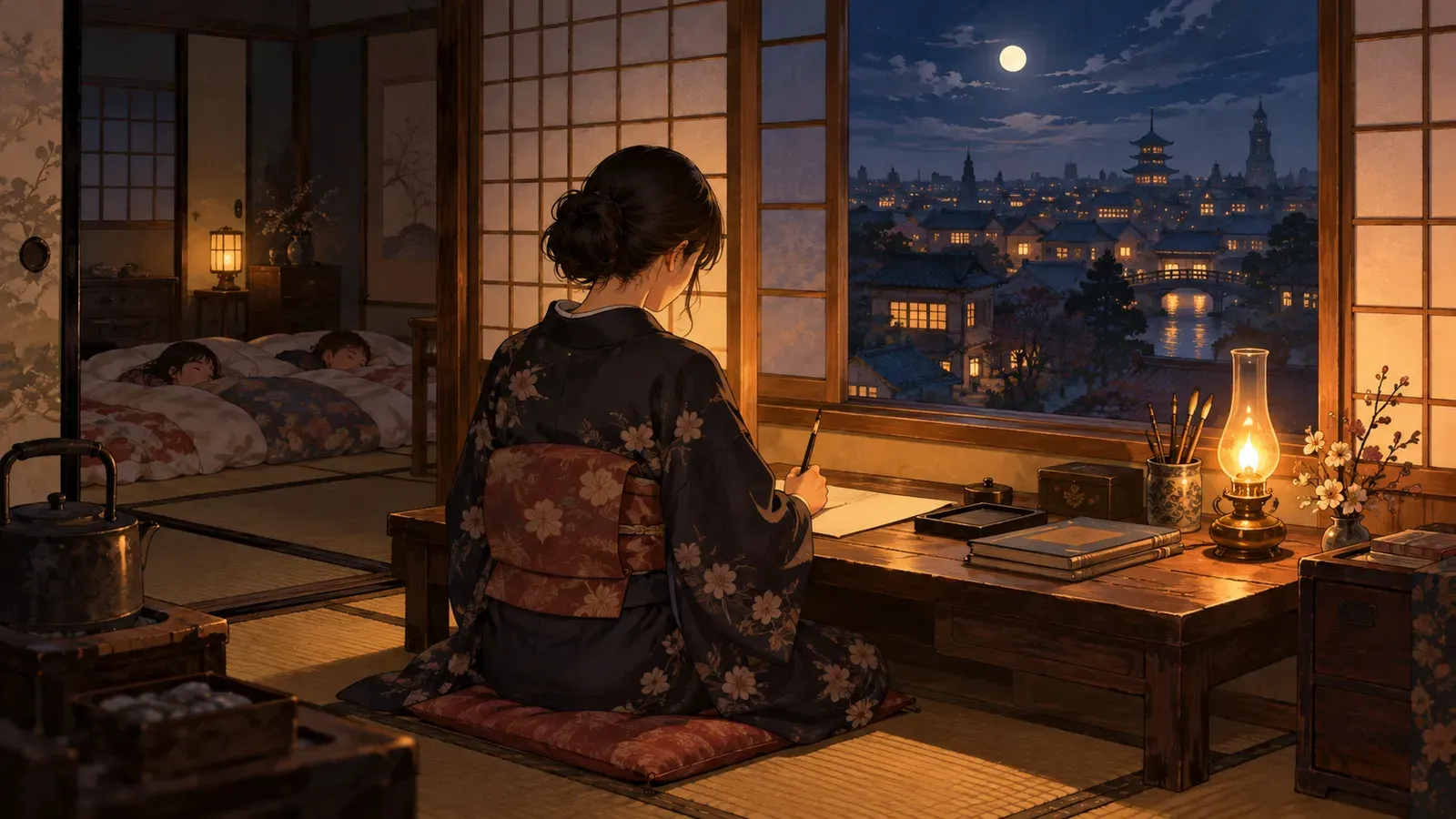
Meanwhile, Tekkan's career declined. Myojo stopped publishing in 1908, and his poetry was no longer as popular as before. Akiko supported the large family mainly with her writing. She wrote poems, essays, children's stories, and articles at an amazing speed, often late at night after the children were asleep.
その一方で、鉄幹の仕事はかげりを見せていきます。『明星』は1908年に廃刊となり、鉄幹の歌も以前ほどの人気はなくなりました。大家族の暮らしを支えたのは、おもに晶子の筆でした。晶子は、詩や随筆、童話、評論を、驚くほどの速さで書きつづけました。子どもたちが寝静まった夜ふけに書くことも、少なくありませんでした。
Akiko also had something to say about the freedom of women. In 1911, a group of young women led by Hiratsuka Raicho started a magazine called Seito, or Bluestocking, written and edited entirely by women. For its first issue, Akiko wrote a poem that began, "The day when the mountains move has come." The mountains, she wrote, had only been sleeping for a while. Long ago, they had all moved with fire. Now, she asked people to believe, all the women who had been sleeping were waking up and beginning to move.
晶子は、女性の自由についても言いたいことがありました。1911年、平塚らいてうを中心とする若い女性たちが、女性だけで書き、編集する雑誌『青鞜』を創刊しました。その創刊号のために、晶子は「山の動く日来る」と始まる詩を書きました。山はしばらく眠っていただけなのだ、と晶子は書きます。遠い昔、山はみな火に燃えて動いていたのだ、と。そして今、眠っていた女たちがみな目を覚まして動きはじめている。人々よ、このことを信じてほしい、と晶子は呼びかけたのです。
In 1911, Tekkan went to Paris, and in 1912, Akiko followed him, travelling across Siberia by train. In Europe, she visited France, England, Germany, and other countries. In Paris, she met the sculptor Auguste Rodin, and later she named one of her sons Auguste in memory of this meeting. She was impressed by the women she saw in Europe, who seemed active and independent, and she came home with even stronger ideas about women's lives.
1911年、鉄幹はパリへ旅立ち、1912年には晶子もあとを追いました。シベリアを列車で横断する旅でした。ヨーロッパでは、フランスやイギリス、ドイツなどの国々を訪れました。パリでは彫刻家のオーギュスト・ロダンに会い、のちに、この出会いを記念して息子の一人をアウギュストと名づけました。ヨーロッパで見た女性たちは、生き生きと活動し、自立しているように見えました。晶子はそのことに心を動かされ、女性の生き方についての考えを、いっそう強くして帰国したのです。
Akiko became one of the leading voices in debates about women in Japan. She believed that women should be educated and should be able to support themselves financially, so that they would not have to depend on husbands or on the state. Around 1918, she had a famous debate with the feminist Hiratsuka Raicho. Raicho argued that the state should protect and support mothers. Akiko disagreed, saying that women should become independent first. Both women wanted a better life for women, but they had different ideas about how to reach it.
晶子は、日本の女性をめぐる論争で、先頭に立つ論客の一人になりました。女性は教育を受け、自分の力で生計を立てられるようになるべきだ、と晶子は考えていました。そうすれば、夫にも国にも頼らずにすむからです。1918年ごろ、晶子は、女性の権利を訴える平塚らいてうと有名な論争をしました。らいてうは、国が母親を保護し、支えるべきだと主張しました。晶子はこれに反対し、女性はまず自立すべきだと述べました。二人とも女性のよりよい生き方を願っていましたが、そこへたどり着く道筋についての考えが違っていたのです。
She also gave much of her life to The Tale of Genji, the book she had loved since childhood. In 1912 and 1913, she published a version of it in modern Japanese, so that ordinary readers could enjoy it. Later, she worked for years on a new and fuller translation. But in 1923, the Great Kanto Earthquake struck Tokyo, and the manuscript, which was kept at a school, was destroyed in the fires that followed. Years of work were lost in a single day.
晶子はまた、子どものころから愛してきた『源氏物語』に、人生の多くをささげました。1912年から1913年にかけて、ふつうの読者にも楽しめるように、今の日本語に訳したものを出版しました。その後、晶子は何年もかけて、もっとくわしい新しい訳に取り組みました。ところが1923年、関東大震災が東京を襲います。ある学校に保管してあった原稿は、地震のあとの火事で焼けてしまいました。何年分もの仕事が、たった1日で失われたのです。
Akiko did not give up. She started again, and her new translation was finally published in 1938 and 1939.
それでも晶子はあきらめませんでした。一から訳し直し、新しい訳はついに1938年から1939年にかけて出版されました。
In 1921, Akiko and Tekkan, together with an architect and a painter, founded Bunka Gakuin, a school in Tokyo with a free and creative style of education. It was one of the first schools in Japan where boys and girls studied together. Akiko taught there and served as one of its leaders.
1921年、晶子と鉄幹は、建築家や画家とともに、東京に文化学院という学校をつくりました。自由で創造的な教育を大切にする学校です。文化学院は、日本で男女が一緒に学んだ最初期の学校の一つでした。晶子はそこで教え、学校を導く一人としても力をつくしました。
Her story has a painful shadow, however. In the 1930s, Japan moved deeper into war, first in China and then against the United States and Britain. Like many writers of the time, Akiko wrote poems that supported the war. In one late tanka, she wrote about her fourth son, a naval officer, telling him to fight bravely. He was the same son she had named after Rodin. The poem appeared in her last collection, which was published after her death.
けれども、晶子の物語には、つらい影もあります。1930年代、日本は戦争に深く入りこんでいきました。はじめは中国と、やがてアメリカやイギリスとも戦うことになります。当時の多くの作家と同じように、晶子も戦争を支持する歌を作りました。晩年のある短歌で晶子は、海軍の士官になった四男に、勇ましく戦えと呼びかけています。それは、ロダンにちなんで名づけた、あの息子でした。この歌は、晶子の死後に出版された最後の歌集にのせられました。
Many readers find it hard to connect these poems with the woman who had once cried out, "Please do not die." Some people think she was swept along by the pressures of the time. Others point out that even her early poem was a personal plea for her brother, not a complete rejection of war. Whatever the reason, this contradiction is part of her life story.
かつて「君死にたまふことなかれ」と叫んだ人と、こうした歌とを結びつけるのは難しい、と感じる読者は少なくありません。時代の圧力に押し流されたのだ、と考える人もいます。もともとあの詩も弟への個人的な願いであって、戦争そのものをまるごと否定したわけではなかった、と指摘する人もいます。理由が何であれ、この矛盾もまた、晶子の生涯の一部なのです。
In 1935, Tekkan died. Five years later, Akiko suffered a stroke and could no longer work as before. She died in Tokyo on May 29, 1942, at the age of sixty-three. In her lifetime, she is said to have written about fifty thousand tanka, as well as many other works.
1935年、鉄幹が亡くなりました。その5年後、晶子は脳卒中で倒れ、以前のようには仕事ができなくなりました。1942年5月29日、晶子は東京で亡くなりました。63歳でした。晶子は生涯に、ほかの多くの作品に加えて、およそ5万首の短歌を作ったといわれています。
Today, Yosano Akiko is remembered as one of the greatest poets of modern Japan, and as a pioneer who dared to write about love and women's lives in her own voice. Her life was not simple. She broke the rules of her society, worked endlessly for her family, and sometimes changed her views as the times changed. But in her best poems, she did exactly what she said a poem should do: she told the truth about her own heart.
今日、与謝野晶子は、近代日本でもっとも偉大な歌人の一人として、そして、恋や女性の生き方を自分の声で歌いあげた先駆者として記憶されています。その生涯は、単純なものではありませんでした。社会のおきてを破り、家族のためにひたすら働き、ときには時代の移り変わりとともに考えを変えもしました。それでも、すぐれた作品の中で晶子がしたのは、まさに自分が歌のあるべき姿として語ったことでした。自分の心の真実を、ありのままに歌ったのです。