
パッヘルベルのジーグ
Pachelbel's Gigue
パッヘルベル・c. 1680–1706
あの「カノン」には、はずむ相棒がいた!知られざる後半戦。
カノンとジーグ ニ長調 より「ジーグ」のページへ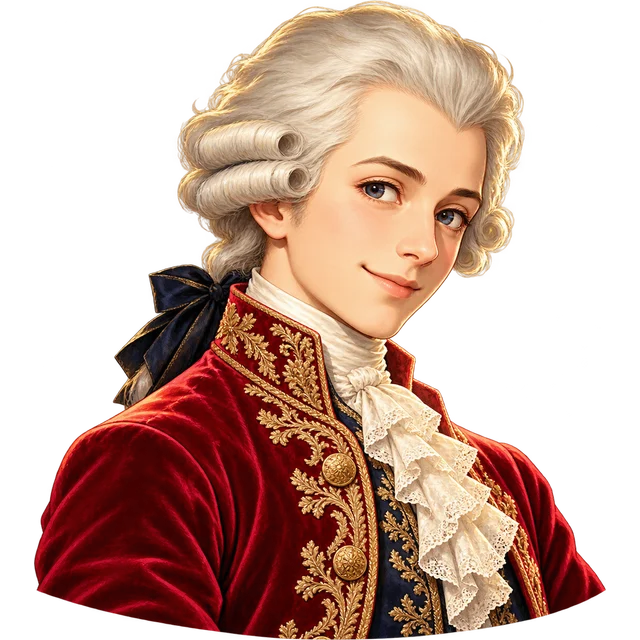
Symphony · K. 385 · 1782
ヴォルフガング・アマデウス・モーツァルト(1756–1791)
大いそぎで書いて、すっかり忘れて、読み返して自分でびっくり!Written in a rush, forgotten, then a surprise for its own composer!
WATCH ON YOUTUBE
この曲は、権利の切れた高音質の録音がまだ見つからないため、YouTube の公式チャンネルなどの名演でお楽しみください(ダウンロードはできません)。YouTube でほかの演奏もさがす ↗
 Mozart: Symphony No. 35 Haffner | Bernard Haitink and the Royal Concertgebouw Orchestra
DW Classical Music(YouTube) YouTube で開く ↗

ホー!モーツァルトは「第1楽章は火のように、終楽章はできるだけ速く」と書いたんだ。
 この曲のおはなし The Story
交響曲第35番は、1782年の夏、ザルツブルクの名家ハフナー家のために書かれました。モーツァルトの幼なじみジークムント・ハフナーが貴族の位をさずかるお祝いのために、父レオポルトが息子に新しい曲をたのんだのです。もとは行進曲などもふくむ「セレナード」として書かれ、それがのちに交響曲に作りかえられました。Symphony No. 35 was written in the summer of 1782 for the Haffners, an important family in Salzburg. Mozart's father, Leopold, asked his son for new music to celebrate Sigmund Haffner, a friend of Mozart's from childhood, being given a noble title. It was first written as a serenade that included a march, and later Mozart turned it into a symphony.
このころのモーツァルトは大いそがしでした。オペラ「後宮からの誘拐」が7月にウィーンで初演されたばかりで、8月4日にはコンスタンツェとの結婚もひかえていました。そのなかで、できた楽章から少しずつザルツブルクの父に送ったのです。父への手紙には「第1楽章はとても火のように、終楽章はできるだけ速く」と演奏のしかたを書いています。Mozart was extremely busy at this time. His opera The Abduction from the Seraglio had just opened in Vienna in July, and he was about to marry Constanze on 4 August. In the middle of all this, he sent the movements to his father in Salzburg one by one as he finished them. In a letter, he explained that the first movement should be played 'with great fire,' and the last 'as fast as possible.'
翌年、ウィーンでの演奏会のためにこの曲を送り返してもらったモーツァルトは、父に「新しいハフナー交響曲には本当におどろきました。1音も覚えていなかったのです」と書きました。行進曲と2つ目のメヌエットをはずし、フルートとクラリネットを加えて交響曲に。1783年3月23日、ウィーンのブルク劇場で、皇帝ヨーゼフ2世も聴くなか演奏されました。The next year, Mozart asked his father to send the music back for a concert in Vienna. He then wrote to his father that the 'new Haffner symphony' had amazed him, because he had forgotten every single note of it. He removed the march and one of the two minuets and added flutes and clarinets, making it a symphony. It was performed on 23 March 1783 at the Burgtheater in Vienna, with Emperor Joseph II in the audience.
Mozart wrote this music very fast. He was very busy, and he was going to get married. A year later, he looked at the music again. He said, 'I forgot every note!' Then he made it a symphony, and people loved it.モーツァルトはこの音楽をとても速く書きました。とてもいそがしく、もうすぐ結婚するところでした。1年後、モーツァルトはこの楽譜をもう一度見ました。そして「1音も覚えていない!」と言いました。それから交響曲に作りかえると、人びとに大人気になりました。
 聴きどころ Listening Guide
 えっ!?ネタ Surprising Facts
 タップすると答えが開きます
1783年2月、送り返された楽譜を見たモーツァルトは、父への手紙に「新しいハフナー交響曲には本当におどろきました。1音も覚えていなかったのです。きっとよい効果があるでしょう」と書きました。大いそぎで書いたとはいえ、自分の曲を忘れてしまうほどたくさん作曲していたのです。
In February 1783, when Mozart saw the music again, he wrote to his father that the new Haffner symphony had truly amazed him, since he had forgotten every note of it, and that it would surely make a good effect. He had written it in a rush, but he was also composing so much that he could forget his own music!
じつは、モーツァルトにはもう1曲「ハフナー」と呼ばれる作品があります。1776年に、ハフナー家の娘エリーザベトの結婚式の前夜祭のために書いた「ハフナー・セレナード」です。同じ一家のお祝いのために、モーツァルトは2度も大きな曲を書いたのです。まちがえやすいので注意しましょう。
In fact, Mozart has another work called 'Haffner': the 'Haffner Serenade,' written in 1776 for the eve of the wedding of Elisabeth Haffner, a daughter of the family. So Mozart wrote big pieces twice for celebrations of the same family. Be careful not to mix them up!
モーツァルトは1782年8月4日、ウィーンでコンスタンツェと結婚しました。父レオポルトはこの結婚に反対ぎみで、父からの同意の手紙がとどいたのは、なんと結婚式の翌日だったと言われています。そんなハラハラの中で、父のための曲も書いていたのです。
Mozart married Constanze in Vienna on 4 August 1782. His father was not happy about the marriage, and his letter giving permission is said to have arrived the day after the wedding! Mozart was writing music for his father in the middle of all this drama.
モーツァルトは父への手紙で、第1楽章は「とても火のように」、最後の楽章は「できるだけ速く」演奏するよう指示しています。この生き生きした言葉から、モーツァルトが求めた曲の勢いがよくわかります。今の指揮者たちも、この言葉をヒントに演奏を考えています。
In a letter to his father, Mozart said the first movement should be played 'with great fire' and the last movement 'as fast as possible.' These vivid words give a clear picture of the energy Mozart wanted. Conductors today still use these words as a guide.
ENGLISH × MASTERPIECE
 slip(すべり落ちる)+mind。頭からするりと抜け落ちる感じです。
 この曲で覚える英単語 Words
 クイズに挑戦 Quiz
 著作権について Credits
MORE MASTERPIECES
パッヘルベル・c. 1680–1706
あの「カノン」には、はずむ相棒がいた!知られざる後半戦。
カノンとジーグ ニ長調 より「ジーグ」のページへシャルパンティエ・c. 1688–1698
パンパカパーン!ヨーロッパのテレビの幕開けを飾ってきた、ごうかな前奏曲。
テ・デウム ニ長調のページへクラーク・c. 1700
結婚式の大定番。でも作曲者は長いあいだ取りちがえられていた!
トランペット・ヴォランタリー(デンマーク王子の行進)のページへ
バッハ・c. 1707–1710 (?)
キラキラの駆け上がりで幕開け!若きバッハのはなやかな鍵盤ショー。
トッカータ ニ長調のページへ
ヴィヴァルディ・published 1711
2本のヴァイオリンが火花を散らす!バッハも編曲した熱い協奏曲。
協奏曲集『調和の霊感』第8番 イ短調(2つのヴァイオリンのための協奏曲)のページへヴィヴァルディ・c. 1715
オクターブがぴょんぴょん跳ねる!喜びがはじける合唱の名曲。
グローリア ニ長調のページへ
テレマン・c. 1710–1720 (?)
バルブのないラッパで高音をきらり!バロックのトランペットの晴れ舞台。
トランペット協奏曲 ニ長調のページへ
ヘンデル・1717
テムズ川の船の上で国王のために!夏の夜の水上コンサート。
水上の音楽のページへ
 MP3