
アブデラザール
Abdelazer Rondeau
パーセル・1695
ブリテンが「オーケストラ入門」のテーマに選んだ、かっこいいメロディー。
劇音楽「アブデラザール」より ロンドのページへ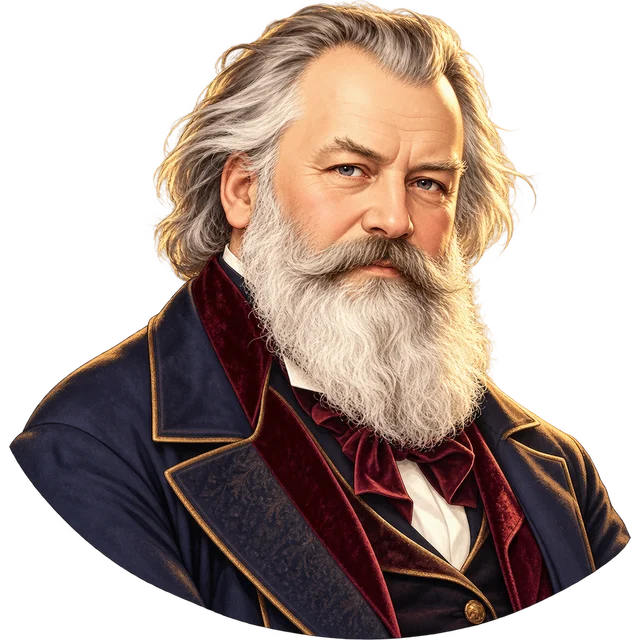
Concerto · Op. 77 · 1878
ヨハネス・ブラームス(1833–1897)
親友の助言を受けて生まれた、ヴァイオリン協奏曲の最高峰のひとつ。Created with help from a close friend: one of the greatest violin concertos.
WATCH ON YOUTUBE
この曲は、権利の切れた高音質の録音がまだ見つからないため、YouTube の公式チャンネルなどの名演でお楽しみください(ダウンロードはできません)。YouTube でほかの演奏もさがす ↗
 Brahms: Violinkonzert ∙ hr-Sinfonieorchester ∙ Leonidas Kavakos ∙ Manfred Honeck
hr-Sinfonieorchester – Frankfurt Radio Symphony(YouTube) YouTube で開く ↗
Brahms: Violin Concerto | Isabelle Faust, Sir Simon Rattle and the London Symphony Orchestra
DW Classical Music(YouTube) YouTube で開く ↗
Brahms - Violinkonzert | Augustin Hadelich | Cristian Măcelaru | WDR Sinfonieorchester
ARD Klassik(YouTube) YouTube で開く ↗
Brahms : Concerto pour violon (Hilary Hahn)
France Musique concerts(YouTube) YouTube で開く ↗

ホー!この曲が生まれたのは1878年の夏。オーストリア南部の湖のほとりだよ。
 この曲のおはなし The Story
ブラームスのヴァイオリン協奏曲は、1878年に作られた、ヴァイオリン独奏とオーケストラのための曲です。日本では、ベートーヴェン、メンデルスゾーンの作品とならんで「三大ヴァイオリン協奏曲」と呼ばれることがあります。3つの楽章でできていて、全部で40分ほどかかる、堂々とした作品です。Brahms's Violin Concerto, written in 1878, is a piece for solo violin and orchestra. In Japan, it is often called one of the 'three great violin concertos', together with those by Beethoven and Mendelssohn. It has three movements and lasts about 40 minutes, a grand and noble work.
ブラームスはピアノの名人でしたが、ヴァイオリンの専門家ではありませんでした。そこで、親友で大ヴァイオリニストのヨーゼフ・ヨアヒムに楽譜を送り、弾きやすさや響きについて何度も意見を求めました。ヨアヒムはこまかく助言し、第1楽章の終わり近くで独奏者がひとりで技を見せる「カデンツァ」も書きました。今もヨアヒムのカデンツァがよく弾かれています。Brahms was a fine pianist, but not a violin expert. So he sent the music to his close friend Joseph Joachim, a great violinist, and asked him again and again how to make the part playable and effective. Joachim gave detailed advice, and he also wrote the cadenza, the solo passage near the end of the first movement where the violinist shows off alone. His cadenza is still often played today.
初演は1879年1月1日、ライプツィヒのゲヴァントハウスで、ヨアヒムの独奏、ブラームスの指揮で行われました。最初は「難しすぎる」「ヴァイオリンが目立たない」という声もありました。でも、交響曲のように深いオーケストラと独奏が対話するこの曲は、しだいに名曲として認められ、今ではヴァイオリニストにとって欠かせないレパートリーになっています。The premiere was given on 1 January 1879 at the Gewandhaus in Leipzig, with Joachim as soloist and Brahms conducting. At first some people said it was too difficult, or that the violin did not stand out enough. But this concerto, in which the soloist has a rich, symphony-like conversation with the orchestra, slowly won people's hearts. Today it is a core part of the violin repertoire.
This is a big piece for violin and orchestra. Brahms wrote it for his best friend, a famous violinist. His friend helped him with the violin part. In the slow part, the oboe plays the beautiful melody first. The last part sounds like a lively Hungarian dance.これは、ヴァイオリンとオーケストラのための大きな曲です。ブラームスは、有名なヴァイオリニストだった親友のためにこの曲を書きました。親友は、ヴァイオリンのパート作りを手伝いました。ゆっくりした楽章では、オーボエが先に美しいメロディーを吹きます。最後の楽章は、元気なハンガリーの踊りのように聞こえます。
 聴きどころ Listening Guide
 えっ!?ネタ Surprising Facts
 タップすると答えが開きます
当時、「これはヴァイオリンのための協奏曲ではなく、ヴァイオリンに反する協奏曲だ」という皮肉が言われたと伝えられています(だれが言ったかは諸説あります)。のちに名ヴァイオリニストのフーベルマンは「ヴァイオリンとオーケストラの対決で、ヴァイオリンが勝つ協奏曲だ」と言い返したと言われています。
It is said that people joked it was a concerto not 'for' the violin but 'against' it, though who first said this is unclear. Later, the great violinist Bronisław Huberman is said to have replied that it is a concerto for violin against orchestra, and the violin wins.
第2楽章では、ヴァイオリンより先に、オーボエが長く美しいメロディーを吹きます。スペインの名ヴァイオリニスト、サラサーテは「オーボエがこの曲でただひとつのメロディーを吹くのを、ヴァイオリンを持って立って聴いていろというのか」と言って、この曲を弾かなかった、という話が伝わっています。
In the second movement, the oboe plays a long, beautiful melody before the violin does. There is a story that the Spanish violinist Pablo de Sarasate refused to play the concerto, saying he would not stand there, violin in hand, listening to the oboe play the only real tune in the piece.
ブラームスは最初、この協奏曲を4つの楽章で作るつもりでした。しかし途中で真ん中の2つの楽章をやめ、ヨアヒムへの手紙に「真ん中の楽章はなくなった。もちろん、それがいちばんよかったのだけど!代わりに、つまらないアダージョを書いている」と冗談まじりに書いています。
Brahms first planned the concerto in four movements. Then he dropped the two middle ones and joked in a letter to Joachim: 'The middle movements are gone, and of course they were the best! I am writing a poor Adagio instead.'
第3楽章は、はずむようなリズムをもった、ハンガリーの踊りのような音楽です。ヨアヒムは当時のハンガリー王国の生まれで、ハンガリー風の音楽が得意でした。この楽章は、親友へのあいさつのようだとよく言われます。
The third movement is full of bouncing rhythms, like a Hungarian dance. Joachim was born in what was then the Kingdom of Hungary and loved Hungarian-style music. This movement is often heard as a friendly greeting to him.
ENGLISH × MASTERPIECE
 日本語の「三人寄れば文殊の知恵」に近いことわざ。英語では「ふたり」です。
 この曲で覚える英単語 Words
 クイズに挑戦 Quiz
 著作権について Credits
MORE MASTERPIECES
パーセル・1695
ブリテンが「オーケストラ入門」のテーマに選んだ、かっこいいメロディー。
劇音楽「アブデラザール」より ロンドのページへ
バッハ・c. 1704 (?)
タラリ〜!一度聴いたら忘れない、オルガンの大迫力の幕開け。
トッカータとフーガ ニ短調のページへバッハ・c. 1703–1707 (?)
音楽の授業でおなじみ!4つの声が同じテーマで追いかけっこ。
小フーガ ト短調のページへバッハ・c. 1706–1713
足が弾く低いテーマが21回!重くて壮大な、オルガンの大建築。
パッサカリアとフーガ ハ短調のページへバッハ・c. 1707–1710 (?)
キラキラの駆け上がりで幕開け!若きバッハのはなやかな鍵盤ショー。
トッカータ ニ長調のページへ
ヴィヴァルディ・published 1711
2本のヴァイオリンが火花を散らす!バッハも編曲した熱い協奏曲。
協奏曲集『調和の霊感』第8番 イ短調(2つのヴァイオリンのための協奏曲)のページへバッハ・c. 1720
チェロ1本だけで、こんなに豊かな世界が広がる!
無伴奏チェロ組曲 第1番 ト長調のページへバッハ・c. 1720
ヴァイオリン1本で、宇宙のように大きな世界を描く傑作。
無伴奏ヴァイオリン・パルティータ第2番 ニ短調より「シャコンヌ」のページへ
 MP3