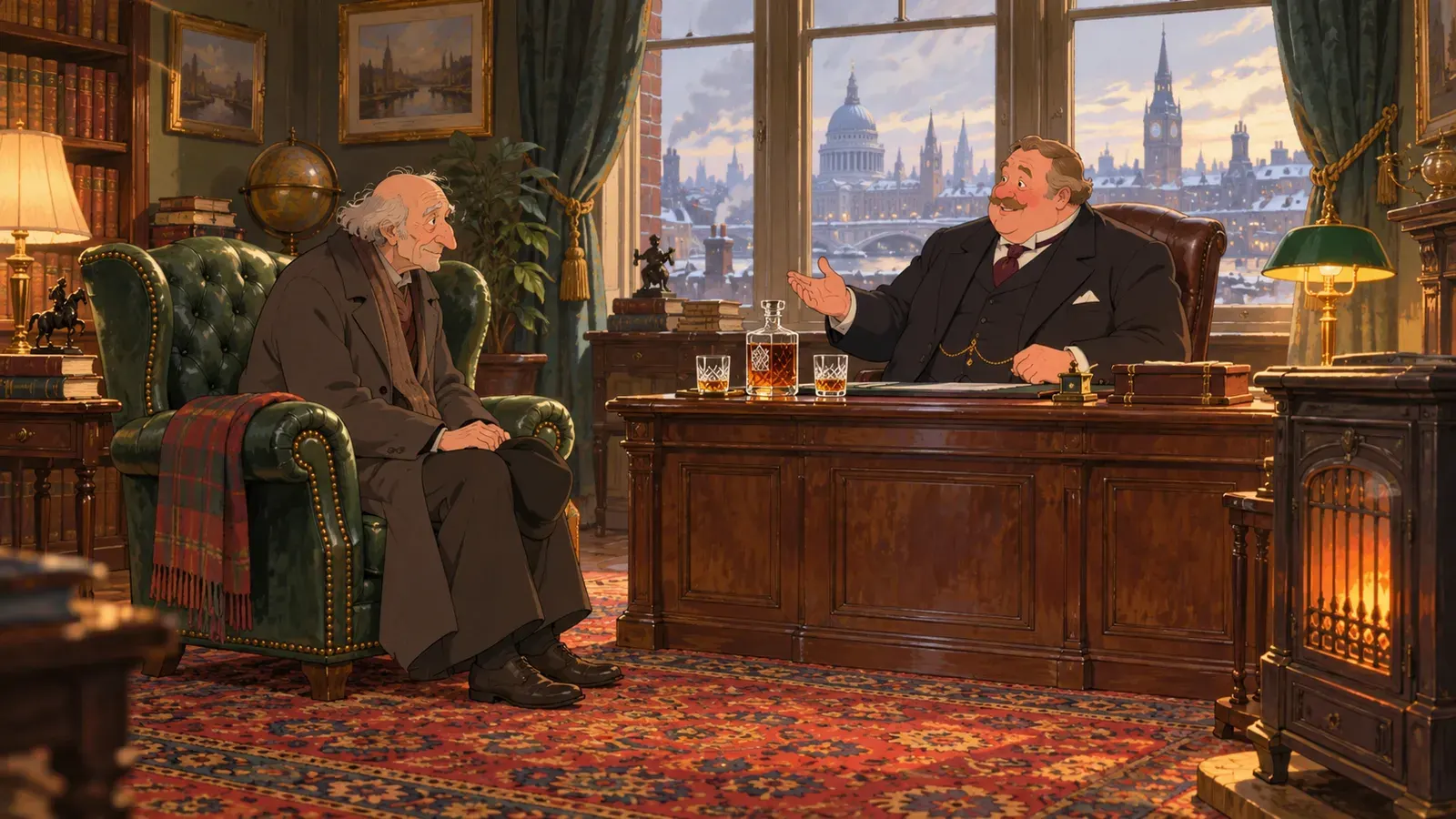
"Y'are very snug in here," piped old Mr. Woodifield, and he peered out of the great, green leather armchair by his friend the boss's desk as a baby peers out of its pram. His talk was over; it was time for him to be off. But he did not want to go. Since he had retired, since his ... stroke, the wife and the girls kept him boxed up in the house every day of the week except Tuesday. On Tuesday he was dressed up and brushed and allowed to cut back to the City for the day. Though what he did there the wife and girls couldn't imagine. Made a nuisance of himself to his friends, they supposed.... Well, perhaps so. All the same, we cling to our last pleasures as the tree clings to its last leaves. So there sat old Woodifield, smoking a cigar and staring almost greedily at the boss, who rolled in his office chair, stout, rosy, five years older than he, and still going strong, still at the helm. It did one good to see him.
「ここはずいぶん居心地がいいねえ」とウッディフィールド老人は細い声で言った。友人である社長の机のそばの、大きな緑の革の肘掛け椅子から、老人は、赤ん坊が乳母車からのぞくように顔をのぞかせていた。話はもうすんでいた。そろそろ帰る時間だった。だが、老人は帰りたくなかった。仕事をやめてから、あの……発作を起こしてから、妻と娘たちは、火曜日のほかは毎日、老人を家に閉じこめていた。火曜日になると、身なりをととのえ、ブラシをかけてもらって、一日だけシティへ出かけることを許されるのだった。そこで何をしているのか、妻と娘たちには見当もつかなかった。きっとお友だちにご迷惑をかけているんでしょう、と思っていた……。まあ、たぶんそうなのだろう。それでも、木が最後の葉にしがみつくように、私たちは最後の楽しみにしがみつくものなのだ。そういうわけで、ウッディフィールド老人はそこに座って葉巻をふかし、ほとんどむさぼるように社長を見つめていた。社長は事務用の椅子をゆらゆら揺らしていた。恰幅がよく、血色がよく、老人より五つ年上なのに、まだ元気いっぱいで、いまも会社の舵をとっている。その姿を見ると、こちらまで元気が出るのだった。
Wistfully, admiringly, the old voice added, "It's snug in here, upon my word!"
老人は、うらやましそうな、感心したような細い声でつけ加えた。「まったく、ここは居心地がいいよ!」
"Yes, it's comfortable enough," agreed the boss, and he flipped the Financial Times with a paper-knife. As a matter of fact he was proud of his room; he liked to have it admired, especially by old Woodifield. It gave him a feeling of deep, solid satisfaction to be planted there in the midst of it in full view of that frail old figure in the muffler.
「ああ、まあ快適だな」と社長は相づちを打ち、ペーパーナイフでフィナンシャル・タイムズをめくった。じつのところ、社長は自分の部屋が自慢だった。人にほめてもらうのが好きだった。とくにウッディフィールド老人にほめてもらうのが。マフラーを巻いた、あの弱々しい老人の目の前で、部屋の真ん中にどっかりと腰をすえていると、深く、どっしりとした満足を覚えるのだった。
"I've had it done up lately," he explained, as he had explained for the past—how many?—weeks. "New carpet," and he pointed to the bright red carpet with a pattern of large white rings. "New furniture," and he nodded towards the massive bookcase and the table with legs like twisted treacle. "Electric heating!" He waved almost exultantly towards the five transparent, pearly sausages glowing so softly in the tilted copper pan.
「最近、改装したんだ」と社長は説明した。ここ何週間、いったい何週間になるだろう、ずっと同じ説明をしてきた。「新しいじゅうたん」と言って、大きな白い輪の模様のついた、鮮やかな赤いじゅうたんを指さした。「新しい家具」と言って、どっしりした本棚と、ねじった飴のような脚のテーブルのほうへあごをしゃくった。「電気暖房だ!」と言って、傾けた銅の受け皿の中でやわらかく光っている、透きとおった真珠色のソーセージのようなものが五本並んでいるほうへ、ほとんど得意げに手を振った。
But he did not draw old Woodifield's attention to the photograph over the table of a grave-looking boy in uniform standing in one of those spectral photographers' parks with photographers' storm-clouds behind him. It was not new. It had been there for over six years.
だが社長は、テーブルの上にかかっている写真には、ウッディフィールド老人の目を向けさせなかった。制服を着た、まじめな顔つきの少年の写真だった。写真屋によくある、幽霊のような公園の背景の前に立ち、後ろには写真屋がこしらえた嵐の雲が広がっている。それは新しいものではなかった。もう六年以上もそこにかかっていた。
"There was something I wanted to tell you," said old Woodifield, and his eyes grew dim remembering. "Now what was it? I had it in my mind when I started out this morning." His hands began to tremble, and patches of red showed above his beard.
「何か話したいことがあったんだがな」とウッディフィールド老人は言った。思い出そうとして、その目がぼんやりとかすんだ。「はて、何だったかな? けさ出かけるときには覚えていたんだが」老人の両手が震えだし、ひげの上のあたりに赤いまだらが浮かんだ。
Poor old chap, he's on his last pins, thought the boss. And, feeling kindly, he winked at the old man, and said jokingly, "I tell you what. I've got a little drop of something here that'll do you good before you go out into the cold again. It's beautiful stuff. It wouldn't hurt a child." He took a key off his watch-chain, unlocked a cupboard below his desk, and drew forth a dark, squat bottle. "That's the medicine," said he. "And the man from whom I got it told me on the strict Q.T. it came from the cellars at Windsor Cassel."
かわいそうに、もうがたがきているな、と社長は思った。そして、やさしい気持ちになって、老人にウインクしてみせ、冗談めかして言った。「いいものがあるんだ。ここにちょっとしたものがあってな。また寒いところへ出ていく前に、これを飲めば元気が出るぞ。上物だ。子どもが飲んだって毒にはならん」社長は時計の鎖から鍵をはずし、机の下の戸棚を開けて、ずんぐりした黒っぽい瓶を取り出した。「これが薬だ」と社長は言った。「これを譲ってくれた男が、ここだけの話だと言って教えてくれたんだが、ウィンザー城の地下蔵から出たものだそうだ」
Old Woodifield's mouth fell open at the sight. He couldn't have looked more surprised if the boss had produced a rabbit.
ウッディフィールド老人は、それを見てぽかんと口を開けた。社長が帽子からウサギでも取り出してみせたとしても、これ以上驚いた顔はできなかっただろう。
"It's whisky, ain't it?" he piped, feebly.
「ウイスキーじゃないかね?」と老人は弱々しい細い声で言った。
The boss turned the bottle and lovingly showed him the label. Whisky it was.
社長は瓶をまわして、いとおしそうにラベルを見せた。たしかにウイスキーだった。
"D'you know," said he, peering up at the boss wonderingly, "they won't let me touch it at home." And he looked as though he was going to cry.
「なあ、きみ」と老人は、不思議そうに社長を見上げて言った。「うちじゃあ、これに手をふれさせてもらえないんだよ」そして、いまにも泣きだしそうな顔をした。
"Ah, that's where we know a bit more than the ladies," cried the boss, swooping across for two tumblers that stood on the table with the water-bottle, and pouring a generous finger into each. "Drink it down. It'll do you good. And don't put any water with it. It's sacrilege to tamper with stuff like this. Ah!" He tossed off his, pulled out his handkerchief, hastily wiped his moustaches, and cocked an eye at old Woodifield, who was rolling his in his chaps.
「ああ、そこがわれわれ男のほうが、ご婦人方より少しはものがわかっているところさ」と社長は声を張りあげた。そして、水差しと一緒にテーブルの上に置いてあるタンブラーを二つ、さっと取ってきて、それぞれに指一本分ほど、たっぷりついだ。「ぐっとやりたまえ。元気が出るぞ。それから、水は入れるなよ。こういう酒に手を加えるのは冒涜だからな。ああ!」社長は自分の分をぐいとあおり、ハンカチを出して急いで口ひげをぬぐった。そして片目を細めて、ウッディフィールド老人をうかがった。老人は、ウイスキーを口の中で転がしていた。
The old man swallowed, was silent a moment, and then said faintly, "It's nutty!"
老人はごくりと飲みこんで、しばらく黙っていたが、やがてかすかな声で言った。「木の実のような香りがするね!」
But it warmed him; it crept into his chill old brain—he remembered.
だがウイスキーは老人を温めた。冷えきった老いた頭の中に、じわじわしみこんでいった。そして老人は思い出した。
"That was it," he said, heaving himself out of his chair. "I thought you'd like to know. The girls were in Belgium last week having a look at poor Reggie's grave, and they happened to come across your boy's. They're quite near each other, it seems."
「それだよ」と老人は言って、椅子からよいしょと体を起こした。「きみが知りたいだろうと思ってね。先週、娘たちがベルギーへ行って、かわいそうなレジーの墓を見てきたんだ。そうしたら、たまたま、きみの息子さんの墓に行き当たったそうだ。どうやら、すぐ近くにあるらしい」
Old Woodifield paused, but the boss made no reply. Only a quiver in his eyelids showed that he heard.
ウッディフィールド老人は言葉を切った。だが社長は何も答えなかった。ただまぶたがぴくりと震えたので、聞いていることがわかった。
"The girls were delighted with the way the place is kept," piped the old voice. "Beautifully looked after. Couldn't be better if they were at home. You've not been across, have yer?"
「娘たちは、あそこの手入れのよさにすっかり喜んでいたよ」と老人は細い声で言った。「すばらしく手入れが行き届いている。国にあったとしても、あれ以上にはならないだろう。きみはまだ向こうへ行ったことはないんだろう?」
"No, no!" For various reasons the boss had not been across.
「いや、ないよ!」いろいろなわけがあって、社長は向こうへ行ったことがなかった。
"There's miles of it," quavered old Woodifield, "and it's all as neat as a garden. Flowers growing on all the graves. Nice broad paths." It was plain from his voice how much he liked a nice broad path.
「何マイルも続いているんだ」とウッディフィールド老人は声をふるわせた。「それが全部、庭みたいにきちんとしている。どの墓にも花が咲いている。広くて、いい道もある」老人が広くていい道をどんなに好きか、その声からはっきりわかった。
The pause came again. Then the old man brightened wonderfully.
また沈黙が来た。それから、老人の顔が不思議なほどぱっと明るくなった。
"D'you know what the hotel made the girls pay for a pot of jam?" he piped. "Ten francs! Robbery, I call it. It was a little pot, so Gertrude says, no bigger than a half-crown. And she hadn't taken more than a spoonful when they charged her ten francs. Gertrude brought the pot away with her to teach 'em a lesson. Quite right, too; it's trading on our feelings. They think because we're over there having a look around we're ready to pay anything. That's what it is." And he turned towards the door.
「ホテルが娘たちに、ジャムひと瓶にいくら払わせたと思う?」と老人は細い声で言った。「十フランだよ! ぼったくりだね、まったく。小さな瓶だったそうだ、とガートルードは言っている。半クラウン銀貨くらいの大きさしかないのにね。それなのに、ひとさじ食べたかどうかってところで、十フランも取られたんだ。ガートルードは、思い知らせてやろうと、その瓶を持って帰ってきたよ。まったく、それでいいんだ。わたしたちの気持ちにつけこんで商売しているんだからな。わたしたちが向こうへ行って見てまわっているもんだから、いくらでも払うと思っているんだ。そういうことさ」そして老人は戸口のほうへ向きを変えた。
"Quite right, quite right!" cried the boss, though what was quite right he hadn't the least idea. He came round by his desk, followed the shuffling footsteps to the door, and saw the old fellow out. Woodifield was gone.
「まったくだ、まったくだ!」と社長は叫んだ。だが、何がまったくなのか、少しもわかっていなかった。社長は机をまわってきて、足を引きずる老人のあとについて戸口まで行き、送り出した。ウッディフィールドは帰っていった。
For a long moment the boss stayed, staring at nothing, while the grey-haired office messenger, watching him, dodged in and out of his cubby-hole like a dog that expects to be taken for a run. Then: "I'll see nobody for half an hour, Macey," said the boss. "Understand? Nobody at all."
長いあいだ、社長はそのまま、何もないところを見つめて立っていた。そのあいだ、白髪の使い走りの男が、散歩に連れていってもらえるのを待っている犬のように、社長の様子をうかがいながら、自分の小部屋を出たり入ったりしていた。それから社長は言った。「三十分、誰にも会わないからな、メイシー。わかったか? 誰にもだ」
"Very good, sir."
「かしこまりました」
The door shut, the firm heavy steps recrossed the bright carpet, the fat body plumped down in the spring chair, and leaning forward, the boss covered his face with his hands. He wanted, he intended, he had arranged to weep....
扉が閉まった。しっかりとした重い足音が、鮮やかなじゅうたんの上をまた横切った。太った体が、ばねのきいた椅子にどさりと落ちた。そして社長は前かがみになって、両手で顔を覆った。社長は泣きたかった。泣くつもりだった。泣くための手はずも、ちゃんととのえていたのだ……。
It had been a terrible shock to him when old Woodifield sprang that remark upon him about the boy's grave. It was exactly as though the earth had opened and he had seen the boy lying there with Woodifield's girls staring down at him. For it was strange. Although over six years had passed away, the boss never thought of the boy except as lying unchanged, unblemished in his uniform, asleep for ever. "My son!" groaned the boss. But no tears came yet. In the past, in the first months and even years after the boy's death, he had only to say those words to be overcome by such grief that nothing short of a violent fit of weeping could relieve him. Time, he had declared then, he had told everybody, could make no difference. Other men perhaps might recover, might live their loss down, but not he. How was it possible? His boy was an only son. Ever since his birth the boss had worked at building up this business for him; it had no other meaning if it was not for the boy. Life itself had come to have no other meaning. How on earth could he have slaved, denied himself, kept going all those years without the promise for ever before him of the boy's stepping into his shoes and carrying on where he left off?
息子の墓のことをウッディフィールド老人にいきなり持ち出されて、社長はひどい衝撃を受けた。まるで大地が口を開け、息子がそこに横たわり、ウッディフィールドの娘たちがそれを見おろしているのを見たかのようだった。というのも、不思議なことだったからだ。六年以上たったのに、社長の思い浮かべる息子は、いつも同じ姿だった。制服を着て、少しも変わらず、傷ひとつなく、永遠に眠って横たわっている。「わたしの息子!」と社長はうめいた。だが、涙はまだ出てこなかった。昔は、息子が死んでから最初の何か月か、いや何年かは、その言葉を口にしただけで、悲しみに打ちのめされた。激しく泣きじゃくりでもしなければ、とてもおさまらなかった。時がたっても何も変わりはしない、と社長はそのころ断言した。みんなにそう言った。ほかの男たちなら、立ち直るかもしれない。失ったものを乗り越えて生きていけるかもしれない。だが自分は違う。どうしてそんなことができよう? 息子はひとり息子だった。息子が生まれてからずっと、社長は息子のためにこの事業を築き上げようと働いてきた。息子のためでなければ、事業には何の意味もなかった。生きていることそのものにも、ほかに何の意味もなくなっていた。息子がいつか自分のあとを継ぎ、自分がやめたところから続けてくれる。その約束がいつも目の前になかったら、いったいどうして、あの何年ものあいだ、身を粉にして働き、我慢をし、がんばり続けてこられただろう?
And that promise had been so near being fulfilled. The boy had been in the office learning the ropes for a year before the war. Every morning they had started off together; they had come back by the same train. And what congratulations he had received as the boy's father! No wonder; he had taken to it marvellously. As to his popularity with the staff, every man jack of them down to old Macey couldn't make enough of the boy. And he wasn't in the least spoilt. No, he was just his bright, natural self, with the right word for everybody, with that boyish look and his habit of saying, "Simply splendid!"
そしてその約束は、もう少しで果たされるところだったのだ。息子は戦争の前の一年間、事務所で仕事のこつを覚えていた。毎朝、二人は一緒に出かけ、同じ列車で帰ってきた。息子の父親として、どれほど人から祝いの言葉を受けたことか! 無理もない。息子は、それはみごとに仕事になじんだのだ。社員たちのあいだでの人気はといえば、メイシー老人に至るまで、一人残らず、息子をかわいがってやまなかった。それでいて息子は、少しもいい気になってはいなかった。そう、いつも明るく、自然なままで、誰にでもぴったりの言葉をかけた。あの少年らしい顔つきで、「まったくすばらしいですね!」と言うのが口ぐせだった。
But all that was over and done with as though it never had been. The day had come when Macey had handed him the telegram that brought the whole place crashing about his head. "Deeply regret to inform you...." And he had left the office a broken man, with his life in ruins.
だが、そんなことはすべて、一度もなかったかのように終わってしまった。メイシーが電報を手渡し、何もかもが頭の上に崩れ落ちてきた日が来たのだ。「謹んでお知らせ申し上げます……」社長は打ちのめされ、人生をめちゃくちゃにされて、事務所を出ていったのだった。
Six years ago, six years.... How quickly time passed! It might have happened yesterday. The boss took his hands from his face; he was puzzled. Something seemed to be wrong with him. He wasn't feeling as he wanted to feel. He decided to get up and have a look at the boy's photograph. But it wasn't a favorite photograph of his; the expression was unnatural. It was cold, even stern-looking. The boy had never looked like that.
六年前、六年……。時のたつのはなんと早いことか! 昨日のことのようだった。社長は顔から両手を離した。とまどっていた。どこかおかしかった。感じたいように感じられないのだ。社長は立ち上がって、息子の写真を見てみることにした。だが、それはお気に入りの写真ではなかった。表情が不自然だった。冷たく、厳しくさえ見えた。息子はあんな顔をしたことは一度もなかった。
At that moment the boss noticed that a fly had fallen into his broad inkpot, and was trying feebly but desperately to clamber out again. Help! help! said those struggling legs. But the sides of the inkpot were wet and slippery; it fell back again and began to swim. The boss took up a pen, picked the fly out of the ink, and shook it on to a piece of blotting-paper. For a fraction of a second it lay still on the dark patch that oozed round it. Then the front legs waved, took hold, and, pulling its small sodden body up it began the immense task of cleaning the ink from its wings. Over and under, over and under, went a leg along a wing, as the stone goes over and under the scythe. Then there was a pause, while the fly, seeming to stand on the tips of its toes, tried to expand first one wing and then the other. It succeeded at last, and, sitting down, it began, like a minute cat, to clean its face. Now one could imagine that the little front legs rubbed against each other lightly, joyfully. The horrible danger was over; it had escaped; it was ready for life again.
そのとき社長は、一匹のハエが大きなインク壺の中に落ちて、弱々しく、だが必死に、はい出そうとしているのに気づいた。助けて! 助けて! と、もがく脚が言っていた。だがインク壺の内側はぬれていて、すべりやすかった。ハエはまた落ちて、泳ぎはじめた。社長はペンを取り上げ、ハエをインクの中からすくい上げて、吸い取り紙の上に振り落とした。ほんの一瞬、ハエは、まわりににじみ出た黒いしみの上でじっとしていた。それから前脚が動いて、紙をつかんだ。小さなびしょぬれの体を引き上げると、羽根からインクをぬぐいとるという、とてつもない仕事にとりかかった。砥石が大鎌の刃を行ったり来たりするように、脚が羽根にそって、行ったり来たりした。それから、ひと休みした。ハエはつま先立ちしているように見え、まず片方の羽根を、それからもう片方を広げようとした。とうとううまくいくと、ハエは腰をおろして、ちっぽけな猫のように顔を洗いはじめた。いまでは、小さな前脚が、軽やかに、うれしそうにこすり合わされているのが、目に浮かぶようだった。恐ろしい危険は去った。逃れたのだ。また生きていく支度ができたのだ。
But just then the boss had an idea. He plunged his pen back into the ink, leaned his thick wrist on the blotting paper, and as the fly tried its wings down came a great heavy blot. What would it make of that? What indeed! The little beggar seemed absolutely cowed, stunned, and afraid to move because of what would happen next. But then, as if painfully, it dragged itself forward. The front legs waved, caught hold, and, more slowly this time, the task began from the beginning.
だが、ちょうどそのとき、社長はあることを思いついた。社長はペンをまたインクにひたし、太い手首を吸い取り紙の上にのせた。そしてハエが羽根をためしているところへ、大きな重いしずくをぽたりと落とした。こいつはどうするかな? まったく、どうするだろう! ちびすけはすっかりおじけづき、ぼうぜんとして、次に何が起こるかと怖くて動けないようだった。だがやがて、いかにも苦しそうに、体を前へ引きずった。前脚が動いて、紙をつかんだ。そして今度はもっとゆっくりと、仕事がまた初めから始まった。
He's a plucky little devil, thought the boss, and he felt a real admiration for the fly's courage. That was the way to tackle things; that was the right spirit. Never say die; it was only a question of.... But the fly had again finished its laborious task, and the boss had just time to refill his pen, to shake fair and square on the new-cleaned body yet another dark drop. What about it this time? A painful moment of suspense followed. But behold, the front legs were again waving; the boss felt a rush of relief. He leaned over the fly and said to it tenderly, "You artful little b...." And he actually had the brilliant notion of breathing on it to help the drying process. All the same, there was something timid and weak about its efforts now, and the boss decided that this time should be the last, as he dipped the pen into the inkpot.
勇ましいちびすけだな、と社長は思った。ハエの勇気に、本当に感心した。ああやって物事に立ち向かうものなのだ。あれこそ正しい心がけだ。決してへこたれるな。ただ、問題は……。だがハエは、またその骨の折れる仕事を終えていた。社長はペンにインクをつけ直し、きれいにしたばかりの体の上に、もうひとしずく、黒いしずくを、ねらいたがわず振り落とした。今度はどうだ? はらはらする、苦しい一瞬が続いた。だが見よ、前脚がまた動いているではないか。社長はどっとほっとした。ハエの上に身をかがめて、やさしく話しかけた。「このずる賢いちび野……」そして、乾くのを助けてやろうと、息を吹きかけるという、すばらしい思いつきまで浮かんだ。それでも、ハエのがんばりには、いまではどこかおずおずとした、弱々しいところがあった。社長はペンをインク壺にひたしながら、今度で最後にしようと決めた。
It was. The last blot on the soaked blotting-paper, and the draggled fly lay in it and did not stir. The back legs were stuck to the body; the front legs were not to be seen.
それが最後だった。びしょぬれの吸い取り紙の上の、最後のしずく。その中に、よれよれになったハエが横たわり、ぴくりとも動かなかった。後ろ脚は体にくっつき、前脚は見えなかった。
"Come on," said the boss. "Look sharp!" And he stirred it with his pen—in vain. Nothing happened or was likely to happen. The fly was dead.
「さあ」と社長は言った。「しっかりしろ!」そしてペンでハエをつついた。だが、むだだった。何も起こらなかったし、起こりそうもなかった。ハエは死んでいた。
The boss lifted the corpse on the end of the paper-knife and flung it into the waste-paper basket. But such a grinding feeling of wretchedness seized him that he felt positively frightened. He started forward and pressed the bell for Macey.
社長はペーパーナイフの先で死骸をすくい上げ、くずかごに放りこんだ。だが、すりつぶされるようなみじめな気持ちに襲われて、本当に怖くなった。社長は身を乗り出して、メイシーを呼ぶベルを押した。
"Bring me some fresh blotting-paper," he said, sternly, "and look sharp about it." And while the old dog padded away he fell to wondering what it was he had been thinking about before. What was it? It was.... He took out his handkerchief and passed it inside his collar. For the life of him he could not remember.
「新しい吸い取り紙を持ってこい」と社長は厳しい声で言った。「さっさとするんだぞ」老いぼれ犬がとぼとぼ出ていくあいだに、社長は、さっきまで何を考えていたのだろうと考えはじめた。何だったか? あれは……。社長はハンカチを取り出して、襟の内側をぬぐった。どうしても思い出せなかった。