The children were to be driven, as a special treat, to the sands at Jagborough. Nicholas was not to be of the party; he was in disgrace. Only that morning he had refused to eat his wholesome bread-and-milk on the seemingly frivolous ground that there was a frog in it. Older and wiser and better people had told him that there could not possibly be a frog in his bread-and-milk and that he was not to talk nonsense; he continued, nevertheless, to talk what seemed the veriest nonsense, and described with much detail the colouration and markings of the alleged frog. The dramatic part of the incident was that there really was a frog in Nicholas' basin of bread-and-milk; he had put it there himself, so he felt entitled to know something about it. The sin of taking a frog from the garden and putting it into a bowl of wholesome bread-and-milk was enlarged on at great length, but the fact that stood out clearest in the whole affair, as it presented itself to the mind of Nicholas, was that the older, wiser, and better people had been proved to be profoundly in error in matters about which they had expressed the utmost assurance.
子どもたちは、特別のごほうびとして、馬車でジャグバラの砂浜へ連れていってもらうことになっていた。ニコラスは、その仲間に入れてもらえなかった。お仕置き中だったのだ。その日の朝、ニコラスは、体にいいパンがゆを食べようとしなかった。中にカエルが入っている、という、どう見てもふざけた理由でだ。自分より年上で、賢くて、立派な大人たちは、パンがゆにカエルなんか入っているはずがない、ばかなことを言うんじゃありません、と言い聞かせた。それでもニコラスは、どう聞いてもたわごととしか思えないことを言いつづけ、そのカエルとやらの色や模様を、事細かに説明してみせた。この出来事の劇的なところは、ニコラスのパンがゆの鉢に、本当にカエルが入っていたことだった。自分で入れたのだから、そのカエルについてはくわしくて当然だ、とニコラスは思っていた。庭からカエルをつかまえてきて、体にいいパンがゆの鉢に入れるという罪については、長々とお説教された。だが、ニコラスに言わせれば、この一件でいちばんはっきりしたのは、年上で賢くて立派な大人たちが、自信たっぷりに言い切ったことで、とんでもないまちがいをしていたと証明された、ということだった。
"You said there couldn't possibly be a frog in my bread-and-milk; there was a frog in my bread-and-milk," he repeated, with the insistence of a skilled tactician who does not intend to shift from favourable ground.
「ぼくのパンがゆにカエルが入っているはずがないって言ったよね。でも、ぼくのパンがゆにはカエルが入ってたんだよ」とニコラスはくり返した。有利な陣地から一歩も動くつもりのない、老練な軍師のようなしつこさだった。
So his boy-cousin and girl-cousin and his quite uninteresting younger brother were to be taken to Jagborough sands that afternoon and he was to stay at home. His cousins' aunt, who insisted, by an unwarranted stretch of imagination, in styling herself his aunt also, had hastily invented the Jagborough expedition in order to impress on Nicholas the delights that he had justly forfeited by his disgraceful conduct at the breakfast-table. It was her habit, whenever one of the children fell from grace, to improvise something of a festival nature from which the offender would be rigorously debarred; if all the children sinned collectively they were suddenly informed of a circus in a neighbouring town, a circus of unrivalled merit and uncounted elephants, to which, but for their depravity, they would have been taken that very day.
そういうわけで、その午後、男のいとこと女のいとこと、まるで面白みのない弟は、ジャグバラの砂浜へ連れていってもらい、ニコラスは家に残ることになった。いとこたちのおばは、なんの根拠もないのに、自分はニコラスのおばでもあると言い張っていた。そのおばが、ジャグバラ遠足を大急ぎで考え出したのだ。朝食の席での恥ずべき行いのせいで、ニコラスがどれほどの楽しみをふいにしたか、思い知らせてやるためだった。子どもの誰かが言いつけにそむくと、その場で何かお祭りのような楽しいことを考え出し、悪い子だけはきびしくのけ者にする。それがおばのいつものやり方だった。子どもたちがそろって悪さをしたときは、急に、となり町にサーカスが来ていると知らされるのだった。またとないすばらしいサーカスで、ゾウも数えきれないほどいる。こんなに悪い子でなかったら、ちょうどきょう、連れていってあげたのに、というわけだ。
A few decent tears were looked for on the part of Nicholas when the moment for the departure of the expedition arrived. As a matter of fact, however, all the crying was done by his girl-cousin, who scraped her knee rather painfully against the step of the carriage as she was scrambling in.
遠足の一行が出発するときには、ニコラスもしおらしく涙の一つも見せるだろう、と思われていた。ところが実際に泣いたのは、女のいとこのほうだけだった。馬車によじのぼろうとして、ステップでひざをかなり痛そうにすりむいたのだ。
"How she did howl," said Nicholas cheerfully, as the party drove off without any of the elation of high spirits that should have characterised it.
「すごいわめきようだったね」とニコラスは陽気に言った。一行は、本当ならうきうきしていていいはずなのに、ちっとも浮かない様子で出発していった。
"She'll soon get over that," said the soi-disant aunt; "it will be a glorious afternoon for racing about over those beautiful sands. How they will enjoy themselves!"
「すぐに治るわよ」と自称おばは言った。「あのきれいな砂浜を駆け回るには、すばらしい午後になるでしょうね。みんな、どんなに楽しむことかしら!」
"Bobby won't enjoy himself much, and he won't race much either," said Nicholas with a grim chuckle; "his boots are hurting him. They're too tight."
「ボビーはあんまり楽しめないよ。それに、あんまり駆け回れもしないね」とニコラスは、意地悪くくすくす笑いながら言った。「靴が痛いんだ。きつすぎるんだよ」
"Why didn't he tell me they were hurting?" asked the aunt with some asperity.
「どうして痛いって言わなかったの?」とおばは、いくらかとげのある声でたずねた。
"He told you twice, but you weren't listening. You often don't listen when we tell you important things."
「二回言ったよ。でも、おばさんは聞いてなかった。ぼくたちが大事なことを言っても、おばさんはよく聞いてないんだ」
"You are not to go into the gooseberry garden," said the aunt, changing the subject.
「スグリ畑に入ってはいけませんよ」とおばは、話をそらして言った。
"Why not?" demanded Nicholas.
「なんで?」とニコラスは問いただした。
"Because you are in disgrace," said the aunt loftily.
「お仕置き中だからです」とおばは、いばって言った。
Nicholas did not admit the flawlessness of the reasoning; he felt perfectly capable of being in disgrace and in a gooseberry garden at the same moment. His face took on an expression of considerable obstinacy. It was clear to his aunt that he was determined to get into the gooseberry garden, "only," as she remarked to herself, "because I have told him he is not to."
ニコラスは、その理屈が正しいとは思わなかった。お仕置き中でいることと、スグリ畑の中にいることは、ちゃんと同時にできると思った。ニコラスの顔に、かなり強情な表情が浮かんだ。この子はどうしてもスグリ畑に入るつもりだ、とおばにはわかった。おばが心の中でつぶやいたところによれば、「わたしが入ってはいけないと言ったから、ただそれだけの理由で」。
Now the gooseberry garden had two doors by which it might be entered, and once a small person like Nicholas could slip in there he could effectually disappear from view amid the masking growth of artichokes, raspberry canes, and fruit bushes. The aunt had many other things to do that afternoon, but she spent an hour or two in trivial gardening operations among flower beds and shrubberies, whence she could keep a watchful eye on the two doors that led to the forbidden paradise. She was a woman of few ideas, with immense powers of concentration.
さて、スグリ畑には入り口が二つあった。ニコラスのような小さな子が、いったんそこにもぐりこんでしまえば、アーティチョークやキイチゴの茎や果物の茂みに隠れて、すっかり姿をくらますことができる。おばは、その午後、ほかにもすることがたくさんあった。それでも一、二時間、花壇や植えこみのあいだで、どうでもいいような庭仕事をして過ごした。そこからなら、禁断の楽園へ通じる二つの入り口を、しっかり見張っていられるからだ。おばは、考えることは少ないが、集中力だけはものすごい女だった。
Nicholas made one or two sorties into the front garden, wriggling his way with obvious stealth of purpose towards one or other of the doors, but never able for a moment to evade the aunt's watchful eye. As a matter of fact, he had no intention of trying to get into the gooseberry garden, but it was extremely convenient for him that his aunt should believe that he had; it was a belief that would keep her on self-imposed sentry-duty for the greater part of the afternoon. Having thoroughly confirmed and fortified her suspicions Nicholas slipped back into the house and rapidly put into execution a plan of action that had long germinated in his brain. By standing on a chair in the library one could reach a shelf on which reposed a fat, important-looking key. The key was as important as it looked; it was the instrument which kept the mysteries of the lumber-room secure from unauthorised intrusion, which opened a way only for aunts and such-like privileged persons. Nicholas had not had much experience of the art of fitting keys into keyholes and turning locks, but for some days past he had practised with the key of the schoolroom door; he did not believe in trusting too much to luck and accident. The key turned stiffly in the lock, but it turned. The door opened, and Nicholas was in an unknown land, compared with which the gooseberry garden was a stale delight, a mere material pleasure.
ニコラスは一、二度、前庭へ出撃した。いかにもこっそり忍びこもうとしているという様子で、どちらかの入り口へくねくねと進んでいく。だが、一瞬たりとも、おばの見張りの目をのがれることはできなかった。実を言うと、ニコラスにはスグリ畑に入るつもりなど、まったくなかった。だが、入るつもりだとおばに思いこませておくのは、とても都合がよかった。そう思いこませておけば、おばは午後のほとんどを、自分で決めた見張り番の仕事に費やしてくれるだろう。おばの疑いをしっかりと固めておいてから、ニコラスはそっと家の中に戻った。そして、前から頭の中でじっくり温めてきた作戦を、すばやく実行に移した。書斎で椅子の上に立つと、棚に手が届く。そこには、太くて重々しい鍵が置いてあった。その鍵は、見かけどおり大事なものだった。物置部屋のなぞを、勝手に入ろうとする者から守り、おばたちのような特別な人にだけ、道を開いてくれる道具なのだ。ニコラスは、鍵穴に鍵をさして錠を回すのに、あまり慣れていなかった。だが、何日も前から、勉強部屋の扉の鍵で練習を積んでいた。運や偶然にたよりすぎるのはよくない、と思っていたのだ。鍵は錠の中でかたく、きしみながら回った。だが、回った。扉が開き、ニコラスは見知らぬ国に足を踏み入れた。それにくらべれば、スグリ畑など、ありふれた楽しみ、ただ食べておいしいだけの楽しみにすぎなかった。
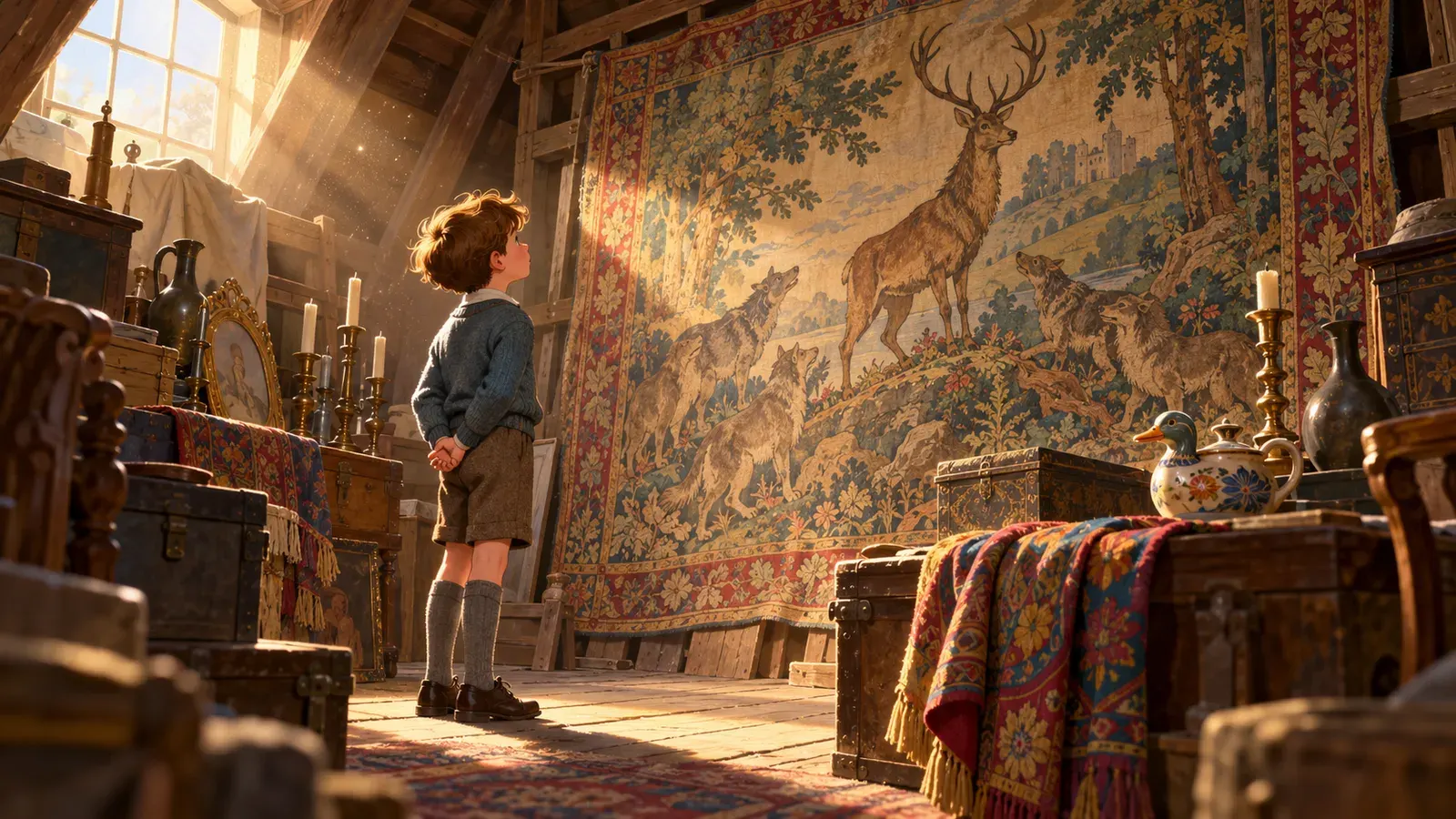
Often and often Nicholas had pictured to himself what the lumber-room might be like, that region that was so carefully sealed from youthful eyes and concerning which no questions were ever answered. It came up to his expectations. In the first place it was large and dimly lit, one high window opening on to the forbidden garden being its only source of illumination. In the second place it was a storehouse of unimagined treasures. The aunt-by-assertion was one of those people who think that things spoil by use and consign them to dust and damp by way of preserving them. Such parts of the house as Nicholas knew best were rather bare and cheerless, but here there were wonderful things for the eye to feast on. First and foremost there was a piece of framed tapestry that was evidently meant to be a fire-screen. To Nicholas it was a living, breathing story; he sat down on a roll of Indian hangings, glowing in wonderful colours beneath a layer of dust, and took in all the details of the tapestry picture. A man, dressed in the hunting costume of some remote period, had just transfixed a stag with an arrow; it could not have been a difficult shot because the stag was only one or two paces away from him; in the thickly-growing vegetation that the picture suggested it would not have been difficult to creep up to a feeding stag, and the two spotted dogs that were springing forward to join in the chase had evidently been trained to keep to heel till the arrow was discharged. That part of the picture was simple, if interesting, but did the huntsman see, what Nicholas saw, that four galloping wolves were coming in his direction through the wood? There might be more than four of them hidden behind the trees, and in any case would the man and his dogs be able to cope with the four wolves if they made an attack? The man had only two arrows left in his quiver, and he might miss with one or both of them; all one knew about his skill in shooting was that he could hit a large stag at a ridiculously short range. Nicholas sat for many golden minutes revolving the possibilities of the scene; he was inclined to think that there were more than four wolves and that the man and his dogs were in a tight corner.
物置部屋とはどんなところなのだろう。ニコラスは何度も何度も思い描いてきた。子どもの目からあれほど念入りに閉ざされ、何をたずねても決して答えてもらえない場所だ。そこは、期待どおりのところだった。まず、広くて薄暗かった。明かりといえば、禁断の庭に面した高い窓が一つあるだけだった。それから、思ってもみなかった宝物の倉だった。自称おばは、物は使うといたむと考えて、大事にしまっておくつもりで、ほこりと湿気にまかせてしまう種類の人だった。ニコラスがよく知っている家の中の部屋は、どちらかといえばがらんとして陰気だった。だが、ここには、目を楽しませてくれるすばらしい品々があった。何よりもまず、額に入ったタペストリーがあった。どうやら暖炉の火よけ用らしい。ニコラスにとって、それは生きて息をしている物語だった。ニコラスは、インド製の壁かけの巻いたものに腰を下ろした。ほこりをかぶってはいたが、その下ですばらしい色に輝いている。そして、タペストリーの絵を、すみずみまでじっくりながめた。どこか遠い昔の狩りの服を着た男が、一頭の牡鹿を、ちょうど矢で射抜いたところだった。鹿は男からほんの一、二歩しか離れていないから、難しい射撃ではなかったはずだ。絵を見ると、草木がうっそうと茂っている。これなら、草を食べている鹿にこっそり近づくのも難しくなかっただろう。追いかけようと前へ飛び出している二匹のぶちの犬は、矢が放たれるまで、主人の足もとを離れないようにしつけられていたにちがいない。絵のその部分は、面白くはあっても、単純だった。だが、ニコラスには見えているものが、あの狩人には見えているのだろうか。四頭の狼が、森の中を全速力でこちらへ駆けてくるのが。木のかげには、四頭よりもっとたくさん隠れているかもしれない。それに、もし狼が襲いかかってきたら、男と犬たちは、四頭の狼を相手に戦えるだろうか。男の矢筒には、矢が二本しか残っていない。一本、いや二本とも、はずすかもしれない。男の弓の腕についてわかっていることといえば、大きな鹿を、ばかばかしいほど近くから射止められる、ということだけなのだ。ニコラスは、宝物のような何分ものあいだ座りこんで、この場面がこれからどうなるか、あれこれ考えをめぐらせた。狼は四頭よりも多くて、男と犬たちは追いつめられているのではないか、とニコラスは考えはじめていた。
But there were other objects of delight and interest claiming his instant attention: there were quaint twisted candlesticks in the shape of snakes, and a teapot fashioned like a china duck, out of whose open beak the tea was supposed to come. How dull and shapeless the nursery teapot seemed in comparison! And there was a carved sandal-wood box packed tight with aromatic cotton-wool, and between the layers of cotton-wool were little brass figures, hump-necked bulls, and peacocks and goblins, delightful to see and to handle. Less promising in appearance was a large square book with plain black covers; Nicholas peeped into it, and, behold, it was full of coloured pictures of birds. And such birds! In the garden, and in the lanes when he went for a walk, Nicholas came across a few birds, of which the largest were an occasional magpie or wood-pigeon; here were herons and bustards, kites, toucans, tiger-bitterns, brush turkeys, ibises, golden pheasants, a whole portrait gallery of undreamed-of creatures. And as he was admiring the colouring of the mandarin duck and assigning a life-history to it, the voice of his aunt in shrill vociferation of his name came from the gooseberry garden without. She had grown suspicious at his long disappearance, and had leapt to the conclusion that he had climbed over the wall behind the sheltering screen of the lilac bushes; she was now engaged in energetic and rather hopeless search for him among the artichokes and raspberry canes.
けれども、ほかにも、楽しくて面白い品々が、早くこっちを見てとニコラスを呼んでいた。ヘビの形をした、ねじれた風変わりな燭台があった。陶器のカモの形をしたティーポットもあって、開いたくちばしからお茶が出てくる仕かけになっていた。それにくらべたら、子ども部屋のティーポットは、なんて退屈で、ぶかっこうに見えることだろう! それから、彫刻をほどこした白檀の箱があった。中には香りのいい綿がぎっしり詰まっていて、綿のあいだに、小さな真鍮の像が入っていた。首にこぶのある牛や、クジャクや、小鬼など、見ても手に取っても楽しいものばかりだった。見かけがあまりぱっとしなかったのは、飾りのない黒い表紙の、大きな四角い本だった。ニコラスがのぞいてみると、なんと、鳥の色刷りの絵でいっぱいだった。しかも、なんという鳥たち! 庭でも、散歩に行く小道でも、ニコラスが出会う鳥はわずかで、いちばん大きいのでも、たまに見かけるカササギかモリバトくらいだった。ところがここには、サギやノガン、トビ、オオハシ、トラフサギ、ヤブツカツクリ、トキ、キンケイなど、夢にも思わなかった生き物たちの肖像画が、ずらりと並んでいた。ニコラスがオシドリの色合いに見とれて、その鳥の一代記をこしらえていると、外のスグリ畑から、ニコラスの名前を呼ぶおばの金切り声が聞こえてきた。あんまり長いこと姿が見えないので怪しんで、ライラックの茂みのかげに隠れて塀を乗りこえたのだと早合点したのだ。おばはいま、アーティチョークやキイチゴの茎のあいだを、勢いこんで、だが、まず見つかる見こみのない捜索をしているところだった。
"Nicholas, Nicholas!" she screamed, "you are to come out of this at once. It's no use trying to hide there; I can see you all the time."
「ニコラス、ニコラス!」とおばは金切り声をあげた。「いますぐそこから出てきなさい。隠れようとしても、むだよ。ちゃんと見えているんですからね」
It was probably the first time for twenty years that anyone had smiled in that lumber-room.
その物置部屋で誰かがほほえんだのは、たぶん二十年ぶりのことだっただろう。
Presently the angry repetitions of Nicholas' name gave way to a shriek, and a cry for somebody to come quickly. Nicholas shut the book, restored it carefully to its place in a corner, and shook some dust from a neighbouring pile of newspapers over it. Then he crept from the room, locked the door, and replaced the key exactly where he had found it. His aunt was still calling his name when he sauntered into the front garden.
やがて、ニコラスの名前を呼ぶ怒った声は、悲鳴に変わった。そして、誰か早く来て、という叫び声になった。ニコラスは本を閉じ、隅のもとの場所にていねいに戻すと、そばの新聞の山からほこりを少し振り落として、その上にかけておいた。それから部屋をそっと抜け出して、扉に鍵をかけ、鍵を見つけたときとそっくり同じ場所に戻した。ニコラスがぶらぶらと前庭へ出ていったとき、おばはまだ名前を呼びつづけていた。
"Who's calling?" he asked.
「誰が呼んでるの?」とニコラスはたずねた。
"Me," came the answer from the other side of the wall; "didn't you hear me? I've been looking for you in the gooseberry garden, and I've slipped into the rain-water tank. Luckily there's no water in it, but the sides are slippery and I can't get out. Fetch the little ladder from under the cherry tree—"
「わたしよ」と塀の向こうから答えが返ってきた。「聞こえなかったの? スグリ畑であなたをさがしていたら、雨水タンクにすべり落ちちゃったのよ。運よく水は入っていないけど、内側がつるつるして出られないの。桜の木の下から、小さなはしごを持ってきて……」
"I was told I wasn't to go into the gooseberry garden," said Nicholas promptly.
「ぼく、スグリ畑には入っちゃいけないって言われたもん」とニコラスは、すぐさま言った。
"I told you not to, and now I tell you that you may," came the voice from the rain-water tank, rather impatiently.
「入るなと言ったけど、いまは入ってもいいと言っているのよ」と、雨水タンクからの声は、かなりいらいらして言った。
"Your voice doesn't sound like aunt's," objected Nicholas; "you may be the Evil One tempting me to be disobedient. Aunt often tells me that the Evil One tempts me and that I always yield. This time I'm not going to yield."
「おばさんの声みたいに聞こえないなあ」とニコラスは言い返した。「ぼくに言いつけを破らせようとしている悪魔かもしれない。おばさんはよく、悪魔があなたを誘惑して、あなたはいつも負けてしまうって言うんだ。今度は負けないぞ」
"Don't talk nonsense," said the prisoner in the tank; "go and fetch the ladder."
「ばかなこと言わないで」と、タンクの中の囚人は言った。「はしごを取ってきなさい」
"Will there be strawberry jam for tea?" asked Nicholas innocently.
「お茶のとき、イチゴジャムは出る?」とニコラスは、無邪気な顔でたずねた。
"Certainly there will be," said the aunt, privately resolving that Nicholas should have none of it.
「もちろん出ますとも」とおばは言いながら、ニコラスにはひとさじもやるものか、とひそかに心に決めていた。
"Now I know that you are the Evil One and not aunt," shouted Nicholas gleefully; "when we asked aunt for strawberry jam yesterday she said there wasn't any. I know there are four jars of it in the store cupboard, because I looked, and of course you know it's there, but she doesn't, because she said there wasn't any. Oh, Devil, you have sold yourself!"
「これで、おばさんじゃなくて悪魔だってわかったぞ」とニコラスは大喜びで叫んだ。「きのう、ぼくたちがおばさんにイチゴジャムをちょうだいって言ったら、ないって言ったんだ。食料戸棚に四びんあるのを、ぼくは知ってる。見たからね。もちろん、おまえもあるって知ってる。でも、おばさんは知らないんだ。だって、ないって言ったんだから。やい、悪魔め、正体を現したな!」
There was an unusual sense of luxury in being able to talk to an aunt as though one was talking to the Evil One, but Nicholas knew, with childish discernment, that such luxuries were not to be over-indulged in. He walked noisily away, and it was a kitchenmaid, in search of parsley, who eventually rescued the aunt from the rain-water tank.
おばに向かって、悪魔に話しかけるように話せるなんて、めったにないぜいたくな気分だった。だが、ニコラスは子どもなりの分別で、そういうぜいたくにおぼれすぎてはいけないと心得ていた。ニコラスはわざと足音をたてて立ち去った。結局、おばを雨水タンクから助け出したのは、パセリを摘みに来た台所の女中だった。
Tea that evening was partaken of in a fearsome silence. The tide had been at its highest when the children had arrived at Jagborough Cove, so there had been no sands to play on—a circumstance that the aunt had overlooked in the haste of organising her punitive expedition. The tightness of Bobby's boots had had disastrous effect on his temper the whole of the afternoon, and altogether the children could not have been said to have enjoyed themselves. The aunt maintained the frozen muteness of one who has suffered undignified and unmerited detention in a rain-water tank for thirty-five minutes. As for Nicholas, he, too, was silent, in the absorption of one who has much to think about; it was just possible, he considered, that the huntsman would escape with his hounds while the wolves feasted on the stricken stag.
その晩のお茶は、おそろしいほどの沈黙のなかで進んだ。子どもたちがジャグバラの入り江に着いたときは、ちょうど満潮で、遊べる砂浜はまったくなかった。お仕置きのための遠足を大あわてで計画したので、おばはそのことを見落としていたのだ。ボビーは靴がきついせいで、午後のあいだじゅう、ひどく機嫌が悪かった。結局、子どもたちはとても楽しんだとは言えなかった。おばは、凍りついたように黙りこんでいた。三十五分間も雨水タンクの中に、みっともなく、いわれもなく閉じこめられていた人らしい沈黙だった。ニコラスはといえば、やはり黙っていたが、それは考えることがたくさんあって、そちらに夢中だったからだ。狼たちが、射倒された鹿をむさぼり食っているあいだに、狩人は犬を連れて逃げられるかもしれない。ひょっとしたら、そういうこともありうるな、とニコラスは考えていた。