"That woman's art-jargon tires me," said Clovis to his journalist friend. "She's so fond of talking of certain pictures as 'growing on one,' as though they were a sort of fungus."
「あの女の美術用語には、うんざりするよ」とクロウヴィスは、新聞記者の友人に言った。「ある種の絵のことを、見ているうちにだんだん『しみついてくる』なんて言いたがるんだ。まるで絵がカビか何かみたいにさ」
"That reminds me," said the journalist, "of the story of Henri Deplis. Have I ever told it you?"
「それで思い出した」と記者は言った。「アンリ・デプリの話だ。きみに話したことがあったかな?」
Clovis shook his head.
クロウヴィスは首を横に振った。
"Henri Deplis was by birth a native of the Grand Duchy of Luxemburg. On maturer reflection he became a commercial traveller. His business activities frequently took him beyond the limits of the Grand Duchy, and he was stopping in a small town of Northern Italy when news reached him from home that a legacy from a distant and deceased relative had fallen to his share.
「アンリ・デプリは、ルクセンブルク大公国の生まれだった。大人になってよく考えたすえに、行商のセールスマンになった。商売のために、しょっちゅう大公国の外へ出かけていた。北イタリアのある小さな町に泊まっていたとき、故郷から知らせが届いた。遠い親戚が亡くなって、その遺産の一部が自分のものになったというんだ。
"It was not a large legacy, even from the modest standpoint of Henri Deplis, but it impelled him towards some seemingly harmless extravagances. In particular it led him to patronize local art as represented by the tattoo-needles of Signor Andreas Pincini. Signor Pincini was, perhaps, the most brilliant master of tattoo craft that Italy had ever known, but his circumstances were decidedly impoverished, and for the sum of six hundred francs he gladly undertook to cover his client's back, from the collar-bone down to the waistline, with a glowing representation of the Fall of Icarus. The design, when finally developed, was a slight disappointment to Monsieur Deplis, who had suspected Icarus of being a fortress taken by Wallenstein in the Thirty Years' War, but he was more than satisfied with the execution of the work, which was acclaimed by all who had the privilege of seeing it as Pincini's masterpiece.
「たいした遺産ではなかった。アンリ・デプリのつつましい目から見ても、そうだった。それでも、遺産のおかげで、デプリは、いくつか害のなさそうなぜいたくをしてみる気になった。とくに、地元の芸術をひいきにしてやろうという気になったんだ。芸術といっても、アンドレアス・ピンチーニ氏の入れ墨の針のことだがね。ピンチーニ氏は、おそらくイタリアが生んだ最高の入れ墨の名人だった。だが、暮らし向きはまぎれもなく苦しかった。それで、六百フランで、客の背中の、肩から腰まで一面に、色あざやかな『イカロスの墜落』を彫る仕事を、喜んで引き受けた。できあがった図柄は、デプリ氏には少々期待はずれだった。イカロスというのは、三十年戦争でヴァレンシュタインが攻め落とした要塞か何かだと思っていたんだ。だが、仕上がりには大満足だった。それを見せてもらった者は、誰もが、ピンチーニの最高傑作だとほめたたえた。
"It was his greatest effort, and his last. Without even waiting to be paid, the illustrious craftsman departed this life, and was buried under an ornate tombstone, whose winged cherubs would have afforded singularly little scope for the exercise of his favourite art. There remained, however, the widow Pincini, to whom the six hundred francs were due. And thereupon arose the great crisis in the life of Henri Deplis, traveller of commerce. The legacy, under the stress of numerous little calls on its substance, had dwindled to very insignificant proportions, and when a pressing wine bill and sundry other current accounts had been paid, there remained little more than 430 francs to offer to the widow. The lady was properly indignant, not wholly, as she volubly explained, on account of the suggested writing-off of 170 francs, but also at the attempt to depreciate the value of her late husband's acknowledged masterpiece. In a week's time Deplis was obliged to reduce his offer to 405 francs, which circumstance fanned the widow's indignation into a fury. She cancelled the sale of the work of art, and a few days later Deplis learned with a sense of consternation that she had presented it to the municipality of Bergamo, which had gratefully accepted it. He left the neighbourhood as unobtrusively as possible, and was genuinely relieved when his business commands took him to Rome, where he hoped his identity and that of the famous picture might be lost sight of.
「それはピンチーニの最大の力作で、そして最後の作品になった。この名高い職人は、代金を受け取りもしないうちに、この世を去ってしまった。そして、天使の像を刻んだ立派な墓石の下に葬られた。もっとも、その天使たちには、彼の愛した技をふるう余地など、ほとんどなかっただろうがね。あとには、ピンチーニの未亡人が残された。六百フランは、未亡人に払わなければならない。そこで、行商人アンリ・デプリの人生に、一大危機がもちあがったんだ。遺産は、こまごまとした出費に少しずつ削られて、すっかり目減りしていた。せっつかれていたワインの勘定や、ほかのつけを払ってしまうと、未亡人に差し出せるのは、四百三十フランそこそこしか残っていなかった。夫人が腹を立てたのは当然だった。夫人がまくしたてたところでは、百七十フランを棒引きにしろと言われたからだけではない。亡き夫の、誰もが認める傑作の値打ちを、値切ろうとしたことにも腹を立てたんだ。一週間後、デプリは申し出の額を四百五フランに下げざるをえなくなった。これで未亡人の怒りは、激しい憤激に燃え上がった。未亡人は、この芸術作品の売買を取り消した。そして数日後、デプリは、未亡人がそれをベルガモ市に寄贈し、市がありがたく受け取ったと知って、がくぜんとした。デプリは、できるだけ目立たないようにその土地を離れた。商用でローマへ行けと命じられたときには、心からほっとした。ローマでなら、自分の素性も、あの有名な絵の素性も、人に知られずにすむだろうと思ったんだ。
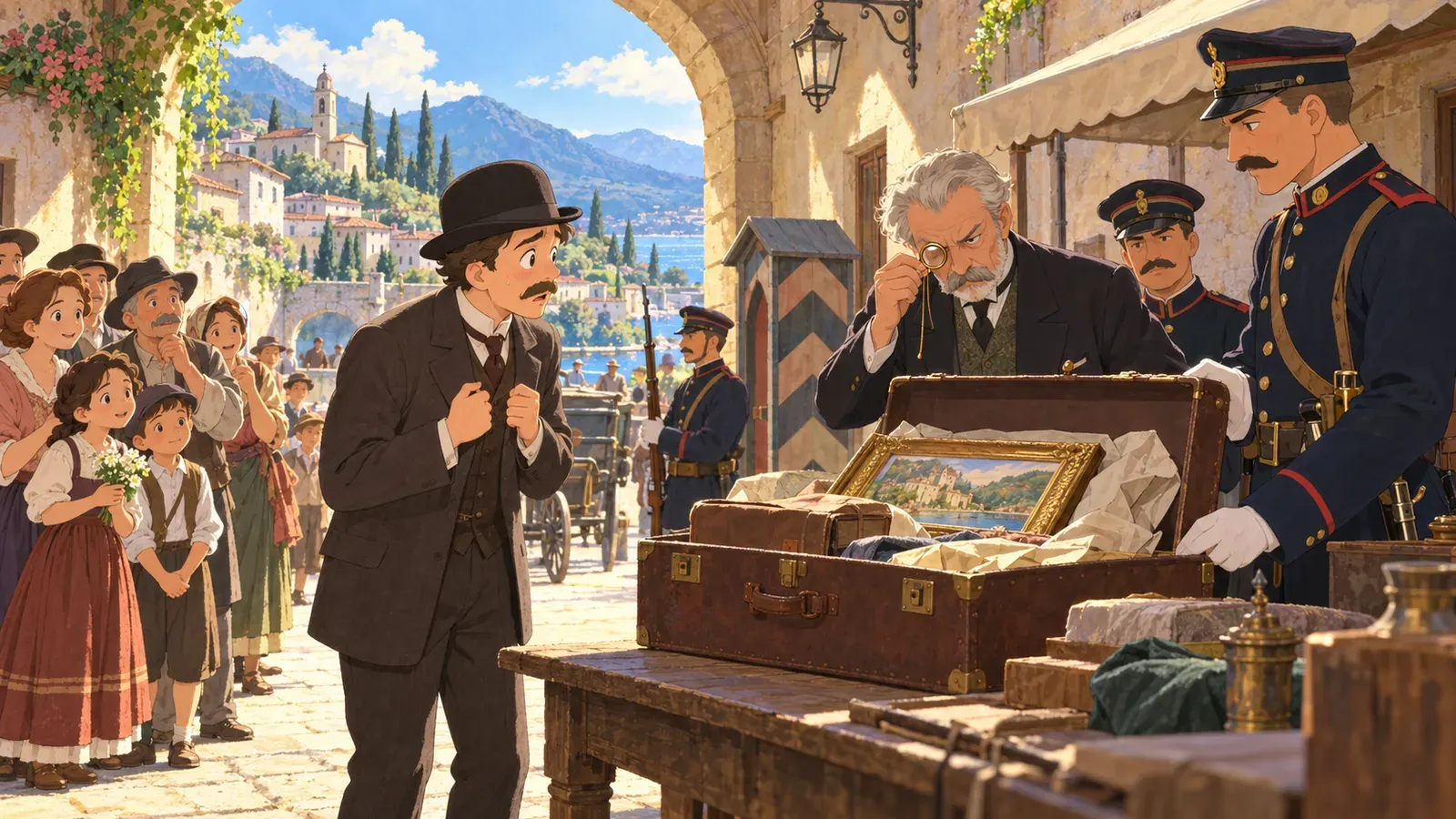
"But he bore on his back the burden of the dead man's genius. On presenting himself one day in the steaming corridor of a vapour bath, he was at once hustled back into his clothes by the proprietor, who was a North Italian, and who emphatically refused to allow the celebrated Fall of Icarus to be publicly on view without the permission of the municipality of Bergamo. Public interest and official vigilance increased as the matter became more widely known, and Deplis was unable to take a simple dip in the sea or river on the hottest afternoon unless clothed up to the collarbone in a substantial bathing garment. Later on the authorities of Bergamo conceived the idea that salt water might be injurious to the masterpiece, and a perpetual injunction was obtained which debarred the muchly harassed commercial traveller from sea bathing under any circumstances. Altogether, he was fervently thankful when his firm of employers found him a new range of activities in the neighbourhood of Bordeaux. His thankfulness, however, ceased abruptly at the Franco-Italian frontier. An imposing array of official force barred his departure, and he was sternly reminded of the stringent law which forbids the exportation of Italian works of art.
「だが、デプリは、死んだ男の天才という重荷を、背中にしょっていた。ある日、蒸し風呂に行って、湯気の立ちこめる廊下に出たとたん、主人に服を着せられて、追い返されてしまった。主人は北イタリアの出で、ベルガモ市の許可なしに、あの名高い『イカロスの墜落』を人前にさらすことは断じて許さない、と言い張ったんだ。この話が広く知れわたるにつれて、世間の関心も、役所の目も、きびしくなっていった。デプリは、どんなに暑い午後でも、肩までしっかりおおう水着を着なければ、海や川でちょっと泳ぐことさえできなくなった。そのうちベルガモ市の当局は、塩水が傑作をいためるかもしれないと思いついて、永久差し止め命令を取りつけた。おかげで、さんざん苦しめられてきたこのセールスマンは、どんな事情があっても、海で泳ぐことを禁じられてしまった。そんなわけで、雇い主の会社が、ボルドーのあたりで新しい仕事を見つけてくれたときには、心の底からありがたく思った。ところが、そのありがたさは、フランスとイタリアの国境で、ぷつりととだえた。ものものしい役人の一団が、デプリの出国をはばんだんだ。そして、イタリアの美術品を国外に持ち出すことを禁じるきびしい法律があることを、いかめしく言い聞かせた。
"A diplomatic parley ensued between the Luxemburgian and Italian Governments, and at one time the European situation became overcast with the possibilities of trouble. But the Italian Government stood firm; it declined to concern itself in the least with the fortunes or even the existence of Henri Deplis, commercial traveller, but was immovable in its decision that the Fall of Icarus (by the late Pincini, Andreas) at present the property of the municipality of Bergamo, should not leave the country.
「ルクセンブルク政府とイタリア政府のあいだで外交交渉が行われ、一時は、ヨーロッパの情勢に、紛争の暗雲が垂れこめた。だが、イタリア政府は一歩も引かなかった。行商人アンリ・デプリがどうなろうと、いや、そんな男がいようといまいと、まったく知ったことではない。ただ、現在ベルガモ市の所有である『イカロスの墜落』(故アンドレアス・ピンチーニ作)は、断じて国外に出してはならない。その決定は、頑として変えなかったんだ。
"The excitement died down in time, but the unfortunate Deplis, who was of a constitutionally retiring disposition, found himself a few months later, once more the storm-centre of a furious controversy. A certain German art expert, who had obtained from the municipality of Bergamo permission to inspect the famous masterpiece, declared it to be a spurious Pincini, probably the work of some pupil whom he had employed in his declining years. The evidence of Deplis on the subject was obviously worthless, as he had been under the influence of the customary narcotics during the long process of pricking in the design. The editor of an Italian art journal refuted the contentions of the German expert and undertook to prove that his private life did not conform to any modern standard of decency. The whole of Italy and Germany were drawn into the dispute, and the rest of Europe was soon involved in the quarrel. There were stormy scenes in the Spanish Parliament, and the University of Copenhagen bestowed a gold medal on the German expert (afterwards sending a commission to examine his proofs on the spot), while two Polish schoolboys in Paris committed suicide to show what THEY thought of the matter.
「騒ぎはやがておさまった。ところが、もともと引っこみ思案な性分の、不運なデプリは、数か月後、またもや激しい論争の嵐のまっただなかに立たされることになった。あるドイツの美術鑑定家が、ベルガモ市の許可を得て、あの名高い傑作を調べた。そして、これはピンチーニのにせものだ、たぶん晩年に使っていた弟子の誰かが彫ったのだろう、と言い出したんだ。この件について、デプリの証言は、まるで役に立たなかった。図柄を針で彫りこむ長いあいだ、いつものように麻酔薬でぼうっとしていたんだからね。イタリアのある美術雑誌の編集長が、ドイツの鑑定家の言い分に反論した。そして、ついでに、その鑑定家の私生活が、いまどきのどんな良識に照らしても、とても許されないものだということを証明してみせると請け合った。イタリアじゅう、ドイツじゅうがこの論争に巻きこまれ、まもなく、ヨーロッパのほかの国々もこのけんかに引きずりこまれた。スペイン議会では大荒れの場面があったし、コペンハーゲン大学はドイツの鑑定家に金メダルを贈った(そのあとで、証拠を現地で確かめるための調査団を送った)。一方パリでは、ポーランド人の男子生徒二人が、この問題についての自分たちの考えを示すために、自殺した。
"Meanwhile, the unhappy human background fared no better than before, and it was not surprising that he drifted into the ranks of Italian anarchists. Four times at least he was escorted to the frontier as a dangerous and undesirable foreigner, but he was always brought back as the Fall of Icarus (attributed to Pincini, Andreas, early Twentieth Century). And then one day, at an anarchist congress at Genoa, a fellow-worker, in the heat of debate, broke a phial full of corrosive liquid over his back. The red shirt that he was wearing mitigated the effects, but the Icarus was ruined beyond recognition. His assailant was severely reprimanded for assaulting a fellow-anarchist and received seven years' imprisonment for defacing a national art treasure. As soon as he was able to leave the hospital Henri Deplis was put across the frontier as an undesirable alien.
「そのあいだも、気の毒な、生身の「背景」の扱いは、ちっともよくならなかった。デプリがイタリアの無政府主義者の仲間に入ってしまったのも、無理はない。危険で好ましくない外国人として国境まで送られたことが、少なくとも四回はあった。だが、そのたびに、『イカロスの墜落』(アンドレアス・ピンチーニ作と伝えられる、二十世紀初め)として、連れ戻された。そしてある日、ジェノヴァで開かれた無政府主義者の大会で、議論が白熱したあげく、同志の一人が、腐食性の薬品の入った小びんを、デプリの背中にたたきつけて割ってしまった。着ていた赤いシャツのおかげで、いくらか被害は少なくてすんだ。それでも、イカロスは見る影もなくなってしまった。襲った男は、同志の無政府主義者に乱暴したことで、きびしくしかられた。そして、国の美術品を傷つけた罪で、七年の禁固刑を言いわたされた。アンリ・デプリは、退院できるようになるとすぐに、好ましくない外国人として、国境の向こうへ追い出された。
"In the quieter streets of Paris, especially in the neighbourhood of the Ministry of Fine Arts, you may sometimes meet a depressed, anxious-looking man, who, if you pass him the time of day, will answer you with a slight Luxemburgian accent. He nurses the illusion that he is one of the lost arms of the Venus de Milo, and hopes that the French Government may be persuaded to buy him. On all other subjects I believe he is tolerably sane."
「パリの静かな通り、とくに美術省のあたりで、ときどき、しょんぼりして、不安そうな顔をした男に出会うことがあるかもしれない。あいさつすると、かすかなルクセンブルクなまりで返事をするだろう。その男は、自分はミロのヴィーナスのなくなった腕の片方だと思いこんでいて、フランス政府が自分を買い上げてくれないものかと願っているんだ。ほかのことについては、まあまあ正気だと思うがね」