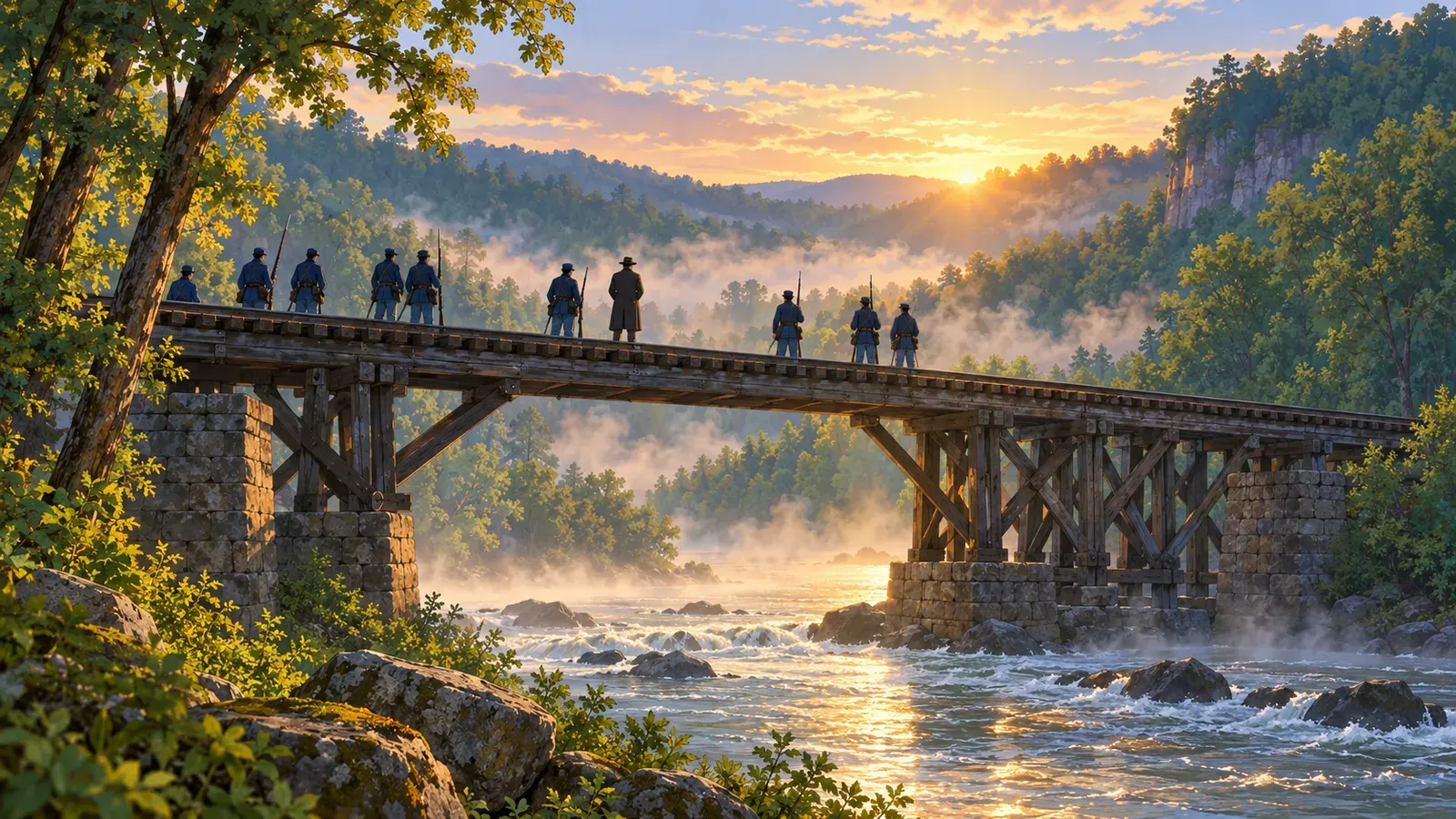
A man stood upon a railroad bridge in northern Alabama, looking down into the swift water twenty feet below. The man's hands were behind his back, the wrists bound with a cord. A rope closely encircled his neck. It was attached to a stout cross-timber above his head and the slack fell to the level of his knees. Some loose boards laid upon the sleepers supporting the metals of the railway supplied a footing for him and his executioners—two private soldiers of the Federal army, directed by a sergeant who in civil life may have been a deputy sheriff. At a short remove upon the same temporary platform was an officer in the uniform of his rank, armed. He was a captain. A sentinel at each end of the bridge stood with his rifle in the position known as "support," that is to say, vertical in front of the left shoulder, the hammer resting on the forearm thrown straight across the chest—a formal and unnatural position, enforcing an erect carriage of the body. It did not appear to be the duty of these two men to know what was occurring at the centre of the bridge; they merely blockaded the two ends of the foot planking that traversed it.
アラバマ州北部の鉄道橋の上に、一人の男が立っていた。二十フィート下を勢いよく流れる川を見おろしていた。両手は背中にまわされ、手首をひもで縛られていた。首にはロープがきつく巻かれている。ロープの先は頭の上の頑丈な横木に結ばれ、たるんだ部分が膝のあたりまで垂れていた。レールを支える枕木の上に板が何枚か渡してあり、それが男と、刑を執り行う者たちの足場になっていた。執行役は北軍の兵卒が二人。指図するのは軍曹で、軍隊に入る前は保安官補でもしていたのかもしれない。同じ仮の足場の少し離れたところに、武器を帯び、階級どおりの軍服を着た将校が一人いた。大尉である。橋の両端には歩哨が一人ずつ立ち、「控え銃」の姿勢をとっていた。左肩の前に銃をまっすぐ立て、胸の前に横に渡した前腕に撃鉄をのせる。背筋をいやでも伸ばさせる、形式ばった不自然な姿勢である。二人の歩哨は、橋の中ほどで何が起きているかを知る役目ではないらしい。橋を渡る歩み板の両端を、ただふさいでいるだけだった。
Beyond one of the sentinels nobody was in sight; the railroad ran straight away into a forest for a hundred yards, then, curving, was lost to view. Doubtless there was an outpost farther along. The other bank of the stream was open ground—a gentle acclivity topped with a stockade of vertical tree trunks, loop-holed for rifles, with a single embrasure through which protruded the muzzle of a brass cannon commanding the bridge. Mid-way of the slope between bridge and fort were the spectators—a single company of infantry in line, at "parade rest," the butts of the rifles on the ground, the barrels inclining slightly backward against the right shoulder, the hands crossed upon the stock. A lieutenant stood at the right of the line, the point of his sword upon the ground, his left hand resting upon his right. Excepting the group of four at the centre of the bridge, not a man moved. The company faced the bridge, staring stonily, motionless. The sentinels, facing the banks of the stream, might have been statues to adorn the bridge. The captain stood with folded arms, silent, observing the work of his subordinates, but making no sign. Death is a dignitary who when he comes announced is to be received with formal manifestations of respect, even by those most familiar with him. In the code of military etiquette silence and fixity are forms of deference.
一方の歩哨の向こうには、人影ひとつなかった。線路は森の中へ百ヤードほどまっすぐ延び、そこで曲がって見えなくなる。その先には、きっと前哨があるのだろう。川の向こう岸は開けた土地だった。ゆるやかな坂をのぼりきったところに、丸太を縦に並べた防柵がある。柵には小銃のための穴があけられ、ひとつだけある砲眼からは真鍮の大砲の筒先がのぞいて、橋をにらんでいた。橋と砦のあいだの坂の中ほどに、見物人がいた。歩兵が一個中隊、一列に並んで「休め」の姿勢をとっている。銃の床尾を地面につけ、銃身を少し後ろへ傾けて右肩にもたせかけ、両手を銃の上で重ねていた。列の右端には中尉が立ち、軍刀の切っ先を地面につけて、左手を右手の上に重ねていた。橋の中ほどにいる四人のほかは、誰一人動かない。中隊は橋のほうを向き、石のような目で見つめたまま、じっとしていた。川岸のほうを向いた二人の歩哨は、橋の飾りの彫像だと言われても通っただろう。大尉は腕を組んで黙って立ち、部下の仕事を見守っていたが、何の合図もしなかった。死とは位の高い客人である。前触れがあってやって来るときは、死といちばん親しい者たちでさえ、礼を尽くして迎えなければならない。軍の作法では、黙って動かずにいることが、敬意の表し方なのだ。
The man who was engaged in being hanged was apparently about thirty-five years of age. He was a civilian, if one might judge from his habit, which was that of a planter. His features were good—a straight nose, firm mouth, broad forehead, from which his long, dark hair was combed straight back, falling behind his ears to the collar of his well-fitting frock-coat. He wore a mustache and pointed beard, but no whiskers; his eyes were large and dark gray, and had a kindly expression which one would hardly have expected in one whose neck was in the hemp. Evidently this was no vulgar assassin. The liberal military code makes provision for hanging many kinds of persons, and gentlemen are not excluded.
これから首を吊られる男は、見たところ三十五歳ほどだった。服装から察するに民間人で、農園主らしい身なりをしている。顔立ちは整っていた。鼻筋が通り、口もとは引きしまり、額は広い。長い黒髪をその額からまっすぐ後ろになでつけ、髪は耳の後ろを通って、仕立てのよいフロックコートの襟にかかっていた。口ひげと、先のとがったあごひげをたくわえているが、頬ひげはない。目は大きく、濃い灰色で、優しげな表情をたたえていた。首に縄をかけられている人間の目とは、とても思えない。どう見ても、ありふれた人殺しではなかった。寛大な軍法は、じつにさまざまな人間を絞首刑にできるように定めており、紳士もその例外ではないのである。
The preparations being complete, the two private soldiers stepped aside and each drew away the plank upon which he had been standing. The sergeant turned to the captain, saluted and placed himself immediately behind that officer, who in turn moved apart one pace. These movements left the condemned man and the sergeant standing on the two ends of the same plank, which spanned three of the cross-ties of the bridge. The end upon which the civilian stood almost, but not quite, reached a fourth. This plank had been held in place by the weight of the captain; it was now held by that of the sergeant. At a signal from the former the latter would step aside, the plank would tilt and the condemned man go down between two ties. The arrangement commended itself to his judgment as simple and effective. His face had not been covered nor his eyes bandaged. He looked a moment at his "unsteadfast footing," then let his gaze wander to the swirling water of the stream racing madly beneath his feet. A piece of dancing driftwood caught his attention and his eyes followed it down the current. How slowly it appeared to move! What a sluggish stream!
準備が整うと、二人の兵卒はわきへ退き、それぞれ自分が立っていた板を引き抜いた。軍曹は大尉に向き直って敬礼し、そのすぐ後ろに立った。大尉は一歩わきへよけた。こうして、死刑囚と軍曹が一枚の板の両端に立つ形になった。板は枕木三本にまたがっている。男の立つ側の端は、四本目の枕木にもう少しで届きそうで、届いていない。この板は、さっきまでは大尉の重みで、いまは軍曹の重みで押さえられていた。大尉が合図をすれば軍曹がわきへのく。板が傾き、男は枕木のあいだから落ちる。仕組みとしては簡単で、確実だ。男自身もそう思った。顔に覆いはかけられず、目隠しもされていなかった。男はしばらく自分の「頼りない足場」を見つめていた。それから、足もとを狂ったように流れていく渦巻く水へと、目をさまよわせた。踊るように流れていく流木がひとつ目にとまり、男はそれを目で追って下流へとたどった。なんとゆっくり動いているように見えることか。なんとのろい流れだろう。
He closed his eyes in order to fix his last thoughts upon his wife and children. The water, touched to gold by the early sun, the brooding mists under the banks at some distance down the stream, the fort, the soldiers, the piece of drift—all had distracted him. And now he became conscious of a new disturbance. Striking through the thought of his dear ones was a sound which he could neither ignore nor understand, a sharp, distinct, metallic percussion like the stroke of a blacksmith's hammer upon the anvil; it had the same ringing quality. He wondered what it was, and whether immeasurably distant or near by—it seemed both. Its recurrence was regular, but as slow as the tolling of a death knell. He awaited each stroke with impatience and—he knew not why—apprehension. The intervals of silence grew progressively longer; the delays became maddening. With their greater infrequency the sounds increased in strength and sharpness. They hurt his ear like the thrust of a knife; he feared he would shriek. What he heard was the ticking of his watch.
男は目を閉じた。最後の思いを妻と子どもたちに向けたかったのだ。朝日を受けて金色に光る水、少し下流の岸辺に重くたちこめる霧、砦、兵士たち、流木。どれもが気を散らした。そしていま、また新しい邪魔が入った。愛する者たちへの思いを突き破って、ある音が聞こえてくる。無視することもできず、何の音なのかもわからない。鋭く、くっきりとした金属の音で、鍛冶屋が金床を槌で打つときのように鳴り響いた。いったい何だろう。とてつもなく遠くからなのか、すぐそばからなのか。どちらのようにも思えた。音は規則正しく繰り返されたが、弔いの鐘のように間遠だった。男は一打ちごとに、じりじりしながら次を待った。なぜか不安もあった。音と音のあいだの静けさは、しだいに長くなっていった。その待ち時間に、気が変になりそうだった。間があくほど、音は強く鋭くなった。ナイフで突かれるように耳が痛んだ。悲鳴をあげてしまいそうだった。男が聞いていたのは、自分の懐中時計の音だった。
He unclosed his eyes and saw again the water below him. "If I could free my hands," he thought, "I might throw off the noose and spring into the stream. By diving I could evade the bullets and, swimming vigorously, reach the bank, take to the woods and get away home. My home, thank God, is as yet outside their lines; my wife and little ones are still beyond the invader's farthest advance."
男は目を開け、ふたたび足もとの水を見た。「この手さえほどければ」と男は考えた。「縄を首からはずして、川に飛びこめるかもしれない。潜れば弾はよけられる。力いっぱい泳げば岸に着ける。あとは森に逃げこんで、家まで帰ればいい。ありがたいことに、わが家はまだやつらの戦線の外だ。妻と子どもたちは、侵略者がいちばん深く攻めこんだところよりも、まだ向こうにいる」
As these thoughts, which have here to be set down in words, were flashed into the doomed man's brain rather than evolved from it the captain nodded to the sergeant. The sergeant stepped aside.
こうして文字にすると長いが、これらの考えは、死を目前にした男の頭の中で順を追って組み立てられたのではない。一瞬にひらめいたのだ。そのとき、大尉が軍曹にうなずいた。軍曹はわきへのいた。
Peyton Farquhar was a well-to-do planter, of an old and highly respected Alabama family. Being a slave owner and like other slave owners a politician he was naturally an original secessionist and ardently devoted to the Southern cause. Circumstances of an imperious nature, which it is unnecessary to relate here, had prevented him from taking service with the gallant army that had fought the disastrous campaigns ending with the fall of Corinth, and he chafed under the inglorious restraint, longing for the release of his energies, the larger life of the soldier, the opportunity for distinction. That opportunity, he felt, would come, as it comes to all in war time. Meanwhile he did what he could. No service was too humble for him to perform in aid of the South, no adventure too perilous for him to undertake if consistent with the character of a civilian who was at heart a soldier, and who in good faith and without too much qualification assented to at least a part of the frankly villainous dictum that all is fair in love and war.
ペイトン・ファーカーは裕福な農園主で、アラバマの古い、たいそう尊敬された家の出だった。奴隷を持ち、ほかの奴隷所有者と同じく政治にも首を突っこんでいたから、当然、はじめから南部の分離を唱え、南部の大義に熱く身を捧げていた。ここで語るまでもないが、どうにもならない事情があった。そのせいで、コリンス陥落に終わる惨めな戦いを重ねたあの勇敢な軍隊に、加わることができなかったのだ。名誉とは縁のないこの不自由に、ファーカーはいらだっていた。力を存分に振るいたい。兵士として、もっと大きく生きたい。手柄を立てる機会がほしい。その機会はきっと来る、戦争中には誰にでも来るのだから、と感じていた。それまでのあいだ、できることはした。南部のためなら、どんなに地味な仕事もいとわなかった。心は兵士である民間人にふさわしいことなら、どんなに危ない冒険も引き受けた。「恋と戦争では何をしても許される」という、あけすけに悪辣な文句がある。ファーカーは、少なくともその一部には、本気で、さほどの留保もつけずにうなずいていたのである。
One evening while Farquhar and his wife were sitting on a rustic bench near the entrance to his grounds, a gray-clad soldier rode up to the gate and asked for a drink of water. Mrs. Farquhar was only too happy to serve him with her own white hands. While she was fetching the water her husband approached the dusty horseman and inquired eagerly for news from the front.
ある晩、ファーカーが妻と一緒に、屋敷の入り口近くの丸太のベンチに腰かけていると、灰色の軍服の兵士が馬で門まで来て、水を一杯もらえないかと言った。夫人は大喜びで、自分の白い手で兵士に水を出そうとした。妻が水を取りに行っているあいだに、夫はほこりまみれの騎兵に近づき、前線の様子をしきりに尋ねた。
"The Yanks are repairing the railroads," said the man, "and are getting ready for another advance. They have reached the Owl Creek bridge, put it in order and built a stockade on the north bank. The commandant has issued an order, which is posted everywhere, declaring that any civilian caught interfering with the railroad, its bridges, tunnels or trains will be summarily hanged. I saw the order."
「ヤンキーどもは鉄道を直して、次の進撃の支度をしています」と男は言った。「アウル・クリーク橋まで来て、橋を直し、北岸に防柵を築きました。司令官が命令を出して、そこらじゅうに貼り出していますよ。鉄道や橋やトンネルや列車に手出しをした民間人は、捕まえしだい、裁判抜きで縛り首にするそうです。わたしはその貼り紙を見ました」
"How far is it to the Owl Creek bridge?" Farquhar asked.
「アウル・クリーク橋まで、どれくらいある?」とファーカーは尋ねた。
"About thirty miles."
「三十マイルほどです」
"Is there no force on this side the creek?"
「川のこちら側には、兵はいないのか?」
"Only a picket post half a mile out, on the railroad, and a single sentinel at this end of the bridge."
「半マイル手前の線路に見張り小屋がひとつと、橋のこちらの端に歩哨が一人いるだけです」
"Suppose a man—a civilian and student of hanging—should elude the picket post and perhaps get the better of the sentinel," said Farquhar, smiling, "what could he accomplish?"
「たとえばの話だが」とファーカーはほほえみながら言った。「民間人で、絞首刑の研究でもしている男がいたとしよう。そいつが見張り小屋の目をすり抜けて、ひょっとしたら歩哨も出し抜いたとする。そうしたら、何ができるだろうね?」
The soldier reflected. "I was there a month ago," he replied. "I observed that the flood of last winter had lodged a great quantity of driftwood against the wooden pier at this end of the bridge. It is now dry and would burn like tow."
兵士は考えこんだ。「ひと月前に行ってみたんですが」と兵士は答えた。「去年の冬の洪水で、橋のこちら側の木の橋脚に、流木がどっさり引っかかっていました。いまはからからに乾いてますから、麻くずみたいによく燃えるでしょうね」
The lady had now brought the water, which the soldier drank. He thanked her ceremoniously, bowed to her husband and rode away. An hour later, after nightfall, he repassed the plantation, going northward in the direction from which he had come. He was a Federal scout.
そこへ夫人が水を持ってきて、兵士はそれを飲んだ。兵士は夫人にていねいに礼を言い、夫に会釈して、馬で去っていった。一時間後、日が暮れてから、兵士はふたたび農園の前を通った。来た方角の北へ向かっていた。北軍の斥候だったのである。
As Peyton Farquhar fell straight downward through the bridge he lost consciousness and was as one already dead. From this state he was awakened—ages later, it seemed to him—by the pain of a sharp pressure upon his throat, followed by a sense of suffocation. Keen, poignant agonies seemed to shoot from his neck downward through every fibre of his body and limbs. These pains appeared to flash along well-defined lines of ramification and to beat with an inconceivably rapid periodicity. They seemed like streams of pulsating fire heating him to an intolerable temperature. As to his head, he was conscious of nothing but a feeling of fulness—of congestion. These sensations were unaccompanied by thought. The intellectual part of his nature was already effaced; he had power only to feel, and feeling was torment. He was conscious of motion. Encompassed in a luminous cloud, of which he was now merely the fiery heart, without material substance, he swung through unthinkable arcs of oscillation, like a vast pendulum. Then all at once, with terrible suddenness, the light about him shot upward with the noise of a loud plash; a frightful roaring was in his ears, and all was cold and dark. The power of thought was restored; he knew that the rope had broken and he had fallen into the stream. There was no additional strangulation; the noose about his neck was already suffocating him and kept the water from his lungs. To die of hanging at the bottom of a river!—the idea seemed to him ludicrous. He opened his eyes in the darkness and saw above him a gleam of light, but how distant, how inaccessible! He was still sinking, for the light became fainter and fainter until it was a mere glimmer. Then it began to grow and brighten, and he knew that he was rising toward the surface—knew it with reluctance, for he was now very comfortable. "To be hanged and drowned," he thought, "that is not so bad; but I do not wish to be shot. No; I will not be shot; that is not fair."
橋のあいだをまっすぐに落ちていくとき、ペイトン・ファーカーは気を失い、もう死んだも同然になった。目を覚まさせたのは、のどを鋭く締めつけられる痛みだった。何百年もたってからのような気がした。続いて息が詰まった。鋭い、刺すような激痛が、首から下へ、体と手足のすみずみまで走るように思えた。痛みは、くっきりと枝分かれした筋をたどってひらめき、考えられないほど速く脈打っているようだった。脈打つ炎の流れが体じゅうを駆けめぐり、耐えられないほど熱くしていく。頭は、ただ張りつめて、血が詰まっているような感じがするだけだった。こうした感覚に、考えはともなっていなかった。ものを考える部分は、すでに消えていた。残っているのは感じる力だけで、感じることは責め苦だった。体が動いているのがわかった。光り輝く雲に包まれ、自分はもう肉体を持たない、その雲の燃える芯にすぎなかった。巨大な振り子のように、考えられないほど大きな弧を描いて揺れていた。そのとき、恐ろしいほど不意に、まわりの光が大きな水音とともに上へ飛び去った。耳の中ですさまじい轟音がし、何もかもが冷たく暗くなった。考える力が戻ってきた。ロープが切れて、川に落ちたのだ。それ以上首を絞められることはなかった。首の輪縄がもう息を止めていて、そのおかげで水が肺に入らずにすんでいた。川の底で、首を吊られて死ぬとは。ばかばかしい話だと思った。暗闇の中で目を開けると、頭の上に光がちらりと見えた。だが、なんと遠く、なんと手の届かない光だろう。体はまだ沈んでいた。光はだんだん弱くなり、とうとうかすかな明かりになってしまったからだ。やがて光は大きく、明るくなりはじめた。水面に向かって浮かび上がっているのだとわかった。わかって、気が進まなかった。いまはとても心地よかったからだ。「首を吊られて溺れるのなら」とファーカーは考えた。「それはそれでかまわない。だが撃たれるのはいやだ。そうだ、撃たれてたまるか。そんなのはずるい」
He was not conscious of an effort, but a sharp pain in his wrist apprised him that he was trying to free his hands. He gave the struggle his attention, as an idler might observe the feat of a juggler, without interest in the outcome. What splendid effort!—what magnificent, what superhuman strength! Ah, that was a fine endeavor! Bravo! The cord fell away; his arms parted and floated upward, the hands dimly seen on each side in the growing light. He watched them with a new interest as first one and then the other pounced upon the noose at his neck. They tore it away and thrust it fiercely aside, its undulations resembling those of a water-snake. "Put it back, put it back!" He thought he shouted these words to his hands, for the undoing of the noose had been succeeded by the direst pang that he had yet experienced. His neck ached horribly; his brain was on fire; his heart, which had been fluttering faintly, gave a great leap, trying to force itself out at his mouth. His whole body was racked and wrenched with an insupportable anguish! But his disobedient hands gave no heed to the command. They beat the water vigorously with quick, downward strokes, forcing him to the surface. He felt his head emerge; his eyes were blinded by the sunlight; his chest expanded convulsively, and with a supreme and crowning agony his lungs engulfed a great draught of air, which instantly he expelled in a shriek!
自分では力を入れているつもりはなかった。だが手首に鋭い痛みが走り、両手をほどこうとしているのだとわかった。ファーカーはそのもがきを眺めた。暇な見物人が、結果などどうでもいいという顔で大道芸人の芸を見るように。なんとみごとな頑張りだろう。なんとすばらしい、人間わざとは思えない力だろう。ああ、うまいぞ。ブラボー! ひもがはずれた。両腕が離れて上へ浮かび、明るさを増していく光の中で、左右の手がぼんやりと見えた。ファーカーは、今度は身を入れてその手を見守った。まず片方の手が、続いてもう片方の手が、首の輪縄に飛びついた。両手は輪縄をむしり取り、荒々しくわきへ押しのけた。輪縄は水蛇のようにくねった。「戻せ、戻せ!」ファーカーは自分の手にそう叫んだつもりだった。輪縄がはずれたとたん、それまでで最悪の激痛に襲われたからだ。首はひどく痛み、頭は燃えるようで、弱々しく震えていた心臓が大きく跳ねて、口から飛び出そうとした。全身が耐えがたい苦しみに引き裂かれ、ねじられた。だが言うことを聞かない両手は、命令などおかまいなしだった。すばやく下へかいて力強く水を打ち、体を水面へ押し上げた。頭が水から出たのがわかった。日の光に目がくらんだ。胸がけいれんするようにふくらみ、最後にして最大の苦しみとともに、肺が空気を大きく吸いこんだ。そしてファーカーは、その息をたちまち悲鳴にして吐き出した。
He was now in full possession of his physical senses. They were, indeed, preternaturally keen and alert. Something in the awful disturbance of his organic system had so exalted and refined them that they made record of things never before perceived. He felt the ripples upon his face and heard their separate sounds as they struck. He looked at the forest on the bank of the stream, saw the individual trees, the leaves and the veining of each leaf—saw the very insects upon them: the locusts, the brilliant-bodied flies, the gray spiders stretching their webs from twig to twig. He noted the prismatic colors in all the dewdrops upon a million blades of grass. The humming of the gnats that danced above the eddies of the stream, the beating of the dragon-flies' wings, the strokes of the water-spiders' legs, like oars which had lifted their boat—all these made audible music. A fish slid along beneath his eyes and he heard the rush of its body parting the water.
いまや体の感覚はすっかり戻っていた。それどころか、感覚は人間ばなれして鋭く、冴えわたっていた。体の仕組みがひどくかき乱されたせいで、感覚が高められ、研ぎ澄まされたのだろう。これまで一度も気づかなかったものまで、とらえられた。顔にさざ波があたるのを感じ、あたるたびに立てる音を一つ一つ聞きわけた。川岸の森に目をやると、一本一本の木が見えた。葉の一枚一枚、その葉脈までが見えた。葉にとまる虫たちまで見えた。バッタ、体のきらめくハエ、小枝から小枝へ糸を張る灰色のクモ。百万本の草の葉におりた露の一粒一粒が、虹の色に光っているのもわかった。川の渦の上で群れ飛ぶブヨの羽音、トンボの羽ばたき、オールで舟を進めるようなアメンボの脚のひとかき。それがみな、耳に聞こえる音楽になった。魚が一匹、目の下をすべっていき、その体が水を分けて進む音が聞こえた。
He had come to the surface facing down the stream; in a moment the visible world seemed to wheel slowly round, himself the pivotal point, and he saw the bridge, the fort, the soldiers upon the bridge, the captain, the sergeant, the two privates, his executioners. They were in silhouette against the blue sky. They shouted and gesticulated, pointing at him. The captain had drawn his pistol, but did not fire; the others were unarmed. Their movements were grotesque and horrible, their forms gigantic.
ファーカーは下流を向いて浮かび上がっていた。たちまち、目に見える世界が、自分を軸にしてゆっくりとまわっていくように思えた。そして見えた。橋が、砦が、橋の上の兵士たちが。大尉、軍曹、二人の兵卒。自分を処刑した者たちだ。その姿は青空を背に、黒い影絵になっていた。男たちは叫び、手を振りまわして、こちらを指さしていた。大尉はピストルを抜いていたが、撃たなかった。ほかの者は武器を持っていなかった。その動きはぶきみで恐ろしく、姿はとてつもなく大きく見えた。
Suddenly he heard a sharp report and something struck the water smartly within a few inches of his head, spattering his face with spray. He heard a second report, and saw one of the sentinels with his rifle at his shoulder, a light cloud of blue smoke rising from the muzzle. The man in the water saw the eye of the man on the bridge gazing into his own through the sights of the rifle. He observed that it was a gray eye and remembered having read that gray eyes were keenest, and that all famous marksmen had them. Nevertheless, this one had missed.
いきなり鋭い銃声がした。何かが頭から数インチのところの水面を激しく打ち、しぶきが顔にかかった。二発目の銃声がした。歩哨の一人が銃を肩に構え、その筒先から青い煙が薄くたちのぼっているのが見えた。水の中の男は、橋の上の男の目が、銃の照準ごしに自分の目をのぞきこんでいるのを見た。灰色の目だった。灰色の目はいちばん鋭く、名だたる射撃の名手はみな灰色の目をしていると、何かで読んだのを思い出した。それなのに、この男は外したのだ。
A counter-swirl had caught Farquhar and turned him half round; he was again looking into the forest on the bank opposite the fort. The sound of a clear, high voice in a monotonous singsong now rang out behind him and came across the water with a distinctness that pierced and subdued all other sounds, even the beating of the ripples in his ears. Although no soldier, he had frequented camps enough to know the dread significance of that deliberate, drawling, aspirated chant; the lieutenant on shore was taking a part in the morning's work. How coldly and pitilessly—with what an even, calm intonation, presaging, and enforcing tranquillity in the men—with what accurately measured intervals fell those cruel words:
逆向きの渦にとらえられて、ファーカーの体は半分まわった。目の前にはまた、砦の向かい側の岸の森があった。そのとき背後で、澄んだ甲高い声が、単調な節をつけて響きわたった。声は水面を渡ってきて、ほかのどんな音よりもはっきりと聞こえた。耳もとを打つさざ波の音さえ、その声にかき消された。ファーカーは兵士ではなかったが、野営地にはよく出入りしていた。だから、そのゆっくりと間のびした、息の強い号令が何を意味するかを知っていた。恐ろしい意味だった。岸の中尉が、この朝の仕事に加わろうとしているのだ。その残酷な言葉は、なんと冷たく、容赦なく響いたことか。兵たちを落ち着かせ、落ち着きを強いる、平らで穏やかな抑揚。きちんと測ったような間合い。
"Attention, company!... Shoulder arms!... Ready!... Aim!... Fire!"
「中隊、気をつけ!……担え銃!……構え!……狙え!……撃て!」
Farquhar dived—dived as deeply as he could. The water roared in his ears like the voice of Niagara, yet he heard the dulled thunder of the volley and, rising again toward the surface, met shining bits of metal, singularly flattened, oscillating slowly downward. Some of them touched him on the face and hands, then fell away, continuing their descent. One lodged between his collar and neck; it was uncomfortably warm and he snatched it out.
ファーカーは潜った。できるかぎり深く潜った。水がナイアガラの滝の声のように耳の中で轟いたが、それでも一斉射撃のくぐもった雷鳴は聞こえた。ふたたび水面へ浮かんでいく途中で、きらきら光る金属のかけらに出会った。妙に平たくつぶれていて、ゆらゆらと揺れながらゆっくり沈んでくる。そのいくつかが顔や手にふれ、離れて、また沈んでいった。ひとつが襟と首のあいだに引っかかった。いやな温かさがあり、ファーカーはそれをつまんで捨てた。
As he rose to the surface, gasping for breath, he saw that he had been a long time under water; he was perceptibly farther down stream—nearer to safety. The soldiers had almost finished reloading; the metal ramrods flashed all at once in the sunshine as they were drawn from the barrels, turned in the air, and thrust into their sockets. The two sentinels fired again, independently and ineffectually.
あえぎながら水面に出ると、ずいぶん長く潜っていたことがわかった。目に見えて下流に流されている。それだけ安全に近づいたのだ。兵士たちは弾をこめ直すのをほとんど終えていた。金属の込め矢がいっせいに日の光にきらめいた。銃身から抜かれ、空中でくるりとまわされ、元の差し口に収められる。二人の歩哨がまた撃った。てんでんばらばらに撃ち、どちらも当たらなかった。
The hunted man saw all this over his shoulder; he was now swimming vigorously with the current. His brain was as energetic as his arms and legs; he thought with the rapidity of lightning.
追われる男は、そのすべてを肩ごしに見ていた。いまは流れに乗って力強く泳いでいた。頭も手足に負けないほど勢いよく働き、稲妻の速さで考えをめぐらせた。
"The officer," he reasoned, "will not make that martinet's error a second time. It is as easy to dodge a volley as a single shot. He has probably already given the command to fire at will. God help me, I cannot dodge them all!"
「あの将校は」とファーカーは考えた。「規則一点張りのあんなへまは、二度とやるまい。一斉射撃なら、一発の弾と同じくらい簡単によけられるのだから。きっともう、各自勝手に撃てと命じているだろう。神さま、お助けを。全部はよけきれない!」
An appalling plash within two yards of him was followed by a loud, rushing sound, diminuendo, which seemed to travel back through the air to the fort and died in an explosion which stirred the very river to its deeps! A rising sheet of water curved over him, fell down upon him, blinded him, strangled him! The cannon had taken a hand in the game. As he shook his head free from the commotion of the smitten water he heard the deflected shot humming through the air ahead, and in an instant it was cracking and smashing the branches in the forest beyond.
二ヤードと離れていないところで、すさまじい水音がした。続いて、ごうっと突き進む大きな音がしだいに弱まりながら、空中を砦のほうへ戻っていくように思えた。そして、川の底まで揺さぶるような爆音になって消えた。水が幕のように盛り上がり、弧を描いてかぶさってきた。水は頭の上から落ちてきて、目をふさぎ、息を詰まらせた。大砲がこの勝負に加わったのだ。打たれて騒ぐ水の中から頭を振って抜け出すと、跳ね返った砲弾が前方の空をうなりながら飛んでいくのが聞こえた。次の瞬間には、その弾が向こうの森で枝をばりばりとへし折っていた。
"They will not do that again," he thought; "the next time they will use a charge of grape. I must keep my eye upon the gun; the smoke will apprise me—the report arrives too late; it lags behind the missile. That is a good gun."
「あれはもうやるまい」とファーカーは考えた。「次は散弾をこめてくるだろう。大砲から目を離さないことだ。煙を見ればわかる。音が聞こえてからでは遅い。音は弾より遅れて届くのだから。なかなかいい大砲だ」
Suddenly he felt himself whirled round and round—spinning like a top. The water, the banks, the forests, the now distant bridge, fort and men —all were commingled and blurred. Objects were represented by their colors only; circular horizontal streaks of color—that was all he saw. He had been caught in a vortex and was being whirled on with a velocity of advance and gyration that made him giddy and sick. In a few moments he was flung upon the gravel at the foot of the left bank of the stream —the southern bank—and behind a projecting point which concealed him from his enemies. The sudden arrest of his motion, the abrasion of one of his hands on the gravel, restored him, and he wept with delight. He dug his fingers into the sand, threw it over himself in handfuls and audibly blessed it. It looked like diamonds, rubies, emeralds; he could think of nothing beautiful which it did not resemble. The trees upon the bank were giant garden plants; he noted a definite order in their arrangement, inhaled the fragrance of their blooms. A strange, roseate light shone through the spaces among their trunks and the wind made in their branches the music of æolian harps. He had no wish to perfect his escape—was content to remain in that enchanting spot until retaken.
とつぜん、体がぐるぐるとまわりはじめた。こまのように回転している。水も、岸も、森も、もう遠くなった橋も、砦も、兵士たちも、何もかもが混ざり合ってぼやけた。ものは色でしか見分けられない。輪を描いて横に流れる色の筋、見えるのはそれだけだった。渦に巻きこまれたのだ。体は前へ運ばれながらまわされ、その速さにめまいがして、気分が悪くなった。ほどなく、川の左岸、つまり南岸のふもとの砂利の上に放り出された。突き出た岬の陰で、敵からは見えない場所だった。急に止まったのと、片手を砂利ですりむいたのとで、ファーカーはわれに返った。うれしくて涙が出た。指を砂に突っこみ、両手ですくっては体に浴びせ、声に出して砂をたたえた。砂はダイヤモンドに、ルビーに、エメラルドに見えた。どんなに美しいものを思い浮かべても、砂はそれに似ていた。岸辺の木々は、庭に植えた巨大な草花だった。並び方にきちんとした秩序があるのに気づき、その花の香りを吸いこんだ。幹と幹のあいだから、ふしぎなばら色の光が差していた。枝のあいだを吹く風は、エオリアン・ハープの調べを奏でた。もう、逃げおおせようという気もなかった。ふたたび捕まるまで、この夢のような場所にいられればそれでよかった。
A whiz and rattle of grapeshot among the branches high above his head roused him from his dream. The baffled cannoneer had fired him a random farewell. He sprang to his feet, rushed up the sloping bank, and plunged into the forest.
頭上高く、枝のあいだを散弾がひゅうっとかすめ、がらがらと鳴った。その音で夢から覚めた。当てそこねた砲手が、別れのしるしにやみくもに一発撃ってよこしたのだ。ファーカーははね起き、坂になった岸を駆けのぼって、森へ飛びこんだ。
All that day he traveled, laying his course by the rounding sun. The forest seemed interminable; nowhere did he discover a break in it, not even a woodman's road. He had not known that he lived in so wild a region. There was something uncanny in the revelation.
その日は一日じゅう歩いた。空をめぐる太陽をたよりに、方角を決めた。森はどこまでも続くように思えた。どこまで行っても切れ目がなく、木こりの道さえない。自分がこれほど人里離れた土地に住んでいたとは知らなかった。そう気づくと、なんとなくぶきみな気がした。
By nightfall he was fatigued, footsore, famishing. The thought of his wife and children urged him on. At last he found a road which led him in what he knew to be the right direction. It was as wide and straight as a city street, yet it seemed untraveled. No fields bordered it, no dwelling anywhere. Not so much as the barking of a dog suggested human habitation. The black bodies of the trees formed a straight wall on both sides, terminating on the horizon in a point, like a diagram in a lesson in perspective. Over-head, as he looked up through this rift in the wood, shone great golden stars looking unfamiliar and grouped in strange constellations. He was sure they were arranged in some order which had a secret and malign significance. The wood on either side was full of singular noises, among which—once, twice, and again—he distinctly heard whispers in an unknown tongue.
日が暮れるころには、疲れはて、足は痛み、腹はぺこぺこだった。それでも、妻と子どもたちのことを思うと足が進んだ。とうとう、正しい方角へ向かう道が見つかった。都会の大通りのように広くまっすぐな道なのに、人が通った跡がない。道ばたには畑もなく、家は一軒もない。人が住んでいることを知らせる犬の声さえしなかった。黒い木々の幹が両側にまっすぐな壁をつくり、地平線で一点に集まっていた。遠近法の授業で使う図のようだった。森のこの裂け目から見上げると、大きな金色の星々が輝いていた。見たことのない星ばかりで、おかしな星座をつくっている。星々はきっと、何か秘密の、不吉な意味のある順に並んでいるのだ。ファーカーはそう信じて疑わなかった。両側の森はおかしな物音に満ちていた。その中に、一度、二度、さらにもう一度、聞いたことのない言葉のささやきが、はっきりと聞こえた。
His neck was in pain and lifting his hand to it he found it horribly swollen. He knew that it had a circle of black where the rope had bruised it. His eyes felt congested; he could no longer close them. His tongue was swollen with thirst; he relieved its fever by thrusting it forward from between his teeth into the cold air. How softly the turf had carpeted the untraveled avenue—he could no longer feel the roadway beneath his feet!
首が痛んだ。手をやってみると、ひどく腫れていた。ロープでつぶれたところに、黒い輪ができているのがわかった。目は血がたまったように重く、もう閉じることもできなかった。舌はのどの渇きで腫れていた。歯のあいだから舌を突き出し、冷たい空気にあてて熱をさました。人の通らないこの並木道は、なんとやわらかな芝で覆われていることか。足の下に、もう道の感触がなかった。
Doubtless, despite his suffering, he had fallen asleep while walking, for now he sees another scene—perhaps he has merely recovered from a delirium. He stands at the gate of his own home. All is as he left it, and all bright and beautiful in the morning sunshine. He must have traveled the entire night. As he pushes open the gate and passes up the wide white walk, he sees a flutter of female garments; his wife, looking fresh and cool and sweet, steps down from the veranda to meet him. At the bottom of the steps she stands waiting, with a smile of ineffable joy, an attitude of matchless grace and dignity. Ah, how beautiful she is! He springs forward with extended arms. As he is about to clasp her he feels a stunning blow upon the back of the neck; a blinding white light blazes all about him with a sound like the shock of a cannon—then all is darkness and silence!
これほど苦しかったのに、歩きながら眠りこんでしまったのだろう。なぜなら、いま別の景色が見えているからだ。いや、うわごとの状態から覚めただけかもしれない。ファーカーはわが家の門の前に立っている。何もかも出てきたときのままで、朝日を浴びて、すべてが明るく美しい。夜どおし歩いてきたにちがいない。門を押し開け、広く白い小道をのぼっていくと、女の服がひらりと揺れるのが見える。妻だ。みずみずしく、涼しげで、愛らしい妻が、ベランダから降りて迎えに来る。階段の下で、妻は立って待っている。言葉にできないほどうれしそうにほほえみ、たとえようもなく優雅で、気品のある姿だ。ああ、なんと美しいのだろう。ファーカーは両腕を広げて駆け寄る。抱きしめようとしたそのとき、首の後ろに気の遠くなるような一撃を感じる。目もくらむ白い光が、大砲を撃ったような音とともに、まわりいっぱいに燃え上がる。そして、すべてが闇と静けさになる。
Peyton Farquhar was dead; his body, with a broken neck, swung gently from side to side beneath the timbers of the Owl Creek bridge.
ペイトン・ファーカーは死んでいた。首の折れたその体が、アウル・クリーク橋の横木の下で、ゆっくりと左右に揺れていた。