


 約42分
 23:38
 原文そのまま
 全訳つき
 お道具箱
 読書ラウンジ
Some time ago I believe I had the pleasure of telling you the story of an adventure which happened to a friend of mine by the name of Dennistoun, during his pursuit of objects of art for the museum at Cambridge.
以前、私の友人デニストンが出会った奇妙な出来事の話を、みなさんに聞いていただいたことがあったと思う。ケンブリッジの美術館のために、美術品を探し歩いていたときの話だ。
He did not publish his experiences very widely upon his return to England; but they could not fail to become known to a good many of his friends, and among others to the gentleman who at that time presided over an art museum at another University. It was to be expected that the story should make a considerable impression on the mind of a man whose vocation lay in lines similar to Dennistoun's, and that he should be eager to catch at any explanation of the matter which tended to make it seem improbable that he should ever be called upon to deal with so agitating an emergency. It was, indeed, somewhat consoling to him to reflect that he was not expected to acquire ancient MSS. for his institution; that was the business of the Shelburnian Library. The authorities of that institution might, if they pleased, ransack obscure corners of the Continent for such matters. He was glad to be obliged at the moment to confine his attention to enlarging the already unsurpassed collection of English topographical drawings and engravings possessed by his museum. Yet, as it turned out, even a department so homely and familiar as this may have its dark corners, and to one of these Mr Williams was unexpectedly introduced.
デニストンは、イギリスに戻ってからも、その体験をあまり言いふらさなかった。それでも、友人たちの多くには自然と知れ渡った。その中に、当時よその大学で美術館を任されていた紳士がいた。デニストンと似た仕事をしている人だから、この話に強い印象を受けたのも無理はない。そして、自分がいつかあんなに恐ろしい目にあうことなど、まずありえない――そう思わせてくれる理屈なら、どんなものにでも飛びつきたくなったのも当然だった。実際、自分の館では古い写本を買い集めなくてもよい、と考えると少しは気が休まった。写本はシェルバーン図書館の受け持ちなのだ。あの図書館のお偉方なら、好きなだけヨーロッパ大陸の片隅を探し回ればいい。自分のほうは、今のところ、館が持つイギリス各地の風景や建物を描いた素描と版画のコレクションを、さらに充実させることだけに専念していればよかった。それがありがたかった。なにしろ、そのコレクションはすでに、ほかに並ぶもののない充実ぶりだったのだ。ところが、あとで分かったことだが、こんなに地味で身近な分野にも、暗い片隅はあるらしい。そしてウィリアムズ氏は、思いがけずその一つに足を踏み入れることになったのである。
Those who have taken even the most limited interest in the acquisition of topographical pictures are aware that there is one London dealer whose aid is indispensable to their researches. Mr J. W. Britnell publishes at short intervals very admirable catalogues of a large and constantly changing stock of engravings, plans, and old sketches of mansions, churches, and towns in England and Wales. These catalogues were, of course, the ABC of his subject to Mr Williams: but as his museum already contained an enormous accumulation of topographical pictures, he was a regular, rather than a copious, buyer; and he rather looked to Mr Britnell to fill up gaps in the rank and file of his collection than to supply him with rarities.
土地や建物を描いた絵の収集に、ほんの少しでも関わったことのある人なら知っているとおり、ロンドンには、その方面の調べものに欠かせない画商が一人いる。J・W・ブリトネル氏である。氏は、イングランドとウェールズの屋敷や教会や町を描いた版画、見取り図、古いスケッチを大量に扱っていて、その在庫は次々に入れ替わる。そして、実に見事なカタログを、短い間隔で出している。もちろんウィリアムズ氏にとって、このカタログはこの分野のいろはだった。ただ、館にはすでにこの種の絵が山ほどあったので、ウィリアムズ氏は、大口の客ではなかったが、欠かさず買う得意客だった。ブリトネル氏に期待していたのも、珍品を見つけてもらうことより、コレクションのうち、ありふれた品でまだ欠けているところを埋めてもらうことだったのである。
Now, in February of last year there appeared upon Mr Williams's desk at the museum a catalogue from Mr Britnell's emporium, and accompanying it was a typewritten communication from the dealer himself. This latter ran as follows:
さて、昨年の二月のことだ。美術館のウィリアムズ氏の机に、ブリトネル氏の店からカタログが届いた。添えられていたのは、店主本人からのタイプ打ちの手紙だった。文面は次のとおりである。
DEAR SIR, We beg to call your attention to No. 978 in our accompanying catalogue, which we shall be glad to send on approval.
拝啓 同封のカタログの第978番の品に、ぜひご注目いただきたく存じます。お買い上げの前に現物をご覧いただけるよう、喜んでお送りいたします。
Yours faithfully, J. W. BRITNELL.
敬具 J・W・ブリトネル
To turn to No. 978 in the accompanying catalogue was with Mr. Williams (as he observed to himself) the work of a moment, and in the place indicated he found the following entry:
同封のカタログの第978番を開くのは、ウィリアムズ氏にとって(本人も心の中でつぶやいたとおり)あっという間のことだった。示された箇所には、次のように書かれていた。
978.—Unknown. Interesting mezzotint: View of a manor-house, early part of the century. 15 by 10 inches; black frame. £2 2s.
978番 作者不詳。興味深いメゾチント(銅版画の一種)。ある荘園屋敷の眺め。今世紀初め。15×10インチ。黒い額入り。2ポンド2シリング。
It was not specially exciting, and the price seemed high. However, as Mr Britnell, who knew his business and his customer, seemed to set store by it, Mr Williams wrote a postcard asking for the article to be sent on approval, along with some other engravings and sketches which appeared in the same catalogue. And so he passed without much excitement of anticipation to the ordinary labours of the day.
特に心ひかれる品ではないし、値段も高すぎるように思えた。しかし、商売にも客の好みにも通じているブリトネル氏が、どうやらこの品を推しているらしい。そこでウィリアムズ氏は、同じカタログに載っていたほかの版画やスケッチと一緒に、この品を送ってほしい、現物を見てから買うかどうか決めたい、とはがきに書いて出した。それから、たいして期待もせずに、いつもの一日の仕事に取りかかった。
A parcel of any kind always arrives a day later than you expect it, and that of Mr Britnell proved, as I believe the right phrase goes, no exception to the rule. It was delivered at the museum by the afternoon post of Saturday, after Mr Williams had left his work, and it was accordingly brought round to his rooms in college by the attendant, in order that he might not have to wait over Sunday before looking through it and returning such of the contents as he did not propose to keep. And here he found it when he came in to tea, with a friend.
小包というものは、どんなものでも、いつも思っていたより一日遅れて着く。ブリトネル氏の小包も、こういうときの決まり文句を借りれば、「例にもれなかった」。届いたのは土曜日の午後の便で、ウィリアムズ氏が仕事を終えて美術館を出たあとだった。そこで、係の者がその小包を学寮にある氏の部屋まで届けてくれた。日曜日をはさんで待たなくても中身に目を通し、手元に置かないものは送り返せるように、という気遣いである。友人とお茶を飲もうと部屋に戻ってきたとき、ウィリアムズ氏はそこに小包を見つけた。
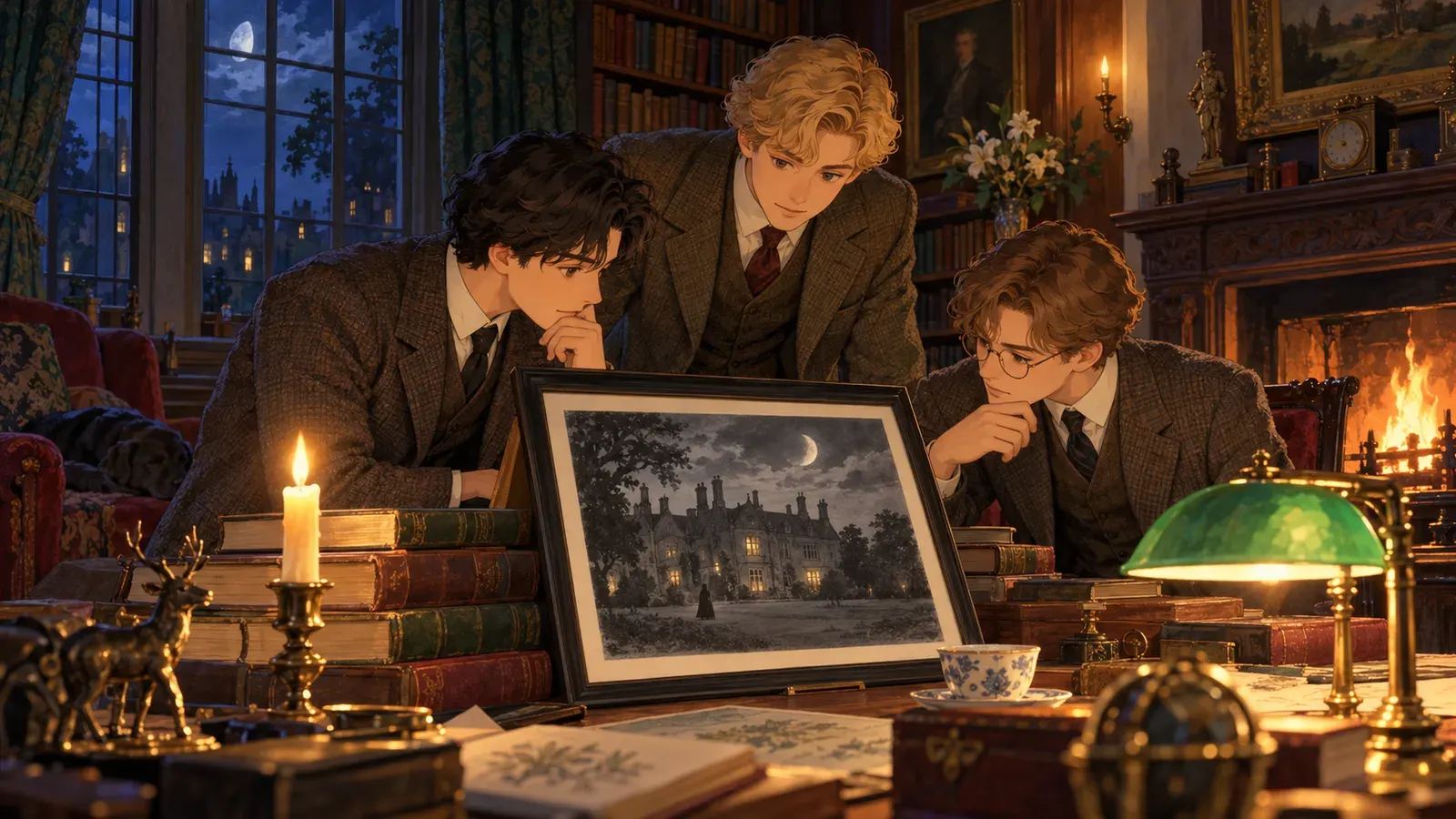
The only item with which I am concerned was the rather large, black-framed mezzotint of which I have already quoted the short description given in Mr Britnell's catalogue. Some more details of it will have to be given, though I cannot hope to put before you the look of the picture as clearly as it is present to my own eye. Very nearly the exact duplicate of it may be seen in a good many old inn parlours, or in the passages of undisturbed country mansions at the present moment. It was a rather indifferent mezzotint, and an indifferent mezzotint is, perhaps, the worst form of engraving known. It presented a full-face view of a not very large manor-house of the last century, with three rows of plain sashed windows with rusticated masonry about them, a parapet with balls or vases at the angles, and a small portico in the centre. On either side were trees, and in front a considerable expanse of lawn. The legend A. W. F. sculpsit was engraved on the narrow margin; and there was no further inscription. The whole thing gave the impression that it was the work of an amateur. What in the world Mr Britnell could mean by affixing the price of £2 2s. to such an object was more than Mr Williams could imagine. He turned it over with a good deal of contempt; upon the back was a paper label, the left-hand half of which had been torn off. All that remained were the ends of two lines of writing: the first had the letters—ngley Hall; the second,—ssex.
ここで私がお話ししたいのは、そのうちのただ一つの品のことである。前にブリトネル氏のカタログの短い説明を引用した、黒い額入りの、かなり大きなメゾチントだ。もう少し詳しく説明しなければならないが、その絵を、私の目に浮かんでいるとおり鮮やかにお伝えできるとは思えない。これとほとんどそっくりの絵なら、今でも古い宿屋の客間や、昔のまま手つかずの田舎の屋敷の廊下で、いくらでも見かける。かなり出来の悪いメゾチントだった。そして出来の悪いメゾチントというのは、おそらく版画の中でもいちばんひどい代物である。描かれていたのは、前世紀の、それほど大きくない荘園屋敷を真正面から見た姿だった。飾りのない上げ下げ窓が三段に並び、窓のまわりは表面を荒く仕上げた石積みで囲まれている。屋根のふちには低い壁がめぐらされ、その角には球か壺の飾りがのっている。正面の中央には、柱の並んだ小さな玄関があった。両側には木々があり、手前には広い芝生が広がっている。細い余白には「A. W. F. sculpsit(A・W・F 刻す)」と彫られていて、ほかには何の文字もない。全体として、素人の作品という印象だった。いったいブリトネル氏は、どういうつもりでこんな品に2ポンド2シリングもの値をつけたのか、ウィリアムズ氏にはさっぱり見当がつかなかった。すっかりばかにしきった気分で、額を裏返した。裏には紙のラベルが貼ってあったが、左半分は破り取られていた。残っていたのは、二行の書き込みの終わりの部分だけである。一行目は「……ngley Hall(……ングリー・ホール)」、二行目は「……ssex」とあった。
It would, perhaps, be just worth while to identify the place represented, which he could easily do with the help of a gazetteer, and then he would send it back to Mr Britnell, with some remarks reflecting upon the judgement of that gentleman.
描かれている場所を突き止めるくらいの手間は、かけてもいいかもしれない。地名辞典を使えば簡単に分かるだろう。そのうえで、ブリトネル氏の目利きぶりに少々皮肉をこめた一言を添えて、送り返してやろう。
He lighted the candles, for it was now dark, made the tea, and supplied the friend with whom he had been playing golf (for I believe the authorities of the University I write of indulge in that pursuit by way of relaxation); and tea was taken to the accompaniment of a discussion which golfing persons can imagine for themselves, but which the conscientious writer has no right to inflict upon any non-golfing persons.
もう暗くなっていたので、ろうそくに火をつけ、お茶をいれて、一緒にゴルフをしてきた友人にすすめた(私がここで書いている大学のお偉方は、どうやら気晴らしにゴルフをたしなむらしいのだ)。お茶を飲みながら、二人はひとしきり議論をした。ゴルフをする人なら中身は想像がつくだろう。しかし良心ある書き手には、ゴルフをしない人にそれを無理やり読ませる権利はない。
The conclusion arrived at was that certain strokes might have been better, and that in certain emergencies neither player had experienced that amount of luck which a human being has a right to expect. It was now that the friend—let us call him Professor Binks—took up the framed engraving, and said:
出た結論は、何打かはもっとうまく打てたはずだということ、そして、いくつかのピンチの場面で、二人とも、人間なら当然期待してよいだけの運にさえ恵まれなかったということだった。この友人を、仮にビンクス教授と呼んでおこう。そのビンクス教授が、このとき額入りの版画を手に取って言った。
"What's this place, Williams?"
「ウィリアムズ、これはどこの屋敷だい?」
"Just what I am going to try to find out," said Williams, going to the shelf for a gazetteer. "Look at the back. Somethingley Hall, either in Sussex or Essex. Half the name's gone, you see. You don't happen to know it, I suppose?"
「それを今から調べようと思っていたところさ」ウィリアムズは、地名辞典を取りに棚へ向かいながら言った。「裏を見てくれ。なんとかングリー・ホール、サセックスかエセックスのどちらかだ。ほら、名前が半分なくなっているだろう。きみ、ひょっとして知らないかい?」
"It's from that man Britnell, I suppose, isn't it?" said Binks. "Is it for the museum?"
「例のブリトネルという男から来たんだろう?」とビンクスは言った。「美術館に買うのかい?」
"Well, I think I should buy it if the price was five shillings," said Williams; "but for some unearthly reason he wants two guineas for it. I can't conceive why. It's a wretched engraving, and there aren't even any figures to give it life."
「そうだな、五シリングなら買ってもいいと思うよ」とウィリアムズ。「ところが、どういうわけか二ギニーもふっかけてきたんだ。まったく訳が分からない。ひどい版画だし、絵に生気を与える人物が一人も描かれていないんだから。」
"It's not worth two guineas, I should think," said Binks; "but I don't think it's so badly done. The moonlight seems rather good to me; and I should have thought there were figures, or at least a figure, just on the edge in front."
「二ギニーの値打ちはないだろうね」とビンクス。「でも、それほど下手でもないと思うよ。月の光なんか、なかなかよく出ているじゃないか。それに、人物もいるように見えるけどな。少なくとも一人、手前のちょうど端のところに。」
"Let's look," said Williams. "Well, it's true the light is rather cleverly given. Where's your figure? Oh yes! Just the head, in the very front of the picture."
「見せてくれ」とウィリアムズは言った。「なるほど、たしかに光の具合はうまく出ている。人物はどこだい? ああ、本当だ! 頭だけだね。絵のいちばん手前のところに。」
And indeed there was—hardly more than a black blot on the extreme edge of the engraving—the head of a man or woman, a good deal muffled up, the back turned to the spectator, and looking towards the house.
たしかに、そこにいた。版画のいちばん端に、黒いしみとたいして変わらないものが見えた。厚い衣にすっぽりと身を包んだ人物が、こちらに背を向けて、屋敷のほうを見ているのだ。見えるのはほとんど頭だけで、男か女かも分からない。
Williams had not noticed it before.
ウィリアムズは、それまで気づいていなかった。
"Still," he said, "though it's a cleverer thing than I thought, I can't spend two guineas of museum money on a picture of a place I don't know."
「それでもね」と彼は言った。「思ったよりは気のきいた作品だとしても、どこだか分からない場所の絵に、美術館のお金を二ギニーも出すわけにはいかないよ。」
Professor Binks had his work to do, and soon went; and very nearly up to Hall time Williams was engaged in a vain attempt to identify the subject of his picture. "If the vowel before the ng had only been left, it would have been easy enough," he thought; "but as it is, the name may be anything from Guestingley to Langley, and there are many more names ending like this than I thought; and this rotten book has no index of terminations."
ビンクス教授には自分の仕事があったので、まもなく帰っていった。ウィリアムズは、学寮の食堂で夕食が始まる直前まで、絵に描かれた場所を突き止めようとがんばったが、むだだった。「ng の前の母音さえ残っていれば、簡単に分かったのに」と彼は思った。「これじゃあ、ゲスティングリーからラングリーまで、何だってありうる。こういう終わり方の名前は、思っていたよりずっと多い。おまけに、このろくでもない本には、語尾から引ける索引がないときている。」
Hall in Mr Williams's college was at seven. It need not be dwelt upon; the less so as he met there colleagues who had been playing golf during the afternoon, and words with which we have no concern were freely bandied across the table—merely golfing words, I would hasten to explain.
ウィリアムズ氏の学寮では、夕食は七時に食堂でとることになっていた。その夕食のことは詳しく書くまでもない。まして、彼がそこで午後にゴルフをしてきた同僚たちと顔を合わせ、私たちには関係のない言葉がテーブル越しにさかんに飛び交ったとなれば、なおさらである。急いでお断りしておくが、ただのゴルフの言葉にすぎない。
I suppose an hour or more to have been spent in what is called common-room after dinner. Later in the evening some few retired to Williams's rooms, and I have little doubt that whist was played and tobacco smoked. During a lull in these operations Williams picked up the mezzotint from the table without looking at it, and handed it to a person mildly interested in art, telling him where it had come from, and the other particulars which we already know.
夕食のあと、いわゆる談話室で一時間かそこら過ごしたのだと思う。夜が更けてから、何人かがウィリアムズの部屋に移った。ホイスト(トランプ遊びの一種)をし、たばこをふかしたにちがいない。その遊びが一息ついたとき、ウィリアムズはテーブルの上のメゾチントを、見もしないで取り上げ、美術に少しばかり興味のある一人に手渡した。そして、どこから来た品かなど、私たちがすでに知っているいきさつを話して聞かせた。
The gentleman took it carelessly, looked at it, then said, in a tone of some interest:
その紳士は、何気なく受け取って目をやった。それから、いくらか興味をひかれた口ぶりで言った。
"It's really a very good piece of work, Williams; it has quite a feeling of the romantic period. The light is admirably managed, it seems to me, and the figure, though it's rather too grotesque, is somehow very impressive."
「これは実にいい作品じゃないか、ウィリアムズ。ロマン派の時代の雰囲気がよく出ている。光の扱いが見事だと思うね。それに、あの人物は、少しグロテスクすぎるけれど、なぜか強く心に残るよ。」
"Yes, isn't it?" said Williams, who was just then busy giving whisky-and-soda to others of the company, and was unable to come across the room to look at the view again.
「そうだろう?」とウィリアムズは答えた。ちょうどほかの客にウイスキーのソーダ割りを配るのに忙しく、部屋を横切ってもう一度絵をのぞきに行くことはできなかった。
It was by this time rather late in the evening, and the visitors were on the move. After they went Williams was obliged to write a letter or two and clear up some odd bits of work. At last, some time past midnight, he was disposed to turn in, and he put out his lamp after lighting his bedroom candle. The picture lay face upwards on the table where the last man who looked at it had put it, and it caught his eye as he turned the lamp down. What he saw made him very nearly drop the candle on the floor, and he declares now that if he had been left in the dark at that moment he would have had a fit. But, as that did not happen, he was able to put down the light on the table and take a good look at the picture. It was indubitable—rankly impossible, no doubt, but absolutely certain. In the middle of the lawn in front of the unknown house there was a figure where no figure had been at five o'clock that afternoon. It was crawling on all-fours towards the house, and it was muffled in a strange black garment with a white cross on the back.
このころにはもう、かなり夜も遅くなっていて、客たちは帰りはじめていた。みんなが帰ったあと、ウィリアムズは手紙を一、二通書き、こまごまとした仕事を片づけなければならなかった。真夜中を少し過ぎたころ、ようやく寝る気になった。寝室用のろうそくに火をつけてから、ランプを消そうとした。絵は、最後に見た人が置いたまま、テーブルの上に表向きになっていた。ランプの火を小さくしたとき、その絵が目に入った。そこに見えたものに驚いて、ウィリアムズはあやうくろうそくを床に落とすところだった。もしあの瞬間に暗闇に取り残されていたら、きっと発作でも起こしていただろう、と本人は今でも言っている。しかし、そうはならなかったので、明かりをテーブルに置き、絵をじっくり見ることができた。疑いようがなかった。まったくありえないことには違いない。しかし、間違いなく本当だった。見知らぬ屋敷の前の芝生の真ん中に、人の姿があったのだ。その日の午後五時には、そこには誰もいなかった。その姿は、四つんばいになって屋敷のほうへはっていた。全身を奇妙な黒い衣でおおい、背中には白い十字のしるしがついていた。
I do not know what is the ideal course to pursue in a situation of this kind. I can only tell you what Mr Williams did. He took the picture by one corner and carried it across the passage to a second set of rooms which he possessed. There he locked it up in a drawer, sported the doors of both sets of rooms, and retired to bed; but first he wrote out and signed an account of the extraordinary change which the picture had undergone since it had come into his possession.
こういう場合にどうするのがいちばんよいのか、私には分からない。ウィリアムズ氏がどうしたかをお伝えできるだけだ。彼は絵の端をつまんで、廊下の向かいにある、自分のもう一つの部屋へ運んだ。そこで引き出しにしまって鍵をかけ、両方の部屋の外側の重い扉を閉めて、誰も入れないようにしてから、寝床に入った。ただしその前に、絵が自分の手に渡ってから起きた異様な変化を書きとめ、署名しておいた。
Sleep visited him rather late; but it was consoling to reflect that the behaviour of the picture did not depend upon his own unsupported testimony. Evidently the man who had looked at it the night before had seen something of the same kind as he had, otherwise he might have been tempted to think that something gravely wrong was happening either to his eyes or his mind. This possibility being fortunately precluded, two matters awaited him on the morrow. He must take stock of the picture very carefully, and call in a witness for the purpose, and he must make a determined effort to ascertain what house it was that was represented. He would therefore ask his neighbour Nisbet to breakfast with him, and he would subsequently spend a morning over the gazetteer.
なかなか寝つけなかった。それでも、絵のおかしなふるまいの証人が自分一人ではない、と考えると心が慰められた。ゆうべあの絵を見た男も、明らかに自分と同じようなものを見ていたのだ。そうでなければ、自分の目か頭のどちらかがひどくおかしくなっているのではないかと、思いかねないところだった。幸い、その心配はない。となると、明日しなければならないことは二つあった。まず、証人を呼んで、絵を念入りに調べること。それから、描かれているのがどこの屋敷なのか、本気で突き止めることだ。そこで、隣に住むニスベットを朝食に呼び、そのあとは午前中を地名辞典に費やすことにした。
Nisbet was disengaged, and arrived about 9.30. His host was not quite dressed, I am sorry to say, even at this late hour. During breakfast nothing was said about the mezzotint by Williams, save that he had a picture on which he wished for Nisbet's opinion. But those who are familiar with University life can picture for themselves the wide and delightful range of subjects over which the conversation of two Fellows of Canterbury College is likely to extend during a Sunday morning breakfast. Hardly a topic was left unchallenged, from golf to lawn-tennis. Yet I am bound to say that Williams was rather distraught; for his interest naturally centred in that very strange picture which was now reposing, face downwards, in the drawer in the room opposite.
ニスベットは都合がつき、九時半ごろにやって来た。言いにくいことだが、こんな遅い時間になっても、招いた側のウィリアムズはまだ着替えを終えていなかった。朝食のあいだ、ウィリアムズはメゾチントのことには触れず、意見を聞きたい絵が一枚ある、とだけ言った。大学の暮らしを知っている人なら、カンタベリー学寮のフェロー(学寮に所属する学者)が二人で日曜の朝食をとれば、会話がどんなに幅広く楽しい話題に及ぶか、想像がつくだろう。ゴルフからローンテニスまで、二人が論じ合わなかった話題はほとんどないくらいだった。それでも正直に言えば、ウィリアムズはどこか上の空だった。当然ながら、彼の関心は、向かいの部屋の引き出しで、今は裏返しのまま眠っているあの奇妙な絵に集中していたのである。
The morning pipe was at last lighted, and the moment had arrived for which he looked. With very considerable—almost tremulous—excitement he ran across, unlocked the drawer, and, extracting the picture—still face downwards—ran back, and put it into Nisbet's hands.
ようやく朝のパイプに火がつき、待ちに待った瞬間がやって来た。ウィリアムズはひどく興奮して、体が震えそうなほどだった。彼は向かいの部屋へ駆けていき、引き出しの鍵を開けて絵を取り出すと、裏返しのまま駆け戻って、ニスベットの手に渡した。
"Now," he said, "Nisbet, I want you to tell me exactly what you see in that picture. Describe it, if you don't mind, rather minutely. I'll tell you why afterwards."
「さあ、ニスベット」と彼は言った。「その絵に何が見えるか、正確に教えてほしいんだ。かまわなければ、かなり細かく説明してくれ。理由はあとで話すから。」
"Well," said Nisbet, "I have here a view of a country-house—English, I presume—by moonlight."
「ふむ」とニスベットは言った。「ここにあるのは、月明かりに照らされた田舎の屋敷の眺めだね。イギリスの屋敷だろうと思う。」
"Moonlight? You're sure of that?"
「月明かり? 確かかい?」
"Certainly. The moon appears to be on the wane, if you wish for details, and there are clouds in the sky."
「もちろん。詳しく言えというなら、月は欠けはじめているようだし、空には雲がある。」
"All right. Go on. I'll swear," added Williams in an aside, "there was no moon when I saw it first."
「よし。続けてくれ」ウィリアムズはそう言ってから、小声でつけ加えた。「誓ってもいい、最初に見たときには月なんかなかった。」
"Well, there's not much more to be said," Nisbet continued. "The house has one—two—three rows of windows, five in each row, except at the bottom, where there's a porch instead of the middle one, and—"
「まあ、ほかに言うことはあまりないね」とニスベットは続けた。「屋敷には窓が、一、二、三段あって、どの段にも五つずつ並んでいる。ただ、いちばん下の段だけは、真ん中の窓のかわりに玄関がついていて、それから……」
"But what about figures?" said Williams, with marked interest.
「でも、人物はどうだい?」ウィリアムズは、ひどく気にかかる様子で言った。
"There aren't any," said Nisbet; "but—"
「一人もいないよ」とニスベット。「でも……」
"What! No figure on the grass in front?"
「なんだって! 手前の芝生に人はいないのか?」
"Not a thing."
「何もない。」
"You'll swear to that?"
「誓ってそう言えるかい?」
"Certainly I will. But there's just one other thing."
「もちろん言えるさ。でも、ほかにもう一つだけ気になることがある。」
"What?"
「何だい?」
"Why, one of the windows on the ground-floor—left of the door—is open."
「いや、一階の窓の一つが開いているんだ。玄関の左側のやつだよ。」
"Is it really so? My goodness! he must have got in," said Williams, with great excitement; and he hurried to the back of the sofa on which Nisbet was sitting, and, catching the picture from him, verified the matter for himself.
「本当かい? なんてことだ! あいつ、中に入ったにちがいない」ウィリアムズはひどく興奮して言った。そして、ニスベットが座っているソファの後ろに急いでまわり、絵をひったくるようにして、自分の目で確かめた。
It was quite true. There was no figure, and there was the open window. Williams, after a moment of speechless surprise, went to the writing-table and scribbled for a short time. Then he brought two papers to Nisbet, and asked him first to sign one—it was his own description of the picture, which you have just heard—and then to read the other which was Williams's statement written the night before.
本当だった。人の姿はなく、窓が開いていた。ウィリアムズは、しばらく言葉も出ないほど驚いていたが、やがて書きもの机に向かい、少しのあいだ何かを走り書きした。それから二枚の紙をニスベットのところへ持ってきた。まず一枚に署名してくれと頼んだ。それは、今みなさんに聞いていただいたばかりの、ニスベット自身による絵の説明だった。そのあと、もう一枚を読んでもらった。前の晩にウィリアムズが書いた記録である。
"What can it all mean?" said Nisbet.
「いったい、どういうことなんだ?」とニスベットは言った。
"Exactly," said Williams. "Well, one thing I must do—or three things, now I think of it. I must find out from Garwood"—this was his last night's visitor—"what he saw, and then I must get the thing photographed before it goes further, and then I must find out what the place is."
「まさにそれだよ」とウィリアムズは言った。「さて、しなければならないことが一つある。いや、考えてみれば三つだな。まず、ガーウッド(ゆうべの客の一人である)に何を見たか聞くこと。次に、これ以上何か起こる前に写真を撮っておくこと。それから、この場所がどこなのか突き止めることだ。」
"I can do the photographing myself," said Nisbet, "and I will. But, you know, it looks very much as if we were assisting at the working out of a tragedy somewhere. The question is, has it happened already, or is it going to come off? You must find out what the place is. Yes," he said, looking at the picture again, "I expect you're right: he has got in. And if I don't mistake there'll be the devil to pay in one of the rooms upstairs."
「写真なら、ぼくが撮れる」とニスベットは言った。「やってあげよう。でもね、これはまるで、どこかで悲劇が進んでいくのを、ぼくらがその場で見届けているような気がするよ。問題は、それがもう起きてしまったことなのか、これから起きることなのかだ。この場所は突き止めなくちゃいけない」それから、もう一度絵を見て言った。「うん、きみの言うとおりだと思う。あいつは中に入ったんだ。それに、ぼくの見立てが間違っていなければ、二階のどこかの部屋で、とんでもないことになるぞ。」
"I'll tell you what," said Williams: "I'll take the picture across to old Green" (this was the senior Fellow of the College, who had been Bursar for many years). "It's quite likely he'll know it. We have property in Essex and Sussex, and he must have been over the two counties a lot in his time."
「そうだ、こうしよう」とウィリアムズは言った。「この絵をグリーンさんのところへ持っていこう」(グリーンは学寮の最古参のフェローで、長年、会計係を務めた人だった)。「あの人なら、たぶん知っているだろう。うちの学寮はエセックスにもサセックスにも土地を持っているから、あの人は現役のころ、二つの州をずいぶん歩き回ったはずだ。」
"Quite likely he will," said Nisbet; "but just let me take my photograph first. But look here, I rather think Green isn't up today. He wasn't in Hall last night, and I think I heard him say he was going down for the Sunday."
「知っていそうだね」とニスベット。「でも、まず写真を撮らせてくれ。それにね、グリーンは今日はいないんじゃないかな。ゆうべは食堂に来ていなかったし、この日曜はよそへ出かけると言っていたのを聞いた気がする。」
"That's true, too," said Williams; "I know he's gone to Brighton. Well, if you'll photograph it now, I'll go across to Garwood and get his statement, and you keep an eye on it while I'm gone. I'm beginning to think two guineas is not a very exorbitant price for it now."
「そうだった」とウィリアムズ。「ブライトンへ行ったんだったな。じゃあ、今写真を撮ってくれるなら、ぼくはガーウッドのところへ行って話を聞いてくる。留守のあいだ、絵を見張っていてくれ。今となっては、二ギニーもそれほど法外な値段じゃない気がしてきたよ。」
In a short time he had returned, and brought Mr Garwood with him. Garwood's statement was to the effect that the figure, when he had seen it, was clear of the edge of the picture, but had not got far across the lawn. He remembered a white mark on the back of its drapery, but could not have been sure it was a cross. A document to this effect was then drawn up and signed, and Nisbet proceeded to photograph the picture.
まもなく彼は、ガーウッド氏を連れて戻ってきた。ガーウッドの話はこうだった。自分が見たとき、人の姿は絵の端からは離れていたが、芝生をまだそれほど進んではいなかった。衣の背中に白いしるしがあったのは覚えているが、十字だったかどうかまでは確かではない。この話を文書にまとめてガーウッドに署名してもらい、それからニスベットが絵の写真を撮った。
"Now what do you mean to do?" he said. "Are you going to sit and watch it all day?"
「さて、どうするつもりだい?」とニスベットは言った。「一日じゅう座って見張っているのかい?」
"Well, no, I think not," said Williams. "I rather imagine we're meant to see the whole thing. You see, between the time I saw it last night and this morning there was time for lots of things to happen, but the creature only got into the house. It could easily have got through its business in the time and gone to its own place again; but the fact of the window being open, I think, must mean that it's in there now. So I feel quite easy about leaving it. And, besides, I have a kind of idea that it wouldn't change much, if at all, in the daytime. We might go out for a walk this afternoon, and come in to tea, or whenever it gets dark. I shall leave it out on the table here, and sport the door. My skip can get in, but no one else."
「いや、それはやめておこうと思う」とウィリアムズは言った。「ぼくらは一部始終を見せられることになっているんじゃないか、という気がするんだ。いいかい、ゆうべぼくが見てから今朝までのあいだに、いろんなことが起こるだけの時間は十分あった。なのに、あいつは屋敷に入っただけだった。その気になれば、そのあいだに用をすませて、自分の居場所に戻ることも簡単にできたはずだ。でも窓が開いているということは、今もあの中にいるという意味だと思う。だから、このまま置いておいても平気だろう。それにね、昼間はたぶん、あまり変わらないんじゃないかという気がする。まったく変わらないかもしれない。午後は散歩にでも出かけて、お茶の時間か、暗くなるころに戻ってくればいい。絵はここのテーブルに出したままにして、外扉を閉めておく。ぼくの召使いは入れるが、ほかの者は入れない。」
The three agreed that this would be a good plan; and, further, that if they spent the afternoon together they would be less likely to talk about the business to other people; for any rumour of such a transaction as was going on would bring the whole of the Phasmatological Society about their ears.
三人は、それがいい考えだと賛成した。さらに、午後を一緒に過ごせば、この件をほかの人にしゃべってしまう心配も少なくなる、という点でも意見が一致した。こんなことが起きているといううわさが少しでも広まれば、幽霊研究協会の連中がこぞって押しかけてくるにちがいないからだ。
We may give them a respite until five o'clock.
では、五時までは三人をそっとしておくとしよう。
At or near that hour the three were entering Williams's staircase. They were at first slightly annoyed to see that the door of his rooms was unsported; but in a moment it was remembered that on Sunday the skips came for orders an hour or so earlier than on weekdays. However, a surprise was awaiting them. The first thing they saw was the picture leaning up against a pile of books on the table, as it had been left, and the next thing was Williams's skip, seated on a chair opposite, gazing at it with undisguised horror. How was this? Mr Filcher (the name is not my own invention) was a servant of considerable standing, and set the standard of etiquette to all his own college and to several neighbouring ones, and nothing could be more alien to his practice than to be found sitting on his master's chair, or appearing to take any particular notice of his master's furniture or pictures. Indeed, he seemed to feel this himself. He started violently when the three men were in the room, and got up with a marked effort. Then he said:
五時ごろ、三人はウィリアムズの部屋へ続く階段を上がっていった。最初、部屋の外扉が閉まっていないのを見て、少しむっとした。しかしすぐに、日曜日は召使いたちが、平日より一時間ほど早く用を聞きに来ることを思い出した。ところが、驚くようなことが三人を待っていた。最初に目に入ったのは、出かけたときのまま、テーブルの上の本の山に立てかけてある絵だった。次に目に入ったのは、その向かいの椅子に座り、恐怖をむき出しにして絵を見つめている、ウィリアムズの召使いの姿だった。いったいどういうことだろう? フィルチャー氏(この名前は私の作りごとではない)は、古株で、まわりから一目置かれている召使いだった。自分の学寮ばかりか、近くのいくつかの学寮でも、召使いたちの礼儀作法の手本とされる人物だったのである。主人の椅子に座っているところを見られたり、主人の家具や絵にとくに目をとめているそぶりを見せたりするなど、ふだんの彼からはいちばんかけ離れたことだった。実際、本人もそう感じているようだった。三人が部屋に入ってくると、彼はびくっと大きく身を震わせ、やっとの思いで立ち上がった。そして言った。
"I ask your pardon, sir, for taking such a freedom as to set down."
「勝手に腰なんぞ下ろしちまいまして、まことに申し訳ございません、旦那さま。」
"Not at all, Robert," interposed Mr Williams. "I was meaning to ask you some time what you thought of that picture."
「いいんだよ、ロバート」とウィリアムズ氏は口をはさんだ。「あの絵をどう思うか、いつかきみに聞いてみようと思っていたんだ。」
"Well, sir, of course I don't set up my opinion again yours, but it ain't the pictur I should 'ang where my little girl could see it, sir."
「へえ、旦那さま。そりゃあもちろん、あっしなんぞが旦那さまのお考えにたてつくつもりはございませんがね。うちのちっちゃな娘の目につくところに掛けたいような絵じゃございませんや、旦那さま。」
"Wouldn't you, Robert? Why not?"
「そうかい、ロバート? どうしてだい?」
"No, sir. Why, the pore child, I recollect once she see a Door Bible, with pictures not 'alf what that is, and we 'ad to set up with her three or four nights afterwards, if you'll believe me; and if she was to ketch a sight of this skelinton here, or whatever it is, carrying off the pore baby, she would be in a taking. You know 'ow it is with children; 'ow nervish they git with a little thing and all. But what I should say, it don't seem a right pictur to be laying about, sir, not where anyone that's liable to be startled could come on it. Should you be wanting anything this evening, sir? Thank you, sir."
「へえ、掛けませんとも、旦那さま。いやね、かわいそうに、あの子はいつだったか、ドレの挿絵入りの聖書を見ちまったことがございましてね。その絵ときたら、こいつの半分もおっかなくなかったんでございますが、それでもあとで三晩も四晩も、あっしらが寝ずについていてやらなきゃならなかったんで。本当でございますよ。それがもし、このがいこつだか何だか知りませんが、こいつがかわいそうな赤ん坊をさらっていくところなんぞ見ちまった日にゃ、そりゃあもう大変な騒ぎになりまさあ。子どもってのはどんなもんか、ご存じでしょう。ちょっとしたことで、すぐびくびくしちまうもんで。ですがね、あっしに言わせりゃ、こいつはそこらに放っておいていい絵じゃございませんよ、旦那さま。びっくりしやすい者が、ひょいと見つけちまうようなところにはね。今晩、何かご用はございますか、旦那さま? ありがとうございます、旦那さま。」
With these words the excellent man went to continue the round of his masters, and you may be sure the gentlemen whom he left lost no time in gathering round the engraving. There was the house, as before, under the waning moon and the drifting clouds. The window that had been open was shut, and the figure was once more on the lawn: but not this time crawling cautiously on hands and knees. Now it was erect and stepping swiftly, with long strides, towards the front of the picture. The moon was behind it, and the black drapery hung down over its face so that only hints of that could be seen, and what was visible made the spectators profoundly thankful that they could see no more than a white dome-like forehead and a few straggling hairs. The head was bent down, and the arms were tightly clasped over an object which could be dimly seen and identified as a child, whether dead or living it was not possible to say. The legs of the appearance alone could be plainly discerned, and they were horribly thin.
この言葉を残して、この立派な召使いは、受け持ちのほかの旦那方の部屋を回りに出ていった。残された紳士たちが、すぐさま版画のまわりに集まったのは言うまでもない。屋敷は前と同じように、欠けていく月と流れる雲の下にあった。開いていた窓は閉まっていた。そして人の姿が、また芝生の上にあった。しかし今度は、両手両ひざをついて用心深くはっているのではなかった。まっすぐに立ち、大またですばやく、絵の手前のほうへ歩いてくるのだ。月はその背後にあり、黒い衣が顔にかぶさるように垂れ下がっていたので、顔はちらりとしか見えなかった。だが、わずかにのぞいた部分だけでも、三人は、それ以上見えずにすんだことを心の底からありがたく思った。見えたのは、白い丸屋根のような額と、ほつれて垂れた数本の髪の毛だけだったのだ。頭は下を向いていた。両腕は何かをしっかりと抱えこんでいた。ぼんやりとしか見えないが、子どもだと分かった。死んでいるのか生きているのかは分からない。この化けものの体のうち、はっきり見分けられるのは脚だけだった。その脚は、ぞっとするほどやせ細っていた。
From five to seven the three companions sat and watched the picture by turns. But it never changed. They agreed at last that it would be safe to leave it, and that they would return after Hall and await further developments.
五時から七時まで、三人は代わる代わる絵を見張った。しかし、絵は少しも変わらなかった。最後に三人は、もう置いておいても大丈夫だろうと決めた。そして夕食のあとに戻ってきて、その後の成り行きを待つことにした。
When they assembled again, at the earliest possible moment, the engraving was there, but the figure was gone, and the house was quiet under the moonbeams. There was nothing for it but to spend the evening over gazetteers and guide-books. Williams was the lucky one at last, and perhaps he deserved it. At 11.30 p.m. he read from Murray's Guide to Essex the following lines:
できるだけ早く三人がまた集まったとき、版画はそこにあったが、人の姿は消えていた。屋敷は月の光を浴びて、静まりかえっていた。あとは地名辞典や案内書を調べて夜を過ごすしかなかった。最後に当たりを引いたのはウィリアムズだった。それまでの苦労を思えば、そのくらいの運はあってもよかっただろう。夜の十一時半、彼はマレーの『エセックス案内』から、次の一節を読み上げた。
16½ miles, Anningley. The church has been an interesting building of Norman date, but was extensively classicized in the last century. It contains the tomb of the family of Francis, whose mansion, Anningley Hall, a solid Queen Anne house, stands immediately beyond the churchyard in a park of about 80 acres. The family is now extinct, the last heir having disappeared mysteriously in infancy in the year 1802. The father, Mr Arthur Francis, was locally known as a talented amateur engraver in mezzotint. After his son's disappearance he lived in complete retirement at the Hall, and was found dead in his studio on the third anniversary of the disaster, having just completed an engraving of the house, impressions of which are of considerable rarity.
16マイル半、アニングリー。教会はもとノルマン時代の興味深い建物であったが、前世紀に大がかりに改修され、古典様式に改められた。教会にはフランシス家の墓所がある。同家の屋敷アニングリー・ホールは、どっしりとしたアン女王時代様式の建物で、教会の墓地のすぐ向こう、約80エーカーの庭園の中に建つ。一族はすでに絶えている。最後の跡取りが、1802年、幼くして謎の失踪をとげたためである。父親のアーサー・フランシス氏は、メゾチントの腕のよい素人版画家として、地元で知られていた。息子が姿を消したのち、氏はホールにこもり、世間との交わりを一切断って暮らした。そして、その不幸からちょうど三年後の同じ日に、アトリエで死んでいるのが見つかった。屋敷を描いた版画を一枚、仕上げたばかりであった。その版画の刷りは、今ではきわめて珍しい。
This looked like business, and, indeed, Mr Green on his return at once identified the house as Anningley Hall.
これは手がかりになりそうだった。実際、戻ってきたグリーン氏は、すぐにその屋敷がアニングリー・ホールだと言い当てた。
"Is there any kind of explanation of the figure, Green?" was the question which Williams naturally asked.
「グリーンさん、あの人影について、何か説明はつくんでしょうか?」ウィリアムズがそう尋ねたのは当然のことだった。
"I don't know, I'm sure, Williams. What used to be said in the place when I first knew it, which was before I came up here, was just this: old Francis was always very much down on these poaching fellows, and whenever he got a chance he used to get a man whom he suspected of it turned off the estate, and by degrees he got rid of them all but one. Squires could do a lot of things then that they daren't think of now. Well, this man that was left was what you find pretty often in that country—the last remains of a very old family. I believe they were Lords of the Manor at one time. I recollect just the same thing in my own parish."
「さあ、どうだろうね、ウィリアムズ。わたしがあの土地を初めて知ったのは、ここへ来る前のことだが、そのころあのあたりで言われていたのはこういうことだよ。フランシスじいさんは、密猟をする連中にいつもひどく厳しかった。怪しいと思う男がいると、機会さえあれば地所から追い出させたんだ。そうやって少しずつ、一人を残してみんな追い払ってしまった。当時の地主は、今なら考えもしないようなことを、ずいぶんやれたものさ。さて、その残った一人というのが、あの地方ではよくあるたぐいの男でね。とても古い家柄の、最後の生き残りだったんだ。一時は、その土地の領主だった家だと思う。わたしの故郷の教区にも、まったく同じような話があったのを覚えているよ。」
"What, like the man in Tess o' the Durbervilles?" Williams put in.
「というと、『ダーバヴィル家のテス』に出てくる男みたいな?」とウィリアムズが口をはさんだ。
"Yes, I dare say; it's not a book I could ever read myself. But this fellow could show a row of tombs in the church there that belonged to his ancestors, and all that went to sour him a bit; but Francis, they said, could never get at him—he always kept just on the right side of the law—until one night the keepers found him at it in a wood right at the end of the estate. I could show you the place now; it marches with some land that used to belong to an uncle of mine. And you can imagine there was a row; and this man Gawdy (that was the name, to be sure—Gawdy; I thought I should get it—Gawdy), he was unlucky enough, poor chap! to shoot a keeper. Well, that was what Francis wanted, and grand juries—you know what they would have been then—and poor Gawdy was strung up in double-quick time; and I've been shown the place he was buried in, on the north side of the church—you know the way in that part of the world: anyone that's been hanged or made away with themselves, they bury them that side. And the idea was that some friend of Gawdy's—not a relation, because he had none, poor devil! he was the last of his line: kind of spes ultima gentis—must have planned to get hold of Francis's boy and put an end to his line, too. I don't know—it's rather an out-of-the-way thing for an Essex poacher to think of—but, you know, I should say now it looks more as if old Gawdy had managed the job himself. Booh! I hate to think of it! have some whisky, Williams!"
「ああ、そうかもしれんね。わたしにはどうにも読み通せない本だがね。とにかく、あそこの教会には、この男の先祖の墓がずらりと並んでいた。そういうこともあって、少々ひねくれてしまったんだろう。だが、フランシスはどうしてもこの男に手を出せなかったそうだ。いつも、ぎりぎりのところで法律にふれないようにしていたからね。ところがある晩、番人たちが、地所のいちばん外れの森で、密猟の現場をおさえた。その場所なら今でも案内できるよ。わたしのおじが昔持っていた土地と、境を接しているんだ。で、想像がつくだろうが、ひと騒動になった。このゴーディという男は……そう、ゴーディ、それが名前だった。思い出せると思ったよ、ゴーディだ……運の悪いことに、かわいそうに、番人を一人撃ってしまった。さて、それこそフランシスの思うつぼだった。それに、当時の大陪審がどんなものだったかは、きみにも想像がつくだろう。哀れなゴーディは、あっという間に縛り首になった。埋められた場所も見せてもらったよ。教会の北側だ。あのあたりのならわしは知っているだろう。絞首刑になった者や自分で命を絶った者は、そっち側に葬るんだ。それで、こう考えられたわけだ。ゴーディの友だちの誰かが……身内じゃないよ。身内なんか一人もいなかったからね、かわいそうなやつだ。あの男は家系の最後の一人だった。ラテン語で言う『スペス・ウルティマ・ゲンティス』、一族最後の望みというやつさ……その友だちが、フランシスの息子をさらって、フランシスの家系も絶やしてやろうとたくらんだにちがいない、とね。どうだかね。エセックスの密猟者が思いつくにしては、ちょっと突飛な話だ。でもね、今のわたしに言わせれば、むしろゴーディ本人がその仕事をやってのけたように見えるよ。うう! 考えるのもいやだ! ウイスキーでもやろうじゃないか、ウィリアムズ!」
The facts were communicated by Williams to Dennistoun, and by him to a mixed company, of which I was one, and the Sadducean Professor of Ophiology another. I am sorry to say that the latter, when asked what he thought of it, only remarked: "Oh, those Bridgeford people will say anything"—a sentiment which met with the reception it deserved.
事の次第は、ウィリアムズからデニストンに伝えられ、デニストンからさらに、いろいろな人が集まった席で語られた。その席には私もいたし、霊のたぐいをいっさい信じない蛇類学の教授もいた。残念なことに、この教授は、どう思うかと聞かれて、こう言っただけだった。「ああ、ブリッジフォードの連中なら、何だって言うさ。」この意見は、当然ながら冷ややかにあしらわれた。
I have only to add that the picture is now in the Ashleian Museum; that it has been treated with a view to discovering whether sympathetic ink has been used in it, but without effect; that Mr Britnell knew nothing of it save that he was sure it was uncommon; and that, though carefully watched, it has never been known to change again.
付け加えることは、あと少しだけだ。この絵は今、アシュリー美術館にある。目に見えないインク(あぶり出しのようなもの)が使われていないか確かめるための処理もほどこしてみたが、何も出てこなかった。ブリトネル氏は、珍しい品だということだけは確かだと思っていたが、それ以外は何も知らなかった。そして、ずっと注意深く見守られてきたが、その絵がまた変わったという話は、それ以来一度も聞かない。
 23段落目に「I can't spend two guineas of museum money on a picture of a place I don't know.」(知らない場所の絵に2ギニーは使えない)とあります。

 原田英語の究極の英単語帳(CEFR-J 6,868語)
 聞くだけモードで、文字を見ずに内容がわかるか試す。
 1文リピートで音読・シャドーイングも。
 英語の名スピーチ