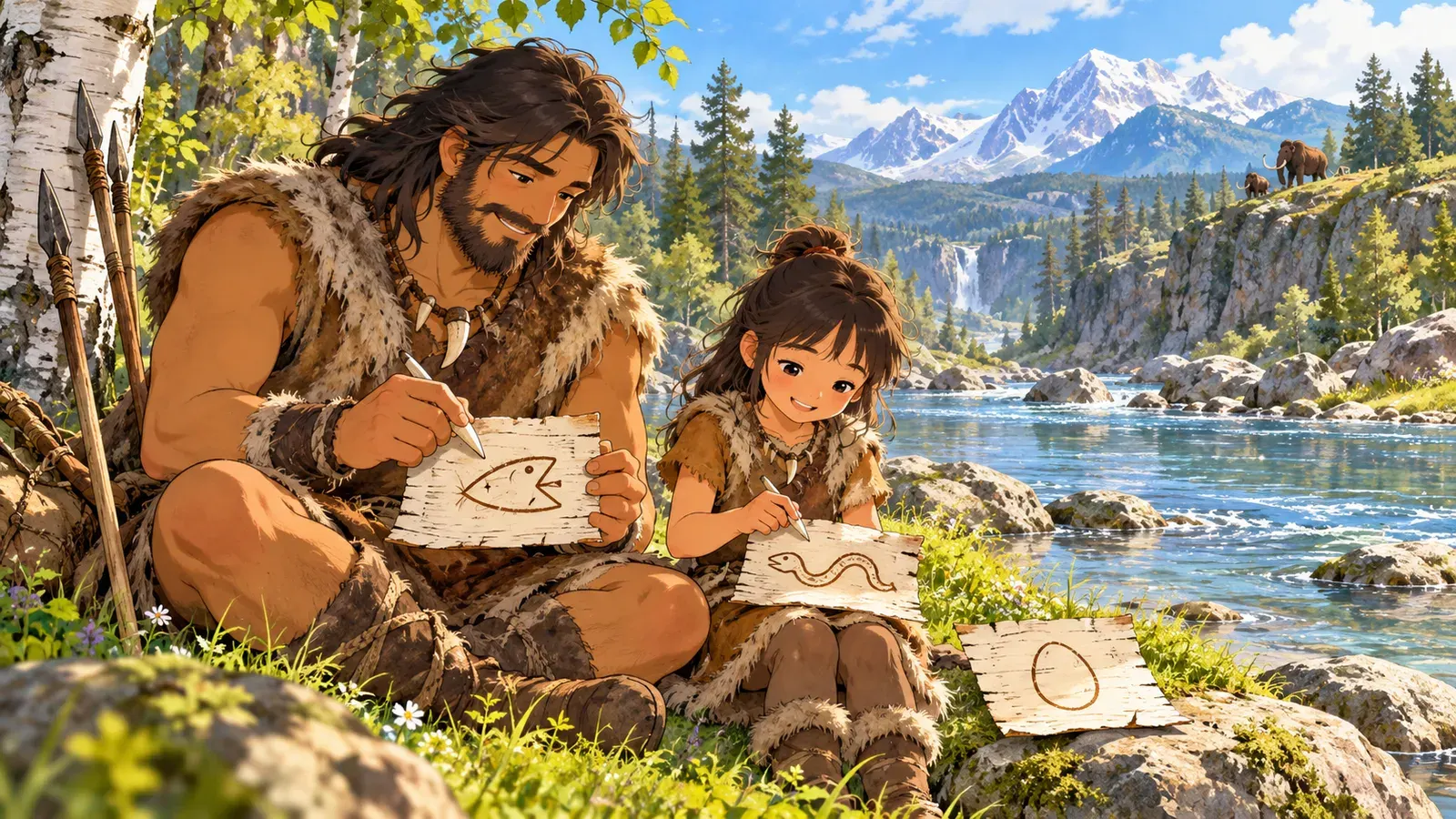
THE week after Taffimai Metallumai (we will still call her Taffy, Best Beloved) made that little mistake about her Daddy's spear and the Stranger-man and the picture-letter and all, she went carp-fishing again with her Daddy. Her Mummy wanted her to stay at home and help hang up hides to dry on the big drying-poles outside their Neolithic Cave, but Taffy slipped away down to her Daddy quite early, and they fished. Presently she began to giggle, and her Daddy said, 'Don't be silly, child.'
タフィマイ・メタルマイは(だいじなきみ、ここでもやっぱりタフィーと呼ぶことにしましょう)、お父さんのやすや、よそ者の男や、絵の手紙のことで、ちょっとしたまちがいをしでかしました。その次の週、タフィーはまたお父さんと一緒にコイ釣りに出かけました。お母さんは、タフィーに家にいて手伝ってほしかったのです。新石器時代のほら穴の外には大きな物干しざおがあって、そこに毛皮をかけてかわかさなければなりませんでした。けれどタフィーは、朝早くにこっそりぬけだして、お父さんのところへ行ってしまいました。そして二人は魚をとりました。しばらくすると、タフィーはくすくす笑いだしました。するとお父さんは言いました。「ばかなまねはおよし」
'But wasn't it inciting!' said Taffy. 'Don't you remember how the Head Chief puffed out his cheeks, and how funny the nice Stranger-man looked with the mud in his hair?'
「でも、わっくわくしたじゃない!」と、タフィーは言いました。「大族長がほっぺたをぷうっとふくらませたのとか、あのすてきなよそ者さんが髪に泥をつめられて、どんなにおかしな顔をしていたかとか、おぼえてないの?」
'Well do I,' said Tegumai. 'I had to pay two deerskins—soft ones with fringes—to the Stranger-man for the things we did to him.'
「よくおぼえているとも」と、テグマイは答えました。「わたしたちがあの人にしたことのつぐないに、シカの皮を二枚――ふさのついたやわらかいやつを――あのよそ者さんに払わなきゃならなかったんだからね」
'We didn't do anything,' said Taffy. 'It was Mummy and the other Neolithic ladies—and the mud.'
「わたしたちは何もしてないわ」と、タフィーは言いました。「やったのはお母さんと、ほかの新石器時代のご婦人たちよ――それと泥」
'We won't talk about that,' said her Daddy, 'Let's have lunch.'
「その話はやめておこう」と、お父さんは言いました。「お昼にしよう」
Taffy took a marrow-bone and sat mousy-quiet for ten whole minutes, while her Daddy scratched on pieces of birch-bark with a shark's tooth. Then she said, 'Daddy, I've thinked of a secret surprise. You make a noise—any sort of noise.'
タフィーは髄骨を一本とって、まるまる十分間ネズミみたいに静かにすわっていました。そのあいだ、お父さんはサメの歯でカバノキの樹皮のきれはしに何か引っかいていました。それからタフィーは言いました。「お父さん、わたし、ないしょのびっくりを思いついたの。何か音を出してみて――どんな音でもいいから」
'Ah!' said Tegumai. 'Will that do to begin with?'
「アー!」と、テグマイは言いました。「手はじめに、これでいいかい?」
'Yes,' said Taffy. 'You look just like a carp-fish with its mouth open. Say it again, please.'
「いいわ」と、タフィーは言いました。「お父さん、口をあけたコイにそっくり。もう一回言って」
'Ah! ah! ah!' said her Daddy. 'Don't be rude, my daughter.'
「アー!アー!アー!」と、お父さんは言いました。「失礼なことをするんじゃないよ、娘や」
'I'm not meaning rude, really and truly,' said Taffy. 'It's part of my secret-surprise-think. Do say ah, Daddy, and keep your mouth open at the end, and lend me that tooth. I'm going to draw a carp-fish's mouth wide-open.'
「失礼なつもりじゃないの、ほんとうにほんとうよ」と、タフィーは言いました。「これはわたしのないしょのびっくりの考えの一部なの。ねえお父さん、アーって言って、最後に口をあけたままにしてて。それから、その歯を貸して。コイが口を大きくあけているところをかくから」
'What for?' said her Daddy.
「何のために?」と、お父さんはたずねました。
'Don't you see?' said Taffy, scratching away on the bark. 'That will be our little secret s'prise. When I draw a carp-fish with his mouth open in the smoke at the back of our Cave—if Mummy doesn't mind—it will remind you of that ah-noise. Then we can play that it was me jumped out of the dark and s'prised you with that noise—same as I did in the beaver-swamp last winter.'
「わからない?」と、タフィーは、樹皮をがりがり引っかきながら言いました。「それが二人のちょっとしたないしょのびっくりになるのよ。ほら穴の奥のすすけた壁に、わたしが口をあけたコイの絵をかくの。お母さんがいやがらなければだけど。そうしたら、お父さんはその絵を見て、アーっていう音を思い出すでしょう。それで、わたしが暗いところからとびだして、その音でお父さんをびっくりさせたことにして遊べるわ。去年の冬に、ビーバーの沼でわたしがやったみたいにね」
'Really?' said her Daddy, in the voice that grown-ups use when they are truly attending. 'Go on, Taffy.'
「ほんとうかい?」と、お父さんは、大人がほんとうに注意して聞いているときの声で言いました。「つづけてごらん、タフィー」
'Oh bother!' she said. 'I can't draw all of a carp-fish, but I can draw something that means a carp-fish's mouth. Don't you know how they stand on their heads rooting in the mud? Well, here's a pretence carp-fish (we can play that the rest of him is drawn). Here's just his mouth, and that means ah.' And she drew this.
「ああ、もう!」と、タフィーは言いました。「コイを丸ごとはかけないわ。でも、コイの口を意味するものならかけるわ。コイがさかだちして泥の中をほじくりまわすの、知ってるでしょう?ほら、これがつもりのコイよ(残りの部分はかいてあることにして遊べばいいわ)。これがコイの口だけで、それがアーっていう意味なの」そしてタフィーはこれをかきました。
'That's not bad,' said Tegumai, and scratched on his own piece of bark for himself; but you've forgotten the feeler that hangs across his mouth.'
「悪くないね」と、テグマイは言って、自分の樹皮のきれはしに自分で引っかきました。「でも、口のところに垂れさがっているひげを忘れているよ」
'But I can't draw, Daddy.'
「でも、わたし、絵がかけないんだもの、お父さん」
'You needn't draw anything of him except just the opening of his mouth and the feeler across. Then we'll know he's a carp-fish, 'cause the perches and trouts haven't got feelers. Look here, Taffy.' And he drew this.
「口のあいたところと、それにかかっているひげのほかは、何もかかなくていいんだよ。そうすれば、それがコイだってわかる。パーチやマスにはひげがないからね。ごらん、タフィー」そしてお父さんはこれをかきました。
'Now I'll copy it.' said Taffy. 'Will you understand this when you see it?'
「じゃあ、わたしがそれをまねしてかくわ」と、タフィーは言いました。「これを見たら、お父さんにわかる?」
'Perfectly,' said her Daddy.
「完全にわかるとも」と、お父さんは答えました。
And she drew this. 'And I'll be quite as s'prised when I see it anywhere, as if you had jumped out from behind a tree and said '"Ah!"'
そしてタフィーはこれをかきました。「それにわたしも、どこかでこれを見たら、お父さんが木のうしろからとびだして『アー!』って言ったのと同じくらい、びっくりするわ」
'Now, make another noise,' said Taffy, very proud.
「じゃあ、もうひとつ音を出して」と、タフィーは、とても得意になって言いました。
'Yah!' said her Daddy, very loud.
「ヤー!」と、お父さんは、とても大きな声で言いました。
'H'm,' said Taffy. 'That's a mixy noise. The end part is ah-carp-fish-mouth; but what can we do about the front part? Yer-yer-yer and ah! Ya!'
「ふうむ」と、タフィーは言いました。「それはまざった音ね。おしまいのところはアーのコイの口だけど、前のところはどうしたらいいかしら?イェ・イェ・イェ、それからアー!ヤー!」
'It's very like the carp-fish-mouth noise. Let's draw another bit of the carp-fish and join 'em,' said her Daddy. He was quite incited too.
「コイの口の音にとてもよく似ているね。コイのほかの部分をかいて、それをくっつけてみよう」と、お父さんは言いました。お父さんもすっかりわっくわくしていました。
'No. If they're joined, I'll forget. Draw it separate. Draw his tail. If he's standing on his head the tail will come first. 'Sides, I think I can draw tails easiest,' said Taffy.
「だめ。くっつけたら、わたし、忘れちゃう。別々にかいて。しっぽをかいて。コイがさかだちしていたら、しっぽが先にくるでしょう。それに、しっぽならいちばんかんたんにかけると思うの」と、タフィーは言いました。
'A good notion,' said Tegumai. 'Here's a carp-fish tail for the yer-noise.' And he drew this.
「いい考えだ」と、テグマイは言いました。「ほら、これがイェの音のためのコイのしっぽだ」そしてお父さんはこれをかきました。
'I'll try now,' said Taffy. ''Member I can't draw like you, Daddy. Will it do if I just draw the split part of the tail, and the sticky-down line for where it joins?' And she drew this.
「じゃあ、わたしもやってみる」と、タフィーは言いました。「わたしはお父さんみたいにはかけないってこと、おぼえておいてね。しっぽの割れたところと、それがくっついているところの下向きの線だけかいたら、それでいい?」そしてタフィーはこれをかきました。
Her Daddy nodded, and his eyes were shiny bright with 'citement.
お父さんはうなずきました。その目はわっくわくで、きらきら輝いていました。
'That's beautiful,' she said. 'Now make another noise, Daddy.'
「きれいね」と、タフィーは言いました。「じゃあ、もうひとつ音を出して、お父さん」
'Oh!' said her Daddy, very loud.
「オー!」と、お父さんは、とても大きな声で言いました。
'That's quite easy,' said Taffy. 'You make your mouth all around like an egg or a stone. So an egg or a stone will do for that.'
「それはすごくかんたんだわ」と、タフィーは言いました。「口をまんまるにするのよね、卵か石みたいに。だから、それには卵か石でいいわ」
'You can't always find eggs or stones. We'll have to scratch a round something like one.' And he drew this.
「卵や石はいつも見つかるとはかぎらないよ。それに似た丸いものを引っかくしかないね」そしてお父さんはこれをかきました。
'My gracious!' said Taffy, 'what a lot of noise-pictures we've made,—carp-mouth, carp-tail, and egg! Now, make another noise, Daddy.'
「まあ!」と、タフィーは声をあげました。「音の絵がずいぶんたくさんできたわね――コイの口に、コイのしっぽに、卵!じゃあ、もうひとつ音を出して、お父さん」
'Ssh!' said her Daddy, and frowned to himself, but Taffy was too incited to notice.
「シーッ!」と、お父さんは言って、ひとりで眉をひそめました。けれどタフィーはわっくわくしすぎていて、気がつきませんでした。
'That's quite easy,' she said, scratching on the bark.
「それはすごくかんたんだわ」と、タフィーは、樹皮を引っかきながら言いました。
'Eh, what?' said her Daddy. 'I meant I was thinking, and didn't want to be disturbed.'
「え、なんだって?」と、お父さんは言いました。「わたしは、考えごとをしているからじゃましないでくれ、と言ったつもりだったんだよ」
'It's a noise just the same. It's the noise a snake makes, Daddy, when it is thinking and doesn't want to be disturbed. Let's make the ssh-noise a snake. Will this do?' And she drew this.
「それだって、やっぱり音よ。それはヘビが出す音よ、お父さん。考えごとをしていて、じゃまされたくないときにね。シーッていう音はヘビにしましょう。これでいい?」そしてタフィーはこれをかきました。
'There,' she said. 'That's another s'prise-secret. When you draw a hissy-snake by the door of your little back-cave where you mend the spears, I'll know you're thinking hard; and I'll come in most mousy-quiet. And if you draw it on a tree by the river when you are fishing, I'll know you want me to walk most most mousy-quiet, so as not to shake the banks.'
「ほら」と、タフィーは言いました。「これもまた、ないしょのびっくりよ。お父さんは奥の小さなほら穴でやすを直すでしょう。その戸口に、シューシュー言うヘビがかいてあったら、お父さんが一生けんめい考えごとをしているんだってわかるわ。そうしたら、わたし、ネズミみたいに静かに入っていく。それから、お父さんが魚をとっているときに、川のそばの木にヘビがかいてあったら、岸をゆらさないように、うんとうんと静かに歩いてほしいんだってわかるわ」
'Perfectly true,' said Tegumai. And there's more in this game than you think. Taffy, dear, I've a notion that your Daddy's daughter has hit upon the finest thing that there ever was since the Tribe of Tegumai took to using shark's teeth instead of flints for their spear-heads. I believe we've found out the big secret of the world.'
「まったくそのとおりだ」と、テグマイは言いました。「それに、この遊びには、おまえが思っているよりずっと大きなものがひそんでいるよ。ねえタフィー、テグマイ族は、やすの先に火打ち石をやめてサメの歯を使うようになった。わたしの娘が思いついたのは、それ以来のいちばんすばらしいものかもしれない。わたしたちは、世界の大きな秘密を見つけたんだと思うよ」
'Why?' said Taffy, and her eyes shone too with incitement.
「どうして?」と、タフィーはたずねました。タフィーの目も、わっくわくで輝いていました。
'I'll show,' said her Daddy. 'What's water in the Tegumai language?'
「見せてあげよう」と、お父さんは言いました。「テグマイのことばで、水はなんと言う?」
'Ya, of course, and it means river too—like Wagai-ya—the Wagai river.'
「もちろんヤーよ。それに川っていう意味もあるわ――ワガイ・ヤーみたいに――ワガイ川ね」
'What is bad water that gives you fever if you drink it—black water—swamp-water?'
「飲んだら熱病になる悪い水――黒い水――沼の水はなんと言う?」
'Yo, of course.'
「もちろんヨーよ」
'Now look,' said her Daddy. 'S'pose you saw this scratched by the side of a pool in the beaver-swamp?' And he drew this.
「じゃあ、見てごらん」と、お父さんは言いました。「もしビーバーの沼の水たまりのそばに、これが引っかいてあるのを見たらどうだい?」そしてお父さんはこれをかきました。
'Carp-tail and round egg. Two noises mixed! Yo, bad water,' said Taffy. ''Course I wouldn't drink that water because I'd know you said it was bad.'
「コイのしっぽと丸い卵。二つの音がまざってる!ヨー、悪い水ね」と、タフィーは言いました。「もちろん、わたし、その水は飲まないわ。だって、お父さんがそれは悪い水だって言ったんだってわかるもの」
'But I needn't be near the water at all. I might be miles away, hunting, and still—'
「でも、わたしは水のそばにいなくたっていいんだよ。何マイルも離れたところで狩りをしていたって、それでも――」
'And still it would be just the same as if you stood there and said, "G'way, Taffy, or you'll get fever." All that in a carp-fish-tail and a round egg! O Daddy, we must tell Mummy, quick!' and Taffy danced all round him.
「それでも、お父さんがそこに立って『あっちへお行き、タフィー、熱病になるよ』って言ったのとまったく同じことになるのね。それが全部、コイのしっぽと丸い卵に入っているなんて!ああ、お父さん、早くお母さんに教えなきゃ!」そう言ってタフィーはお父さんのまわりをぐるぐる踊りまわりました。
'Not yet,' said Tegumai; 'not till we've gone a little further. Let's see. Yo is bad water, but So is food cooked on the fire, isn't it?' And he drew this.
「まだだよ」と、テグマイは言いました。「もう少し先まで進んでからだ。そうだな。ヨーは悪い水だが、ソーは火で料理した食べものだろう?」そしてお父さんはこれをかきました。
'Yes. Snake and egg,' said Taffy 'So that means dinner's ready. If you saw that scratched on a tree you'd know it was time to come to the Cave. So'd I.'
「そうよ。ヘビと卵ね」と、タフィーは言いました。「だから、それはごはんができたっていう意味ね。もしお父さんが木にそれが引っかいてあるのを見たら、ほら穴に帰る時間だってわかるわね。わたしもよ」
'My Winkie!' said Tegumai. 'That's true too. But wait a minute. I see a difficulty. SO means "come and have dinner," but sho means the drying-poles where we hang our hides.'
「なんてこった!」と、テグマイは言いました。「それもそのとおりだ。でも、ちょっと待って。むずかしいところがあるぞ。ソーは『ごはんを食べにおいで』という意味だが、ショーは毛皮をかける物干しざおのことだ」
'Horrid old drying-poles!' said Taffy. 'I hate helping to hang heavy, hot, hairy hides on them. If you drew the snake and egg, and I thought it meant dinner, and I came in from the wood and found that it meant I was to help Mummy hang the two hides on the drying-poles, what would I do?'
「いやな物干しざお!」と、タフィーは言いました。「重くて、暑苦しくて、毛むくじゃらの毛皮をあれにかけるのを手伝うのなんて大きらい。もしお父さんがヘビと卵をかいて、わたしがそれをごはんだと思って森から帰ってきたら、お母さんが二枚の毛皮を物干しざおにかけるのを手伝えって意味だったなんてことになったら、わたし、どうすればいいの?」
'You'd be cross. So'd Mummy. We must make a new picture for sho. We must draw a spotty snake that hisses sh-sh, and we'll play that the plain snake only hisses ssss.'
「おまえはぷりぷりするだろうな。お母さんもだ。ショーのために新しい絵をつくらなきゃならないね。シュッシュッと言うぶちのヘビをかいて、ぶちのないヘビはスーッとしか言わないことにして遊ぼう」
'I couldn't be sure how to put in the spots,' said Taffy. 'And p'raps if you were in a hurry you might leave them out, and I'd think it was so when it was sho, and then Mummy would catch me just the same. No! I think we'd better draw a picture of the horrid high drying-poles their very selves, and make quite sure. I'll put them in just after the hissy-snake. Look!' And she drew this.
「ぶちをどうやって入れたらいいか、わたし、自信がないわ」と、タフィーは言いました。「それに、もしお父さんが急いでいたら、ぶちをかき忘れるかもしれないでしょう。そしたらわたし、ショーなのにソーだと思っちゃって、やっぱりお母さんにつかまっちゃうわ。だめ!あのいやな高い物干しざおそのものの絵をかいて、ちゃんとまちがいのないようにしたほうがいいと思うわ。シューシュー言うヘビのすぐあとに、それを入れるわね。見て!」そしてタフィーはこれをかきました。
'P'raps that's safest. It's very like our drying-poles, anyhow,' said her Daddy, laughing. 'Now I'll make a new noise with a snake and drying-pole sound in it. I'll say shi. That's Tegumai for spear, Taffy.' And he laughed.
「たぶん、それがいちばん安全だろうね。とにかく、うちの物干しざおにそっくりだ」と、お父さんは笑いながら言いました。「じゃあ今度は、ヘビと物干しざおの音が入った新しい音を出してみよう。シーと言うよ。これはテグマイのことばで、やすのことだよ、タフィー」そしてお父さんは笑いました。
'Don't make fun of me,' said Taffy, as she thought of her picture-letter and the mud in the Stranger-man's hair. 'You draw it, Daddy.'
「わたしをからかわないで」と、タフィーは、自分の絵の手紙のことと、よそ者の男の髪の泥のことを思い出しながら言いました。「お父さんがかいて」
'We won't have beavers or hills this time, eh?' said her Daddy, 'I'll just draw a straight line for my spear.' and he drew this.
「今度はビーバーも丘もなしだよ、いいね?」と、お父さんは言いました。「わたしのやすのために、まっすぐな線を一本引くだけにしよう」そしてお父さんはこれをかきました。
'Even Mummy couldn't mistake that for me being killed.'
「これならお母さんだって、わたしが殺されたなんてまちがえようがないだろう」
'Please don't, Daddy. It makes me uncomfy. Do some more noises. We're getting on beautifully.'
「お願い、やめて、お父さん。落ち着かなくなっちゃう。もっと音をやりましょうよ。すごくうまくいってるんだもの」
'Er-hm!' said Tegumai, looking up. 'We'll say shu. That means sky.'
「えへん!」と、テグマイは上を見あげながら言いました。「シューと言ってみよう。これは空という意味だ」
Taffy drew the snake and the drying-pole. Then she stopped. 'We must make a new picture for that end sound, mustn't we?'
タフィーはヘビと物干しざおをかきました。それから手を止めました。「おしまいの音のために、新しい絵をつくらなきゃいけないわよね?」
'Shu-shu-u-u-u!' said her Daddy. 'Why, it's just like the round-egg-sound made thin.'
「シュー・シュー・ウーウーウー!」と、お父さんは言いました。「なんだ、丸い卵の音を細くしたのとそっくりじゃないか」
'Then s'pose we draw a thin round egg, and pretend it's a frog that hasn't eaten anything for years.'
「じゃあ、細い丸い卵をかいて、それが何年も何も食べていないカエルだっていうことにしたらどう?」
'N-no,' said her Daddy. 'If we drew that in a hurry we might mistake it for the round egg itself. Shu-shu-shu! 'I tell you what we'll do. We'll open a little hole at the end of the round egg to show how the O-noise runs out all thin, ooo-oo-oo. Like this.' And he drew this.
「い、いや」と、お父さんは言いました。「急いでそれをかいたら、丸い卵そのものとまちがえてしまうかもしれない。シュー・シュー・シュー!こうしよう。丸い卵の端に小さな穴をあけて、オーの音がそこから細く流れ出していくのを示すんだ、ウーウーウーってね。こんなふうに」そしてお父さんはこれをかきました。
'Oh, that's lovely! Much better than a thin frog. Go on,' said Taffy, using her shark's tooth. Her Daddy went on drawing, and his hand shook with incitement. He went on till he had drawn this.
「まあ、すてき!細いカエルよりずっといいわ。つづけて」と、タフィーは、サメの歯を使いながら言いました。お父さんはかきつづけました。その手はわっくわくで震えていました。お父さんはかきつづけて、とうとうこれをかきあげました。
'Don't look up, Taffy,' he said. 'Try if you can make out what that means in the Tegumai language. If you can, we've found the Secret.'
「顔をあげちゃだめだよ、タフィー」と、お父さんは言いました。「これがテグマイのことばで何という意味か、読みとれるかどうかやってごらん。もし読めたら、わたしたちは秘密を見つけたことになるんだ」
'Snake—pole—broken—egg—carp—tail and carp-mouth,' said Taffy. 'Shu-ya. Sky-water (rain).' Just then a drop fell on her hand, for the day had clouded over. 'Why, Daddy, it's raining. Was that what you meant to tell me?'
「ヘビ――ざお――割れた――卵――コイ――しっぽとコイの口」と、タフィーは言いました。「シュー・ヤー。空の水(雨)」ちょうどそのとき、タフィーの手に雨つぶがひとつ落ちてきました。空がくもってきていたのです。「あら、お父さん、雨がふってきたわ。お父さんがわたしに言いたかったのは、それだったの?」
'Of course,' said her Daddy. 'And I told it you without saying a word, didn't I?'
「もちろんさ」と、お父さんは答えました。「それに、ひとことも言わずにおまえに伝えただろう?」
'Well, I think I would have known it in a minute, but that raindrop made me quite sure. I'll always remember now. Shu-ya means rain, or "it is going to rain." Why, Daddy!' She got up and danced round him. 'S'pose you went out before I was awake, and drawed shu-ya in the smoke on the wall, I'd know it was going to rain and I'd take my beaver-skin hood. Wouldn't Mummy be surprised?'
「そうね、すぐにわかったと思うけど、あの雨つぶで、すっかりまちがいないってわかったわ。これからはいつもおぼえておくわ。シュー・ヤーは雨、それか『雨がふりそう』っていう意味ね。まあ、お父さん!」タフィーは立ちあがって、お父さんのまわりを踊りまわりました。「もしわたしが目をさます前にお父さんが出かけて、壁のすすけたところにシュー・ヤーってかいておいたら、わたし、雨がふるんだってわかって、ビーバーの毛皮のずきんを持っていくわ。お母さん、びっくりするでしょうね?」
Tegumai got up and danced. (Daddies didn't mind doing those things in those days.) 'More than that! More than that!' he said. 'S'pose I wanted to tell you it wasn't going to rain much and you must come down to the river, what would we draw? Say the words in Tegumai-talk first.'
テグマイも立ちあがって踊りました。(そのころのお父さんは、そういうことをするのを気にしなかったのです)「それだけじゃない!それだけじゃないぞ!」と、お父さんは言いました。「たとえば、雨はたいしてふらないから川まで来なさい、とおまえに伝えたかったら、なんとかけばいいだろう?まず、テグマイのことばで言ってごらん」
'Shu-ya-las, ya maru. (Sky-water ending. River come to.) what a lot of new sounds! I don't see how we can draw them.'
「シュー・ヤー・ラス、ヤー・マル。(空の水、おしまい。川へ、来い)まあ、新しい音がたくさん!どうやってかいたらいいのか、わからないわ」
'But I do—but I do!' said Tegumai. 'Just attend a minute, Taffy, and we won't do any more to-day. We've got shu-ya all right, haven't we? But this las is a teaser. La-la-la' and he waved his shark-tooth.
「でも、わたしにはわかる――わたしにはわかるぞ!」と、テグマイは言いました。「ちょっとだけ聞いておくれ、タフィー。そうしたら今日はもうおしまいにしよう。シュー・ヤーはもうちゃんとできているね?でも、このラスはやっかいだ。ラ・ラ・ラ」そう言ってお父さんはサメの歯をふりまわしました。
'There's the hissy-snake at the end and the carp-mouth before the snake—as-as-as. We only want la-la,' said Taffy.
「おしまいにはシューシュー言うヘビがいて、ヘビの前にはコイの口があるわね――アス・アス・アス。あとはラ・ラだけね」と、タフィーは言いました。
'I know it, but we have to make la-la. And we're the first people in all the world who've ever tried to do it, Taffimai!'
「わかっているよ。でも、そのラ・ラをつくらなきゃならないんだ。それに、それをやってみようとしたのは、世界じゅうでわたしたちがはじめてなんだよ、タフィマイ!」
'Well,' said Taffy, yawning, for she was rather tired. 'Las means breaking or finishing as well as ending, doesn't it?'
「そうねえ」と、タフィーはあくびをしながら言いました。少しくたびれてきていたのです。「ラスって、おしまいっていう意味のほかに、こわれるとか、すんじゃうっていう意味もあるのよね?」
'So it does,' said Tegumai. 'To-las means that there's no water in the tank for Mummy to cook with—just when I'm going hunting, too.'
「そのとおりだ」と、テグマイは言いました。「トー・ラスは、お母さんが料理に使う水がかめに一滴もないという意味だ――それも、わたしがちょうど狩りに出かけようとしているときにかぎってね」
'And shi-las means that your spear is broken. If I'd only thought of that instead of drawing silly beaver pictures for the Stranger!'
「それからシー・ラスは、お父さんのやすが折れたっていう意味ね。よそ者さんにばかみたいなビーバーの絵をかくかわりに、それを思いついていればよかったのに!」
'La! La! La!' said Tegumai, waiving his stick and frowning. 'Oh bother!'
「ラ!ラ!ラ!」と、テグマイは、棒をふりまわして眉をひそめながら言いました。「ああ、もう!」
'I could have drawn shi quite easily,' Taffy went on. 'Then I'd have drawn your spear all broken—this way!' And she drew.
「シーならかんたんにかけたのに」と、タフィーはつづけました。「そしたら、お父さんのやすがすっかり折れているところをかけばよかったのよ――こんなふうに!」そしてタフィーはかきました。
'The very thing,' said Tegumai. 'That's la all over. It isn't like any of the other marks either.' And he drew this.
「まさにそれだ」と、テグマイは言いました。「それこそまるごとラだ。それに、ほかのどのしるしにも似ていない」そしてお父さんはこれをかきました。
'Now for ya. Oh, we've done that before. Now for maru. Mum-mum-mum. Mum shuts one's mouth up, doesn't it? We'll draw a shut mouth like this.' And he drew.
「さて次はヤーだ。おや、それはもうやったね。次はマルだ。ム・ム・ム。ムは口を閉じるだろう?閉じた口をこんなふうにかこう」そしてお父さんはかきました。
'Then the carp-mouth open. That makes Ma-ma-ma! But what about this rrrrr-thing, Taffy?'
「それからコイの口をあける。それでマ・マ・マになる!でも、このルルルルっていうのはどうしよう、タフィー?」
'It sounds all rough and edgy, like your shark-tooth saw when you're cutting out a plank for the canoe,' said Taffy.
「ごつごつして、ぎざぎざした音ね。お父さんがカヌーの板を切り出すときの、サメの歯ののこぎりみたいだわ」と、タフィーは言いました。
'You mean all sharp at the edges, like this?' said Tegumai. And he drew.
「ふちがすっかりぎざぎざになっている、こんなふうにかい?」と、テグマイは言いました。そしてお父さんはかきました。
''Xactly,' said Taffy. 'But we don't want all those teeth: only put two.'
「そのとーり」と、タフィーは言いました。「でも、そんなに歯はいらないわ。二つだけにして」
'I'll only put in one,' said Tegumai. 'If this game of ours is going to be what I think it will, the easier we make our sound-pictures the better for everybody.' And he drew.
「一つだけにしよう」と、テグマイは言いました。「わたしたちのこの遊びが、わたしの思っているようなものになるのなら、音の絵はかんたんにすればするほど、みんなのためになるからね」そしてお父さんはかきました。
'Now, we've got it,' said Tegumai, standing on one leg. 'I'll draw 'em all in a string like fish.'
「さあ、できたぞ」と、テグマイは片足で立ちながら言いました。「全部を、魚みたいに一本のひもにつなげてかこう」
'Hadn't we better put a little bit of stick or something between each word, so's they won't rub up against each other and jostle, same as if they were carps?'
「ことばとことばのあいだに、小さな棒か何かをはさんだほうがよくない?コイみたいに、おたがいにこすれあったり押しあったりしないように」
'Oh, I'll leave a space for that,' said her Daddy. And very incitedly he drew them all without stopping, on a big new bit of birch-bark.
「ああ、そのためにはすきまをあけておこう」と、お父さんは言いました。そしてとてもわっくわくしながら、大きな新しいカバノキの樹皮に、止まらずに全部かきました。
'Shu-ya-las ya-maru,' said Taffy, reading it out sound by sound.
「シュー・ヤー・ラス・ヤー・マル」と、タフィーは、音をひとつずつ読みあげました。
'That's enough for to-day,' said Tegumai. 'Besides, you're getting tired, Taffy. Never mind, dear. We'll finish it all to-morrow, and then we'll be remembered for years and years after the biggest trees you can see are all chopped up for firewood.'
「今日はこれでじゅうぶんだ」と、テグマイは言いました。「それに、おまえもくたびれてきたね、タフィー。気にしなくていいんだよ。あした全部しあげよう。そうしたら、今見えるいちばん大きな木がみんな切られてたきぎになってしまったあとも、何年も何年も、わたしたちのことはおぼえていてもらえるだろう」
So they went home, and all that evening Tegumai sat on one side of the fire and Taffy on the other, drawing ya's and yo's and shu's and shi's in the smoke on the wall and giggling together till her Mummy said, 'Really, Tegumai, you're worse than my Taffy.'
そこで二人は家へ帰りました。その晩じゅう、テグマイは炉の片側に、タフィーは反対側にすわって、壁のすすけたところにヤーやヨーやシューやシーをかいては、二人でくすくす笑っていました。とうとうお母さんが言いました。「まったく、テグマイ、あなたったら、タフィーよりひどいわ」
'Please don't mind,' said Taffy. 'It's only our secret-s'prise, Mummy dear, and we'll tell you all about it the very minute it's done; but please don't ask me what it is now, or else I'll have to tell.'
「お願い、気にしないで」と、タフィーは言いました。「これはただの、わたしたちのないしょのびっくりなの、大好きなお母さん。できあがったらすぐに、全部教えてあげるわ。でも、今はそれが何なのかきかないでね。きかれたら、言わなきゃならなくなっちゃうもの」
So her Mummy most carefully didn't; and bright and early next morning Tegumai went down to the river to think about new sound pictures, and when Taffy got up she saw Ya-las (water is ending or running out) chalked on the side of the big stone water-tank, outside the Cave.
そこでお母さんは、うんと気をつけてきかないでいました。次の日の朝早く、テグマイは新しい音の絵のことを考えに川へおりていきました。タフィーが起きると、ほら穴の外にある大きな石の水がめの横腹に、ヤー・ラス(水がおしまい、またはなくなりかけている)とチョークでかいてあるのが見えました。
'Um,' said Taffy. 'These picture-sounds are rather a bother! Daddy's just as good as come here himself and told me to get more water for Mummy to cook with.' She went to the spring at the back of the house and filled the tank from a bark bucket, and then she ran down to the river and pulled her Daddy's left ear—the one that belonged to her to pull when she was good.
「うーん」と、タフィーは言いました。「この絵の音って、なかなかやっかいね!お父さんが自分でここへ来て、お母さんが料理に使う水をもっとくんでおくようにわたしに言ったのとおんなじだわ」タフィーは家の裏の泉へ行って、樹皮のバケツで水がめをいっぱいにしました。それから川へ駆けおりていって、お父さんの左の耳をひっぱりました――タフィーがいい子にしていたときに、ひっぱってもいいことになっている耳です。
'Now come along and we'll draw all the left-over sound-pictures,' said her Daddy, and they had a most inciting day of it, and a beautiful lunch in the middle, and two games of romps. When they came to T, Taffy said that as her name, and her Daddy's, and her Mummy's all began with that sound, they should draw a sort of family group of themselves holding hands. That was all very well to draw once or twice; but when it came to drawing it six or seven times, Taffy and Tegumai drew it scratchier and scratchier, till at last the T-sound was only a thin long Tegumai with his arms out to hold Taffy and Teshumai. You can see from these three pictures partly how it happened. (20, 21, 22.)
「さあ、おいで。残りの音の絵を全部かいてしまおう」と、お父さんは言いました。そして二人は、このうえなくわっくわくする一日を過ごしました。途中ですてきなお昼ごはんを食べ、二回ふざけっこをしました。Tまでくると、タフィーが言いました。「わたしの名前も、お父さんの名前も、お母さんの名前も、みんなこの音で始まるでしょう。だから、三人が手をつないでいる家族の絵にしましょうよ」一度や二度かくぶんには、それでとてもよかったのです。けれど六回も七回もかくうちに、二人はだんだんぞんざいにかくようになりました。とうとうTの音は、細長いテグマイが一人、タフィーとテシュマイと手をつなごうと両腕をのばしているだけの形になってしまいました。それがどんなふうに起こったのかは、この三つの絵を見ると少しわかるでしょう。(20、21、22)
Many of the other pictures were much too beautiful to begin with, especially before lunch, but as they were drawn over and over again on birch-bark, they became plainer and easier, till at last even Tegumai said he could find no fault with them. They turned the hissy-snake the other way round for the Z-sound, to show it was hissing backwards in a soft and gentle way; and they just made a twiddle for E, because it came into the pictures so often; and they drew pictures of the sacred Beaver of the Tegumais for the B-sound (25, 26, 27, 28); and because it was a nasty, nosy noise, they just drew noses for the N-sound, till they were tired; and they drew a picture of the big lake-pike's mouth for the greedy Ga-sound; and they drew the pike's mouth again with a spear behind it for the scratchy, hurty Ka-sound; and they drew pictures of a little bit of the winding Wagai river for the nice windy-windy Wa-sound (32, 33); and so on and so forth and so following till they had done and drawn all the sound-pictures that they wanted, and there was the Alphabet, all complete.
ほかの絵も、たいていは、はじめは立派すぎました。とくにお昼ごはんの前はね。けれどカバノキの樹皮に何度も何度もかくうちに、だんだん簡単でかきやすくなっていきました。とうとうテグマイでさえ、もう直すところはないと言うほどになりました。Zの音には、シューシュー言うヘビを逆向きにしました。やわらかくやさしく、うしろ向きにシューシュー言っていることを示すためです。Eは絵の中にあんまりしょっちゅう出てくるので、ただのくるりとした線にしました。Bの音には、テグマイ族の神聖なビーバーの絵をかきました(25、26、27、28)。Nの音は、いやな鼻にかかった音だったので、くたびれるまで鼻ばかりかきました。食いしんぼうのガの音には、湖にすむ大きなカワカマスの口の絵をかきました。引っかくような、痛そうなカの音には、もう一度カワカマスの口をかいて、そのうしろにやすをかきました。気持ちのいいくねくねしたワの音には、くねくね曲がったワガイ川のちょっとした部分の絵をかきました(32、33)。そんなふうに、あれやこれやとつづけていって、とうとうほしい音の絵を全部やりおえて、かきおえました。こうしてアルファベットがすっかりできあがったのです。
And after thousands and thousands and thousands of years, and after Hieroglyphics and Demotics, and Nilotics, and Cryptics, and Cufics, and Runics, and Dorics, and Ionics, and all sorts of other ricks and tricks (because the Woons, and the Neguses, and the Akhoonds, and the Repositories of Tradition would never leave a good thing alone when they saw it), the fine old easy, understandable Alphabet—A, B, C, D, E, and the rest of 'em—got back into its proper shape again for all Best Beloveds to learn when they are old enough.
それから何千年も何千年も何千年もたちました。そのあいだに、文字はヒエログリフになったり、デモティックになったり、ナイロティック、クリプティック、クーフィック、ルーニック、ドーリック、イオニックになったり、ありとあらゆる〈ック〉やトリックに化けたりしました(ウーンやネグスやアクフーンや伝統の守り手たちは、いいものを見つけると、決してそのままにしておかなかったのです)。けれど最後には、古くてやさしい、分かりやすいすてきなアルファベットが、もとの正しい形にもどってきました。A、B、C、D、E、そのほか全部です。だいじなきみたちがみんな、大きくなったら習えるようにね。
But I remember Tegumai Bopsulai, and Taffimai Metallumai and Teshumai Tewindrow, her dear Mummy, and all the days gone by. And it was so—just so—a little time ago—on the banks of the big Wagai!
けれどわたしはテグマイ・ボプスライのことを、タフィマイ・メタルマイのことを、そしてその大好きなお母さんのテシュマイ・テウィンドロウのことを、それに過ぎ去った日々のことをみんなおぼえています。そしてそれは、まさにこのとおりだったのです――ほんの少し前のこと――大きなワガイ川の岸辺でね!
OF all the Tribe of Tegumai Who cut that figure, none remain,— On Merrow Down the cuckoos cry The silence and the sun remain.
あのりっぱな姿をしていた テグマイ族の者は、今は誰も残っていない―― メロウ丘陵ではカッコウが鳴き、 静けさと太陽だけが残っている。
But as the faithful years return And hearts unwounded sing again, Comes Taffy dancing through the fern To lead the Surrey spring again.
けれど、誠実な年月がめぐりきて 傷ついていない心がふたたび歌うとき、 タフィーがシダの中を踊りながらやってきて サリーの春をまた導いてゆく。
Her brows are bound with bracken-fronds, And golden elf-locks fly above; Her eyes are bright as diamonds And bluer than the skies above.
その額にはワラビの葉が巻かれ、 金色のもつれ髪がその上になびく。 その目はダイヤモンドのように輝き、 頭上の空よりも青い。
In mocassins and deer-skin cloak, Unfearing, free and fair she flits, And lights her little damp-wood smoke To show her Daddy where she flits.
モカシンをはき、シカ皮のマントをまとい、 恐れを知らず、自由に、美しく、彼女は飛ぶように駆け、 湿った薪で小さな煙をあげる、 自分がどこを駆けているかをお父さんに知らせるために。
For far—oh, very far behind, So far she cannot call to him, Comes Tegumai alone to find The daughter that was all to him.
なぜなら、遠く――ああ、はるか遠くうしろから、 呼んでも声が届かないほど遠くから、 テグマイがたったひとりで、 自分のすべてだった娘をさがしにやってくるのだから。