One sunny autumn afternoon a child strayed away from its rude home in a small field and entered a forest unobserved. It was happy in a new sense of freedom from control, happy in the opportunity of exploration and adventure; for this child's spirit, in bodies of its ancestors, had for thousands of years been trained to memorable feats of discovery and conquest—victories in battles whose critical moments were centuries, whose victors' camps were cities of hewn stone. From the cradle of its race it had conquered its way through two continents and passing a great sea had penetrated a third, there to be born to war and dominion as a heritage.
晴れた秋のある午後、一人の子どもが、小さな畑の中に建つ粗末な家から迷い出て、誰にも気づかれずに森へ入っていった。子どもは浮き浮きしていた。誰にも縛られない自由を、生まれて初めて味わっていたのだ。探検し、冒険する機会が来たのもうれしかった。この子の魂は、何千年ものあいだ、先祖たちの体に宿って、語り伝えられるほどの発見と征服の手柄を立てる訓練を積んできたのである。その勝利は、勝負どころが何百年も続き、勝者の陣営が切り石を積んだ都であるような戦いの勝利だった。この子の一族は、そのゆりかごの地から、二つの大陸を征服しながら進み、大海を渡って三つ目の大陸に踏みこんだ。そしてそこに、戦いと支配を受け継ぐべき遺産として、生まれてきたのだ。
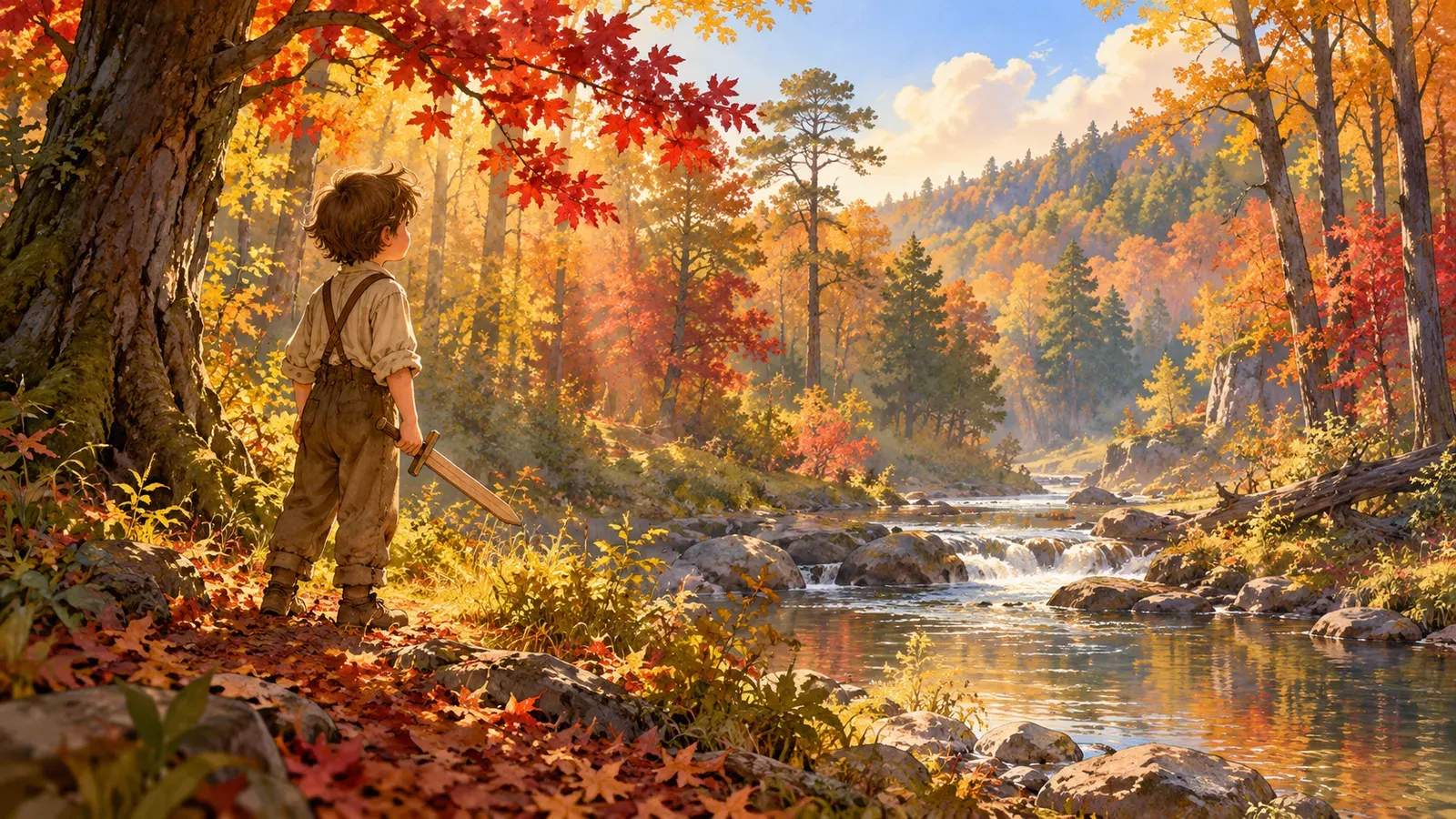
The child was a boy aged about six years, the son of a poor planter. In his younger manhood the father had been a soldier, had fought against naked savages and followed the flag of his country into the capital of a civilized race to the far South. In the peaceful life of a planter the warrior-fire survived; once kindled, it is never extinguished. The man loved military books and pictures and the boy had understood enough to make himself a wooden sword, though even the eye of his father would hardly have known it for what it was. This weapon he now bore bravely, as became the son of an heroic race, and pausing now and again in the sunny space of the forest assumed, with some exaggeration, the postures of aggression and defense that he had been taught by the engraver's art. Made reckless by the ease with which he overcame invisible foes attempting to stay his advance, he committed the common enough military error of pushing the pursuit to a dangerous extreme, until he found himself upon the margin of a wide but shallow brook, whose rapid waters barred his direct advance against the flying foe that had crossed with illogical ease. But the intrepid victor was not to be baffled; the spirit of the race which had passed the great sea burned unconquerable in that small breast and would not be denied. Finding a place where some bowlders in the bed of the stream lay but a step or a leap apart, he made his way across and fell again upon the rear-guard of his imaginary foe, putting all to the sword.
子どもは六歳ほどの男の子で、貧しい農園主の息子だった。父親は若いころ兵士だった。裸の先住民と戦い、祖国の旗に従って、はるか南の、文明を持つ国の都まで攻め入ったこともある。農園主として穏やかに暮らすいまも、戦士の炎は消えずに残っていた。一度燃えついたこの炎は、けっして消えないものなのだ。父親は軍隊の本や絵が好きだった。少年もそれを見て、木の剣をこしらえるくらいのことはわかっていた。もっとも、それが剣だとは、父親の目にもほとんどわからなかっただろうが。少年はいま、英雄の一族の息子らしく、この武器を勇ましく手にしていた。そして日の当たる森の空き地でときどき立ち止まっては、版画で教わった攻めと守りの構えを、いくらか大げさにとってみせた。行く手をはばもうとする見えない敵をたやすく打ち負かしたので、少年はすっかり調子に乗った。そして軍隊ではよくある失敗をやらかした。危ないところまで深追いしすぎたのだ。気がつくと、幅は広いが浅い小川のほとりに出ていた。逃げる敵は、理屈に合わないほどたやすく川を渡ってしまったのに、少年は速い流れにはばまれて、まっすぐには追えない。だが恐れを知らぬ勝者は、くじけなかった。大海を渡ってきた一族の魂が、その小さな胸の中で負けじと燃えさかり、あきらめることを許さなかったのだ。川床の大きな石が、ひとまたぎか、ひと跳びずつの間をおいて並んでいる場所を見つけると、少年はそこを渡った。そして架空の敵の殿をふたたび襲い、ひとり残らず斬り捨てた。
Now that the battle had been won, prudence required that he withdraw to his base of operations. Alas; like many a mightier conqueror, and like one, the mightiest, he could not curb the lust for war, Nor learn that tempted Fate will leave the loftiest star.
戦いに勝ったのだから、用心するなら、本陣へ引き上げるべきだった。だが悲しいかな、少年よりはるかに強い多くの征服者たちと同じように、そして誰よりも強かったあの一人と同じように、少年もまた 戦いへの欲を抑えられず、 運命を試せば、いかに高い星もやがて見放すことを、悟れなかった。
Advancing from the bank of the creek he suddenly found himself confronted with a new and more formidable enemy: in the path that he was following, sat, bolt upright, with ears erect and paws suspended before it, a rabbit! With a startled cry the child turned and fled, he knew not in what direction, calling with inarticulate cries for his mother, weeping, stumbling, his tender skin cruelly torn by brambles, his little heart beating hard with terror—breathless, blind with tears—lost in the forest! Then, for more than an hour, he wandered with erring feet through the tangled undergrowth, till at last, overcome by fatigue, he lay down in a narrow space between two rocks, within a few yards of the stream and still grasping his toy sword, no longer a weapon but a companion, sobbed himself to sleep. The wood birds sang merrily above his head; the squirrels, whisking their bravery of tail, ran barking from tree to tree, unconscious of the pity of it, and somewhere far away was a strange, muffled thunder, as if the partridges were drumming in celebration of nature's victory over the son of her immemorial enslavers. And back at the little plantation, where white men and black were hastily searching the fields and hedges in alarm, a mother's heart was breaking for her missing child.
小川の岸から進んでいくと、少年はいきなり、もっと手ごわい新しい敵と向かい合った。たどっていた小道の上に、背筋をぴんと伸ばして座っていたのだ。耳をぴんと立て、前足を胸の前に浮かせた、一匹のウサギが! 子どもはぎょっとして叫び、向きを変えて逃げだした。どっちへ向かっているのかもわからない。言葉にならない声で母親を呼び、泣き、つまずいた。やわらかな肌はイバラにむごたらしく引っかかれ、小さな心臓は恐ろしさに激しく打った。息を切らし、涙で前も見えない。森の中で、迷子になってしまったのだ。それから一時間以上も、少年はからみ合った下草の中を、道に迷ったままさまよい歩いた。とうとう疲れはてて、小川から数ヤードのところにある二つの岩のすきまに横になった。おもちゃの剣は、まだ握りしめていた。もう武器ではなく、友だちだった。少年は泣きじゃくりながら眠りこんだ。頭の上では森の鳥たちが楽しげにさえずっていた。リスたちは自慢の尻尾をさっと振り、鳴きながら木から木へ駆けまわっていた。この子のあわれさには、気づきもしない。そしてどこか遠くで、奇妙な、くぐもった雷のような音がしていた。ヤマウズラたちが羽で太鼓を打ち鳴らしているかのようだった。大昔から自然を従えてきた人間の、その息子に、自然が勝ったことを祝っているのだ。小さな農園では、白人も黒人もうろたえて、畑や生け垣を大急ぎで探しまわっていた。そして一人の母親が、いなくなったわが子を思って、胸が張り裂けそうになっていた。
Hours passed, and then the little sleeper rose to his feet. The chill of the evening was in his limbs, the fear of the gloom in his heart. But he had rested, and he no longer wept. With some blind instinct which impelled to action he struggled through the undergrowth about him and came to a more open ground—on his right the brook, to the left a gentle acclivity studded with infrequent trees; over all, the gathering gloom of twilight. A thin, ghostly mist rose along the water. It frightened and repelled him; instead of recrossing, in the direction whence he had come, he turned his back upon it, and went forward toward the dark inclosing wood. Suddenly he saw before him a strange moving object which he took to be some large animal—a dog, a pig—he could not name it; perhaps it was a bear. He had seen pictures of bears, but knew of nothing to their discredit and had vaguely wished to meet one. But something in form or movement of this object—something in the awkwardness of its approach—told him that it was not a bear, and curiosity was stayed by fear. He stood still and as it came slowly on gained courage every moment, for he saw that at least it had not the long, menacing ears of the rabbit. Possibly his impressionable mind was half conscious of something familiar in its shambling, awkward gait. Before it had approached near enough to resolve his doubts he saw that it was followed by another and another. To right and to left were many more; the whole open space about him was alive with them—all moving toward the brook.
何時間かたって、小さな眠り人は起き上がった。手足には夕方の冷えがしみこみ、心には暗がりへの恐れがしのびこんでいた。けれども休んだおかげで、もう泣いてはいなかった。じっとしていられない、本能のようなものに突き動かされて、少年はまわりの下草をかき分けて進み、もっとひらけた場所に出た。右手には小川。左手には、木がまばらに立つゆるやかな上り坂。そして一面に、迫ってくる夕闇。水面に沿って、薄い、幽霊のような霧が立ちのぼっていた。少年はその霧が怖くて、近づく気になれなかった。だから川を渡って来た方へ戻るのはやめ、霧に背を向けて、まわりを囲む暗い森のほうへ進んでいった。と、いきなり目の前に、何か奇妙なものが動いているのが見えた。大きな獣のようだった。犬か、豚か、何なのかわからない。もしかするとクマかもしれない。クマの絵なら見たことがあった。クマが悪さをするとは聞いたこともなかったし、一度会ってみたいとなんとなく思っていた。だが、その形か動き方の何かが、とりわけ近づいてくるときのぎこちなさが、これはクマではないと告げていた。好奇心は恐ろしさにせき止められた。少年はじっと立っていた。だがそれがゆっくり近づいてくるにつれて、だんだん勇気がわいてきた。少なくとも、ウサギのあの長くて恐ろしい耳はないとわかったからだ。感じやすい心は、そのよろよろとしたぎこちない歩き方に、どこか見覚えのあるものを感じとっていたのかもしれない。それがよく見えるところまで来ないうちに、少年は、その後ろにまたひとつ、さらにまたひとつと続いているのに気づいた。右にも左にも、たくさんいた。まわりのひらけた土地が、それでうごめいていた。そのすべてが、小川へ向かって動いていた。
They were men. They crept upon their hands and knees. They used their hands only, dragging their legs. They used their knees only, their arms hanging idle at their sides. They strove to rise to their feet, but fell prone in the attempt. They did nothing naturally, and nothing alike, save only to advance foot by foot in the same direction. Singly, in pairs and in little groups, they came on through the gloom, some halting now and again while others crept slowly past them, then resuming their movement. They came by dozens and by hundreds; as far on either hand as one could see in the deepening gloom they extended and the black wood behind them appeared to be inexhaustible. The very ground seemed in motion toward the creek. Occasionally one who had paused did not again go on, but lay motionless. He was dead. Some, pausing, made strange gestures with their hands, erected their arms and lowered them again, clasped their heads; spread their palms upward, as men are sometimes seen to do in public prayer.
それは人間だった。手と膝で這っていた。手だけで這って、脚を引きずっている者がいた。膝だけで這って、腕をだらりと脇に垂らしている者がいた。立ち上がろうとして、そのままうつぶせに倒れる者もいた。誰一人、ふつうの動き方をしていなかった。誰一人、同じ動き方もしていなかった。同じなのはただ、同じ方角へ、少しずつ進んでいくことだけだった。一人で、二人で、小さな群れになって、男たちは薄闇の中を進んできた。ときどき止まる者がいると、ほかの者がゆっくりとその横を這い抜けていき、止まった者はまた動きだした。男たちは何十人、何百人とやって来た。深まる闇の中で見わたすかぎり、左右どこまでも続いていた。背後の黒い森からは、いくらでもわいて出てくるように見えた。地面そのものが、小川へ向かって動いているかのようだった。ときおり、止まった者が、それきり動かなくなった。死んだのだ。止まって、手で奇妙なしぐさをする者もいた。腕を差し上げてはまた下ろし、頭を抱え、手のひらを上に向けて広げた。人前で祈るとき、人がときどきそうするように。
Not all of this did the child note; it is what would have been noted by an elder observer; he saw little but that these were men, yet crept like babes. Being men, they were not terrible, though unfamiliarly clad. He moved among them freely, going from one to another and peering into their faces with childish curiosity. All their faces were singularly white and many were streaked and gouted with red. Something in this— something too, perhaps, in their grotesque attitudes and movements— reminded him of the painted clown whom he had seen last summer in the circus, and he laughed as he watched them. But on and ever on they crept, these maimed and bleeding men, as heedless as he of the dramatic contrast between his laughter and their own ghastly gravity. To him it was a merry spectacle. He had seen his father's negroes creep upon their hands and knees for his amusement—had ridden them so, "making believe" they were his horses. He now approached one of these crawling figures from behind and with an agile movement mounted it astride. The man sank upon his breast, recovered, flung the small boy fiercely to the ground as an unbroken colt might have done, then turned upon him a face that lacked a lower jaw—from the upper teeth to the throat was a great red gap fringed with hanging shreds of flesh and splinters of bone. The unnatural prominence of nose, the absence of chin, the fierce eyes, gave this man the appearance of a great bird of prey crimsoned in throat and breast by the blood of its quarry. The man rose to his knees, the child to his feet. The man shook his fist at the child; the child, terrified at last, ran to a tree near by, got upon the farther side of it and took a more serious view of the situation. And so the clumsy multitude dragged itself slowly and painfully along in hideous pantomime—moved forward down the slope like a swarm of great black beetles, with never a sound of going—in silence profound, absolute.
子どもが、これをすべて見てとったわけではない。これは大人が見ていたら気づいただろうことだ。子どもにわかったのは、これが人間で、それなのに赤ん坊のように這っている、ということくらいだった。人間なのだから、見慣れない服を着てはいても、怖くはなかった。少年は男たちのあいだを気ままに歩きまわり、一人また一人と、子どもらしい好奇心で顔をのぞきこんだ。どの顔もやけに白く、多くは赤い筋や、赤いしみがついていた。そのせいか、それとも男たちのおかしな格好や動きのせいか、少年は去年の夏にサーカスで見た、顔に絵の具を塗った道化を思い出した。それで、男たちを眺めながら笑った。だが男たちは、体の一部を失い、血を流しながら、どこまでも這い進んでいった。少年の笑い声と、自分たちのぞっとするような真剣さとの、あまりの違いには、少年と同じく気づいてもいなかった。少年にとっては、楽しい見ものだった。父親の黒人奴隷たちが、少年を喜ばせようと手と膝で這ってみせたことがある。少年はその背中に乗って、馬になったつもりで遊んだのだった。そこで少年は、這っている男の一人に後ろから近づき、ひょいとその背にまたがった。男は胸から地面に崩れた。だが体を立て直すと、まだ乗り慣らされていない子馬のように、小さな少年を荒々しく地面に振り落とした。そして、こちらに顔を向けた。その顔には、下あごがなかった。上の歯からのどにかけて、大きな赤い穴があいていた。穴のまわりには、ちぎれた肉と骨のかけらが垂れ下がっていた。鼻が不自然に突き出し、あごがなく、目はぎらぎらしている。そのせいで男は、獲物の血でのどと胸を真っ赤に染めた、大きな猛禽のように見えた。男は膝立ちになり、子どもは立ち上がった。男は子どもに拳を振り上げた。子どもはとうとう怖くなって、近くの木まで走り、その陰にまわって、これはただごとではないぞと思いはじめた。こうして、ぶざまな群れは、ぞっとするような無言劇を演じながら、のろのろと、苦しそうに体を引きずっていった。大きな黒い甲虫の群れのように、坂を下っていった。進む音ひとつ立てない。深い、まったくの静けさの中だった。
Instead of darkening, the haunted landscape began to brighten. Through the belt of trees beyond the brook shone a strange red light, the trunks and branches of the trees making a black lacework against it. It struck the creeping figures and gave them monstrous shadows, which caricatured their movements on the lit grass. It fell upon their faces, touching their whiteness with a ruddy tinge, accentuating the stains with which so many of them were freaked and maculated. It sparkled on buttons and bits of metal in their clothing. Instinctively the child turned toward the growing splendor and moved down the slope with his horrible companions; in a few moments had passed the foremost of the throng—not much of a feat, considering his advantages. He placed himself in the lead, his wooden sword still in hand, and solemnly directed the march, conforming his pace to theirs and occasionally turning as if to see that his forces did not straggle. Surely such a leader never before had such a following.
この亡霊のとりついたような景色は、暗くなるどころか、明るくなりはじめた。小川の向こうの木立の帯ごしに、奇妙な赤い光が差してきたのだ。木々の幹や枝が、その光を背に、黒いレース模様を描いていた。光は這う人影を照らし、化け物じみた影をつくった。影は明るくなった草の上で、男たちの動きを、いっそうおかしくまねてみせた。光は男たちの顔にも落ちて、白い顔に赤みを差し、多くの顔にまだらについたしみを、いっそう目立たせた。服のボタンや金具のかけらが、光を受けてきらめいた。子どもは思わず、強まっていく輝きのほうへ向き直り、恐ろしい仲間たちと一緒に坂を下りはじめた。ほどなく、群れの先頭の者を追い越した。少年の身軽さを思えば、たいした手柄でもない。少年は先頭に立ち、木の剣をまだ手にしたまま、おごそかに行進を指揮した。男たちに歩調を合わせ、ときどき振り返っては、部下が遅れていないか確かめるようなそぶりをした。こんな指揮官が、こんな軍勢を率いたことは、いままで一度もなかったにちがいない。
Scattered about upon the ground now slowly narrowing by the encroachment of this awful march to water, were certain articles to which, in the leader's mind, were coupled no significant associations: an occasional blanket, tightly rolled lengthwise, doubled and the ends bound together with a string; a heavy knapsack here, and there a broken rifle—such things, in short, as are found in the rear of retreating troops, the "spoor" of men flying from their hunters. Everywhere near the creek, which here had a margin of lowland, the earth was trodden into mud by the feet of men and horses. An observer of better experience in the use of his eyes would have noticed that these footprints pointed in both directions; the ground had been twice passed over—in advance and in retreat. A few hours before, these desperate, stricken men, with their more fortunate and now distant comrades, had penetrated the forest in thousands. Their successive battalions, breaking into swarms and re-forming in lines, had passed the child on every side—had almost trodden on him as he slept. The rustle and murmur of their march had not awakened him. Almost within a stone's throw of where he lay they had fought a battle; but all unheard by him were the roar of the musketry, the shock of the cannon, "the thunder of the captains and the shouting." He had slept through it all, grasping his little wooden sword with perhaps a tighter clutch in unconscious sympathy with his martial environment, but as heedless of the grandeur of the struggle as the dead who had died to make the glory.
水をめざすこの恐ろしい行進がじわじわと進むにつれて、まだ通っていない地面はしだいに狭まっていった。その地面のあちこちに、いろいろな物が散らばっていた。だが指揮官の頭の中では、どれも何かと結びつくことはなかった。ところどころに毛布が落ちていた。縦にきつく巻いて、二つに折り、両端をひもで縛ってある。こちらには重い背嚢、あちらには壊れた銃。つまりは、退却する部隊のあとに残されるような物ばかりだった。狩人から逃げる人間たちが残していった、獣の通り跡のようなものである。小川のこのあたりは、岸に低い土地が広がっていた。そこはどこもかしこも、人と馬の足に踏みにじられて、ぬかるみになっていた。もっと目の使い方を心得た者が見ていたら、足跡が両方の向きについていることに気づいただろう。この土地は二度、踏み越えられていたのだ。攻めていくときと、退くときに。ほんの数時間前、この絶望した、傷ついた男たちは、もっと運のよい、いまは遠くにいる仲間たちと一緒に、何千人となく森へ踏みこんだのだった。大隊がつぎつぎにやって来ては、群れにばらけ、また隊列を組み直しながら、子どものまわりをあらゆる方向から通り過ぎていった。眠っている子どもを、あやうく踏みつけそうになりながら。だが、行進のざわめきにも、子どもは目を覚まさなかった。子どもが寝ていたところから石を投げれば届くほど近くで、戦いがあった。それでも、小銃の轟きも、大砲の響きも、「将軍たちの雷のような号令と、ときの声」も、子どもの耳には何ひとつ届かなかった。少年はそのあいだずっと眠っていた。小さな木の剣を握りしめていた。まわりの戦いの気配に知らず知らず応えて、いつもより固く握っていたのかもしれない。けれども戦いの壮大さには、栄光のために死んでいった死者たちと同じくらい、無関心だった。
The fire beyond the belt of woods on the farther side of the creek, reflected to earth from the canopy of its own smoke, was now suffusing the whole landscape. It transformed the sinuous line of mist to the vapor of gold. The water gleamed with dashes of red, and red, too, were many of the stones protruding above the surface. But that was blood; the less desperately wounded had stained them in crossing. On them, too, the child now crossed with eager steps; he was going to the fire. As he stood upon the farther bank he turned about to look at the companions of his march. The advance was arriving at the creek. The stronger had already drawn themselves to the brink and plunged their faces into the flood. Three or four who lay without motion appeared to have no heads. At this the child's eyes expanded with wonder; even his hospitable understanding could not accept a phenomenon implying such vitality as that. After slaking their thirst these men had not had the strength to back away from the water, nor to keep their heads above it. They were drowned. In rear of these, the open spaces of the forest showed the leader as many formless figures of his grim command as at first; but not nearly so many were in motion. He waved his cap for their encouragement and smilingly pointed with his weapon in the direction of the guiding light—a pillar of fire to this strange exodus.
小川の向こう岸の木立の帯の、さらに向こうで燃えている火が、自分の吐き出した煙の天井に照り返し、いまや景色全体を赤く染めていた。くねくねと続く霧の筋が、金色の靄に変わった。水面には赤いきらめきが散り、水から頭を出している石の多くも赤かった。だがそれは血だった。それほど深手でない者たちが、渡るときに石を染めたのだ。子どももいま、その石を伝って、勇んで川を渡った。火のところへ行くつもりだった。向こう岸に立つと、少年は振り返って、行進の仲間たちを眺めた。先頭がいま、小川に着こうとしていた。まだ力の残っている者は、もう岸まで体を引きずっていって、流れに顔を突っこんでいた。身動きもせずに横たわっている三、四人は、頭がないように見えた。これには子どもも目を丸くした。何でも受け入れるこの子の頭でも、それほどしぶとい命があるとは信じられなかったのだ。男たちは渇きをいやしたあと、水から身を引く力も、頭を水の上に出しておく力も、残っていなかったのである。溺れ死んでいたのだ。その後ろ、森のひらけた場所には、恐ろしい部下たちのぼんやりとした姿が、まだ初めと同じくらいたくさん見えた。だが動いている者は、初めよりずっと少なかった。少年は皆を励ますように帽子を振り、ほほえみながら、道しるべの光を武器で指し示した。この奇妙な出エジプトを導く、火の柱である。
Confident of the fidelity of his forces, he now entered the belt of woods, passed through it easily in the red illumination, climbed a fence, ran across a field, turning now and again to coquet with his responsive shadow, and so approached the blazing ruin of a dwelling. Desolation everywhere! In all the wide glare not a living thing was visible. He cared nothing for that; the spectacle pleased, and he danced with glee in imitation of the wavering flames. He ran about, collecting fuel, but every object that he found was too heavy for him to cast in from the distance to which the heat limited his approach. In despair he flung in his sword—a surrender to the superior forces of nature. His military career was at an end.
部下がちゃんとついてくると信じきって、少年は木立の帯に入った。赤い光の中を楽々と通り抜け、柵を乗り越え、畑を駆け抜けた。ときどき振り返っては、自分の動きに合わせて動く影とたわむれた。そうして、燃えさかる家の残骸に近づいた。どこもかしこも荒れはてている。煌々と照らされた広い一帯に、生きているものの姿はひとつも見えなかった。少年はそんなことは気にもしなかった。その光景がうれしくて、揺れる炎をまねて、大喜びで踊った。走りまわって燃やすものを集めたが、見つけた物はどれも重すぎた。火が熱くて、ある程度より近くには寄れない。そこから投げ入れるには重すぎたのだ。少年はやけになって、自分の剣を投げこんだ。自然の圧倒的な力に、降参したのである。少年の軍人としての経歴は、ここに終わった。
Shifting his position, his eyes fell upon some outbuildings which had an oddly familiar appearance, as if he had dreamed of them. He stood considering them with wonder, when suddenly the entire plantation, with its inclosing forest, seemed to turn as if upon a pivot. His little world swung half around; the points of the compass were reversed. He recognized the blazing building as his own home!
立つ場所を変えると、いくつかの離れ屋が目に入った。妙に見覚えがある。夢で見たことがあるような気がした。ふしぎに思いながら眺めていると、とつぜん、農園全体が、まわりの森ごと、軸を中心にくるりとまわったように思えた。少年の小さな世界が半回転し、東西南北が入れ替わった。燃えているのは、自分の家だったのだ!
For a moment he stood stupefied by the power of the revelation, then ran with stumbling feet, making a half-circuit of the ruin. There, conspicuous in the light of the conflagration, lay the dead body of a woman—the white face turned upward, the hands thrown out and clutched full of grass, the clothing deranged, the long dark hair in tangles and full of clotted blood. The greater part of the forehead was torn away, and from the jagged hole the brain protruded, overflowing the temple, a frothy mass of gray, crowned with clusters of crimson bubbles—the work of a shell.
それに気づいた衝撃に、少年は一瞬、ぼうぜんと立ちつくした。それから、つまずきながら走りだし、焼け跡の半分をぐるりとまわった。そこに、火事の明かりにくっきりと照らされて、女の死体が横たわっていた。白い顔を上に向け、両手を投げ出して、草をいっぱいに握りしめている。服は乱れ、長い黒髪はもつれて、固まった血にまみれていた。額の大部分がもぎ取られ、ぎざぎざの穴から脳がはみ出して、こめかみにあふれていた。泡立った灰色のかたまりで、そのてっぺんに、真っ赤な泡の粒がいくつも盛り上がっていた。砲弾のしわざだった。
The child moved his little hands, making wild, uncertain gestures. He uttered a series of inarticulate and indescribable cries—something between the chattering of an ape and the gobbling of a turkey—a startling, soulless, unholy sound, the language of a devil. The child was a deaf mute.
子どもは小さな両手を動かし、めちゃくちゃな、定まらない身ぶりをした。そして言葉にならない、何とも言いようのない叫び声を、続けざまにあげた。猿がきいきい鳴くのと、七面鳥がごろごろ鳴くのの中間のような声だった。ぎょっとするような、魂のこもらない、忌まわしい声。悪魔の言葉だった。その子は、耳が聞こえず、口がきけなかったのだ。
Then he stood motionless, with quivering lips, looking down upon the wreck.
それから少年は、唇を震わせながら、身じろぎもせずに立ちつくし、そのむごたらしい亡骸を見おろしていた。