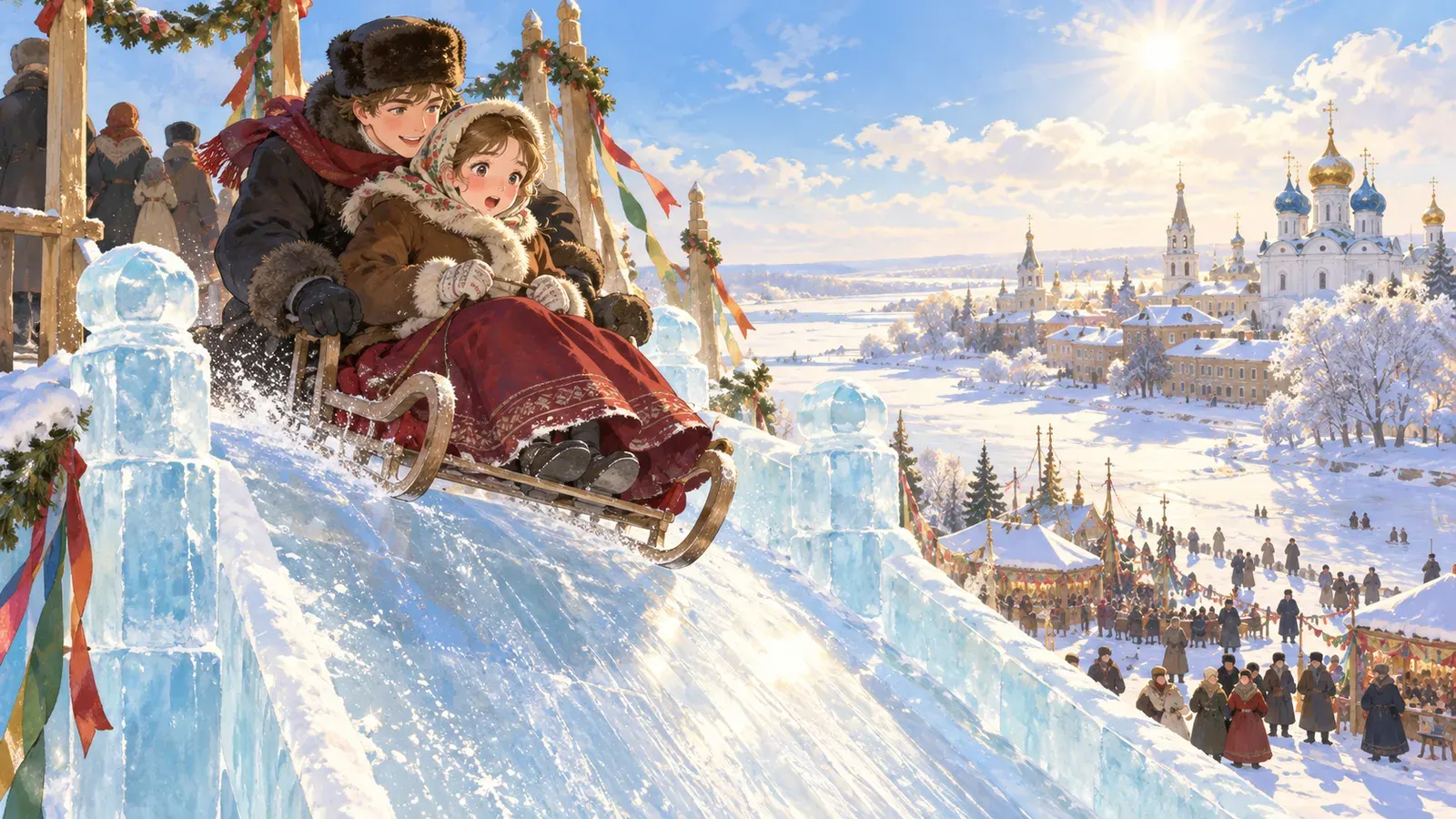
It was a bright winter midday. . . . There was a sharp snapping frost and the curls on Nadenka's temples and the down on her upper lip were covered with silvery frost. She was holding my arm and we were standing on a high hill. From where we stood to the ground below there stretched a smooth sloping descent in which the sun was reflected as in a looking-glass. Beside us was a little sledge lined with bright red cloth.
よく晴れた冬の真昼だった……。肌を刺すような厳しい寒さで、ナージェンカのこめかみの巻き毛にも、上唇のうぶ毛にも、銀色の霜がおりていた。ナージェンカは僕の腕につかまっていて、僕たちは高い丘の上に立っていた。足もとから下の地面まで、なめらかな斜面が続いていて、そこに太陽が鏡のように映っていた。そばには、真っ赤な布を張った小さな橇があった。
"Let us go down, Nadyezhda Petrovna!" I besought her. "Only once! I assure you we shall be all right and not hurt."
「すべりましょうよ、ナジェージダ・ペトローヴナ!」と僕はたのみこんだ。「一度だけ! 大丈夫、けがなんかしませんから」
But Nadenka was afraid. The slope from her little goloshes to the bottom of the ice hill seemed to her a terrible, immensely deep abyss. Her spirit failed her, and she held her breath as she looked down, when I merely suggested her getting into the sledge, but what would it be if she were to risk flying into the abyss! She would die, she would go out of her mind.
けれどもナージェンカは怖がっていた。小さなオーバーシューズの先から氷の丘のふもとまでの斜面が、恐ろしい、底知れない深い淵に見えたのだ。橇に乗ろうと誘っただけで、ナージェンカは気が遠くなり、下を見おろして息をのんだ。まして思いきってその淵へ飛びこんだりしたら、どうなることか! 死んでしまうか、気が変になってしまうだろう。
"I entreat you!" I said. "You mustn't be afraid! You know it's poor-spirited, it's cowardly!"
「お願いです!」と僕は言った。「怖がっちゃいけません! ねえ、そんなの意気地なしですよ、臆病ですよ!」
Nadenka gave way at last, and from her face I saw that she gave way in mortal dread. I sat her in the sledge, pale and trembling, put my arm round her and with her cast myself down the precipice.
ナージェンカはとうとう折れた。その顔を見れば、死ぬほど怖い思いで折れたのがわかった。青ざめてふるえているナージェンカを橇に座らせ、その体に腕をまわして、僕は二人一緒に断崖へ身を投げた。
The sledge flew like a bullet. The air cleft by our flight beat in our faces, roared, whistled in our ears, tore at us, nipped us cruelly in its anger, tried to tear our heads off our shoulders. We had hardly strength to breathe from the pressure of the wind. It seemed as though the devil himself had caught us in his claws and was dragging us with a roar to hell. Surrounding objects melted into one long furiously racing streak . . . another moment and it seemed we should perish.
橇は弾丸のように飛んだ。切り裂かれた空気が顔に打ちつけ、うなり、耳もとでひゅうひゅう鳴った。僕たちを引き裂き、怒ってむごたらしくつねり、頭を肩から引きちぎろうとした。風に押されて、息をするのもやっとだった。悪魔そのものが僕たちを爪でつかみ、うなり声をあげて地獄へ引きずりこもうとしているようだった。まわりのものが溶け合って、猛烈な勢いで流れていく一本の長い筋になった……。もう一瞬で、二人とも死んでしまいそうだった。
"I love you, Nadya!" I said in a low voice.
「好きだよ、ナージャ!」と僕は小声で言った。
The sledge began moving more and more slowly, the roar of the wind and the whirr of the runners was no longer so terrible, it was easier to breathe, and at last we were at the bottom. Nadenka was more dead than alive. She was pale and scarcely breathing. . . . I helped her to get up.
橇はだんだんゆっくりになった。風のうなりも、滑り木のしゅうしゅういう音も、もうそれほど恐ろしくなくなった。息をするのも楽になり、とうとう僕たちは下に着いた。ナージェンカは生きた心地もしない様子だった。青ざめて、息もろくにしていなかった……。僕はナージェンカが立ち上がるのに手を貸した。
"Nothing would induce me to go again," she said, looking at me with wide eyes full of horror. "Nothing in the world! I almost died!"
「もう二度とごめんだわ」とナージェンカは、恐ろしさでいっぱいの大きく見開いた目で僕を見ながら言った。「何があったって、絶対いや! 死ぬかと思ったわ!」
A little later she recovered herself and looked enquiringly into my eyes, wondering had I really uttered those four words or had she fancied them in the roar of the hurricane. And I stood beside her smoking and looking attentively at my glove.
少したつと、ナージェンカは落ちつきを取り戻し、問いかけるように僕の目をのぞきこんだ。あの短い言葉を、この人は本当に言ったのだろうか。それとも、嵐のうなりの中で空耳を聞いたのだろうか。そう考えていたのだ。僕はそばに立って、たばこをふかしながら、自分の手袋をしげしげと眺めていた。
She took my arm and we spent a long while walking near the ice-hill. The riddle evidently would not let her rest. . . . Had those words been uttered or not? . . . Yes or no? Yes or no? It was the question of pride, or honour, of life—a very important question, the most important question in the world. Nadenka kept impatiently, sorrowfully looking into my face with a penetrating glance; she answered at random, waiting to see whether I would not speak. Oh, the play of feeling on that sweet face! I saw that she was struggling with herself, that she wanted to say something, to ask some question, but she could not find the words; she felt awkward and frightened and troubled by her joy. . . .
ナージェンカは僕の腕をとり、僕たちは氷の丘の近くを長いこと歩いた。どうやらあの謎が、ナージェンカの心を落ちつかせてくれないらしかった……。あの言葉は口にされたのか、されなかったのか?……そうなのか、違うのか? そうなのか、違うのか? それは誇りの、名誉の、人生の問題だった。とても大事な問題、世界でいちばん大事な問題だった。ナージェンカはじれったそうに、悲しそうに、何度も何度も、刺すような目で僕の顔をのぞきこんだ。僕の話にはうわの空で答え、僕が何か言いださないかと待っていた。ああ、あのかわいい顔に浮かんでは消える気持ちといったら! ナージェンカが自分と闘っているのがわかった。何か言いたくて、何か聞きたくてたまらないのに、言葉が見つからないのだ。きまりが悪く、怖くて、自分のうれしさにとまどっていたのだ……。
"Do you know what," she said without looking at me.
「あのね」とナージェンカは僕のほうを見ないで言った。
"Well?" I asked.
「なんです?」と僕は聞いた。
"Let us . . . slide down again."
「もう一度……すべりましょうよ」
We clambered up the ice-hill by the steps again. I sat Nadenka, pale and trembling, in the sledge; again we flew into the terrible abyss, again the wind roared and the runners whirred, and again when the flight of our sledge was at its swiftest and noisiest, I said in a low voice:
僕たちはまた段をのぼって、氷の丘の上に出た。僕は、青ざめてふるえているナージェンカを橇に座らせた。ふたたび僕たちは恐ろしい淵へ飛びこみ、ふたたび風がうなり、滑り木が鳴った。そしてふたたび、橇がいちばん速く、いちばんやかましく飛んでいるときに、僕は小声で言った。
"I love you, Nadenka!"
「好きだよ、ナージェンカ!」
When the sledge stopped, Nadenka flung a glance at the hill down which we had both slid, then bent a long look upon my face, listened to my voice which was unconcerned and passionless, and the whole of her little figure, every bit of it, even her muff and her hood expressed the utmost bewilderment, and on her face was written: "What does it mean? Who uttered those words? Did he, or did I only fancy it?"
橇が止まると、ナージェンカは二人ですべりおりてきた丘をちらりと見た。それから長いこと僕の顔を見つめ、僕の声に耳を澄ました。僕の声は、そっけなく、何の熱もこもっていなかった。ナージェンカの小さな姿のすべてが、どこもかしこも、マフやずきんまでもが、すっかり途方に暮れていた。そして顔にはこう書いてあった。「どういうことなの? 誰があの言葉を言ったの? この人なの、それとも空耳だったの?」
The uncertainty worried her and drove her out of all patience. The poor girl did not answer my questions, frowned, and was on the point of tears.
はっきりしないのがつらくて、ナージェンカはすっかりじれていた。かわいそうに、僕が話しかけても答えず、眉をひそめ、いまにも泣きだしそうだった。
"Hadn't we better go home?" I asked.
「もう家に帰ったほうがよくありませんか?」と僕は聞いた。
"Well, I . . . I like this tobogganning," she said, flushing. "Shall we go down once more?"
「あの、わたし……わたし、この橇すべりが好きなの」とナージェンカは顔を赤らめて言った。「もう一度すべりましょうか?」
She "liked" the tobogganning, and yet as she got into the sledge she was, as both times before, pale, trembling, hardly able to breathe for terror.
橇すべりが「好き」だというのに、橇に乗りこむとき、ナージェンカは前の二回と同じように青ざめ、ふるえ、恐ろしさのあまり息もろくにできなかった。
We went down for the third time, and I saw she was looking at my face and watching my lips. But I put my handkerchief to my lips, coughed, and when we reached the middle of the hill I succeeded in bringing out:
僕たちは三度目にすべりおりた。ナージェンカが僕の顔を見つめ、唇を見張っているのがわかった。けれども僕はハンカチを口にあてて咳をし、丘の中ほどまで来たところで、うまく言ってのけた。
"I love you, Nadya!"
「好きだよ、ナージャ!」
And the mystery remained a mystery! Nadenka was silent, pondering on something. . . . I saw her home, she tried to walk slowly, slackened her pace and kept waiting to see whether I would not say those words to her, and I saw how her soul was suffering, what effort she was making not to say to herself:
そして謎は謎のままだった! ナージェンカは黙りこみ、何か考えこんでいた……。僕はナージェンカを家まで送っていった。ナージェンカはゆっくり歩こうとし、足どりをゆるめては、僕があの言葉を言わないかと待っていた。ナージェンカの心がどんなに苦しんでいるか、僕にはわかった。自分にこう言い聞かせまいとして、どんなに必死になっているかも。
"It cannot be that the wind said them! And I don't want it to be the wind that said them!"
「風があんなことを言うはずがないわ! それに、言ったのが風だなんて、わたしはいやよ!」
Next morning I got a little note:
翌朝、僕は小さな手紙を受けとった。
"If you are tobogganning to-day, come for me.—N."
「きょう橇すべりにいらっしゃるなら、わたしを誘いに来てください。N」
And from that time I began going every day tobogganning with Nadenka, and as we flew down in the sledge, every time I pronounced in a low voice the same words: "I love you, Nadya!"
その日から、僕は毎日ナージェンカと橇すべりに出かけるようになった。そして橇で飛ぶようにすべりおりるたびに、小声で同じ言葉を口にした。「好きだよ、ナージャ!」
Soon Nadenka grew used to that phrase as to alcohol or morphia. She could not live without it. It is true that flying down the ice-hill terrified her as before, but now the terror and danger gave a peculiar fascination to words of love—words which as before were a mystery and tantalized the soul. The same two—the wind and I were still suspected. . . . Which of the two was making love to her she did not know, but apparently by now she did not care; from which goblet one drinks matters little if only the beverage is intoxicating.
まもなくナージェンカは、お酒かモルヒネのように、その言葉なしではいられなくなった。それなしでは生きていけなくなったのだ。たしかに、氷の丘をすべりおりるのは、前と同じように恐ろしかった。けれどもいまでは、その恐ろしさと危なさが、愛の言葉に独特の魅力を添えていた。その言葉は前と同じく謎のままで、心をじらし続けた。疑われているのも、やはり同じ二人、風と僕だった……。二人のうちどちらが自分に愛をささやいているのか、ナージェンカにはわからなかった。だが、いまではもうどうでもよくなっているらしかった。酔わせてくれる酒でさえあれば、どの杯で飲もうと、たいしたことではないのだ。
It happened I went to the skating-ground alone at midday; mingling with the crowd I saw Nadenka go up to the ice-hill and look about for me . . . then she timidly mounted the steps. . . . She was frightened of going alone—oh, how frightened! She was white as the snow, she was trembling, she went as though to the scaffold, but she went, she went without looking back, resolutely. She had evidently determined to put it to the test at last: would those sweet amazing words be heard when I was not there? I saw her, pale, her lips parted with horror, get into the sledge, shut her eyes and saying good-bye for ever to the earth, set off. . . . "Whrrr!" whirred the runners. Whether Nadenka heard those words I do not know. I only saw her getting up from the sledge looking faint and exhausted. And one could tell from her face that she could not tell herself whether she had heard anything or not. Her terror while she had been flying down had deprived her of all power of hearing, of discriminating sounds, of understanding.
あるとき、僕は昼にひとりでスケート場へ行った。人ごみにまぎれていると、ナージェンカが氷の丘へやって来て、僕を探してあたりを見まわすのが見えた……。それからナージェンカは、おずおずと段をのぼっていった……。ひとりで行くのが怖かったのだ。ああ、どんなに怖かったことか! 雪のように真っ白な顔をしてふるえ、まるで処刑台へ向かうように歩いていった。それでも行った。振り返りもせず、きっぱりと行ったのだ。とうとう試してみることにしたらしかった。僕がいないときにも、あの甘い、ふしぎな言葉が聞こえるだろうか? ナージェンカが青ざめ、恐ろしさに唇を開いたまま橇に乗りこむのが見えた。目を閉じ、この世に永遠の別れを告げるようにして、すべりだした……。「ザーッ!」と滑り木が鳴った。ナージェンカがあの言葉を聞いたかどうか、僕は知らない。ただ、ナージェンカが気の遠くなったような、ぐったりとした様子で橇から立ち上がるのが見えただけだ。何か聞こえたのかどうか、本人にもわからないのだと、その顔からわかった。すべりおりるあいだの恐ろしさで、耳も、音を聞き分ける力も、ものを考える力も、すっかり奪われていたのだ。
But then the month of March arrived . . . the spring sunshine was more kindly. . . . Our ice-hill turned dark, lost its brilliance and finally melted. We gave up tobogganning. There was nowhere now where poor Nadenka could hear those words, and indeed no one to utter them, since there was no wind and I was going to Petersburg—for long, perhaps for ever.
けれどもやがて三月が来た……。春の日差しがやわらいできた……。僕たちの氷の丘は黒ずみ、輝きをなくし、とうとう溶けてしまった。僕たちは橇すべりをやめた。かわいそうなナージェンカがあの言葉を聞ける場所は、もうどこにもなかった。言ってくれる者もいなかった。風はやんでいたし、僕はペテルブルクへ行くことになっていたからだ。長いあいだ、ひょっとすると永久に。
It happened two days before my departure I was sitting in the dusk in the little garden which was separated from the yard of Nadenka's house by a high fence with nails in it. . . . It was still pretty cold, there was still snow by the manure heap, the trees looked dead but there was already the scent of spring and the rooks were cawing loudly as they settled for their night's rest. I went up to the fence and stood for a long while peeping through a chink. I saw Nadenka come out into the porch and fix a mournful yearning gaze on the sky. . . . The spring wind was blowing straight into her pale dejected face. . . . It reminded her of the wind which roared at us on the ice-hill when she heard those four words, and her face became very, very sorrowful, a tear trickled down her cheek, and the poor child held out both arms as though begging the wind to bring her those words once more. And waiting for the wind I said in a low voice:
出発の二日前のことだった。僕は夕暮れどき、小さな庭に座っていた。その庭は、ナージェンカの家の中庭と、釘を打ちつけた高い塀で隔てられていた……。まだかなり寒く、肥やしの山のそばには雪が残っていて、木々は枯れているように見えた。けれども、もう春のにおいがして、ミヤマガラスたちがねぐらにつきながら、やかましく鳴いていた。僕は塀に近づき、すきまから長いことのぞいていた。ナージェンカが玄関口に出てきて、悲しげな、恋いこがれるような目で空を見上げるのが見えた……。春の風が、青ざめて沈んだその顔にまともに吹きつけていた……。その風に、ナージェンカは思い出したのだ。あの短い言葉を聞いたとき、氷の丘で二人に向かってうなっていた風を。ナージェンカの顔はとても、とても悲しそうになり、涙がひとすじ頬を伝った。そしてかわいそうなその子は、もう一度あの言葉を運んできてと風にたのむように、両腕を差しのべた。僕は風が吹くのを待って、小声で言った。
"I love you, Nadya!"
「好きだよ、ナージャ!」
Mercy! The change that came over Nadenka! She uttered a cry, smiled all over her face and looking joyful, happy and beautiful, held out her arms to meet the wind.
ああ! そのときのナージェンカの変わりようといったら! ナージェンカは声をあげ、顔じゅうでほほえみ、うれしそうに、幸せそうに、美しく輝いて、風を迎えるように両腕を差しのべた。
And I went off to pack up. . . .
そして僕は荷造りをしに帰った……。
That was long ago. Now Nadenka is married; she married—whether of her own choice or not does not matter—a secretary of the Nobility Wardenship and now she has three children. That we once went tobogganning together, and that the wind brought her the words "I love you, Nadenka," is not forgotten; it is for her now the happiest, most touching, and beautiful memory in her life. . . .
それはずっと昔のことだ。いまではナージェンカは結婚している。自分で選んだのかどうかはどうでもいいが、貴族後見局の書記と結婚して、いまでは子どもが三人いる。昔、二人で橇すべりをしたこと、そして風が「好きだよ、ナージェンカ」という言葉を運んできたことは、忘れられてはいない。それはいまのナージェンカにとって、一生でいちばん幸せで、いちばん胸にしみる、美しい思い出なのだ……。
But now that I am older I cannot understand why I uttered those words, what was my motive in that joke. . . .
けれども、年をとったいまの僕には、なぜあんな言葉を口にしたのか、あのいたずらにどんなつもりがあったのか、わからない……。