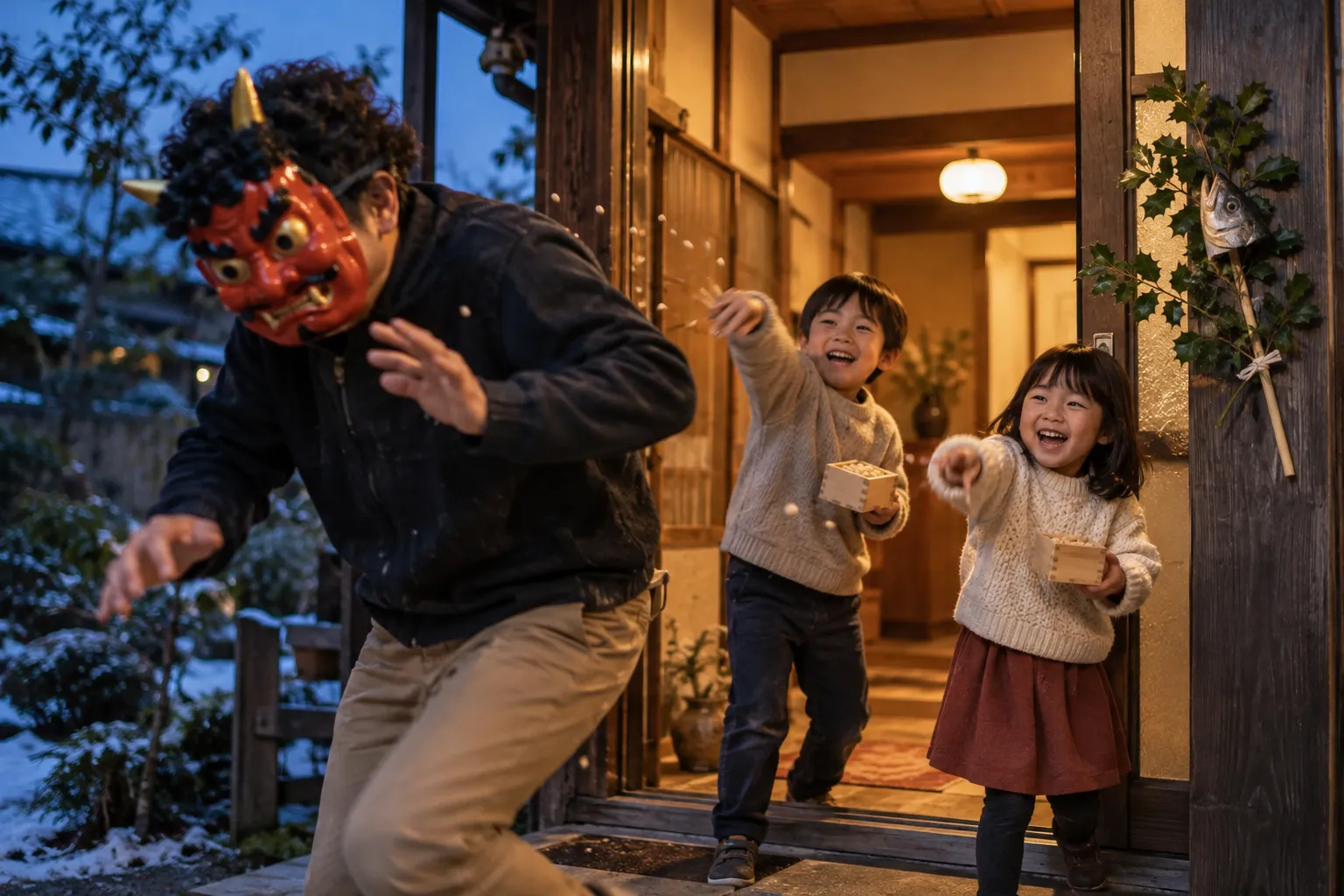
Setsubun
節分の英語の授業アイデアとワークシート
印刷してすぐ使えるワークシート(PDF・Word・解答つき)と、授業の手順書。
🖨️Worksheetsワークシート(無料・A4)
① 「中身を見る・印刷」で全ページを確認 → ② そのページ上の 🖨️ 印刷する でそのまま印刷できます。A4・無料。
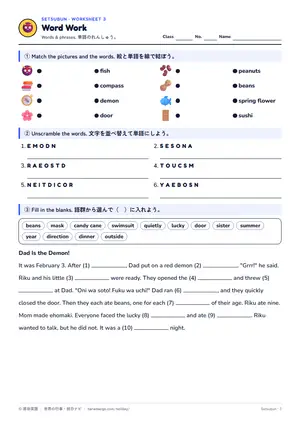
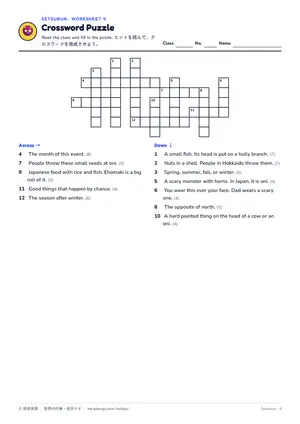
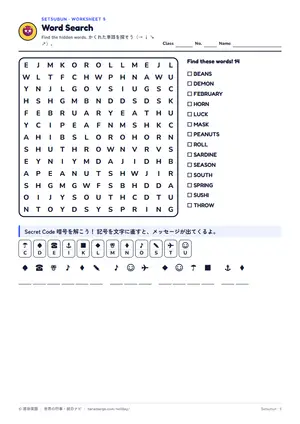
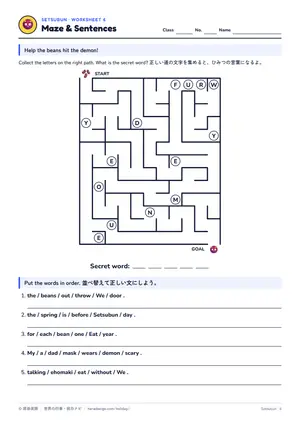
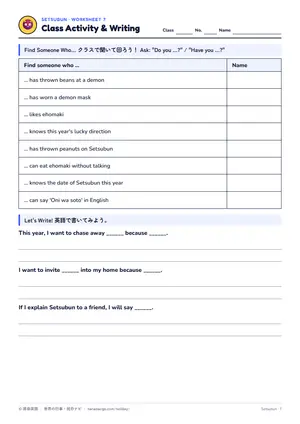
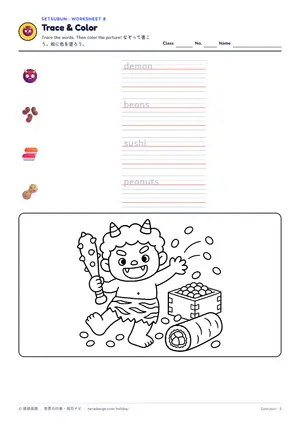
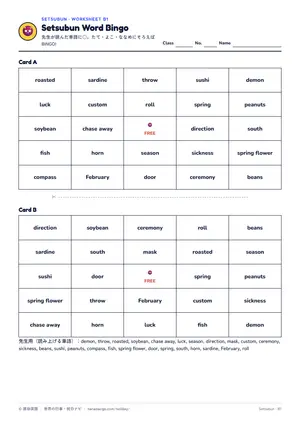
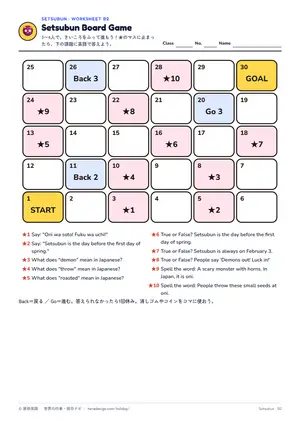
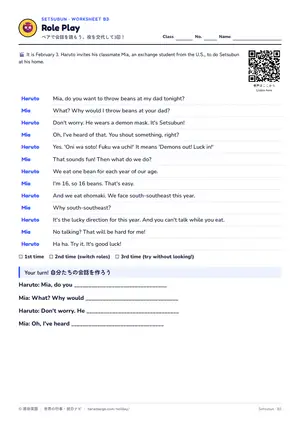
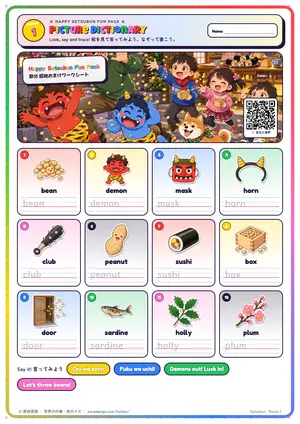
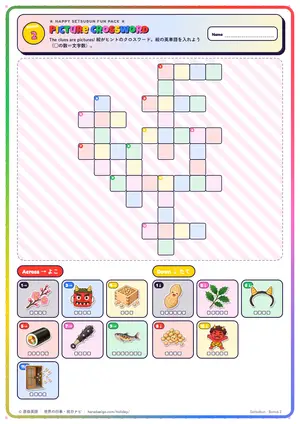
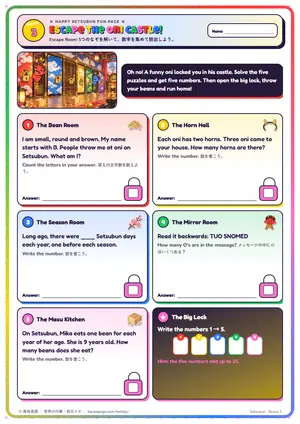
🍎Lesson Ideas節分を使った英語の授業アイデア
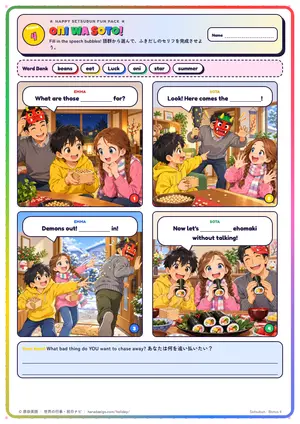
英語で豆まき:「〇〇 out! 〇〇 in!」
🎯 out / in を使って、追い出したいもの・招きたいものを英語で言う。
- 鬼の絵に "homework" "cold" "sleepy" など追い出したいものを書いて黒板に貼る。
- 丸めた紙の豆を投げながら "Cold out!" "Smile in!" と言う。
- 最後にクラス全員で "Demons out! Luck in!" と言って終わる。
詳細版を開く(時間配分・Teacher Talk・板書)
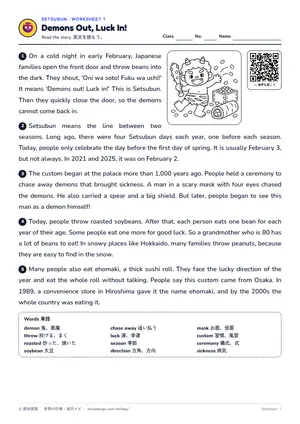
鬼の絵を見せ、What's this? と聞く。本文の第1段落の Oni wa soto! Fuku wa uchi! It means Demons out! Luck in! の部分を音声で聞かせ、英語では Demons out! Luck in! と言うことを伝える。
🗣️ What's this? Yes, an oni. A demon! / Listen. Oni wa soto! Fuku wa uchi! / In English, Demons out! Luck in! Say it with me.
鬼の絵のまわりに追い出したいもの(homework / cold / sleepy など)、お多福の絵のまわりに招きたいもの(smile / luck / friends など)のことばカードを貼る。子どもたちにも「ほかに追い出したいものは?」と聞き、出てきた語を英語にして貼り足す。
🗣️ What do you want to chase away? Cold? Homework? / What do you want to invite in? Smile? Friends? / Any other ideas? Tell me in Japanese, and I'll say it in English.
紙の豆を配り、1人ずつ黒板の鬼に向かって投げながら Cold out! のように言わせ、そのあとお多福に向かって Smile in! と言わせる(豆は投げる真似だけでもよい)。言えたらみんなで拍手する。
🗣️ Throw your beans at the demon. Say, Cold out! / Now look at the lucky face. Say, Smile in! / Great! Next person, please.
最後にクラス全員で Demons out! Luck in! と大きな声で言って終わる。日本では年の数だけ豆を食べることも伝え、「今日家で豆まきをしたら、英語でも言ってみよう」と声をかける。
🗣️ Everyone, together! Demons out! Luck in! / At home, people eat one bean for each year of their age. / Try saying it in English at home tonight!
Setsubun 👹🫘

Demons out! Luck in!(鬼は外!福は内!)

👹 __ out!
homework / cold / sleepy / angry / mistakes

😊 __ in!
smile / luck / friends / health / fun
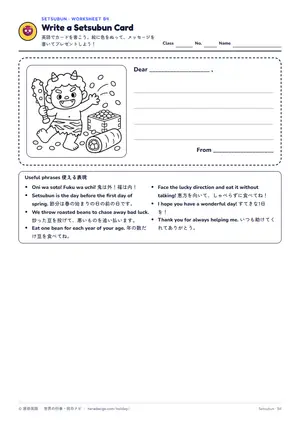
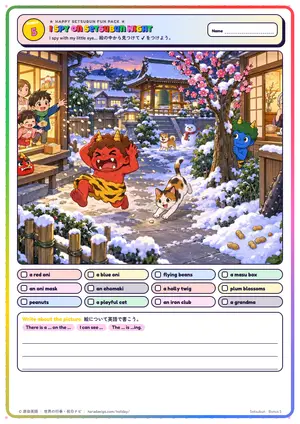
鬼の自己紹介を書こう
🎯 三人称単数の表現で、オリジナルの鬼のプロフィールを書く。
- "He has two horns. He likes ... He doesn't like beans." の例文を確認する。
- 自分だけの鬼(例:Homework Oni, Smartphone Oni)を絵にかき、5文で紹介する。
- グループで発表し、聞き手は "How can we chase it away?" と質問する。
- 追い払い方を英語で1文書いて完成。
詳細版を開く(時間配分・Teacher Talk・板書)
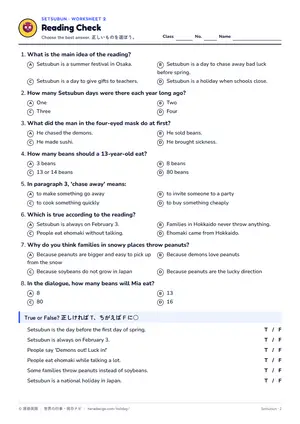
英語ページの会話の最初(Mia, do you want to throw beans at my dad tonight? から It's Setsubun! まで)を聞かせ、お父さんがなぜ豆を投げられるのかを聞き取らせる。鬼の絵を見せ、角の数や色を英語で言わせる。
🗣️ Why will Mia throw beans at Haruto's dad? / Because he wears a demon mask! / Look at this demon. How many horns does he have? / What color is he?
見本の Homework Oni のプロフィールを読む(This is Homework Oni. He has two horns. He likes long homework. He comes on Sunday night. He doesn't like beans.)。has / likes / comes のように s がつくこと、否定は doesn't を使うことを確認する。
🗣️ This is Homework Oni. He has two horns. / He likes long homework. He comes on Sunday night. / He doesn't like beans. / Look. He has, he likes, he comes. Don't forget the s!
自分だけの鬼(Smartphone Oni、Sleepy Oni など)を考えさせ、用紙に絵を描き、5文のプロフィールを書かせる。言葉カードを参考にさせ、机間指導で三人称単数の s を確かめる。
🗣️ Make your own demon. Smartphone Oni? Sleepy Oni? / Draw it first. Then write five sentences. / Use has, likes, and doesn't like. / Check the s at the end of each verb.
4人グループで1人ずつ鬼を紹介させる。聞き手は1人が How can we chase it away? と質問し、発表者は追い払い方を答える(例:Put your phone in a box at nine.)。
🗣️ Show your demon to your group and read your profile. / Listeners, ask, How can we chase it away? / Speakers, give one idea. For example, put your phone in a box at nine.
用紙の最後の欄に、追い払い方を英語で1文書かせて完成させる。何人かの鬼を紹介し、教室に掲示する。
🗣️ Write your idea in the last box. / Let's put your demons on the wall. / Demons out! Luck in!
My Demon Profile 👹

This is __ Oni.
He has __.(two horns / big eyes)
He likes __.
He comes __.(on Sunday night / in the morning)
He doesn't like __.(beans!)

Q. How can we chase it away?
A. __.

三人称単数:he has / he likes / he comes / he doesn't like
なぜ節分は2月2日になる? 理科×英語
🎯 数字や天文の説明を英語で読み、自分の言葉で説明し直す。
- "A year on the calendar is 365 days, but the earth takes about 365.24 days to go around the sun." などの英文を読む。
- 2025〜2029年の立春の時刻(このページの本文)を表にし、日付が変わる理由をペアで話し合う。
- "Setsubun moves because ..." で始まる3文の説明を書き、発表する。
詳細版を開く(時間配分・Teacher Talk・板書)
「節分は何月何日?」と聞き、2月3日と答えさせる。本文の第2段落を音声で聞かせ、It is usually February 3, but not always. In 2021 and 2025, it was on February 2. を確認する。2021年の2月2日は1897年以来124年ぶりだったことも伝える。
🗣️ When is Setsubun? February 3? / Listen. It is usually February 3, but not always. / In 2021, it was February 2 for the first time in 124 years. Why?
英文プリントを読ませ、365日と365.24日の差が約6時間であること(0.24日×24時間)を計算で確かめさせる。節分は立春の前日なので、立春の日付が変われば節分も変わることを確認する。
🗣️ Read the handout. The calendar year is 365 days. The earth needs about 365.24 days. / What is 0.24 days in hours? Let's calculate. / About six hours. So spring starts about six hours later every year. / Setsubun is the day before spring. So when spring moves, Setsubun moves.
データ表を配り、ペアで2025〜2028年の立春の時刻が毎年約6時間ずつ遅れていることを確かめさせる。そのうえで「2029年は?」と問い、うるう年(2028年)のあとで1日もどることを使って予想させる。答えは、記事にあるとおり2029年の節分は2月2日になることを確認する。
🗣️ Look at the table. How many hours later is spring each year? / 2028 is a leap year. What happens after a leap year? / Guess. When is Setsubun in 2029? / February 2! Your prediction was right.
Setsubun moves because ... で始まる3文の説明を、自分の言葉で書かせる。英文プリントの文をそのまま写さず、数字(365 / 365.24 / six hours / leap year)を使って説明するよう指示する。
🗣️ Write three sentences. Start with Setsubun moves because ... / Use the numbers. 365 days, 365.24 days, six hours, and leap years. / Use your own words. Don't copy the handout.
2〜3人に説明を発表させ、わかりやすかった点を確認する。最後に、節分はもともと四季それぞれの前日にあって年に4回だったことを紹介して終わる。
🗣️ Who can explain it to the class? / Good. Short sentences and numbers make it clear. / Long ago, there were four Setsubun days each year, one before each season.
Why does Setsubun move?

calendar year:365 days
the earth:about 365.24 days → 0.24 × 24 = about 6 hours

立春 / 節分
2025 Feb 3 23:10 → Feb 2
2026 Feb 4 5:02 → Feb 3
2027 Feb 4 10:46 → Feb 3
2028 Feb 4 夕方ごろ → Feb 3(leap year)
2029 ? → Feb 2!(うるう年のあと1日もどる)

Setsubun moves because __.
So __. In a leap year, __.
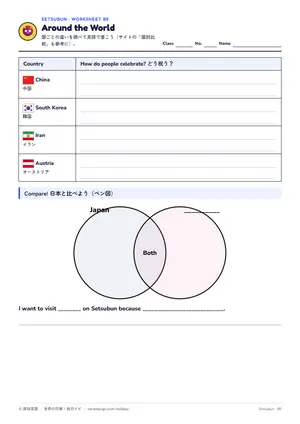
世界の鬼払いマップ
🎯 世界の厄払い行事を調べ、比較の英語表現で発表する。
- 春節の年獣、クランプス、クケリ、チャハールシャンベ・スーリーなどから1つ選ぶ。
- いつ・何を追い払うか・どうやって、の3点を英語でまとめる。
- "Like Setsubun, ..." "Unlike Setsubun, ..." の形で節分とくらべる文を作る。
- 世界地図に貼って発表する。
詳細版を開く(時間配分・Teacher Talk・板書)
本文の第1段落と第3段落を音声で聞かせ、節分で何を追い払うか(demons that brought sickness)と、どうやって追い払うか(throw beans / a man in a scary mask)を確認する。「世界にも悪いものを追い出す行事がある」と伝える。
🗣️ Listen. What did people chase away long ago? / Demons that brought sickness. How did they do it? / Other countries also chase away bad things. Let's find out how.
グループで担当カードを1枚選び、記事のコピーや信頼できる資料で When? / What do they chase away? / How? の3点を調べ、英語でシートにまとめさせる。例:China / on New Year's Eve in the old story / a monster called Nian / with red decorations and loud firecrackers。
🗣️ Choose one card for your group. / Find three things. When? What do they chase away? How? / For example, in China, people use red decorations and loud firecrackers. / Write short English notes.
Like Setsubun, ... / Unlike Setsubun, ... の形で、節分と比べる文を1つずつ作らせる。例:Like Setsubun, Kukeri uses scary masks to chase away bad spirits. / Unlike Setsubun, Chaharshanbe Suri uses fire, not beans.
🗣️ Now compare your festival with Setsubun. / Like Setsubun, ... What is the same? / Unlike Setsubun, ... What is different?
各グループが世界地図の担当国に付せんを貼り、2分で発表する。3点の紹介と、比べる文2つを言わせる。聞く側は表を埋める。
🗣️ Put your sticky note on the map. / Tell us the three facts, then your two comparison sentences. / Listeners, fill in your table.
地図を見て、多くの行事が冬の終わりや新年の時期にあることに気づかせる。「なぜこの時期に悪いものを追い出すのか」を一言ずつ答えさせて終わる。
🗣️ Look at the map. When do most of these festivals happen? / Around the new year or the end of winter. Why then? / A new season is a good time for a fresh start.
Chasing away bad things around the world 🌍 国 / When? / What? / How?Setsubun / the day before spring / demons(sickness, bad luck)/ throw roasted beans
China / New Year's Eve(old story)/ the monster Nian / red decorations, firecrackers
Austria / December / Krampus walks the streets
Bulgaria / winter / bad spirits / Kukeri:fur, big masks, bells, dancing
Iran / the last Tuesday night before Nowruz / bad things of the old year / jump over fires
Korea / Daeboreum / skin problems / crack nuts with your teeth Like Setsubun, __. Unlike Setsubun, __.
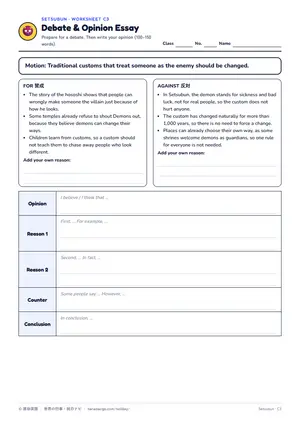
恵方巻は伝統か? 食品ロスと商業化を考える
🎯 伝統と商業化、食品ロスの問題について英語で議論する。
- 本文の恵方巻の歴史(1932年のチラシ、1989年、1998年)を確認する。
- 「新しく広まった習慣は伝統と言えるか」をグループで話し合う。
- 食品ロスへの対策(予約販売など)を英語で3つ提案する。
- 意見を150語の英文にまとめる。
詳細版を開く(時間配分・Teacher Talk・板書)
「恵方巻を食べたことがある人?」「いつから食べている?」と挙手で聞く。本文の第5段落を音声で聞かせ、恵方巻という名前が1989年に広島のコンビニでつけられたことを確認する。
🗣️ Have you ever eaten ehomaki? Since when? / Listen to paragraph five. / When did the name ehomaki start? Where? / 1989, in a convenience store in Hiroshima.
記事の節を読ませ、年表を埋めさせる:1932年の大阪の鮓商の組合のチラシ(「節分の日に丸かぶり」)、1970年代の海苔業界の宣伝、1989年の広島での販売、1998年の全国展開、2000年代のほかのコンビニやスーパーの参加。起源には諸説あることも確認させる。
🗣️ Read the handout and fill in the timeline. / What happened in 1932? Who made the flyer? / When did it go nationwide? / Is the origin clear? No, there are several ideas.
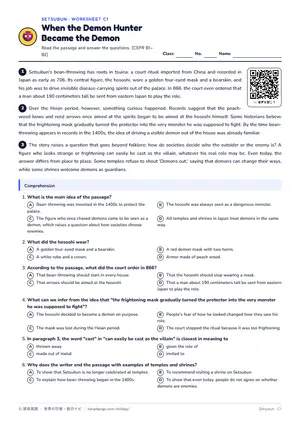
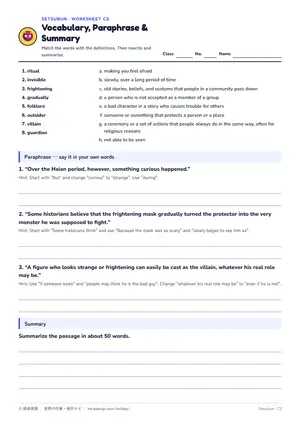
「新しく広まった習慣は伝統と言えるか」をグループで英語で話し合わせる。advanced の英文で、鬼を追う役が鬼になったように、節分そのものも時代とともに変わってきたことを材料として示す。グループの結論と理由を2つ、英語でまとめさせる。
🗣️ Ehomaki spread across Japan only about 30 years ago. Can we call it a tradition? / Remember, Setsubun itself has changed. The demon hunter became the demon! / How old does a custom need to be? Who decides? / Write your group's answer and two reasons.
食品ロスの問題(売れ残った恵方巻が大量に捨てられ、農林水産省が業界に需要に見合った販売を呼びかけたこと)を紹介する。グループで対策を英語で3つ提案させる(予約販売、小さいサイズ、売れ残りの活用など)。提案シートの4つの欄を埋めさせる。
🗣️ Many unsold ehomaki are thrown away. That is food loss. / Think of three ideas to reduce it. / Who should do it? Stores? Customers? Families? / Explain why each idea works.
各グループが提案を1つずつ発表する。最後に、恵方巻は伝統か、食品ロスをどう減らすか、の2点を含めた150語の英文の意見文を課題とし、授業中は最初の段落を書かせる。
🗣️ Each group, share your best idea. / For homework, write 150 words. / Is ehomaki a tradition? How can we reduce food loss? / Start your first paragraph now.
Is ehomaki a tradition?

1932 Osaka:a sushi shop group's flyer(節分の日に丸かぶり)
1970s:nori companies' events
1989 Hiroshima:a convenience store → the name ehomaki
1998:nationwide
2000s:other stores join
※ origin:several ideas

Advanced:the demon hunter became the demon → customs change

Food loss:unsold rolls thrown away
Ideas:reservations / smaller sizes / __

Problem / Our idea / Who does it / Why it works