Lunar New Year
旧正月(春節・ソルラル・テト)の英語の授業アイデアとワークシート
印刷してすぐ使えるワークシート(PDF・Word・解答つき)と、授業の手順書。
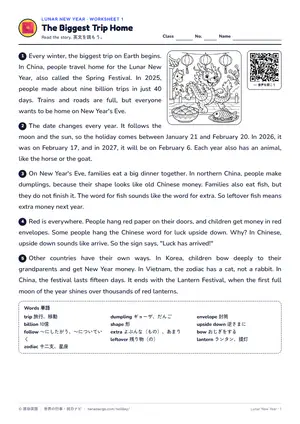
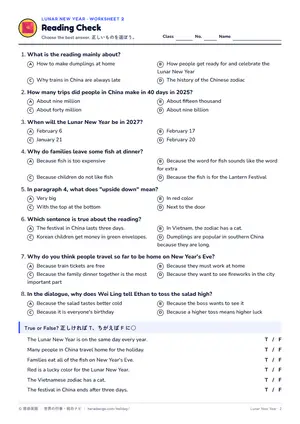
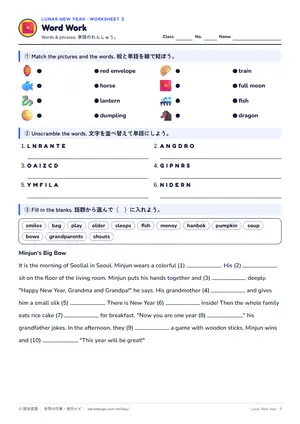
🖨️Worksheetsワークシート(無料・A4)
① 「中身を見る・印刷」で全ページを確認 → ② そのページ上の 🖨️ 印刷する でそのまま印刷できます。A4・無料。
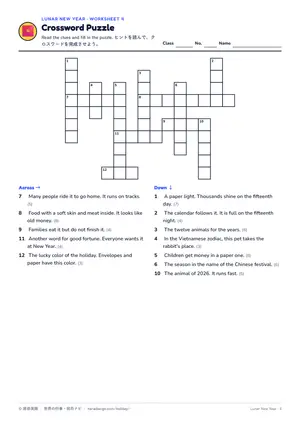
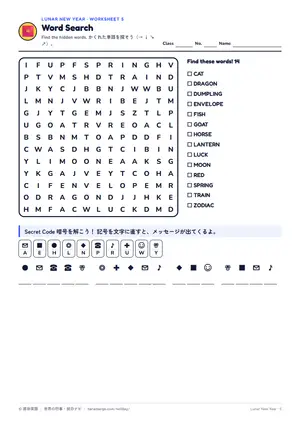
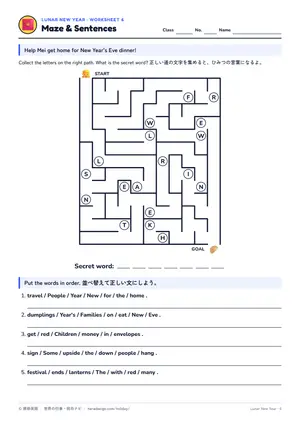
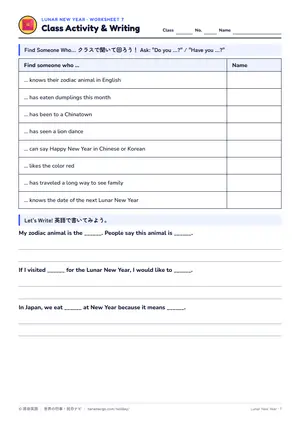
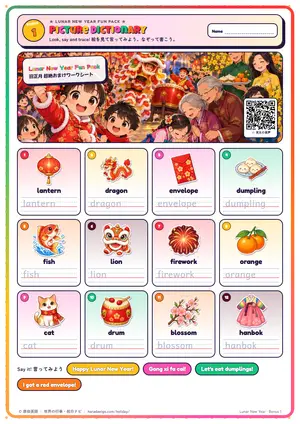
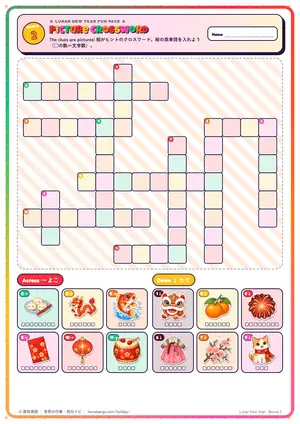
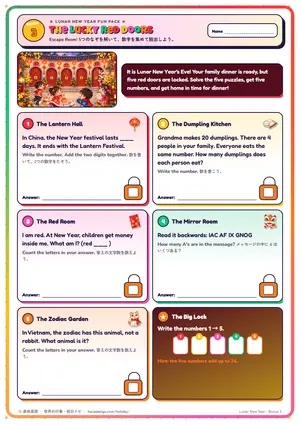
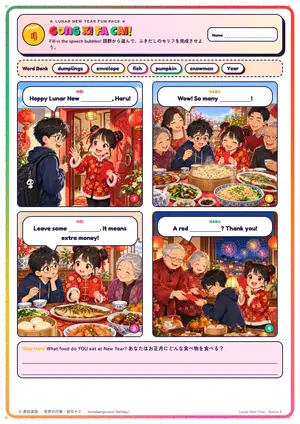
🍎Lesson Ideas旧正月(春節・ソルラル・テト)を使った英語の授業アイデア
干支インタビュー:What's your zodiac animal?
🎯 十二支の動物の英語名を覚え、たずね合う表現に慣れる。
- 十二支の絵カードで rat, ox, tiger … pig を発音練習する(ベトナムでは rabbit が cat になることも紹介)。
- What's your zodiac animal? / I'm a horse. の会話をペアで練習する。
- 教室を歩いて、同じ干支の人をできるだけ多く探す。
- 家族の干支も聞いてくる宿題を出す。
詳細版を開く(時間配分・Teacher Talk・板書)
十二支の絵カードを順に黒板にはり、全員で英語の名前を言う。2回目は先生がカードを指さし、子どもたちが言う。rabbit のところで「ベトナムでは rabbit のかわりに cat が入る」と cat のカードを見せる。
🗣️ Let's say the animals together. Rat, ox, tiger, rabbit ... / Now I point, and you say the name. / In Vietnam, there is no rabbit. There is a cat!
早見表で自分の干支を確かめさせる。What's your zodiac animal? / I'm a horse. を先生と子どもでやって見せ、ペアで2回練習させる。
🗣️ Find your zodiac animal on this chart. / Listen. What's your zodiac animal? I'm a horse. / Now ask your partner. Then change roles.
教室を歩いて、同じ干支の人をできるだけ多く探させる。見つけたらインタビューカードに名前を書く。違う干支の人とも会話をしてから別れるよう伝える。
🗣️ Walk around and ask your friends. / If you find the same animal, say: Me too! Write their name. / Different animal? Say: Thank you! and find another friend. / Stop! Sit down, please.
何人見つけたかを聞き、多かった子をほめる。宿題カードを配り、家族に「何年?」を聞いて、英語の動物名で書いてくるよう伝える。
🗣️ How many friends did you find? / Homework! Ask your family. What's your zodiac animal? / Write the animals in English. See you next time!
What's your zodiac animal? I'm a __. Me too! rat ox tiger rabbit dragon snake horse sheep monkey rooster dog pigVietnam:rabbit → cat 🐱
語呂合わせ縁起物クイズ:魚はなぜ残す?
🎯 音のしゃれで縁起をかつぐ文化を、日本と比べながら英語で説明する。
- 魚・逆さまの福・年糕・ギョーザの写真を見せ、「なぜ縁起がよい?」を予想させる。
- 答えを英文カード(The word for fish sounds like ~.)で読む。
- 日本の語呂合わせの縁起物(黒豆=まめに、昆布巻き=喜ぶ、など)を探す。
- In Japan, we eat ~ because it sounds like ~. の文を作って発表する。
詳細版を開く(時間配分・Teacher Talk・板書)
魚料理の写真を見せ、「中国の大みそかでは、魚をわざと少し残す。なぜ?」とクイズを出す。ほかの3枚の写真も見せ、「どれも縁起がよいとされる。理由を予想しよう」とペアで予想させる。
🗣️ Look at this fish. In China, families do not finish it. Why? / Here are three more pictures. Why are they lucky? / Guess with your partner. Japanese is OK.
答えの英文カードを1枚ずつ見せて読ませ、写真と結びつけさせる。英語ページ本文の第3・第4段落を音声で聞かせ、fish と extra、upside down と arrive のしゃれを確かめる。ギョーザだけは音ではなく形(昔のお金に似ている)が理由であることに気づかせる。
🗣️ Read this card. The word for fish sounds like the word for extra. / So leftover fish means extra money next year. / Upside down sounds like arrive. So the sign says, Luck has arrived! / Dumplings are different. Is it the sound or the shape?
「日本にも語呂合わせの縁起物はある?」と聞き、おせちの写真を見せる。グループで黒豆(まめに)・昆布巻き(喜ぶ)・鯛(めでたい)などを探させ、言葉と意味を表にまとめさせる。
🗣️ Do we have lucky foods like this in Japan? / Look at osechi. Find foods with a sound joke. / Konbu sounds like yorokobu. What does yorokobu mean?
In Japan, we eat 〜 because it sounds like 〜. の型を板書し、1文書かせる。日本語の意味の部分は means 〜 で英語を補ってよいとする。数人に発表させて終わる。
🗣️ Write one sentence. In Japan, we eat konbu because it sounds like yorokobu. / Then add: Yorokobu means to be happy. / Who can read their sentence?
Why lucky?(音のしゃれ)
🐟 fish 魚(ユィ)= extra 余 → leftover fish = extra money
福 upside down 倒 = arrive 到 → Luck has arrived!
🍡 nian gao 年糕 = higher every year 年高
🥟 dumplings → shape = old Chinese money(形)

Japan:
kuromame → mame ni(まじめに・元気に)
konbu → yorokobu(喜ぶ)
tai → medetai

In Japan, we eat __ because it sounds like __.
春運シミュレーション:90億回の旅を数字で読む
🎯 大きな数(million / billion)を英語で読み、データから気づきを話す。
- million と billion の読み方を練習する(9 billion=90億)。
- 春運の移動回数・鉄道利用者数・日本のお盆やお正月の帰省ラッシュのデータを比べる。
- グループで The number of ~ is about ~. の形で3文書く。
- 「どうしてそこまでして帰るのか」を英語で一言ずつ意見を出す。
詳細版を開く(時間配分・Teacher Talk・板書)
英語ページ本文の第1段落を音声で聞かせ、about nine billion trips in just 40 days を聞き取らせる。「9 billion は何回?」と聞き、90億であることを確かめる。
🗣️ Listen. How many trips did people make? / About nine billion trips in just 40 days! / How do you say nine billion in Japanese?
黒板に 1,000 / 1,000,000 / 1,000,000,000 を書き、カンマ3つごとに thousand → million → billion と名前が変わることを示す。日本語の「万・億」とずれることを確かめ、数字カードを使ってペアで読み合わせる。
🗣️ Look at the commas. One comma, thousand. Two commas, million. Three commas, billion. / So 500,000,000 is five hundred million. / Read the cards with your partner. Take turns.
データ表を配り、春運と日本の帰省ラッシュを比べさせる。グループで The number of 〜 is about 〜. の形で3文書かせる(The number of train trips in China is about 500 million. など)。人口のちがいにも目を向けさせる。
🗣️ Look at the data. Compare China and Japan. / Write three sentences. The number of train trips is about ... / China has many more people than Japan. Think about that too. / You have seven minutes.
各グループが1文ずつ読み上げる。最後に「どうしてそこまでして帰るのか」を問い、Because 〜. の一言で意見を出させる(大みそかの夜に家族そろって食べるごちそうのため、など)。
🗣️ Read one sentence from your group. / Why do so many people go home? Give me one reason. / Because they want to eat dinner with their family on New Year's Eve. Good!
1,000 = one thousand(千)
1,000,000 = one million(百万)
1,000,000,000 = one billion(十億)

9,000,000,000 = nine billion = 90億
500,000,000 = five hundred million = 5億

春運 2025:about 9 billion trips in 40 days(train:about 500 million)

The number of __ is about __.
Why do people go home? Because __.
アジアの旧正月比べポスター
🎯 中国・韓国・ベトナム・シンガポールなどの祝い方を調べ、共通点と相違点を英語で発表する。
- グループごとに国を1つ担当し、名前・料理・お年玉・あいさつ・特別な風習を調べる。
- ポスターに both ~ and ~ / but in ~, people ~ などの比較表現を使ってまとめる。
- ギャラリーウォークで他のグループのポスターを読み、質問を1つ付せんで残す。
- 日本の正月との共通点を1つ選び、全体で共有する。
詳細版を開く(時間配分・Teacher Talk・板書)
英語ページ本文の最終段落を聞かせ、韓国(祖父母におじぎしてお年玉)・ベトナム(十二支にネコ)・中国(15日間、最後はランタン・フェスティバル)のちがいを確かめる。「同じ旧正月でも国によってちがう」ことを示し、担当国を決める。
🗣️ Listen. How do people in Korea celebrate? / In Vietnam, the zodiac has a cat, not a rabbit. / Today, each group will research one country and make a poster.
グループごとに担当国の名前(ソルラル・テト・ツァガーン・サルなど)・料理・お年玉・あいさつ・特別な風習を調べさせる。記事の節と英語ページを基本の資料にし、足りない分はネットで調べてよいが、出典を書かせる。
🗣️ Research five things. Name, food, money gift, greeting, and one special custom. / Start with the article. Then you can search online. / Write down where you found the information.
比較表現(Both China and Korea 〜. / But in Vietnam, people 〜. / Unlike China, 〜.)を板書し、日本の正月と比べる文を最低2つ入れてポスターを作らせる。写真や絵は少なめにし、英文を中心にするよう伝える。
🗣️ Use these expressions. Both ... and ... / But in ..., people ... / Write at least two sentences that compare your country with Japan. / Make the English big and clear.
ギャラリーウォークをする。ポスターを教室の壁に貼り、各グループ1人が説明役で残り、ほかの人は回って読む。読んだポスターには英語の質問を1つ付せんで残させる。途中で説明役を交代する。
🗣️ Put your poster on the wall. One person stays and explains. / Others, walk around and read. / Leave one question on a sticky note. For example, why is the rice cake square? / Change roles now.
各グループに「日本の正月との共通点」を1つ選ばせ、全体で共有する。付せんの質問から1つ取り上げ、先生が答えるか次回の課題にする。
🗣️ Choose one thing your country and Japan have in common. / People in both Korea and Japan eat rice cake soup at New Year. Nice! / Here is a great question from a sticky note.
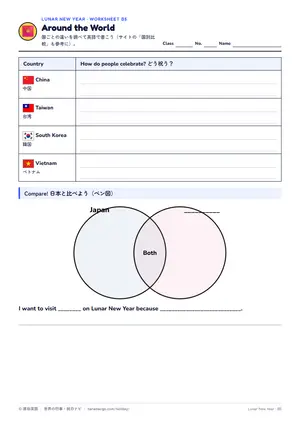
Lunar New Year in Asia
China:Spring Festival/dumplings, fish/red envelopes/15 days → Lantern Festival
Korea:Seollal/tteokguk/bow to grandparents → New Year money
Vietnam:Tet/banh chung(square)/zodiac has a cat
Singapore:yusheng/Lo hei!(toss it high)
Mongolia:Tsagaan Sar(White Moon)

Both __ and __ __.
But in __, people __.
Unlike __, __.
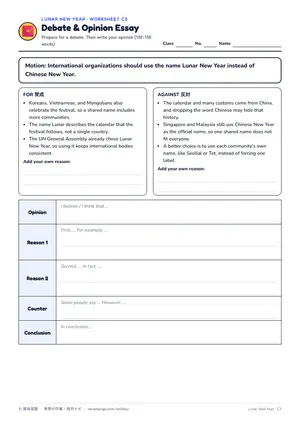
名前は誰のもの? Chinese New Year vs Lunar New Year
🎯 advanced の英文を読み、祝日の名前とアイデンティティの関係について意見文を書く。
- advanced「Whose New Year Is It?」を読み、両方の立場の根拠を表にまとめる。
- 企業広告や自治体のウェブサイトでどちらの名前が使われているか調べる。
- 少人数で議論し、第三の選択肢(各国名で呼ぶなど)も考える。
- 150語の英語の意見文を書き、ピアレビューをする。
詳細版を開く(時間配分・Teacher Talk・板書)
Chinese New Year / Lunar New Year / Spring Festival の3つの名前を板書し、「どれを使う?なぜ?」とペアで30秒話させる。シンガポールやマレーシアでは正式な祝日名が今も Chinese New Year であることを伝え、本文につなげる。
🗣️ Which name do you use? Chinese New Year, Lunar New Year, or Spring Festival? / Tell your partner why. Thirty seconds. / In Singapore and Malaysia, the official name is still Chinese New Year.
本文を個人で読ませ、両方の立場の根拠と、国連総会(2023年12月)・ユネスコ(2024年)の動きを表にまとめさせる。ペアで確認し、One decision used a shared name, while the other honored a single nation's tradition. の意味を説明させる。
🗣️ Read the passage. Fill in the three columns. / Why did some American politicians choose Lunar New Year? / Why do others worry about dropping the word Chinese? / What did the UN do, and what did UNESCO do?
企業の広告や自治体・大学のウェブサイトで、どちらの名前が使われているかを調べさせる。国・地域ごとに傾向があるか、グループで2〜3例を報告させる。
🗣️ Search for ads and city websites. Which name do they use? / Do you see a pattern by country? / Share two or three examples with the class.
4人グループで「どの名前を使うべきか」を議論させる。2つの名前のどちらかを選ぶだけでなく、第三の選択肢(Seollal・Tet など各国の名前で呼ぶ、場面で使い分ける など)も考えさせる。最後に各グループの結論を1文で発表させる。
🗣️ Discuss in groups. Which name should we use, and when? / Think of a third option. What about calling each New Year by its own name? / Give us your group's answer in one sentence.
150語の英語の意見文を書かせる(14分)。主張 → 根拠2つ(本文と調べた例)→ 反対意見への言及 → 結論の構成を示す。残り6分でペアを組み、チェックリストを使ってピアレビューをさせる。
🗣️ Write a 150-word opinion essay. Start with your main idea. / Give two reasons. Use the passage and your research. / Mention the other side, then write your conclusion. / Now swap essays. Use the checklist and write one comment.
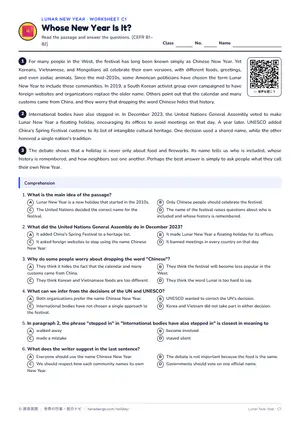
Whose New Year Is It?

Chinese New Year 派:calendar and many customs came from China → dropping "Chinese" hides history
Lunar New Year 派:Koreans, Vietnamese, Mongolians have their own versions → include communities
国際機関:UN General Assembly(Dec 2023)→ Lunar New Year = floating holiday
     UNESCO(2024)→ China's Spring Festival = intangible cultural heritage

Third option? → Seollal / Tet / Tsagaan Sar ...

Essay:opinion → reason 1 → reason 2 → other side → conclusion(150 words)