
テ・デウム
Te Deum
シャルパンティエ・c. 1688–1698
パンパカパーン!ヨーロッパのテレビの幕開けを飾ってきた、ごうかな前奏曲。
テ・デウム ニ長調のページへ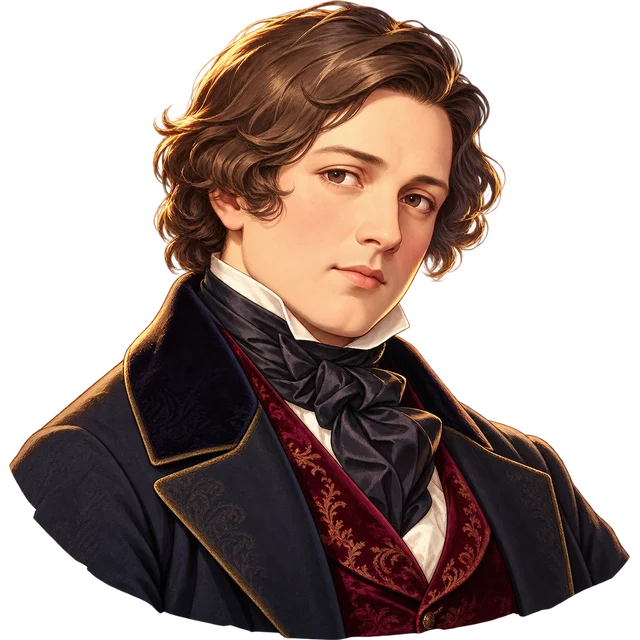
Chamber · Op. 44 · 1842
ロベルト・シューマン(1810–1856)
ピアノと弦楽器4人がひとつに!室内楽の新しい扉を開いた輝く名作。Piano plus string quartet: a glowing work that opened a new door.
WATCH ON YOUTUBE
この曲は、権利の切れた高音質の録音がまだ見つからないため、YouTube の公式チャンネルなどの名演でお楽しみください(ダウンロードはできません)。YouTube でほかの演奏もさがす ↗
 Martha Argerich Schumann Piano Quintet (2009)
Martha Argerich Archive(YouTube) YouTube で開く ↗
Robert Schumann - Piano Quintet in E flat major, Op. 44
olla-vogala(YouTube) YouTube で開く ↗
ホー!クララが体調をくずして、メンデルスゾーンが初見で代わりに弾いたんだって。
 この曲のおはなし The Story
ピアノ五重奏曲は、ピアノと、ヴァイオリン2・ヴィオラ・チェロの弦楽四重奏が合わさった、5人のための曲です。シューマンが1842年の9月から10月にかけて書きました。この年は、シューマンが室内楽をたくさん書いた「室内楽の年」。華やかなピアノと弦楽器ががっちり組み、まるで小さなオーケストラのような、輝かしい響きを生み出します。The Piano Quintet is a piece for five players: a piano and a string quartet of two violins, viola and cello. Schumann wrote it in September and October 1842, his 'year of chamber music'. The brilliant piano and the strings work closely together, creating a glowing sound like a small orchestra.
この曲は妻クララにささげられ、ピアノのパートも彼女が弾く予定でした。ところが1842年12月の内輪の演奏会の日、クララが体調をくずしてしまいます。そこでピアノを弾いたのが、友人のメンデルスゾーンでした。彼はほぼ初見で弾いたうえ、スケルツォの中間部をもっと生き生きさせては、などのアドバイスもしました。シューマンはそれを受けて、曲を手直ししています。The quintet was dedicated to Clara, and she was supposed to play the piano part. But on the day of a private performance in December 1842, Clara fell ill. Their friend Mendelssohn stepped in and sight-read the piano part. He also made suggestions, for example that part of the scherzo should be livelier, and Schumann revised the piece in response.
1843年1月、ライプツィヒのゲヴァントハウスで、クララのピアノによって公開の初演が行われました。この曲の成功によって、「ピアノと弦楽四重奏」という組み合わせは、ロマン派を代表する室内楽の形になりました。のちにブラームスやドヴォルザークも、すばらしいピアノ五重奏曲を書いています。シューマンの室内楽の中で、今もとくによく演奏される作品です。In January 1843, Clara played the piano at the public premiere at the Leipzig Gewandhaus. Thanks to the success of this work, the combination of piano and string quartet became one of the great forms of Romantic chamber music. Later, Brahms and Dvořák also wrote wonderful piano quintets. It remains one of Schumann's most often performed chamber works.
This piece is for five players: one piano and four string players. Schumann wrote it for his wife, Clara. But Clara got sick before a private concert in December! His friend Mendelssohn played the piano for her. The music is bright, strong and exciting.この曲は5人のための曲です。ピアノ1人と、弦楽器4人です。シューマンは妻のクララのためにこの曲を書きました。でも、12月の内輪の演奏会の前に、クララは体調をくずしてしまいました!友人のメンデルスゾーンが、代わりにピアノを弾きました。音楽は明るく、力強く、わくわくします。
 聴きどころ Listening Guide
 えっ!?ネタ Surprising Facts
 タップすると答えが開きます
1842年12月、ヘンリエッテ・フォイクトの家で開かれた内輪の演奏会で、体調をくずしたクララの代わりにピアノを弾いたのはメンデルスゾーンでした。ほぼ初めて見る楽譜で、この難しいピアノパートを弾いてしまったのです。当時ライプツィヒの音楽界の中心にいた彼ならではのエピソードです。
In December 1842, at a private performance at the home of Henriette Voigt, the person who played the piano in place of the sick Clara was Mendelssohn. He played the difficult part almost at first sight. It is a story worthy of the man at the center of Leipzig's musical life.
1848年、リストはこの曲について「少しライプツィヒっぽすぎる」と言いました。メンデルスゾーンたちのライプツィヒ流の、まじめで保守的なスタイルだ、という意味です。シューマンはこの言葉にとても気分を害したと伝えられています。作曲家どうしの関係も、なかなか複雑だったのですね。
In 1848, Liszt said the work was 'somewhat too Leipzig-like', meaning it was in the serious, conservative style of Mendelssohn's Leipzig. Schumann was reportedly deeply offended. Even great composers did not always get along.
1842年、シューマンは3曲の弦楽四重奏曲、このピアノ五重奏曲、そしてピアノ四重奏曲と、室内楽の名作を次々に書きました。1840年は「歌の年」、1841年は「交響曲の年」、そして1842年は「室内楽の年」。シューマンは、ひとつのジャンルに集中して書くタイプの作曲家でした。
In 1842, Schumann wrote three string quartets, this piano quintet and a piano quartet, one masterpiece after another. 1840 was his 'year of song', 1841 his 'symphony year' and 1842 his 'year of chamber music'. He was a composer who liked to focus on one kind of music at a time.
最終楽章のクライマックスでは、第1楽章の最初の主題がもどってきて、最終楽章の主題と同時に組み合わされ、追いかけっこ(フーガ)のように重なります。曲の始まりと終わりがひとつにつながる、見事なしかけです。
At the climax of the finale, the opening theme of the first movement returns and is combined with the finale's own theme, the two weaving together like a fugue. It is a brilliant way of tying the beginning and the end of the work together.
ENGLISH × MASTERPIECE
 城壁の破れ目(breach)に立ってふさぐことから。困ったときに代わりを引き受けることです。
 この曲で覚える英単語 Words
 クイズに挑戦 Quiz
 著作権について Credits
MORE MASTERPIECES
シャルパンティエ・c. 1688–1698
パンパカパーン!ヨーロッパのテレビの幕開けを飾ってきた、ごうかな前奏曲。
テ・デウム ニ長調のページへクラーク・c. 1700
結婚式の大定番。でも作曲者は長いあいだ取りちがえられていた!
トランペット・ヴォランタリー(デンマーク王子の行進)のページへ
バッハ・c. 1707–1710 (?)
キラキラの駆け上がりで幕開け!若きバッハのはなやかな鍵盤ショー。
トッカータ ニ長調のページへ
ヴィヴァルディ・published 1711
2本のヴァイオリンが火花を散らす!バッハも編曲した熱い協奏曲。
協奏曲集『調和の霊感』第8番 イ短調(2つのヴァイオリンのための協奏曲)のページへヴィヴァルディ・c. 1715
オクターブがぴょんぴょん跳ねる!喜びがはじける合唱の名曲。
グローリア ニ長調のページへ
テレマン・c. 1710–1720 (?)
バルブのないラッパで高音をきらり!バロックのトランペットの晴れ舞台。
トランペット協奏曲 ニ長調のページへ
ヘンデル・1717
テムズ川の船の上で国王のために!夏の夜の水上コンサート。
水上の音楽のページへバッハ・1720
止まらない!キラキラ走る、ヴァイオリン1本の大はしゃぎ。
無伴奏ヴァイオリン・パルティータ第3番 ホ長調より「プレリュード」のページへ
 MP3